Shownotes
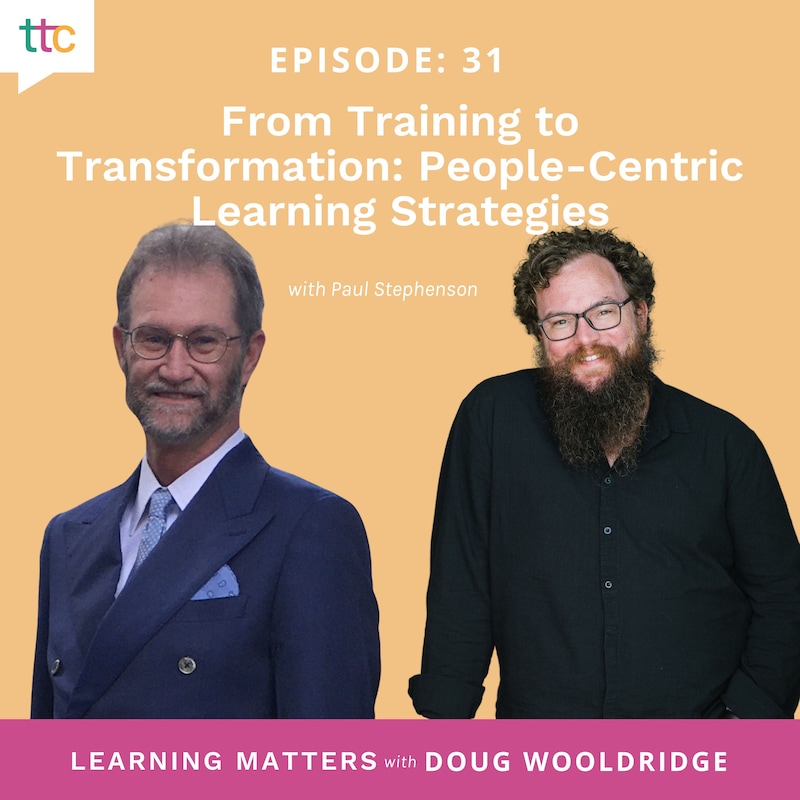
This week we're joined by Paul Stephenson Director, Learning - Client Relationships at TIAA to discuss his approach to learning and development. The secret is.... people. We cover everything from human connection, to AI, and cohort-based training. Hope you enjoy!
🔗 Connect with Paul Stephenson via LinkedIn: https://www.linkedin.com/in/paulr4stephenson/
🔗Check out Pauls books here: https://www.lulu.com/spotlight/pr4s
🔗Learn more about TIAA: https://www.tiaa.org/public
What's Inside This Episode?
People Over Tech: AI is a tool, not a replacement—L&D should always start with people.
Measuring Success: Using Six Sigma and real-world KPIs to track training impact.
Making Training Less Painful: Test-out options and adaptive learning paths.
AI in L&D: Enhancing coaching and leadership training.
Onboarding at Scale: How TIAA trains 100+ new hires per quarter efficiently.
Doing More with Less: Smart restructuring and redeploying talent.
At ttcInnovations, we help businesses create lasting change with immersive learning experiences. Through instructional strategy, design, and content development we empower employee confidence, performance, and results.
💡 Looking for custom learning experiences without licensing fees? Contact us for a free consultation! https://bit.ly/4aOhPKq
🤝 Need extra hands fast? Try staff augmentation! Click here to get matched with experts in 48 hours - no job posting needed. https://bit.ly/3RiEfLT
🚀 Simplify outsourcing with our subscription plans - predictable pricing and limitless innovation. Book a meeting for your free first week! https://bit.ly/3RiEfLT
🎯 Boost results with serious games for optimal retention and results. Contact our Sales team to learn more: https://bit.ly/3RiEfLT
Transcripts
Welcome back to Learning Matters. I'm Doug Wooldridge, your host.
rience by JD powers was ATD's:Boarding achieving 43 % efficiency gains by reducing the process from seven weeks down to four. He's director learning client relations at TIAA. Paul Stevenson, welcome to the show.
Well, thank you, Doug. That was very gracious of you for all those statistics that you put out there. So thank you for that.
Thank you. Today, as always, we'll be covering some of the big questions, concerns, and exciting changes in the world of learning and development. So I'd like to start with this. What strategy matters most in learning and development today?
(:For me, think being in the people business, it's always about the people. Now, I know the big buzzword right now for everyone is machine learning, large language models, AI, whatever buzzword you want to talk about. But for me, it's always about the people. Without the people, you don't have any large language models to program. You don't have any AI to do your chat engineering. So it's always for me about the people.
100 % agree. And with that in mind, how do you focus on the people at your organization?
So yeah, there's several strategies and tactics we always like to use. Of course, we start at the very beginning with the managers. How can we help managers help their direct reports? So we do different things like one-on-one coaching, talent management coaching. Right now we went through a whole exercise of redesigning all of our job descriptions to be more competency based and then skills based. And then from that model,
We can coach our managers and our executive leadership and down to the individual contributor about here's what a career path looks like, or here's the skills that you can use not only in your current job, but also to build out a career journey for yourself so that these skills are transportable.
I would imagine that with that you're getting a whole bunch of new data in there. So how are you keeping track of all that data and making use of it?
(:Yes, mining the data lake, which I always found an interesting term is how do you mine a lake? On there is a challenge because it's what do you measure, especially in a learning environment where it's like soft skill stuff is how do you get hard data about that? So we like to use the six sigma model is that as we go into learning and vent or learning situation.
We always ask the managers and leadership what does success look like to you on there? And then we use that as a measurement is that at the end of whatever training program we're going through or whatever learning journey we've put together, said, remember at the beginning you said success would look like this? Well, here's how we've measured it. Do you agree with that? So it's more like a case basis where you're building up a business model or a business case for your success.
as opposed to looking at hard data. Now we are getting better at good and hard data. We got the traditional Kirkpatrick's model of, know, measuring did the learners like what they did? Are they applying it on the job? Did they pass their quizzes at a certain percentage? We can get that sort of data. But the data that we're really wanting to get to is how are we moving the needle on business objectives. And that's where we're working with a lot of our partners and a lot of
line of business leaders to say, based on what you're looking at, what percentage of training would you attribute to your success in moving the needle in whatever metric that you're working at?
And I would imagine that throughout the different lines of business, it's going to be a different case. So you're going to have to sit there and go through each different line of business and go through different data sets for each of those. How do you keep track of all?
(:Yes. So right now we're old school and we're using Excel spreadsheets. All right. It's always the default because that's what everyone knows about. And you're right. Every line of business is different. I mean, in sales, it's real simple because you're like, here's our base numbers we got to look at. Here's where we made. And then based on that, it's because of these training interventions, sales was moved up X percentage. So that's kind of easy.
Night!
(:For relationship management, it's a little bit harder because it's like, know, how do you improve a relationship with a client? It's like, yeah, we were really bad off and now we're really good. But how do you measure that? So, yeah, those are a little bit harder and we're working through different models and experiment. We're iterating on did this work? No. Okay. Well, let's try something different. And that's where we get to reach out to our clients and say, can you partner with us?
and say, does success look like to you when you're working with us? So that's been very profitable for us.
How do you go about mentioning that to clients? Just saying something along the lines of, we're, you know, we're working on having better relationships overall. We want you to be a part of this process.
Exactly, just like that. we do reach out to our clients and we try and move into that trusted advisor space as opposed to like here we're here to upsell you on something new. We try and move beyond that. And since we're in the retirement space on that, we're trying to prepare our clients for a successful retirement on there. The big push here at TIAA is
is we have the cadence of we want people to retire with dignity. Meaning that, you know, are they financially secure and feel safe with their retirement funds or are they worried about it?
(:Yeah, I think that's the scariest portion of life is sitting there being like, okay, well, I'm not generating an income anymore. I'm retired. Do I have enough to be able to meet my needs and to live the life that I want to live now that I have so much more time on my hands?
Exactly. And so that helps us move into that trusted advisor space with our clients and say, will you help us on this journey? One of the things we need your help with is how do we improve our relationship? then you do the simple little scale model, you know, on a scale of one to five, are you satisfied, dissatisfied or something like that? And we can do the before and after type measurements to get some sort of metric around that.
Sure. You mentioned leadership training. What's your, do you focus on that and how do you make sure that that is one of the main focuses because obviously without good leadership, you don't have a good organization.
So yeah, so the philosophy our team takes is leadership is not a title, it's a privilege. Okay, I like that. With that, we look at the traditional leadership model of, we start with the executive suite and work our way down through that through the traditional, but leaders don't have to always have a title. Leader could be someone that's like a subject matter expert that's really good and always reaching out to them. They're a leader in that space. So we've designed our leadership program
as a two-prong approach. Those that like to be subject matter experts don't want to climb the corporate ladder. They're happy where they're at, but they want to share their knowledge. So we look at different training interventions that we can do for that segment of the population. Then we do the traditional model of, yeah, I'm an individual contributor. I'd like to move into a people leader role, lead a team, lead a function, lead an organization up that way. And then we look on that scale and say, OK,
(:Going from individual contributor to leadership is a whole different skill set. Here's what that journey looks like. Here's the skills you need to look at. know, typical thing, active listening, how to do a one-on-one performance evaluation, all the traditional stuff. But then we lay it out for them in what we call a learner centric model where they go into, we'll use an example everyone knows about LinkedIn learning. You can go in LinkedIn learning, look at all the classes.
click your favorites and then put together a collection. We do the same sort of thing.
Very cool. And you mentioned your main strategy is people focus. So has that always been your first priority or was there maybe like an aha moment in your career where that really lit a fire under you?
Yeah, so.
I've always kind of leaned that way. My career journey has been I started off in the legal field as a paralegal and I was always the one that said, hey, Paul, you know how to take this legalese and make it transferable into normal language. could you have it? Right. Yeah, yeah, it is a little tough on there. But yeah. So from there, you know, I was able to translate legalese for the rest of our firms and other attorneys to say this is
(:Gift.
(:what the statute really means or this is what this new law really means. That's what lit the fire under me is like having that aha moment of when people get it on there and it's like, this is kind of cool. And then I realized from there, I transitioned more into the learning space. And that's where I found out I had a mentor once tell me when we were all going through the technology revolution and everything was switching over.
is that, yeah, it doesn't matter what technology you're using, it's garbage in, garbage out. And that we're all garbage men.
You
So it's like, yeah, it's the people input. Right. So like if we're all garbage men, we're just putting garbage in, hoping for something else. It ain't going to work. So that's where the people focus came to me. It's like, if you train your people on what to do and how to do it right, then you won't get garbage out. It's the old adage of, know, practice makes perfect. And everyone says, no, that's wrong.
Perfect practice makes perfect. Yes. That's my job is to make sure that you're practicing perfect
(:And with that perfect practice, how are you showcasing ROI to your organization? Not just like the C level folks, but to the learners as well. How are you taking them through these journeys and then show them?
is always a big, it's another, for me it's a buzzword. Sure. So ROI is really about return on investment and is investment a capital expenditure? So the first thing I always ask C-suite people is like, are you willing to take your training as a capital investment expenditure and compare it to all your other capital expenditures? And then all of a sudden it's like, you mean like we got to compare it to like what we spend on our
IT people and what we spend in like sales marketing. Well, yeah, that's what ROI is really all about, right? Is allocating capital expenditures. well, maybe we don't want to really take training on that. So then it's OK. But you want to see something for your bank for your buck, right? That's what you're trying to get to. Typical learner, right? Root cause analysis. What is it that you're really wanting to get to on there?
So then I pitched the ideas like what you really want is to compare us to industry standards. So how we compare to peers. Are we over expending like per student or per learner capital expenditure? we within parameters based on peers outside parameters or are we a market leader? So then we set up that sort of thing. That's how we got the best award. If we compared ourselves to the industry.
and how we matching up to that.
(:That's incredible. And how do your learners take this too? You know, a lot of folks when doing training for whatever job it may be, they're like, it's just another, another compliance thing I got to do, or this is just more, you know, we're, we're implementing a new program that I got to learn. How do you make them fall in love with the idea of learning?
Well, Doug, you've hit the nail on the head right there with your example. great. Here comes compliance training. I got to sit through two hours of mandatory clicking the fastest I can to get through this. So the first thing we did is data driven decision making. Right. What's the data is telling us that no one likes mandatory anything. So we did the first step was if you can test out at 100 percent.
You don't take the training. So at the beginning of all our modules, you said, if you want to opt out of this training, take the test right now. If you get 100%, you're done. Very cool. Because it shows you've mastered it. Yeah. 100%.
You may have been here for years and you've taken the same training every single year.
Right, which is another good example. I've been here for years. I know all about this training. You take the test and you only get a 75. You really know it? man. So then if you don't get 100%, then you go into the training. Now what we're trying to work on, and this is on the technical side, is if I say I get 75%, we want to have the mechanisms in place that says,
(:Hahaha
(:Whatever you got 100 % on that piece, you don't need to learn. Whatever you were failing that 25%, that's the curriculum we want you to go through on there. So we're trying to look at the logistics of how do you get a training module parsed out to the point where it will just pick up the pieces that you failed and give that to the training as opposed to just dump you into the whole training.
Yeah, well maybe that helps me transition into this next question. Is there an initiative or project that you all are working on that you're very excited for this year?
That that one is that one. The other one is our onboarding program that we're working on We've have the mandate that they're expanding their sales force both in the retirement Segment and in the wealth management segment, so they're targeting little over a hundred people a quarter to hire Wow on there. So yeah, we're in a growth phase so putting together
a curriculum for new board for new hires and onboarding them is a challenge. Yeah.
especially at that amount.
(:Right on there. So what we're trying to do is get cohorts set up and then have the training be relevant on there and sticky enough, but so that when they're get out of the training and that that's where you mentioned at the top of the broadcast is going from six weeks to four weeks. We're having monthly cohorts. So at the end of that cohort, it's just not the fire hose. We hope you understood it and good luck with testing that on all the clients you have. We're trying to get it down to the point is at the end of that
30 days of onboarding, they feel confident enough to stand in front of a client and give 100 % accuracy to the information they're sharing with them.
Have you guys always worked in cohorts when training a of folks?
that has been something new that I've introduced and through my team is the old model was we had five different curriculums for five different job categories. And the only difference was the job description was I'm an online relationship manager. I'm an in-person relationship manager, or I'm an on-campus relationship manager. But don't they do all the same thing? no, no, no.
one's online, one's in person. And it's like, well, okay, so, but they're still doing the same thing,
(:Yes, but did you did I say that it was online instead of in person?
I want to make that clear that it's really on this. So that's what one of things we did to bring efficiencies is collapse five different curriculums that were basically the same thing. It was just the only difference with the job title and put those together. Then because the old model was if you're online, you go through the online onboarding. If you're in person, you go through the in person. So we combine that. The other pitch that we made to leadership was that
By building these cohorts, even though they might have different job titles, they're building their own network from day one. So that even though I might be a campus assigned relationship manager, I know, there's this onboarding guy over here that was in my cohort. there's this technology person that's over there that's in my cohort. They've already got a network built.
And I think you get a lot more buy-in from that because you immediately have...
Friendships develop, have, what's the word I'm looking for? You have a that comes together and you all feel like you're working towards a similar goal, which is very different than just personal training. Now personal training is great in all other aspects, but I feel it's very exciting. think it's kind of a new trend overall.
(:in the industry is to have whether it's a cohort or it's like a social training network. I've heard it called. and I think that it just allows folks to, to really get something more than just I'm doing this for my career because I need a job. It becomes, no, we, we do this job because it serves a purpose and I have a purpose within that job.
Right. So it's the holistic approach, right? As opposed to I'm taking this onboarding training because I'm this cog in this wheel that turns this bigger wheel. you have, you're talking about Doug, the holistic experience is like, this is how my piece of the job fits in the overall help. And like at TIAA, it's like, how are we helping people retire with dignity? Yeah. this is how I'm contributing. And this person over here, that's a portfolio manager. This is how they're helping.
on there and then they get the whole thing, which makes a better client experience at the end. It's like if I'm, you're my client and you're getting ready for retirement, I can talk to you and say, here's the holistic approach Doug of how you're going to feel secure in your retirement.
Well, I appreciate that. I have a little ways to go, but I know when I get there, I will want to feel the exact same thing that I'm sure your guys' clients end up feeling, which is just happy to that you're in good hands and you're set. Yes. Off the top of your head, is there a challenge that you and your team recently had to solve for that you're most proud of?
I would say it was TIA just went through a, reconfiguration and so yeah, so we had to downsize on that. So it's the typical doing more with less type of thing. And it's getting to the point now where there is no more less. I mean, if you, if you keep cutting, then there's nothing there. It's like, the typical ad is we use is like,
(:Why don't we have any facilitators? Because they're all been let go. oops.
Yeah.
(:I forgot about that.
Sort of like what's happening in the news right now. It's like we're seeing these mass government cutoffs. But then the downside is like, we need people to tell how planes to fly.
Yeah. Dang. Could have used that. better luck next time. So how do you solve for that in an organization that does need to downsize to become more lean and in a lot of ways more efficient? How do you go from, we've gotten to the downsize, now we need to go towards the future.
Bye.
(:Right. So there's a couple of approaches that I've personally used and this isn't my first rodeo through this. I've been in the industry 20 plus years now. So not the first time through this cycle. The first thing is you don't approach it wholesale. You actually really have to look at it surgically. Where's the efficiencies that you can gain that make sense? In our example, it's like, why do you have five different curriculums just based on job code?
We can consolidate those. There's, you know, we by just doing that, we've had a 15 % savings in time and budget just by consolidating on there. So now you're starting to see gains on that. Then you start looking at, OK, if we need to cut personnel, what makes sense on there? Let's look at the job codes and do we need to cut them or do we need to move them? That's where this whole philosophy that we came up with.
of doing competency based job descriptions and skills so that that skill might not be applicable over here in this part of the organization, but we do need it over there on that part of the organization. So let's do a transfer instead of a downsize.
It just seems like it makes sense to, before downsizing and making cuts, to sit there and go, okay, let's be surgical about this, let's take the time, and it could take months to really do that, but you end up at a much better position.
And that's the target there Doug is is what you're talking about instead of looking at what do we need to do this quarter to hit our quarterly numbers to make Wall Street happy Let's take the holistic bigger picture and say what do we need to do? That's right for our clients. I Like and that's where the leadership and that's part of our leadership training is that is training leaders to say no to the short term and yes to the long term
(:tough to do sometimes but oh yes i feel like once you get into that mindset you never leave it and so unit having a much healthier organization throughout much longer period of time and you're able to be a lot more flexible during times uh... where things just go right the times are changing
And it helps build up that resiliency where people are going along with you for the ride. They understand the long-term vision. we know TIAA is here to help me have a sustained retirement where I can be in retirement with dignity. Not that, I can only be in retirement in dignity for the first quarter, but then after that.
Man that was a great first quarter
Woo! But yeah, but then once everyone understands that's the big vision, everyone starts going towards that and then say, we understand this is going to take a little while, but the bigger payoff is going to be much more sustainable.
Are there any trends in the learning and development world that you're most excited for?
(:Uh, well the big one of course right now is the AI model. But I mean, we've been going through that for a long time actually. I mean, if you ever done a Google search, you've been doing AI. If you ever interacted with a chat box, AI. you've ever been stuck in a phone tree, that's AI on there. But yes, yeah. Everyone's favorite is like, oh, press one for this. Oh, press nine for that. Yeah, no. The one I'm excited about though is
See?
Please favorite one.
(:utilizing technology as a coach and not as a replacement. So in our world, we're looking at different models where AI can help us in coaching models instead of taking up personnel time. So what's nice is all those soft skills that you have to learn about, know, how do you do an opening or how do you do a closing or how do you have difficult conversations or how you have a performance evaluation conversation?
We're trying to get AI to the point where, like you and I are talking, one of us could be an AI avatar on there, and then give you real-time feedback based on the responses you're giving.
do learners feel about that?
So what's nice is that if it's done correctly, is that they don't know the difference on there. So there isn't it. So right now we're in that pioneer phase. It's like, yeah, I can definitely tell that's an avatar just by looking at it. And if the value is there, if they get over the hurdle of like, okay, it's an AI, but the value I'm getting from it is beneficial to me and helping me do my job better, then you're okay.
To go back a little bit to keeping everything involving people to people, how do you balance that line of having utilizing something like an avatar to help it coaching and then still having that person to person connection as well?
(:Right. So the model we're working on is that the AI is not a replacement. It's an enhancement. like in the coaching model, if you're going through, we'll take the typical one right now is performance evaluations and setting up for the new year. So how do managers go through that coaching conversation? They can go through an AI model, get some pointers on that. But then in their one-on-one conversations with who they report to with their boss, they can say,
I've done this coaching. Here's how I scored on it. And the, boss can look at it say, yeah, you did pretty good on there. Here's some points for you to work on. on that. it's, it's a, what's the word I'm looking for? It's a, extended model where it's not, it's just like, it's not an event where I've done the AI coaching. That's the event. And now I'm good to go. No, it's part of a journey that says I've done the AI coaching.
Now I'm talking with my boss to get further feedback on that. And then on those one-on-one coachings, you can get the real world experience. Where like that mentoring thing, it's like, yeah, back in my day, this is the challenges I had that you can't really program into an AI model. And then what we're, the thing we're trying to introduce now is the flow of information going back and forth so that if you're my direct report and I'm
doing my first time performance evaluation with you, I can be honest with you, transparent is another buzzword we can use and say, hey, I've just gone through this AI coaching. Here's the tips I've learned. Doug, can you help give me some feedback to see am I being a good boss for you? And now you get that open dialogue back and forth.
It sounds like a much more responsible way to utilize the technology than to just be like, well, we're using this AI. It's going to give you the pointers that you need and then you move on and good luck. Yeah.
(:Right, the check the box model, right?
Well, now I'd like to get into a little bit more of the personal side of things. tell me about you, Paul. Take me back in time to little Paul days. What led you into this position and how did you get here? Maybe tell us some of the highlights and some of the ways that life has shaped you.
As I mentioned earlier, I start off in the legal field as a paralegal, and I was able to translate legalese into common language. From there, I moved into government work where I led a program for the state of Colorado called the Collection Investigator Program. They're the people that are in the courts that says, you can't pay your financial orders, we can set up a payment plan for you. So I led that program, moved it from like,
65 people to 85 people from collecting right around 15 million up to 30 million dollars in restitution going back to victims of crime on that so as the winds of change Happen in political environments the winds have changed happened in government and I then I moved into the private sector and that was my opportunity to move out of government work and Being more the legalese type of thing into training
And then that's where I really got the training bug. that's my forte has always been coming into fortune 500, fortune 200 companies and setting up training departments. A lot of times training departments aren't what they're supposed to be. They're just a bunch of smeeze that have done a PowerPoint. So they think they have a training department. So my job has always been the care and feeding of how to set up a training department on there. that, and that's just, I've just,
(:climb the ladder from there is I've led bigger and bigger teams on that to now that I'm leading entire divisions.
did you do to learn how to set up a training department from scratch?
Trial and error really is the trial by fire and it's just I'm a lifelong learner. So I would look to my peers. I belong to ATD Before it was ATD, you know all that all the different training organizations I belong to I reached out build up my network ask different people How's it working for you? Looking at other people that was successful at it and mirroring, you know borrowing and leveraging
their ideas to make sure it would work for their. So yeah, it's been a self-taught journey and it's always been my philosophy to be collaborative and not just go and say, hey, I have the title, therefore I'm the boss. This is what we're doing. It's more of my openness. It's like, hey, this is what we need to accomplish. Here's what I can contribute. What can you contribute and how do we get to this goal?
Were there any moments in time where you were sitting there and saying to yourself, what did get myself into? Oh yeah.
(:Mostly around leadership development programs and when you're dealing with not the C-suite but the C-man or the C-woman on that. It's like I'm dealing with either a founder or the head of the organization that has very strong ideas about this is what a leadership program should be. And then having the courage to not be a yes person and say
Tell me more about that. Why do you think this is the model? And then help guiding them to the decision of this is what true leadership means, this is what the leadership means to the whole organization based on what you've said our vision and mission is. This is how we get there. So learning to be a negotiator.
I like that you mentioned courage because I do think it's very important to know that when you get when you get brought into an organization they brought you in for the reason to to bolster them to take your knowledge and make the most out of that organization so you have to have the courage to stand your ground because that's why they brought you in there
Exactly. think is it Richard Branson has something to say about that about we didn't we didn't hire smart people to and then tell them what to do. We hired smart people so they could tell us what to do. I think it's something like that.
Yeah, well it makes sense. I mean, otherwise, why are you paying the salary? So what brought you to TIAA?
(:Right. Exactly.
was the downsizing cycle on that. I was before I was at T I A I was with dish network and as anybody follows the news dishes going through a transition as well, they're transitioning, more into the five G area and mobile communications on there. So it was my opportunity to, to leave that I've, I've made my mark there. I set them up for, for good success and it was time to move over to T I A.
and help them become more successful.
And if you could say one or two things of why folks should utilize TIA services, why should they go to you guys for retirement?
Because we're actually the number one in the industry. All right. Now, of course, you know, fidelity and all of those could say that too. We were founded by Andrew Carnegie. You know, Carnegie Library, all that. The reason we were founded was because before us, teachers in particular college professors didn't have any retirement plan whatsoever. It was up to them. And Andrew said, that's not enough.
(:We should have teachers retire with niggunity. That's where our phrase came from. Retire with dignity. Start all the way back to Andrew Carnegie. From there, we set up the first annuity ever. I mean, that's our thing is annuities to set up for teachers. I mean, it's in our name. Teachers Insurance Association of America is setting up annuities so that you can retire with dignity and have a safe retirement. We've been number one in that.
o the variable annuity in the:and you retired from a corporation for that loyalty. The corporation gave you a pension pensions, you know, in the late seventies eighties were replaced by 401ks on there. TIA can come in and say that three-legged now you're getting me to talk shop. There's a three-legged stool of retirement, right? You have social security. You have your what used to be the pension. Now is the 401k and then your personal savings either Roth IRA or something like like that.
So you got social security on there. TIA is really great at taking that 401k or that pension piece of it, that stability piece and putting that leg in it. And then working with our partner, Nuveen Investments, Nuveen can help set you up for that Roth ROA or anything like that on there. So it's that three legged stool that we've been doing great at for the last 120 years.
And so that's why I would recommend you go into TIA because we've had longevity at it and have won Nobel prizes for our work.
(:Well, it sounds like an incredible organization. So if you could go back in time and have a chat with yourself, maybe just coming in right out of college, what advice would you give to yourself? Not what advice would you give to the world, but just to yourself?
Thank you.
(:would say to be patient would be number one. Is don't be so anxious to make your mark so quickly. It takes time. And that the plans you have laid are not the plans that will come to fruition. So be open to change.
you
Yes. I love it. Well, before I get you out of here, where can people connect with you?
The best place is on LinkedIn. You can find my profile on LinkedIn, Paul Stevenson. I don't know there's that many of us on there a PH on there. And that's my best place is right there. So feel free to look me up on LinkedIn. I post every Tuesday. I post an article about what's happening within our industry on there. You can link to my website from there. And I look forward to connecting with all of you. And I'm sure there's
A lot of your audience members that have follow-up questions, feel free to connect with me on LinkedIn and I'm happy to answer any questions your audience has.
(:Awesome. We'll definitely have all of that in the show notes and the show description. So thank you so much, Paul, for coming on to the show. This has been an incredible conversation. Really loved hearing what you have to say about the industry and what you have to say about the world in general.
It's been my pleasure and it's great and your podcast is one of the ones I always listen to.
Thank you so much. And thank you to our listeners. If you learned something today or had a laugh, tell someone about the show for us. Thanks again, Paul. This has been another episode of learning matters. As always, like and subscribe wherever you get your podcast. Do not hesitate to reach out to us here at TTC innovations to learn more about how we can help you with your training needs and sign up for our newsletter, the buzz to keep up with all things L and D. See you next time.
Appreciate it.


