Shownotes
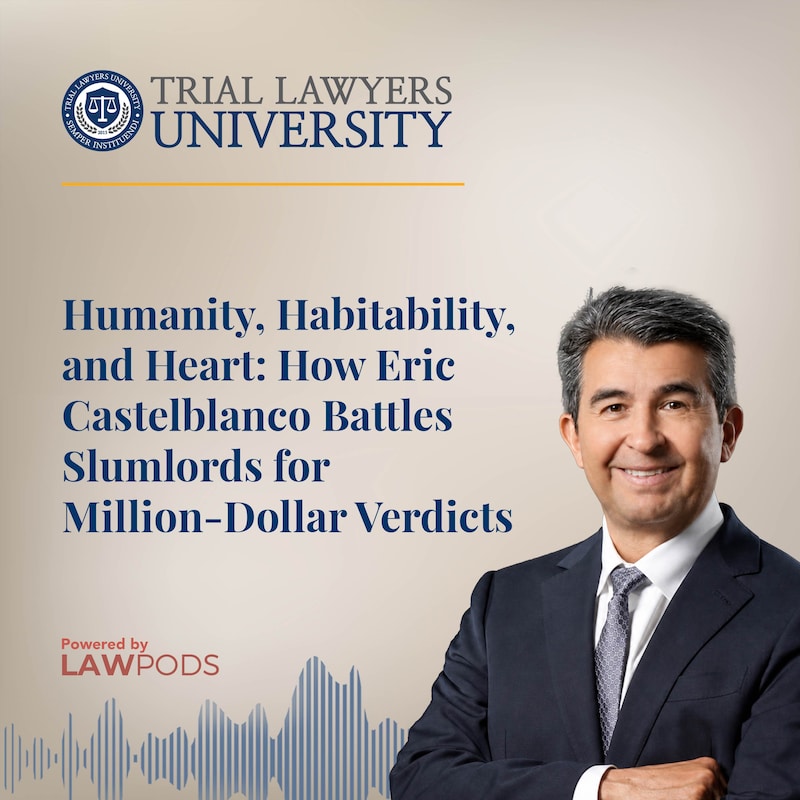
Eric Castelblanco was helping a client navigate the immigration system when she told him about her neighbor’s slip-and-fall in their apartment building. Would he help her? Of course he would. Not only did he secure a $250,000 settlement for that client, he later took a case for 92 residents who lived in squalor at the same building. The $2.14 million settlement compelled him to switch from immigration law to habitability law. In this conversation with host Dan Ambrose, Eric reflects on how he built one of California's leading habitability practices from scratch and how he keeps the firm driven to prepare every case as if it’s going to trial.
Train and Connect with the Titans
☑️ Eric Castelblanco | LinkedIn
☑️ Castelblanco Law Group | Instagram | LinkedIn | Facebook | TikTok | YouTube
☑️ TLU On Demand Instant access to live lectures, case analysis, and skills training videos
☑️ TLU on X | Facebook | Instagram | LinkedIn
☑️ Subscribe Apple Podcasts | Spotify | YouTube
2026 Programming
☑️ TLU Beach, June 3-6, Huntington Beach, CA
Episode Snapshot
- Eric immigrated to the U.S. as a toddler; his family lived in nine different apartments over 12 years, giving him a firsthand understanding of what it means to be a powerless tenant.
- His father worked in factories and car washes before opening a small machine shop. Working for his father from age 13 "really taught me the work ethic,” he says.
- Eric attended Loyola Marymount University, passed the CPA exam on his first try, worked two years at KPMG, and then enrolled at Harvard Law School.
- After five years in corporate law, Eric left because he felt a greater kinship with the plaintiffs’ lawyers he watched in depositions.
- Eric's first habitability case came through an immigration client who referred him to his neighbor, who was injured from a slip-and-fall at their apartment building. That led to a $250,000 settlement..
- When Eric's immigration client visited his new office to pay rent, he learned that the same management company owned her residential building — where 92 tenants lived in squalor. He mortgaged his house multiple times to fund their case and nearly went bankrupt before a $2.14 million settlement on the eve of jury selection.
- Castelblanco Law Group now operates with six attorneys and over 20 staff under the Entrepreneurial Operating System (EOS), which Eric credits with transforming how he holds his team accountable and maintains a long-term vision for the firm.
- At TLU Beach, Eric will teach a lecture and workshop on how to identify, build, value, and try habitability cases.
Produced and Powered by LawPods
Transcripts
The most dangerous place you can be as a trial lawyer is to think you've got to figure it out.
(:I'm still trying to get better. I still have the passion for it. I believe in it.
(:Everyone can learn to do what I do. And yet there's a group here that continues to get extraordinary verdicts. Trial Lawyers University is revolutionizing educating lawyers to be better trial lawyers. It's been invaluable to me.
(:Trial Lawyers University, where the Titans come to train. Produced and powered by LawPods.
Dan Ambrose (:All right. So today we got Eric Castelblanco joining us. And Eric, you and I have been knowing each other for about, what, 10 years now?
Eric Castelblanco (:About 10 years. Yeah, quite a while. 2016.
Dan Ambrose (:2016. So tell us, because in 2016 you saw an ad or you heard about the Trojan Horse Method and you got yourself and a couple of teammates, a couple of your attorneys from your firm to come up to Seattle. So tell us, how was your first Trojan Horse Method program? Well,
Eric Castelblanco (:We came across your ad because we were trying to prepare for a trial that was going to go on in 2017. And we were pretty scared, I think. And we saw a Trojan horse and we're like, "Let's just do it. Let's take a chance." Your name wasn't on it, but it's kind of catchy name, Trojan Horse. So we went up to Seattle and I believe it was like a four day conference. It was very unusual. It wasn't like a normal conference because you usually just sit down, you hear people speak and take notes. This was like very interactive. It was more like you were up on your feet most of the day. You started early, you ended late, but it wasn't just that type of dynamics. It was the dynamics with the instructors. And you were one of the instructors. You had a couple helpers at that time.
(:But the dynamics were basically, you get up on your feet, you do your thing, and your feedback, at least back then, was just much more direct, I think, than I'd ever experienced in my life. Some people might not do well with that, but I really liked it and I enjoyed it and it gave me a lot of confidence for the trial that came up.
Dan Ambrose (:Yeah. Well, my feedback was very direct then, but maybe the tone was a little harsher than it is now because when I give feedback to the people that do my trial TLU skills bootcamps, which you've done, we'll talk about that later. But I think I've gotten better at the coaching aspect of it and not having ... Because you use the wrong tone and it could cause a person even that wants to learn to maybe recoil a bit. And so I've gotten more aware of that. Honestly, it takes a long time to learn how to do stuff. Right now, I truly believe I'm the best coach of trial lawyers in the world. Well,
Eric Castelblanco (:I'm sure it looks like you have reflected on your teaching style. I think you have gotten better. I think your techniques have gotten better in terms of what you're teaching as well. But back at the end of the day, I think it was very effective with what we needed at the time.
Dan Ambrose (:Yeah. And I've always given everything I have to every class, every student, and just what I could ... You could only give what you have though. And it took a long ... It takes time to learn how to be a good teacher, especially of I call them performance and connection skills when nobody else is really teaching that before. Because I started off with the Trial Lawyers College for many years, and I think they attempt to do that, but obviously they have a philosophy that didn't quite align with me because I stopped doing it and started my own thing. But you had a little bit different route to becoming a lawyer. So kind of just give us a little context to how it is, because we're talking about how you became a lawyer and then how you really started focusing on habitability. But how is it that you find your way to law school?
Eric Castelblanco (:How far back do you want to go?
Dan Ambrose (:Start with, well, I know you came to this country with your parents when you were maybe two or three years old and that the first dozen years of your life or so you lived in apartments. And so take it from there though, so that way kind of gives context on who you
Eric Castelblanco (:Are. Yeah. So I mean, I think that I have the typical immigrant background, trying to live that American dream and seeing that as attainable for me. And I saw it as education eventually, but correct. The first 14 years of my life, I lived in apartments. We basically immigrated to this country when I was a toddler. And then for the next 12 years, we lived in nine different apartments. We would move all the time. I never understood why we moved all the time, but we moved all the time. So there was a little bit of instability in terms of a living situation in that context, but I had a very loving family, but I realized and I knew what it meant to be a tenant and not having control. And depending on who the manager was, dictated how much freedom you had as a kid, where you can play, where you couldn't play, what the living conditions were, were the things fixed, unfixed, was it clean, unclean?
(:So even at a young age, I could grasp those types of situations. My family basically immigrated here and my dad worked in factories, my mom in factories. My dad even started off in working in car washes, but all the while being an immigrant and he wanted to start his own business. So I really learned a lot of my entrepreneurial skills from my dad. He was eventually able to open up his own machine shop, like an engine laid, milling machine, small little business. And that was our family business. So from the age of 13, I would work every Saturdays, every vacation at the machine shop. So I really worked hard. My dad really taught me the work ethic, which I appreciate at this point in my life. It's really helped me out a lot.
Dan Ambrose (:Yeah. Having a strong work ethic, it's good to be helpful to be smart, help with good ideas, but if you don't have a strong work ethic, you can have all the ideas you want, but they're not getting executed.
Eric Castelblanco (:Very true. So I worked a lot during high school, which I didn't dedicate a lot to books. I didn't dedicate to homework and or to getting good grades. I think that I was really lucky to get into college. I went to Loyola Marymount University, and I believe that LMU really turned my life around. At LMU, I was able to just concentrate on my issues, my problems. I didn't have to worry about taking care of my family, and I excelled. I really excelled at LMU and I became actually one of the top students there.
Dan Ambrose (:And so after going ... And what was your focus of study at LMU?
Eric Castelblanco (:Well, at first it was economics, then it was business. And then I ran across a person that lived in the same dorms and he asked me a question. He says, "Well, what do you want to do after LMU? What do you want to study? What are your goals?" And really I hadn't thought about it in such a concrete way. And I asked him, "What are you going to do? " And he says, "Oh, I have a plan." And he had a very detailed plan. It was basically majoring in accounting at LMU because it has a good program, passing the CPA exam, which is very difficult, getting a job in a big ... At that time it was big eight accounting firm, now I think it's big four accounting firms. And then studying for the LSAT, nailing the LSAT, getting into a really good law school as a CPA with an accounting degree, and then going to a top law school, and then going to become a corporate lawyer.
(:And I heard his story and it seemed really clear to me at that point, and I was like, "I'm going to do that. I'm going to do exactly what that guy did." But I did a little bit better.
Dan Ambrose (:How so?
Eric Castelblanco (:I got better grades. I did better on the LSAT, went to really good CPA firm, KPMG, and then I got into a better law school. I went to Harvard Law School.
Dan Ambrose (:So how many years did you spend at KPMG?
Eric Castelblanco (:Two years to the day. So back then, you had to be two years of work experience to get your CPA. So I passed a CPA exam on the first try and then did the two year work experience and then I was out the door going to Cambridge.
Dan Ambrose (:And so how did you ... Because I think you might be the only Harvard law graduate teaching at TLU this year. Certainly, I mean, maybe the only one coming to TLU, Harvard doesn't really produce too many plaintiff's lawyers.
Eric Castelblanco (:Correct. It's very unusual. Maybe more so now, maybe more common, but back in the day, you all pretty much went to big law, big corporate law.
Dan Ambrose (:And so how was your time at Harvard? What was your favorite part? What's your favorite memories from Harvard?
Eric Castelblanco (:Adjusting at Harvard Law School was very difficult for me. It was a higher level of education that I had been used to. I mean, to be honest with you, for the first month, I kind of didn't even know they were speaking in the same language because it was so advanced, but you just get used to everything. I adapted, I studied really hard. Second and third year were much easier for me, but there wasn't a process of just getting used to that environment. And now I love it. I'm still involved. I'm still involved with the Alumni Association. I'm involved with the Dean's Leadership Council. I go back every year for combined meetings with the Dean. So now I'm really involved, even though back then I was kind of a back bencher.
Dan Ambrose (:TLU Beach has happened right here at the Paseo Hotel, June 3rd through 6th, Huntington Beach, California. But it all starts out on June 2nd because we're taking over the Lorea restaurant and the entire pool area. We're having a dinner party hosted by our friends at Finch. At TLU, we not only have the greatest education because we got five lecture tracks with the top trial lawyers of the country and eight workshop tracks for smaller group, interactive, on your feet training. But on top of all that, we got networking, we got friend making, because we got golf, we got pickleball, we got go- kart racing, we got surf camp, we got all that stuff going on. And on top of that, we're going to feed you the entire time. We provide a full breakfast for everybody, full lunch, dinner parties, food trucks, because we're having themed parties every night.
(:Thursday night, 80s track suit party hosted by Supio. Friday night, the Wild West Satch Oliver party hosted by our friends at Eve. And Satchel's bringing 500 pounds of Angus beef. We're going to have a mechanical bull. And then Saturday night, the opera ski adult swim pool party happened right here. So come for the education, stay for the food and make lots of new friends and change your life at TLU Beach. We'll see you here. So you get out of Harvard and where do you get your first job out of law school?
Eric Castelblanco (:I went to a big firm. It was like about almost a thousand lawyers at the time, huge, huge firm. And I did corporate law. I did corporate transactions. So my dream really wasn't being in a courtroom. My dream was being in the boardroom. I wanted to be a big corporate lawyer. So that's what I did. I did that for, I don't know, four years or so, another year at a smaller firm, but it was called Pillsbury and they were a big firm and I think they still are a big firm.
Dan Ambrose (:Well, why'd you quit? Why'd you leave?
Eric Castelblanco (:It just wasn't for me. The money was good, but what I was doing wasn't fulfilling for me. And it was just a personal decision that I just said, I'm not going to lead my whole life this way. In the last year that I was at Pillsbury, I was placed in the litigation department because it was a huge case. A pharmaceutical company was getting sued. It was a huge class action. And I was on it and I'd be in depositions, not being the principal defender of the depo, because it's a huge firm, but I'd see the plaintiff's lawyer on the other side and I'd see the clients, their clients on the other side. And I just felt more of a kinship, more of a closeness. I could relate more to the other side. And I could see that the plaintiff's bar seemed happier. It seemed like they were more at ease.
(:And the defense bar, which I was part of at that time, just really uptight, just really stressed out. And also they were making probably a lot of money on this class action. So that's probably why they were so happy. But I'm like, "You know what? I should do something different with my life."
Dan Ambrose (:Well, making money and doing meaningful works is usually a pretty good combination for happiness.
Eric Castelblanco (:Very true.
Dan Ambrose (:I
Eric Castelblanco (:Think. You find it a lot with plaintiff's lawyers.
Dan Ambrose (:Yeah. A lot of players will be pretty happy, pretty happy. So you think the other side is better and it would come-
Eric Castelblanco (:Better for me. Better for me.
Dan Ambrose (:Right. There are some people that lack personality, like confinement, love billing hours, love grinding their life away for the man, like being a corporate slave. Sure. It's maybe more appropriate for them. Those are called defense lawyers.
Eric Castelblanco (:I opted out.
Dan Ambrose (:Yeah. One time some defense lawyer typed me a text and said, "Oh, I was leasing your podcast, but I was really offended by it by the way you talk about defense lawyers, but would you like to call me and talk about this? " And I'm like, "No." If you were offended, maybe that's, but I could care less if you were offended if you're a defense lawyer. Don't listen to my podcast. It wasn't meant for you.
Eric Castelblanco (:Why is he listening to the
Dan Ambrose (:Podcast? Listen to something from those guys that wrote the book, Tyson and Mendez about their new leader. Go listen to those podcasts. This isn't for you. So you come to the realization that billion hours and being a corporate slave is not your game. So you get out. Do you go start your practice then?
Eric Castelblanco (:No. I think I was just really disillusioned with the law altogether. I mean, it was kind of a crisis for me. Here I am. I want to be in this courtroom and I'm sorry, this corporate lawyer and then all my dreams just kind of vanished. And I'm like, whoa, I was a little lost. So I did know that I wanted to be an entrepreneur. So my brother had an idea to do a telecommunications company. Now, both of all, we didn't have any money. And to start like a long distance company back then, took some money, but we kind of did it on shoestring budget and we put something together and we did it for like a couple years and we make ends meet, but we didn't make a lot of money. And it just, we were both, how do you say? We both came from good schools.
(:We had the opportunity to make more money working for other people. So my brother went back to school. He went back to work and then go to MBA JD at Stanford. He went to Stanford. The
Dan Ambrose (:Brain's running your family.
Eric Castelblanco (:Yeah, a little bit. Yeah. I have a smart sister too.
Dan Ambrose (:I wasn't
Eric Castelblanco (:A surprise.
Dan Ambrose (:Shock.
Eric Castelblanco (:Yeah. But so he went back to school. I stayed with the company, didn't do very well. And I did that struggle maybe for another four years. And here I am after four years of being out and trying to be an entrepreneur, one thing after another, didn't have any money, ton of debt. And I basically sold the company for very little. Just got out of it.
Dan Ambrose (:And is it then that you started your
Eric Castelblanco (:Law
Dan Ambrose (:Firm? Yes. All right. So tell us about Eric Casablanco, the entrepreneurial law firm owner.
Eric Castelblanco (:Right. So I did come away from that experience as an entrepreneur selling long distance with one critical skill that helped me a lot in my own business. And that is learning how to sell.
Dan Ambrose (:Yes. You got to sell. You got to sell the clients, you got to sell the jury, you got to sell the judge. We're selling all day, every day. Everybody's selling selling. Everybody's selling something.
Eric Castelblanco (:So I started my law firm and I took over a firm. So I started out with like no employees, but within two months, I saw an opportunity to buy a practice. I did for very little. The attorney had passed away and I went and took over an immigration law practice. So I did immigration law for about four years in that practice.
Dan Ambrose (:And so how do you transition from immigration to your current focus of habitability?
Eric Castelblanco (:Well, although I was helping a lot of people in immigration and it was very fulfilling work, it wasn't very financially rewarding. Called
Dan Ambrose (:Lucrative. It wasn't very lucrative.That's the word you're looking for. Mr. Harvard, lucrative is the word you're looking for.
Eric Castelblanco (:For myself, it wasn't because I had such a huge heart and they would say, "Oh, I'll pay you later and I'll pay you in payments," and they wouldn't pay.
Dan Ambrose (:I had that similar experience in doing criminal defense work back in Michigan, payment plans that go until the day of trial and then if you win, they say, "Oh, it was an easy case." Anybody could win that. If you lose, you're the biggest piece of crap God ever put on earth. Exactly. It's a no win situation, these payment plans, but go on. You got the payment plans and you got
Eric Castelblanco (:The- I got the payment plans, but then I get a client that had a hard luck story, really down on her luck. She had a great immigration case, very winnable case, but she had no money.
Dan Ambrose (:When you say had a great story, what was her story?
Eric Castelblanco (:Yeah. I mean, a sad story, I should say. She came across the border and during the crossing, she was sexually assaulted. From that rape, she had a child and the child was autistic and she just had no money, but a really good and strong immigration case. And in my feeling of, I really want to help this person, I took on her case and I asked her, I said, "Look, I can't do it for free because I didn't want her to just think I'm just charity." So I said, "Look, just pay me $20 a month."
Dan Ambrose (:Yeah, you're a
Eric Castelblanco (:Real
Dan Ambrose (:Lawyer, $20 a
Eric Castelblanco (:Month. You're no
Dan Ambrose (:Charity.
Eric Castelblanco (:Yeah. 20 bucks a month. And she says, "Yes, I can do that. " And I just wanted her to have a little skin in the game, but she paid me like three, four, five months and then stopped paying me.
Dan Ambrose (:What a shock.
Eric Castelblanco (:Yeah. Amazing.
Dan Ambrose (:You came lower on the total pool of priorities even at $20 a month.
Eric Castelblanco (:Go ahead. Exactly. Yeah. She'd rather go to Starbucks, right?
Dan Ambrose (:What a shock. Go ahead.
Eric Castelblanco (:So then about a year later, her immigration case is winding down, getting her green card and everything. And she calls me and she's all guilty. She's like, "Avodo, I'm so sorry I haven't kept up with my payments, but my neighbor slipped and fell in the apartment complex where I live and she's having surgery today, but do you do those type of cases?" Yeah, I do those cases. Of course I do those cases.
Dan Ambrose (:Now I do those cases. Never done one before, but of course I do those cases.
Eric Castelblanco (:Of course I'm going to do those cases, especially in surgery, right? And so I said-
Dan Ambrose (:You dn't have any personal injury experience at the time, but you put together liability, owning a building and person needing surgery thought, "You know what? This could have some value." Could
Eric Castelblanco (:Have some value. So it did, actually. So it turns out that this woman came from the hospital and was at her apartment and they invited me over. I went to this complex and I had not done this type of law before. I'd not been visiting complexes before. I was doing immigration law. I came in here, I went into her apartment and I was probably there half an hour and it was half an hour that I felt so uncomfortable being there. They live there, but I was a visitor. I was so uncomfortable, I would see cockroaches during that half hour, rodents.
Dan Ambrose (:What kind of rodent? Mouse?
Eric Castelblanco (:Mice.
Dan Ambrose (:Mice. Okay.
Eric Castelblanco (:Little mice.
Dan Ambrose (:Little mice, not a big
Eric Castelblanco (:Ranch, just little mice. Inside, but I mean, I hadn't seen that and it kind of freaked me out and I'm like-
Dan Ambrose (:Seeing a mouse inside the house freaking
Eric Castelblanco (:Out? Wow. You're
Dan Ambrose (:Such a weak
Eric Castelblanco (:Temperament. It's concerting. So I'm like, okay, I sign her up, she's my client now and I head out of there as fast as I can. So in terms of building up the personal injury case, you have to show negligence on the part of the landlord. So we had the inspectors go out there, the health inspectors, the housing inspectors, and they had violations, like hundreds of violations, and they didn't just concentrate on the stairwell. They went into apartments and they cited for cockroaches and they cited for rodents and they cited for all of these horrible violations in this complex. And it was a big complex, like 30 units. So in building this case up, there was a track record of negligence and habitability issues. At that moment, I didn't know what that meant. And we settled that case about a year after I signed her up and we set up, I think it was about $250,000 or so.
(:And then I'm like, "Whoa, this is amazing." Like I have money. This is exciting. I call up my client, the immigration client, and I say, "Don't worry about your bill. Thank you so much for that, for referring me to this case, blah, blah, blah." She goes, "Okay, no problem." So I did her case and all is good and about a year later I'm moving office complex. I'm moving my office, my legal office to another building. Your law firm?
(:My law firm. So I moved my office from one corner of Wilshire Boulevard in Beverly Hills to Midwilshire in Los Angeles. And I go into this high rise, I signed the lease and I come back to the office and I give the lease to my office manager and I say, "Hey, this is where we're going to move. Can you file this in our files, a lease agreement?" She looks at it and she says, "Eric, this is X management company." And I'm like, "Yeah, so don't you remember you sued X management company a year ago in that building where that woman fell in the stairwell and you got $250,000? Don't you remember? It's the same company." And I'm like, "Oh, wow. Okay. So I'm now going to be a tenant where I sued on the residential apartment building." So now I put myself in that position.
(:I'm like, "Well, they didn't realize it. I didn't realize it. I'm not going to say anything." I move in and lo and behold, this ex managing company, they're kind of cheap. They don't treat people very nicely and they do it in the residential environment and also in the commercial environment. So here I am a commercial tenant, but I felt powerless a bit because I would ask for different things that are normal things, locks on the door, cleaning the hallways, whatever it is, and it would be like nickel and dumbing me. So I'm like, "Okay, I guess I have to put up with it for the next three years." I had a three-year lease.
Dan Ambrose (:TLU On-Demand is the library for trial. You catch everything you missed over the last six years, and we've collected all the pleadings, transcripts, and PowerPoints for all these cases and presentations from Las Vegas, New York, and from right here at Puicea. And it's an app for your phone, and there's a Dan GPT feature on the desktop so you can search the entire database for exactly what you're looking for when you need it. If you're not a subscriber, you can call me on my cell phone or text me 248-808-3130, and I will send you a 30-day comp code so you can try it at no risk. And then finally, you will see what you've been missing out on for all these years.
Eric Castelblanco (:Well, a little while later after I moved into this building, my immigration client pops in for a normal appointment and she's like, "Bogado, the same people that own our building own this building. Did you know that? Because this is where I pay my rent." And I'm like, "Yeah, I found that out after I signed the lease." And then I just, I don't know why I asked her, I said, "The building where you live, is it better after the lawsuit? Did they improve the conditions? Did they fix everything?" Because they got cited hundreds of times. She's like, "Oh no, it's worse. It's bad. Everybody's complaining. It's all they talk about. " And I'm like, "Whoa, maybe I can help them." She says, "Okay, let me talk to my neighbors." And about a week later, I kind of forgotten about this, a week later she calls me back and she says, "Avogado, we're ready." And I'm like, "Me, ready?
(:Who are we? Who's we? " She says, "My neighbors." And I go, "Your neighbors?" "Yeah. How many? ""92 people. " I'm like, "What? 92 people. " "Yes, and they want you to come to the building to have a meeting. "And I'm like, " Oh my God, what did I step into here? "I mean, I went and their stories, man, it was just heartbreaking. Families, men, so emotional that they couldn't protect their families from the landlord and keep things clean. There were cockroaches everywhere, and it was getting into their clothes, into their food. So I just felt like I had to help them somehow. Even though I hadn't done a case like that before, I knew that the law could help them. So I went and did my research.
Dan Ambrose (:And what'd you find out?
Eric Castelblanco (:I found out that there's a law right on point.
Dan Ambrose (:Wow,
Eric Castelblanco (:Wow.
Dan Ambrose (:Oh my goodness, thank
Eric Castelblanco (:God. Warranty of habitability, right on point that the landlord is responsible for providing safe and clean housing for folks. Under California, it's very strict, especially in the city of Los Angeles. And we were in the city of LA.
Dan Ambrose (:All right. And so how does that ... Tell us about how the case works out for you and the clients.
Eric Castelblanco (:Well, I started the case and they fought it. They fight these cases. They fight these cases tooth and nail because nobody wants to be called a slumlord, right? Nobody wants to be called as a landlord irresponsible or you're not running your business properly. So they take personal offense to it. So they fought it for two years. Now, here I am, a small law firm. I asked everybody for help. It wasn't just me. I asked my friends from law school. I asked people from undergrad, anybody that would know a little bit about this type of issue that were lawyers. And there were two nonprofit groups that really helped me out. And one of them was Inner City Law Center. Inner City Law Center basically said," Yeah, of course, Eric, come in. "They showed me all their stuff, their complaint, their discovery. They told me how to do it, the X, Y, and Z of it.
(:And the other one was Legal Aid Foundation of Los Angeles who had done cases like this as well. There were not a lot of private lawyers that were doing these kind of cases. There was one that helped me out as well. His name was Barry Litt. And Barry Litt also took me in and showed me everything. And so I had a lot of guidance.
Dan Ambrose (:And with the help of this guidance, how did you were able to help these people?
Eric Castelblanco (:Well, I had guidance, so I knew what I was doing at that point, but the financial resources, my Achilles heel came back to haunt me. So at that point, I already had a house, so I mortgaged my house. I got the second, I got a third, I put all this money-
Dan Ambrose (:Just to fund this one case?
Eric Castelblanco (:Just to fund this case, because I really believed in it. And I was almost at the point of bankruptcy. They almost bankrupted me. But two years to the day when we were picking a jury, they settled.
Dan Ambrose (:That was your first jury trial?
Eric Castelblanco (:First jury trial. We didn't get to the jury trial yet. We were picking a jury.
Dan Ambrose (:Yeah, I get it.
Eric Castelblanco (:Okay? But they settled. They blink.
Dan Ambrose (:All right. So obviously what we care about in the plaintiff world, what was the number?
Eric Castelblanco (:I still remember the number exactly. I
Dan Ambrose (:Bet you do.
Eric Castelblanco (:$2.14 million.
Dan Ambrose (:Wow.
Eric Castelblanco (:In the year 2000, that was a lot of money.
Dan Ambrose (:It's still a lot of money today.
Eric Castelblanco (:It was a lot of money. It was a lot of money to me.
Dan Ambrose (:No. Yeah.
Eric Castelblanco (:I can only imagine. Crazy money.
Dan Ambrose (:Like a new life, a new focus, a new ...
Eric Castelblanco (:I said, "Hey, immigration, I'm not going to do this anymore. I'm just going to do housing." And that's how I started.
Dan Ambrose (:And that's how you started the housing?
Eric Castelblanco (:Yeah. So it was interesting that when you look back, that first immigration, Martha Alvarado, the immigration client, that I did it for free basically and just in trying to help her basically referred me to a case and then made my career. So it's just-
Dan Ambrose (:Amazing. With kindness and generosity towards your fellow human beings who may be a little bit down their luck, how the good Lord sees that there's a little bit of balance and reciprocity in this world. So
Eric Castelblanco (:That's- I've been blessed.
Dan Ambrose (:Oh, me too. Me too. Beyond my dreams. So you developed this focus and this practice that just really focuses on habitability and you've been doing that now for what, 26 years? Six years. And so what does your law firm look like today? Because I know I was just over there recently and seen pictures and it's looking very sharp.
Eric Castelblanco (:Thank you. Awesome. Well, it's evolved. Let's hope so. It keeps evolving. I am a true believer in continuous self-improvement and to reflect, we operate our business because it's a business.
Dan Ambrose (:It is a business.
Eric Castelblanco (:I operate it under a business, I guess, methodology. It's called Entrepreneurs Operating System.
Dan Ambrose (:EOS for
Eric Castelblanco (:Sure. EOS. And it's based on a book by Gino Wickman called Traction. And I've been operating under EOS for about nine years or so. And it's really transformed the way that I operate the business, how I hold people accountable to goals. We have an accountability chart. We have a vision of how we're going to be in five years, 10 years. And it really keeps me invigorated. It keeps me learning and it keeps me motivated.
Dan Ambrose (:And so how many lawyers are at Casta Blanco now?
Eric Castelblanco (:Right now it's six.
Dan Ambrose (:With your focus on habitability and how many people overall work for you?
Eric Castelblanco (:Quite a bit. Over 20.
Dan Ambrose (:Yeah. So a lot of people to be responsible for. When you're entrepreneur, it's, "Oh, it's so great to be visible." Guess what? The downside is all those people who paycheck reposit you, that's all pressure. Making sure that you continue to grow the business to give them the opportunity to have the life of their dreams, not just your dreams, right?
Eric Castelblanco (:True. In
Dan Ambrose (:Fact, the entrepreneur's business responsibility is to understand their people and help them accomplish their dreams.
Eric Castelblanco (:Very true.
Dan Ambrose (:And that's a great business. That way people are excited about coming to work because they're fulfilling their dreams too. So you got the law firms built upon this habitability. So for people that don't do habitability, but I think this is a very ... I mean, obviously not a lot of people do that. So what kind of criteria do you look for when deciding whether to ... Because I'm sure you're selective with the cases you could take. You can't help everybody because you're running a business and some cases might be righteous, but it's not a feasible business opportunity. So what kind of criteria do you look for when deciding whether to take a case?
Eric Castelblanco (:Well, we're very selective in terms of our cases, but I would say we're more of a personal injury firm within the housing environment. So we get a lot of calls for people that have leaky sinks or my manager looked at me, twisted eye, things like that. Unfortunately, we look for cases that people have been damaged, have been hurt physically. So we look for cases that have, let's say, pest infestations like cockroaches. Cockroaches cause asthma, respiratory issues, allergies, rashes. There's cockroaches in the ear, ear canal.
Dan Ambrose (:How
Eric Castelblanco (:Many
Dan Ambrose (:Cockroaches in the ear case have you handle? Because I remember
Eric Castelblanco (:When- Too many.
Dan Ambrose (:Too many. I remember because we did a witness prep class when I was doing Trojan horseback back in 2017, 2018. And I think you were working on a cockroach in the ear case then because you may talk about it now. It's just so viscerally horrific.
Eric Castelblanco (:It's horrible. I mean, just that ... I have a lot of clients that sleep with cotton balls in their ear. They take the cotton ball a little bit and they put it in their ear because cockroaches love to go into very small, warm spaces. That's why you see them in microwaves. I don't know if ... In a cockroach infestive department, you look at the microwave and you'll see cockroach feces or cockroaches in back where the clock is, because that's always warm. They like kind of going in there and hiding there. And unfortunately, if the infestation is very bad, they'll be in the bedroom and kids will be sleeping in the bedroom. Adults will be sleeping in the bedroom and the cockroaches will go and go in to the ear canal. Cockroaches can go in, but they can't come out because they don't walk backwards. So they'll be stuck in there and you have to go to the emergency room or the doctor immediately to get them out.
Dan Ambrose (:That is a horrific sounding, traumatizing, sounding experience. So cockroaches, how about bedbugs?
Eric Castelblanco (:Bedbugs too. We do bedbug cases because bedbugs cause bites on a person, causes rashes, itchy, itchiness, also scarring. So we do a lot of those type of cases as well. Rodents, they cause allergies. The rodent bites as well. I've had cases where people have been bitten by rodents, mice.
Dan Ambrose (:Wow. I can't imagine how awful it must be to be a father and have children living in these environments. I mean, just must be so disheartening. May 8th and 9th right here at the TLU Beach House, you should join us because we're going to do a two-day witness preparation and direct examination workshop. It's going to be a small group limited to eight people, eight students. We're going to teach you how to prep your clients and your lay witnesses. So when they're up there in deposition, they're not just remembering the story, but they're reliving it. So the jury just doesn't hear it, but they experience it. We'll see you here.
(:I remember when I first got to California, I was working with a friend of mine who was teaching with me back then, Tiffany Chug, and we were working on some habitability case and we had to go to this building and she told me about all these cockroaches and we get there and she's got these hazmat suits and everything. And I'm like, yeah, because she's like, yeah, you don't want to go in there without a hazmat. There's bedbugs.You can't see them. They could jump on your clothes or jump on your shoes, you take them home, you have an infestation. And so that was very surreal for me to like, "Oh, you don't go in this building unless you got your hazmat suit done." But you explained to me, I was telling you about that and you tell me that you don't really do that anymore. How do you handle it now?
Eric Castelblanco (:We don't do that because I find it to be a bit disrespectful to our clients. I've been in thousands of apartments personally. You have to have respect because this is where they live. This is where they make their home. And if you go up in a hazmat suit, that's not what I want to portray in terms of my dedication to my clients. So we do take precautions. So we use pest control type of product. So there's a spray that's called prometherine and it's like a bug repellent. So you put your shoes out in the garage or your clothes out, you lay them out and then you spray permetherine all over it, get it very damp, let it dry out there overnight. And then those clothes you can take and it'll be bug repellent for at least a couple months.
Dan Ambrose (:All right. I mean, I take a bedbugs home to the family.
Eric Castelblanco (:Then you don't. Yeah.
Dan Ambrose (:Probably appreciate that.
Eric Castelblanco (:I know. Hasn't happened so far. All right. Hopefully that would be bad.That's
Dan Ambrose (:Good stuff. That's good stuff. So this year you're going to be teaching a lecture and a workshop at TLU. And so I know I bet that's going to have to do with habitability.
Eric Castelblanco (:Yeah.
Dan Ambrose (:And so give us a little overview of what the lecture's going to be about.
Eric Castelblanco (:Yeah. I'm really excited about that because I'm going to bring my team and we have a lot of knowledge. There's a lot of folks out there that see these cases, but they don't know how to identify the good cases or cases that can be triable. Every case that we take on is a case that we prepare for trial, every case, even though they don't go to trial, every case, but we prepare it as if it's going to go to trial. So basically teaching those type of skills in terms of identifying the right type of case, how to build up a case, how to frame it, what experts do you need, what to do with reports, building something up to mediation, preparing your client, because a lot of these folks is the first time they've ever had a lawsuit. The socioeconomic level that I deal with in my firm is pretty low.
(:Sometimes the next step is homelessness for them, and that's why they put up with the stuff. Even though the landlord's completely egregious and irresponsible, they still put up with it. They pay their rent. And so preparing them for deposition, for trial, I mean, that's a big component of it.
Dan Ambrose (:All right. And then the workshop is going to be where people are going to bring their cases that they're currently working on and need help with them, whatever aspect of it they're working up. And then you and your team are going to help them put their cases together, think about their cases differently, what experts they need, what inspections they might need to do, what reports they need, what discovery they might need so they can kind of look to maximize the value of those cases.
Eric Castelblanco (:And that's important because if there's a firm out there that has a great case and they don't know they have a great case, they don't know how to value it. So we would talk about valuations, we would talk about past histories that I've had, not naming names, but just kind of a roundabout numbers. Being able to value is really important. You don't want to undersell the case because you're underselling this family and this is their only case. They only have one case. And if you undersell their family, you're underselling the kids for their future. So I really pride myself in terms of getting full value for folks and changing lives.
Dan Ambrose (:And when we first started chatting about your journey to my program in 2016 with a couple of your team members, you were talking about a case you're getting ready for trial, but we didn't finish talking about
Eric Castelblanco (:That.
Dan Ambrose (:So tell us what happened in that case.
Eric Castelblanco (:So that case was against an attorney that had many, many trials. He was in ABOTA. So you know that he was a decent trial lawyer, right?
Dan Ambrose (:No, I know he had at least 10 trials.
Eric Castelblanco (:Yeah.
Dan Ambrose (:You could get 10 trials and lose every one of them
Eric Castelblanco (:And
Dan Ambrose (:Be in ABOTA. I
Eric Castelblanco (:Don't know if he lost him or not.
Dan Ambrose (:I'm just saying.
Eric Castelblanco (:He claimed he had more than 50 and I had like less than that. A
Dan Ambrose (:Lot less than
Eric Castelblanco (:That. A lot less than that. So we were, in terms of our settlement discussions, if you can believe this, we were $5,000 apart. And then it became almost like ego. He did not want to settle that case. He did not want to give an inch. And then I would have met him in the middle at that point, right? He looked me in the eye and I asked him, I said," Are you going to try this case for $5,000? "And he looked at me and he says," Looks that way. "Right? Big smile on his face. He thought he was going to just clean the floor with me. And that's when I'm like, " Well, he's going to go to trial. "That's when we looked you up. And we went to Seattle, came back, prepared for trial, learned the skills that you taught us, and we went to trial.
(:And I remember after the first day, after the opening and all that, he had brought the people that help him in his presentation and I had my own team, but we were walking out with the defense lawyer and his person that does the presentation and the guy goes," Hey, did I get this right? You guys are in trial now because you were $5,000 off? "And I said," Looks that way. "It was really funny. And then a week later, the defense lawyer comes up to me and says," Oh, Eric, I took you out of your comfort zone, huh? "And I'm like, " Yeah, you really did. "And he's like, " Well, you want to settle the case? "And I'm like, " No, once we start, I just want to see this through, win or lose. I'm just going to do it for the experience. "And we won.
(:We won. And he basically said that he gave me a good compliment. He said," Every day that we were in trial, he noticed that I got better. "So that was a big compliment from that guy. And I mean, it was good working with him too. He wasn't a jerk or anything like that. He was a nice guy, but he lost and we came up with ... We only wanted like $10,000 a person, but that was a long time ago, but the jury gave us a little over $65,000 a person and there were four people in the case. And then our attorney's fees clause, because these type of cases have attorney's fees clauses. So we did an attorney fee motion. We settled. It was attorney fee motion for like 800 grand. We settled it for less than that, but we were very happy with the outcome.
(:I
Dan Ambrose (:Bet you were.
Eric Castelblanco (:And that set me off.
Dan Ambrose (:That set you off. And so that was your Trojan horse program and you did ... I think you did the case framing one that we did. And I know we did a witness prep, a couple of the programs, but then in 2021, you were in my very first TLU skills bootcamp that I did at my apartment in downtown LA. So I look back on that with Georgio there running the camera and there was like ... I know Ike, I don't remember. I know Ike Caluti was there and I think you had one other person from your firm there with
Eric Castelblanco (:You.
Dan Ambrose (:Bomaro and ...
Eric Castelblanco (:Paola.
Dan Ambrose (:Paola and I just-
Eric Castelblanco (:Choppa.
Dan Ambrose (:Chopa. But they came at different times. I was thinking about that first class. There was like five or six of us. And that was so long ago for me. And the program is so different now because we used to teach ... I remember we used that story, I think it was a tanning salon story, but it was really long. It was like a 10 minute story and like you guys didn't know ... There was no preparation. Nobody knew the story. I just remember that was so ... But you know what?
Eric Castelblanco (:Trucker Tom is better,
Dan Ambrose (:Huh? Oh yeah, Trucker Tom's way a better story. Well, but it was my first ... Even though I look back on a lot of these things I used to teach, and I remember one person saying to me, " Dan, I came to your program because I thought you were kind of full of shit. "He goes," But you so believed in whatever the hell you were saying, I thought if I could believe in my cases, like you believe in this crap that you're teaching, I'll be really successful. "So I came to your program. I'm like, " I'll take that as a compliment. "I mean, you got to believe. At least
Eric Castelblanco (:He went there and
Dan Ambrose (:You know what? I mean, you got to believe, but ... August 24th through 28th, Satch Oliver has come all the way from Arkansas to right here to Hermosa Beach to TLU Beach House. And we're going to be teaching a five day depositions our trial bootcamp. You're going to be working on your cases. Sacha's going to be working with you on your cases. So not only are you going to transform your case, but at the end of the day, it becomes a case expense because your case is going to get that much better. This program's limited to 10 participants. So if you want to come get registered today, we'll see you right here. But you were just, we did our most recent program down in Cabo, and so that was you and we had about 25 people down there. Other than playing pickleball, what was your ... Oh, just on a side note, do you remember Chris Hammons, the big guy that was there?
Eric Castelblanco (:Yeah. Yeah.
Dan Ambrose (:Like the six foot five guy from Oklahoma City and he was working on this police chase case where this kid died or his client died because his asshole cop was driving like 110 miles an hour, but he just got that verdict today in Oklahoma and he'd been working on this case like crazy
Eric Castelblanco (:For
Dan Ambrose (:A while, but he got $126 million. Oh
Eric Castelblanco (:My goodness.
Dan Ambrose (:Yeah, that's a heck of a verdict. I'm so happy for him. He's coming to TLU Beach and teaching on that case and he's a real nice guy and he worked his ass off and it came through. But we were down there, I think it was about 25 of us down there. It was great. It was great. So the evolution, because we worked on ... So what were your big takeaways from a performance standpoint from that program? I think
Eric Castelblanco (:It evolved in terms of the scripts were a little tighter. I liked Cabo because it was smaller groups. Our professors would stay the same. I think my professors stayed the same.
Dan Ambrose (:Yeah. Everybody just kept the same groups, same teachers, so that way people could really work together, connect, and really kind of just refine their skills. And that's why I did it. And I was really happy with it because I just recently started doing that, but it's great because then the instructor takes ownership for the group. The group kind of takes ownership for each other and really supportive each other and kind of grow together.
Eric Castelblanco (:Skills. I think the way that you did it with smaller groups was way better for me. I like that, but I work better in small groups.
Dan Ambrose (:Me too. Me too. And we got a big conference coming in the TLU Beach conference, which I'm so stoked about ... Oh, before I talk about that, so if somebody needs to get ahold of you because they have a habitability case, whether they want to refer it or just pick your brain for it, how did they find you?
Eric Castelblanco (:Well, generally, my telephone number, 213-388-6004. My email is [email protected]. But if you go to sueyourslumlord.com, so sueyoursllumlord.com, that'll go right to my website and that'll go right to my email and our phone number's on there too.
Dan Ambrose (:All right. And so I know you've been to a lot of conferences, and you were at TLU Beach last year. So what are your favorite things about the TLU Beach Conference?
Eric Castelblanco (:Well, I've seen the evolution of Trojan Horse to TLU to TLU Beach. I mean, first of all, as an entrepreneur businessman, I mean, ultimate respect for you, Dan. You've done really well with it and you've helped a lot of people. There's so much learning. Top notch lawyers that are going to be there. I really like the connections, the networking. The classes are great, and it's more like the nuts and bolts. So you come away from a conference like TLU Beach and you can actually apply it to your case. It's not so theoretical as maybe some other conferences are. So it's very practical. That's what I like about it.
Dan Ambrose (:Practical. Well, this year it's going to be our fifth year at the Puice Hotel. And I personally focus really hard on making the conference better every year. I think I have a really ... I feel I have a big obligation and responsibility to the folks that come back every year to impress them and to raise the bar both on education and on the sociability of it. Because people come to conference for one main reason, to make more money. And then we do that by learning and getting knowledge and getting skills. And that's why we have five lecture tracks and seven workshop tracks so that way people can be in smaller groups, but more importantly, they can be in the group learning what they need to learn because we all have different gaps in our abilities and our knowledge. And I don't know what they are, but you know what yours are.
(:I know what mine is. Every individual knows what there is. And this way, if I give them a menu of 12 choices every day, well, they could pick out and say, "This, I need depositions. I need to learn how to prep witnesses, man. That's just a real Achilles heels of mine. My clients are not good in deposition and if they ain't good in deposition, they ain't going to be good that's going to kill the case because it's going to devalue the case and they're going to be afraid to go to trial and that's the end of the case." And so that's where it all begins. And so there's going to be workshops on witness prep, workshops on cross-examination from my coaches that we're teaching down there in Cabo, workshops on presentation skills and how to use the Google map and how to create space and make stories come to life.
(:And then Ben Rabinowitz and Mike Kelly are doing an expert cross-examination workshop, Philip Miller, Ed Serambolia, a deposition. So we got all these great workshops, but then we got some of the greatest trial lawyers like Brian Panish and Nick Riley and
(:Aunt Joe Freed, Satch Oliver, on and on and on with the great trial lawyers that are going to be there. What's great is too, is that they just don't ... So many conferences, you see these quote unquote big guys show up and they speak for a couple hours and they leave because they don't really know anybody there. And it's not really their community. It's not their friends, but it's different at TLU. The people that come to TLU, they come and stay for the whole time. And this TLU is going to start for everybody that wants it to start on Tuesday. And some people be like, "Oh dad, your conference is so long and it's too long." I'm like, "Nobody says you have to come for the whole thing. Come for the first three days and go home. Make it yours. Do what fits you. Come for the last three days." I'm just here to give people a menu and give the people like, "I think it's the perfect amount of time because we're going to have dinner Tuesday night." And my buddy Veraj Bindra, who's the founder of Finch, is hosting it all for us.
(:And then Wednesday, we're having a hosted breakfast at the hot restaurant. You go in and we've got workshops all day on Wednesday. We got a golf outing on Wednesday afternoon. We got pickleball. Kurt Zander's taking people out to go- karting. Ted Wacker's hosting the golf, our first annual golf tournament. He's a great guy out of Orange County. And that night we're having the opening reception. And then Thursday morning, you've been kind enough to sponsor and host breakfast for everybody. And we have the best breakfast with bacon, eggs, juice, coffee, fruit, oatmeal, whatever. But a full breakfast outside of the ocean lawn. That's where you get to meet everybody, get those connections going. Then you got all these selections for classes every day. And then we've got a full lunch for everybody. And then we're going to have ... We really upped our social ability though because we're going to have, as you may have noticed, I have my track suit on here.
(:And so we're going to have Thursday night's going to be the Supio 80s track suit party. And we've rented out not just the restaurant, but the rooftop bar above it. So we're going to have both of it. And then we've got the Wayward Suns out there and it's around the pool too. So it's just going to be a whole different new vibe. And then Friday night, the Sacha Oliver Western Wild West party and Sasha is such a great guy and he's bringing burgers in from his ranch. My boot's
Eric Castelblanco (:Ready.
Dan Ambrose (:And we're getting that mechanical bull. So have a little excitement there. And then Saturday, we're going to end it off with opera ski, adult swim pool party. And then every night the lobby, remember turns into like, it's got a couple of ping pong tables, a foosball, a bar. And my nephew Harrison, he turns into DJ Avichemi because he's a lawyer too. But at night with the right vibe, he becomes the DJ and then we're going to finish off on Sunday morning with a Sunday brunch before we all go home. So we're going to have so much ... I'm so ... I'm working hard on it.
Eric Castelblanco (:It's
Dan Ambrose (:Going to be the biggest conference I think we ever had at the beach last year with 820 people. I'm confident we'll get closer to a thousand this year based upon how registrations are going. That's
Eric Castelblanco (:Fantastic.
Dan Ambrose (:It's great because it's like the more people, the more energy. And the hotel at the Pueblo sold out now, but the Hilton's next door. It's right across the street. It's a fantastic hotel. Right. And so a lot of people stay there and I'm just really stoked for it. So well, Eric, I appreciate you coming down to Hermosa Beach to the beach house and giving Elizabeth inside of your story. And I look forward to what you're going to be doing. I know that on May 7th and 8th, I think one or two of your folks is going to come and do my witness prep and direct workshop. And then I'm doing the bootcamp for the five days before TLU Beach. So I think you're going to be part of that too. I'm going to work on some of these habitability cases, which I'm really looking forward to getting in the courtroom on these asshole sloan lords because that one I really excited to ... You hear that stuff just drives.
(:It's wrong. Because it's so intentional too. That's the worst part. It's so preventable, so intentional. These poor people as such victims, these children. All right. Well, thanks,
Eric Castelblanco (:Eric. All right, thank you. Perfect. Thanks for the invitation.




