Shownotes
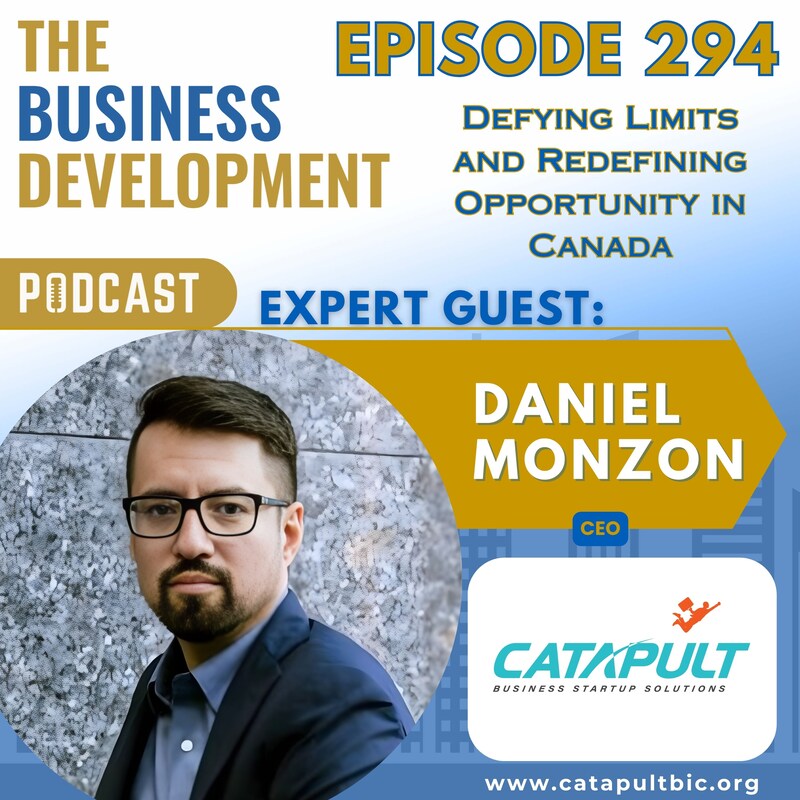
In Episode 294 of The Business Development Podcast, Kelly sits down with the extraordinary Daniel Monzon, an entrepreneur whose story rewrites what resilience and leadership truly mean. Born with one arm and one leg, Daniel has spent his life climbing mountains both literally and figuratively, turning adversity into strength and strength into purpose. From navigating early career challenges to becoming a driving force in Alberta’s innovation ecosystem, Daniel shares how his lived experience shaped his mindset, sharpened his instinct for opportunity, and fueled his mission to support others on their entrepreneurial journey.
Today, Daniel leads Catapult Startups, a not for profit accelerator empowering immigrant, refugee, and underrepresented founders to build thriving businesses in Canada. In this conversation, he offers powerful insights on validation, sales, hiring, and the importance of understanding real customer needs, while highlighting the impact of Elevate IP and his work in economic development. Whether you are launching a business, scaling one, or searching for the courage to take your next step, Daniel’s wisdom and story will leave you inspired, grounded, and ready to push forward.
Key Takeaways:
1. Resilience is built through action and Daniel’s journey proves that challenges can become your greatest source of strength.
2. Validating an idea early saves time, money, and frustration and most entrepreneurs wait far too long to test their assumptions.
3. A great product means nothing without customers who are willing to pay for it.
4. Talking directly to potential clients is the fastest way to refine your offer and understand the real problem you solve.
5. Hiring friends without considering skill fit and culture can set a business back six to twelve months.
6. The right team can take you farther than you could ever go alone and leadership starts with letting smarter people lead in their lane.
7. Understanding intellectual property can unlock new revenue streams and protect what makes your business unique.
8. Entrepreneurs must let go of perfection and operate confidently at 80 percent to maintain momentum.
9. The willingness to take calculated risks is often the dividing line between businesses that grow and those that stall.
10. Your personal story and the adversities you have faced can become a powerful foundation for impact and opportunity.
Learn more about Elevate IP Alberta and Catapult Startups here: https://catapultbic.org/
If you listen to The Business Development Podcast, you belong in The Catalyst Club.🔥
Join a private community of entrepreneurs, founders, and business development leaders committed to growth, accountability, and bold action.
👉 Step in at www.kellykennedyofficial.com/thecatalystclub
Mentioned in this episode:
Hypervac - Revolution Vacuums
Transcripts
I never cease to be impressed by the incredible guests who grace our stage, but Daniel Munson may be among the most exceptional.
Speaker A:His story is one of grit, courage, and an unwavering refusal to accept limitations.
Speaker A:Daniel has climbed mountains with one arm and one leg, built companies from the ground up, and devoted his life to empowering immigrant and underrepresented founders across Canada.
Speaker A:Through Catapult Startups, he is opening doors, creating opportunity and reshaping the entrepreneurial landscape one leader at a time.
Speaker A:This is a conversation that will challenge you, inspire you, and remind you of what is possible when resilience meets purpose.
Speaker A:Stick with us.
Speaker A:You won't want to miss this episode.
Speaker B:The great Mark Cuban once said, business happens over years and years.
Speaker B:Value is measured in the total upside of a business relationship, not by how much you squeezed out in any one deal.
Speaker B:And we couldn't agree more.
Speaker B:This is the Business Development Podcast, based in Edmonton, Alberta, Canada and broadcasting to the world.
Speaker B:You'll get expert business development advice, tips and experiences and you'll hear interviews with business owners, CEOs and business development reps. You'll get actionable advice on how to grow business brought to you by Capital Business Development capitalbd ca.
Speaker B:Let's Do It.
Speaker B:Welcome to the Business Development Podcast and now your expert host, Kelly Kennedy.
Speaker A:Hello.
Speaker A:Welcome to episode 294 of the Business Development Podcast and today it is my absolute pleasure to bring to you Daniel Monzen.
Speaker A:He is a trailing entrepreneur and an advocate for underrepresented communities whose work is reshaping the entrepreneurial landscape in Alberta and beyond.
Speaker A:As the CEO and co founder of Catapult Startups, a not for profit accelerator, Daniel is dedicated to empowering immigrant, refugee and minority entrepreneurs to overcome systemic barriers and launch thriving businesses.
Speaker A: ized enterprises take root by: Speaker A:With its focus on mentorship, funding, support and tailored business resources, Catapult Startups is not just fostering individual success, it's driving economic growth and innovation at scale scale.
Speaker A:Daniel's passion for creating pathways to success is deeply personal.
Speaker A:Born in Lima, Peru and raised in Calgary, Alberta, he has drawn from his own challenges to champion resilience and opportunity for others.
Speaker A:In addition to his work with Catapult, Daniel founded Creative Social, an IT services firm dedicated to helping small and medium sized businesses navigate the digital transformation.
Speaker A:His dedication extends to volunteer work with organizations like Shriners Hospital and the Calgary Catholic Immigration Society where he Supports newcomers in building professional skills through catapult startups.
Speaker A:Daniel is not just helping to launch businesses.
Speaker A:He's creating a legacy of empowerment and redefining economic opportunity for future generations.
Speaker A:Daniel, wow.
Speaker A:It is an honor to have you on the show today.
Speaker C:Thanks, Claudia.
Speaker C:Appreciate that.
Speaker C:I just want to make one thing clear with the Shriners.
Speaker C:I used to volunteer with them when I was going to the Shriners Hospital.
Speaker C:And one of the things that I would do, I actually do translations.
Speaker C:So any kid coming in from, what a country that couldn't speak English, I would literally do to be the one translating to them with the doctors and nurses and things like that.
Speaker C:So I should have edited that.
Speaker C:Apologies for that, but I just wanted to clarify that one there.
Speaker A:Oh, no, not at all.
Speaker A:Not at all.
Speaker A:I appreciate the clarification.
Speaker A:And like I said, either way, you're doing some pretty big things.
Speaker A:It's an honor to have you on the show.
Speaker C:Thank you.
Speaker C:I appreciate that.
Speaker C:I appreciate that.
Speaker C:And yeah, excited to get going.
Speaker A:Absolutely.
Speaker A:You know, catapult startups is something that's been on my list for a while.
Speaker A:I've been trying to do an Alberta ecosystem series.
Speaker A:So basically, from the beginning of the business development podcast, I've had the pleasure of meeting with quite a few different organizations across Alberta.
Speaker A:And this was just one that I needed to get off the list.
Speaker A:And when I met you, I was like, wow, we really need to talk.
Speaker C:No, I'm glad.
Speaker C:I'm glad we're talking.
Speaker C:And also, you know, I'm glad that it's.
Speaker C:Oh, not glad, but thank you for your patience.
Speaker C:You know, it's taken quite a while for us to get a.
Speaker C:Communicate and get going.
Speaker C:I know you reached out to me, like, last year, and I finally had the time to now start talking to you.
Speaker C:So apologies for that.
Speaker C:Like, I was, you know, like, I communicate.
Speaker C:Earlier forms are my pet, my Achilles heel.
Speaker C:But now we have a bigger team and I'm working with that to speed up that process.
Speaker C:But so I appreciate your patience and thank you for welcoming to your show.
Speaker A:Yeah, no, not a problem.
Speaker A:Actually, you hold a record.
Speaker A:At least at this point in time.
Speaker A:You hold a record for, like, the longest time between an initial conversation and an actual recording at a full year later.
Speaker A:And the funny thing is, Daniel, we're actually recording almost a full year ahead.
Speaker A:So by the time people are hearing this show, me and you have been in conversation for two years to make it happen.
Speaker C:Yeah.
Speaker C:So moving.
Speaker C:Really interesting.
Speaker C:You know, it's how things.
Speaker C:How some.
Speaker C:Some things go sometimes, you know.
Speaker C:Yeah.
Speaker C:Again, really excited to be here and hey, let's get the show going.
Speaker A:I think the lesson here really just is that nothing happens as fast as you hope it would in business.
Speaker C:No, it's true.
Speaker C:The other one too.
Speaker C:It's just because you.
Speaker C:You lost touch or you lost connection with somebody else doesn't mean you can't re engage with them.
Speaker C:Because I remember putting you in a red flag and always looking at that email, I'm like, all right, I gotta get this done today.
Speaker C:I think the funny thing is, I think we booked it, or I booked it in August or July of last year, but you were already so booked.
Speaker C:Yeah, the only time was January.
Speaker C:And I'm like, okay, there's nothing January.
Speaker C:Right.
Speaker A:But we're at.
Speaker C:Yeah, but I'm glad I did it then instead of waiting for January of this year and then God knows, who knows when I'll.
Speaker C:Will we be talking by then?
Speaker A:Absolutely.
Speaker A:Absolutely.
Speaker A:No, we are.
Speaker A:You know, I mean, I don't want to say it's a blessing and a curse.
Speaker A:We're blessed on this show to have so many people who want to come on it.
Speaker A:And unfortunately, the downside to that is I want to have them on, but I have to wait, you know, until sometimes a year to get their show out.
Speaker A:But the conversations, the cool thing about the business development podcast is that the conversations are pretty much evergreen, relevant, always.
Speaker A:Like the lessons we learn from, you know, experts like yourself, they're just as relevant 5, 10 years from today as they are today.
Speaker A:So it's cool that, like, even though we are a ways into the future, the lessons are still hot and fresh, typically by the time they come out for sure.
Speaker C:Exactly.
Speaker A:Dude, take us back to the beginning.
Speaker A:You're a serial entrepreneur, but that clearly couldn't have always been the case.
Speaker A:You know, who is Daniel Monz and how did you end up on this entrepreneurial journey?
Speaker A:Take us back to the very beginning.
Speaker C:That's a good question.
Speaker C:I would say, honestly, what came out of creating an opportunity, creating a niche?
Speaker C:Funny enough, you know, went through university, going to university, I really, really applied.
Speaker C:My applied myself somewhere, I'll be honest.
Speaker C:But the biggest thing I tried to do was get into those internship programs.
Speaker C:That's why I would recommend anybody in university right now.
Speaker C:If you're a post secondary or college or whatever, try to get into an internship program.
Speaker C:An internship program essentially will pro.
Speaker C:Will give you work experience while you go into school and give you a better chance when you're out of university to land a job you're looking for within your field.
Speaker C:Right.
Speaker C:So one of the things I was, I was doing essentially trying to get into these internship programs, but then also executive programs.
Speaker C:Now these executive programs are programs that you get that they put you in SNF pathos and to be an executive, most of them tend to be from large energy companies.
Speaker C:And I was talking to two currently and I ended up making a final, final like I guess step or interview process with one of them.
Speaker C:And, and I won't say the name because I.
Speaker C:They were really great with me.
Speaker C:They were honest and upfront front.
Speaker C:That's the biggest thing I think in business is if you're honest and upfront, it's okay, but you have to be honest and upfront.
Speaker C:And they had the decency to bring me in.
Speaker C:We had a conversation.
Speaker C:It's a tough conversation.
Speaker C:But they were like, Daniel, for you to go into an executive program because you gotta go into in the field and you know, switch every quarter, every three months, it will.
Speaker C:You would cost us.
Speaker C:Your insurance cost to be too high.
Speaker C:It's unfortunate.
Speaker C:We looked at it every way possible we could do it, but we just can't get around it.
Speaker C:But at least I had the decency to bring me in and have this as a proper conversation.
Speaker C:It wasn't an email, it wasn't a phone call, it wasn't a text.
Speaker C:It was a one on one face to face.
Speaker C:And for that I will always give them thanks.
Speaker C:Not the answer I wanted to hear, but at least they were able to communicate that.
Speaker C:So from that, at that point I was like, okay, if that path is closed, what other paths can I go through?
Speaker C:So I started applying and going to and working for small businesses.
Speaker C:And in small businesses you wear multiple hats.
Speaker C:You're looking very quickly even if you're applying for an account manager position or a business development position or an operations position.
Speaker C:Yeah, coordinator or anything like that.
Speaker C:Every time it's entry level, you're going to quickly go into wearing multiple hats.
Speaker C:It's just how it is.
Speaker C:And I really enjoyed that.
Speaker C:And I did that for about, I would say five years when I started thinking, I'm like, you know what?
Speaker C:I can do this for myself.
Speaker C:And it wasn't.
Speaker C:That was like the initial thought was there, but I feel like, okay, I could, but you know, I need so much capital.
Speaker C:You need so much this and that and that.
Speaker C:I would make excuses why I couldn't do it.
Speaker C:It wasn't until I would say I started volunteering for TEDxCalgary.
Speaker A:Yeah.
Speaker C:That I met a couple individuals.
Speaker C:The biggest one was a Keith McDonald.
Speaker C:He's one of my mentors.
Speaker C:And he was like, hey, Daniel, what you're trying to do here?
Speaker C:Because I essentially communicate TEDxcallery at the time.
Speaker C:It's like I think 13 or 14 years ago, maybe not 15 years ago now, how to quantify social media.
Speaker C:Because they were doing an event.
Speaker C:They're like, here's how you quantify social media and here's how you get drive, you know, traffic into your website and how you can track sales cost as well.
Speaker C:Right.
Speaker C:And you can see and you can have a return on investment on which channel, whether that's media, text, graphic or, you know, it's giving you the more bang for your buck.
Speaker C:Right.
Speaker C:And they were like, that's.
Speaker C:You do that.
Speaker C:I'm like, yeah, just simply quantifying.
Speaker C:And I show them all this.
Speaker C:And he was like keto saying, hey, there's something here.
Speaker C:He at the time worked for Shell in the operations human department area.
Speaker A:Yeah.
Speaker C:Out and.
Speaker C:But he was, I think stationed out in the Netherlands for a couple LNG projects.
Speaker C:Right.
Speaker C:But he saw what I was doing and he was like, there's something here.
Speaker C:You should probably develop a business.
Speaker C:And I was like, really?
Speaker C:You think so?
Speaker C:And I was like, I think I would need to give, you know, give 10 free clients or something like that or for it to get traction because I need to build, you know, some credibility validation.
Speaker C:They're like, daniel, no, you're ready.
Speaker C:Go for it.
Speaker C:Right.
Speaker C:Start putting an ad, put in some marketing collateral, things like that and get going.
Speaker C:So with that, I was like, okay.
Speaker C:I still was hesitant until literally I got a phone call from those meetings.
Speaker C:Got a phone call saying, you've been highly recommended.
Speaker C:We know that you know social media, how to quantify it.
Speaker C:We're looking at someone to jump into this startup.
Speaker A:Yeah.
Speaker C:To kind of focus on communications and be that driver.
Speaker C:Would you be interested?
Speaker C:And I'm like, yeah, absolutely.
Speaker C:So I jumped in and essentially I've never looked back.
Speaker C:That was.
Speaker C:Yeah.
Speaker C:Now 13, maybe four, no longer 16, 15, around 14 years ago.
Speaker C:That I haven't had to write a resume.
Speaker C:And I think that's the best part I enjoy about this whole thing.
Speaker A:Yes.
Speaker C:Because it's just so tedious.
Speaker A:Yeah.
Speaker C:But I love writing project proposals.
Speaker C:That's a whole different thing because you're writing a project, working on a project or a business.
Speaker C:Right.
Speaker C:So it's a whole different area.
Speaker C:And yeah, it's literally changing that mindset.
Speaker C:Instead of spending time on writing resumes, spending time writing proposals and yeah, I kind of never looked back.
Speaker C:I mean, they gave me a call.
Speaker C:They're thinking you're interested in this project.
Speaker C:I took on the project.
Speaker C:That's when I learned about really doing your due diligence on the entrepreneur hand.
Speaker C:They were building a really cool little product.
Speaker C:The product was like a lantern that gets powered by salt water.
Speaker A:Oh, cool.
Speaker C:The inventor, the CEO, signed an agreement with the investor.
Speaker C:So where the money came in that it could only be marketed to doomsday people or preppers.
Speaker C:So I was like, I.
Speaker C:So you're literally.
Speaker C:Sorry for the pun, but you're literally tying one arm behind my back.
Speaker A:Yeah.
Speaker C:You know, because you just focus me helping me, tell me we should focus on one tiny section of the population.
Speaker A:Yeah.
Speaker C:That characteristically isn't going to be online, doesn't want to be found or market to that.
Speaker C:And, and, and the funny thing is, we would get consultants from California that were $40,000 and New York that were $50,000, and they would all say, why are.
Speaker C:This is a tech product.
Speaker C:Why are you targeting it to.
Speaker C:To.
Speaker C:To teenagers, to.
Speaker C:To parents as a camping product.
Speaker C:Tech camping product.
Speaker C:You can charge your batteries, you can provide you light, you can charge your phones, you can watch, you know, iPad and watch movies.
Speaker C:You should promote it as that.
Speaker C:Yeah, but because of the contract and the stipulation, there's nothing we could do.
Speaker A:Wow.
Speaker A:Yeah.
Speaker C:Less and learn.
Speaker C:Like, do your due diligence before you join a team.
Speaker C:What you're signing up to.
Speaker C:And I guess the investor thought that maybe he can make a work around it.
Speaker C:Maybe he can eventually convince him.
Speaker C:But once you sign something, the inventor had him over, he's like, there's nothing you can do.
Speaker C:You signed it, you gave me the funding.
Speaker C:You're managing the team, which is your job to do.
Speaker C:But it says here you can only market it.
Speaker C:Weird.
Speaker A:Wow.
Speaker A:Wow.
Speaker A:I'm not sure that I understand the reasoning behind that.
Speaker A:Like, what investor wouldn't want to sell it to the broadest spectrum of people possible?
Speaker C:The thing I want to say is this.
Speaker C:And I'll say with a grain of salt, entrepreneurs, when you're starting out, they tend to use this phrase, and to me, it's a red flag.
Speaker C:Oh, this is my baby.
Speaker C:No, it's not your baby.
Speaker C:Your child is your baby.
Speaker C:That's just a business.
Speaker C:And business come and go all the time.
Speaker C:But they are so protective of the idea that they think it's the best idea in the world.
Speaker C:They're not willing to listen to feedback.
Speaker C:They're not willing to listen to just criticism, constructive Criticism and they're not open minded to see revenue generation.
Speaker C:They feel that, no, you're not communicating my message properly enough.
Speaker C:Because a product as it is, it's so wonderful and great and it's like nobody cares about your product.
Speaker C:I'm sorry to say this, unless people are willing to pay for it.
Speaker C:Yeah, you do care for your product and that's great and dandy.
Speaker C:I applaud you.
Speaker C:But if you can't find customers that are willing to pay a dollar value, exchange actual cash for your product or service, I'm sorry, you have nothing.
Speaker C:And with catapult, what we're doing, because we do talk to entrepreneurs and we talk to them early stage sometimes, whether they're launching a startup or a small business.
Speaker C:Some of them are really good, head on their shoulders, they understand business, they understand processes, and they also want to admit what they don't know, which is why they're talking to us.
Speaker C:But others are so adamant that no, my idea is the best and it's all about the technology.
Speaker C:I'm like, great, but what is the business model?
Speaker C:How are you making money?
Speaker C:And they get stuck on that.
Speaker C:Like they don't know how to make money.
Speaker C:And that's a very frustration part for me.
Speaker A:Yeah.
Speaker A:And you see that a lot in startups.
Speaker A:And I think because a lot of startups are university students, right?
Speaker A:Like they're, they have incredible ideas, but they haven't necessarily spent a lot of time in the business world.
Speaker A:And so, you know, I mean, I've interviewed quite a few different mentors for startup founders over the show, on the show over time and I noticed that that's a problem that comes up pretty consistently is that they build a product without thinking of who's going to buy it.
Speaker A:They just assume, well, I have this great product, somebody's going to want to buy it.
Speaker A:But they're not building a product to solve a problem.
Speaker A:They're building a product then trying to find a problem to solve with it.
Speaker C:Right, exactly.
Speaker C:And it makes no sense.
Speaker C:Like, and this is where you have to have the honest conversation with yourself.
Speaker C:And this is what I mean by this.
Speaker C:Entrepreneurship or starting a small business, running a company, it's like you're flying a plane as you're building it while it's on fire and you're putting out the fire.
Speaker C:If you're comfortable with that, perfect.
Speaker C:And the other thing too is you have to feel comfortable operating at 80%.
Speaker C:What does that mean?
Speaker C:Nothing's ever going to be perfect.
Speaker C:And I deal with so many entrepreneurs, they're like, well, we need our product to be perfect.
Speaker C:It needs to be perfect.
Speaker C:I'm like, why?
Speaker C:Well, we want it to be perfect so then we can talk to clients.
Speaker C:And I'm like, you haven't talked to clients yet?
Speaker C:No.
Speaker C:And I'm like, how much have you spent on this perfect product?
Speaker C:Oh, $200,000.
Speaker C:So you spent $200,000, which I'm assuming it's either your own money or grant money.
Speaker C:And let's say it's grant money.
Speaker C:You spend time and resources to write those grants.
Speaker C:There's money behind that.
Speaker C:And you spend time building this thing, but you haven't had the time to talk to up to a hundred potential clients to figure out what features or things or even if they're interested in this product.
Speaker C:I'll give you a quick example.
Speaker C:Okay.
Speaker C:Have you ever heard of Pet Rock or the Pet rock in the 80s?
Speaker A:Yeah, I. I know what you're talking about.
Speaker C:Pet Rock.
Speaker C:Horrible idea.
Speaker C:Anybody that said a pet rock?
Speaker C:That's a dumb idea.
Speaker C:Me.
Speaker C:And you can say it's a dumb idea all day.
Speaker C:Everybody can say it's a dumb idea all day.
Speaker C:But you know what doesn't make it a dumb idea?
Speaker C:The fact that guy made a million dollars in revenue, in sales, because people were willing to give him cash.
Speaker C:So someone out there was willing to give out cash.
Speaker C:And anybody listening to this podcast, please Google Pet Rock.
Speaker C:You're gonna laugh.
Speaker C:Trust me on this.
Speaker C:It's literally any rock you can find out there in the park.
Speaker C:It would just come in a little box, and they would put googly eyes and little things.
Speaker C:You can stick to it so you can decorate your rock and it became your pet rock.
Speaker C:Yeah.
Speaker C:And they charge these people.
Speaker C:This was.
Speaker C:You can find them at Toys R Us, Walmart Superstores, anyhow.
Speaker C:But they validated the idea that people were willing to pay for that.
Speaker A:Yeah.
Speaker C:And that's, I think, a problem that I see with a lot of young entrepreneurs, students.
Speaker C:They're a little scared or intimidated to talk to customers, potential customers.
Speaker C:And you don't need a lot of money or resources to validate an idea.
Speaker C:It can be a simple Facebook post, LinkedIn post, Instagram, TikTok, whatever, saying, hey, we're building this or we're creating this.
Speaker C:Would you pay for it, yes or no?
Speaker C:Just do a quick test run, see how many people say yes or no.
Speaker A:Yeah.
Speaker C:And if you come to yourself like, oh, well, you know, people said no, because I don't think they understood our value proposition.
Speaker C:Well, there are two things.
Speaker C:Either a, you're communicating piss poorly or B, no, they understood it, and they don't want to buy it.
Speaker C:They're not willing to give you money for that idea.
Speaker C:I'm sorry.
Speaker C:There's, you know, like, we worked with one entrepreneur who had a really good idea we thought had a good idea.
Speaker C:It was about understanding notifications and seeing when a system would go down so you would miss out on notifications that would conventionally cost you money because of emails and things like that.
Speaker C:Once we talked to him, he was telling us, and he was very upfront and honest, like, hey, Daniel, I'm starting this out, but I want to talk to accelerators and incubators to figure out which one's the right one for me while I'm doing my validation process.
Speaker C:Yeah, perfect.
Speaker C:Awesome.
Speaker C:A month later, he comes back to us.
Speaker C:Hey, Daniel, I want to let you know what I found out of the validation.
Speaker C:Cool idea, but there's no way I can make money of it because I cannot scale it.
Speaker C:I'm like, hey, nothing wrong with that.
Speaker C:You had the idea.
Speaker C:You validated it quickly.
Speaker C:You tested it out.
Speaker C:You're like, yeah, there's no way I can make money at this.
Speaker C:The market's not ready for it.
Speaker C:Perfect.
Speaker C:You put it to rest.
Speaker C:You didn't try to force something that wasn't there.
Speaker C:You did your due diligence, and you were.
Speaker C:You were able to put your ego aside.
Speaker C:Hey, this is not going to work.
Speaker C:It's okay.
Speaker C:Let's put it aside.
Speaker A:Yeah, no, I.
Speaker C:It's.
Speaker A:At least they did.
Speaker A:Most people would just still keep trucking forward.
Speaker A:I know.
Speaker A:It's.
Speaker A:It's hard.
Speaker C:It's hard.
Speaker A:It's hard to have an idea and think that it could work and then find out that maybe it's not the right time.
Speaker A:And I do think that in a lot of cases, that's all it is.
Speaker A:It's not the right time.
Speaker A:I think many ideas are excellent, but you have to wait for the time for it to work.
Speaker A:And I think that's kind of the kicker, too.
Speaker C:Exactly.
Speaker C:I mean, an example of that is Tebow.
Speaker C: s and early: Speaker C:They could literally record your TVs.
Speaker C:It was early AI if you think about it, it re understand your patterns of watching TVs, and it would start recording the shows that you think you might want to watch.
Speaker C:You even knew having to click record.
Speaker C:Yeah, but people were like, hold on, that's too scary.
Speaker C:We're not ready for it.
Speaker C:No one bought it.
Speaker C:It's still one of the best Manufactured products out there, bar none.
Speaker C:But the people weren't ready for it.
Speaker C:Now it's a joke.
Speaker C:It's a very TiVo.
Speaker C:I mean, I don't know, I guess I'm 40, turning 41 this year, so people might, might know who TiVo is.
Speaker A:But, well, it's.
Speaker A:You're absolutely right because I remember at the time being like, oh, that's kind of a cool idea, like the whole idea of a dvr.
Speaker A:But now they're just like, they're gone.
Speaker A:Like that whole thing just missed.
Speaker A:I think Blu Ray is also, if we want to talk about something that was like really cool but just short lived, just Blu Ray, right?
Speaker A:Like sure we still have, you can go buy a Blu Ray video, but who in the world is buying Blu Ray videos anymore, right?
Speaker A:It's kind of too bad because it was like the pinnacle of, of discs, right?
Speaker A:But its lifespan was what, five years tops.
Speaker C:And that's the thing though, now you look at some companies that, okay, they invested or betted on Blu Ray, PlayStations, Sony's video game systems that instead of putting DVD, they put it the Blu Ray.
Speaker C:So then you can play the games and watch Blu Rays.
Speaker C:But now Blu Rays no longer exist.
Speaker C:Now some of them, you can still do a streaming system on them with your PlayStation and Xbox or whatever.
Speaker C:But again, it's the means that changed, right?
Speaker C:I mean if you think about it, Neff, streaming services nowadays are, it's on demand watching.
Speaker C:It's video on demand.
Speaker C:You watch when you want to.
Speaker C:I mean the days of Saturday morning cartoons are gone.
Speaker C:I, I remember when it was like Saturday morning cartoons, five in the morning, six in the morning.
Speaker C:I set time to watch those cartoons.
Speaker C:Now you can watch whenever you want.
Speaker A:Yeah, no, me too.
Speaker A:And honestly dude, I'm so disappointed with it because like my kids, I want them to love Saturday morning cartoons, right?
Speaker A:God, I can watch cartoons anytime.
Speaker A:There's no such like a Saturday morning cartoons.
Speaker A:Like ah, it's too bad, really.
Speaker C:It's too bad they don't know what they're missing.
Speaker C:And, and memory sound a little silly, but I think it builds a little bit of discipline is what I mean by that.
Speaker C:Okay, so you go to school Monday to Friday and you and your parents are waking up.
Speaker C:At least for me they're like, wake up, go to school.
Speaker C:And I'm like, no, I don't wanna sleep, I don't wanna go like please leave me alone yet on a Saturday morning.
Speaker C:Because it's what I wanted.
Speaker C:That cartoon that I wanted to watch, I was willing to internally just wake up at 5am, grab that, go downstairs in the kitchen, pour myself a bowl of cereal, milk, watch some Saturday morning cartoons.
Speaker A:Yeah.
Speaker C:But now you correlate that to like, okay, business world.
Speaker C:I want something, you're gonna have to get up early to go get it.
Speaker C:Early bird gets a warm.
Speaker C:And I think a lot of us who lived in that area, I feel that, yeah, waking up early might be tough, but if it's something that we want, we're able to almost, how can I put it?
Speaker C:Attach ourselves to that feeling or emotion of like, hey, Saturday morning cartoon.
Speaker C:Something we wanted to do.
Speaker A:Yeah.
Speaker C:And we were able to do it.
Speaker C:So let's go back here.
Speaker C:Hey, this early meeting or this project or this whatever, me getting early is going to help me achieve that goal or get what I want.
Speaker C:Right.
Speaker C:But I don't know.
Speaker C:And again, maybe it's an assumption.
Speaker C:I don't know.
Speaker C:People that didn't grow up with Saturday morning cartoons, is that damaging in that aspect?
Speaker C:Are they not maybe getting that training quote unquote when they were young to wake up early because they got an award?
Speaker A:As humans, we love instant gratification, don't we?
Speaker C:We do, we do.
Speaker A:And that's the world they're growing up in, man.
Speaker A:For better, for worse.
Speaker A:Who knows?
Speaker A:I have no idea.
Speaker A:What I can say is, is we gave them tablets initially, learned our lessons, ended up fighting to take the tablets back and now we have a tablet free household.
Speaker A:So it is possible.
Speaker A:But I don't know, man, it's hard.
Speaker A:It's really hard because now the fight is, you know, trying to get them off YouTube.
Speaker A:And, and I think the argument for me with YouTube is it's not YouTube, it's the crap on YouTube that's for kids.
Speaker C:Yeah.
Speaker A:It's the people that are marketing all these games and all this other garbage to kids that's like, oh, like, I don't hate YouTube.
Speaker A:I love YouTube.
Speaker A:But I love YouTube to learn things and I want my kids to love YouTube to learn things, not to just watch a bunch of idiots do dumb things.
Speaker C:And I, and I will agree with you on that.
Speaker C:I think we all had a time when we looked at stupid stuff on the Internet to laugh.
Speaker C:But at the same time, you do want to make a balance.
Speaker A:Yeah.
Speaker C:You know, within what you're learning and what you're being entertained with.
Speaker A:Oh my God, I love that you touched on that because, dude, I, you're absolutely right.
Speaker A:I look back to like when I was a kid and we'd watch like, I don't know, mini clip.com or something like that.
Speaker A:Just watch, like, stupid videos all day long.
Speaker C:It was no different.
Speaker A:But the adult Kelly is just like, that's such a waste of time.
Speaker A:You guys got to do something better with your time, watch something more educational.
Speaker A:But it's like you completely get disconnected with the fact that you did the exact same thing at the dawn of the Internet and.
Speaker C:Exactly.
Speaker A:And.
Speaker C:And maybe just to touch that to a little bit, like, there's nothing wrong.
Speaker C:So, like, everybody takes a different journey in business.
Speaker C:Right.
Speaker C:I would consider myself an extremely late bloomer.
Speaker C:Like, I mean, I'm 40 now, turning 41 this year.
Speaker C:I got a top 40 under 40 when I was 39, like the last year possible.
Speaker A:Yeah.
Speaker C:I got married at 40.
Speaker C:I'm having my kid at 40.
Speaker C:You know, I would say that I wouldn't.
Speaker C:I. I feel not comfortable under my own shoes and my under and my own skin in any kind of situation.
Speaker C:I would say starting around maybe 35, I think around that age, I was extremely sure of myself.
Speaker C:Yeah, I would consider myself a bloomer.
Speaker C:Now I look back because I'm.
Speaker C:I'm gonna.
Speaker C:Again, sorry, People might not know out there, but I'm having a kid pretty soon with my wife.
Speaker C:End of January, beginning of February.
Speaker C:So I've been thinking about my kid and what I'm gonna try to teach him and tell him.
Speaker C:And one of those things, I was looking back at what I was doing in my twenties, in my, you know, in late teens, and it's like, yeah, okay, I went to university, but I wasted a lot of time just doing stupid stuff that I'm just looking back, I'm like, I wish I didn't.
Speaker C:But then I'm like, okay, what?
Speaker C:That made me the person that I am today.
Speaker C:Because even though I felt that it didn't, maybe gave me the.
Speaker C:How can I put it?
Speaker C:The quote, unquote, corporate experience that I needed to polish that.
Speaker A:Yeah.
Speaker C:I think what it did give me, it gave me an understanding of how the actual world works.
Speaker C:It gave me an understanding how people are, which is really important because people.
Speaker C:You don't deal with businesses.
Speaker C:We deal with people.
Speaker A:Correct.
Speaker C:And sometimes I think when we think of.
Speaker C:I can't fathom someone doing that and then that happens is because we don't understand people.
Speaker C:Right.
Speaker C:I think sometimes you can be in a bubble.
Speaker C:Right.
Speaker C:So looking back at all that dumb things that I've done and putting myself in the dumb situations, whether that's partying or whatever, hanging out with your friends, and you look at the different surroundings or experiences that you had that maybe prepared you for a situation where looking back, it can be like, yeah, I dealt with a lot of fires that I had to put out, with a lot of situations that I have to like right away, think fast on my feet quickly and make executive decisions that maybe because of those experiences prepared me for me today.
Speaker C:Right.
Speaker C:That I'm ready to take on this challenge instead of maybe like, hey, if I were to go down, let me say more, that traditional 8 to 5 kind of job scale, maybe I would have been already molded into like, no, I can only work 8 to 5 because I'm comfortable working.
Speaker C:It's not a complicated thing, but I try to keep it to eight hours.
Speaker C:But realistically, it's sometimes 10 to 12 hours because I'm working on multiple things.
Speaker C:But I do make sure to spend time with the family.
Speaker C:Family time is family time.
Speaker C:Right.
Speaker C:But there's a lot of time.
Speaker C:There's a lot of downtime that looking back and you're trying to assess, like, what was I doing all those years or all those time?
Speaker C:And you're like, what the hell?
Speaker C:And then you figure out how you can manage so many things and so quickly because you get used to making decisions, high level decisions, really quickly.
Speaker C:So again, for us, my Achilles heel.
Speaker C:But you asked me for a strategy or ask me a forecast or for a hard hitting question.
Speaker C:I'm like, yeah, boom, done.
Speaker C:Let's next question.
Speaker C:Let's go ahead.
Speaker C:Right?
Speaker C:We made an executive decision.
Speaker C:We can put it to bed.
Speaker C:I'm comfortable saying it was my fault.
Speaker C:I'm comfortable giving the other person praise.
Speaker C:At the end of the day, if you make it about yourself, no one really likes you.
Speaker C:If you always work with a team and give praise to the other people, always want to work with you, and if you always take the blame is because, hey, you're the CEO, your bucket stops with you.
Speaker C:Right?
Speaker C:You cannot blame anybody else.
Speaker A:Yeah, yeah, I can.
Speaker A:I can definitely resonate with you kind of saying like, you know, I'm a bit of a late bloomer.
Speaker A:I started my business at 30, so I'm right there with you.
Speaker A:But you know what?
Speaker A:Here's the thing.
Speaker A:Here's my belief.
Speaker A:My belief is there's never a wrong time to start a business.
Speaker A:You're never too old or too young to start a business.
Speaker A:And it was my time and it was your time, and we needed whatever we needed to get to the point where we were prepared mentally, physically, whatever, to take that leap.
Speaker A:Because starting a business takes bravery.
Speaker A:It takes courage.
Speaker A:And it takes a little bit of.
Speaker A:Of.
Speaker A:Of trust in the universe.
Speaker A:I think it does.
Speaker C:You need to feel comfortable with risk.
Speaker C:Like.
Speaker A:Yes.
Speaker C:And just I think for me, one thing that I did that I can always look back at, and whenever.
Speaker C:Whenever I have days with a tough decision, a tough challenge, something that I think, quote, unquote, is impossible.
Speaker C:Yeah.
Speaker C:I look back to this moment.
Speaker C:I climbed Huayna Picchu.
Speaker C:So that Huayna Picchu is a mountain next to Machu Picchu.
Speaker C:Now, people in this podcast might not know this or I don't know if you heard listen to the podcast.
Speaker A:I don't know yet.
Speaker C:Unless you know you exactly is that I was born with one arm and one leg.
Speaker C:So I climbed the Wana Picchu with one arm and one leg.
Speaker A:Wow.
Speaker C:This kind of pissed me off a little bit.
Speaker C:I was, I think, the 20th person to do it that had a disability.
Speaker C:Yeah.
Speaker C:That's what pissed me off.
Speaker C:I was hoping maybe it could be like the fifth, but I was like, you're 20.
Speaker C:I was like, okay.
Speaker C:There was a lady who climbed the way in a Picchu, and she only had one limb.
Speaker C:And I was like, holy crap.
Speaker C:So she was a person on one limb.
Speaker C:And I'm like, that's like record breaking.
Speaker A:Yeah.
Speaker C:And I was like, no, for two limbs.
Speaker C:You're like the 20th person with two limbs who has climbed that mountain.
Speaker A:Yeah.
Speaker C:And the thing with that mountain, it's you sign a waiver when you go up, because if you fall down, they're not going to search for you, they're not going to find you, and no amount of money that you may have is going to help because the jungle eats you.
Speaker C:There has been cases where people will get lost going up or take get out of the trail or fall down.
Speaker C:And they might come from very affluential families with a little capital.
Speaker C:And they'll bring on the capital, they'll bring in rescue teams and everything, but you don't find the people, you don't find the person, because the jungle eats you.
Speaker C:Right.
Speaker C:So literally, I signed this waiver.
Speaker C:It takes you an hour to go up the mountain, an hour down.
Speaker C:I did it in an hour and a half up, hour and a half back.
Speaker C:So an hour, half an hour extra, both ways.
Speaker A:Yeah.
Speaker C:And I trained for about a year.
Speaker C:Everybody in my family was like, don't do it.
Speaker C:You're gonna die.
Speaker C:You're gonna fall.
Speaker C:And I'm like, no, I'm gonna be prepared.
Speaker C:It is a risk, but it's a very prepared risk.
Speaker C:I even went to the point that I would watch YouTube videos of people climbing that mountain, like two hours long.
Speaker A:Yeah.
Speaker C:Just seeing where all the barriers are going to be.
Speaker C:There's a large boulder where the metal rope is broken, which essentially all the whole way up.
Speaker C:So you learn not to hold onto it because that's what people slip or fall.
Speaker A:I see.
Speaker C:And really understanding where.
Speaker C:Okay, this face is where I'm going to have to cut my arm.
Speaker C:There's no other ways about it.
Speaker C:I'm going to grab here, scrape my arm.
Speaker C:It is what it is.
Speaker C:Yeah.
Speaker C:But I did it all the way up and remember doing it and coming back and the feeling that I got, I'm like, if I did that, I can do anything.
Speaker C:I remember texting my dad and my dad was like, holy, I can't believe he did that.
Speaker A:Yeah.
Speaker C:And he's not very a kind of like rah rah kind of guy, but he texted me like, daniel, you're a champion.
Speaker C:You have a heart of a champion.
Speaker C:I don't know how you.
Speaker C:You did that, but now I take that feeling of me going up and down.
Speaker A:Yeah.
Speaker C:Getting prepared.
Speaker C:Readiness.
Speaker C:The risk associated to.
Speaker C:And you gotta push through.
Speaker C:And the funny thing too about that climb is that morning, because we did it at 6am I was sick.
Speaker C:Day before, I was Tylenol.
Speaker C:Black market Tylenol.
Speaker C:Whatever I could find in a small town.
Speaker A:It's Whatever.
Speaker C:Okay.
Speaker C:It is Tylenol.
Speaker C:It wasn't.
Speaker C:I was.
Speaker A:Yeah.
Speaker C:But different brand of Tylenol.
Speaker C:Right.
Speaker C:And I'm like, okay, taking that.
Speaker A:Yeah.
Speaker C:I'm sorting it out.
Speaker C:And even at six in the morning, while we're eating breakfast, I'm like, how much do you want it?
Speaker C:Am I gonna look back 10, 20 years from now thinking I should have gone up the mountain?
Speaker C:I don't have to, because I did.
Speaker A:Yeah.
Speaker C:And I take that in transition into entrepreneurship, you might be scared about starting a business.
Speaker C:You might be scared about maybe opening into a new market or maybe are scaling into new areas.
Speaker C:But until you do, you won't know.
Speaker C:And I would encourage everybody just take the risk.
Speaker C:Because you never know what's going to happen.
Speaker C:And it's better to take the risk and not know and be like, okay, it happened or it didn't.
Speaker A:Yeah.
Speaker C:Then wonder.
Speaker A:I think everybody has moments in their life where you accomplish something that you may not have ever thought you could and it changes you forever.
Speaker A:And, you know, obviously this was one of those moments for you.
Speaker A:For me, it sounds really stupid.
Speaker A:This one's gonna sound really dumb.
Speaker A:But quitting smoking at 25, I remember thinking like, I tried to quit like 17 times, dude.
Speaker A:Like, I, I just, like, I, I wanted to quit.
Speaker A:I just couldn't stick to it, couldn't do it.
Speaker A:And when I finally did, the, like, the strength in that for me gave me the strength to move up in my life and do something better and basically be a better person than I was before.
Speaker A:Right.
Speaker A:And I would argue too that, like, starting my business and succeeding at it was also something that gave me a strength.
Speaker A:It's like, and made me a better person.
Speaker A:Like, I genuinely think that entrepreneurship makes people better.
Speaker A:It just, if you were willing to take that risk and that's.
Speaker A:And that strength and that challenge on, you can't.
Speaker A:Even if you aren't successful, you will still come out a better person than you were when you began.
Speaker C:Oh, 100%.
Speaker C:And thanks for sharing that, Kelly.
Speaker C:And then it's not a small, silly thing.
Speaker C:I mean, smoking, it's a big deal.
Speaker C:A lot of people struggle with quitting smoking.
Speaker C:But hey, kudos to you.
Speaker C:Congratulations for doing that.
Speaker C:But that must have been like, really tough.
Speaker C:And I'm glad that you shared and said you tried 17 times, you kept trying and you eventually did it.
Speaker C:And that's another thing, too.
Speaker C:I want to communicate to entrepreneurs or business people like, you might fail the first time, you might fail the second time, but if you stick long enough with it, you might succeed.
Speaker C:Now what do I mean by that?
Speaker C:And I really want to touch back to that point to that example I talked earlier with that client that we're talking to with those notification business that he eventually, you know what, after validating it, he just shut it off.
Speaker C:That's because he validated it, but he pivoted to something else.
Speaker A:Yeah.
Speaker C:Because he still wanted, he thought, okay, maybe not with this specific stream or service or product, but there could be another way for me to, you know, be a small business owner or an entrepreneur.
Speaker A:Yeah.
Speaker C:Or any.
Speaker C:Continue on that path.
Speaker C:So that's what I mean by that.
Speaker C:Right.
Speaker C:And like you maybe you're 17 times as you were trying different ways to quit until you found one that worked for you.
Speaker C:But great.
Speaker C:Now here we are.
Speaker A:Yeah.
Speaker C:You know, so many years later when you're like, yeah, that thing worked.
Speaker C:And I would say that's a thing for entrepreneurs.
Speaker C:Sometimes you might think it's the first thing or the second or third.
Speaker C:I mean, I remember the first business that I ever tried running was an events company when I was 23.
Speaker A:Wow.
Speaker C:You know, and really thinking about it, I'm like, I was doing it because it was A pain point I was experiencing because I'm living at home and I can't hang out with friends.
Speaker C:This is learning.
Speaker C:But.
Speaker C:And me and my friend were like, yeah, we should really take this idea to the next level.
Speaker C:And.
Speaker C:Yeah.
Speaker C:And you look back and you're like, no, that took a lot to do.
Speaker C:And, and of course, I mean, you saw one of my close friends, but you can tell that he's not in.
Speaker C:He was like, more.
Speaker C:It's a cool thing to talk about.
Speaker A:Yeah.
Speaker C:But then when you gotta put operations tasks, strategy calendar, so we're moving the needle forward, you realize.
Speaker C:Right.
Speaker C:But of course, that quickly ended nowhere.
Speaker C:But the biggest thing and lesson learned that I learned from that was you don't need a BlackBerry because you're starting out a business.
Speaker C:Because we were just spending money to look, quote, unquote.
Speaker A:Yes.
Speaker C:Oh, yeah.
Speaker C:Hey guys, I have a BlackBerry.
Speaker C:Yeah.
Speaker C:You know, it's just out.
Speaker C:And I'm like, this makes me a business.
Speaker C:No, it doesn't.
Speaker C:Why does it do that?
Speaker C:No, it doesn't.
Speaker C:I'm sorry, it doesn't.
Speaker A:Yeah, yeah, it doesn't.
Speaker C:It's.
Speaker C:It's very easy to spend money, very hard to make money.
Speaker C:And, and one of the things I want people to, to really think about this, it's the quicker you're comfortable validating your idea, even if it's not a hundred percent flushed out, even if it's just 60% flushed out.
Speaker C:But you're just asking questions.
Speaker C:You're about trying to validate it.
Speaker C:And there's many different ways.
Speaker C:I would suggest use any AI platform, whether that's whatever the Google one is.
Speaker C:I forgot what it's called.
Speaker C:Gemini, I think.
Speaker C:Put on those prompts and try to figure out a way.
Speaker C:Again, the biggest thing for me I see is that it's just quickly validated.
Speaker C:Be like, ask it.
Speaker C:How can I validate this idea without costing me a lot of money?
Speaker C:Was a quick, inexpensive way to validate this.
Speaker C:Is it through social campaign, Is it.
Speaker C:You know that most companies, sometimes almost, but a lot of companies validate products or a potential service by just making a fake button and adding it to the website.
Speaker C:And people click on that.
Speaker C:That costs you, like what?
Speaker C:Okay, so let's think about that.
Speaker C:The cost of the developer to write that code or put that button in there, maybe the graphic designer to maybe the color scheme or whatever.
Speaker C:But it's already a template or a branding.
Speaker C:It's no color associated with it.
Speaker C:And maybe the marketing manager coordinator for the actual name that we want to call me, Schedule A conversation.
Speaker C:Learn more.
Speaker C:Because those things will drive as well clicks, but they'll validate it and test it out.
Speaker C:Now, have you spent money on building that product and the infrastructure behind it?
Speaker C:You were just seeing it.
Speaker C:If the market was interested and you set a parameter and you're like, okay, I'm going to put this link on a Wednesday.
Speaker C:And I know that our marketing campaign launched out on Monday, so we're going to get traffic to our website not about that service, but about just general marketing.
Speaker A:Sure.
Speaker C:And let's say for me to see that this product or service, it's a good metric and I'm going to make this up.
Speaker C:Let's say the metric for me that I'm trying to go look for, it's a 25% conversion rate.
Speaker C:So out of 100 people that come to my website, if I get 25 people clicking on that specific link or that product or service, I'm going to go ahead and build it.
Speaker A:Yeah.
Speaker C:Or start the process.
Speaker C:But if I get less than that, I'm not going to build it quick and easy.
Speaker C:And you have to feel comfortable making those executive decisions.
Speaker C:What if you get 24?
Speaker C:You decided on 25.
Speaker C:What's a policy there?
Speaker C:That's when you really, really test yourself as a leader on your executive team.
Speaker C:Because it's all about your ability to make those quick executive decisions.
Speaker A:Yeah.
Speaker C:And then you want to the next.
Speaker A:I love that.
Speaker A:I love that.
Speaker A:And I also love the idea of like testing for marketing stuff because I think a lot of us are just spending money on.
Speaker A:On advertising, whether it be like meta ads or Google Ads or Facebook or whatever you name it, LinkedIn.
Speaker A:But we're not really sure what it's doing a lot of the time.
Speaker A:Right.
Speaker A:Like that's the kind of downside to these passive marketing strategies is sometimes it's really hard to tell.
Speaker A:It's like, sure, you might get X number of impressions, but the impressions don't matter.
Speaker A:And I think people kind of forget about that.
Speaker A:It's not about how many people see it, it's about how many people actually engage with it.
Speaker C:Right now, for example, if your goal is just to generate awareness, so you need to practice because then it's different.
Speaker C:But if your goal is sales, you need engagement and in many different things.
Speaker C:Right.
Speaker C:So I think as people really need to focus on what is their goal and their intent and kind of work backwards.
Speaker A:Absolutely, absolutely.
Speaker A:And I think it's also important to remember that business is done through interaction.
Speaker A:So like everything that we do with regards to business development is always to get to a meeting.
Speaker A:Because if we can have a, if we can have a meeting, whether that be a virtual meeting or a face to face meeting with another human being, be able to address questions, address challenges, introduce a product or service, actually have a real conversation, a real relationship that is like way more likely to turn into real revenue for your business at some point than somebody who just saw an ad on LinkedIn and might have even looked at it or maybe didn't.
Speaker A:Or maybe scrolls right on by.
Speaker C:Right, exactly.
Speaker C:No, exactly.
Speaker C:You're, you're, you're, you're, you know, you're, you're right, you're right about that.
Speaker A:Well, one of the questions that I want to have, obviously, you know, working with a lot of startups and having that conversation with them is how do you, what type of advice do you give to your startups when you're talking about marketing and actually getting to a customer?
Speaker A:Because I think, you know, anybody starting a business, the goal here is to get customers right.
Speaker A:Well, obviously we need brand awareness.
Speaker A:That's one part of the strategy.
Speaker A:But brand awareness is great, but it also doesn't necessarily turn into revenue.
Speaker A:You know, talk to me.
Speaker A:What kind of advice do you give your startups when you're working with them to actually generate sales?
Speaker C:That's a good question.
Speaker C:I would, I would say it depends on their business model.
Speaker C:It really depends on the business model.
Speaker C:So we look at, we gotta look at business models.
Speaker C:So is your business model a B2B?
Speaker C:Is it a B2C?
Speaker C:Is it subscription based?
Speaker C:Is it B2G government?
Speaker C:Right.
Speaker C:And look at that and then look at your value proposition.
Speaker C:Look at your product or service and look who you're targeting.
Speaker C:At majority of the people, they have a. I would say they have a problem targeting their product to the right audience.
Speaker C:I think they think it's for everybody and it's not as far as very specific amount of people.
Speaker C:So that's one.
Speaker C:The other thing we want to try to communicate is let's put in mechanisms in place that can quickly disqualify people.
Speaker C:Yeah, because what you don't want is people that are not interested in your product or your service, in your feed or in your pipeline.
Speaker C:Because that's taking away time from you and resources from people that are actually interested in your pipeline.
Speaker C:And that's something like, even for us, as catapult, we struggle a little bit.
Speaker C:At the beginning, for example, we were like, do we put in practicing very specific information and we're like, you know what?
Speaker C:We have to be upfront with what we're looking for and what we're trying to do because at the end of the day is making sure we talk to the right individuals for the right program, making sure it's the right fit and same thing for any kind of business.
Speaker C:Right.
Speaker C:So you really need to understand that.
Speaker C:So it's looking at your business model, looking at how you're engaging and communicating, looking what your strategy is, but then putting some processes in place when it comes to that.
Speaker C:So what do I mean?
Speaker C:Let's look at retail.
Speaker C:If you're going to do sales in retail, we got to look at your product very specifically and put in some parameters around it.
Speaker C:Okay.
Speaker C:If it's ice cream, well, ice cream is going to sell itself.
Speaker C:It's ice cream.
Speaker C:It's more funding.
Speaker C:You're like a specific location in a corner with foot traffic.
Speaker C:Go sell your ice cream.
Speaker A:Yeah, right.
Speaker C:But more what we're doing is what is a good high traffic area or potential families that might want to buy your ice cream because your ice cream is, you know, let's say it's healthy.
Speaker C:So maybe let's go to an area that has a lot of single families or multifamily or families and then we're like, okay, based on our assessment, that's this communities in the southwest and these communities in Northwest, whatever.
Speaker C:We would suggest when you go in two locations in these areas at these times because they have a whole lot of traffic which will generate some sales for you.
Speaker C:But we would also recommend with you in that space, use the physical location as almost branding and marketing, have a QR code to your website, then people can have access to your website there.
Speaker C:It's almost like a pop up deck.
Speaker C:Because again, you don't want to spend $2 to make 50 cents.
Speaker A:No.
Speaker C:What is your return on investment?
Speaker C:You want to spend 50 cents and make two bucks, right?
Speaker A:Absolutely.
Speaker C:I mean that's a goal.
Speaker C:I mean that's true.
Speaker C:I mean almost want to have a ratio, but again it's your internal investment.
Speaker C:Right.
Speaker C:So ideally what we're trying to do when we communicate, that's one example.
Speaker C:Right.
Speaker C:But let's say it's more a B2B.
Speaker C:It's all about how are you engaging with your clients.
Speaker C:You can kind of talk to your clients.
Speaker C:But the biggest thing we notice is that entrepreneurs are scared out to their clients.
Speaker C:Talk to your clients, pick up the phone, make a phone call, send them an email, send them a text, engage with your clients, don't be afraid to talk to your clients.
Speaker C:The biggest thing to kind of get the ball rolling when it comes to that.
Speaker C:Be where they are.
Speaker C:Where do you think there will be an opportunity for you to interact with them?
Speaker C:Is it a hockey game?
Speaker C:Is it a networking event?
Speaker C:It is as a business after hours thing, like, you know, Calgary Chamber of Commerce.
Speaker C:Yeah.
Speaker C:What is it?
Speaker C:Is it maybe going to your, your kids lacrosse game or hockey game or whatever?
Speaker C:Like where are they spending time at?
Speaker C:And then going to those events and meeting those people.
Speaker C:But again, it's about talking to your clients.
Speaker C:If you're not talking to your clients and you're hoping they'll find you on social media, you got to go directly to them.
Speaker C:And the first step is your network.
Speaker C:A lot of people don't value their network and they have a vast network and it's all structuring in a way that you, for lack of a better term, you don't want to sound annoying.
Speaker C:You don't want to be bugging them saying, guys, come on, please use my services.
Speaker C:You want to come across very professional and you want to also engage with people from your network that you know that, hey, you know what?
Speaker C:This is a potential service that can work for them because that's going to create a pipeline.
Speaker C:You're going to start having those conversations and it's going to do two things.
Speaker C:One, it's going to get you comfortable talking about your product or service.
Speaker A:Yeah.
Speaker C:Potential clients, even if they're your friends or close your network.
Speaker C:Right.
Speaker C:Or people that you, your colleagues that you work with or university students or high school friends or whatever the case may be, be, they're going to get you comfortable with your elevator pitch, your selling proposition, your buy proposition.
Speaker C:The second thing it's going to do, it's going to improve that process.
Speaker C:So then when you do meet that real individual or you know, it's going to also help you close a sale because even though they're from your network, you never know who needs your product or your service.
Speaker C:Yeah, right.
Speaker A:Yeah.
Speaker C:There's a lot of individuals and it's kind of funny that we're noticing that usually entrepreneurs tend to know other entrepreneurs.
Speaker C:Yes.
Speaker C:And it's always like, yeah, my friend started this and we've been talking about it for two or three years and they think I'm ready for it now.
Speaker C:So they always know someone that did it first, that helped them validate it or you know, mentor them around it.
Speaker C:They don't have the capacity to run another business, but they pick their brain and they're always encouraging that friend, hey.
Speaker C:To that he or she person to Go ahead and do it.
Speaker C:Go ahead and do it.
Speaker C:It's not.
Speaker C:You can ask me questions and things like that, but it's not as scary as it sounds.
Speaker A:Yeah.
Speaker C:And then two or three years and they're like, okay, I'm, I'm ready for this.
Speaker A:Absolutely.
Speaker A:Absolutely.
Speaker A:I love that the entrepreneurial community is actually quite tight and you're.
Speaker A:You kind of nailed it.
Speaker A:Most people don't like, realize that, but I feel like since I became a business owner, I know more people than I like ever have, especially from this show.
Speaker A:But like, even if I hadn't started this show, it's just a community of incredible people.
Speaker A:I'm, I'm proud to know so many entrepreneurs because you know what?
Speaker A:They really are incredible, incredible individuals, every one of them.
Speaker C:No, for sure.
Speaker A:You know, Daniel, I wanted to spend a little bit of time just chatting about how Catapult fits in the Alberta ecosystem.
Speaker A:Right.
Speaker A:Obviously you work with government, you work with other startup companies.
Speaker A:I imagine you also work with.
Speaker A:Do you work with Edmonton Unlimited or from Calgary at all as well?
Speaker C:Yeah, we do.
Speaker A:Talk to me, how does, how does catapult startups fit into this ecosystem?
Speaker A:Who is it for and when do people need it?
Speaker C:No, that's a great question.
Speaker C:I would say, Kelly, Catapult, how it fits in the Alberta ecosystem.
Speaker C:We see ourselves as an economic catalyst.
Speaker C:We're here to.
Speaker C:We see ourselves as job creators and someone that's here to help drive the economy forward.
Speaker C:Now, how do we drive the economy forward?
Speaker C:We want to, we're here to empower, whether it's new Canadians or, you know, we call like first generation or even just people that were born in Canada, Canadians here, and essentially all people that are wanting to either start a startup or a small business who are looking to scale their small business or scaling or growing.
Speaker C:And essentially the type of individuals that we work with is whether when you're a startup or a small business that's just launching, it's someone that understands that, hey, I need help.
Speaker C:Because a lot of entrepreneurs aren't going to admit to that.
Speaker C:So if an entrepreneur needs help, specifically when it comes to marketing, sales, when it comes to legal, when it comes to accounting and financing, your team strategy and your operations were there for those.
Speaker C:So the specific six areas we focus on, right?
Speaker C:So that's marketing and sales, your accounting, your finance, your people, your strategy and operations, your legal and your accounting and finance, those six areas very, very specific.
Speaker C:Okay.
Speaker C:Now within those areas, the one thing we notice in time and time again, whether you're, if you're.
Speaker C:Starting out, the biggest things you're looking for and we're noticing is you they're needing help with marketing and sales and then they're needing help with team building.
Speaker C:A lot of, and what I mean material building is that a lot of entrepreneurs come with already a team built three or five individuals.
Speaker C:Great.
Speaker C:And they're looking to scale and grow.
Speaker C:But it's at first hire.
Speaker A:Yeah.
Speaker C:It's not part of the C suite team that may be trouble.
Speaker C:What do I mean by that?
Speaker C:They might bring in someone that you know, they know from the network that's a good individual, but might not be a good fit.
Speaker C:And startups need to understand that you start being a startup the moment you start thinking yourself as an actual business.
Speaker C:And to become an actual business, you got to put in policies and processes.
Speaker C:And that means your first hire is your first hire.
Speaker C:And it's a very important hire because it sets a tone and culture for the company.
Speaker C:And when you're hiring your friends who aren't qualified because you want to give them an opportunity, are you taking your business seriously?
Speaker C:There's nothing wrong with hiring your friend if they're qualified for it.
Speaker A:Yeah.
Speaker C:But if they're not qualified, they have a cultural fit.
Speaker C:It's going to slow down your business.
Speaker C:It needs to be a culture product market fit with that individual.
Speaker C:Because when you're starting out your company and your business, you're wearing so many hats.
Speaker C:And you need to remember that when you bring in somebody, it takes them six months to completely get onboarded.
Speaker C:So if you bring in somebody and you have to fire them and let them go, you're already six months behind.
Speaker C:Now you got to hire somebody new and they have to learn another six months until they're now carved to that point.
Speaker C:So now you're up to a year.
Speaker C:So now you wasted a year because of that hire.
Speaker C:And that's what a lot of businesses sometimes forget.
Speaker C:So it's really critical that you, your first hire really drives the business forward.
Speaker C:The second thing we look at and where the marketing and sales is pivoting your segment, who is it, how are you going about doing it?
Speaker C:For example, when it comes to retail and a lot of other manufacturing space, I know that sometimes it can be very attractive to go and work with a broker to try to get some deals with larger big box stores.
Speaker C:But what are your margins going to be 3, 5% now?
Speaker C:What are your margins online and direct to sale B2C?
Speaker C:I mean your margins B2C tend to be, I mean I've heard some margins to be 90%.
Speaker C:It's like between 90 and 70%.
Speaker C:That's insane.
Speaker A:Yeah.
Speaker C:And you're.
Speaker C:And now you're gonna go down to 3%.
Speaker C:Did you associate that cost or did you add that, think about that cost decrease, you know, into your sales and into your operator and everything else now that you're going with a broker into bigger box stores.
Speaker C:And yeah, you might say, what's volume, Daniel?
Speaker C:But did you do your financial projections?
Speaker C:And you'd be surprised how many times they don't because they see, oh, it's a contract, it's a Walmart, it's a Sobeys.
Speaker C:Oh, my God, we made it.
Speaker A:Yeah.
Speaker C:Did you really look at the fine print, really understand the process?
Speaker A:Yes, yes.
Speaker A:I think people get disconnected and they see revenue and they think, oh, we just sold, call it $10 million in product.
Speaker A:Right.
Speaker A:But like you said, if you're only making 1% at the end of the day, you might do better to not sell.
Speaker A:10 million to sell, you know, 500, but at a profit.
Speaker C:Exactly.
Speaker C:And that's the thing is.
Speaker C:Right, so now are you spending resource and time to get the raw materials to deliver that bulk production, or are you going to maybe spend time and resource engaging with buyers to buy your product?
Speaker C:Yeah, it's allocation, it's understanding that the third thing I would say about that, that we do very well now.
Speaker C:And this is a partnership that we've done with the federal government and the provincial government here in Alberta and Canada.
Speaker C:It's the Elevate IP Alberta program and Elevate IP program.
Speaker C:It's a program that's done, is done federally through all provinces.
Speaker C:So anybody across Canada has access to this and what it is, it's to inform and educate people, whether you're a startup or a small business.
Speaker C:Okay, I'm going to make that very clear.
Speaker C:Whether you're a startup or a small business and you've been operating, let's say under 10 years, the government, both provincial and federally, we're looking to help you understand ip.
Speaker C:What does intellectual property look like?
Speaker C:What is, what are patents, copyright, trademarks, trade secrets?
Speaker C:What does this mean to you as your business and how can it help you grow and scale and monetize?
Speaker C:What we're noticing is that there's a lot of wonderful businesses that aren't.
Speaker C:Their IPs, intellectual property isn't protected.
Speaker C:And at first the idea thought, is this something that was provided to the ecosystem within startups within or small businesses are just in their first or two years.
Speaker C:And yeah, a lot of Them meet it because they're understanding or providing education.
Speaker C:So they're becoming aware of this process and they're putting it into their business plan and their strategy.
Speaker C:But we're also noticing is now existing companies that already been around for under the eight year mark with a strong financial sheet, they're like, hey, we have ip.
Speaker C:We weren't aware that we had an intellectual property.
Speaker C:How can we monetize that and how can we use this now to scale and grow?
Speaker C:And that's what we're finding out in the last two or three months.
Speaker C:Yeah, that's a really interesting things because what everything is going on in the political landscape, you know, with tariffs and everything happening, I feel that there's a real opportunity, especially in Alberta, for these businesses, you know, to really scale and grow.
Speaker C:And again, it's just because of the information being available through this program.
Speaker C:Right.
Speaker C:So I would strongly suggest anybody to look into the elevate IP Alberta program or in general wherever you're hearing this across Canada Elevate IP program, please Google it.
Speaker C:It's a free program by the federal government.
Speaker C:It does provide education and funding for you to get an IP for your business.
Speaker C:So again something we recommend and again that for us ip, I need to understand how to protect the business.
Speaker C:In terms of property, there's so many different revenues, sorry, so many different revenue streams.
Speaker C:You have no idea.
Speaker C:You can open up with whether that's subscription based, licensing based, even helping you with your marketing strategy to go into new markets.
Speaker C:There's so many different levels.
Speaker C:Right.
Speaker C:And that's what we're really understanding and, and pushing here.
Speaker A:For Daniel, how does a company know if they have intellectual property that could be protected?
Speaker A:Like I think, I don't think it's that they necessarily don't want to do it, but they may not even know that this is available to them.
Speaker C:You're right.
Speaker C:And that's where we are.
Speaker C:We're in the states that people aren't aware.
Speaker C:So what we're currently doing is an awareness campaign to engage with as many people out there to let them know what intellectual property is.
Speaker C:So I guess a good first step would be one, come to our website.
Speaker C:We have a video recording that anybody can access.
Speaker C:We'll give them information about what the program is.
Speaker C:The second thing too engage with us and we can talk and we can connect you with one of our lawyers, our IP lawyers and then they can talk to you about do you have anything that's probably AP able.
Speaker C:And it starts by having a conversation.
Speaker C:I think there's Nothing wrong with having a conversation.
Speaker C:And you'd be surprised by the amount of businesses they're like, that's IP able.
Speaker C:I wasn't aware of this.
Speaker C:Now I'm not that person.
Speaker C:Not a lawyer.
Speaker C:That's our lawyer's team.
Speaker C:But that's the first thing I would say.
Speaker C:So first, sorry, first step, go to the Elevate AP website.
Speaker C:Google it.
Speaker C:Go on, go to our second step, go to our website, download our video, watch and explain to you what elevate IP is.
Speaker C:The different intellectual properties available.
Speaker C:And at the same time, if you want to engage with one of our IP lawyers, please engage with us.
Speaker C:More than happy to connect you with that and they can provide you with an asset.
Speaker C:Let you know, is there an opportunity or is something that it's IP able?
Speaker C:And you never know.
Speaker C:And I would encourage everybody to just have a conversation.
Speaker A:Amazing.
Speaker A:And I will make sure that both your website links and the Elevate IP links are with this show.
Speaker A:So it'll be easy to find.
Speaker A:You'll just be able to find it in the show notes.
Speaker A:Perfect.
Speaker A:Daniel, though, you know, we've been talking a lot about catapult startups, which is awesome and I'm happy we were able to do that.
Speaker A:But I would also like to dig a little bit into creative social.
Speaker A:Talk to me.
Speaker A:You know, creative social is really, I know you said not to say your baby, but it's your baby, right?
Speaker A:You've been with it for a long time.
Speaker C:I wouldn't say no because like even we're actually changing names.
Speaker C:Like we're changing names.
Speaker C:So I'm not.
Speaker C:The company's growing and growing to a couple more individuals.
Speaker C:It's.
Speaker C:That was more like, let's say, a solo project that I, that I was still kind of working on.
Speaker C:And I started out about 15 years ago.
Speaker C:Yeah.
Speaker C:And it was my first real 4, 10 trip entrepreneurship.
Speaker C:That's what really helped me grow.
Speaker C:And essentially I grew it on my own from, you know, social media analyst to then all the way going to analysts to implementing systems, to understanding systems, to then going into sales and marketing.
Speaker C:And if I'm going to go to sales and marketing, I'm going to go into inventory because I want to know what I'm selling or that system and then I'm going to go into inventory.
Speaker C:We started going into strategy behind that and then eventually leading to government relations.
Speaker C:So all three levels, federal, provincial and municipal.
Speaker C:So over the last 13 years, or 16 or 15 years, however, as long it's been, it's giving me a nice wealth Rounded, I guess, experience of the different kind of industries and you know that, and the different departments that a business has to do to run properly and grow and scale.
Speaker C:But for me, the biggest lesson learned is that if you want to go fast, you go alone and you go nowhere.
Speaker C:I was going fast, but I was going alone and nowhere.
Speaker C:But you want to go far and the keyword is far.
Speaker C:You go as a team.
Speaker C:And now that I have a team going very far and so I'm accountable.
Speaker C:It's a team based organization.
Speaker C:Right.
Speaker C:And I think that was a big, big key thing for me.
Speaker C:It's knowing that, Daniel, you don't have all the answers and that's okay.
Speaker C:Put the ego aside.
Speaker C:I am comfortable now being not being the smartest person in the room.
Speaker C:If you're the smartest person in the room, you're in the wrong room.
Speaker C:Yes, my team has to be smarter than me because they gotta advise me and I gotta pick the best decision out there.
Speaker C:Right.
Speaker C:But if I'm gonna be hiring people that are, that are not as smart as being like, I'm doing a bad job.
Speaker C:So I love working with my team.
Speaker C:My team is extremely smart, brilliant individuals, way smarter than me that gave me great advice.
Speaker C:Whatever we're trying to do and whatever many different industries we're trying to work in, you know, we're industry agnostic.
Speaker C:But yeah, it's on your team.
Speaker C:And that's the one thing too, I would say is that that's the biggest lesson that I learned from creative social.
Speaker C:It's the ego gets in the way because you're thinking you can do everything and you start thinking, well, you know, if I share my revenue, but then you don't understand that you're going to be able to get two contracts and three and four and getting, you know, smaller pie, quote unquote of 10 pies.
Speaker C:It's bigger than getting the whole pie.
Speaker C:One pie.
Speaker C:Yeah.
Speaker A:Amazing.
Speaker A:So talk to me then.
Speaker A:Who are the ideal customers?
Speaker A:Actually break it down because we are talking about both talk about catapult startups and who the ideal customers would be for catapult startups and then lead me into creative social and who maybe the ideal customers are for that.
Speaker A:So if there are people listening to this, they can reach out to you after.
Speaker C:Yeah, for sure.
Speaker C:So I would say for catapult startups, for startups looking to, you know, launching out under three years, I would say anybody that's looking to get help in navigating the ecosystem that has already needing help with building an MVP or is looking for investments and has a nice healthy budget of what I would say around anywhere between $7,510,000.
Speaker C:Okay.
Speaker C:You have to have a budget outside because you need to have some kind of budget in the year to scale.
Speaker C:That's one.
Speaker C:If you're a small business, I would say it depends a small business if the biggest thing is if you're looking to grow and scale.
Speaker C:If you're growing and scaling within the agricultural, manufacturing, retail side of things.
Speaker C:We want to talk to you.
Speaker C:We love working with you and we know how to scale and grow you.
Speaker C:The biggest thing here that we're trying to the right customer for us, for small business.
Speaker C:And I would say it's they're looking to grow and scale.
Speaker C:They're that low mid market business that wants to go above the $5 million mark.
Speaker C:So if you're looking to go above the $5 million mark, or let's say now you're 50 million and you're looking to go above 15 million, the next stage of your business, come and talk to us.
Speaker C:That's the right fit for what we're doing here.
Speaker C:And the programs and services that we have for creative social that we're more focused on implementing now systems, system implementation and I would say more on automation.
Speaker C:So very specifically wanting manufacturing, supply chain and logistical companies.
Speaker A:Okay, perfect, perfect.
Speaker A:Daniel, we're talking to a lot of young entrepreneurs, maybe people that haven't taken that jump.
Speaker A:Dude.
Speaker A:And you know, you're a serial entrepreneur.
Speaker A:You're an exceptional serial entrepreneur.
Speaker A:You've lived with a disability and accomplished so much.
Speaker A:I don't have a lot of people come on this show who can speak to other people who maybe are struggling with disability.
Speaker A:And I would just, I would love for you to speak to them because guaranteed we have listeners around the world who are struggling with different types of disabilities and maybe wondering if they can accomplish and you know, you're living proof that not only can you accomplish, you can sky high excel things.
Speaker C:I pretty much, I, I appreciate that, Kelly.
Speaker C:I really do.
Speaker C:What I would have to say to them, it's make your weakness your strength.
Speaker C:It's not a weakness, it's a strength.
Speaker C:And what do I mean by that?
Speaker C:So I have one leg and one arm.
Speaker C:And when I was little, I would, you know, get singled out.
Speaker C:You know, it's, it's.
Speaker C:I would stick out like a sorta.
Speaker C:And I'm like, why am I sticking out like a sore thumb?
Speaker C:I don't want to stick out.
Speaker C:I want to be like everybody else.
Speaker C:What I realized though, Is that the older I got and the more I got into business, the more that became a superpower.
Speaker C:Because it takes seven points of contact for someone to remember your name.
Speaker C:And for me it only takes them one.
Speaker C:And in business, that's half the battle.
Speaker C:If someone remembers who you are, you're 50% there.
Speaker C:So whenever I meet somebody now, instead of being like, oh my God, no, I'm Daniel, one of my one legged, I'm like, great, you're gonna remember me off the bat, I'm gonna have.
Speaker C:We're gonna be able to have a second conversation more focused about a perceived.
Speaker C:A possible project or sales thing or sales that we can work together on.
Speaker C:But that comes from turning that weakness into a strength.
Speaker C:I know it's gonna sound a little bit corny, but it's like, why, why try to blend in when you were meant to stand out, you were meant to shine.
Speaker C:So I use that as a strength now, right?
Speaker C:And then, yeah, you know, I'm not gonna lie.
Speaker C:Like, sometimes I feel like I'm getting maybe too much attention and it makes me feel a little bit uncomfortable.
Speaker C:But at the same time, I know that that's the superpower that's going to help me close deals a lot quicker because I don't have to spend those seven points of contact with a client or a potential client before they even trust me.
Speaker C:It's that first meeting, initial conversation.
Speaker C:Trust is built because they remember you.
Speaker C:So then the next conversation you're having is now more fruitful conversation.
Speaker C:So anybody dealing with any disability or barriers out there, whether it's a physical disability or mental disability, the biggest advice I can give you is don't give up.
Speaker C:Really, really focus on your internally, on.
Speaker C:On what is your internal strength and focus on the things that bring you joy.
Speaker C:Because that little things that bring you joy is also gonna.
Speaker C:It's a kind of a domino effect into the things that you want to do that maybe you're thinking, can I do this?
Speaker C:I don't know, what do I mean by that?
Speaker C:Okay, so I'm gonna take a very like normal kind of, what do I think?
Speaker C:Normal kind of acceptance.
Speaker A:Example.
Speaker C:Video games.
Speaker C:A lot of people play video games.
Speaker C:I play video games.
Speaker C:Even with my one hand, I figured out how to play video games with no one controller, not a special controller like a normal standard controller.
Speaker C:Okay.
Speaker C:But playing video games brings me a little bit of joy.
Speaker C:It makes me happy and I get a little excited.
Speaker C:And we know when I beat a level or do something like that, then I'll go, yeah, okay, good.
Speaker C:For me, now I take that emotion and I'm like, I was able to do something with my one arm that most people think couldn't do because, oh, how can a person with one arm play a video game?
Speaker C:And then I take that little approach that I'm okay, well, it took me a little bit to figure out how to put the controller between my legs so then I can hold it and then put my fingers on top of it to then manage it, to figure out a different way to get the outcome that I was looking for, which is to play the video game.
Speaker C:Yeah.
Speaker C:Now I take that same approach when I'm doing something different.
Speaker C:So I know that if I'm going to an event, maybe I need to prepare differently than somebody else that's more able to move around.
Speaker C:But I take that same approach.
Speaker C:It's okay.
Speaker C:I know it's going to take me a little longer, but I'm still going to be able to do it.
Speaker C:Yeah, right.
Speaker C:And it's just pushing through.
Speaker C:And I know at first it's going to feel a little uncomfortable pushing through and maybe doing things differently than somebody else that's able or doesn't have a disability is able to do.
Speaker C:But what you will get, so you will feel a little awkward during the process, but once the process is done, you'll feel amazing, like you just on top of a mountain.
Speaker C:Even if it's as simple as tying your shoes.
Speaker A:Yeah.
Speaker C:Again, I'm not, I don't understand the level of mobility and what you can and cannot do.
Speaker C:But just because doesn't mean you can't tie your shoes.
Speaker C:Doesn't mean you have a wonderful brain with an incredible IQ that I would love to engage with and talk to that you can't.
Speaker C:You can provide a lot of value to a company.
Speaker A:I love.
Speaker A:When you talked about, basically, you're not going to let the fact that you have one arm stop you from enjoying video games.
Speaker A:Right.
Speaker A:And I guess, you know, I love that because I, you know, obviously I'm a gamer.
Speaker A:I grew up in that time.
Speaker A:You know, I think on occasion I still enjoy a game of Call of Duty, although I'm getting my butt kicked by the 12 year olds these days.
Speaker A:I am not teenage Kelly anymore.
Speaker A:I don't quite got the same speed I once had.
Speaker A:But I love that because I look at it from that standpoint of if you're not going to let that hold you back.
Speaker A:There's certain things in business that maybe would really like kick someone on their butt.
Speaker A:But it's like if you have to have that level of resilience to be able to take that on.
Speaker A:It's nothing but a gigantic advantage in a playground that's naturally hard.
Speaker A:Like business.
Speaker C:Right?
Speaker C:Exactly.
Speaker C:I mean.
Speaker C:I mean.
Speaker C:And just to put them on context, when people ask me, what's the hardest thing you've done?
Speaker C:Learn how to walk at 6.
Speaker C:After that, it's a piece of cake.
Speaker C:Yeah.
Speaker C:Like, literally.
Speaker C:And.
Speaker C:And literally, think about this, Okay.
Speaker C:I had to learn how to walk at 6 by holding my own pants.
Speaker C:I was holding my pants and taking one step at a time.
Speaker C:So literally holding myself, I was moving forward.
Speaker C:I don't know.
Speaker C:That's a bigger metaphor for life than that.
Speaker C:That I was literally holding myself to push myself forward.
Speaker C:So I wasn't holding into a railing.
Speaker C:I was literally folding down to my.
Speaker C:Each pants and moving one leg at a time to learn.
Speaker C:Wow.
Speaker C:But I think that trend.
Speaker C:I learned that once you learn that skill.
Speaker C:So anybody dealing with a disability or a barrier, once you go overcome it, it's your superpower.
Speaker C:Because I don't wish what I went through to enemies, to my.
Speaker C:Any enemies or anybody or ill people.
Speaker C:Anyone that I don't like.
Speaker C:I don't.
Speaker C:I don't.
Speaker C:Wouldn't want that.
Speaker C:And a lot of the times people ask me, like, how do you get out of bed?
Speaker C:I'm like, I just get out of bed.
Speaker C:But I know that they're asking essentially.
Speaker C:I don't think they could get out of bed if they were dealing with what I'm dealing with.
Speaker C:So I think a lot of people that are dealing with a disability right now, I want you to give yourself a pat on the back and be like, hey, you're here.
Speaker C:And that's courage.
Speaker C:That takes a lot.
Speaker C:Some people just can't deal with having a disability, and it's tough.
Speaker C:And they would shut down.
Speaker C:And if you're listening to this and you're trying out there and you're engaging with people.
Speaker C:Keep going, man.
Speaker C:Keep going.
Speaker C:I mean, hey, I'm.
Speaker C:I'm married and have a kid on the way.
Speaker C:Those are things that I thought would never happen.
Speaker C:And if I'm being honest.
Speaker C:Right.
Speaker C:So.
Speaker C:But again, I never gave up.
Speaker C:I pivoted the way I was communicating, learning, engaging, and you find your way.
Speaker C:Right.
Speaker C:Like you were saying, kelly, took you 70 times to quit smoking.
Speaker A:Yeah.
Speaker C:But you figure out how to do it, and now look at you.
Speaker A:That's right.
Speaker C:You're just flying.
Speaker A:That's right.
Speaker C:That's right.
Speaker A:Everything that you overcome, every hurdle in your life that you overcome.
Speaker A:My God, does It make you stronger.
Speaker A:And I didn't re.
Speaker A:Like, it took me a long time in my life to realize the little moments that made me stronger.
Speaker A:And at the time, I was pissed because they were sucky and they hurt and they were hard.
Speaker A:But they made me who I am today.
Speaker A:And so I. I learn now to be grateful for the hard times, because the hard times make me a better person.
Speaker C:And another thing too, about that.
Speaker C:Hard times make good times.
Speaker C:Good times make for hard times.
Speaker C:Think about that.
Speaker C:Just think about that.
Speaker A:It's a crappy cycle.
Speaker C:It is the harder of a life you have.
Speaker C:You know, it's gonna.
Speaker C:You're gonna have a good life later.
Speaker C:And it's.
Speaker C:It is how it is that you reap the fruit of your labors.
Speaker A:That's right.
Speaker A:That's right.
Speaker A:You know, everything worth doing is hard.
Speaker A:That's something that I kind of realized a long time ago.
Speaker A:Right.
Speaker A:If it's handed to you, you don't appreciate it.
Speaker A:But if you work for it, it tastes so much sweeter.
Speaker C:Exactly.
Speaker A:Daniel, this has been an absolutely incredible show.
Speaker A:You're an incredible individual.
Speaker A:Thank you so much for joining us today.
Speaker C:Hey, thank you, Kelly.
Speaker C:I had a great time on the show.
Speaker C:It's a pleasure and please hope you to have me back anytime.
Speaker C:And hopefully we can have this quicker than a year in between conversations.
Speaker A:Yeah, absolutely.
Speaker A:Absolutely.
Speaker A:Well, this next year, who knows what it holds for us Canadians.
Speaker A:But you know what?
Speaker A:I have a good feeling about it.
Speaker A:I think we're going to be just fine.
Speaker C:I think we're going to be okay too as well.
Speaker C:I have a pretty good feeling as well.
Speaker A:Until next time, this has been episode 294 of the Business development podcast and we will catch you on the flip side.
Speaker B:This has been the business development podcast with Kelly Kennedy.
Speaker B: business development firm in: Speaker B:His passion and his specialization is in customer relationship generation and business development.
Speaker B:The show is brought to you by Capital Business Development, your business development specialists.
Speaker B:For more, we invite you to the website at www.capitalbd.ca.
Speaker B:see you next time on the business development podcast.



