Shownotes
Brand loyalty at Nissan isn’t earned during a sale. It’s earned later, when a driver needs a repair, and the part they need is already there. That moment shapes Darrin Lucas’s work. He leads after-sales supply chain operations across the Americas, making sure vehicles stay in service instead of sitting in a bay waiting for parts.
His team manages warranty support, service parts, and dealer inventory with one goal in mind: a repair should feel routine to the customer. The planning beneath it, however, is anything but routine. Instead of reacting to dealer requests, they work ahead of demand and stock items based on what they expect will be needed weeks from now.
To make those decisions earlier and with more accuracy, Nissan is moving past traditional forecasting habits. The company utilizes AI-driven predictions, real-time performance dashboards, and automation in its distribution centers to prepare the correct parts before customers arrive for service.
With better insight comes a different kind of supply chain partnership. Suppliers aren’t just shipping parts; they’re sharing data, adapting quickly, and helping Nissan support both production and service without sacrificing one for the other.
Dealers are also part of the strategy. Darrin talks about advisory boards where dealers give feedback, test ideas, and influence how inventory gets planned.
This helps Nissan prevent shortages before they occur, and it provides a clearer picture of what customers are actually experiencing in service bays, not just what spreadsheets predict.
Darrin’s own career mirrors the way Nissan wants the organization to work. He joined Nissan as a packaging engineer and moved into logistics, quality, and operations because leaders encouraged him to learn beyond his role. That gave him the perspective he uses today.
Now, he leads by giving his team the same space to grow, allowing people to learn, think independently, and solve problems without being controlled by every metric. When people understand the business, the KPIs follow.
Nissan views after-sales as an ongoing promise to customers who have already chosen the brand. It isn’t a backup to manufacturing or a response to breakdowns. It’s part of the relationship that continues long after the car leaves the showroom, earning loyalty through every mile the vehicle stays on the road.
Themes discussed in this episode:
- How stocking service parts weeks in advance prevents vehicles from sitting idle at the dealership
- The shift from outdated forecasting methods to AI-driven demand planning in automotive after-sales
- How automation in distribution centers speeds up service part delivery and reduces wait times
- Why suppliers must support both production and after-sales to meet customer repair expectations
- The increasing demand for OEM parts through e-commerce and how it disrupts traditional delivery models
- How proactive parts planning turns after-sales into a strategic advantage instead of a reaction to breakdowns
- The value of cross-functional experience in building leaders who understand the entire parts lifecycle
- The responsibility of after-sales supply chain teams to maintain customer confidence after the sale
Featured on this episode:
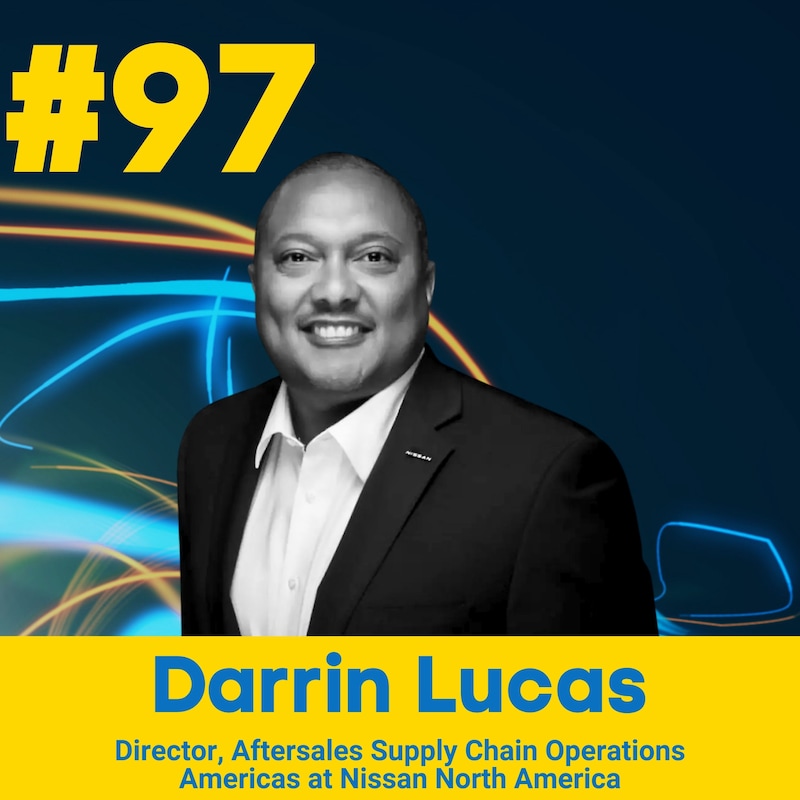
Name: Darrin Lucas
Title: Director, Aftersales Supply Chain Operations Americas at Nissan North America
About: Darrin is the Director of Aftersales Supply Chain Operations for the Americas region at Nissan Motor Corporation, where he leads strategies to optimize logistics and ensure the timely delivery of parts across the dealer network. With nearly two decades at Nissan, Lucas has played a pivotal role in strengthening supply chain resilience and driving operational excellence. Passionate about collaboration and continuous improvement, Lucas emphasizes efficiency, speed to market, and customer satisfaction as core priorities for Nissan’s aftersales operations.
Connect: LinkedIn
Episode Highlights:
[04:41] Where Loyalty Actually Starts: After sales is the part of the business that earns trust by keeping vehicles on the road through parts support, service, and warranty care long after the sale.
[06:50] Forecasting the Fix: Nissan is shifting from traditional demand guesses to AI forecasting and stronger supplier partnerships to keep the right parts flowing where repairs are needed most.
[08:43] Manual to Smart: Nissan is introducing AI forecasting, real-time dashboards, and new automation tools to replace manual after-sales planning and boost operational efficiency.
[09:24] From Hesitant to All In: Darrin admits he once doubted AI, but now pushes his team to embrace it fully as a tool that strengthens customer support and future talent development in supply chain.
[10:13] Collaboration Still Wins: Darrin credits better forecasting and open performance data as the foundation for trust-driven collaboration with suppliers, purchasing, and dealerships.
[11:07] Dealers in the Driver’s Seat: Nissan uses rotating advisory boards to test ideas, challenge plans, and give real service feedback before new after-sales initiatives roll out.
[12:57] A Culture People Return To: Nissan’s culture encourages employees to explore new functions, build cross-functional experience, and even boomerang back because empowerment makes them want to grow there.
[16:31] AI, Automation, and Going Green: Nissan plans to expand AI forecasting, automate distribution centers, adopt eco-friendly packaging, and build centers of excellence across the Americas to boost after-sales performance.
[17:25] No More “How We’ve Always Done It”: Darrin challenges suppliers to move faster, stay flexible, and break old norms so they can meet changing customer needs without hesitation.
[18:28] Unlearning the OEM Way: The industry must rethink daily dealer delivery models and learn to serve e-commerce customers with new expectations and faster final-mile options.
[19:35] Empower First, Measure Second: Darrin leads with family-style trust and balance, believing that when people are empowered, culture delivers the results KPIs never could.
[21:35] Leaders Who Think Ahead: He looks for people who challenge norms, plan beyond the KPIs, and drive improvement instead of repeating the same work without progress.
Top Quotes:
[00:00] Darrin: “After sales or service part is everything we do to support the customer after that initial vehicle sale. That's about keeping the vehicles on the road and ensuring the customers are confident in our parts availability, service support, and warranty care. It's where we build a trust with the customers, and we want that brand loyalty because we want them to come back to the brand again and again.”
[17:54] Darrin: “We have to be more dynamic, flexible, and adjust to our customer needs and adjust to the industry. I think we've had a lot of events over the last 15 to 20 years that've kind of challenged us from a flexibility perspective, and we're better for it, but I think we can even improve on that. With customer demands and trends changing ever so often, we have to be able to shift almost on a dime these days to make sure we're satisfying them.”
[20:23] Darrin: “Leading a large team as I do, across the Americas region, it's all about empowering my team. And I think it's key to our success, right? Without it, we can't service our customers. And I like to say I try to lead with balance. So that's operational excellence, sustainability, and team engagement. Because strategies only work where the culture brings it to life.”
Transcripts
[Transcript]
[:[00:00:27] Jim Liegghio: I'm Jim Liegghio from AIAG.
[:[00:00:36] Jan Griffiths: Hello and welcome to another episode of the Auto Supply Chain Prophets Podcast. Let's check in with my co-hosts. Terry Onica, what have you been up to?
[:[00:01:13] Jan Griffiths: Good advice. Jim, what about you?
[:I'm actually getting ready to bring online six new training classes next year. It was gonna be three, then it was gonna be two, and then I started doing some digging and I found four more. So, I'm really excited because I oversee the training department here at AIAG, and we're bringing on six brand new classes, open enrollment next year. So that'll be an undertaking, but I'm looking forward to bringing that to the industry. So, that's what I been up to Jan.
[:It just reminded me, you know, it's about dealing with the unexpected, right? And there's so much of that going on in the automotive industry today. How you handle disruptions, how you handle changes. How you wake up one morning, and there's a different tariff rate or there's a supply chain shortage, a chip shortage. You've always gotta keep on going.
But an area that we really haven't paid much attention to is the area of service parts. The OES tend to refer to it as after sales. The supply chain tends to refer to it as either service or aftermarket, and there is a difference between those two terms, I know that.
And so, I'm thrilled today that we are able to bring on the show an OEM. Somebody who understands the challenges and understands maybe more importantly, the opportunities of after sales and what that does for an OEM. And we are gonna dive deep into that subject. That's why I am thrilled today that we can bring onto the show Darrin Lucas. Darrin is the Director of After Sales Supply Chain Operations Americas at Nissan. Darrin, welcome to the show.
[:[00:03:41] Jan Griffiths: Are you excited bring the spotlight onto after sales?
[:I go back to my original origins when I started at Nissan, I transitioned over from the Saturn brand, and when I used to venture over to our manufacturing facility in Smyrna and I would explain to them, what division I work for and they're like, what? Who? Is that a part of Nissan? So it was a head scratcher to me because we play such an important part in the company, and at that time, very few people knew about it.
[:Before we dive in too deep, let's level set just a little bit here. How would you define after sales for our audience? Maybe take a minute to just kinda explain what that means from the insider point of view.
[:It's where we build a trust with the customers, and we want that brand loyalty because we want them to come back to the brand again and again. So, once again, like I said, a lot of people, they don't understand the importance, but it's not about just that initial purchase, it's the carry through, it's that lifecycle with the customer, and that's what we do at after sales.
[:[00:05:40] Darrin Lucas: Oh, absolutely. I'm over the America's region and I visit a lot of our different countries. I've just done a two week session, one week in Mexico, one weekend in Canada. And I was talking to one of my leaders or my sub directors there, and he was talking about visibility and I told him about supply chain, where that entity is. If we're doing our job well, you don't know that we are there, but when we start screwing up, everybody knows about us. So we wanna stay radar, 'cause if nobody's talking about us, we knew we were doing our job and we're doing it well.
[:[00:06:25] Darrin Lucas: Yes, about everything we do from our operational excellence, our advanced forecasting, we wanna make sure we have the right part on time, undamaged to the customer. You think about your customer's vehicle, that's a key component in their life and when something's wrong with it, it causes disruption and we wanna minimize that disruption and, everything we do. Is about delivering that part and building that trust and once again representing that brand.
[:[00:07:07] Darrin Lucas: It's funny you ask that, we're in a definite transition. Historically, we would use previous demand, seasonality to kind of drive our forecasting. Now, we're transitioning over into more causal forecasting, AI driven.
And when you think about supply chain with Nissan, we're broken into two pillars, right? We have our supply chain management and we have our supply chain operations. So we partner with our supply chain management team to make sure that we are transitioning and we have the right parts.
We build those relationships with our suppliers so we can transition from a transactional relationship with our suppliers to more strategic partnership so we can drive for operational excellence and parts availability to again fit our customer's needs.
[:[00:08:08] Darrin Lucas: I would say that's been an evolving partnership over the years, 'cause, historically, anybody that's been in the market, they know predominantly manufacturing or production gets that priority. And within Nissan, I would like to say, no, we've built a nice balance of making sure our suppliers know we work closely with manufacturing to make sure that we give priority to both after sales and production, 'cause we need to satisfy those customers that have already invested in our product and they're looking for that loyalty from Nissan as we suspect the loyalty from them as well.
[:[00:08:54] Darrin Lucas: We're transitioning into more AI forecasting, predictive analytics, and also trying to bring more real-time dashboards into our supply chain management. On the operational side is very interesting, 'cause when you look at Nissan, we do a lot of benchmarking versus our peers, and we're very efficient when it comes to operational perspective, but we're very manual. So we're trying to use a lot of new tools and dashboards to help our operational efficiency while looking into automation as we move forward.
[:[00:09:37] Darrin Lucas: Oh. I think if you had asked me that question long ago, I was very hesitant. But as I've seen the capabilities and what it can bring to the table to help us satisfy our customer, I am all in. As far as my team, I'm open for them to use it as much as possible. And with a lot of the challenges that we have in supply chain right now with growth and the complexities of supply chain, it is only gonna make us stronger. And we think about how we recruit our talent, how we develop our talent, and to make sure that they're able to maximize our usage of AI.
[:I mean, to do what you guys do. That's my question. You know, AIAG we're all about collaboration. And sure, AI, the technology piece is huge and it's on, we're burgeoning on the front of that, but what about collaborating with your suppliers, purchasing, and the dealerships? How do you make that all come together?
[:[00:11:06] James Liegghio: Is there a like a feedback mechanism from the dealership side? Is there kind of a reverse feedback from the dealer? I'm only asking this, 'cause I'm kind of new to the whole after sales thing and I'm very curious how that works.
[:They can tell us, whether they think this is gonna work, what changes we can incorporate? And even we go back and we do that PDCA after we launch initiatives just to make sure it's working as we planned. So, it's a very powerful tool. And not only that we have those advisory boards. We constantly change the members after a period of time to make sure we're getting fresh voices and fresh commentary back from my dealers.
[:[00:12:17] Darrin Lucas: So from a customer experience, when they walk into the dealer and they go into that service lane, you know, that first interaction, what we try to build is that, from our past knowledge of that customer, whether it be a first time visit or a second visit, we can look back at that historical data and look at what needs done to that certain care points for that customer. And all of that information is driven back to our what we call our DBS system that transitions that information to us and it helps us build our inventory at the dealer for that retail inventory management. And it also helps us build our trend and our forecasting moving forward so we can make sure that the dealer has the right parts available at the time of service when that customer walks in the door.
[:Let's go back to the beginning, you talked about your journey from being a packaging specialist and now you are a director for after sales. You can see the career progression. Why, Darrin, what's so magical about the culture at Nissan that you stay, because that's not typical in this day and age. What is it that keeps you there?
[:And all of my leaders throughout my career has always encouraged me to reach out and do more. And I was given that ability, that opportunity, and I took advantage of it. And it wasn't just, I was siloed in packaging, I was given the ability to delve into quality, delve into logistics, delve into operations. That was very important to me, and I think a lot of people see that. So, I think that's why you see so many people stick around for decades, if not their entire career. You also have what I call boomerangers. They all, you know, be with Nissan, they all leave and they come back, 'cause that culture is so strong here.
[:[00:14:58] Darrin Lucas: Absolutely, that's something we encourage, right? And don't be afraid to fail, you're not gonna be chastised just because you took a stretch assignment into another group. 'Cause what we find is, those individuals that rotate, they go and they take those stretch assignments, they become stronger leaders. They become stronger individual contributors because they understand the business more. And that's been very vital in our cultural development here. And I think we're still, to this day, pushing for that even more.
[:[00:15:38] Terry Onica: And I wanna add to that, we work with a lot of university and now even high school students, and I love to tell them that supply chain is such a huge field. And to your point, you can keep moving around. You start at one point, but all of us, it ended up someplace differently than what we really expected, so I love your story. And I'm sure a lot of our listeners who are university students will really take what you said to heart. And thanks for confirming that from your own experience as well, too.
[:[00:16:26] Jan Griffiths: Yeah.
[:[00:16:31] Terry Onica: Looking ahead in supply chain, at Nissan and after sales, what do you see are some innovations that are coming forward for you? It could be in technology, it could be other innovations, but what are you seeing you're gonna be doing in the future?
[:Even with some of the geopolitical changes in the automotive field, we still have those commitments there. And also, just other innovations across the Americas, right? We talked about aligning across North and South America and just building centers of excellence. So I think we have opportunities to create some efficiencies and operational centers of excellence across the America's region.
[:[00:17:37] Darrin Lucas: Let's find out how we can be more dynamic and flexible. That's the one thing that I see as we move forward. We have a lot of norms that's been in place for many decades, you know, how we've always done it is what you hear. About we can't continue to operate in that vein anymore. We have to be more dynamic, flexible, and adjust to our customer needs and adjust to the industry. I think we've had a lot of events over the last 15 to 20 years that's kind of challenged us from a flexibility perspective and we're better for it, but I think we can even improve on that. With customer, demands, and trends changing ever so often, we have to be able to shift almost on a dime these days to make sure we're satisfying them.
[:[00:18:41] Darrin Lucas: I would say unlearn the OEM way, 'cause I think all of us have very similar models. When we think about our final mile, how we deliver to the customer, the base of customer that we are delivering to. I think, historically, we've all been set up to distribute to our dealers and to their dealerships daily. But I think every OEM right now is working in partnership with our dealers to expand our e-commerce presence. And when you have that new evolving channel, we have to be able to deliver to our customers in a different way, in a different manner. That's a different expectation that right now that we're not fully ready to address, but we're evolving quickly to meet those customer's needs.
[:[00:19:34] Darrin Lucas: Absolutely.
[:[00:19:49] Darrin Lucas: Yeah. So, for me, we talk about culture and it started early on in my career, starting with the Saturn brand. I think that was the best opportunity I could have started with, 'cause that was such a unique culture and I've taken it on throughout my career. And I think, if you speak to anyone that's ever been on my team, whatever, and it keeps coming out. And when I talk to people, it's about feeling of family and culture. I empower my team. I think that's very important. I think I spoke on, from my perspective, I was able to do that within my career. So I definitely wanna do that with my team members. And leading a large team as I do, across the Americas region, it's all about empowering my team. And I think it's key to our success, right? Without it, we can't service our customers. And I like to say I try to lead with balance. So that's operational excellence, sustainability, and team engagement. Because strategies only works where the culture brings it to life.
[:[00:21:13] Darrin Lucas: Yeah, absolutely. Managing a large scale team like I do, and really at my level, I'm not digging into the weeds managing all the KPIs, but you have to trust and empower your people to do that. And when you do it, they take care of it because they feel empowered to do so. I don't have to micromanage, and it just comes through in the overall performance of the team.
[:[00:21:40] Darrin Lucas: Dynamic leaders like leaders that are not only gonna try to achieve and accomplish the KPIs, but also ones that are forward thinking, right? What's the next step? How can we plan ahead? Because if you're just doing the same thing over and over again, you're not really getting any better. You know, there's an old saying, "If you're not improving, you're getting worse." So, just leaders that are going to challenge the norms, understand what our vision is as a company and our brand image, and move forward from there.
[:[00:22:26] Darrin Lucas: Thank you all, and thank you for having me.
[:
