Shownotes
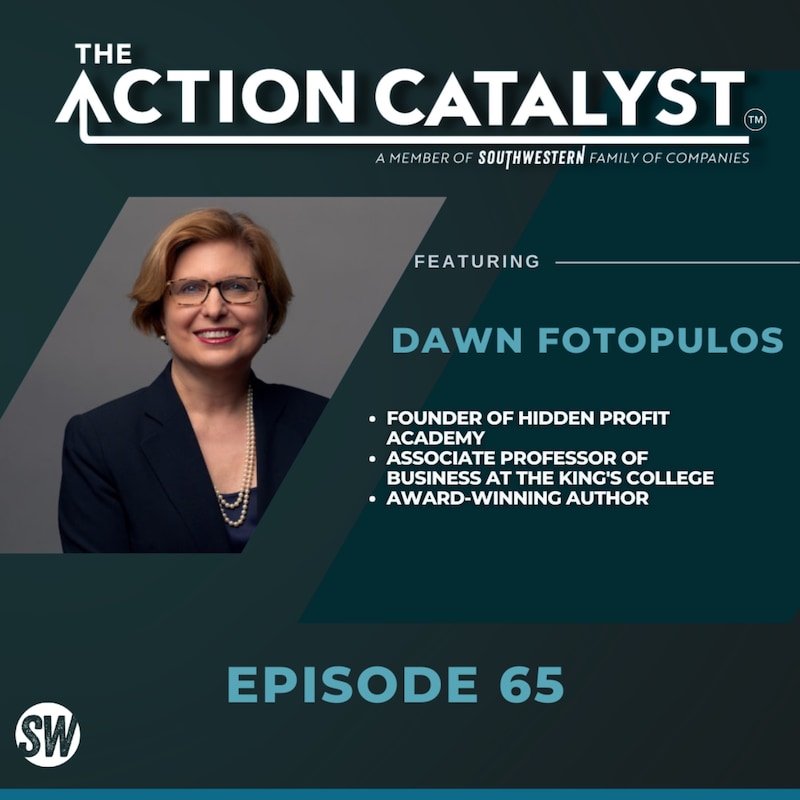
Dawn Fotopulos, Founder of Hidden Profit Academy, and Associate Professor of Business at The King's College, lays out the 3 financial questions to ask when running ANY business, what bankruptcy IS and ISN'T, the 3 main parts of a balance sheet, recognizing accounting yellow flags, and the importance of adopting a new mindset around managing your money.
Transcripts
PNL, or if you're an employee, the principles are universal. And she's an Associate Professor at of Business at the King's College, the thing that most impressed me about her, though, was a 20 year career in business as an experienced entrepreneur turning around small businesses, working as vice president at Citigroup, as a Wall Street trader, and she is the author of a book called Accounting for the Number Phobic, a Survival Guide for Small Business Owners, so Dawn, thank you for being here with me and all the other number phobic listeners.
Dawn Fotopulos:That was so great, great to be with you, thanks.
Host:A lot of small business owners just kind of say, Hey, I'm just going to hire somebody like an accountant or a bookkeeper. But you say, that's not really good enough. Why not?
Dawn Fotopulos:Well, here's the thing, do you drive a car?
Host:Indeed.
Dawn Fotopulos:So when we drive a car, would we ever close our eyes and put the car in gear and drive it with our eyes closed? Not a good idea. Well, I took a poll. I just want you to take a poll just to see if I was if this was accurate. 5000 small business owners over a period of five years, true or false, a net income statement and a P and L are the same thing. Guess what percentage out of those 5000 knew that that was a true statement? It was less than 1% so I'm saying, if they don't know that, they don't know how to read one but more importantly, what I have seen over and over again is that when these small businesses, first of all, even large businesses now, are really coming bumping up against, you know, limits and the failure rates are starting to accelerate, and there's a reason for that. But what's interesting is the reason this is such a big deal is because the way they get them so the way they think they're going to get out of the hole is by finding new
Dawn Fotopulos:customers, right? So if they can't pay the bills, they go, Okay, I'm going to go out there and I'm going to grow the business. I'll grow the business out of this really tough place. But if you're not making money right now and you don't know that, all you're doing is scaling an unprofitable business, you're digging a hole deeper faster. You're burning cash faster. So the whole idea of the numbers isn't so much about the numbers, but it's about reading the gages, you know, seeing the signs of what's going on in the business, so that you can make some course corrections, the right course corrections, before you really end up in a crisis. So, for example, you know, a net income statement. There's no magic here, right? It's money in, money out. What are you left with? That's really all it is. And when you're running a business, I don't care if it's General Motors or if it's the corner grocery store, you got to answer three questions. The first is, are you making money? And
Dawn Fotopulos:if you're not, what to do about it, right? But are you making money? Do you have enough cash to pay your bills? And are you building wealth or destroying it? In other words, are you building equity in the business or are you destroying it? And that has a lot to do with how much debt you have, how much debt that business is carrying relative to the asset base. But without making it more complicated than that, the first question, are you making money or not? Is important, because margins are very thin. If you run a grocery store, for every dollar you pull in, it's about a penny and a half. So it's really, really important that you know, for example, which of the products and services are really helping you drive the business forward. You know which of those products and services are really making you, making the business money and protecting the future, viability of the business. Then you also have to know profitability of that client.
Host:One of the things I think that a lot of people don't realize is that you can be you can be showing a profit and still be going bankrupt.
Dawn Fotopulos:That's right. Well, let's first understand what the definition of bankruptcy really is. The definition of bankruptcy is running out of cash. And small businesses do this every day. And Bear Stearns did this too. Bear Stearns was showing a profit the Friday before the Monday that they declared bankruptcy. Okay? So running out of cash or sources of cash is the definition of bankruptcy, and that the challenge with just reading your your profit and loss statement or your net income statement, same thing, right? Is it just shows you based on sales, based on expenses. What? You have left over. And a lot of times, revenues don't necessarily translate into cash into the business. So if you're in a service business, for example, there's going to be a time lag. You offer the product or service, and then you bill for it, and then you don't get paid until 30 days. 45 days, one can only hope, right? So there's a time lag when the cash actually comes in versus when
Dawn Fotopulos:you actually book the sale. And that's what's really important to not just understand the net income statement, but the cash flow statement. So sometimes, you know, customers take discounts and what you booked in sales doesn't actually get realized in cash, because they take the 5% or 10% or whatever it is. So there is a relationship, certainly, between the net income statement and the cash flow statement, but they measure slightly different things the same way that when you go to a doctor, the doctor is going to check various vital signs, because, for example, even though you show a pulse, it doesn't tell the doctor if you have diabetes, for example, right? So each of these different statements, and there are only three that I'm advocating everybody understand, the net income statement, cash flow statement and the balance sheet, because they will give you a 360 degree view, sort of like the global positioning satellite for what's really going on in the business. So
Dawn Fotopulos:the cash flow statement is going to measure exactly how much cash goes out the door, and it will also tell you how much cash is left over to pay future bills. So instead of sort of crossing our fingers behind our backs and praying we have enough cash at the end of the month to pay for the lights, you know, in the rent tomorrow, we can actually plan for that. And one of the things in chapters five and six of my book, I talk about things like invoicing policy and collections policy. And it is astounding to me how it's not a focus, or it's, it's, it's not even done well that is sending out invoices after you finish doing a project, sending out invoices after the goods have shipped. It's astounding how few businesses really do that have good business discipline around that, or have good business discipline around collecting on outstanding invoices. So I have to tell you a funny story. I had a seminar called I Hate numbers, accounting for the number phobic. No joke,
Dawn Fotopulos:that's what we called it. And I had some women's Presidents Organization people in the room. So these are multi million dollar businesses. And after I talked about things like, you know, collections and why collections is so important, one woman jumped up and she said, Are you kidding that it's that easy if I just go out and just like, ask to get paid? I said, Well, you have to start that way if you expect somebody to take payments seriously. She said, I've got $75,000 in accounts receivables. I think I'm going to go call those clients. I said, that's a really good idea. And let me tell you one other thing. You know, I had an interview with Norm broski, and he's a very successful entrepreneur, and he said most of the people that he knows that either go into their businesses or were people that he coaches are, in fact, salespeople. And he said sales people need to understand payment policies, and they need to be negotiated. When you pull the purchase order,
Dawn Fotopulos:you need to talk about payment policies and collections policies at the outset of the conversation, and not three months or six months down the road. And he said something that was also very interesting. He said, You know, I got to the point where I didn't pay my salesman commission until the business got paid. So I made my salesman responsible for the clients paying us that they were not off the hook after they just pulled the PO. I thought, Whoa, that's different.
Host:So talk to me about the balance sheet for a second, because I would say, what should they be looking for to kind of get an understanding of the current state of the business?
Dawn Fotopulos:Yeah, it's a good question. The beauty of the balance sheet is that it's a catcher's mitt. It basically collects a cumulative total of everything that's happened in the business from the day the doors were opened. So what it really is is a net worth statement. So you and I have net worths in our personal lives, right? We own things that have value, and then we also owe money. Let's assume, you know, on a mortgage or whatever, and if we own more than we owe. We have a positive net worth. Well, it's no different in a business, and it doesn't matter what size the business is. So you have really three sections on a balance sheet. You have assets, which are things that are that you own, the title to, as a business has title to. These are things that are cash or convertible into cash. And then you have liabilities, if the business has credit lines or loans that are outstanding, then those are, of course, things that have to get paid back. So those are, those
Dawn Fotopulos:are things that are owed. And then if you just take the difference between those two, you end up with owner's equity, or basically net worth. And one of the things that I speak to sir. Only small and medium sized businesses about and owners about is you want to build your asset base as quickly as you can, as large as you can, so that you actually have a business that is saleable. I mean, are we at this for 10, 15, 20 years, killing ourselves, making all these sacrifices, and then we have nothing to show for it. You know, after a few decades of taking all that risk, well, why did Instagram sell for a billion dollars? Because they built a huge asset base, which was basically their client base that they were able to leverage for Facebook. So, you know, are our businesses only worth? What the breakup value of the desks and chairs and computers are, or can we actually build something that has a terminal value that we can sell to the next generation? And I would argue
Dawn Fotopulos:that the balance sheet, if we have a strong balance sheet, and we position our businesses for sale, that we actually can sell these businesses, even service businesses, can be sold. So the balance sheet becomes very important, because investors and bankers are going to scrutinize the balance sheet and and you know, that's the first place they're going to go. So chapter eight of of number phobic, basically, it's called How to Win Friends and Influence anchors, because I sat down with a senior vice president of one of the big banks here in New York. And you know, as a former banker, I speak her language, but she opened up a whole nother world for me that even I didn't know. And she said, This is how we look at businesses. This is why we approve loans or don't approve loans. These are the things that you shouldn't do if you are an independent contractor or or a business owner when you're applying for a loan. These are the red flags we look for, but these are the things that
Dawn Fotopulos:are also very positive in your favor. And so we're we want to make the readers of the book kind of ultimate insiders, so that they really position themselves as as strong as they can when they speak to their bankers, and frankly, make your banker a collaborator. You know, part of the challenge is, you know, if your cash is a million, but you owe 5 million, what do you do about that, if you've got that kind of a gap? And one of the things that Brodsky said, and I never heard anybody else but him, say this, he said, if your current assets minus your current liabilities is negative. It's a sign you're going to go bankrupt unless you do something about it quickly. And I thought that was very interesting. He said, Because anybody can call a current loan right away, anybody, any bank, any investor, can do that. So then the challenge becomes, how do we fix it as we start to see some of these signs. So the first question is, do you see the signs in the yellow flags? And the second
Dawn Fotopulos:question is, do you know what to do about it when you see them? And so what we try to do in the book, through all the stories that we have in there, and through some of the funny illustrations. By the way, my illustrator worked for Disney for 20 years. So we decided we were going to take an accounting book and make it funny. You know, the idea, of course, is to teach people the basics and to say, Okay, if this is off the rails, here are three things you should think about doing that might help it get back on the rails. So whether it's profitability or cash flow or net worth, we've got those strategies in the book so that we don't leave people hanging either.
Host:And so last little question, and the time always flies by. What is the first thing that somebody should do to get a handle on their numbers?
Dawn Fotopulos:Yeah, the first thing you have to do is you got to change your mindset. You really have to change your mindset. And you you've got to say yourself, I can really understand this. This is not hard, but I've got invest probably, you know, a couple of hours a week, or maybe over a month period of time to really wrap my mind around this, because I can work half as hard and make twice as much money. And if this little hurdle, and it's a little hurdle, when you really break it down, and we we have in the book, you know, why wouldn't you want to do that? Why wouldn't you want to make that investment, have the discipline so you can get to where you want to go? And this is a really small sacrifice. I know people that have been banging their head against a brick wall for years. They read the book and they go, Holy cow. Why didn't I know this 12 years ago. So the first thing you have to do is change your mindset. The second thing you have to do is take it step by step. So I
Dawn Fotopulos:would argue with the folks you know, a thermometer doesn't teach you how to dress in the morning. It doesn't tell you how to do that. You had to learn how to interpret what the thermometer is telling you, and that's all we're really doing with this book, is just show you how to read the thermometer for your business or your Financial Dashboard for that matter.
Host:That's awesome. Well, Dawn Fotopulos is her name, Dawn thank you so much for being here. It's great. Great. Great having you.
Dawn Fotopulos:Thanks a million.






