Shownotes
Transcripts
Why are there so many Jewish comics? Well, I guess part of comedy is irreverence and part of irreverence was because the Jews lost their God. My generation has no God at all. That's truth. And the Jews that go to shul go with respect for the parents.
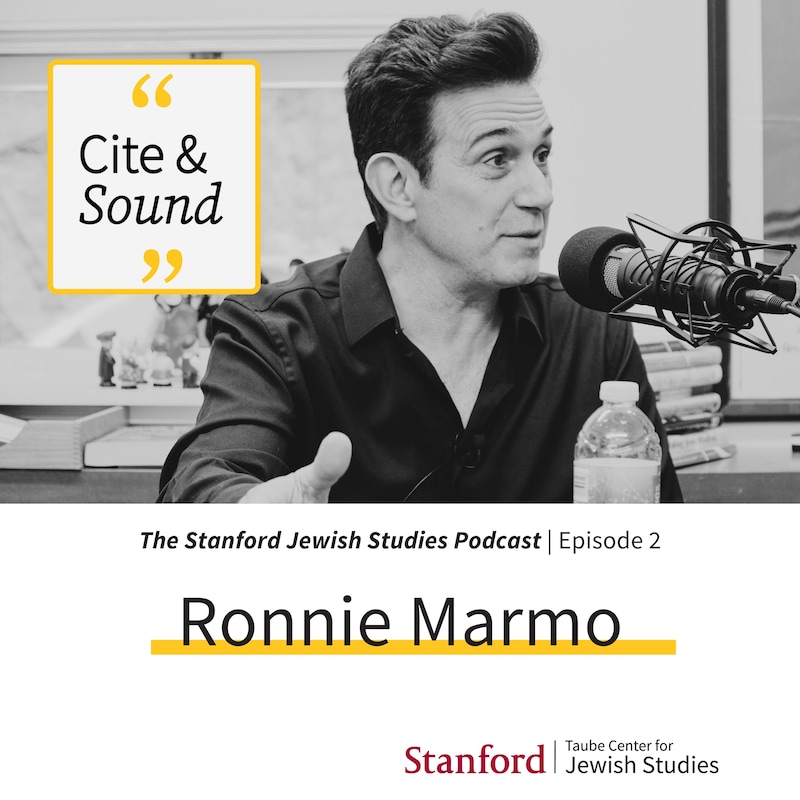
Shaina Hammerman:That was notorious standup comedian Lenny Bruce riffing as he often did on the differences between Judaism and Christianity. When is this reverent joke offensive and what are the limits of free speech? How can we understand the relationship American Jews have with freedom of speech? I'm Shaina Hammerman, the associate director for Jewish studies at Stanford. And this is Cite and Sound, the Stanford Jewish Studies Podcast. Here we host conversations with scholars and artists as we explore Jewish scholarship, culture, and history. Listen to the voices shaping the Jewish studies conversation at Stanford University and beyond. On today's episode of Cite and Sound, veteran actor, director, producer, and writer, Ronnie Marmo joins us to discuss his one-man bio-play called, “I'm Not a Comedian, I'm Lenny Bruce.” Ronnie talks with Dr. Vered Shemtov, the faculty director of the Taube Center for Jewish Studies and a literary scholar to explore Jewish storytelling, comedy, and how Ronnie finds his voice through Lenny Bruce. And now, the conversation.
Vered Shemtov:Ronnie, welcome to Stanford. It's great to have you here.
Ronnie Marmo:Thank you so much. This is fantastic.
Vered Shemtov:You have a relatively new show about the comedian Lenny Bruce. Can you tell us who was Lenny Bruce in your view and why did you feel drawn to him?
Ronnie Marmo:Lenny Bruce was a comic. On the surface, he was a comic. He was so much more than that. But in the 50s and 60s, And he fought freedom of speech all the way to Supreme Court and he lost. He was the last person to be arrested for word crimes on stage in this country. So he really paved the way for comics, you know, all the way down to Dave Chappelle, even Jerry Seinfeld, you know, all the great comics, clean, dirty comics, whatever. Lenny really paved the way.
Vered Shemtov:Okay. Well, we'll get to back to Seinfeld later. But for now, I wanted to ask you if you could share something about the creative process behind the play.
Ronnie Marmo:Well, it was an interesting journey. About 15 years ago, a friend of mine came to me and said, do you know who Lenny Bruce was? And he's an old school comic, and these great comics that I get to hang out with, they let me have lunch with them, they're all in their 80s and 90s, and they made a great living doing it. And I said, well, I don't really know exactly who Lenny was. I know his name, but he was before my time. I grew up on like Richard Pryor and George Carlin and that. And so he said, you remind me of Lenny. And I said, really? And he said, yeah. He said, there was this play written called “Lenny's Back and Boy Is He Pissed,” which was the title, it was funny. And he said, I want you to do it I'll direct it. And I was like, listen, Lenny Bruce at this point would be in his eighties. I don't know, his friends are still alive. Like, I don't know if I want to do that in Los Angeles. Well, two years it took him to talk me into it. And then once I started to do my homework, I really fell in love with this guy. I identified with him on so many levels. And so I did the play, it ran for six months. Big hit, big success. Five years later, I did it again, ran for another six months. But then I woke up one day and I thought, well, this is a really nice play, but I feel like in some ways it was a safe version of Lenny Bruce. And it wasn't really, I was missing some stuff. And so I set out to write my own and that was seven years ago. And so...That's how it all kind of came to be. And when I started to study Lenny, I realized his story is more important now than ever.
Vered Shemtov:And was Kitty Bruce, Lenny's child, involved in the production?
Ronni Marmo:Yes, Kitty was involved in many ways. I wouldn't say the day-to-day writing of the script, but she gave me lot of information that people didn't know. And so that's what's cool about the show…if you are a Lenny Bruce fan, you won't find a third of this play on Google. You won't be able to find this information, private stories. And Kitty, you know, it took her a year to see it because she was worried about seeing it. You know, she was very close to her dad. And so she finally came a year into the run, sat in the front row with Joe Montegna, which I was like, oh my goodness, she's in the front row. It's stressful, you know. But then, you know, we shared a hug after the show that felt like very cathartic for both of us. So Kitty's been the biggest supporter and in fact, she said publicly it's the greatest portrayal of her father she's ever seen. So to me, it's like, that's the biggest thing.
Vered Shemtov: Ronnie Marmo:It's interesting you say that because the other portrayals I've seen of Lenny Bruce, a lot of times, not all of them, but a lot of them feel like they lean into the angry, bitter guy at the end of his life, or they do a caricature of Lenny, the idea of Lenny. And I really wanted to make him a human being and really lean into the truth of this guy and his family and who he was and how vulnerable he was. I wanted to play him as a real person just to make him more…have people identify with him. And I feel like if you're doing a show about Lenny and you play it one-note the whole time, I could see you not identifying. But the way I do it, I feel like every audience member, if they come with an open heart, can see themselves in the performance.
Vered Shemtov:I once heard someone say that profanity should be the seasoning, but not the main dish. Is that true about Lenny's work? And if yes, what do you think is the main dish?
Ronnie Marmo:What's the main ingredient? That's an amazing question. Y’know, Lenny used to always say like, there's no dirty words, only dirty minds, you know, it's the intention of the word that makes it so. I think Lenny, I think he wasn't a comic for shock value, but I think some people put him in that bucket. But I think the main dish was him being authentic and speaking truth, his truth.
Holding a mirror up to society, dealing with the taboo subjects at that time that people were afraid of. They're still afraid of some of those subjects, which is a little scary in itself. So I'd say the language was maybe in some ways his way of cutting through, but I don't think he ever sat home in the morning going, okay, tonight on stage, I'm going to say this dirty word. I think he was just very authentic and he just was who he was and I think the main dish was trying to get to a point, make us think, make us consider things and I think that's why he was so important. So the language, even today sometimes, when we book the show around the country people go, Lenny Bruce, I can't do Lenny Bruce in my theater. I go, no, no, you can. The more conservative the audience, the more excited they are about the show, I promise you. And I think people have a stigma with Lenny, but that was 19…I mean, you put on the news, you hear worse. I'm hearing language on the news. I'm like, oh my goodness. anyway. Things changed. Things changed in some ways, but Lenny has this reputation even today of being like, oh, I don't know if I could have that play in my theater. I'm really proud of the JCCs because they don't seem to have that issue at all, which is a whole nother subject I realize. So, so yeah, it wasn't about the cursing.Occasionally he dropped a curse word, but that wasn't his thing. The main course was holding a mirror up to society, I think, and making a point.
Vered Shemtov:The JCC in Palo Alto is going to hold the show this weekend.
RM
Yes.
VS
And were you surprised that Jewish venues were interested in the show? Did you expect it?
RM:No, I did not expect it. In fact, so I usually tell a joke. say, you know, when I wrote this play,I really thought I would be touring up and down Florida the rest of my career because you get the older folks down there who moved to Florida, they know who Lenny was. And then the Marvelous Mrs. Maisel came out, the television show, and they put Lenny Bruce on the map for this new generation, at least his name and the idea of Lenny. And so what happened, how the JCCs came to be was nothing I planned. You remember Ed Asner, the great actor, Ed Asner? He's a friend of mine.
And one time he saw the play twice actually, and he said, I'm gonna call the JCC in Rochester. The guy Ralph, he's my friend. You're gonna do it there, we'll do it there. So I guess his daughter reached out to Ralph for us and long story short went up to this JCC in Rochester and the Buffalo JCC had us at the same time, the same week we did all the shows, eight shows over a week. And then all of sudden the phone started to ring because I guess they sent the message out to their listserv saying, what an incredible production, you know, they're good people. Lenny Bruce was proud to be Jewish. And so it was really a gift that fell out of the sky because we thought we'd just be pursuing traditional theaters and to end up at all these JCCs. I don't know how many we've played now, but over a dozen already and we're just getting started. So I'm really proud of that. And I think it's cool.
VS:I just finished reading the autobiography, Lenny's autobiography. And he was proud about being Jewish, but there isn't much in the autobiography about his Jewish identity. I was wondering how important it was for you to include that in the show. And how did you go about thinking about him as a Jewish comedian?
RM:That's funny. First of all, How to Talk Dirty and Influence People, That's the the book, right? I don't know if you know this, but I'm the voice of the book. I did the audiobook, which was a huge honor to ask me. So I read it like Lenny, you know, I'm doing like Lenny, man, you know, so I read the whole book as Lenny. So that's fun. Anyway, little plug for the book. You know, as far as Lenny's Jewishness, I kind of just, as I read the book and as I did all my homework and study, I said, he's proud. I mean, he wasn't outward about it, but he was proud to be Jewish. So he threw in a lot of Yiddish in his bits and I thought, well, wow. So again, back to the comment about touring up and down Florida the rest of my career. I'm like, okay, I think some of the older Jewish folks would dig that. They remembered Lenny. I think they would get a kick out of some of the Yiddish he used. So let me try to put that in the show. But I didn't realize when I was writing it, just how important it was. He had a funny bit and I'm going to botch it right now because I don't do it in the show, but it was a bit about, um, he, said, “Lenny, what are you going to do? You have a tattoo. You can't be buried in a Jewish cemetery.” And he said, “well, just cut off my arm. The goyim will bury anything. Put that in that cemetery and then bury me with the Jewish people.” Something like that. So that was typical Lenny. And in fact, that bit itself, people found that so offensive that he wasn't able to do it on television. They said, “Lenny, you're going to offend the Jewish people and the goyim.” So he couldn't do it. But in terms of that, just thought that adding the Yiddish authentically from what I heard Lenny talk about. It's so funny when I'm doing this show now and I say farbissene [sour] and some words, you know, I say a couple of, I can always tell when the audience gets crazy and I'll usually ad lib and say, “oh, we've got a bunch of Jews here tonight, fantastic.” And so just to know, like, I didn't realize what a hero he was to so many Jewish folks, but having been on this journey, it's been, how do I say, it's been uncovered and revealed to me as I've gone on. wasn't something I sat down…When the first time I approached the script, it's been revealed over time just how important that was. So it's really great.
VS:Jewish humor is often seen as involves self-deprecation and embodies the idea that humor is the weapon of the weak. I think the last time I heard it was from Etgar Keret, an Israeli author. But Lenny Bruce doesn't strike me as weak. He's also not Woody Allen or Seinfeld. Instead, his humor seems to come from a place of strength, a clarity of vision that allows him to articulate truths as he sees them. You worked so closely with his material and know him better than I do. What do you think?
RM:I think you just said it. His, uh, I think Lenny definitely was not weak. He was certainly at the end of his life, a beaten man. He got beat down, never weak in that. I feel like he always punched up and never down on people. So, you know, he definitely was not weak, but he put himself in situations that most people weren't willing to at that time. And I think here's the best way to say it. If you find Lenny Bruce, on your own and you try to sift through whatever you could get your hands on, Google or whatever you could find. You might miss his magic. And I think what made him special is he was trying to find his voice in front of the audience constantly. He didn't sit home writing jokes. That's why in some ways I'm very lucky because you'll never see him do the same joke the same way twice.
So when people say, oh, he said this line, I go, well, not in this version. So it gives me a little bit of leeway, you know? So I think, I think what made Lenny strong was that he was very vulnerable in front of an audience and would just get up and try to figure out his thoughts. And he had a funny mind. And so he was a funny person. He could look at that table and see that funny somehow, but, but he actually had a bigger mission. And that was to, you know, try to influence and affect society in a way that people were scared of. So, self-deprecating, I think he at times, he was in his humor, but most comics I think end up doing that. When you poke fun at yourself, you make it more available for everyone watching. You know what I mean? So he did a little bit of that, but I think that was more in like good fun as opposed to weakness.
VS:Yeah. So more of the social criticism.
RM
I think so.
VS:Would you like to say something about that? And maybe where does it meet you? Which issues were important for you that were part of also of Lenny's kind of world?
RM:Yeah, you know, it's interesting. It's like, I think back when I started this journey and at that time I didn't agree with every single thing Lenny did when I started to write this. But today I couldn't tell you what those were. Because I always say nobody wants to see acting and so I give my heart over to every performance I give my heart over to. \..So when you're fighting for someone on stage and you're really, I feel like I'm kind of trying to finish something Lenny didn't get to finish, for him. I'm not just doing a show, I feel like I'm here to represent something for him and say, I got it, I'm gonna keep going for you. And so seven, eight years ago, there were definitely differences. Today I couldn't tell you what they are.
My heart doesn't know, so we've come together. I'm just proud. You know, in some ways I think he would, we've regressed as a country in a lot of ways in society. In some ways we've regressed and in many ways we've progressed. In some ways we've regressed. You know, it's, on a personal note, you know, I identify his feelings about his mom, about his daughter. I have the same feelings for my daughters and my mom. We have a very similar relationship.
But in terms of society, I am just proud that he spoke truth to power. I mean, freedom of speech was the obvious first amendment and that was what he fought for. But he just fought truth to power and always tried, you know, never punched down. And I feel like I'm that way, or at least I'd like to think I am.
VS:So this is what you would like the audience to take away from the show besides, you know, being exposed to Lenny Bruce?
RM:You know, it's an interesting thing. I mean, I always believe theater has the power to move people and change people. And I think I've seen people walk in a certain way and leave a theater two hours later, changed in some ways, even if it's slight. But with this show specifically, you know, Lenny has such a stigma about him. And I just want people to see that we have to have more conversations. I think the show really opens up a conversation on both sides. I mean, politically, this country is in big trouble right now, as we all know. On both sides, it's just getting crazy. And so I just want people to feel like, wow, I'm so glad I came. I'm glad I had that experience. I learned something. The biggest compliment you could give me is that you went home and googled all the players and wanted to know everything. That's the biggest, y’know… Patti LuPone is one of the great actors who came and saw the show and that's what she told me. She's like, I went home and I couldn't stop thinking about everybody. Lenny's wife, Honey Harlow and Kitty. And so that's the biggest compliment. So I would say, you know, it's a very powerful show. And if I'm stepping outside and looking at it, you know, it's powerful. And I feel like many people reach out to me weeks and months later, say, I'm still thinking about it. And I think that's really important for theater to do something meaningful like that. I just hope people feel like it's time well spent.
VS:Well, I can't wait for our students to see it. I asked you what inspired you in Lenny, but what do you think inspired Lenny?
RM:Well, Lenny was asked that question and he said, if you get the autobiography, you'll see the very last paragraph of the book. He goes on, he talks about lots of random things, very funny at times and some, you know, not so funny.
But at the end he said, that's a silly question because I'm inspired by basically every moment and every waking hour. This is inspired by everything. And so I think as human beings, I know I can relate to that. It's like some things are obvious and they hit us over the head and we're like, I'm inspired by that thing. And other things just kind of seep in nice and easy and you don't know it even happened. And then suddenly you're having a conversation with somebody and you regurgitate something that you heard. so I could relate to that. I'm inspired by when I'm open and available, I'm inspired by everything.
VS:I actually, remember that from the end of the autobiography and it stayed with me, but it's good to hear it again.
RM:It's very funny and a little over the top, but it's really great. know, what an answer.
VS:Yeah. Amazing answer. I don't often get to interview actors and I wonder how do you bring yourself into it and present somebody else at the same time? How can you be you and Lenny at the same time?
RM:Well, it's an interesting question actually. I often say with this face, my career has been a lot of, know, “Vinny put him in the trunk.” You know, I play a lot of mob guys and a lot of cops. And “Mr. You forgot your pickle.” You know, I play that guy at the deli. So to do this important work as Lenny, I do believe with every actor, some of those roles, know, “Sarge, phone call!” you leave it at that. Some of those roles are hard to really find, you know, to go beyond and really do the work. But as an actor, and with Lenny Bruce specifically, it's like there comes a time when you have to kind of meet in the middle. I'm the type of actor that works from inside out.
You know, how does he talk? How does he walk? I don't imitate Lenny because I found it all so authentically. I had listened to tapes and maybe sounds like this. And suddenly this energy came out of me. And so, but when I'm talking about my mom on stage, Lenny's mom, the doing the part about the mom or his ex-wife and the troubles or his daughter, I believe as an actor, you have to find all of that within you.
You ever see an actor act? You're like, oh, I don't want to watch that. But, you know, I really believe that an audience doesn't come to the theater to see me or Lenny. They come to see themselves in me. So if you think back on that and you think of the greatest performances you've seen, whether it be theater, film, TV, there's an identification and somehow it goes under your ribs and touches your heart. And you're like, oh, What's that about? That's because they're portraying something honestly and authentically. So I believe the work starts for me inside. And to do somebody like Lenny, it's pretty wild because, you know, as an actor, you really hope, I know I'm in a very small percentage of actors that A, get to make a living at this, but also to find a piece of work as an actor that is so important to me. And it turns out so important to so many. That's like, I mean, that's lottery stuff, you know? And so, yeah, I know it's a long-winded answer, but I love talking about acting. I mean, it's very important. I mean, normally when I discuss Lenny, those questions don't come up.
VS:Was there a moment in the performance or when you wrote it that you wanted to change a line or a word that Lenny said?
RM:Sure, all the time. That's the thing about Lenny is that he said things differently every time. So I kind of had that little bit of permission, you know. I don't take that for granted and I don't do it that much. In fact, Joe Mantegna, the great actor, is my director. And Joe Mantegna, you know, he's like, stop changing the script because I can't help myself, you know? But when I'm on stage and I'm having a moment and it's really, and I feel like the audience is in step with me, they're really present, something new will, sometimes something new will come up and I go with it. I follow it, you know?
VS:Yeah. Listening to you makes me think about praying because you go to synagogue and you repeat the same prayer, but you perform it differently every time. And you sometimes want to change the word, but you stick with it and say differently.
RM:That's so cool you said that. So here's the thing, I love what you just said, because sometimes I say the same words over and over. I mean, I've done three, 453, this week it'll be 453 performances of this 90 minute monologue, the same monologue. So like you say in synagogue, you say, and I grew up a Catholic, I was raised a Catholic. And so, you know, you say the same thing over and over, but I think the trick is, is to be exploring it each time. So it might sound exactly the same to an audience, but I'm having authentic experience like praying, right?
It's like, if you start to go by rote, then maybe there's a disconnect with your relationship with a higher power, or God is a disconnect because you go, okay, this is when I stand, this is when I kneel, this is when I sit, I stand, I kneel. And then it starts to feel like calisthenics as opposed to some sort of relationship, right? But if you could explore yourself each time and be present to that moment, even though the words are the same, I think maybe that's when, that's when it's authentic. That's when you connect with the audience. I think that's the difference, yeah. Because a savvy audience, you can't fake them out. You can't. I mean, there's been a few times I've gone on stage and I was like, I got this. I got this. I'm good at this. And within 10 minutes, I fall right on my face. It's not good. It's when I'm vulnerable and I'm afraid. When I'm not feeling that like, oh no.
My wife will tell you, and Courtney, my stage manager, often I'm like, I don't want to do it. I'm not going out there tonight. I don't care that there's 500 people. I'm not doing it. Because I don't want to. Then those are the nights where the magic happens because I'm available.
VS:What do you think Lenny would say about the state of comedy now? What would be Lenny's influence on today's society?
25:26
Well, I think he'd be disappointed that, you know, comics are afraid to do the material that they want to do, people are now sitting home writing, trying to figure out jokes that won't offend as opposed to just being authentic and whatever that means. You know, we're in a woke generation now in a woke culture and, and you know, I personally feel like, and I believe Lenny would too, I feel like Lenny and I are hand in hand in this, that comedy clubs need to reclaim their place as free speech zones. And if you were offended, don't buy a ticket. I think there's an audience for everybody. And I think if you don't like it, don't go. It's really that simple. But people don't make it that simple. Everybody wants to fight, you know, have a cause and, it, y’know, freedom of speech for thee, but not for me, you know, or freedom of speech for me and not for thee. You know what I mean? So I think that's how people feel. So I just wish people would go back to, uh…It's going to start with the comedy club owners having the courage to book the Chapelles and the Bill Burrs and all these guys. And then the comics not being afraid. I don't believe in mean-spirited comedy. Don't get me wrong. There's a difference. I don't like when you punch down on people. But when you have Jerry Seinfeld being booed and booed at a college… Jerry Seinfeld one of the cleanest comics we have…then this country's upside-down. I mean, this guy's, he's one of the greats. And so, you have no idea how excited I am. And I realized a lot of people tell me it's a risk to come do a show at a college to do Lenny. And I want that opportunity because I want, if I'm a part of a conversation with students that is bigger than what maybe they had anticipated, then that's what I want. And I've had lots of...
My old manager used to say to me, don't bring the show to college, just please. And I'd be like, no, that's the point. And what am I doing? I'm putting tape over Lenny's mouth again and mine.
VS:It's crazy that in order to speak about free speech, we need to bring back people from the past.
RM
Isn't that wild?
VS
Yeah, comedy from the past. Is there anything that I didn't ask you and that you would like to add?
RM:Y’know, that's, listen, we could talk about this for 24 hours. I mean, that's a really tough question. I think, I just want to see people start to think for themselves. I used to have a bit in the show that I've taken out. I don't know how much you know about Lenny or your audience will know about Lenny, but there was a famous bit he did about the N-word. Okay? You could look it up. You'll see Lenny did a whole bit about the N-word. In fact, he offended everybody. That wasn't the only, but obviously that's the word. That's the worst of them all, right? But he offended everybody. And it was in the show for years. And I used to do it like nine minutes into the show. And his point with the bit was he thought in the 60s, he's like, well, if we could just say the word enough, it'll lose its power and it won't make a little Black kid go home crying from school today. So his heart was beautiful. He had great intentions saying it.
It played really well in African American clubs. They loved him, they got it. In many ways they would say, Lenny's the voice of the Brown and Black people and we need him. He really stood up for people. And I did it in the show for about three years. I did it for a year in New York, a year and a half in LA, six months in Chicago. And it was scary because every night I'm on stage and people are staring at me like they're gonna kill me. I'm like, oh my God. But I understood where I was going with this bit.
Well, then the whole thing happened with George Floyd and the pandemic. And then I just couldn't do it anymore. And so I talked to Kitty Bruce and Joe Mantegna. I was like, listen, I think I'm going to remove the bit for a while. I just can't sleep at night. And, uh, and they were like, thank goodness. Thank you. Thank you. They were like, relieved. And so people were like, well, you're selling out. You're selling out. Lenny wouldn't remove the bit. No, no, you know what? He would remove the bit because Lenny was a smart person and you can still be authentic and do this show and not be tone deaf to the world we're living in. I was so afraid that people would encapsulate the two minute bit as all of Lenny Bruce rather than hearing the other 88 minutes. And so I took it out and I thought I would miss it as a playwright. It was scary because eight minutes into the show when I do this bit, it was so shocking that people wouldn't move a muscle the next 80 minutes, not a muscle, but I realize that that's not everything and Lenny had a lot to offer and not just that routine. We talk about people selling out or being afraid to do their comedy or go to comedy clubs and do what they authentically want to do. I don't put that in that category because for a lot of people that just felt mean today, not 60 years ago, but today. So I just want people to start being authentic and think for themselves, you know, not put everything through a filter system that we've been provided. We think we're supposed to.
VS:We usually at the end of the show ask people to share with us a Jewish text or any text that they find meaningful and relevant to our contemporary moment. And we thought maybe we will ask you to share with us a routine from Lenny Bruce and from maybe the show.
RM:Okay, I'll do it.
VS
Thank you.
RM:You're welcome. Normally I don't because I'm always like, out of context, people won't get it, but I'm excited about it. So here's a short one and a pretty typical, this should give you an idea of Lenny's mind. So, and what got him in the most trouble are bits like this, with no curse words.
[As Lenny] Dig this man. If the bedroom is dirty to you, then you're a true atheist. If anyone in this audience believes that God made his body and your body's dirty, well then the fault lies with the manufacturer. You have a body that God made in his image and now you want to judge some parts as good and some as bad. No man, I don't see any reference to that in the Bible, man. Yeah, if God made it all, it's either all clean or it's all dirty.
he got arrested in Chicago in:And that was like, you know, and people, you know, and it was a joke. But so anyway, that's pretty typical, Lenny.
VS:Wonderful. Thank you so much. This was a real pleasure and I'm looking forward to the show.
RM:Thank you so much. Thanks for having me.
Shaina Hammerman:Today's episode was produced by me, Shaina Hammerman, along with Iva Klemm and Adam Jacobson. Sound designed by Romi Chicorean. Original music is by Jeremiah Lockwood. Cite and Sound is a production of the Taube Center for Jewish Studies at Stanford.

