Shownotes
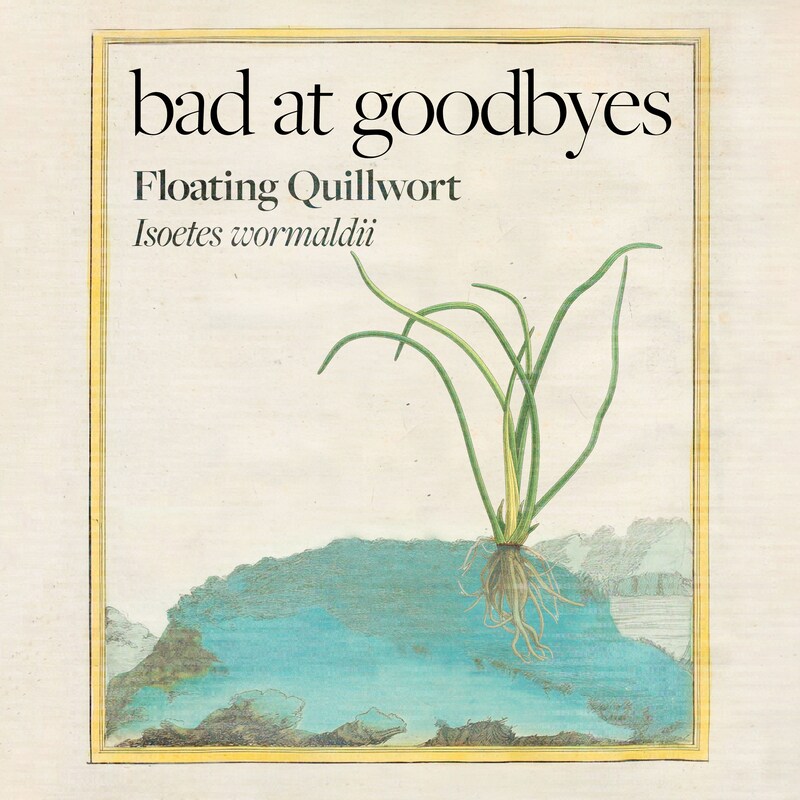
Floating Quillwort :: Isoetes wormaldii
Bad at Goodbyes :: Episode 076
On today’s show we learn about the Floating Quillwort, a critically endangered freshwater semi-aquatic plant native to South Africa, specifically to the Eastern Cape province, found roughly 25 miles from the coast. Its scientific name is Isoetes wormaldii and it was first described in 1906.
- (00:05) Intro
- (02:05) Species Information
- (19:13) Citations
- (20:57) Music
- (27:10) Pledge
Research for today’s show was compiled from:
- Azzella, M. M., Vecchia, A. D., Abeli, T., Alahuhta, J., Amoroso, V. B., Ballesteros, E., Bertrin, V., Brunton, D., Bobrov, A. A., Caldeira, C., Ceschin, S., Chemeris, E. V., Čtvrtlíková, M., de Winton, M., Gacia, E., Grishutkin, O. G., Hofstra, D., Ivanova, D., Ivanova, M. O., … Bolpagni, R. (2024). Global assessment of aquatic Isoëtes species ecology. Freshwater Biology, 69, 1420–1437. – https://doi.org/10.1111/fwb.14316
- Freund, F. D. (2022). The Genus Isoëtes L., evolution, diversification and population structure in a free-sporing heterosporous lycophyte. UC Berkeley. ProQuest ID: Freund_berkeley_0028E_21171. Merritt ID: ark:/13030/m5nx0dn2. – https://escholarship.org/uc/item/937695n1
- iNaturalist – https://www.inaturalist.org/observations?lat=-33.33523469222247&lng=26.571899142994628&quality_grade=research&radius=1.6281024631201406
- Larsén, E., Wikström, N., Khodabandeh, A. et al. Phylogeny of Merlin’s grass (Isoetaceae): revealing an “Amborella syndrome” and the importance of geographic distribution for understanding current and historical diversity. BMC Ecology and Evolution v 22, 32 (2022). – https://doi.org/10.1186/s12862-022-01988-w
- Larsén, E., Khodabandeh, A. & Rydin, C. (2025). Spore morphology and evolution in Isoëtes (Isoëtales). Botanical Journal of the Linnean Society, boaf078 – https://doi.org/10.1093/botlinnean/boaf078
- Mucina, Ladislav, Michael C. Rutherford, Johannes L. Nel, Jan H. J. Vlok, Doug I. W. Euston-Brown, Leslie W. Powrie, Anthony P. Dold, and Robert A. Ward. 2006. "Azonal Vegetation." In The Vegetation of South Africa, Lesotho and Swaziland, edited by Ladislav Mucina and Michael C. Rutherford, 614–648. Strelitzia 19. Pretoria: South African National Biodiversity Institute. – https://www.sanbi.org/wp-content/uploads/2024/05/2006_Strelitzia19.pdf
- Sim, T. R. 1915. The Ferns of South Africa, Containing Descriptions and Figures of the Ferns and Fern Allies of South Africa. Cambridge [Eng.]: University Press. – https://www.biodiversitylibrary.org/page/51313623
- Victor, J. E., and A. P. Dold. 2003. "Threatened Plants of the Albany Centre of Floristic Endemism, South Africa." South African Journal of Science 99 (9/10): 437–446. – https://hdl.handle.net/10520/EJC97693
- Victor, J. E., & Dold, A. P. (2007). "Isoetes wormaldii Sim". National Assessment: Red List of South African Plants version 2024.1. South African National Biodiversity Institute. – http://redlist.sanbi.org/species.php?species=2184-15
- Victor, J.E. & Dold, A.P. 2010. Isoetes wormaldii. The IUCN Red List of Threatened Species 2010: e.T185429A8409995. – https://dx.doi.org/10.2305/IUCN.UK.2010-3.RLTS.T185429A8409995.en
- Wickell, D., Kuo, LY., Yang, HP. et al. Underwater CAM photosynthesis elucidated by Isoetes genome. Nature Communications v.12, 6348 (2021). – https://doi.org/10.1038/s41467-021-26644-7
- Wood D, Besnard G, Beerling DJ, Osborne CP, Christin PA (2020) Phylogenomics indicates the “living fossil” Isoetes diversified in the Cenozoic. PLOS ONE 15(6): e0227525. – https://doi.org/10.1371/journal.pone.0227525
- Wikipedia – https://en.wikipedia.org/wiki/Isoetes
Please find us on the web at Bad at Goodbyes and on instagram. Please subscribe and rate/review Bad at Goodbyes wherever you listen to podcasts. Please help spread the word about the show and about the species we feature. Please take care of each other, and all of our fellow travelers.
A note on accuracy: I strive for it! These episodes are well-researched and built from scholarly sources, hoping to provide an informed and accurate portrait of these species. That said, I’m a musician! I am not an academic and have limited scientific background. I may get things wrong! If you are using this podcast for scholarship of any kind, please see the cited sources and double-check all information.
Transcripts
Welcome to Bad at Goodbyes.
On today’s show we consider the Floating Quillwort.
Species Information:The Floating Quillwort is a critically endangered freshwater semi-aquatic plant native to South Africa, specifically to the Eastern Cape province, found roughly 25 miles from the coast. Its scientific name is Isoetes wormaldii and it was first described in 1906.
The Floating Quillwort is semi-aquatic, they root in the soft mud and silt of fairly shallow freshwater ponds, marshes, and slow streams, with leaves that grow upward through the water, to the light and air above. Each plant grows roughly 50 very slender leaves that have a dark green, grass-like appearance. Each leaf is like a long, flexible, slightly flattened cylindrical tube, growing roughly 9 to 18 inches tall. The Floating Quillwort's leaves and their leaf veins are low in lignin, which is a tissue that provides structural rigidity. So the leaves that crest the water line, do not poke upward, instead they lay flat on the water's surface, appearing, as the name suggests, to float.
The Floating Quillwort is a lycophyte, this is a class of plant species of ancient lineage, dating from over 400 million years ago. We have fossil evidence of Quillwort from roughly 165 million years ago (the Jurassic period) that appears nearly identical to their modern counterpart. Quillwort has survived, relatively unchanged, since the age of dinosaurs.
But going back even farther into the lycophyte lineage, to roughly 350 million years ago, in the Carboniferous and Permian periods, we find fossil evidence of arborescent lycophytes. These quillwort ancestors are gargantuan. Reaching heights up to 160 feet, with 6 foot diameter trunks, and root systems that would spread up to 60 feet. These Lepidodendrales formed the canopies of our planet's earliest great forests.
In the millenia since, changing climatic conditions, selection pressures, resulted in a kind of miniaturization, a reductive evolution in which lycophytes adapted to new ecological niches, by no longer committing energy to producing bark, nor a spreading canopy, and by growing smaller, from hundreds of feet tall to a dozen inches, adapting to semi-aquatic ecosystems where they faced less competition. And as such their lineage has persisted for hundreds of millions of years as their larger ancestors went extinct.
Today, modern lycophytes, like our Floating Quillwort, retain vestigial traits from their ancient past. Specifically we find lingering structures in their rootstock that were once used to produce the woody tissue necessary for towering growth. A holdover from a few hundred million years of natural selection.
Floating Quillwort reproduction, also evidences its historic lineage and its semi-aquatic adaptations. Unlike flowering plants, Floating Quillwort does not produce flowers, seeds, pollen, nor rely on pollinators. Instead, reproducing through the production and release of two kinds of tiny spores: Megaspores and microspores, both smaller than twenty-five thousandths of inch, smaller than a grain of table salt. Megaspores, which are the larger female reproductive structure, contain the egg; the smaller Microspores become male sperm. The released spores are dispersed by hydrochory (that's water) and perhaps by zoochory (that's animals). The microspores become male sperm, and that sperm is motile, it is capable of spontaneous, independent, though undirected movement; it swims in the waters of the Floating Quillwort's habitat. If it happens upon a female macrospore egg, fertilization occurs.
Additionally, the Floating Quillwort may rely on animals for reproductive success. The mechanism here is not entirely clear, but the South African National Biodiversity Institute reports on a conservation program which, concerned about grazing pressures, removed livestock from the habitat of a Floating Quillwort subpopulation. But after the livestock was excluded from the wetland, the Quillwort population plummeted. The report concludes that the trampling of the wetland, which may aid in spore dispersal, plays a role in successful Quillwort reproduction. This too may be a kind of holdover adaptation from a time when megafauna like waterbuffalo or hippopotamus roamed the area.
Additionally, and perhaps relatedly, Floating Quillwort reproduction relies on the longterm viability of their spores. Their habitat has ecosystem fluctuations in which the wetlands and ponds of their habitat will dry up. And without water, quillwort sperm cannot reach egg, so the spores, during unfavorable arid conditions, will remain dormant, building up in a stored sporebank in the dried pondbed. But remaining viable to be then activated again, when water returns, facilitating the possibility of fertilization. Studies have documented stored sporebank viability for as long as six years.
————
In the dream,
I dream of what we keep,
What we hold close in memory,
in our bodies,
Ghost echos in our roots, of our roots,
Of the route from then to now.
The bits of yesterdays we cling to through tomorrows.
In the dream.
————
The Floating Quillwort is native to the far southeastern tip of the African Continent, to the country of South Africa, to the Eastern Cape province, near the city of Makhanda. This region is known as the Albany hotspot, a convergence of six distinct temperate and subtropical biomes, where unique ecosystemic conditions support a rich assortment of plant and animal diversity, many species found nowhere else on earth.
The Floating Quillwort is restricted to a tiny sliver of this habit, occurring in 3-4 subpopulations, only in an area of about one half a square mile. This is a grassland thicket of seasonal wetland, pool and stream. In the winter months, its a dusty undulating sandy-clay landscape with patches of scrub and grass. But when the summer rains arrive, the clay soil is slow-to-drain and the lower depressions fill with water, creating the seasonal wetlands, temporary ponds, and slow waterways in which our quillwort thrives.
The weather here is fairly dry and mild, summer highs average in the low 80s°F, winter lows in the upper 40s°F. Annual precipitation averages 27 inches, most of which is concentrated in the summer months.
Floating Quillwort share their home near Makhanda with:
African Honeysuckle, Wild Pomegranate, Common Slug-Eater, African Clawed Frog, Tarwood, African Plum, Shoddy Ragwort, Cape Aloe, White-Ironwood, Plain Tiger Butterfly, Wild Peach, Sweet Thorn, Cape Four-striped Grass Mouse, Common Bracken, Sagewood, Cape Honeysuckle, Bitter-Leaf, Eastern Leopard Toad, Plains Zebra, Brown-hooded Kingfisher, White-starred Robin, Black Wattle, Cabbage Tree, Licorice Plant, Collared Sunbird, Hairy Golden Orb-weaving Spider, and many many more.
Both historically, and today, the Floating Quillwort's population is threatened by human habitat destruction and encroachment. Development, urban sprawl, and agriculture has cleared, built over, drained, and filled in the temporary wetlands of the quillwort's native habitat. Human encroachment has also displaced the megafauna that may play a role in their reproductive success.
And the Floating Quillwort's very small population makes it vulnerable to stochastic events, say a drought or a new disease or an aggressive developer, where a single event or phenomenon could rapidly lead to extinction.
And human induced climate change, resulting from persistent overreliance on fossil fuels, is an imminent threat. Global warming is resulting in overall hotter temperatures and longer dry seasons in this region. And while our Quillwort is well adapted for fluctuations in wet and dry seasons, extended drought imperils their reproduction.
As of: ed on the IUCN Red List since:Our most recent counts estimate that less than 45 Floating Quillwort remain in the wild.
Citations:Information for today’s show about the Floating Quillwort was compiled from:
ova, M. O., … Bolpagni, R. (: Freund, F. D. (: .: (: Khodabandeh, A. & Rydin, C. (: P. Dold, and Robert A. Ward.: Sim, T. R.: ictor, J. E., and A. P. Dold.: Victor, J. E., & Dold, A. P. (: Victor, J.E. & Dold, A.P.: ,: DJ, Osborne CP, Christin PA (:Wikipedia – https://en.wikipedia.org/wiki/Isoetes
Music: Pledge:I honor the lifeforce of the Floating Quillwort. I will commit its name to my record. I am grateful to have shared time on our planet with this being. I lament the ways in which I and my species have harmed and diminished this species. I grieve.
And so, in the name of the Floating Quillwort I pledge to reduce my consumption. And my carbon footprint. And curb my wastefulness. I pledge to acknowledge and attempt to address the costs of my actions and inactions. And I pledge to resist the harm of plant and animal kin and their habitat, by individuals, corporations, and governments.
I forever pledge my song to the witness and memory of all life, to a broad celebration of biodiversity, and to the total liberation of all beings.




