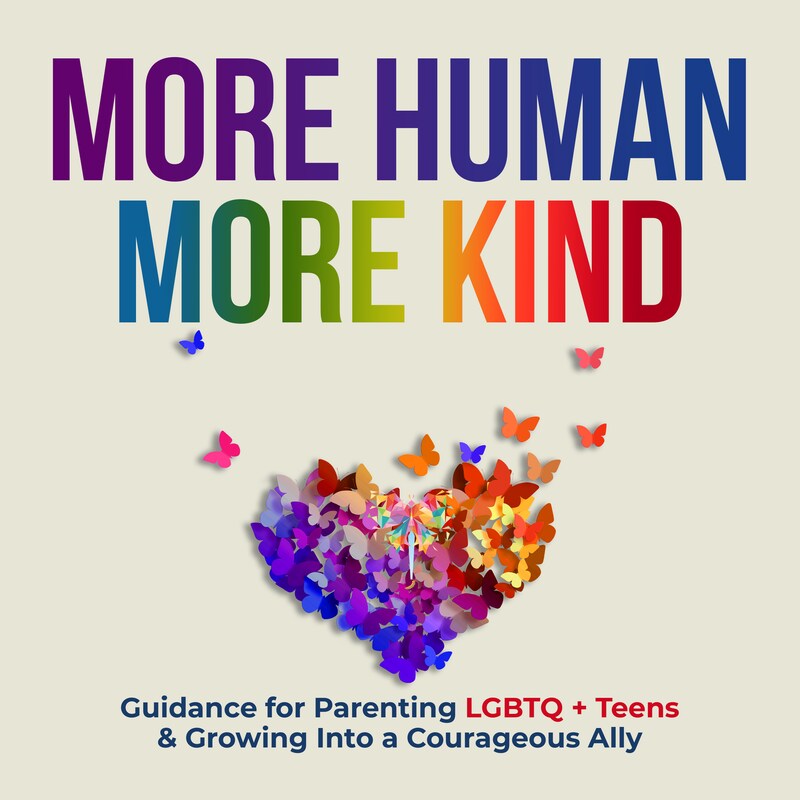
Why "Waiting for Things to Get Better" Is Widening the Gap With Your LGBTQ Child
Episode 249 •
20th February 2026 • More Human. More Kind. | Parenting LGBTQ Kids, Unlearning Fear, Becoming More Human • Heather Hester | Advocate for Parents of LGBTQ Teens
Are you an overwhelmed mom of an LGBTQ+ teen who's feeling lost trying to navigate the coming out process, and wants to let go of shame and embarrassment, as well as build a deeper connection of trust within yourself and your teen? Click hereto learn how to work with me 1-1.
Have you been telling yourself, “Let’s just give it time,” while the distance between you and your LGBTQ teen quietly grows?
Many loving parents believe waiting is the mature, thoughtful move. Don’t push. Don’t overreact. Don’t say the wrong thing.
But in this episode, Heather Hester unpacks why silence often lands as disapproval, how emotional restraint creates disconnection, and why waiting for clarity can actually widen the gap you’re trying to close.
If you’re trying to be a steady LGBTQ ally but feel stuck in fear, this episode offers grounded guidance that moves you from hesitation to connection.
In this episode, you’ll:
Understand why silence feels protective but often lands as rejection
Learn how waiting becomes a loop and how it quietly increases emotional distance
Get one simple, doable sentence you can use this week to reopen connection without escalating tension
You’ll leave with a calmer nervous system and a clearer path forward.
Press play to learn how to interrupt the silence, reconnect with your LGBTQ child, and show up as the steady, loving ally they need — even before everything feels “figured out.”
Hi, I’m Heather Hester, and I’m so glad you’re here!
Feeling uncertain or overwhelmed? Download my free guide to take you from Panic to Plan.
Listen to *NEW* episodes every Tuesday and Friday!
At the heart of my work is a deep commitment to compassion, authenticity, and transformative allyship, especially for those navigating the complexities of parenting LGBTQ kids. Through this podcast, speaking, my writing, and the spaces I create, I help people unlearn bias, embrace their full humanity, and grow their capacity for courageous, compassionate connection.
For parents, allies, and those pioneering a way to lead with love and kindness, I’m here with true, messy, and heart-warming stories, real tools, and grounding support to help you move from fear to fierce, informed action.
Whether you’re listening in, working with me directly, or quietly taking it all in, I see you. And I’m so glad you’re part of this journey.
More Human. More Kind. formerly Just Breathe: Parenting Your LGBTQ Teen is a safe and supportive podcast in a heartfelt and empowering space where a mom and advocate offers the wisdom of lived experience and practical guidance and education to parents and allies, teaching empathy, kindness, love, and strong boundaries while supporting LGBTQ teens and the diverse LGBTQ community, including gay, lesbian, bisexual, trans, transgender, and queer individuals, through conversations about mental health, grief, gender identity, sexual orientation, human rights, social justice, parenting, parent support, and meaningful LGBTQ allyship and allyship in action.
This podcast uses the following third-party services for analysis:
Podscribe - https://podscribe.com/privacy
Transcripts
Speaker A:
In this episode, you will discover why waiting for things to settle down or get better isn't protecting your child.
Speaker A:
Welcome to More Human, More Kind.
Speaker A:
I'm Heather Hester, author, speaker, and advocate for LGBTQ youth and the families who love them.
Speaker A:
This show is for the parent who's holding it together on the outside, while inside, your nervous system is bracing for impact.
Speaker A:
Here we tell the truth gently.
Speaker A:
We unlearn what fear has taught us, and we build the kind of internal safety that lets you lead with love instead of panic.
Speaker A:
You're not broken.
Speaker A:
You're human.
Speaker A:
Let's dive in.
Speaker A:
Welcome to More Human, More Kind.
Speaker A:
I'm Heather Hester.
Speaker A:
This is the podcast for the parent who was trying so hard to stay still, steady, even when everything outside feels uncertain.
Speaker A:
If you've been telling yourself, let's just give it time.
Speaker A:
If you've been hoping this tension passes, if you're waiting for clarity before you act, you're not weak.
Speaker A:
You're not negligent.
Speaker A:
You're overwhelmed.
Speaker A:
You're protecting yourself from fear.
Speaker A:
And that fear, if left unchecked, is quietly widening the gap between you and your child.
Speaker A:
And today we're going to talk about why.
Speaker A:
Waiting to get support may feel safe, but it might actually be the very thing keeping you stuck.
Speaker A:
So if you're listening right now after another quiet car ride, or after a family dinner where the conversation delicately skirted the feet, ear and tension hanging in the air, or maybe after your child shut their bedroom door and you stood in the hallway for a second wondering whether to knock, just take a breath with me for a moment.
Speaker A:
Sometimes the heaviest thing in a home isn't the loudest or the most obvious.
Speaker A:
It's the restraint.
Speaker A:
Maybe you have convinced yourself they'll bring whatever it is up to me and come to me when they're ready.
Speaker A:
I don't want to push them too hard.
Speaker A:
I need to educate myself more.
Speaker A:
Maybe you scroll on your phone while they scroll on theirs, both of you avoiding eye contact.
Speaker A:
Maybe rehearse conversations in your head and then decide, not tonight.
Speaker A:
Maybe you're waiting for the perfect tone or the perfect mood or perfect timing.
Speaker A:
And underneath all of that, you are afraid that if you say the wrong thing, you'll make it worse.
Speaker A:
So you say nothing.
Speaker A:
And then you lie awake thinking about everything you didn't say.
Speaker A:
By the end of this episode, you will understand why silence feels protective, but often lands as rejection.
Speaker A:
You'll see how waiting creates emotional distance, even when you mean well.
Speaker A:
And you'll walk away with one grounded, doable step to reconnect without escalating tension and stick around until the end for the butterfly effect.
Speaker A:
One small action that can interrupt the silence this week I know that waiting for things to quote, unquote, settle down or get better feels like the mature decision.
Speaker A:
It feels thoughtful even, perhaps like you have control of the situation.
Speaker A:
It feels like you're not overreacting.
Speaker A:
Maybe.
Speaker A:
However, here is what often happens beneath the surface.
Speaker A:
Your child interprets silence or the waiting or inaction as uncertainty or discomfort or worse, disapproval.
Speaker A:
And teens are highly sensitive to emotional shifts.
Speaker A:
They notice your pauses.
Speaker A:
They notice the way you change subjects.
Speaker A:
They notice the way your tone tightens when certain words or ideas come up.
Speaker A:
And the worst part is, they may decide not to bring things to you because they don't want to burden you.
Speaker A:
So now you're in a loop of protecting each other, and neither of you feels close or connection with the other.
Speaker A:
And the longer this continues, the harder conversation feels.
Speaker A:
Because now it's not just about identity or mental health.
Speaker A:
It's about the distance, too.
Speaker A:
And of course, the real reason you're waiting isn't because you don't care.
Speaker A:
Quite on the contrary.
Speaker A:
Right?
Speaker A:
It's because you care so much you're afraid of causing harm.
Speaker A:
But here is what is so important for you to hear.
Speaker A:
Silence doesn't prevent harm.
Speaker A:
It just postpones distant discomfort.
Speaker A:
I want to say that again, so you really hear it.
Speaker A:
Silence or waiting doesn't prevent harm.
Speaker A:
It just postpones discomfort.
Speaker A:
And discomfort is not the enemy.
Speaker A:
Disconnection is because I think memorable names help us remember things.
Speaker A:
I call this one the Weight, Worry, Widen loop.
Speaker A:
First is wait.
Speaker A:
You wait.
Speaker A:
You hold back, thinking that once things settle, whatever that means for you, it will be safer or easier.
Speaker A:
And then you begin to worry.
Speaker A:
Your anxiety builds because nothing is being addressed, which then causes emotional distance to grow, widening of the gap in your relationship.
Speaker A:
This distance makes the conversation feel even riskier.
Speaker A:
So you wait some more.
Speaker A:
And thus the loop.
Speaker A:
And now what started as caution becomes just separation.
Speaker A:
So what can you do instead?
Speaker A:
First, tune into your nervous system.
Speaker A:
Before initiating anything, place one hand on your chest and say internally, connection over perfection that reorients your body toward relationship, not performance.
Speaker A:
Second, take a look at relational cues.
Speaker A:
Approach your child, your teen.
Speaker A:
The conversation with curiosity, not correction or judgment.
Speaker A:
Begin with I wonder.
Speaker A:
Or by sharing a vulnerable moment, saying something like, sometimes I get really quiet with and fill in the blank.
Speaker A:
Or you can offer this sentence I may not say this perfectly, but I care about you too much to stay quiet.
Speaker A:
That sentence lowers defensiveness immediately so look, if you are tired of walking on eggshells, if you want to close the distance but you don't know how, if you are exhausted from waiting for the right moment or things to settle or get better.
Speaker A:
That is why my one on one private coaching programs exist inside.
Speaker A:
We don't just talk about communication strategies.
Speaker A:
I help you regulate your fear.
Speaker A:
I help you untangle this silence.
Speaker A:
And I give you real tools to reconnect without blowing things up.
Speaker A:
If this sounds interesting to you, go to the Show Notes and click on the link at the very top.
Speaker A:
For next steps, let's interrupt this.
Speaker A:
Wait, worry, widen, loop together.
Speaker A:
And now it is time for the butterfly effect.
Speaker A:
The small shift that creates big change.
Speaker A:
This week's micro rebellion is this.
Speaker A:
Don't wait for the perfect moment.
Speaker A:
Create a small one.
Speaker A:
Sit beside your child, say something real, authentic, simple.
Speaker A:
And then listen.
Speaker A:
Really listen.
Speaker A:
Small shifts change nervous systems.
Speaker A:
Small shifts change relationships.
Speaker A:
Small shifts change families.
Speaker A:
That's the butterfly effect.
Speaker A:
Today we talked about why waiting isn't neutral and how silence, even when well intended, can quietly widen the emotional gap.
Speaker A:
The shift isn't performative and it certainly isn't small.
Speaker A:
It's brave, imperfect presence.
Speaker A:
If this resonated, follow more human, more kind, so you don't miss what's next and share this with a parent who might be stuck in silence right now.
Speaker A:
Until next time, keep choosing real, messy, vulnerable love.