Shownotes
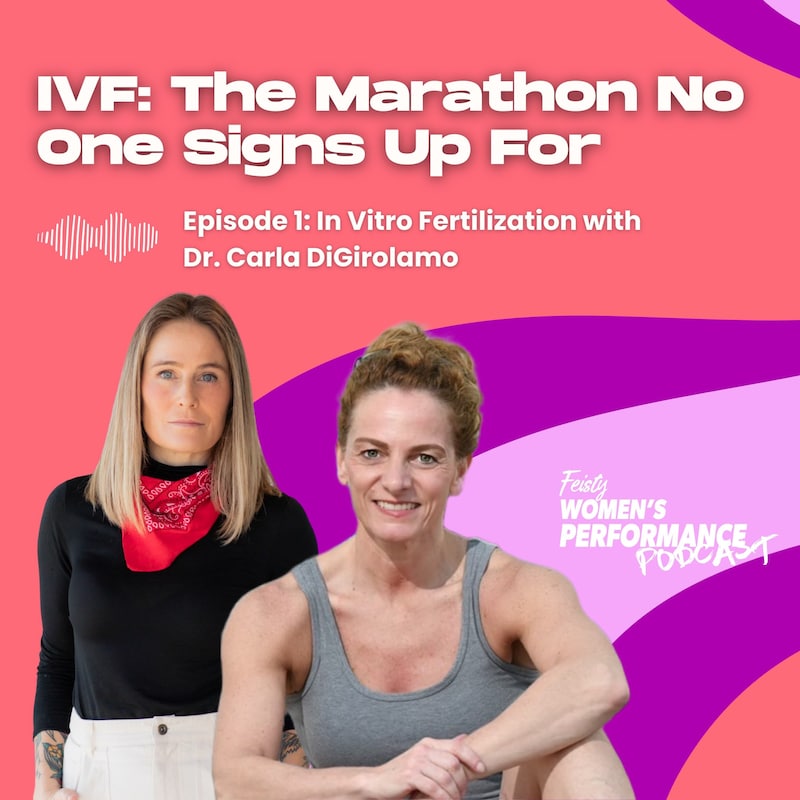
Episode 1: In Vitro Fertilization 101
In the first episode of this informative and deeply personal limited podcast series, guest host Jill Van Gyn is joined by Dr. Carla DiGirolamo, a board-certified reproductive endocrinologist, for an open and honest conversation about the physical, emotional, and medical complexities of in vitro fertilization (IVF).
Drawing from Jill’s personal experience and Carla’s 18+ years of medical expertise, they break down the IVF process—from ovarian stimulation to embryo transfer—while shedding light on the psychological toll it can take. Together, they unpack why individualized care and realistic expectations are essential for those undergoing fertility treatment.
You'll learn:
- Why someone might pursue IVF
- Details of the IVF process and what can candidates expect
- The emotional and physical impact of IVF
- Success rates of IVF and limitations as we age
- Additional factors that contribute to IVF success rates
- Why the right fertility clinic and care plan matter
- How to set realistic expectations for treatment outcomes
- Ways to support someone experiencing infertility
Whether you're navigating IVF yourself or want to better understand what a loved one may be going through, start with this episode.
FeistyFest Info: https://www.wetravel.com/trips/feistyfest-feisty-media-1943243299#about-this-trip
Courses and Coaching: https://feisty.learnworlds.com/
Women's Mechanic Camp in Tucson: https://www.wetravel.com/trips/women-s-bike-mechanic-camp-tucson-az-feisty-media-24985624#about-this-trip
Sign up to Receive The Feisty Women's Performance Newsletter:
https://feisty.co/newsletters/feisty-womens-performance/
Follow us on Instagram:
@feisty_womens_performance
Support our Partners:
Momentous: Head to https://www.livemomentous.com/ and use promo code PERFORMANCE for up to 35% off your first order
Wahoo: Learn more about Wahoo Fitness Products at: https://wahoofitness.pxf.io/0GAByR
Tifosi Optics: Use code FEISTY2026 for 20% off at https://tifosioptics.com/
Hettas: Use code STAYFEISTY for 20% off at https://hettas.com/
Orca: Use the code FEISTY15 for 15% off at https://orca.avln.me/c/HzUkzIfxsmYo
Transcripts
Hello, feisties.
Speaker A:Welcome back to the women's Performance Podcast.
Speaker A:It's been a little while, but I guarantee you it was worth the wait.
Speaker A:We have another incredible series and I have another amazing co host with me today, Jill Van Gene.
Speaker A:Jill, welcome.
Speaker B:Thank you.
Speaker B:Thanks for having me.
Speaker A:Did I say your name right?
Speaker A:I know you have a lot of last names.
Speaker B:Yeah, no, Jill Van Jean is fine, but I am a hyphenate, so Jill Van Jean car.
Speaker B:But it feels like eating marbles when you say it.
Speaker B:So as long as it's not Jill Van Geyn, I'm happy.
Speaker A:Right.
Speaker A:Well, I did see your Instagram and knew exactly how to forget it.
Speaker B:So it's pronounced Van Jean, and don't you forget it.
Speaker A:I love it.
Speaker A:I know Jill from here in Victoria, bc.
Speaker A:She is an entrepreneur, an amazing entrepreneur, built an amazing brand and a writer and also a highly intelligent person who I love to be around.
Speaker A:So, so excited to have her talk about something completely different today as well.
Speaker A:Well, for this series, but something that's very personal to you, right, Jill?
Speaker C:Yes.
Speaker B:So in this series, we're going to be tackling the very broad topic of ivf.
Speaker B:And, you know, for a women's performance podcast, I think one of the aspects to an IVF journey is the grueling nature of that journey and how many people actually have to go through it and the severe impacts that it can have on your mind and body.
Speaker B:And so I thought this fit really well into shedding some light on so many of the unknowns that take place with ivf, infertility, pregnancy loss, and bringing some of that to, like, illuminating a lot of the things that I didn't know when I went into my own IVF journey.
Speaker B:And I wish I had known.
Speaker B:So the goal here is to, you know, give some perspective on what people can expect.
Speaker B:And then if you aren't pursuing IVF or you haven't had to do that, you to get an understanding of what it's like to go through something like that.
Speaker A:Yeah, absolutely.
Speaker A:And I feel like one of the things I learned kind of in my 30s and 40s that I think I wouldn't have known before that is that so many women and couples struggle with things like infertility, end up doing IVF or some related fertility, you know, treatments.
Speaker A:And this affects a lot of people.
Speaker A:And also the emotional journey is very unique.
Speaker A:And, you know, like my as you, I listened to the second episode which we're going to have on next week, and I really was relating, even though I didn't have that Journey myself.
Speaker A:Like, I was really relating to those feelings that you get when you're, like, trying to get pregnant.
Speaker A:You know, everything kind of your world kind of changes a little bit.
Speaker A:It's really difficult to explain, but I think a lot of women are really going to relate to the things, the topics and the things that you talk about in this series.
Speaker B:Yeah, I think the big thing was when I went in so blind to into, like, these processes, it was very isolating.
Speaker B:It was very lonely.
Speaker B:And I really wish I had had a better picture of what I was signing up for.
Speaker B:And I think a lot of women are going into this because a lot of us are pursuing careers and we wait a little longer and it takes us a little longer than it did with our parents to get financially stable.
Speaker B:And I know that was my.
Speaker B:That was my decision as well as my husband and I wanted to wait until we kind of felt like, you know, we had the resources and means to have a family.
Speaker B:And then when we started, when I was 36 years old, it was such a blow to know that, you know, this wasn't going to take one year or two years.
Speaker B:It would end up taking us six years and 11 rounds of IVF.
Speaker B:Eleven rounds, yeah.
Speaker B:So, you know, I mean, we talk about, you know, endurance and performance.
Speaker B:I mean, my body has never undergone such rapid changes and challenges in my life.
Speaker B:And I, you know, was an athlete for many years in CrossFit and did marathon running and really trying to juggle both of those things was a real uphill battle.
Speaker B:So really grappling with those deeply physical changes to my body and having to adapt to this new style of performance.
Speaker B:So.
Speaker B:But yeah, I think so many people do go through this and, or they will, and this will give them a little bit of a picture of what they've.
Speaker B:What they've signed up for.
Speaker A:And I think, you know, having gone through those 11 rounds and.
Speaker A:And obviously I have the advantage of having heard some of the things that are coming up in the series, but, like, you've seen the full gamut.
Speaker A:You've seen it all, right.
Speaker A:Like, you've gone through the treatments, the emotional journey, had the losses.
Speaker B:I have, yeah, yeah.
Speaker B:And I have two wonderful children and I still sometimes can't believe that we're on the other side of this.
Speaker B:And they are currently two and a half and five and a half, but they're both egg donor babies.
Speaker B:And we are so grateful to have somebody come into our lives to help us out with that.
Speaker B:So, you know, I think going into it, you think, okay, well, it's gonna be hard, and then you're like, okay, well, there's gonna be losses.
Speaker B:And then you have to wrap your brain around the fact that, like, hey, you're not gonna have your own children.
Speaker B:But they are my own children, of course.
Speaker B:And really trying to grapple with that and, like, align these new ideas was so what a really wonderful journey for me in some aspects, and also just really, really hard.
Speaker B:But, you know, being on the other side is.
Speaker C:Is.
Speaker B:I mean, it's a gift.
Speaker B:And, you know, we're.
Speaker B:We're thrilled we were able to push through, but, you know, not everybody is.
Speaker B:And I think that's also part of people's journey is pursuing IVF and then having to accept that, you know, they're going to move on with their life without children.
Speaker B:And there's just so many outcomes when people are trying to get pregnant.
Speaker B:And it was something that Carla and I discussed is this idea of a lot of people go into it, and they're like, you're either gonna get pregnant or you're not.
Speaker B:And there's this entire massive gray area in between that I had no idea existed, and I had no understanding of my own body or my reproductive system.
Speaker B:I mean, I really felt like I had no information going into this, and I consider myself a pretty educated person, so.
Speaker B:Yeah, so, yeah, there's a.
Speaker B:There's a lot.
Speaker B:There's a lot to discuss.
Speaker A:Yeah, it wasn't, you know, and we're going to hear you and Carla talk about it today, but I.
Speaker A:I didn't sort of realize that you actually can be a little bit pregnant.
Speaker A:Yeah, that was the phrase that you used.
Speaker A:And that's even an expression, isn't it?
Speaker A:Like, you can't be a little bit pregnant to, like, make something really black and white.
Speaker A:It's like, oh, actually, you can.
Speaker A:So I definitely learned a lot, too.
Speaker C:Yeah.
Speaker B:Yeah.
Speaker B:So, yeah, the goal here is to really bring people up to speed, and we could talk for ages about all the different treatments and all the different outcomes and what it does to your body and, you know, your mind and your spirituality in many ways, too.
Speaker B:But I think we scratched the surface with this.
Speaker A:Great.
Speaker A:And so walk us through what we can expect with the series, like, what's coming up over the next few weeks.
Speaker B:Yeah.
Speaker B:So we'll be talking to Carla, and we're going to be really focusing on the physical aspect and the medical aspects of it, and we're so grateful.
Speaker B:She spent 18 years as a fertility doctor at the Boston Fertility Clinic, and I think understanding what the different medical protocols are, and then, you know, what are some of the approaches that people will have and what doctors will have, why it's important to connect with the doctor and the right fertility clinic for yourself.
Speaker B:And then we do touch a little bit on physical performance as well throughout that process, which is it's a juggle, for sure.
Speaker B:So in speaking with Carla, we'll have a lot more information on what IVF does to your physical body.
Speaker B:And then we'll be speaking with Alexandra, who is a therapist and focuses mainly on fertility issues.
Speaker B:And this we really go into the personal side of things.
Speaker B:And I'll tell a little bit more about my story.
Speaker B:And Alexandra was gracious enough to share that she also had struggles with fertility.
Speaker B:So, you know, having some perspective on how people can fortify themselves going into this and what they can expect in terms of potential loss and really dig into the idea of hope around pregnancy and how that can work for or against you.
Speaker B:So, so many things to cover.
Speaker C:Yeah, Great.
Speaker D:Cool.
Speaker A:Well, looking forward to Carla's interview.
Speaker C:Great.
Speaker B:Thanks, Sarah.
Speaker B:I'm here with Carla D.
Speaker B:Girolamo, who.
Speaker C:Is a board certified OB gyn, a reproductive endocrinologist and Menopause Society certified practitioner.
Speaker C:And she spent 18 years as a partner at Boston IVF and is now transitioned into her own private practice focusing on reproductive endocrine needs of active and athletic women from puberty straight through menopause.
Speaker C:And she's also the director of Women's health at Eternal, a healthcare company dedicated to longevity and athletic performance.
Speaker C:That is quite the resume.
Speaker C:Carla, welcome and thank you so much for joining me today.
Speaker D:Well, thank you for having me, Jill.
Speaker D:It's a pleasure to be here.
Speaker C:So in this series, we're seeking to uncover some of the mystery around ivf.
Speaker C:And I have been through ivf.
Speaker C:I found the inability to fully understand the scope of what IVF is, from the physical to the emotional, to be a really big uphill battle.
Speaker C:And that's one of the reasons why I wanted to talk to some experts.
Speaker C:And because of your background in IVF medicine, I wanted to help to inform our listeners on what IVF is, who needs ivf, and what are the physical effects and processes associated with ivf.
Speaker C:And I'd also like to talk a little bit about how the athletic person is affected by IVF throughout their training as well.
Speaker C:So, again, welcome.
Speaker C:And why don't I just start by asking you a question that's probably pretty broad.
Speaker C:Why might somebody need to pursue ivf?
Speaker D:So there are a lot of different indications for IVF in the infertility area.
Speaker D:One might have fallopian tubes that are blocked or scarred.
Speaker D:Or maybe in their younger years, they had their tubes tied as a form of contraception, and then later, many years down the road, change their mind and decide that they do want to have children with a different partner and however but their tubes are tied to.
Speaker D:So tubal disease is one indication for ivf.
Speaker D:The other indication is male factor, where the sperm may be insufficient or unable to fertilize the egg in vivo, meaning, you know, in the uterus, in the fallopian tubes.
Speaker D:And so what needs to happen is that the eggs and the sperm need to be put together in the laboratory to be sure that fertilization happens.
Speaker D:We also do IVF for unexplained infertility.
Speaker D:Sometimes people go to the clinic and they get an evaluation and nothing is turning up as being abnormal.
Speaker D:The eggs are great, the tubes are great, the sperm is great.
Speaker D:They've tried multiple different things and nothing is working.
Speaker D:And so IVF is the next step.
Speaker D:And sometimes, lo and behold, it works, and we never find out why it didn't work in the first place.
Speaker D:So those are some of the fertility indications for ivf.
Speaker D:Another reason to do IVF might be to do embryo banking, where you might have a couple who isn't ready to have children quite yet, but they want to preserve their fertility for the future, or, God forbid, one of them has a cancer diagnosis, and they want to preserve embryos before they have chemotherapy treatment.
Speaker D:And then another indication is for sex selection or family balancing.
Speaker D:We have other types of testing we can do in addition to ivf.
Speaker D:We can do genetic testing on embryos that allows us to very accurately select the biological sex of the embryo if someone wants to do family balancing.
Speaker D:So there's lots of indications for ivf.
Speaker C:Yeah.
Speaker C:And I think what's really interesting about this is that there are so many indications.
Speaker C:So as an individual, I mean, in my case, I just waited a really long time to get pregnant, and I was with the right person.
Speaker C:And we had waited until I was settled in my career, and I was 36 when I started to try and get pregnant.
Speaker C:And, you know, we did that whole, like, first year of trying.
Speaker C:And for me, what was interesting was that I just had this feeling, like, I just had a feeling that I wasn't going to be able to get pregnant easily.
Speaker C:And it.
Speaker C:I had to go through a lot of doctors and sort of pushing and at times even fibbing around, like trying to get a referral to a fertility clinic, because I was just like, I needed to advocate for myself because I just knew this was going to be a problem.
Speaker C:And I was ultimately correct in this assumption.
Speaker C:But I think one of the things that I was challenged by so much is just like, how common IVF is, because, I mean, there's you and you given us a lot of different reasons why somebody might pursue ivf.
Speaker C:And then they're like, you know, out of every one of those, there's probably about 10 more, not the least of which being like same sex partnerships or, you know, different family makeup, single moms and single parents.
Speaker C:But for me, it was just like it took us forever to figure out that I just had bad eggs.
Speaker C:And I think that now, you know, when I talk to other people that are waiting to pursue pregnancy late into their 30s, I often encourage them, like, hey, you should just like, kind of find out if it's going to work out for you, because it didn't take me six years to complete our family.
Speaker C:And I think that more people should be empowered with the knowledge of, like, what IVF is for and how to pursue understanding what our fertility needs are.
Speaker C:So can you tell me exactly what the IVF process is and then what are the overall outcomes that people can expect?
Speaker C:Because I know that there are many of them.
Speaker D:Sure, sure.
Speaker D:So in the United States, IVF is done pretty much the same way at most centers.
Speaker D:IVF is done in lots of other countries.
Speaker D:But the structure and resources available might be a little bit different.
Speaker D:But so what I'm speaking to is the process that's pretty common in the United States.
Speaker D:So basically, the first step is to stimulate the ovaries to produce multiple eggs.
Speaker D:And this requires some injectable hormone medications.
Speaker D:And usually these medications are very similar to the hormones that your body naturally produces, but we just want your ovaries to see more of it.
Speaker D:And so when your ovary sees more follicle stimulating hormone, it's going to develop more, more eggs.
Speaker D:Because under normal circumstances, when women are just having regular menstrual cycles, the ovary selects one egg to ovulate, it selects a group, and then from that group of eggs, one ovulates.
Speaker D:But when you are taking fertility medications and your ovaries are seeing more fsh, that entire group that originally would just pick just one egg, that entire group comes forward.
Speaker D:And so that's how we are able to get more than one egg at a time.
Speaker D:So this usually requires a series of injections and ultrasound and blood testing, monitoring during the time that you're stimulating your ovaries.
Speaker D:And that usually is around 10 to 14 days on average.
Speaker D:Sometimes it could be less, sometimes it could be more, but that's around the average.
Speaker D:And so during that 10 to 12 days that you're on the hormones, you're coming in for blood testing, ultrasound, and periodic intervals.
Speaker D:It's not usually every day.
Speaker D:And that allows the physician to know when the eggs are mature and ready to be retrieved.
Speaker D:And so once that happens, you usually take what's called the trigger shot, and that does the last 24 hours of maturation.
Speaker D:And then typically, the egg retrieval is scheduled about 36 hours after you take your trigger shot.
Speaker D:That allows the timing for the maturation and then release of the eggs from the wall of the follicle.
Speaker D:The follicle is the area in the ovary where it's developing because it has to come into the fluid for us to be able to access it.
Speaker D:So that 36 hour timing is pretty critical to make sure that we're in the right place to retrieve those eggs at the time of retrieval.
Speaker D:The egg retrieval itself is a very simple procedure.
Speaker D:It takes about five to 10 minutes.
Speaker D:It's typically done under conscious sedation.
Speaker D:Doesn't usually require intubation.
Speaker D:What we used to use at Boston IVF was propofol and fentanyl.
Speaker D:And propofol is fairly fast acting.
Speaker D:People go to sleep, they're comfortable.
Speaker D:We use a vaginal ultrasound to visualize the ovaries.
Speaker D:Then attached to the ultrasound is a needle guide where we slip a needle right along the visual field of the ultrasound and we pass the needle into each little follicle, each little sac of fluid that the egg develops in, and we aspirate them.
Speaker D:We aspirate as many follicles as we can see that are likely to have eggs.
Speaker D:The eggs then go to the laboratory.
Speaker D:The embryologists in the laboratory will look at the eggs and determine which ones are mature and which ones are not.
Speaker D:And then in the laboratory, after you've woken up and recovered and gone home, the embryologists prepare the eggs for insemination.
Speaker D:So while you're having your egg retrieval, the sperm source, whether it's a partner or whether it's donor sperm that's frozen, in the laboratory, the eggs are inseminated.
Speaker D:And then about 18 hours later, they, which is usually the next day, they'll check to see if fertilization has occurred.
Speaker D:And then assuming it is, it has occurred, then we typically grow embryos out for three to five days.
Speaker D:More commonly, we're growing them out for five days.
Speaker D:And then the best embryo that you have that has survived to that point is selected for embryo transfer.
Speaker C:Yeah, it's so interesting because, you know, as you're describing this process, there are so many steps, steps along the way that need to go.
Speaker C:Right.
Speaker C:Can you talk a little bit about, like, the success rates of IVF and what people can expect going into this?
Speaker C:Because I know for myself, one of the biggest disappointments I suffered, and there were many along the way, was walking in and going, well, no worries, we'll just do ivf.
Speaker C:And I think that is something that I would love for our listeners to take forward with them, is that IVF is not a miracle.
Speaker C:It is a standardized medical practice that has limitations.
Speaker C:Can you talk about those success rates and those limitations?
Speaker D:Sure, sure.
Speaker D:So success rates of IVF are highly, highly variable and influenced by a number of factors.
Speaker D:The most important determinant of IVF success is a woman's age, the age of the woman who is spying the eggs.
Speaker D:Under 35.
Speaker D:Actually, under 32 is really where your best success rates are.
Speaker D:At Boston IVF, we would quote around 45 to 50% conception rates with our IVF practices in that age group.
Speaker D:And then in the 35 plus group, it might be 35 to 40%.
Speaker D:Over 38, it's a little bit less.
Speaker D:So typically with age, you can have a very dramatic difference in success rates.
Speaker D:Over 44, success rates are probably in the 1 to 2% range, very, very low.
Speaker D:Once we get to that age group.
Speaker D:The other determinant of success rates is really the center where you are having your IVF done.
Speaker D:So when one is looking around for an IVF clinic, it's important to look at the center's specific success rates.
Speaker D:And most accredited centers are required to check in their outcomes with a CDC database.
Speaker D:It's called SART S A R T.
Speaker D:And to get accreditation, you have to report your outcomes.
Speaker D:And so these outcomes are readily available by clinics.
Speaker D:So you can go to the SART website and you can look up a clinic and find out what its success rates are.
Speaker D:So the other thing that determines it is, you know, what is.
Speaker D:What is your diagnosis, you know, unexplained infertility, or is it male factor?
Speaker D:And how many IVF cycles have you already had without success?
Speaker D:Have you had an IVF success with a live birth?
Speaker D:So there's lots and lots and lots of factors that your managing physician needs to have their arms around and be able to give you an estimate based on all of those things of what your personal chance of successes with ivf.
Speaker C:And would you say too?
Speaker C:Because I've always found This.
Speaker C:I mean, I did 11 rounds of IVF, and I think by the end of it, I was kind of like, I don't know, this feels like just luck because I know that there are, like, standard.
Speaker C:Standard medical practices that will be deployed, and then there's like, sort of.
Speaker C:I wouldn't say alternative therapies, but there was some, like, I think I mentioned to you, and I can't remember what the.
Speaker C:What the protocol was, but it was like they took my blood out and they put it into a centrifuge, and then they shot it back up into my uterus.
Speaker C:And, like, there was just all sorts of interesting things that we were trying.
Speaker C:And is it like, when we get down to, you know, we've got a good egg, we've got.
Speaker C:It's.
Speaker C:It's a good quality embryo and we're ready to transfer.
Speaker C:How much of it is just like the condition of the woman's body when she walks in?
Speaker C:And what are those things that, like, I guess what I'm asking is, like, how are we physically preparing ourselves for a good transfer?
Speaker C:Because I think I tried everything, and at the very end of it, I just thought, you know, I don't know what works anymore.
Speaker D:Yeah.
Speaker D:In my experience, and, you know, this isn't a randomized controlled trial.
Speaker D:This is not a formally done study.
Speaker D:With my 18 years of experience as a fertility specialist, there are two things inherent to the individual the couple that are important.
Speaker D:One is stress management, which is really hard to do when you're going through IVF and you're having trouble, and it's like, well, you gotta relax or whatever.
Speaker D:And that's easier said than done.
Speaker D:Boston IVF was one of the pioneers in the mind body clinic that we had.
Speaker D:It used to be called the Domar center, and they were one of the first in the country to actually have a dedicated center for.
Speaker D:For mind body work and trying to facilitate that kind of relaxation and developing that connection between the mind and body to help to, you know, get that positive energy to help through the IVF process.
Speaker D:Acupuncture is also very helpful.
Speaker D:Anything to try to reduce that stress and to, you know, bring some psychological balance into the equation.
Speaker D:That can be very helpful.
Speaker D:I can't tell you how many times and how many many stories I have of women who were pretty far down the road on their last embryo.
Speaker D:They're just.
Speaker D:They've given up, They've given up, and then, boom, it happens.
Speaker D:Or they exhausted IVF as an option, were convinced they were never going to get pregnant, they go out and Try on their own.
Speaker D:It happens on their own.
Speaker D:So I really do believe there is something to that.
Speaker D:Once you let go of that, of that.
Speaker D:That boulder on your shoulders and what feels like it's a big boulder on your shoulders, that can potentially make a difference.
Speaker D:So I think the stress equation is an important variable.
Speaker D:The other thing that's important is just basic healthy habits.
Speaker D:You know, do you smoke?
Speaker D:Do you smoke marijuana?
Speaker D:Do you exercise?
Speaker D:What kind of food do you put in your body?
Speaker D:Is it processed food?
Speaker D:Or, you know, do you focus on more whole foods and a balanced nutritional program?
Speaker D:That's really important.
Speaker D:I mean, you are what you eat really.
Speaker D:Sounds trite, but there's something to that, because when the body is happy, then it's more apt to accept a pregnancy.
Speaker D:You know, when you are in your healthiest place, that is one thing that will only do positive things for implantation rates.
Speaker D:So I really, when I was seen fertility clients, I would always emphasize lifestyle as a really, really important variable to try to, to pay attention to as they go on that journey.
Speaker C:Yes.
Speaker C:And I.
Speaker C:I certainly went on that journey, and I think I tried.
Speaker C:I mean, I went through naturopathy and acupuncture and therapy, infertility counseling, and I had tinctures and.
Speaker C:And I had meditation apps that were all focused on the golden egg.
Speaker C:And I actually had printed out this, like, beautiful golden egg.
Speaker C:It's actually, I still have it up in my house because for some reason it's just this, like, little talisman that I like to have there.
Speaker C:And I did visualization and I think around my, probably my ninth round, I was trying to control so much.
Speaker C:And like, it's so interesting to hear you talk about that stress factor and that idea of letting go, because, you know, I've.
Speaker C:I was given the sort of, not the advice, but the anecdote that, like, women in highly stressful, like, situations conceive all the time.
Speaker C:Right.
Speaker C:So, like, in war and like, all sorts of different environments.
Speaker C:And for me, I was certainly one of those people who.
Speaker C:We were at the end of the road.
Speaker C:It was my 11th round.
Speaker C:I was stressed beyond belief with my personal career and just the grief and loss that comes with 11 rounds of IVF.
Speaker C:And I just gave up and I.
Speaker C:My lifestyle went completely out the window.
Speaker C:And, you know, it's so difficult to know when you know what is going to work for the individual.
Speaker C:But something that was helpful for me was, you know, once I left a doctor's office and once I left, like, the medication, I found a way to sort of regain some Power and control over my journey by lifestyle.
Speaker C:Eating well, sleeping well, trying to manage stress, exercising often.
Speaker C:And so there were periods of time where that was really, really helpful for me, and then there were periods of time where that wasn't helpful.
Speaker C:But this idea of letting go is so funny because it is certainly not a scientific.
Speaker C:It can't be measured.
Speaker C:Could, because it almost feels like it's like the quality of your letting go, because I know letting go in the middle of hoping and praying that you are going to be pregnant can be so tough.
Speaker C:Like, it's.
Speaker C:It's a very spiritual disconnection from the process.
Speaker C:And then once I let go, I mean, I just remember the day I tested positive for pregnancy.
Speaker C:I also tested positive for Covid, and I just said, all right, well, I'm going to lose this one, too.
Speaker C:And today she is absolutely running my life, and we love her.
Speaker D:So, yeah, I mean, I think the letting go is something that can be worked on through meditation.
Speaker D:You know, one of my favorite meditation apps is Headspace.
Speaker D:And the.
Speaker D:The whole cornerstone around the.
Speaker D:The focus of the meditation is finding that way to not be too attached to those thoughts and to.
Speaker D:To like, a thought comes in, you acknowledge it and then let it go.
Speaker D:Pushing it away is very different from letting it go, because when you push it away, it's going to come back and grip harder with a vengeance.
Speaker D:But if you can manage to truly let it go, there's some value in that.
Speaker D:So meditation training is a way.
Speaker D:Way to move in that direction.
Speaker D:It's just, you know, obviously it's not for everybody, but it's something that could be helpful, certainly.
Speaker C:Yeah.
Speaker C:Yeah.
Speaker C:So can we talk a little bit about how this impacts your body?
Speaker C:Like, I mean, you've mentioned shots, and there's tons of treatments, and like, I went.
Speaker C:Did a thing where they just blew out my fallopian tubes.
Speaker C:That was horrific.
Speaker C:I mean, there I went through a number of different treatments.
Speaker C:And, you know, this process is going to be great for some people and, like, really rewarding.
Speaker C:And for other people, that comes with, like, a quite a bit of medical trauma and physical trauma.
Speaker C:Can you talk a little bit about what people can expect as they go through this process?
Speaker D:Sure.
Speaker D:So with the stimulation piece, that's the 10 to 14 days that you're on the hormone stimulating the ovaries to develop the eggs.
Speaker D:The ovaries increase in size dramatically.
Speaker D:They go from being the size of, like, a very small egg, you know, maybe like a quail egg, not like a chicken egg, to probably being the size of.
Speaker D:Of an orange.
Speaker D:So, you know, if you look down, your pelvis isn't very big.
Speaker D:And so you got these two things that are increasing in size.
Speaker D:I've had patients describe to me, oh, my God, I look like I'm 24 weeks pregnant.
Speaker D:So some people can see that outwardly, if they're thin, people, they.
Speaker D:It can be very obvious they look pretty pregnant, and that can be uncomfortable.
Speaker D:Most people can go about their day and do their usual stuff, go to work and what have you.
Speaker D:I just encourage people to wear comfortable clothing just because the belly can be bloated from the ovarian enlargement.
Speaker D:One of the risks that goes along with ovarian stimulation is ovarian hyperstimulation syndrome.
Speaker D:It's ohss.
Speaker D:You know, there's lots of strategies to avoid OHSS nowadays, and we really see a lot less of it than we used to.
Speaker D:But some of the more significant episodes of OHSS can include the belly filling up with fluid.
Speaker D:This is just an effect that the hormones have on the fluid balance in your vasculature.
Speaker D:And so what happens is, as you start to swell up, a lot of the fluid starts to leave the vasculature and go into the tissues.
Speaker D:And there have been some cases of hyperstem syndrome, where we would do what's called a cul de syntesis, where we would insert a needle vaginally and drain this fluid.
Speaker D:You can take three or four liters of fluid off of somebody.
Speaker D:It's dramatic.
Speaker D:This probably complicates 1 to 2% of IVF cycles.
Speaker D:And we really do have good tools like Lupron triggers and freeze all cycles that allow us to avoid this, that we didn't really have access to 10, 15 years ago.
Speaker D:But that's probably one of the more common significant complications of IVF is hyperstem syndrome.
Speaker D:But like I said, probably 1 to 2% of IVF cycles.
Speaker D:Your egg retrieval, it's typically done under anesthesia.
Speaker D:You're typically a little sore after it for about 24 hours.
Speaker D:But usually people return to work the next day or the day after, so that's not too bad.
Speaker D:And there's no incisions with the egg retrieval.
Speaker D:It's just a needle puncture.
Speaker D:It's kind of like an ovarian biopsy.
Speaker D:Sometimes there are mood swings in response to these hormones, and this is variable among people.
Speaker D:And one of my observations in the years that I've done this is that if you're somebody that with your natural menstrual cycles has a lot of pms, you're very sensitive to your natural menstrual cycles.
Speaker D:You will probably have some sensitivity to these hormones because different women have different sensitivities to their own hormone fluctuations.
Speaker D:So some people have significant mood swings.
Speaker D:And also it's the emotional dynamics surrounding the fertility situation.
Speaker D:For example, a couple who have been struggling to get pregnant, who's getting older, and the pressure is on, their emotional dynamic's gonna be different from the couple that is banking embryos just because they're not quite ready to have a child.
Speaker D:So, you know, the emotional dynamics surrounding the situation also can factor in to the mood swings.
Speaker D:So those are some of the more common, more common things that we would run into.
Speaker C:You know, I think I went into this, and I think a lot of people go into it being like, well, I'm going to get this on the first try.
Speaker C:And that often isn't the case.
Speaker C:And can you talk a little bit about what it looks like?
Speaker C:Maybe we could talk about two things.
Speaker C:The first thing is I was shocked and also horribly disappointed to find out that you can be a little bit pregnant.
Speaker B:What is that?
Speaker C:Why did I not know what this was?
Speaker C:I've had a few chemical pregnancies and then just like low hcg, so, you know, the embryo just wasn't developing or didn't bed.
Speaker C:Can you talk a little bit about those outcomes of what people can expect?
Speaker C:Because it can be quite jarring to get a positive pregnancy test and then be told that this is not a viable pregnancy.
Speaker D:Yeah, this is really unnerving, understandably, for a lot of patients.
Speaker D:And so what that little bit of pregnant refers to is kind of like this limbo period where you have a positive pregnancy test, but you can't yet see the pregnancy on ultrasound.
Speaker D:And so that we really can't get a look at a gestational sac and a yolk sac until the HCG levels reach about 3,000.
Speaker D:Okay, so when you get your initial pregnancy test about two weeks after your embryo transfer, we're probably looking at levels between 150 and 300.
Speaker D:So levels typically double every two days.
Speaker D:And so to get from, say, 200 to 3,000, that's gonna take a little bit of time.
Speaker D:So there's a few weeks there where the only evidence that this pregnancy even exists is in the HCG levels.
Speaker D:Now, sometimes those HCG levels aren't going up as predicted, which is doubling every two days.
Speaker D:When that happens, we have to be worried or at least alert to the possibility that that pregnancy is in a location that it shouldn't be in, like the fallopian tube.
Speaker D:Most commonly, that's called an ectopic pregnancy.
Speaker D:And one of the red flags of an ectopic pregnancy is when those HCG levels are not going up appropriately.
Speaker D:So if we notice that, and usually after you have a positive pregnancy test, they might repeat it a few times to make sure the trajectory is correct.
Speaker D:And if it's not, then we're gonna keep drawing those HCGs.
Speaker D:But yet we can't do that ultrasound until we really get to be above, you know, above 3,000 before we see anything.
Speaker D:So watching these creeping HCGs and not being able to see anything or know what's going on is really unnerving for people.
Speaker D:But that's what's going on.
Speaker D:We just don't know where the pregnancy is or if it's, you know, if it's ultimately going to be viable.
Speaker D:And it really is difficult to manage that emotionally.
Speaker D:But there is not much we can do except watch and wait, because just the limitations of what we can see.
Speaker C:Oh, the amount of Reddit threads that I was on was.
Speaker C:And I finally just said, I've got to stop Googling my hcg, because I would, like Google this HCG and be like, is this good?
Speaker C:Is this viable?
Speaker C:Who's had babies with this hcg?
Speaker C:So that period of time, I mean, you are operating with such blindness and you are also so emotionally charged.
Speaker C:And like, I, yeah, it took me a few cycles to get my feet underneath me, but, you know, the, the adrenaline and the fixation on that period, I never was able to shake because the only way you can see, you know, how things are progressing.
Speaker D:So in the uncertainty of just not knowing which way it's going to go, and the doc really can't tell you.
Speaker D:Yeah, and it's unnerving for the providers, too, because we don't, we don't like to see our patients suffer, and it's hard on everybody, for sure.
Speaker C:Yeah.
Speaker C:And, you know, I was, you know, I've had excellent fertility doctors, and I've had not so great fertility doctors.
Speaker C:And I will say that those that appreciate the, the, the deep uncertainty and the emotional stress that comes with this were the people that really helped me through this.
Speaker C:And we talk about, you know, providers offering resources to alleviate stress.
Speaker C:Medical practitioners that have the ability to consistently be empathetic is.
Speaker C:That's a superpower.
Speaker C:I mean, I would, I would say, in my opinion, in the fertility sciences, that would be, you know, just such an asset in that field.
Speaker C:So let's say this doesn't work out and we're coming off A cycle.
Speaker C:What does it look like to get back on?
Speaker C:Because we don't just say, okay, well, it didn't work, and that's it, we're done.
Speaker C:Most of us will want to go back in and try and find a solution here.
Speaker C:And many people will do this cycle multiple times.
Speaker C:And how does that look for other people?
Speaker C:And what are some alternative methods that fertility sciences can try?
Speaker D:So when I would have patients that would not be successful with their cycle, usually I would try to meet with them and I would help them.
Speaker D:We would all look together and say, okay, let's analyze this.
Speaker D:Let's look at the data.
Speaker D:And it's like, okay, how did the ovaries stimulate?
Speaker D:Did we get a good.
Speaker D:Do we get a good number of eggs, or did we not get as much as we expected?
Speaker D:And by looking at the outcomes from start to finish, that helps to paint a picture of, okay, what's.
Speaker D:What's really going on here.
Speaker D:And that can also inform how we do the next cycle.
Speaker D:So if I find out that, okay, these medications were a little bit too low, you know, we would like to get a greater egg yield next time, then you might increase the doses of the gonadotropins that you're using, the FSH hormone and the other hormones that we use sometimes.
Speaker D:So if we find out that, okay, we retrieved all these eggs, we tried to inseminate the sperm and let them do their thing, lo and behold, there's no fertilization.
Speaker D:That's very informative.
Speaker D:It's like, okay, the sperm and egg can't do it on their own.
Speaker D:We need to apply a technique called icsi, Intracytoplasmic sperm sperm injection.
Speaker D:And then oftentimes that fixes the problem.
Speaker D:We get embryos, transfers.
Speaker D:Everything's great.
Speaker D:Sometimes it is that easy, Sometimes it is not.
Speaker D:But the IVF process can be very diagnostic because we are able to see every step in the conception equation under the microscope.
Speaker D:So when I have people that are going back and forth, do I just stay with IUIs?
Speaker D:I don't really want to do this.
Speaker D:It's like, well, you know, especially for unexplained infertility, it's like, if, you know, I get it, I get.
Speaker D:No one really wants to do it this way.
Speaker D:But we may find out valuable information that we can't find out on just your initial day three testing, HSG and semen analysis.
Speaker D:There could be some real biological barriers that, aha, there it is.
Speaker D:We can fix it and, you know, be.
Speaker D:Be well on our way.
Speaker D:So when I, When I have A patient with a failed cycle, I always try to meet with them and then, you know, you know, go on the.
Speaker D:You know, learn from it and then.
Speaker D:And then make a plan.
Speaker D:In Massachusetts, where I used to practice, and there's probably about somewhere between 15 and 20 states that have insurance mandates, a lot of times, insurance can be a barrier, and that causes women a lot of stress.
Speaker D:And so in between cycles, there's usually submission for approval, and sometimes if that does, it doesn't happen.
Speaker D:We have to appeal.
Speaker D:And the insurance companies can add a whole other layer of stress to this.
Speaker C:Right.
Speaker D:But I figured I had to include that because so many states nowadays have insurance mandates and people are using insurance for these treatments.
Speaker C:Yeah.
Speaker C:In Canada, it is limited.
Speaker C:Since I have had both my babies, I know that it has improved.
Speaker C:I think that is such.
Speaker C:It's such an astute point on this, because financial barriers to IVF are certainly real.
Speaker C:But what I found interesting about trying to figure out how to get from where we were to holding a baby and how that happened, I was not too concerned about it.
Speaker C:We certainly entertained adoption.
Speaker C:And we went through an adoption seminar, and.
Speaker B:We had just done ivf, and.
Speaker C:I, I ended up miscarrying the same day.
Speaker C:But we had gone to the seminar just to, you know, just in case, which was smart.
Speaker C:And so we had decided to.
Speaker C:To adopt.
Speaker C:And we were, you know, three rounds into ivf, and then we went to go look at adopt.
Speaker C:And I think people also, again, don't have a good idea because we actually did have people say to us, well, you know, like, it's nice to have biological children, but have you ever considered adopting?
Speaker C:And you're like, listen, listen, adoption is very expensive.
Speaker C:And we get stuck in this.
Speaker C:Like, when we were looking at.
Speaker C:We looked at Canada, I believe it's about $30,000 to start the process.
Speaker C:And then you get put on a list and the.
Speaker C:And the.
Speaker C:The adoptive parents, or the parents will pick the adoptive parents.
Speaker C:The United states is about $90,000 U.S.
Speaker C:japan is about the same.
Speaker C:And anywhere else, typically you'll have to go and either live a year in country.
Speaker C:Many developing countries are cutting off adoption for very good reasons, or you can end up with sibling groupings that are a little bit older as well.
Speaker C:So when we went into the prospect of adoption and IVF was expensive, but it wasn't $90,000 expensive or $30,000 expensive even.
Speaker C:Right.
Speaker C:Like, we had done some, and the retrieval costs a little more and the transfers are a little bit less.
Speaker C:And so you do have to play this sort of like, transactional game in your head.
Speaker C:And it's quite.
Speaker C:It's a really tough thing to grapple with because often adoptive agencies will say, you have to be done with ivf.
Speaker C:I mean, that is the way it is in Canada.
Speaker C:You have to be done with IVF before you pursue adoption.
Speaker C:They don't want to do the sort of like.
Speaker C:Like the having an adoptive baby while you're actually pregnant.
Speaker C:So we made the decision to go back into ivf, and that worked out well with us once we had an egg donor come through for us.
Speaker C:And.
Speaker C:And that is how I have my two children today.
Speaker C:But, yeah, I think this idea of financial barriers, I mean, I think most people who are trying to build a family are open to adoption.
Speaker C:I mean, it can be tough.
Speaker C:I remember when I found out that, you know, I couldn't have my own biological children, but I just, like, there's a point where you stop caring.
Speaker C:At least that was.
Speaker C:That's what it was like for me.
Speaker C:So adoption was always on the table.
Speaker C:And yeah, the financial sort of transactions that you have to go through in your head and how to manage that can be really, really challenging.
Speaker C:And add again, to that factor of stress, though, and, you know, I do know that a lot of our listeners are involved with it in athletics and our athletes themselves.
Speaker C:And I'm so interested in this idea of training at a high level or being a person that is active in their regular day and then making a decision to pursue ivf.
Speaker C:And how do those things interact with each other?
Speaker D:There is a lot of layers to this onion.
Speaker D:One of the things that I was constantly frustrated about was at Boston ibf.
Speaker D:And I know that this isn't just one fertility practice.
Speaker D:This is true.
Speaker D:Just the American culture, maybe Canada as well, is just this perception that if you're trying to get pregnant, you really need to eliminate all physical stress.
Speaker D:And it just is not accurate and it is not substantiated by any data.
Speaker D:And stress to one person is not stress and serenity for somebody else.
Speaker D:And yes, stress is important for implantation, but, you know, we're talking about famine.
Speaker D:We're talking about, you know, not feeling safe in your environment.
Speaker D:We're talking about maybe grieving, marital distress, you know, things like that.
Speaker D:That's the kind of stress that we want to avoid.
Speaker D:The stress that comes with physical activity is good stress.
Speaker D:Now, can people overdo that?
Speaker D:Do I advocate that people train for a triathlon and run it in their second trimester?
Speaker D:No, but I have cared for a lot of highly competitive and professional athletes going through this process.
Speaker D:And there's a lot of moving parts.
Speaker D:But the frustration is that, is that I wrote the guidelines at Boston IVF for Exercise and Pregnancy.
Speaker D:And I did this after a very deep dive into the literature.
Speaker D:Plus, I have a background in this as a fitness professional for decades.
Speaker D:And so that's why they asked me to do it.
Speaker D:And no matter what, I put in those guidelines, which is that, like the can't get your heart rate above 140, 40 beats per minute, which has been completely debunked.
Speaker D:Still, even after writing those guidelines, I had nurses telling them, don't get your heart rate above 140 beats per minute.
Speaker D:And then I would resend them the guidelines.
Speaker D:And then, you know, something else would happen.
Speaker D:The patient would come back to me.
Speaker D:Well, my nurse told me that I can't exercise until my pregnancy test.
Speaker D:Okay, that's actually not in the guidelines.
Speaker D:I send the guidelines.
Speaker D:And I finally got sick of just resending the guidelines.
Speaker D:I'm like people who are just not listening.
Speaker D:But there is this cultural thing.
Speaker D:There's this resistance to exercise during this process that is completely unnecessary.
Speaker D:And I would see a lot of patients whose exercise was their form of stress relief.
Speaker D:It is their form of pleasure.
Speaker D:It is something that they can't live without.
Speaker D:I'm one of those people.
Speaker D:I understand that.
Speaker C:Yeah, me too.
Speaker D:And so when you tell these people, sorry, but you can't exercise for, you know, the next however you're going to create stress, that is not going to be good for them, not to mention you're going to deprive them of the physical benefits of exercise that we all know exist.
Speaker D:So this is a huge hurdle.
Speaker D:And, you know, my.
Speaker D:The athletes that are competitive and training for events, you know, while they're going through their IVF cycles, it's challenging.
Speaker D:So with that, some of the things that we have to be aware of is when you're going through IVF stimulation, the ovaries are enlarging.
Speaker D:We talked about that.
Speaker D:During that phase, that 10 days or so of stimulation and about a week after egg retrieval, I tell my athletes, we can't do anything high impact because you don't want to bounce the ovaries around because if they're enlarged, they can twist on themselves.
Speaker D:That's called an ovarian torsion.
Speaker D:And that's a surgical emergency.
Speaker D:You can.
Speaker D:You can lose your ovary, and it's painful as hell.
Speaker D:It's really an unpleasant thing.
Speaker D:Nobody wants to go through this, and no one wants to lose an ovary.
Speaker D:So that's one of the limitations I put on my athletic people is to just, you know, you can get on the bike, you can even maybe get on the rower.
Speaker D:Just don't go running, don't go jumping up and down or turning upside down or anything like that.
Speaker D:That can twist the ovaries.
Speaker D:So I usually give them that little limitation, but I give them alternatives.
Speaker D:You know, like I, I used to treat.
Speaker D:There was a world, world class hockey player who was in the middle of a season and, you know, we had her on the bike.
Speaker D:You know, that's how she had to, you know, keep her lung capacity and her endurance, her cardiovascular endurance, you know, on point.
Speaker D:But we had to just do it differently and that was okay.
Speaker D:The other thing competitive athletes can run into is that a lot of the medications that we use for IVF are on the banned substance list.
Speaker D:And so, yes, so what has to happen is that, and I would have this, this would happen a lot.
Speaker D:They would provide me with the organization's list of banned substances.
Speaker D:And what I would have to do is to write letters to them saying, she is on this medication and this is why she's on this medication.
Speaker D:This is why.
Speaker D:So you kind of have to inventory what they're taking.
Speaker D:But a lot of medications used in IVF are on the banned substance list, so that's another thing.
Speaker D:And most fertility doctors won't even know what that is.
Speaker D:I did, because that's my background.
Speaker D:But that's another little bit of a barrier if you're a competitive athlete.
Speaker D:But yeah, there's a big cultural stigma there that is really not grounded in any good science or research.
Speaker D:But there are some real limitations.
Speaker D:Like I said, we have to make sure that we keep the ovaries and the woman safe during that time of egg retrieval and stimulation.
Speaker C:Yeah, I mean, I definitely went into IVF going like, well, as soon as I do this, I'm just this delicate little creature and I'm not going to be.
Speaker C:I mean, I remember being told, like, don't lift over five pounds.
Speaker C:And I was like, five pounds is like not much more than a cup of coffee.
Speaker C:So, you know, it was really hard to avoid lifting anything.
Speaker C:And by, by the 11th round, I was like, fully working out through everything and just like, you know what, I'm just going to do my thing and, you know, I'm going to keep myself happy throughout this process.
Speaker B:So.
Speaker D:Oh, well, the thing that, that makes me laugh about that because that's another debunked, you know, wives tale or whatever, is that, you know, before there were IVF doctors before there were even obgyns.
Speaker D:We'd be having babies in the fields.
Speaker D:We'd be working, hunting.
Speaker D:We'd be lifting up our kids, and we would be doing all this physical stuff because out of necessity.
Speaker C:Yeah.
Speaker D:And, you know, families would have six kids without.
Speaker D:Without blinking an eye.
Speaker D:So, you know, there really is a lot.
Speaker D:Again, it's.
Speaker D:It's that stigma, and that has just been perpetuated through time that is just not grounded in any real science.
Speaker C:Yeah.
Speaker C:Well, listen, I think we'll wrap it up there.
Speaker C:And I feel like we've only just, like, touched the surface of this, but I really hope that there's been a little bit of illumination and some questions answered, and I just really appreciate you taking the time and sharing, like, your.
Speaker C:Your deep knowledge of this field with us today.
Speaker C:So it was so nice to talk to you.
Speaker D:You're very welcome, Jill.
Speaker D:Thank you for having me and for giving me the opportunity to reach your listeners.
Speaker C:Awesome.
Speaker C:Thank you.
Speaker C:Take care.
Speaker D:You too.

