Shownotes
Watch Video Version:
https://www.youtube.com/watch?v=iVk9S5jajX4
Show Notes
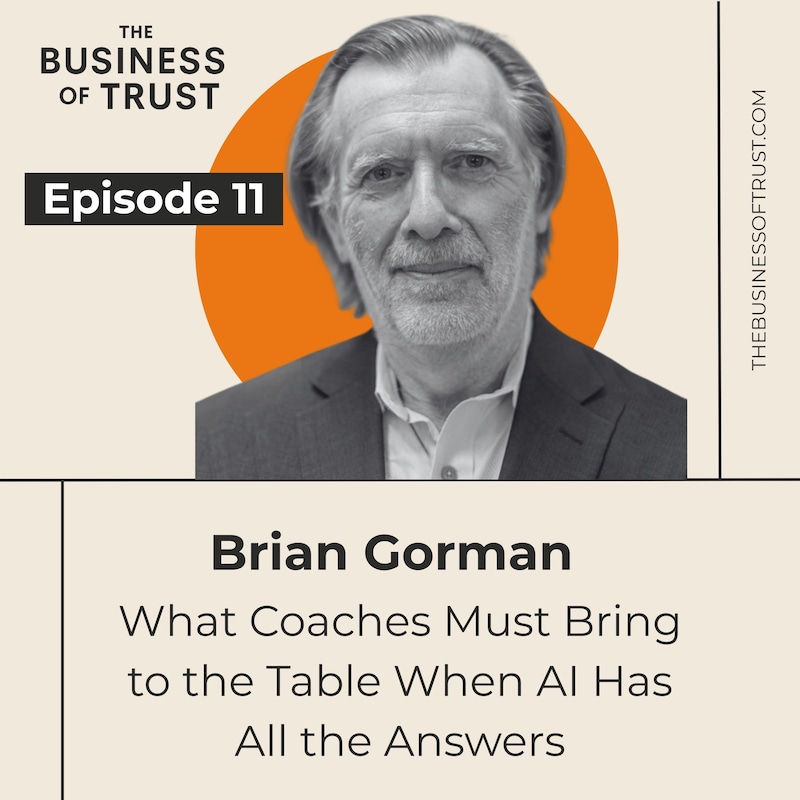
In this episode of The Business of Trust, I sit down with Brian Gorman—leadership and transformation coach, founder of TransformingLives.coach, host of the Conversations Podcast, and author of his new book "Leading into the Age of Wisdom."
Brian has spent decades helping organizations navigate change, he brings a level of perspective that feels especially relevant right now. What stood out to me in this conversation is how clearly he names what many of us are sensing but haven’t fully articulated yet: intelligence is being commoditized—but wisdom is not.
We talk about why this moment isn’t an evolutionary shift, but a revolutionary one—on the scale of the Industrial Revolution—and why coaches, consultants, and trusted advisors have a critical role to play if we’re willing to bring our whole selves to the work
What You’ll Learn:
- The difference between intelligence, knowledge, and wisdom, and why that distinction matters more than ever
- How organizations are stuck in outdated Industrial Age rituals (like time-based work) that no longer serve us
- Why engagement is so low in most organizations—and what happens when wisdom is captured from the frontline, not just the C-suite
- The role of energy, nervous system regulation, and belonging in creativity and leadership
- How coaches can use AI as a tool without outsourcing their responsibility or integrity
Connect with Brian:
Website: transforminglives.coach
Transcripts
leadership and transformation coach. He's a trusted advisor and the founder of transforminglives.coach. Brian helps leaders succeed today and into the future as we navigate the uncharted territory with the search of artificial intelligence. He was a member of the Forbes Coaches Council from 2019 to 2020, and he's the host of the Conversations Podcast.
Brian just released a book titled Leading into the Age of Wisdom, which explores the difference between knowledge and wisdom and offer practical ways on which we can enable wisdom both at the personal level and the organizational level. In today's conversation, Brian and I discuss how we can access our own wisdom and how trusted advisors can navigate the AI revolution by bringing their whole selves to the table. Let's get started.
Hugo Sanchez (:Hello, Brian. Welcome to the Business of Trust Podcast.
Brian Gorman (:Hugo, it's great to be here.
Hugo Sanchez (:Well, thank you for being here. I always like to start this conversation just with a little bit of your story. perhaps can you tell our listeners, ⁓ how did you end up in this line of business?
Brian Gorman (:It's a long story because I'm about to turn 76 years old, so I'll fly from the beginning to the end very quickly. As a freshman in college, I got involved in trying to make some change happen regarding how Syracuse University was portraying their Native American mascot at the time. We're talking 1967-68.
That sparked in me a real passion for change and change has been the common thread through my career ever since. For many years I was an organizational change management consultant.
and learn some things. So in:And one of the things that I learned very quickly was that in fact, as a coach, I am taking my clients through the same change journey as I was taking organizations through when I was working as a consultant.
Hugo Sanchez (:I see. And Damien Goldberg for Joseph our listeners is also a common friend here. He's actually episode number four of the business of trust podcast. ⁓ but I want to go to, something about change that I really appreciate as I read your content is that, I mean, you can't fight change. Change is, happening all the time. And you recently wrote a book titled
leading into the age of wisdom. Can you perhaps tell us what this book is about and what prompted you to write this book?
Brian Gorman (:And what prompted me to write the book is the voice that you and I and every one of your listeners keeps hearing that artificial intelligence can replace people in the workplace. Artificial intelligence is replacing people in the workplace. I've even heard at least one CEO said, artificial intelligence can replace me in the workplace. And as I listened to that,
it just didn't sit right with me. There was something missing. And as I really began to think about it, what's missing is, Hugo, you and I can be as smart as the smartest person in the world or smarter, as long as we have access to artificial intelligence and we know how to write the prompts. Intelligence is not...
all we are though. What we are as human beings is wise and as we grow older, hopefully we grow wiser. And our wisdom is about how do we apply that intelligence? Do we apply it? What about it is
right for this situation, what about it is wrong for this situation. So my book really begins with the premise that there's a difference between intelligence and artificial intelligence and wisdom. That artificial intelligence is not going away. So how do we bring wisdom to its application in organizations?
And then looking at the pace of change and looking at how much wisdom organizations require today, how do we leverage wisdom from the bottom of the organization to the top? Because the wisdom that sits in the executive suite is not all the wisdom that there is. And it's not all the wisdom that organizations need. So.
And that's really where the book begins and then we look at, so how do we do that? What does that mean for how organizations are structured? What does that mean for ⁓ the culture of organizations? What does that mean for leadership in organizations? What does that mean for where work gets done and how work gets done? What does that mean for how we measure the success of an
Hugo Sanchez (:And I mean, I studied industrial engineering. So something that I really appreciate about the concepts that you're bringing forth is how we have evolved through different eras. mean, through the agricultural era, through the industrial era, to the informational era. And now information, gets translated into knowledge. And now we're entering, I mean, some people would say the, knowledge, but you're actually going to step forward further and saying,
Let the knowledge be the machines but like the human part is the wisdom era. What are some characteristics of like entering this wisdom era? How do you see the wisdom era taking shape?
Brian Gorman (:So just like any change, I thank you for that introduction to this question because I do believe we are at the equivalent of the start of the Industrial Revolution. This is not an evolutionary change. This has the potential for being revolutionary. And just like any big change, it takes some people to lead the way and
In the book I write about the importance of wayfinding because you can't navigate into something that we don't know. There is not a whole lot of clarity. There are no clear paths forward. ⁓ So we need those leaders who say, it ain't working. It's slowing down or stopping working. We need new paths forward. And I'm willing to...
venture into that unknown. ⁓ A couple of key points that I make just very briefly. One is, again, that wisdom resides from the front line to the C-suite. The people that know what is and is not working about what you're delivering, the people that know
what is and is not meeting the needs of your customers are your frontline workers. And yet, historically in the age of the industrial age, they weren't considered for their wisdom. If I was a frontline worker and I left, there would be a set of skills that people would look for to replace me.
however many years of collecting the experience and ⁓ satisfaction and dissatisfaction of customers would be lost. one of the things that's very important is developing the means for capturing that wisdom at all levels of the organization. ⁓ If you look at the data about employee engagement, and I...
tend not to even use the word employee because it suggests that somehow the company owns me. But if we look at that engagement data, it is pathetic.
Hugo Sanchez (:Mm-hmm.
Brian Gorman (:It is pathetic. If we could just double the level of engagement in organizations, we would have a totally different economy, a totally different socioeconomic reality.
So think about this. What if, and these are not theoreticals, there are companies that are doing these things now. What if we took a company and we restructured it around different product lines, different ⁓ customer niches. We call them micro enterprises.
And what if we take those micro enterprises and we create teams of 6, 8, 10 people. And each team has to support itself. And each micro enterprise has to support itself. And they support themselves through selling whatever it is they're producing to other teams or other micro enterprises or to external customers.
If you were on a team of 6 or 8 10 or 12 people, what are the chances that you would not be actively engaged? What are the chances that you would be on that team for very long if it didn't excite you to get up and go to work every day? GE Appliances is doing just this right now as we talk. And they have gone from having fallen down in
Hugo Sanchez (:Hmm.
Brian Gorman (:their ⁓ industry to rising back up to the top because they rethought how they were structured. ⁓ What if Hugo instead of saying, Hugo, we need this in ⁓
the next week and you are in the consulting business saying, Hugo, this is a 10 hour project. You can have 10 billable hours. Well, it isn't the hours that get the work done. It's your energy. your mental, physical, spiritual, emotional energy.
So what if instead of saying you have 10 hours to get this done, I said, Hugo, given the nature of this particular project.
how much energy do you need to put in, what energy do you need to put in, and given that, when can you reach the finish line?
totally different way. know, 40 hours, Monday to Friday, 8 to 5, 9 to 5, however you measure that, that literally came from Henry Ford doing research in how to be most effective in building Model Ts. We're not building Model Ts anymore, and yet we're still living by that paradigm. those are just a few and one more. Diversity.
Hugo Sanchez (:Mm-hmm.
Brian Gorman (:Diversity tends to be ⁓ a politically sensitive word these days. Diversity provides strength. we look at biology, you live down in Florida, lots of palm trees. Palm trees have a very simple cellular structure.
They're pretty much the same cell over and over and over again. And they grow pretty quickly. I live up north where we have a lot of oak trees. Oak trees have a very diverse complex cellular structure. They grow very slowly.
Oak trees are a lot stronger in turbulence than palm trees. Diversity gives strength. And to have diversity in the organization, not just on the surface, but in engagement, it means creating a culture of belonging is a strategic imperative. So pardon my rant, but that's...
Hugo Sanchez (:Mm-hmm.
Brian Gorman (:high-level flyover.
Hugo Sanchez (:It's a beautiful rant and I really love how holistic it is because I mean, I completely subscribed, for example, to the concept that our nervous system is our most important system and no ideas come from a dysregulated nervous system. So if we are no longer machine, if you mentioned, think in your podcast, which is a great podcast conversations, we're going to talk about it in a moment, but you mentioned that
Industrial Revolution gave us a lot of efficiency a lot of like great things But it also gave us the concept that we should operate like machines the problem is that we're not machines and entering the age of wisdom what I'm hearing as you say this and reflect back is understanding that we are not machines and that wisdom and our highest self our highest creativity also comes from a regulated nervous system if I put that into my words and Which is when your vitality your energy is at the highest?
at its highest point, from a sense of belonging, from a sense of inclusion and this is beautiful, like beautiful words. Thank you, Brian I want to go into a very practical portion in your book. You talk about something that I really appreciated was how practical do you get into how you can actually adopt these things? Like you're saying like GE is doing it
You used the word rituals and that was an interesting word when I read it, but then it made total sense. Can you perhaps tell us a little bit more about what are rituals in this concept and what are some rituals that we can include in to enable a leading in this age of wisdom?
Brian Gorman (:So we perform rituals at multiple levels. At a personal level, we each have a ritual around preparing for work, around ⁓ how we spend our work day, around...
how we leave at the end of the day. there may be a ritual around listening to podcasts while we're commuting to work. There may be a ritual around packing our lunch or when we, ⁓ well, I worked with somebody many years ago who might get to the office an hour early some days, but she set an alarm. ⁓
And she sat at her desk and read her newspaper until we were supposed to start to work at nine o'clock and then she would put the newspaper down and dive in. That was a ritual for her. A bit extreme, but we all have those rituals. Then organizationally, we have rituals. It may be part of the culture that...
everybody is at their desk before the boss gets in. It may be part of the culture that everybody is at their desk until the boss leaves. We have rituals around celebrating anniversaries or birthdays or promotions or departures. We used to have a ritual around gold watches in retirement. That's sort of gone away.
Rituals give us anchors. They give us sense of predictability and security and they function at some level very often below the surface much like anchors. We need to let go of some of those rituals because they will hold us back. If 40 hours punching the time clock or ⁓ recording in the time clock app now
⁓ If that's a ritual, that's going to hold us back because I'm going to focus on the time instead of the work.
We need some new rituals. If we talk about energy, energy ebbs and flows. We need a ritual that gives space for restoring energy when it gets low. If we're talking about capturing wisdom, we need a ritual and I talk about this in some detail in the book. ⁓
taken from indigenous cultures, and in my experience and my training, it's largely out of Native American cultures, but a ritual of wisdom circles, which is ⁓ a coming together to focus not on what a mastermind focuses on, which is how are going to fix this problem, how are we going to boost our shareholder value, whatever, but focuses on
Hugo Sanchez (:Mm-hmm.
Brian Gorman (:Who am I being in my role in this organization and how do I become a fuller sense of me? So there are a number of rituals, some of which we can carry over, some of which we need to let go of, and some of which we need to develop.
Hugo Sanchez (:There was a pivotal moment in my life where I did a vision quest ceremony and talking about Native American wisdom and it completely changed my life. the purpose of this for me was like how, like I wanted to find out what was my mission. What was my north guiding start to drive me forward. And I did like four days in the mountains with just water and a tarp.
and a journal and that's it by myself. And what came down to me was that relationships is the most important thing in my life because I reflected on the moments that I've been the happiest and it's been when I'm in relationship with other people. And what I appreciate of what you're saying now, the word that comes to me is a sense of integration, like integrating the spirit, the mind expanded with AI and the knowledge, all the access that we have with the heart as well. So.
⁓ That's the reflection I get out of it.
Brian Gorman (:Absolutely. Head, heart and God
Hugo Sanchez (:Brian, you are a coach. are the founder of changinglives.coach. you write about this, ⁓ future of like how we're going to lead into the wisdoms. How do you see the profession of coaching adapting or correlating with the rise of
AI and knowledge commoditization.
Brian Gorman (:When I coach a client, always begin my work with two key messages. The first has to do with my commitment to confidentiality and the ethical guidelines that I'm required to adhere to as a coach.
The second is I tell them I bring a lot of experience, a lot of lessons learned along the way, some from getting it right, some from getting it wrong. The one thing I don't bring is the answers that are right for you at this moment.
One of the things, I just had this conversation with a fellow coach earlier today who said, well, can't we plug our wisdom into the artificial intelligence database? And the answer is, of course we can. But at that point, it still becomes intelligence. Because if I say, you
99.999 % of the time when I encounter this particular challenge, this is the path forward.
If I say, Hugo, my coaching client, go find your answer in the database, you may be the exception to that. And I have abrogated my responsibility. So as a coach, I believe it is my obligation and it's one of the reasons why I podcast. It's my obligation to continue to learn and grow.
and to make that learning and growth available in whatever ways I can to my clients. But also as a coach, I have a responsibility to say, let me help you find the right path forward for you in this moment. Because you're not going to find it in a massive database. ⁓
Hugo Sanchez (:Wow! what a great answer.
Because this is a podcast about business development and growing a successful firm through trust. I'm wondering what is your word of advice for coaches out there who are seeing this whole development of AI and I see some tension. I perceive some tension of like I need to adopt AI to be relevant. And but there's also the other flip side of it, is like truly AI can really substitute the
real nature, the wisdom that comes with this What more of advice do you have out there for people out there navigating this tension?
Brian Gorman (:forget either or. It's both end. It is both calling on
the available intelligence, just like you did before, but the available intelligence has just exploded exponentially, and bringing your own wisdom to its application.
Hugo Sanchez (:Is there some technique that perhaps or some sort of like self assessment that allows me to identify if I'm engaging with someone that I'm coming from a place of wisdom, whole integrity of like the integrated self like, or just coming from knowledge. Is there a way to discern one from the other
Brian Gorman (:Knowledge for me, knowledge is facts and data and knowledge ⁓ is sorted and compiled through algorithms and so forth and so on.
Let me give you an example. And it's a bit far-fetched and we can sort of challenge it pretty easily, but I think it paints the picture. And somebody shared with me the difference between knowledge or intelligence and wisdom that their father taught them.
Intelligence tells me a tomato is a fruit. Wisdom tells me don't put it in the fruit salad.
Wisdom is about making decisions, taking the knowledge that's available, everything I know about how to record a successful podcast, let's say. And might even say, Hugo, go into whatever your AI engine of choice is.
and get everything you can about how to make a successful podcast. And you'll have a whole lot of information. You'll have a whole lot of knowledge based on your own experience. But wisdom says, which parts of this do I throw away? Which parts of this do I adjust? Which parts of this do I apply just?
Like, AI is telling me.
And then, if it doesn't work exactly as you expected it to work,
AI can't fix that for you because it won't know it didn't work unless you tell it!
Now you can make further adjustments. You can learn from what went right, what went wrong.
Hugo Sanchez (:And a big component of navigating this for me has been the accountability part. Like AI has no accountability. It is a robot. It's like, and it's not real. Like the humans have accountability for one another. And I think that's a big component in the decision making something that when I'm picking something from AI and discerning what to use, it's also coming from a sense of I'm accountable for this because it's my brand behind it. It's my work behind
and that kids be granted.
Brian Gorman (:Absolutely.
Hugo Sanchez (:Well, Brian, thank you so much for an amazing conversation. For people who want to learn more about you, connect with you, where would you like to send them?
Brian Gorman (:So my website is transforminglives.coach. I'm also available on LinkedIn. You can also hear right now I have 142, I think, episodes of my podcast Conversations. And that's spelled just like it sounds except with a Q instead of a C. Or you can email me at brian, B-R-I-A-N, at transforminglives.coach.
Hugo Sanchez (:And thank you so much for showing up fully here and sharing your wisdom with us and our listeners. am really grateful.
Brian Gorman (:Thank you for this opportunity Hugo, I sincerely appreciate it.
Hugo Sanchez (:goes both ways. Bye for now.
Hugo Sanchez (:Hey, that's all for today. I hope that you enjoy my conversation with Brian and that you found it actionable and insightful. Please rate us and subscribe in whatever platform you're listening from. And if you would like to stay up to date with all the new I'm releasing, just go to thebusinessoftrust.com, hit subscribe, and you will receive a weekly email every Friday with new episodes. That's all for now. I'm your host, Hugo Sanchez, and I'll see you in our next episode. Bye for now.



