Shownotes
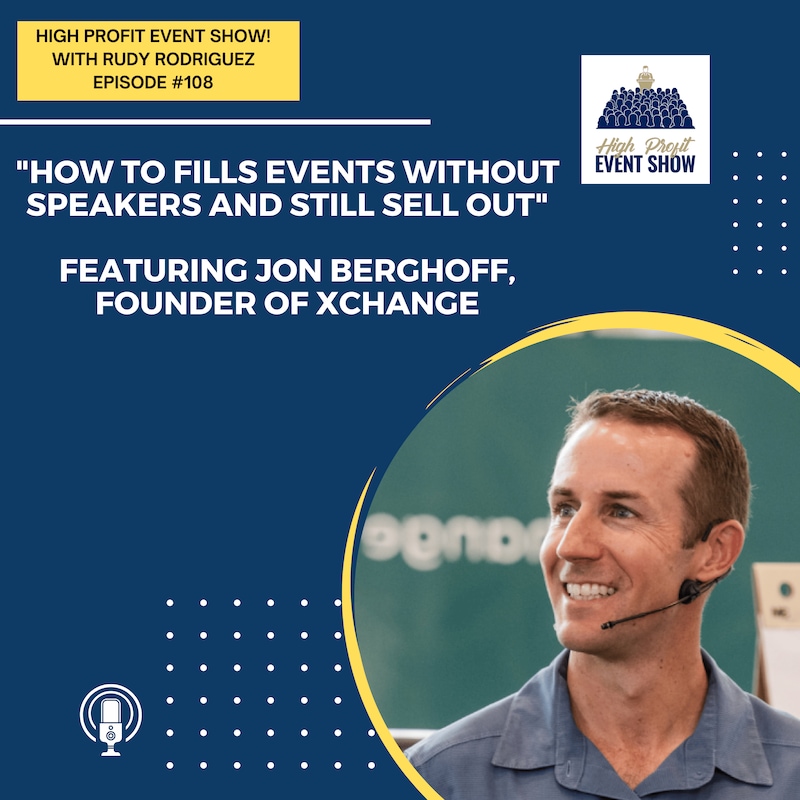
On this episode of The High Profit Event Show, host Rudy Rodriguez sits down with Jon Berghoff, founder of XCHANGE, a globally recognized facilitation company that has transformed the way organizations and communities gather, discover, and grow together. Jon is one of the most respected voices in the world of experiential design and facilitation, having led transformative sessions for major brands like Facebook, BMW, Google, and Conscious Capitalism. Known for earning up to six figures per facilitation session, Jon brings a wealth of insight into what makes events truly impactful—and profitable.
From the very beginning of the conversation, Jon pulls back the curtain on a major shift happening in the events industry. He explains that traditional “sage on the stage” formats are quickly becoming obsolete. With information so easily accessible online, people are no longer paying just to be informed—they want to be transformed. Jon introduces a new model that puts the audience at the center of the experience. His mantra? “Turn the room into the stage.” This approach challenges event leaders to stop thinking like lecturers and start thinking like facilitators of transformation.
Jon shares his powerful framework of designing events around three core forms of capital: intellectual, social, and communal. Intellectual capital provides attendees with new ideas and learning. Social capital facilitates meaningful connections among participants. But it’s communal capital—creating a deep sense of belonging—that becomes the glue that keeps people coming back. According to Jon, it’s not just what people learn that matters—it’s who they become in the process and how they feel seen and connected in the room.
One of the most valuable parts of the episode is when Jon breaks down his transparent enrollment strategy. Without using scripts or high-pressure tactics, he explains how he builds trust and inspires action using three simple steps: gain permission up front, create real-time proof by facilitating a shared experience, and let current students authentically share their own stories. This heart-centered, service-first approach to enrollment has been the foundation of his business growth over the past five years—and it's a model that any event leader can adopt.
If you’re an event leader ready to ditch outdated models and lead events that convert through connection, this episode is a must-listen. Jon’s wisdom, authenticity, and practical insights will completely reshape how you approach event design, facilitation, and enrollment.
Want to connect with Jon?
Register for the XCHANGE Approach Monthly Workshop: https://www.xchangeapproach.com/xchange-approach-workshop/
Website: https://www.xchangeapproach.com/
Jon’s LinkedIn: https://www.linkedin.com/in/jonberghoff/
XCHANGE LinkedIn: https://www.linkedin.com/company/xchangeapproach
Facebook: https://www.facebook.com/xchangeApproach
Instagram: https://www.instagram.com/xchange.approach/
Transcripts
Welcome to today's episode. We have a really special guest with us, Mr. Jon Berghoff. Welcome to the show, sir.
Jon Berghoff:Hey, Rudy, I'm glad to be here. Thanks for having me.
Rudy Rodriguez:Yeah, man, it's great to have you here. I know you came highly recommended by one of our recent guests, Yancy. And man, it's been so wonderful just to connect with you here in the green room just for a few minutes. I can tell that you are a world-class expert in what you do and a fun fact for our audience is when it comes to live events, you're actually considered to be the highest paid facilitator in the world when it comes to facilitating meaningful conversations at live events, sometimes being paid as much as a quarter million dollars to facilitate a two or three day event. I say that not to brag on you, but rather to have our audience lean in. They're like, man, Jon, lean into this episode. He has something to teach, something to learn from you and you become now the founder of a company called Xchange. So as Xchange, you're in the pioneer of the field of trans-racial facilitation and you work with companies like Facebook, NASA, BMW, Women's President Organization. You've worked with over 20,000 coaches, consultants, and community builders to learn how to unlock the learning and the connection and the belonging that's possible in live events. In fact, we were just talking in the room about your event coming up in the fall, in September, which is totally sold out. You can't even get a ticket and the crazy thing about that event is there are no speakers. It's interesting, huh? Yeah, so I'm really curious to hear from you, learn from you here today, from all your breadth of over a decade of experience, your experience with filling live events, and also when it comes to what happens in the room from a facilitation perspective that ultimately makes it a foregone conclusion that they're gonna convert and move to the next program or next event. So super excited to hear, with that being said, I'd love to turn it over to you.
Jon Berghoff:Yeah, well, where to start? I appreciate the kind introduction and I'm grateful to meet you, Rudy. And even though you and I just met, I'm appreciative of what you do and what you stand for because from the research that our company has done or seen, the event industry is both a place where a massive amount of resources are invested. We actually look at multiple industries everywhere where we bring people together. We call that the convening industry. It's trillions of dollars are spent bringing people together and yet the industry is under threat right now. So when you point out that we have an event that does really well and it has no speakers, I just wanna take a step back and say, anybody who either currently does or aspires to make a difference, to be of service through any type of gathering, event, retreat, conference, whatever it is, we can change lives through events and we've gotta pay close attention to the writing on the wall. There's a reason why a lot of people who've been in the event space are struggling now more than ever before. I'm happy to talk about anything that you want from our experience. I just hope it's helpful for whoever listens to this.
Rudy Rodriguez:Absolutely, Jon. One of the things I appreciate about you is your willingness to talk honestly and candidly from your experience. We talked in the agreement about some of the not so glamorous aspects of the industry, especially when getting started. I'd be very curious to hear from you, maybe a little bit about the unglamorous experience you had when you came to filling and promoting your early events. I think that'd be a good place to start and then kind of build a bridge to where you're at today and what's working for you.
Jon Berghoff:Sure, yeah, I'm happy to. Well, this would qualify as the part of the conversation people don't wanna hear because those of us who've learned the hard way and are slow learners, most of what we've learned, we've learned from struggling or failure and for me, I learned to fill events actually by hanging out at a lot of other people's events. Then I was eventually a facilitator of other people's events, which was a very unique path and then I realized, you know what? If I'm gonna have my own events, I've gotta be willing to do the hard work of putting myself in front of other people's audiences, delivering with excellence, and then inviting them to become a part of mine. I know that there's ways to market and advertise and use social media and AI that are all very enticing. But I actually think, Rudy, the part of the conversation that I'm most interested in is what are the things that are threatening the event industry that really should be changing how we think about the way we design an event? Because I think that's the conversation that most people in the event space would benefit from. So if I can just give one example of how our world has been changing and how I think this is like a big red flag, red alarm for you and I. It is the way that information has been, you can use whatever word you want, democratized, commoditized, and of course, tools like AI are making this more obvious that the value of information is going down.
Jon Berghoff:So I think one of the things we need to be wide-eyed about if we're putting on events is that if we're putting on an event and we are designing that event where the majority of the time we're expecting an audience to place value on sitting there, listening to a few people, sharing their wisdom, where we are up against a lot of headwind right from the start. In fact, I'm gonna date myself. I'm 43 years old, Rudy, I don't know how old you are, but there was a time when I had to sit down in front of the television, Sunday night at eight o'clock, because if I didn't, I was gonna miss whatever TV show I wanted to watch. Now your listeners right now either understand this or they don't based on their age. Here's the interesting thing. For those of us who are old enough to remember that we used to have to sit down in front of the television, otherwise we were gonna miss that show, how long ago was it that the technology came around where we no longer had to do that? It was 30 years ago. So my point is this, when it comes to content consumption, the threat here is not something that OpenAI brought to us last year. The threat is that for decades, whoever's watching or listening to this interview right now, they're probably watching or listening at the speed that they want, on the device that they want, at the time of day that they want, and they're gonna re-watch or not, however much they want. So the way people consume content, the way information has been commoditized, we have to expand the way we're designing and leading events if we wanna even survive in the industry, let alone thrive. So that's where a lot of my curiosity is and let me stop and let you take that wherever you want.
Rudy Rodriguez:No, that's great and I'm hearing you say early on in your event career, you went from hanging out at people's events to doing your own event by speaking at other people's events and inviting them into your event. That's how you kinda got your start? Getting in front of other people's audiences, delivering with excellence, as you said, and then bringing them to your event. Can you share with us how that's evolved over time?
Jon Berghoff:Sure. Well, I'm in a very different position today that I wasn't in back at the beginning. Early on, in fact, it might help somebody to understand, before we founded our company and before I was facilitating other people's events, I was an executive for The Vitamix Corporation. They make high-end blenders. I was the head of sales and I noticed that one of our biggest opportunities to solve so many things we were trying to solve had to do with how we put on our sales meetings. I'm going all over the world. When I got there, I was 27 years old. Our product was already in 88 countries. We were already kind of an iconic brand. So I'm now traveling to every continent and I'm responsible for bringing groups of salespeople together and I noticed that we could design and lead these meetings many different ways and what I really struggled with, and it was really stressful for me, was the idea that we'd put on a meeting and everybody would listen to a few people talk to all of us, as though a few people have the answers for everybody else, as opposed to there's so much wisdom sitting in the room. There's so much experience that's sitting in the audience. So our methodology that we teach today or that I've been brought in to lead global summits for the biggest companies, it all began really as an experiment when I was trying to put on better sales meetings and what I discovered during that time, Rudy, is that there's so much wisdom in the room.
Jon Berghoff:If I learn to play a different role, and the role I play is not to be the sage on the stage. What I'm about to say is a confrontation. There's gonna be people that aren't gonna like hearing this. If instead of being the sage on the stage, I'm willing to shift my identity, either for a moment or more, and be the guide on the side that designs questions and facilitates conversations, I now can tap into the heads and the hearts of the people sitting in the room. I can actually turn the room into the stage. I can turn learners into teachers through facilitation processes and that's kind of where things began for me. When I was attending other people's meetings, I just kept noticing how much value was unlocked every time we stopped talking to people, at people from the stage and we started presenting questions and guiding conversations that invited people to learn with and from each other. So that's kind of how this all began and someone could hear this and on one hand, it almost sounds boringly simple. That's it, that's all you got to offer, questions and conversations. Well, it's amazing what it can make possible when we know how to do it. So I'm happy to go wherever you want.
Rudy Rodriguez:Thank you for that, Jon. Yeah, I get the difference between sage on the stage and guide by your side. I like that kind of tagline, easy to remember framework and as far as today, when it comes to filling your events, you're in a different position today. I mean, it kind of almost seems like the events are filling themselves from your previous events. Anything you'd like to say about that specifically or tactically so our audience knows that, what's working for you today?
Jon Berghoff:Yeah, absolutely. I think I know that the sexier or maybe more in demand conversation between you and I would be, how do I fill up my event for the first time? I get it. I would argue that I would tell someone who is, if they're genuinely at the starting point, start smaller and go slower. Don't be seduced by people like me who have a big global community and think I wanna get there fast. What I would suggest instead is to really lean into whether you can get 500 or 100 or 50 or five people to your next event or your first event, how can you lead that event in a way where people undeniably are begging you to tell them when the next one is so they can come back and bring their friends? Because I have no interest in talking with anybody in the event industry who wants to do one event. I wanna meet people who want to do this sustainably, who want to have a healthy business that thrives. So I'll share with you one of the things that we've discovered and that is there's really one of three reasons why somebody would come to any event. This is our model of the world. It's not the only model and you could debate this to the moon and back. But look at it this way. The transcendent reason is somebody wants some part of their future to be different than their present moment. They want something to change. The vehicle through which events enable that are what we consider to be three sources of value, intellectual, social, and communal capital and if I can say something about each of these, this can be illuminating for folks who are really interested in this.
Jon Berghoff:Intellectual capital is just a fancy way of saying, people will go to an event because they want that idea that's gonna solve a problem, help them create a better future, et cetera, et cetera. They wanna learn. I've already pointed out there's a huge disruption in the whole idea that we can package and put on event that's just about one way content that is quickly becoming obsolete and we have to expand and evolve to where, even if learning is the main thing, we at least need to know how to make the learning interactive and experiential as opposed to passive. Because anybody who's delivering the learning in highly passive ways, they're already or soon gonna be struggling to get people to come back. So intellectual capital is people wanna learn, okay? The second reason someone might come to an event is what we would call social capital. We wanna connect. You and I wanna connect with people like you and I who we can have resonant conversations. We can relate, we share values or interests. I'll give you the warning on the social capital because social capital, nobody listening needs me to explain it. Yeah, sometimes I wanna meet other people. That might be where I'm gonna find the value or the solution or partnerships or new opportunities through relationships. When I ask people who put on events, well, when and where and how are you gonna deliver on that relationship building? The answer I hear the majority of the time, it doesn't mean it's everyone listening, but the majority of the time, you wanna know what the answer is, it's not gonna be a surprise. John, it's gonna be during that morning, they call it the networking break. It's really the bathroom break.
Jon Berghoff:From 10:30 to 10, whatever. It's gonna be over lunch from 12 to one. Whatever it's gonna be during the five o'clock open happy bar hour. Rudy, I'm gonna tell you, I'm gonna confess what my inner voice, my team tells me often I shouldn't do this. I'm gonna tell you my inner dialogue when I hear those answers and I'd love to hear your perspective on this. So what I'm hearing is I'm supposed to go from that business and life-changing partnership during that 20-minute break when number one, I need to pee and number two, I'm checking in at home. I'm a dad of five kids. I gotta find out if my 15-year-old is beating the c*** out of my 10-year-old. My break's over. Or my lunch break, when I, an entrepreneur with 13 employees, am getting through 50 emails and trying to check in at the office and I'm stuffing my face full of food, that's when I'm going to go find a mentor or a mentee. Or the open happy bar hour, I'm actually an introvert by every textbook definition. So I go as far from that as fast as I can as possible. So when I hear people saying, yeah, people are gonna connect, what I really hear in that is a good intention, but the actual design is it's gonna happen in the cracks and the crevices. It's a distant priority. So anybody putting on events who wants real connection to happen needs to learn how to design and facilitate meaningful connection as part of the prime time and we can talk about how to do that, but we have to understand the problem we're creating in the first place. If I can add one thing, Rudy, about this idea that there's three forms of capital, intellectual, social, and communal capital. Ideas and relationships are typically the number one and two reasons someone's gonna come to an event the first time the way I see it.
Jon Berghoff:The reason they will come back is something completely different. The reason they will come back is because of this thing called communal capital. So I should take at least a second to explain what is communal capital. Communal capital is, it is both a biological experience, when the nervous system is regulated, when people feel psychologically safe. What we're talking about, by the way, is the experience of belonging and at a moment in time where people are more polarized and divided and fractured than ever before, those of us that know how to architect the experience of belonging in an event, our customers may not realize it, but we're actually delivering on the deepest, highest human need right now. So it's not only biological, this need to belong, it's mythological. If we understand how to create a bigger story, the transcendent purpose for our event in a way that people wanna be a part of that, they feel that experience of belonging. If someone needs a practical explanation, Rudy, here it is. Every human being needs to know, can I be me and fit in with whoever these people are? When we know how to design and facilitate so that people can check that box of belonging, that is the single greatest thing that will get people to wanna come back. The irony is it is also the thing that opens up their cognitive capacity to actually learn and connect with other people. So we optimize everything we do for belonging because that actually makes everything else more possible. So let me stop, because I just dumped a mouthful. Maybe that was too much or uninteresting, but happy to go where that takes us.
Rudy Rodriguez:Too much, possibly uninteresting, I would say no. Very interesting. But that's why, as you said, people can rewind and watch this content as they please. They can record, go back, back and forth, read the transcript, et cetera, because you dropped a lot of golden nuggets there. I love the three different forms of capital that you shared. But I think the key that brought it all home is what has people stay and come back? There's a sense of belonging. My takeaway is also that, what does that mean? That means that someone feels like they could be themselves and be accepted by the people that they're around and I love how you optimize for that. When people feel like they belong, then it engages their full capacity to be present, to learn, to grow and I'm assuming, I think we're kind of getting to that next, the desire to come to the next event, to join you.
Jon Berghoff:Yeah, and if I can offer one edit, because maybe I misspoke, it's not that we want everybody to feel like they can fit in. We want the people who are right for our community, our event, to be able to be who they are and fit in. Because in order to actually create inclusion, you actually have to be exclusive. So I wanna be really clear, part of the key to an event actually having its own identity and sense of community is being really clear on who you're for, but also equally articulate on who you're not for. We don't wanna be everything for everybody because that dilutes and you don't really have culture. We really want to, now we're talking about really what creates community, which is a shared identity.
Jon Berghoff:Community, which is a shared identity and part of that is being clear on, hey, this event, this gathering, this group, this community is for people who stand for this, but it's not for these people over here. That's just as important. We don't want to be everything for everybody.
Rudy Rodriguez:Thanks for clarifying that. Yeah. Inclusion. In order to have inclusion, you must have exclusion.
Jon Berghoff:Yeah. That's it. Sounds like, that's an idea to sit with the yin or yang, light and dark, you got to have both to have the contrast. Yeah. If anybody ever wants to watch me do it, by the way, I do this in public all the time. So because somebody could be confronted by what I just said, like, wait a minute. I don't get that. Or I don't agree with that. Let me give an example. So I put on a monthly workshop to introduce our methodology. I lead it live. It's experiential. It's me and whoever shows up every month and usually in the first 5 to 10 minutes, I check in with everybody and I ask them, hey, are you here? Like, are you really here? You know, people send their robots. Like, if you're here to engage, you're here to engage and if you're not, please find us some other time or place. I literally uninvite people. I'm excluding those who are not ready to engage because it'll actually take away from the experience for those who are. So I'm just pointing out this whole idea of exclusion and inclusion. I do it myself live. I've done it in front of 25,000 people in the last five years and people actually appreciate it. They respect it because we're setting a container through an agreement right up front that, hey, this experience is for those of you who are ready to rock and roll this way, and it's not for those of you who aren't right and who am I to tell you who you are? If you're ready to engage, right, you choose and if it means find us another time, that's fine. So, exclusion and inclusion, when we kind of like get the baggage away from those words, it's actually very practical.
Rudy Rodriguez:I appreciate you giving that very specific real world example with how you do it on your monthly virtual events, which is great. Thank you for sharing that. As far as, one of the main goals people oftentimes have when they have events is to get clients, people come to the event and then they join the next event or they join a coaching program, et cetera, that's like the third piece to the equation. Can you speak to your experience with that and best practice?
Jon Berghoff:Sure. So, what I hear you asking about is, so it's funny, we're going to come back and talk about this and I'm great with it, is what you might call an enrollment event. Would that be correct? So I'm happy. So if you talk to folks who've come through our certifications or our university, we are an open book, transparent, open source. I'll tell you any of our secret sauce. I'll tell you exactly how it's worked for us. So there's three things that are key at our enrollment event. I'm literally about to tell you what somebody could watch me do. It is the only way we've grown our business for the last five years and it's worked really well for us. So when someone comes to our introductory to our workshop, number one is we get upfront permission for whatever the call to action is going to be later on. Would you get, you want me to model exactly how I do that? It's very simple. So, and there's a little bit of a preamble, there's some pacing and use of language devices or whatever you want to call this, but there is a point at the beginning of our workshop in the first 10 minutes, Rudy, where I say to everybody, hey, we are going to rock and roll for about, I don't know, 80 minutes, whatever it is and then at that point, I'm going to tell you I'm all done. I hope you tell me this was worth more than you thought it would be. If you have unanswered questions, I'll stay and answer them. If you want to learn about our paid offerings, I'll stay and talk about them. But if none of you have questions about them, I'm not going to talk about them. That is verbatim. What I say at the beginning of our workshop, there's no bait and switch. There's no pretending that I don't have something to sell. By the way, I don't actually do that every workshop. I don't always stay and talk about our offerings, but if I'm going to, I tell them upfront, I'm going to tell you I'm done.
Jon Berghoff:You can leave. You can stay. If you have questions, I'll answer them. If you don't, I'm not going to talk about what you don't want to talk about. I can't tell you how many people have sent us notes right at that moment in the workshop saying, thank you. Thank you for the honesty. Thank you for the transparency. And what I've come to learn is that I'm building trust. I'm building safety. Their nervous system is now much more regulated because they're meeting somebody who's not hiding anything. I'm just telling them upfront and giving them a chance to agree, disagree, or lean in. Upfront permission is key. That may be obvious to a lot of folks in the event space. I'm going to share with you something we do during our experiential introductions. It might be a lot less obvious. So I'm going to try and describe something that I'd much rather people come witness it live, because it's like telling you what an orange tastes like, which it feels like a failure, no matter what, biting the orange is much better. When we lead an experiential introduction, I give people a live experience of our methodology, which I can't do on a podcast because there's no audience here for me to lead them through a group conversation, but I lead them through that experience. Then Rudy, right at the end of the experience, I ask the audience, this question, what was that like? I ask them to answer that question honestly and if they're willing openly in the zoom chat box, now I have this little exercise that I'm describing. I've done this with tens of thousands of people live on zoom. So I can tell you exactly how it goes. They then put in the zoom chat box. It was this, it was this now because we know what we're doing. Their answers are, it was deeply human. It was safe. It was vulnerable.
Jon Berghoff:It was honest. It was real. It was amazing. It was and then once in a while, someone will say it was too fast. It was clunky or whatever. So my point is this, I lead a live experience of what we teach. Then I ask the audience, you tell me and be honest, what was the, and these are strangers that show up at our public workshops. I have no idea what they're going to, I don't know who they are. I say, what was that like? They put their answers and I sit there and I read their answers. This moment, Rudy is what we call real time proof. I could sit here and I could tell you all the companies who've hired us and all the famous influencers that I've trained, but there's a reason that I'd rather people come to our introductory workshop and judge for themselves because I have a bias, which is I actually want my work to stand on its own as opposed to what I tell people about our work, when people say things like, well, where's the proof, where's the data, where's the evidence when people ask questions like that, those people, whatever you show them, it's going to be the wrong data, you want to know the data people never disagree with their own. So this little exercise that I'm describing is called real time proof. Everybody who does anything in front of groups should learn to create their own example of real time proof, because that moment is more powerful than anything I can tell people about what our method makes possible. I'll give you the third and final thing, which is when I get to the end of the workshop, and it's time for me to answer questions about our trainings. One of the things that I do is I look out into the audience and I see, are there any prior students who are there now, by the way, you can invite prior students to your enrollment events, especially when you do this online and not every time, but many times what I'll do is I'll say, hey, there's folks who've been to our trainings instead of me telling you, I'm going to let them answer your questions or give you their opinion.
Jon Berghoff:I literally, Rudy, if anybody ever watches me lead our two hour intro, I have no scripted sales pitch. I have no canned sales pitch. One out of five people buy whatever we're selling. I have no script. I let our current customers talk to people who are thinking about joining. Is it clunky? Do they sometimes say interesting things? Sure. But there's honesty there. There's transparency, there's believability. Then I'll come in and answer whatever questions haven't been answered. So that's low hanging fruit to me is to let current or prior customers talk to prospects and once in a while, I haven't done this lately, but in the past, I've actually invited customers. I tell them I'm doing an enrollment event online. If you're willing to come join, come and share your experience. There's nothing wrong with that. I'm not controlling or coercing them into what they say. They can speak their truth. I'm inviting them to contribute if they want to. Rudy, I'll stop because you asked about enrollment events and I'm just sharing, these are a few parts of our playbook. There's more we could talk about, but I just want to check, see where this has helped or not.
Rudy Rodriguez:Jon, I appreciate your ask for real time proof right now. It was a great, great takeaway, several great takeaways there. I'm actually going to go back and go through the transcript and I look forward to going back and reading some of the content that we create from this as well. You've given some really clear, actionable items, but to your point, the proof is in the pudding and there's nothing better than actually having an experience of what you're describing. You mentioned you have this monthly event that you do. Can you kind of go into more details about that and just make it plain, plain for the audience? Like, hey, if they want to learn more, if they want to have this experience for themselves, how can they go about doing that?
Jon Berghoff:Yeah. So this has been our number one marketing vehicle over the past five years. So I'm just telling everybody that upfront, it's a marketing event and what's really interesting about it is it works really, really well because not just because it's live and experiential. It's not prerecorded. It's me live. But because we are an open book, we share all of our intellectual property when people show up to these and they're blown away by it and it's controversial. I've hired a lot of coaches of my own and consultants who are like, ah, you give away too much or you should stop short right there. But we've chosen to be a bit contrarian when it comes to the marketing side and a part of that is when people come to these workshops, I facilitate an experience. I share our core operating system frameworks and then when people stay late, I will sit there and offer whatever coaching council answer, whatever questions they have. So what people often comment about when they come to these workshops is universally, they say this is unlike every other workshop I've been to online, probably because there's no slides. There is a 12 page workbook, but there's no slides and they realize how much of it is unscripted. And I'll just say one thing about that, Rudy, there's obviously a plan, but within the plan, I'm modeling what it means to facilitate and to facilitate masterfully is about striking a balance between precision with our process and presence to what's unfolding.
Jon Berghoff:I think that's what people witness and they go, oh my gosh, I don't have to just have two hours of content. I can just facilitate a few experiences that connect learners to their own learning to each other and build a sense of community. So part of why our approach has worked is because we're just modeling what we teach and our prospects get to judge for themselves right there in real time. There's this, this radical element of transparency that I think is a necessity to sell in today's world.
Rudy Rodriguez:Jon, this has been wonderful. Thank you. We're going to be sure to include a link to register for your monthly course, here somewhere around the show notes or the video. So to people listening, this can go, you can click on the link, check out the details, register for the course, have that experience yourself and Jon, can you speak specifically to who this course is for, who would you recommend attend this event?
Jon Berghoff:Yeah. I know your mission is to serve folks in helping them put on impactful, profitable events. I think one of the reasons I'm thrilled to be with you right now is because just about anybody who wants to put on an event that's high impact, that is profitable and sustainable, I think would have a genuine interest in coming and checking out one of our workshops. So really anybody that wants to put on events, and I'll give one other nuance for those that are interested in creating not only a transformational experience from a learning standpoint, but simultaneously want to understand how to build community, our methodology will be really interesting for you. If someone is not interested in the idea of the experience of community, the science behind it, how to create it at an event, you might be less interested because that is a big part of what we are doing is we are leveraging both the biology and the benefits of experiences that are designed around more communal experiences. So hopefully that's helpful.
Rudy Rodriguez:That's wonderful. Thank you. I'm actually looking forward to checking it out myself. I'm going to definitely go and participate in one of your events. Sounds pretty special. Cool. Jon, just any final words of advice you have for our audience here as we wrap up our interview today?
Jon Berghoff:Appreciate the question. Yeah. If there was a topic though, there's a lot that we didn't talk about and one thing we did not talk about is the art of facilitating. I think facilitating group experiences is, it's probably one of the more under appreciated, under valued competencies when it comes to events and if anybody were to come to our workshop where you get to take home some of the tools that we teach and go try it for yourselves or you're just going to go start facilitating conversations, which is fine. I would give an encouragement, which is to remember that, you can get trained on the art, the science of question design and how to choreograph conversations and how to move people in and out of experiences where they become peer coaches. You can learn all that stuff and what is of equal importance is the place from which we operate as facilitators and what I'm talking about is what's motivating us. What are our true intentions? There's a saying that we use with our students, Rudy, which is when we are given the privilege to lead, teach, or convene a group to remember, to make sure that everything that comes out of our mouth is tethered to our hearts. If people know that we care about their success and their wellbeing, they can feel that genuine concern and that compassion I have found that can more than make up for whether or not you are highly skilled with all the types of techniques and tools and processes that somebody like us teaches.
Jon Berghoff:So just remember that people's internal radar, their deeper intuitive knowing will pick up on if we are coming from a place of genuine care, it can make up for a lot of other things when we're putting on our events. So hopefully that hits home for the right person.
Rudy Rodriguez:I appreciate it, Jon. Thanks for the final takeaway there, coming from the heart, whatever we're doing. All right. It's been a pleasure to be with you here, Jon. It's been a wonderful episode. I look forward to going back and listening to this one myself again and for the audience here, I encourage you, invite you to go to Jon, the website, you can check it out here near the episode, register for his virtual workshop. Check it out. Jon is a real deal world-class. He is one of the most highly paid facilitators in the world. Gets paid up to a quarter million dollars to facilitate a three day event. So he's somebody that I personally would look forward to learning from, and I invite you to as well. Thank you again, Jon. It's been a pleasure to have you on today.
Jon Berghoff:Thanks Rudy.



