Shownotes
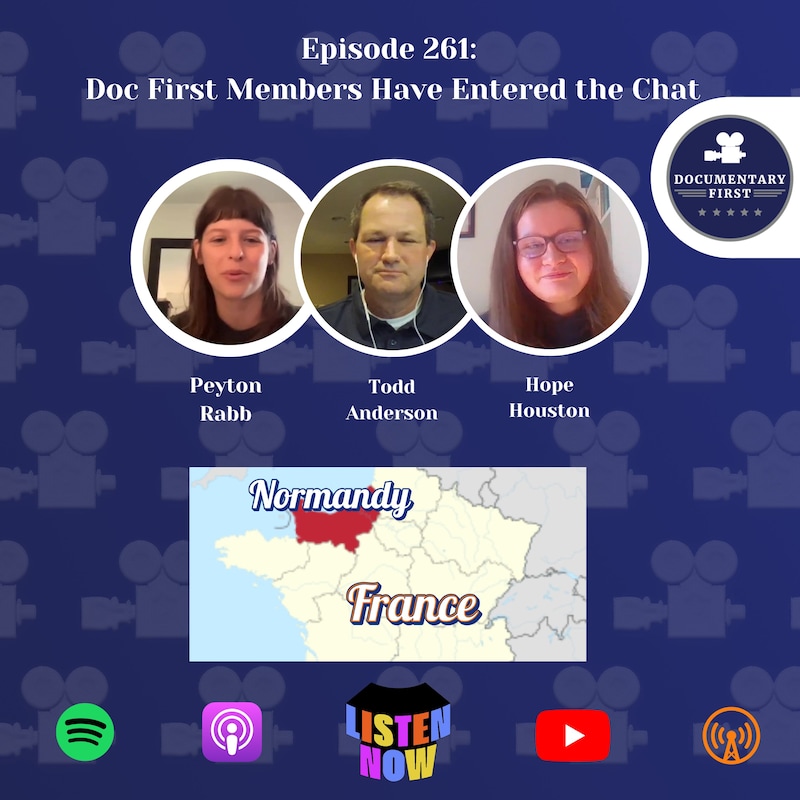
In this episode of Documentary First, host Christian Taylor opens up with heartfelt personal updates and reflections on the journey of documentary filmmaking. Fresh off a moving trip to Normandy, Christian is joined by team members Peyton Rabb and Todd Anderson to share stories, challenges, and unforgettable moments from the experience.
Together, they explore how veterans continue to impact younger generations, the role of gratitude in storytelling, and how filmmaking shapes not just the audience but the filmmakers themselves. From moments of humor and surprise to deeply emotional encounters with history, this episode captures the resilience, growth, and transformative power of telling true stories.
Sponsor: Virgil Films http://www.virgilfilms.com/
Support us by buying merch or watching our films: https://documentaryfirst.com/
Transcripts
Welcome everybody to Documentary First.
2
:I'm your host, Christian Taylor.
3
:This is a podcast where we talk about all things documentary and documentary filmmaking.
4
:However, lately we've been talking about a lot more than documentary films.
5
:Sometimes we bring in narrative filmmakers and just talk about filmmaking in general.
6
:Today we're going to talk about our company Documentary First Productions and give a
little bit of a company update.
7
:We went to Normandy back in May and haven't had a chance to do a production update.
8
:So today I am joined by two of my team members, Peyton Rab.
9
:Last year was our team intern and she joined us again this year for part of the trip.
10
:We're delighted to have you with us today, Peyton.
11
:Thanks for being here.
12
:course, happy to be here.
13
:And we are also joined by Todd Anderson, another one of our team members.
14
:So excited to have you with us, Todd.
15
:This was his first trip to Normandy.
16
:And for our first time being with us sort of on the road, showing the film and seeing how
all of the machinations of our company work.
17
:So Todd, great to have you here.
18
:Can't wait to hear your thoughts and insights on this trip.
19
:Thank you.
20
:um Also, everybody, before we begin, I just want to give another little bit of a company
update.
21
:As we are recording right now, it's September 5th.
22
:So it has been a bit of time since I recorded last.
23
:The last podcast I recorded was on June 26th, actually.
24
:We had gotten back from Normandy, but only by about two weeks.
25
:And I was set to have major surgery, cervical spine surgery, actually.
26
:It's something I'd been putting off for quite a while.
27
:I'd been experiencing some major symptoms of actually walking like a drunken soldier, not
really being myself.
28
:My equilibrium was all off.
29
:My arms were uh really numb and hands were, uh you know, I hadn't much feeling in my
hands.
30
:And so that surgery was set for June 30th and it was going to be in Utah and it was going
to be, you know, a long recovery.
31
:And three days before that happened, uh actually two days before that happened,
32
:I had my big interview with Steve Cohen about the And So It Goes film.
33
:And we talked about uh just all things Billy Joel and uh the film And So It Goes.
34
:If you have not listened to that podcast, it's a two-part podcast, actually.
35
:I encourage you to do so.
36
:If you haven't seen the documentaries, uh totally go and watch those documentaries on HBO.
37
:They're fantastic, especially if you're a Billy Joel fan.
38
:uh On that podcast, one of the things that I talked about is how I was struck by Billy
Joel's relationship with his mother and how he talked about that relationship in such a
39
:respectful way because his mother had uh emotional and mental challenges.
40
:And it was on the one hand, something that was really very difficult for him emotionally
and I think impacted his life in a very challenging way.
41
:And yet on the other hand, she was like the wind beneath his wings.
42
:She really was oh the one who believed in him and the one who gave him a lot of his uh
creative energy.
43
:And he really thanked her for that.
44
:And he talked about her so respectfully uh and was honest about, I think, her
difficulties.
45
:And I was impressed by that.
46
:And that was one thing that I mentioned on the podcast.
47
:But I was a little bit trepidatious about saying anything.
48
:And I started on the podcast by saying, I hope my mother doesn't listen to this podcast.
49
:um But then I really didn't go into much more um simply because I had a lot of the same
issues with my own mom.
50
:ah But we worked through those issues many years ago.
51
:My mom got healthy and I got healthy and we worked through a lot of stuff and ended up
having an extremely
52
:close relationship.
53
:That podcast went pretty late into the night.
54
:I just was on a high.
55
:I was so excited.
56
:I had a good friend here and we talked through the night about how wonderful it was.
57
:And I woke up the next morning ready to pack my suitcase to go to Utah for this surgery.
58
:And at eight 20, I got a phone call that would change my life.
59
:And it was my little sister Anne and she called me to tell me that my mom had died.
60
:And, um, of course that was incredibly shocking and, I didn't believe it at first and it
was devastating, totally devastating.
61
:And I immediately recognized the irony of, you know, this high, high experience and what I
had said the night before.
62
:And then what was happening in that moment.
63
:And of course I had.
64
:this huge thing that was about to happen to me and I had to decide was I going to go
forward with that or not.
65
:And actually I had no choice.
66
:It was a surgery that had to happen and my mom would have wanted me to have it.
67
:So I did go forward with that.
68
:But what that meant was for the rest of the summer uh I was oh battling back from a major
uh emotional blow as well as a major physical
69
:challenge.
70
:um so that's why you've been listening to other things other than me recording podcasts.
71
:um And we have been replay replaying uh wonderful podcasts that we had done earlier with
the movie Rob Minnett on his show that our audience had not seen.
72
:And we'd really wanted to show those earlier.
73
:So hopefully people have listened to those and enjoyed them.
74
:um
75
:But I did want to share that because, um you know, when that happened, everything changed
for me.
76
:um Whenever you lose someone like that, I think it brings incredible clarity to your life.
77
:um And that really brought incredible clarity to my life.
78
:It put a lot of things into perspective for me, work being one of them.
79
:I think when you lose somebody that close to you, you realize that um nothing is as
important as the people that you love.
80
:um not even work that you care about, like I care about um filmmaking.
81
:So it will be interesting to see how my work life proceeds forward.
82
:I know that this podcast is one thing that is incredibly important to me.
83
:I do love um bringing filmmakers on and talking about um film and helping other filmmakers
be better.
84
:So this is certainly going forward.
85
:um But I wanted to share that so that our audience knew kind of what's been happening over
the last few weeks.
86
:Now,
87
:Going forward, I'm happy to have another one of our interns.
88
:This is our intern Hope Houston.
89
:She joined us this year.
90
:Hi Hope, how are you today?
91
:Good to see you, glad to have you here.
92
:So Hope is from Laurel, Mississippi, my hometown.
93
:And we met when I went down to show our film.
94
:Hope was actually the reason that we had a screening in my hometown, Laurel, Mississippi.
95
:uh Interestingly enough, Hope went to Normandy last year, but
96
:didn't meet me or Peyton.
97
:Instead, she saw the girl who wore freedom on the plane ride home, went home and then
hope, I'm gonna let you finish the rest of the story.
98
:What happened next?
99
:So I went home and I volunteered at this museum that has a World War II veteran that comes
in every Thursday.
100
:And he showed me a flyer for your film, The Girl Who Wore Freedom, and was like, Hope, you
know, you just got back from Normandy.
101
:I love this film.
102
:I think you need to watch it.
103
:uh The lady who made it, Christian Taylor, is from here.
104
:And I was like, wow, that's really cool.
105
:I was like, I saw this actually on my flight.
106
:like what a small world.
107
:And so, but at that time I didn't realize you were from Laurel.
108
:And so anyways, I reached out and told you how much I enjoyed the film.
109
:And we talked about doing a screening in a few, I think it was two weeks later, because
you were coming to Laurel in two weeks.
110
:Two weeks later, we had a screening and
111
:Yeah.
112
:You had called and said, you know, I heard that you were coming and I was like, how did
you hear that?
113
:Anyway, I was like, can we do a screening?
114
:And I'm like, tried to do that before.
115
:Nobody's really interested, but if you think you can get an audience together, I'll be
there.
116
:And you know, she did, she filled up the, world war two veterans museum.
117
:She and her mom were amazing and they got an audience there and they had this amazing food
spread.
118
:got.
119
:three World War II veterans there, I think that night?
120
:Yeah, yeah, you did.
121
:And uh it was very, very memorable.
122
:But the thing that really blew my mind was this young woman who cared so much about
history and teaching others that she was that passionate and able to do that.
123
:So I said, hey, do you want to come with us to Normandy?
124
:And she said, yes.
125
:That was an incredible blessing to us.
126
:Me in particular.
127
:Um, I think what I did not expect is that I was struggling so mightily with the physical
problems that I had that hope became really, the person that kept me alive and going and
128
:able to do the whole summer, or the whole two weeks that we were there.
129
:Um, and that became crucial, because, um, we had so many challenges.
130
:I have never had as many challenges in Normandy as we had the summer at never.
131
:Never, not ever have I ever had.
132
:mean, normandy is always challenging, but this summer took the cake and I'm not really
sure.
133
:Maybe our veteran was older for sure.
134
:We had more people on our team than we'd had before.
135
:um We had, I took my son Hunter, who was in the military and who has very high
expectations about military protocol.
136
:And so you have a military officer who wants everything to be done by military protocol.
137
:And you have a creative filmmaker who's in charge of event in Normandy.
138
:And oftentimes those things clashed.
139
:So that was challenging.
140
:And then we had a van, that uh van problem that was really the, just the, think it was.
141
:really the source of a lot of trouble that ended up being uh taken up a lot of Todd's
time.
142
:um but when I look back at our time in Normandy and I look at the challenges that we
overcame, what stands out to me more than anything else are the lives that we touched
143
:while we were there.
144
:And um we're going to talk about what I asked our team here to think about are the two
moments
145
:that stand out to them most.
146
:And I'm gonna share mine, you know, as we go through, we're gonna do a round robin, sort
of, where we just all share one moment and then share the second.
147
:And we are going to just talk about, you know, what we saw and what stood out to us.
148
:And I do this because I want you as filmmakers to think about this.
149
:I made a film, this film actually began 10 years ago.
150
:It was 2015 was my first trip to Normandy.
151
:2016, the idea percolated that I wanted to make a film.
152
:2017, I started researching and went over for a first two week research trip like
pre-production.
153
:Can I really do this?
154
:Will I have access?
155
:And 2018 began raising funds and started to film.
156
:And 2019 had the rough cut done and screened it in Normandy.
157
:And 2020, it was released during COVID, which was not good.
158
:So anyway.
159
:It's been sort of out on the market since 2021 actually.
160
:And the whole point of releasing a film into the world is so that it can make a difference
and so that people can see it.
161
:And you you think by the time your documentary is released, you release it, you give it to
a distributor, you go on and you make your other film.
162
:And that's what I thought would happen.
163
:And here we are five years later and I am still even in October going to France again to
do it.
164
:screen more films, screen more schools, take this film again.
165
:It just has not stopped.
166
:um And I can't be more happy about this because um you really do want to um affect
people's minds and behaviors when you make a documentary film that you're passionate
167
:about.
168
:So um I wanna talk about that change, that effect that it had this summer.
169
:um
170
:And I'm doing that in hopes of inspiring filmmakers to realize when you are passionate
about a project and you want to change people's hearts and minds, uh it can have this kind
171
:of effect.
172
:So that being said, who wants to go first?
173
:first.
174
:All right, Peyton, thank you for jumping in.
175
:All right, Peyton Rav, ladies and gentlemen.
176
:Peyton, tell a little bit about yourself.
177
:Where are you right now?
178
:What's happening?
179
:um I am a fourth year at UVA, University of Virginia.
180
:I'm in Charlottesville right now at school.
181
:em I went to Normandy again this past year, even though I wasn't the intern, because I was
studying abroad in London for school.
182
:So I figured I'd go a little bit early, a couple of weeks early, and em go along with the
team again and see CO.
183
:So.
184
:Let me interject.
185
:I'm sorry.
186
:I know it's your story, but I have to say this one thing.
187
:You were really there only because when I saw CEO and I went up there to, uh, to do the
first, to do a podcast with him actually, um, and to help him because he had a sign that
188
:he wanted to put up there to dedicate to his battle buddy.
189
:He said he wanted you to come.
190
:Where's Peyton?
191
:Can she come to Normandy?
192
:That is why you were there.
193
:He loved you so much.
194
:Yeah.
195
:I'm a bit on a college student budget, so I can't just go to Normandy all the time as I
would, but I was already going abroad and so it really worked out for me.
196
:is like, these experiences don't happen all the time and he's very supportive of you.
197
:Yay, Travis.
198
:He's so in support.
199
:Thank you, Travis.
200
:You're listening.
201
:em So, yeah, it was just an incredible experience.
202
:And it was really different this time because the last time I met Mina was there working
out as an intern.
203
:But then this time we sort of struggled even like listing out on paperwork like what my
role was there because I was really just there to like help out and see people.
204
:yeah, just sort of help where I could.
205
:em when it got kind of wishy washy and we had this whole big team.
206
:I think Christian, ended up listing me as like CEO's granddaughter on some of the forums.
207
:And so.
208
:the other thing that was weird was that you did get sick early on and that threw
everything off, I think.
209
:Yeah, that was a whole hot mess.
210
:don't know, jet lag, some sort of sickness.
211
:Then
212
:you immediately, you got there and as his granddaughter, you were the only one allowed up
in the C-130 flight because that was a hot mess.
213
:And so many things changed.
214
:Here's the other thing that changed.
215
:We had a new president this year and that changed so many things.
216
:Um, it just was a very different experience and, um, that was one of them.
217
:Only you were allowed to go.
218
:Yeah.
219
:so definitely, I mean, that's one of my favorite memories, even though I was sick on the
plane the entire time, which didn't happen last year, so we couldn't have anticipated it.
220
:But being able to go up there with CEO again and just watch him and he gets to sit in the
front and like look out the windows like that I know is just the most incredible
221
:experience for him because when he was on a plane the last time like before Normandy of
last year, was
222
:he was injured and he was flying out from the war.
223
:And so it's just really cool to see him there experiencing that again with like the
biggest smile on his face.
224
:So definitely one of those em life-changing moments.
225
:Yeah.
226
:And that was actually not only, you know, the last time he was in a C 130 really, it was
the very first time he was ever on a plane.
227
:He had been shot up and by this bomb or whatever, and he was evacuated on an airplane and
that was the first time he'd ever been on a plane.
228
:Yeah.
229
:So, yeah.
230
:Yeah.
231
:So, okay.
232
:So would you say that was your first moment you want to share?
233
:Yeah, I don't know.
234
:There was just something about being there with CO and I was the only one able to go with
him and like one of the only people able to go with him.
235
:And so it was this big plane and it was just CO in the front and me having the experience
of watching him enjoy that moment.
236
:So yeah, that has to be one of my favorites.
237
:We had a big team that went last year.
238
:mean, Danny and flow went and all of our staff went and it really was, I mean, you were in
a very, you know, special position this year as his granddaughter.
239
:I mean, and, and in a sense you were, mean, you, he treated you that way.
240
:He loves you like that.
241
:So pretty cool.
242
:All right.
243
:Who wants to go next?
244
:I can go.
245
:all right, Todd, jump in there.
246
:Okay, yeah, I'm Todd Anderson.
247
:I'll go ahead, yes.
248
:I'm Todd Anderson.
249
:I've been helping uh with Christian's team here over the last couple of years off and on.
250
:And I had the opportunity, I had a couple of weeks open and she was looking for some
additional help with the trip to Normandy.
251
:And it's a place I hadn't been or at least a region of France I hadn't been to before.
252
:um Hadn't seen any of Normandy previously and...
253
:uh
254
:was quite interested in doing so and you never know when you're going to get there.
255
:uh And I was, was, hopefully I could be of some help as, as they, as they try to manage
those two weeks with, with, with everything going on and all the people and all of the
256
:events.
257
:And uh that was, that was quite amazing.
258
:And Christian had put together quite a calendar for us and it was a little difficult to
envision what it was going to look like, but yeah, every day was hectic.
259
:Every day there was something we were running off to.
260
:uh
261
:because every town and every event they wanted to see CO.
262
:And so it was lot of fun to uh be with CO and to uh just to see the perspective that they
have of our US vets or the vets that came to save them back on D-Day.
263
:um
264
:The couple of moments that come to mind for me were a couple that were unique.
265
:And for me, I had a lot of memories because this was my first trip over there.
266
:so a lot of these events uh were a first.
267
:um One of the unique experiences, well, first of all, I think for the whole team, what was
new was going to the lower valley.
268
:So when we left Paris, we went to the lower valley, which is...
269
:a bit south of Normandy, not on the coast.
270
:It's more inland, more farmland, um but a region that had some folks who were interested
in meeting SEO, in honoring um our veteran.
271
:And I'm sure they've always had some periphery to the Normandy events every year, but
within their region, they certainly have their own history of remembering those days and
272
:appreciating what...
273
:to what happened.
274
:So they had invited our team down there to uh be part of their celebrations.
275
:And it was amazing to see how well they set us up and took care of us while we were there
um and all of the festivities that they had around it.
276
:And I know they have a lot of people there that are experienced in the days.
277
:Todd, stop, stop, Todd, stop.
278
:So we lost you for a while.
279
:And so we, um we had to stop.
280
:So do you guys remember what he was saying?
281
:He was just talking about the lower valley and getting there and kind like the people's
mindset.
282
:And that they were excited.
283
:say, okay, everybody.
284
:Yep.
285
:So we had a little, we had a little glitch and we're going to jump back in.
286
:Todd, you were saying that you were seeing the people's mindset in the Loire Valley and
that it was very impressive.
287
:Yes, yeah, so it was great to uh travel the lower valley.
288
:uh still hadn't been to Normandy at that point, but I think for the whole team it was an
opportunity to see a new region and for those folks in that region to have an opportunity
289
:to meet our veteran and to have their celebrations, but this time with a veteran from the
US.
290
:And our veteran, CEO Bauer, was the only veteran there.
291
:So it uh was uh pretty wild to see how well they took care of us while we were there and
how well they revered CO.
292
:And there were thousands of people there that we had a chance to meet and so many of them
were so moved by the fact that this veteran was in front of them for many of them.
293
:It was the first time they'd met a veteran.
294
:and they understood the history.
295
:They knew the importance of everything that happened.
296
:They understood that this was France and it was still France because of what had happened.
297
:So uh it was impressive and amazing how much was put together for our little visit, a
handful of folks that came out to meet them.
298
:One of the experiences we had there and Christian and I were the only ones that had the
opportunity to ride in a parade.
299
:Yeah.
300
:so we had finished up a celebration and it had a full morning and most of the day, think,
uh and warm out.
301
:And so most of the team had gone back to take a rest.
302
:And uh we were asked if we wanted to ride in the parade or go see, actually it was just to
go see the parade.
303
:everybody was like, do you want to go see the parade?
304
:I thought I knew it was right in the parade and everybody was like, no, we're going to go
back.
305
:And I was like, yes, please.
306
:Yes, please.
307
:I want to go.
308
:And Todd's like, yeah, I'll go.
309
:And I was like, I love you.
310
:I love it.
311
:Yes, let's go.
312
:Yeah, so and at first I think it was we're just going to go see the parade and then it
became, wait a second, we've got a couple of seats on this this Jeep or truck.
313
:uh Do you want to ride in the parade?
314
:Well, sure.
315
:Well, when I think of a parade, I think of a parade in a little town back here in the
States, maybe on the Fourth of July or uh Memorial Day weekend.
316
:And usually it's a you might have some floats and some trucks and so forth.
317
:And they kind of go through town and it might be, uh you know, it might be a mile long,
slow process.
318
:oh to drive through the center of town and everybody's waving and throwing candy and so
forth.
319
:And in this case, was, we all got onto military, military jeeps and trucks and different,
different vehicles.
320
:Yeah, World War II era, more than I probably ever seen in one place.
321
:And we all went on this track and it turned into what seemed like a 30 mile, uh had to
have been more than three hours.
322
:Thank you.
323
:through the countryside and through every little town within their county or region or
province or whatever, uh where they were set up to have this celebration and just people
324
:all over the place uh waving and with all the reenactors amongst us.
325
:So that was just a unique experience.
326
:I sat in the truck, thought it was gonna be something and it turned into.
327
:Some completely different.
328
:had, what do we have helicopters and airplanes flying right over top of us.
329
:it was, it was off the hook.
330
:mean, it was crazy.
331
:Like we just kept looking at each other going like, is this for real?
332
:Like it was really like beyond the imagination because we ended up, uh I don't know after
the events and these events were Chateau Renault is one town and the other town is, um,
333
:Montoir sur le Loire.
334
:So these are two towns that are in the same region and they do things together.
335
:And they're about 30 minutes apart.
336
:But this is where our whole events took place.
337
:One day, one Saturday, it was in one place.
338
:Sunday, it was in the next place.
339
:And um we had on Saturday, we ended up at this big, huge farm.
340
:And so our event was under this barn.
341
:and out in this area outside, you had amassed all of these vehicles.
342
:there were like all of these, if you've seen them, the French resistance cars, you see
them in the black and white photos or videos or whatever.
343
:And then all these other army trucks that you see and all these people, all these like
hundreds and hundreds of reenactors, like I'm not exaggerating here.
344
:And then they start driving out and I'm looking at this line of cars and Todd and I are in
the back of this gigantic truck.
345
:with a team of people who are reenactors, but there's also a group of people filming in
there.
346
:Fortunately, they spoke English and they were explaining to us what was happening.
347
:And he's not kidding.
348
:I think we were there for two hours and over us helicopters were flying over filming us
and these World War II era planes were kind of doing like waving and flying.
349
:And then at the end they had, they had parachutists.
350
:that were jumping out with, and they were doing a thing where this was recognizing all of
the allies.
351
:And so they had people that were jumping with a Canadian flag, with a French flag, with
the Polish flag, think.
352
:and it was a French flag, Canadian.
353
:It was just crazy.
354
:was, it was so amazing and it was beautiful, Todd, right?
355
:We just kept looking at each other going.
356
:I mean, everybody missed out.
357
:Like this is one of the most
358
:memorable, special.
359
:I almost fell out of the truck 15 times.
360
:That's so fun.
361
:it was unique and it was another example of where they in that region of France or in a
couple regions of France seem to celebrate our veterans more than we typically have.
362
:And there's good reason for that.
363
:I mean, from the standpoint that their lives and their world, their whole world over there
was truly impacted by the war and D-Day.
364
:Yeah, and they also along the route, everybody came out.
365
:They came out of their windows.
366
:They were on their intersections.
367
:They were standing out in their towns.
368
:They were lining the streets.
369
:Like that's how they did a parade.
370
:Like everybody just lined the routes that we were driving and waving flags and cheering us
on.
371
:was ah remarkable.
372
:One day I may make a documentary about that.
373
:It would be amazing.
374
:Okay, so um that is one of your things.
375
:We'll come back to you.
376
:Peyton unfortunately has to leave us early.
377
:So Peyton, what's your second big memorable moment?
378
:So my big memorable moment isn't like a parade, I just always, when I come home, what I
remember the most is the moments like having breakfast when I'm drinking tea and eating a
379
:croissant.
380
:And I look over and Seo is not eating yet, but he's writing down in his diary all of the
experiences that he's had.
381
:uh
382
:It's in those moments where everything's sort of more still and like not chaotic for a
second that I'm just realizing like how much Seo really gets out of it because he just
383
:wants to record everything and he's asking like, who was that mayor we met the other day?
384
:And we're like, Sarah, S, A, R.
385
:it just, those are my favorite moments because they're so funny and they're also so sweet.
386
:So that has to be another big one.
387
:you know he's kept a diary every day since like 1940, since the war.
388
:So he has like volumes and volumes and volumes in his house.
389
:Like my plan is to publish those things.
390
:Like, can you imagine what they say?
391
:Like I've talked to his family, like I cannot wait to read those things.
392
:And we're gonna be in it, you know?
393
:Can't wait to see what they say.
394
:Anyway, that's awesome.
395
:Yeah, it's those small moments, Peyton.
396
:you realize how special and fortunate we are, you know, to sit with this guy.
397
:You know, he called, I called him like two weeks ago on a Sunday because at the end of the
trip, he fell.
398
:Remember that?
399
:And he hurt his knee in the middle of the night getting up.
400
:And, um, I was really worried about him.
401
:And when he got home, did you know he got COVID?
402
:No.
403
:had COVID the whole time ever.
404
:And he got COVID when he got back.
405
:Nobody else did.
406
:I don't know how it happened.
407
:I don't know if he got it in the airport going home.
408
:I don't know what happened, but he got COVID and lost taste and he was really sick.
409
:And then the heat happened and he didn't have air conditioning in his house and he was not
good.
410
:But I called him a couple of weeks ago and he sounded so strong and so happy.
411
:And he sounded like full of energy and life and
412
:We this hour long conversation just like, like always.
413
:And, and I was like, see you, you sound so great.
414
:Like I'm so happy you feel better.
415
:And he began to tell me a story about how the day before he had heard that there was a uh
veteran fundraising thing at, it was sort of like this dance.
416
:And so he went and he doesn't normally go to these things in his town and he realized that
it was free for him.
417
:And he got to go and he went and he goes, you he was telling me about how, and I gave him
my spiel and I told them, you know, and I, and he just told me that he did everything.
418
:He's like, everything I did in Normandy, I did there.
419
:And they, they ate it up.
420
:And I ended it with Vive la France.
421
:be, know, Viva USA and long live the United States of America.
422
:And I said with him, you know, and our free world allies, because that's what he always
says.
423
:And, you know, I could just tell like that had just given him so much energy even to the
next day, because that's what he feels like he's here for is to continue to inspire
424
:others.
425
:That's what he can give back.
426
:And um that is what, you know, I mean,
427
:I'm going to go ahead and share one of my most memorable moments is this was near the end
of the trip.
428
:were wrapping up in Normandy and I was with Thomas Boisson and he is one that's been with
me from the very beginning, one of the French reenactors, but now he's become part of a
429
:producer team.
430
:we were in St.
431
:Mary, Gleaz.
432
:We were in the square after a big parade.
433
:And I pushed CO2 to the middle of the square and French people were just like surrounding
him.
434
:Like, mean, flies on, you know, I don't know, manure.
435
:So that's a terrible, terrible, terrible example.
436
:But that's what it was like crazy.
437
:And I was trying like to have a circle around him, like to push people back because it was
just insane.
438
:you know, Toma was there with me.
439
:We had three or four or five American soldiers trying to push people back and create some
440
:order to get people to have pictures and sign things.
441
:And Tomah looked at me and he said,
442
:Do you realize how many memories you are creating for French people to have for the rest
of their lives?
443
:And I was like, I just was like exactly like I am now.
444
:I like stood there and I was like, holy cow, this is like at the end of the trip.
445
:And we had been doing this for 12 days and we started in the Loire Valley.
446
:at one point, and Peyton, I wish you had been there.
447
:We were doing the same thing.
448
:This was the beginning of the trip.
449
:We were at this big, you know, barn and I'm standing there with CEO, you know, trying to
help people get signatures.
450
:And there was this young boy there and he was probably 19.
451
:He ended up being in the truck with us randomly later.
452
:And, uh, he, he was too afraid to take a picture.
453
:And I was like, don't you want a picture?
454
:He's like, Oh, no, no, no.
455
:It's my first veteran.
456
:And I was like, what?
457
:You've never met a veteran.
458
:He's like,
459
:No, I'm like, go get your camera.
460
:He's like, I'm gonna go get your camera right now.
461
:Because I knew that those moments are so special because I've seen people show me the
picture of the moment they met their first veteran.
462
:Like it's huge.
463
:And so I made him go get his camera and I took a picture.
464
:Later in the truck, I was telling the camera, the film team, I was like, you know, I met
this guy, I told him the story and the French person turned to me and he said, well,
465
:that's true for all of us here.
466
:The American veterans don't come here.
467
:They didn't pass here.
468
:There's no battles here.
469
:They just would pass through.
470
:So basically none of us have ever met a veteran.
471
:And I was like shocked, but it explained why everybody was just so over the top about
meeting him.
472
:And I thought without our team, without our film, you know, without the commitment of CEO
to go over there, you know,
473
:They would not have had the opportunity to thank, and this is what it comes down to, they
would not have had the opportunity to thank a veteran for their freedom, which for them is
474
:everything, right?
475
:And so that moment for me will stick in my head forever.
476
:And I told CEO that, I said, CEO, you you just got to think about, think about all the
people.
477
:that you have all the autographs you've signed, all the people that you've talked to, all
the photographs you've taken, not just this trip, but last trip.
478
:you know, think about that out of all the lives that you've touched.
479
:And he goes, yep, it's my duty.
480
:Which is what he always says.
481
:It's my duty.
482
:It's not for me.
483
:It's for all the people that couldn't be here.
484
:Love him.
485
:Hey, Christian, I've got to pop off, but thank you so much for having me.
486
:Bye.
487
:Me too.
488
:All right, Hope, you've been so patiently silent.
489
:Talk to me about your most memorable moment.
490
:ah That's so hard.
491
:ah There are so many moments I feel like I could talk about um But if I had to pick one
right now it would be I'm not a big crowds person like huge crowds a lot of noise all of
492
:that So I enjoyed like the more like when it was smaller groups and the more meaningful
connections I remember there was one morning when we were in Normandy just getting ready
493
:for the day
494
:And know how it's always crazy checking off our list, making sure we have everything
before we run out the door.
495
:um But I had the opportunity to sing at some events and Mr.
496
:CEO was like, uh Hope, you know, I really want to sing with you.
497
:And I was like, yeah, let's do it.
498
:Like, what do want to sing?
499
:And ah I think he said, we'll meet again.
500
:And I was like, 100%.
501
:Like, I will sing with you.
502
:And that moment of just
503
:It was just so surreal.
504
:We were just in the kitchen singing, you know, uh a World War II song ah that we both
loved dearly and there being like, what, an 80 years age gap between the two of us.
505
:But it didn't really matter.
506
:And it was just so special to just have that moment and have that memory.
507
:um Yeah, it's something I'll always treasure.
508
:Remind me of that song again.
509
:How does it go?
510
:well, it goes, we'll meet again.
511
:Don't know where, don't know when, but I know we'll meet again some sunny day and on and
on and on.
512
:But yeah.
513
:And keep going, please, please, for our audience's enjoyment.
514
:Sure.
515
:Keep smiling through, just like you always do.
516
:Till the bluebirds drive the dark clouds far away.
517
:And won't you please say hello to the folks that I know?
518
:Tell them I won't be long.
519
:They'll be happy to know.
520
:Right as you saw me go, I was singing a song.
521
:Oh, we'll meet again.
522
:Don't know where, don't know what.
523
:I think I messed up the words, but that's the concept.
524
:That's okay.
525
:You know what?
526
:I actually think I may have filmed that and if I can find it and I did, then we might put
that up somewhere.
527
:That would be really cool.
528
:Yeah.
529
:Those special moments with CEO, you just can't beat them.
530
:That's for sure.
531
:Uh, you know, then and the stuff that he says and the lessons that he teaches just when
you're with him, can't beat it.
532
:That's for sure.
533
:really the second, if you want to move into the second suggestion I had, it was along the
same lines of both Hope and Peyton.
534
:uh It wasn't a specific moment.
535
:We had a lot of different events in Normandy, for example.
536
:uh Every day has its stories and uh issues, trials and tribulations and so forth.
537
:But I had the opportunity to drive CO's van.
538
:for a lot of the trip.
539
:And so there were a lot, and I didn't really think about it until after I'd been doing it
for a while, but there were a lot of days where as we were going to the next place and the
540
:next place and the next place where I was sitting right next to CEO and he was telling
story or he was trying to teach me something or he was uh trying to remember something
541
:else from the day, if you will.
542
:And so I think just...
543
:uh
544
:I wrote down driving, driving Mr.
545
:CEO.
546
:So it was kind of like driving Ms.
547
:Daisy at the end of the trip.
548
:I realized that spent a lot of time, just, just him and I sitting up front chatting, um
typically with Carl in the back listening and laughing.
549
:think at the different, the various conversations we had.
550
:And uh so we had a lot of, a lot of fun with that.
551
:And I,
552
:I don't think I'd ever met anybody over a hundred before.
553
:And I was amazed.
554
:think my summary of what he was like was to him every day is brand new.
555
:I think if there was a secret to uh living long, it's being excited about the next day and
about the next discussion and about, mean, every person he met, was like the first time
556
:he'd ever met somebody.
557
:You want to know everything about him.
558
:And uh unlike anybody else I've ever met, it was uh sort of inspiring to see it from his
perspective.
559
:And no matter how difficult the day was for all of us, you could turn to him and he'd have
something wise and calming and uh uplifting actually.
560
:He didn't see there was a problem in anything.
561
:um
562
:That's not a problem.
563
:Let's go.
564
:You know, that kind of thing.
565
:so it was, it was fun just to spend time around with him.
566
:I think that was sort of the moments I had the one, the one story I do want to tell is,
um, it was me, CEO and Carl drive and, uh, late in the day and we're heading back up to
567
:share board.
568
:Uh, I think it was for the evening, uh, speech that he gave in their lobby to many of the
folks.
569
:wasn't the evening.
570
:It was a late afternoon that we were driving up.
571
:And I think we needed to get up there by 430 or something like that.
572
:So maybe it was middle of the afternoon, but it had been a long day and we were all tired
and we knew he was tired and he needed some sleep.
573
:So we got in the car and we had about an hour's drive up to the share board.
574
:And so this was going to be a good opportunity for him to, to, to, catch some Z's.
575
:Well, he starts telling stories and he's going and going and going.
576
:And we're trying to stay quiet so that when he, he slows down, he'll fall asleep.
577
:And eventually he, he,
578
:There was a pause there and he closed his eyes, took a little nap.
579
:He thought, good, he'll get a half hour or so before he's got his next speech.
580
:And it wasn't 30 or 40 seconds later, he wakes up and he just rolls right into the next
story with me.
581
:Just one after the next.
582
:And I realized he wasn't gonna grab any sleep on the way up there.
583
:But he was fine and of course when he got up there, he had his...
584
:It was his duty to meet with those soldiers and to tell his story.
585
:And I think with every audience he had, had his standard speech items that he covered.
586
:But I think he would kind of paint it a little differently, whether he was meeting with
kids or he was meeting with soldiers.
587
:He had a kind of message for each of them and a part of his story that he would tell or
not tell, depending on who he was talking to.
588
:So it was just, it was interesting to see him.
589
:see him operate and see how he tackled every new conversation and every new day as if it
was new.
590
:And then of course the whole Possum Lodge thing, you know, he's got his own international
club right now that he inducts everybody into.
591
:He's 102 turning 12, so.
592
:It is true.
593
:It is true.
594
:You know, you, you make a great point about, you know, his longevity and I just think, you
know, he found new life at some point along the way when somewhere in the eighties where
595
:he started going back and Carl at some point pointed this out to me, which I never ever
thought about.
596
:He really only had a couple of days of action like
597
:He's turned a couple of days of action in the war into the rest of his life.
598
:Like he trained, yes, but he went to Normandy and he played football and baseball for
about three or four weeks in Normandy.
599
:They headed to the front and he had a couple of days in action and got wounded and that
was it.
600
:And you know, he's really spent the rest of his time using that to inspire others and
601
:You know, not only that, like even in his hometown, he realizes how important it is to
remember the lessons and remember others that have come before.
602
:He's put the money that he's earned and saved and grown in, you know, uh investment funds
to uh rehab the Civil War and the World War I and World War II graves that had fallen into
603
:disrepair in his own town.
604
:He's built monuments.
605
:He's, you know,
606
:He helps other people, you know, he helped fund our film anywhere that he feels like his
money can be used to help further these kinds of stories.
607
:And you're right.
608
:He tailors his message to each audience and he gets excited for each day when he can meet
new people and encourage and inspire them.
609
:And that gives him energy and joy.
610
:And he keeps going like the Energizer Bunny.
611
:There's no question about that for sure.
612
:Alright Hope, give me another one.
613
:Okay, so um, let's see the morning of June 6 would be my next one um So June 6 is the it
was the 81st anniversary of D-Day and the night before we were up really late and I was so
614
:tired because I think we woke up at like 5 in the morning
615
:to go watch the sunrise.
616
:I'm so tired, I rolled out of bed on June 6th.
617
:Uh-huh.
618
:is when the landings happen.
619
:And so we like to go to Utah Beach at 6.30 in the morning and watch the sunrise.
620
:Mm-hmm.
621
:So I rolled out of bed and I was like, do not want to go right now.
622
:Like, I know I'll appreciate this moment later, but we drove to Utah Beach and we had to
climb this like hill thing.
623
:ah And just the view that we saw on June 6th, just the sunrise and just imagining what had
happened 81 years before, what was happening on that beach 81 years before and what that
624
:meant for
625
:my freedom and for France's freedom and for just ah humanity at large.
626
:It was just insane to just imagine all what went down 81 years ago and I was so grateful.
627
:It almost brought me to tears just because it was such a momentous moment in my life that
I don't think I'll ever forget.
628
:Yeah, I know those are beautiful, beautiful experiences when you contemplate what happened
and how what they did has given us not only that moment to enjoy, but um you know, so much
629
:more just our whole society after that changed um for the better.
630
:Yeah.
631
:Yeah, I tell you for me, um you know, my second moment um
632
:came at the end of our time in the Loire Valley.
633
:It ended, the whole weekend ended with this incredible firework show.
634
:They had put together this show that was fireworks over the, um, castle, right?
635
:The are in Montour-Stuart-le-Loire.
636
:And it was fireworks that were set to music that told the story of the whole
637
:story of the region from before occupation to occupation to liberation to freedom.
638
:And it was, you know, set to music and narration.
639
:And in front of the stage, CEO and I were on the stage and in front of the stage was just
a sea of thousands of people and that were there to see him and to thank him.
640
:And Helen Patton was there.
641
:And Randolph Churchill was there.
642
:my goodness.
643
:His dancing, CEO's dancing.
644
:We have to mention that.
645
:Like everywhere he went, he wanted to dance.
646
:Anytime he heard music, he was on the dance floor.
647
:My favorite thing was when he said to me, come on Christian, let's cut in on Churchill.
648
:And he took me and wanted to cut in on Randolph Churchill.
649
:One time, you know, telling me wanted to dance with his wife.
650
:That was hilarious.
651
:Anyway, up there, we were up there with Randolph Churchill and Helen Fatten and um
652
:We're just, I'm down with him next to him, listening to all of this, the music from his
era, um know, the sounds of war and just, you know, when the music comes on, watching how
653
:he reacts and just how he feels and seeing the emotion in his face as, and there was this
one little girl at the bottom of the stage that wasn't watching anything, this amazing
654
:fireworks show.
655
:or this unbelievable crowd or Helen Patton or Randolph Churchill, nothing.
656
:She stood at the bottom of the stage and she looked at him the whole time.
657
:And he just kept looking down at her and he kept saying to me, she just loves me.
658
:Look at her, look at her, look at her.
659
:She just loves me.
660
:And she had met him at the beginning of the night, early, early on.
661
:And I thought,
662
:How unbelievable is this?
663
:She wasn't liberated.
664
:Her parents weren't liberated.
665
:Even her grandparents weren't liberated.
666
:It was her great-grandparents.
667
:And yet, that gratitude for freedom, that reverence for a liberator, had trickled down to
her.
668
:And that's what she was just mesmerized by.
669
:I'll never forget that.
670
:Never, ever, ever forget that.
671
:It was so, so powerful.
672
:Um, it was meaningful for him.
673
:It was meaningful for her, you know, and the other thing I'll say is, you know, I watched
how meaningful it was for the American soldiers.
674
:Once we got to Normandy, when he had time talking with the other soldiers, he became one
of the soldiers and they talked with each other just as if they were in a foxhole.
675
:And I really loved that too.
676
:Um, so.
677
:There's one other moment I'll share, which isn't a fond one.
678
:Well, not a good one, not a happy one.
679
:It actually was very disconcerting.
680
:And this came on June 6 as well.
681
:And I was with CEO underneath the tent.
682
:We were at Utah Beach at the International uh Remembrance Ceremony.
683
:And this is where all of the representatives of each country come, uh Canada, England,
France, and the USA, and Poland probably.
684
:only a few make speeches and we weren't sure that anybody would be there for the United
States.
685
:Cause oftentimes they don't send anyone, you know, on the, not the five years.
686
:with this, the 81st last year, Biden was there.
687
:And of course Trump wasn't going to be there this year, but we heard that Pete Hexeth
might come.
688
:Well, he indeed did come.
689
:And I was a little bit worried about this.
690
:Um, I didn't know how this would go.
691
:You know, somebody told us that he was going to see and be with the veterans.
692
:That's really all that he wanted to do.
693
:Um, and so anyway, the day comes and you know, he was a Fox news commentator, loves the
cameras and he gets there.
694
:He makes his speech.
695
:Great speech.
696
:And then he and the other leaders come over.
697
:to the veterans to see them.
698
:I thought they were going to shake his hands or talk to them or whatever.
699
:But they stand behind a barrier and they just look at them and just wave and say thank you
and then walk away.
700
:And then they fly away.
701
:And that was it.
702
:And I felt so disappointed in my country because I felt like that is pathetic.
703
:That is awful.
704
:It's all, it was all for show.
705
:was for the cameras.
706
:It was not for the veterans.
707
:And that made me very unhappy.
708
:And that was, um, not a fun moment.
709
:It didn't make me proud of my country and it didn't make me happy about how that was
handled.
710
:And that, that was different than the way the French had treated the veterans.
711
:um And so I think there was just such a stark difference.
712
:Yeah, that was, um it was a uh very uh corporate feel to the overall.
713
:mean, it is the big celebration where they have big um prominent people speak.
714
:And so there's a lot of security and there's a lot of hassle to getting in and getting out
and trying to enjoy that whole day.
715
:So it does have a less than personal.
716
:feel to the whole thing perhaps.
717
:were like what?
718
:10 veterans underneath a tent?
719
:How hard is it to let them go underneath a tent and shake their hands?
720
:Not very hard.
721
:All the security is right there.
722
:know, they're all, the security was all around us.
723
:They could take five minutes and say thank you and shake their hands and they didn't.
724
:So I get it.
725
:I understand what you're saying.
726
:Don't disagree.
727
:But I think it could have, you know, I don't know.
728
:It just sat with me, not very well at all.
729
:it was different than the warm stories we have of all of the other smaller celebrations
and smaller moments where this was supposed to be sort of the pinnacle of the calendar in
730
:my mind.
731
:And yet it felt very uh corporate.
732
:screened to even get there.
733
:last year at the 80th, there was a choreographed even more.
734
:mean, McClellan was there and the president of the United States was there and he was in a
tent and able to meet celebrities and dignitaries.
735
:you know, he was the timing wasn't right for him to meet the president, but,
736
:He could have and he could have met and he did meet other people.
737
:He met senators and congressmen and all these other people.
738
:And so there could have been that set aside.
739
:There was a tent afterwards where he met other people.
740
:So it wasn't like there couldn't have been an opportunity for a different situation.
741
:So um that for me, again, just it was a different situation because there was a different
administration.
742
:and they handled everything differently this year.
743
:In fact, this must be said, um there were many things that were set up to happen with the
army that were all canceled at the last minute.
744
:And that was very unhappy for the French people and unsettling about the way that it was
done.
745
:And um it threw everything into chaos.
746
:And so that was another reason that everything was very difficult.
747
:because everything had to be redone at the last minute.
748
:So that was part of the difficulty.
749
:oh anyway, but you know what was so amazing?
750
:CEO never complained once.
751
:Not one time, not one time.
752
:I never, ever, ever heard him complain.
753
:And one of the biggest problems we had was our van, our vehicle.
754
:We had van troubles and vehicle troubles that were tremendous and that affected him.
755
:And he never complained.
756
:And you know what, you guys, there was a lot of conflict between Hunter and I, which by
the way, is completely resolved.
757
:And he has of course been incredibly remorseful um and apologetic.
758
:And there have been wonderful amends made, but um he's like, when I talked to him on the
phone two weeks ago and we talked about that, he's like, yeah, I had no idea about that.
759
:Carl had to explain it to me.
760
:He was blissfully unaware and.
761
:uh
762
:You know, for him, it was just a wonderful time.
763
:so anyway, I just, you know, think that, you know, for you documentary filmmakers out
there, I hope that you will understand that your work can be more than just creating a
764
:film.
765
:can change people.
766
:It can change lives, you know, not only the lives of the people watching your film, but
the lives of the people on your team, the lives of the people in your film.
767
:And so
768
:Don't think that, just don't minimize that.
769
:Don't think that what you do is just, I don't know, it's just a job.
770
:So I would say think about it as more than a job.
771
:The way that I look at filmmaking is that this is an opportunity.
772
:Every film I make, I think about this as a training tool or an opportunity to...
773
:It's really a vehicle in order to teach other things or to learn other things.
774
:Character, patience, joy, um to learn how to work together, to learn how to overcome
challenges, to learn how to make decisions, to learn how to work with and appreciate
775
:people that are difficult.
776
:There are so many lessons that can be learned and so many things that can be gained.
777
:by going through a filmmaking experience.
778
:It's one of the most challenging things that can ever happen.
779
:But if you look at it um as a way of growing, um it can be one of the most rewarding
experiences that you ever go through.
780
:Would you agree, Hope?
781
:Thank you.
782
:What about you Todd?
783
:ah Yeah, a great experience for me.
784
:And I think that's how I saw going into it.
785
:um I joke that, you know, I'm not the cinematographer, I'm not uh the movie expert, um but
I'm able to help out where I can.
786
:so that's uh my role was to be there.
787
:And in being there, I had a number of wonderful experiences and the people I spent.
788
:the time with there was fabulous.
789
:Our whole team was interesting from top to bottom and I appreciate them just being a part
of it.
790
:And so in the end, it was a lot of work and it was a lot of effort and some headaches
along the way, yet it was a vacation.
791
:I tell you though, Todd's minimizing his role.
792
:And you got to think about this.
793
:People that em are the support people um on a film are indispensable.
794
:Todd, actually, in my opinion, was the hero of the trip because he really was the stopgap
for all of the issues.
795
:um He tracked all of the budget, um all of the finances.
796
:He was absolutely the one that
797
:was and is still helping with the transportation problems that we were having, which was a
lot of his uh challenge and responsibility while he was there.
798
:uh He stayed up a lot of nights making call sheets and just tracking people and
situations, and he was indispensable.
799
:And so those people on your team that are the support staff, uh man.
800
:They are incredibly valuable and I don't know what we would have done without him.
801
:really, really don't.
802
:So thank you, Todd, for everything that you did.
803
:You are indispensable to my team, I feel.
804
:And yeah, I'm very thankful for you being here.
805
:um And you know, as far as what's happening next with The Girl Who Wore Freedom, um I am
actually traveling to Atlanta next week because Virginie Dürr, who is the person who
806
:actually saw our film in Buford, South Carolina a while back,
807
:and wanted to put our film on Delta.
808
:uh We then did put it on Delta and she and I together began creating uh opportunities for
uh veterans to go back to Normandy on Delta.
809
:And we did three of those trips along with the Best Defense Foundation.
810
:France is giving her the highest medal of honor for the things that she did to get the
veterans back to Normandy and for all of these trips.
811
:So she has invited me to come be a part of that experience in Atlanta.
812
:So that's happening next week.
813
:And I'm very excited that our film, uh you know, was a part of her experience and has
allowed her to honor her country in that way.
814
:And then uh from there, I will be going back to France to see uh Nadej and the people in
Drulinge in France and in her area.
815
:They would like to show the film in some schools again.
816
:So I'll be taking the film back to France and to, um into a few schools.
817
:So I'm very excited for that.
818
:And then I am waiting to see what's next.
819
:We are about to hopefully sign contracts with Swank France to put it in more schools and
um looking to figure out how to fund um Heroes of Carinthian and
820
:just expand our podcasts.
821
:Those are the things that we're focused on right now.
822
:And we have rehabdocumentaryfirst.com.
823
:So if you haven't been there in a while, check that out and make sure you follow us on our
social media channels to see what's happening.
824
:So that's what's going on at Documentary First.
825
:I do appreciate you guys listening.
826
:We've got some really cool filmmakers coming up.
827
:I just interviewed Josh Roush
828
:And he's got made an incredible documentary that I love.
829
:So his podcast is coming up pretty soon.
830
:um And so, yeah, everybody, thanks so much for listening to documentary first where we
believe everybody has a story to tell and you can be the one to tell it.
831
:Bye everybody.
832
:All right.






