Shownotes
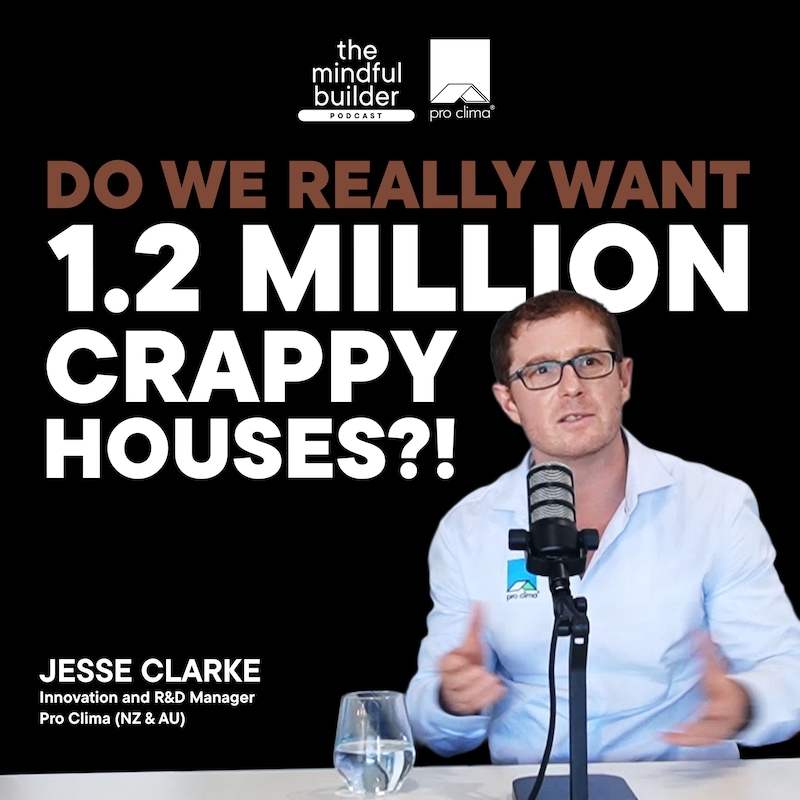
“Do we want 1.2 million crappy houses?” That’s the question Jesse Clark (pro clima) drops early in this episode, and it pretty much sets the tone. We talk about Australian housing supply, building quality, and why “more homes” is not the win if we’re locking in mould risk, discomfort, and expensive fixes for decades. If you care about better homes, healthier homes, and what the future of construction should actually look like, this one’s for you.
Jesse’s whole approach is simple and repeatable building systems. We look at practical building science for real sites: the building envelope, airtightness, membranes, wraps, and the kind of construction details that can be done consistently across projects without relying on luck or one superstar tradie.
A big focus is moisture management and ventilation, because moisture safety is the foundation of durable homes. We get into vapour-permeable assemblies, how leaky buildings happen, and why mould in Australian homes is often the outcome of small decisions made early. We also touch on the debate around energy efficiency and building codes (NCC), and how chasing energy targets without understanding moisture can create unintended consequences.
If you’re a builder, architect, designer, certifier, or homeowner trying to understand high performance homes without the hype, this conversation will help. Topics include sustainable building, passive house principles, condensation control, indoor air quality, and what it takes to build homes that last in Australian climate zones.
👇 CHAPTER MARKERS 👇
00:00 Meet Jesse Clarke
01:03 Simple Repeatable Systems
01:36 Australia Study Origins
02:12 Healthy Envelope Basics
03:21 Tropics Mould Reality
05:33 Future Building Trajectory
07:17 Carbon Versus Health
10:24 Energy Code Debate
15:10 Density And Housing Targets
19:13 Why Codes Move Slowly
22:48 Standards Board Conflicts
28:10 Membrane Standard Breakthrough
30:57 R&D Heat and Vapour Tradeoffs
34:48 Consensus Voting Explained
38:22 Leaks and Insurance Policy Wraps
42:04 Iterating to Build Better
43:19 Builder Journey Timeline
47:53 Mindful Moment Closing
LINKS:
Our Sponsors:
Pro Clima - https://mindful-builder.captivate.fm/proclima
MEGT - https://mindful-builder.captivate.fm/megt
Connect with us on Instagram: @themindfulbuilderpod
Connect with Hamish:
Instagram: @sanctumhomes
Website: www.yoursanctum.com.au/
Connect with Matt:
Instagram: @carlandconstructions
Website: www.carlandconstructions.com/
Transcripts
So this guest doesn't need any introduction.
Speaker:Jessie who?
Speaker:Isn't he probably the smartest?
Speaker:Huh.
Speaker:Look, he's already smiling.
Speaker:No, no, no, no, no.
Speaker:We had the smartest person on yesterday- Yeah … and that
Speaker:was Villy.
Speaker:Oh.
Speaker:Villy, yeah.
Speaker:Yes, so yeah, so- That was Villy.
Speaker:That's true, yeah.
Speaker:Yeah.
Speaker:So we have Jesse Kark, the smart guy from Pro Clima that everyone
Speaker:knows, that wrote, uh, the Moisture Management book, which a great resource.
Speaker:Is it now called the Blue Book?
Speaker:Is that… What's the difference between the Blue Book and- No, the Blue
Speaker:Book was a different concept.
Speaker:No, it was the Australia Study was a residential-focused guide
Speaker:on how to build a decent house.
Speaker:So- And the Blue Book was a whole bunch of construction systems that we had
Speaker:so many questions from the Woofy users and people trying to invent different,
Speaker:um, layers of construction systems, how you layer the insulation and membranes,
Speaker:and people just wanna do things different because they wanna be clever.
Speaker:And you go, "Okay, if you're gonna be clever- … then you
Speaker:need to do a calculation and work out if it actually works."
Speaker:Simple shit works, yeah.
Speaker:Yeah.
Speaker:Well, don't, don't come back to us
Speaker:and say-
Speaker:Simple, repeatable … "I've come up with this." Yeah.
Speaker:Simple, repeatable.
Speaker:Simple, repeatable.
Speaker:Well, that's it.
Speaker:So 140 mil walls, Intello, Extasana, can you go wrong?
Speaker:Work out… Yeah.
Speaker:Well, that's right.
Speaker:Work out what works in your climate zone, and then simple and repeatable.
Speaker:Yeah.
Speaker:Or as our sales manager, or our GM in, um, New Zealand would
Speaker:say, "Rinse, dry, repeat."
Speaker:Yep.
Speaker:Rinse, dry, repeat.
Speaker:You should-
Speaker:I like that … why don't you have… You've got, you-
Speaker:th- you've got dry as a bone.
Speaker:Maybe that needs to go on the membrane.
Speaker:You could- Rinse, dry, repeat … yeah.
Speaker:So- Just ki- it kind of works in two elements.
Speaker:But,
Speaker:but most people are- There we go, Gus, the marketing communications
Speaker:is sitting here smiling.
Speaker:We've just given him a bit of a tip.
Speaker:So the, you, th- this whole study that we're talking about was a, was, I don't
Speaker:know, in, in, in the world that we operate in was a, was a big deal, right?
Speaker:What was the genesis of it?
Speaker:Like, 'cause from… I've heard all these sort of different stories
Speaker:about why you did it, and you did it in your own time, and all that.
Speaker:Which
Speaker:book?
Speaker:The-
Speaker:The Australia Study … Australia.
Speaker:Australia Study.
Speaker:Oh, why did we do it?
Speaker:Because, uh, that's the Pro Clima method.
Speaker:We go out there and we put a Australia Study into every
Speaker:market that we go into before we-
Speaker:So there's a New Zealand one as well?
Speaker:There is a New Zealand one, yeah.
Speaker:It's a little bit thinner, but yeah.
Speaker:Yeah.
Speaker:And what is it?
Speaker:Just for those who haven't read it, what, what is, what is this book?
Speaker:What is this r- research project that you did?
Speaker:It's
Speaker:a, not a book, it's like a great resource.
Speaker:The Australia Study is an outline of how to build a house that is
Speaker:highly efficient but also healthy.
Speaker:Yep.
Speaker:Uh, and the focus on the building envelope, of course, envelope first,
Speaker:and weather tightness, one of the key aspects to that, obviously stop the
Speaker:water getting in, so yeah, making sure that you've got all the details right.
Speaker:Uh, a lot about the hygrothermic, so temperature and humidity and how that
Speaker:flows through construction systems once you start to insulate those systems,
Speaker:uh, and make sure you don't entrap water vapor in the system, create high humidity,
Speaker:create conditions for mold growth.
Speaker:Yeah.
Speaker:And that varies across all climate regions in Australia, so obviously you need to
Speaker:have potentially different solutions.
Speaker:Everyone's looking for the silver bullet that works everywhere in
Speaker:Australia, but it's very difficult.
Speaker:The same problem in the US- Very difficult to have one solution
Speaker:that works everywhere from the tropics down right down to Tasmania.
Speaker:Kind of
Speaker:got like a 90% silver bullet.
Speaker:And we got a 90% silver bullet, yeah, which is what you were alluding to.
Speaker:You use a vapour permeable on the outside and a intelligent vapour
Speaker:control system on the inside.
Speaker:Except the tropics.
Speaker:Except the tropics, yeah.
Speaker:And the tropics are a bit special, um, because their climate, uh, there's not…
Speaker:You know, you can't leave them out because that's, you know, it's
Speaker:like- Rude to Queenslanders
Speaker:… po- political suicide.
Speaker:You need to… If you're gonna be operating in Australia, you need to
Speaker:have a solution for everywhere, and that's what I said to the management.
Speaker:I said, "We can't just ignore the tropics. We need to tell people what works."
Speaker:Yep.
Speaker:Um, and this happens a lot in the regulatory space as well.
Speaker:It's like, "Yeah, but there's not that many people that lives there.
Speaker:Don't worry about it." But they're an, potentially a noisy minority,
Speaker:and you've got to address everything
Speaker:for the tropics.
Speaker:Well, they're a noisy minority and, and I guess, like instinctively if we- if
Speaker:we're insulating and putting a building wrap on a, on a, on a home in the
Speaker:tropics, like m- my mind goes to there's probably a higher chance of mold growth
Speaker:in clothes, not, not so much trapped in the wall assemblies, but on things that
Speaker:are kind of around your home because you've got such a higher humidity- Mm
Speaker:in the, in the building.
Speaker:Mm-hmm.
Speaker:Yeah, absolutely, and that, um, is, yeah, 100% correct 'cause there's,
Speaker:there's… I mean, in the tropics there's so much humidity outside.
Speaker:You gotta… If you're gonna air condition, you gotta keep it outside.
Speaker:Yep.
Speaker:And in my personal experience when, you know, going back a few years when
Speaker:we were visiting the, the Daintree and when, when the tourist center there, and
Speaker:obviously they had a bit of a problem, 'cause you walk, walk in there and the
Speaker:first thing you smell is mold, like the whole thing- And you know it's
Speaker:musky
Speaker:and, and you know.
Speaker:But, you know, someone in my field goes, "Yeah, okay, I know what it is." But
Speaker:most people, it's just like, "Eh." Yeah.
Speaker:Carry on.
Speaker:That's what it is.
Speaker:So you said at the start, "What are we talking about?" Now, Hamish and I don't
Speaker:really prepare much for each podcast.
Speaker:We actually just like to love… Whoever comes in, we like to just
Speaker:listen to what they have to say, and we adapt the conversation.
Speaker:Now, you've been on a lot of podcasts.
Speaker:You do a lot of public speaking.
Speaker:You present.
Speaker:What is something that we don't talk about enough that you think
Speaker:we should be talking about?
Speaker:We're gonna see where this takes us.
Speaker:Oh.
Speaker:You can take as long as you want, and
Speaker:we can- Yeah … edit out the, the pause.
Speaker:No, no, let's keep the pause in because- The pause … it shows that
Speaker:this is actually a natural conversation
Speaker:Or have you already solved all the problems?
Speaker:W- I think, I think what, what, what we don't talk about is… And this, this
Speaker:comes up, uh, uh, comes up a lot in the, I guess the, the regulatory think-
Speaker:regulatory thinking space, which is the trajectory on where we're going and why.
Speaker:It's like, yeah, sure, what's the best possible building you can build?
Speaker:And it's like, okay, it looks like this.
Speaker:Is that where we need to be, and when do we need to be there?
Speaker:When do we need to be there?
Speaker:Do
Speaker:you know, that's a really interesting… I've never thought of that.
Speaker:Like, is there… And I'm doing this in my own business at the moment, right?
Speaker:So we're, we're trying to do- we're trying to plan for a year,
Speaker:three years, and then, well, what is it that we're working towards?
Speaker:You know, so we've got this 10-year goal, this ambitious 10-year goal,
Speaker:and we've actually started there, and we're working our way back.
Speaker:Mm.
Speaker:And then breaking that down, you know, into quarterly little things
Speaker:that we're doing to reach this goal.
Speaker:Is there, like, this perfect idea of what a building should look
Speaker:like in Australia that you know of that we're trying to achieve?
Speaker:But that's, that's the g- the, the great debate, right?
Speaker:Um, what does that look like?
Speaker:And I don't wanna get into the, you know-
Speaker:What should it
Speaker:look
Speaker:like?
Speaker:What does it look like to you?
Speaker:Yeah … I, I don't wanna get into the passive house, uh- What does it look like?
Speaker:No, but it doesn't have to be … passive design debate.
Speaker:What does it,
Speaker:what does it look like for you?
Speaker:Yeah.
Speaker:W-
Speaker:what,
Speaker:what i- what is a home that every Australian, uh, should be living in?
Speaker:Jesse's the prime minister, what changes?
Speaker:And, and take your proclama off for a sec.
Speaker:Like, what- Someone asked… Did you
Speaker:ask me that last time?
Speaker:Did we?
Speaker:Yeah, but like- Someone
Speaker:asked me that.
Speaker:Yeah, but like, yeah, what do… Like, you, you have a vision.
Speaker:You have a very clear… Like, you're very intelligent.
Speaker:You, you have the answers yourself.
Speaker:What would you start with?
Speaker:What would be the 50-year plan, 25-year goal, 10-year target?
Speaker:We've
Speaker:got him.
Speaker:Well, no, but I mean, it, it, it gets into that.
Speaker:Well, th- there's a lot of… The, the big driver is carbon, carbon reduction.
Speaker:Yeah.
Speaker:And I mean, a l- it's, it's a little bit frustrating, uh, to me that,
Speaker:that there is so much emphasis on, you know, energy and carbon.
Speaker:I get it, it's important, but it's the, the health aspect and
Speaker:the reasons of, you know, what, what is the government there for?
Speaker:For the people?
Speaker:I think, I've said this to
Speaker:Haydn- To, to make, to make the population prosperous?
Speaker:Well, I said w- I've s- said to Haydn this morning, like obviously the war's
Speaker:going on in Iran at the moment, and maybe I was a naive young… as I was 30, but I
Speaker:think as you get older you start to learn a little bit more about how the world
Speaker:actually operates, and the governments really aren't there to protect the people.
Speaker:No.
Speaker:But in theory they are.
Speaker:In theory, but they- So what
Speaker:are they there for?
Speaker:This is a really, this is a really good, deep conversation.
Speaker:Some- someone needs to be sitting there.
Speaker:But, uh, you know what?
Speaker:I, I don't know- Yeah.
Speaker:Yeah … I don't, I don't know if we should- I don't know if we have the answer
Speaker:… I don't know if we should go there, but you, you brought up carbon reduction.
Speaker:And I agree with, well, maybe I do agree, maybe I don't agree with you.
Speaker:I, I think that we probably should be focusing on how we're reducing
Speaker:our carbon and the, I guess, the, it's the embodied carbon, it's the
Speaker:carbon that already exists in homes, it's the carbon that takes, you
Speaker:know, our operational carbon as well.
Speaker:What is it that you're referring to when you're saying carbon reduction?
Speaker:Well, it's, it, it's everything, right?
Speaker:Yeah.
Speaker:Okay.
Speaker:So, so that whole embodied carbon discussion versus the operational
Speaker:energy and, you know, any- anywhere you use energy generally
Speaker:requires, well, will have a-
Speaker:Carbon
Speaker:… carbon
Speaker:output.
Speaker:Car- carbon output, yep.
Speaker:So reducing that is, you know, it's all grand, it's, it's good, but then I've
Speaker:spent years, you know, speaking about, you know, energy efficiency and trying
Speaker:to push energy efficiency, and then it was the other side of it which we focus
Speaker:on, on Pro Clima, which is the moisture management, healthy buildings, and that
Speaker:was always labeled unintended consequence.
Speaker:I hate that.
Speaker:I hate that term so much, unintended consequence.
Speaker:Like, it's something that's a consequence of this regulation we're making, but we
Speaker:don't really want to address it right now, or don't care about it 'cause it's not
Speaker:important to the mandate we've been given.
Speaker:Yeah, I mean, m- so what's going through my head right now is that I actually think
Speaker:about it the way that you think about it.
Speaker:I don't actually start at carbon reduction.
Speaker:I actually think about a healthy home first.
Speaker:Yeah.
Speaker:Or of a healthy building fabric first.
Speaker:What is a healthy building?
Speaker:'Cause again, it's just another buzzword, like sustainability-
Speaker:Well, so, sorry, sorry.
Speaker:A, a, a building- … a building, like if we're wrapping it with the
Speaker:Pro Clima system, or you know what?
Speaker:Insert any-
Speaker:But just wrapping it with a Pro Clima system isn't- Well- … because you
Speaker:see people just getting a weather board and nailing straight through again, and
Speaker:process- Okay.
Speaker:Let's, let's for a second- … a trumped product … let's for a second
Speaker:assume that people are following the right way to do it, right?
Speaker:Uh, 'cause what we're talking about right now is, is what does the perfect home
Speaker:look like that we should be living in?
Speaker:And we've brought up carbon reduction.
Speaker:In 50 years.
Speaker:In 50 years, right.
Speaker:Well, hang on.
Speaker:So the carbon reduction, that, that wasn't saying, "Oh, it's, you know,
Speaker:a low carbon home, therefore it's perfect." That wa- that was just a big
Speaker:driver of, of a lot of the discussions that happened- Yeah … and the energy
Speaker:efficiency in the building code.
Speaker:What's energy efficiency doing in the building code?
Speaker:I mean, I- Can you
Speaker:expand on that?
Speaker:Like-
Speaker:Well, well- I'm, I'm keen to hear that … the building, the building code is there
Speaker:for the health and safety of the people.
Speaker:Yeah,
Speaker:amenity.
Speaker:Yep,
Speaker:yep.
Speaker:What's energy got to do with health and safety?
Speaker:Actually, it's, it's a cost of living thing
Speaker:Or is it a cost of living thing, or is it the fact that you use
Speaker:energy to stay comfortable so that you stay healthy, healthy?
Speaker:So the comfort part is the health part, and then… Well, hang on, but why energy?
Speaker:To reduce carbon?
Speaker:So it's actually protecting the future of the people, because if
Speaker:we put too much carbon into the atmosphere, then we create global
Speaker:warming, and then we can't grow crops anymore, and everyone dies of hunger.
Speaker:This is odd.
Speaker:It's like a, a aha moment, as you just said that.
Speaker:Well, there's, that's a question that comes up for the, the, the anti-lobby.
Speaker:Like, why, why have we got energy efficiency in the building code?
Speaker:You- And to some extent, and I, I agree with them.
Speaker:Why do we have energy efficiency in the building code?
Speaker:Like, if you want to go spend $2,000 a month heating your
Speaker:home, is that your choice?
Speaker:Is that, is that what you're
Speaker:saying?
Speaker:Or you, you, you spend $2,000 a month, or, uh, how did you say?
Speaker:A month?
Speaker:Yeah, if you just have it- $2,000 a month heating your home to, so that
Speaker:it stays within a comfortable range- Yeah … so that you're staying healthy,
Speaker:'cause comfort is a proxy for health.
Speaker:Yeah.
Speaker:If you stress yourself, you get unhealthy.
Speaker:Yep, yeah.
Speaker:Um, so you're spending $2,000 a month, and you can afford that, well, good
Speaker:on you, but you're putting all this pollution into the atmosphere, which
Speaker:is actually affecting everyone else.
Speaker:Uh, it's like passive smoking.
Speaker:But what if they,
Speaker:yeah, but what if they went all electric and had solar panels?
Speaker:Well, that's the other thing, which is where it's whole of home
Speaker:assessments is kind of going.
Speaker:Yeah.
Speaker:We can have a really poor building fabric and put a band-aid on top,
Speaker:which is a massive solar system.
Speaker:Yes.
Speaker:Happy days.
Speaker:So you, so you're saying that we shouldn't be worrying about energy efficiency
Speaker:and start to, like, like, 'cause the anti-lobby would say remove it.
Speaker:Are you also technically kind of agreeing but on a different way of agreeing?
Speaker:I'm, I'm saying that I can see their argument that why is energy
Speaker:efficiency in the building code?
Speaker:Yeah.
Speaker:I bet we should then expand on the health and amenities part.
Speaker:And you expand on the health and, uh, emphasize the health and amenity, and
Speaker:back to what Hamish was saying, the Trojan horse, which comes in along with health,
Speaker:is a better building, which is low carbon.
Speaker:Yep.
Speaker:So, so the out- the outcome- Or low energy
Speaker:use
Speaker:… there's, there's these really nice outcomes of, of building a home that's
Speaker:sealed well, insulated well, ventilated well, that the nice outcomes are, uh,
Speaker:you use less energy to heat and cool it, which reduces the operational carbon,
Speaker:and then off the, you know, comfort, as you said, proxy to health, we've got this
Speaker:comfortable, healthy living environment, which also then leads to health.
Speaker:So I don't disagree that energy should- I actually think, I actually
Speaker:think it's really clever … energy sh- energy should get taken out.
Speaker:And, and, and more of a focus, yet agree with those guys, give
Speaker:them a win, and then let's just focus on building a better home.
Speaker:Mm-hmm.
Speaker:And the results, 'cause if you follow, we all know if you follow
Speaker:building science, the by, the, the by-product is energy efficiency.
Speaker:If, if you build it as a healthy home, so you're not stressing the people,
Speaker:but then you could argue that I'm just gonna put a massive AC unit-
Speaker:Yeah,
Speaker:this, yeah … on the house, massive heating system, and I'm gonna
Speaker:constantly be in that comfort range.
Speaker:I'm not gonna stress the occupants, 'cause they're always in the- Band
Speaker:20 to 24 degree band.
Speaker:Yeah.
Speaker:And I've done it using a crap load of energy.
Speaker:Oh, but I've offset that using solar, so it's okay.
Speaker:Mm. I don't agree with it, because back to the discussion off the record that
Speaker:we're having yesterday, uh, about lean.
Speaker:Oh, what's this lean stuff and being efficient and, you know- Yeah
Speaker:being just using things efficiently and not wasting resources- I thought
Speaker:you meant you telling me to lose weight
Speaker:originally
Speaker:… and not wasting time.
Speaker:I know, the whole, the whole lean concept and what is lean, but, but
Speaker:that's, that, that's the same thing.
Speaker:It's like, why would you put a 50 watt, a 50 kilowatt air conditioner on and
Speaker:offset it with solar when you could do the same thing in a much smarter manner?
Speaker:It's like the big houses that you see that, oh, we've got a $3 million budget
Speaker:and got 150k hydronic heating system.
Speaker:We c- we could build a passive house and save you some extra cash.
Speaker:Yeah, and you don't need the hydronic
Speaker:system, no.
Speaker:I mean, take passive house out of it.
Speaker:Just, just, just, just, just- Yeah, yeah, yeah, just, I just use as a reference
Speaker:yeah, yeah, yeah.
Speaker:Yep,
Speaker:yep.
Speaker:I mean- So, but that's, yeah, and then the whole debate around, yeah,
Speaker:what does the ideal house look like?
Speaker:Is it a passive house?
Speaker:Is it passive solar?
Speaker:Is it a house on stilts where you don't have any air conditioning
Speaker:and we just live outdoors?
Speaker:But the, the, the- Ah, simpler life … the times are changing- 2019
Speaker:where w- not everyone has, is gonna be living in a house.
Speaker:We look to, say, Singapore, like especially in Sydney, you look
Speaker:to Hong Kong and Europe, they're, everything wants some townhouses.
Speaker:Mm-hmm.
Speaker:Yeah.
Speaker:Not, not in
Speaker:town, as apartments.
Speaker:Yeah, like sorry, apart- yes, apartments.
Speaker:Apartments, yeah.
Speaker:So- Everything goes vertical, but that's a…
Speaker:Then you got the whole other debate over it, which is the, the urban
Speaker:sprawl and, you know, just wasting agricultural land on building houses.
Speaker:Yeah, yeah, and, and I, I think that I look at my daughter, who's
Speaker:nine months old, the only way she's gonna get a house is if I buy it for
Speaker:her or put away money for her now.
Speaker:Mm-hmm.
Speaker:There's no chance she buys a house.
Speaker:Like, prices on average, they say, double every 20 years, the housing.
Speaker:So my little crappy house that I bought in a shit suburb, I pay, like it's, that's,
Speaker:no one's buying that for $2 million.
Speaker:Like, so I look at it and go, "Well, the an- the answer has to be apartments.
Speaker:There's no other choice."
Speaker:Yeah.
Speaker:Yeah.
Speaker:Yeah, density.
Speaker:You have to increase the urban density, but there's all these overlaying,
Speaker:all these, um, discussions, uh, that overlay on the top of each other.
Speaker:Is that government getting in the way when you go back to the conversation of,
Speaker:like, what do governments actually do?
Speaker:So in, in terms of housing and planning- Yeah … and putting KPIs,
Speaker:I think we had a discussion a while back on the phone talking about, um,
Speaker:the, the metrics they, or the targets they wanna hit for new housing.
Speaker:Uh, and build that many houses at any cost.
Speaker:What was the number?
Speaker:Do
Speaker:you- 1.2 million houses in five years.
Speaker:There
Speaker:you go.
Speaker:1.2 million houses in five years.
Speaker:Do we want 1.2 million crappy houses, or 1.2 million houses
Speaker:that we can point to and tell our children we're proud of those houses?
Speaker:That's it.
Speaker:I'll tell you what, those, Hamish and I, that's our future retrofit market.
Speaker:Yeah, correct.
Speaker:Like- But we're also creating a, a, a, um, a job for our children, right?
Speaker:Yep.
Speaker:And that job for our children to fix the crap.
Speaker:But the c- but that's the, you know, back to the
Speaker:work that- Do you reckon that's considered?
Speaker:Do you reckon they go, "Let's actually… So we have jobs in the future," because
Speaker:construction is one of the biggest GDP or taxable incomes in especially Victoria.
Speaker:Do you reckon they actually think like, "Well, if we don't build them to that
Speaker:standard, we understand the future we're gonna be able to tax that set
Speaker:of trades," especially with AI coming in, is a pretty safe form of income?
Speaker:I, I, I, I can't remember off the top of my head if that's
Speaker:been factored in, but yeah.
Speaker:So in- Oh, like- … in 20, in 15 to 20 years, all these houses have to be
Speaker:retrofitted and- It's a massive thing … now we've created a massive market.
Speaker:I
Speaker:know, I know, but like, like do you reckon, like just 'cause-
Speaker:I dunno.
Speaker:I dunno.
Speaker:It'd be so interesting.
Speaker:But I, I would, I would like to think so to, to- But that's
Speaker:not … to have some faith in humanity is that that's not the case.
Speaker:Well, correct, because then you take the, the, um, the case of Scotland-
Speaker:Yep
Speaker:… that mandated, uh- Passive house … passive house.
Speaker:Actually certified passive house.
Speaker:Yeah.
Speaker:But, but saying that, well, what are we doing here?
Speaker:We're creating houses and places for people to live that are gonna
Speaker:be outdated in 5 to 10 years.
Speaker:They're, they're not gonna be any good.
Speaker:If everyone's
Speaker:built- So just build the best you know how to build.
Speaker:But the discussion we haven't landed on in Australia is what is the best,
Speaker:which is a question you asked me.
Speaker:Do, do you think, and I'm- Yeah … this is just a thought that's come to my mind.
Speaker:Like, and Australia's pretty young, right?
Speaker:We've, we've, um, what, 300 years, 200 years?
Speaker:I don't know.
Speaker:What- whatever it is.
Speaker:Mm-hmm.
Speaker:You know, you go to Europe, and there are buildings there that have
Speaker:been there for thousands of years.
Speaker:You know, they have always built things that have lasted.
Speaker:Yeah.
Speaker:Whereas Australia doesn't really have a history of building
Speaker:things that have lasted.
Speaker:Yeah.
Speaker:Do you think that's like a, like a just a, this is like our kind
Speaker:of short-term housing solution, I'm gonna call short-term housing
Speaker:solution, I'm gonna label that volume build homes, is just a product of
Speaker:just our, how young Australia is?
Speaker:Possibly.
Speaker:I mean, we don't have those heritage buildings and everything, you know,
Speaker:those old stone buildings sitting around apart from- Yeah … you know, inner city
Speaker:suburbs of some of the capital cities.
Speaker:And yeah, we, we're not exposed to that, that whole historical culture.
Speaker:Yeah.
Speaker:I think we also think that like, oh, we don't get that extreme snow.
Speaker:I think
Speaker:that- Well, that's as well.
Speaker:Uh, but that's always the argument.
Speaker:We- we're not extreme here.
Speaker:We, we don't have… Oh, that's not our climate, therefore it doesn't matter.
Speaker:You- And it's easier to pass things off like that.
Speaker:Yeah.
Speaker:Oh, it doesn't matter.
Speaker:I
Speaker:don't, I don't know if you can talk about this, but I know that
Speaker:you sit on, is it the ABCB board,
Speaker:or?
Speaker:I'm on the ABCB, yeah, um, committee.
Speaker:What, what, what is some of the friction in there, and you don't have
Speaker:to name names, of, of why they're not advancing the code quicker?
Speaker:There's a lot of different, um, points of view that need to be considered.
Speaker:But-
Speaker:And do you have like
Speaker:a spread of state?
Speaker:And, and part of that is…
Speaker:Well, well, part of that is if you do go too quick, you get market failure.
Speaker:Yep.
Speaker:If we said everyone has to build a house tomorrow- Yeah.
Speaker:Yeah, okay
Speaker:… at .6 air changes at 50 pascals, how many people would actually
Speaker:be able to comply with that?
Speaker:So do
Speaker:you- And how many people would just go, "Stuff it, doesn't
Speaker:matter, 'cause no one's doing it"?
Speaker:Do you agree-
Speaker:That's market failure.
Speaker:Do you agree to a point then to implement these changes slow, and on some level,
Speaker:um, agree with the freezing or the slow
Speaker:adoption?
Speaker:I don't agree with the freezing.
Speaker:What they should be doing is telegraphing the changes well in
Speaker:advance, 'cause this goes back to every time there's a new code update,
Speaker:all the states go, "Oh yeah, we're, we're gonna adopt it in a year's time."
Speaker:They kick the can down the road every single time.
Speaker:But that kinda goes back to what we were talking about before.
Speaker:Uh-huh.
Speaker:There's no… There doesn't feel like there's this like, like
Speaker:what we're trying to achieve.
Speaker:There's not this sort of- No … you know- 10 year … pedestal home
Speaker:that we're all trying to get to.
Speaker:Yeah, correct.
Speaker:You don't know, and there's a massive debate out there.
Speaker:I mean… And back to that, yeah, oh, is passive house the, the, the end game?
Speaker:Or is a really well sort of designed solar passive house the end game?
Speaker:Um, who knows?
Speaker:But well, should
Speaker:we put a d-
Speaker:Sorry, not the right end game, 'cause I feel like we're playing a video
Speaker:game here, because we shouldn't have an end game because technology
Speaker:will change and things will change.
Speaker:Correct.
Speaker:So it needs to be somewhat fluid.
Speaker:But-
Speaker:You, you know what?
Speaker:Sorry, I'm gonna, I'm gonna disagree with that.
Speaker:You can still have something you're working towards and it still
Speaker:change as new things come out.
Speaker:No,
Speaker:I know.
Speaker:I, I don't, I, I, yeah, yeah.
Speaker:Agree.
Speaker:'Cause my, say, my 10-year target might be my 10-year target today,
Speaker:but it might change next week.
Speaker:But you still need something that you can then plan around, and
Speaker:that's the issue at the moment.
Speaker:There's nothing that we're working towards.
Speaker:I mean, there's, there's nothing that we're working towards.
Speaker:That's politics.
Speaker:Like, they get four years terms, and it's all about the next election
Speaker:and next election and next election.
Speaker:That's the problem.
Speaker:That, that ultimately politics has become about the person and their
Speaker:reputation on the short term rather than a holistic long-term vote, uh, view,
Speaker:and that's… We had David on, so Dave came on, uh, liberal shadow minister
Speaker:for, in Victoria for building, and he just said we for s- And I, I kind of
Speaker:agree, just take the handbrakes off, and then let's then see what's going on.
Speaker:Have a very long-term view on things.
Speaker:Mm-hmm.
Speaker:Let's not, let's not actually, uh, just bring in things to win an election.
Speaker:Let's actually stop, think about what our future looks like, and then start.
Speaker:Do you know what?
Speaker:I, I g- I, I really enjoyed our conversation with Dave, and I'm sure
Speaker:by the time this comes out- Yeah
Speaker:people would've heard it.
Speaker:However, you know, it is great to sit here and have a really good
Speaker:conversation with someone, but if-
Speaker:They don't do
Speaker:it … if Liberal do get voted in in November, which is a pretty
Speaker:reasonably high chance it'll happen, what actually is gonna happen
Speaker:when the rubber hits the road?
Speaker:Yeah, no, I agree.
Speaker:Like, you know, uh, i- is it, is it all, are they all the same?
Speaker:Is the-
Speaker:I would love politicians, if you say something, they do it, and you
Speaker:could be legally held responsible.
Speaker:Yeah.
Speaker:Well, that's, that's the question.
Speaker:Yeah, what… Will they do what they said, said they were gonna do?
Speaker:Yeah.
Speaker:But that, I think, I think, not going to into politics, but I think if you
Speaker:wanna go out there and say we're gonna do something, you could be legally
Speaker:held responsible as a person for not- Being accountable to your decisions.
Speaker:Yes.
Speaker:Like a CEO, like Hamish and I with our clients, like you with Pro Clima.
Speaker:Yeah.
Speaker:You run the country, is the country run like a business, or?
Speaker:Yeah.
Speaker:Run, run like nothing.
Speaker:Um, so I wanna go back to codes and standards, because one thing that
Speaker:confuses me, and I kind of under- I understand why, but why should Jesse
Speaker:from Pro Clima be on the standards board?
Speaker:'Cause wouldn't Jesse from Pro Clima have Pro Clima's interests at heart?
Speaker:And the same as every- everyone else.
Speaker:Like, shouldn't they be independent people?
Speaker:You, you, you always gotta declare, um, interest.
Speaker:Uh, you're meant to, 'cause then if anything does come out, um, then
Speaker:it's like, oh, but hang on, you had investments here, investments
Speaker:there, and you were saying this.
Speaker:So, as a-
Speaker:But as an employee, you're not technically invested in… Well,
Speaker:you are as a person for your job.
Speaker:Yeah.
Speaker:But from a monetary shareholder.
Speaker:Yeah.
Speaker:So I would always declare, saying I work for a, um, building product supply
Speaker:company in weatherproofing membranes.
Speaker:So then if anyone later comes along and say, "Oh, okay, I can see why you're
Speaker:saying that," or, you know, if it…
Speaker:I was clearly trying to push something down that route, then
Speaker:And one thing Pro Clima are really good at- Pro Clima … is you've, you
Speaker:do not sh-can other products, ever.
Speaker:Ever.
Speaker:Like, there's videos and photos you guys have shown me of other products
Speaker:failing, and you will not give them to me.
Speaker:Where some other companies would be quickly to jump onto that.
Speaker:C- c- just getting back to that, um, you know, who, why Jesse sits on the
Speaker:board and why other people sit on the board, I think it's really important
Speaker:to have lots of different stakeholders.
Speaker:I agree.
Speaker:Like- Yeah … from, from all different facets of the building
Speaker:industry, if they're gonna be making, um, decisions on how we build homes.
Speaker:Because you, you need, you need that kind of balance of opinion on something,
Speaker:because someone over here from the steel, you know, industry might say something
Speaker:that sort of sparks something in your brain and go, "Oh, hang on, I actually get
Speaker:that. All right, that makes sense. Thanks for bringing that up." And vice versa.
Speaker:Mm-hmm.
Speaker:So I think it's important to actually be in- involved in a, in
Speaker:a conversation where people are actually challenging what you think.
Speaker:It's a cost thing, though.
Speaker:It's not like they have the biggest budget to work with either.
Speaker:So, like, they rely on companies to do the R&D to then
Speaker:present, I'm assuming, as well.
Speaker:The, which
Speaker:entity?
Speaker:The board.
Speaker:Like, the board.
Speaker:Um-
Speaker:The codes and standards … mainly through academic organizations,
Speaker:which may be supported by companies.
Speaker:And they… Yeah.
Speaker:And we spoke with Ariana yes- yesterday- Yeah … which will be a podcast episode.
Speaker:Do they have to disclose if-
Speaker:Disclose where they got their funding?
Speaker:Yeah.
Speaker:Um, most of the time it probably is.
Speaker:Yeah.
Speaker:Okay.
Speaker:Um, if, if you read the research outputs.
Speaker:Yeah, in the journal article
Speaker:or something.
Speaker:Um, yeah.
Speaker:And, and yeah, where it was funded or who supports it.
Speaker:I think one thing that we didn't touch on before, Jesse, what is your background?
Speaker:I'm an engineer.
Speaker:Yeah.
Speaker:Uh, as a- So I did an undergrad- undergraduate engineering degree
Speaker:at University of New South Wales.
Speaker:But I actually started off, uh, that was in photovoltaics, so solar energy.
Speaker:Yeah.
Speaker:But don't ask me too much about solar energy, 'cause it was a long time ago.
Speaker:Yeah.
Speaker:So engineering degree is quite broad.
Speaker:It was more of an electrical engineering focused degree- Yep … if
Speaker:you wanted to, you know, go broader.
Speaker:So your degree is kind
Speaker:of totally relevant to where you've ended up?
Speaker:Uh, yeah, pretty much, yeah.
Speaker:Apart from if you put solar panels on the roof.
Speaker:Did you do a PhD? No.
Speaker:No.
Speaker:No
Speaker:PhD.
Speaker:How'd
Speaker:you learn?
Speaker:Do you reckon Aus- the Australian study would be close enough to a PhD?
Speaker:Well, that's what Clarence MacA- McAlister said.
Speaker:He said- Yeah … "I should give you a PhD." I guess it's prob- I'm still
Speaker:waiting for one, but no one's- Can you get a- My physio wouldn't give me one.
Speaker:I asked him … can you
Speaker:get an honour- honour- He loves you, though.
Speaker:Can, can you get an honorary doctorate or anything like that?
Speaker:Uh, you can, you can get them.
Speaker:Uh, to be honest, I don't know what the process is, but yeah, you
Speaker:can.
Speaker:Dr. Jesse Clark.
Speaker:Do you think Dr. Jesse Clark would just have this, you
Speaker:know… I'm, I'm just imagining
Speaker:your emails when you
Speaker:send it through, or like on your shirt, Dr.
Speaker:Jesse Clark.
Speaker:Can you, can you give me one from the Sustainable Builders Alliance?
Speaker:Absolutely.
Speaker:Yeah.
Speaker:Yep, absolutely.
Speaker:But so the- An
Speaker:honorary doctorate, sure.
Speaker:So you- I want, I really wanna head this codes and standards
Speaker:conversation still, because there must be some very robust discussions
Speaker:Yeah?
Speaker:Yeah.
Speaker:Like
Speaker:Yeah.
Speaker:All
Speaker:right.
Speaker:Yeah.
Speaker:Uh, yep, there is, yeah.
Speaker:I wanna know the juicy goss.
Speaker:Well, well,
Speaker:yeah, yeah.
Speaker:Well, in the standard- standards committee process?
Speaker:Yeah.
Speaker:Yeah, so standards committee pro- it's, it's a technical game of chess.
Speaker:That's what it is.
Speaker:So
Speaker:you gotta have a real long-term outlook.
Speaker:Well, you've got to know what everyone's positions are, who they work for, and
Speaker:what they might be saying for whatever, as you talked about, reasons that
Speaker:they may or may not have disclosed.
Speaker:So are you legally required to disclose things?
Speaker:You're meant to be… On a standards committee, the standards are
Speaker:there for the people of Australia.
Speaker:Yeah, but you- I bring it up quite often- But you- … we're here for
Speaker:the people of Australia … but you also have to pay a shitload of money
Speaker:to access the law with the standards.
Speaker:You wouldn't access the law.
Speaker:I don't, I don't mean to get into it with
Speaker:Jesse, though.
Speaker:No, no, no, but these Australian standards are not e- easily accessible.
Speaker:Oh, yeah, yeah, sure.
Speaker:So- You gotta pay
Speaker:them.
Speaker:You
Speaker:gotta pay for them, yeah.
Speaker:And a large
Speaker:amount.
Speaker:Yeah, you gotta pay, you gotta, you gotta bo- um, pay for the standards, yes.
Speaker:Um, and you're… Oh, you're, so you're having a go at the whole-
Speaker:Cost of what
Speaker:it- Yeah, the cost of standards that are called up in the building code,
Speaker:and if you- He- … bought every standard on the- … be hundreds of
Speaker:thousands of dollars … the cost of the building code- Yeah … you'd be broke.
Speaker:Yeah.
Speaker:Yeah.
Speaker:Yeah, and that's then why you end up getting experts to tell you,
Speaker:because they've actually read those and bought those standards.
Speaker:But then, yeah.
Speaker:Yeah, or have they?
Speaker:Well, maybe, maybe not.
Speaker:So, but anyway, on the standards committee, yeah, there's, there's… You
Speaker:know, in my opinion, yeah, people should be there to make the standards better.
Speaker:Uh, and a lot of people are there- Yeah … to make the standards better, to make…
Speaker:You know, for the people of Australia.
Speaker:Um, but there's also a lot of stalling tactics, and there's a lot
Speaker:of, um… Yeah, just keep everything the same sort of philosophy,
Speaker:because no change is good change.
Speaker:What are you most proud of, of a standard that's changed?
Speaker:What the what?
Speaker:A- A- What are you most proud of of a certain standard you've changed,
Speaker:or had a major influence on change?
Speaker:Well, I think the… Going back to 2017 revision of the membrane standard
Speaker:when opened up the categories of, um, to vapor permeability completely.
Speaker:You know, it's only coming through now, and we're talking-
Speaker:Yeah … almost 10 years later.
Speaker:So-
Speaker:So that's how long it takes to make change
Speaker:… that's how long it takes to change, to pull the lever, and then the market react.
Speaker:So d- so were you quite influential in, um,
Speaker:the change from using, uh, perforated foil-backed sisalation
Speaker:to using a Class 4 membrane?
Speaker:Uh, yeah, yeah.
Speaker:So the standard that when they open up the categories to vapour
Speaker:permeability, obviously you can get that, um, achieve that target
Speaker:in terms of vapour permeability through perforating a membrane,
Speaker:perforating a piece of aluminum foil.
Speaker:It's just so
Speaker:stupid.
Speaker:Um, so that then overlays with weatherproofing, uh, and is a piece of
Speaker:perforated foil actually weather tight.
Speaker:Yeah.
Speaker:Which then comes back to a philosophical discussion around
Speaker:what's the hierarchy of design, and what's the most important thing that
Speaker:we're using these membranes for.
Speaker:And, you know, if you go through the building science and, you know, speak
Speaker:to and read and look at damages, it's always weather tightness.
Speaker:Number one, stop bulk water getting into the building.
Speaker:So at some point in history, and going back to this is my interpretation of
Speaker:the, the membrane standard, it got put into the insulation, um, committee.
Speaker:So what do insulation guys care about?
Speaker:Insulation.
Speaker:R-values.
Speaker:Yeah.
Speaker:How do you get an R-value?
Speaker:S-
Speaker:still air.
Speaker:Still air and aluminum foil.
Speaker:So that's got- But technically, but technically it doesn't
Speaker:actually… You can't get still air on a, in a cavity whatsoever.
Speaker:Yeah.
Speaker:It's impossible.
Speaker:So, so you can't get still air in a cavity.
Speaker:The original research going all the way back to 1954, housing research
Speaker:paper number 32 out of the US.
Speaker:Just know that off the top of your head.
Speaker:Yeah.
Speaker:Well, I've talked about it a lot.
Speaker:But that- Sounds like a riveting read … and I also tried to reverse engineer all
Speaker:their calcs, which was quite difficult.
Speaker:But, um, that original research paper was a three-inch cavity, and they did
Speaker:it on different slopes with still air.
Speaker:So looking at-
Speaker:Yeah
Speaker:… different angles and what the R-value was.
Speaker:Uh, to some extent, still air for heat flow out is very important.
Speaker:For heat flow in, um, the ventilation or moving air can actually provide a
Speaker:benefit even with an aluminum foil.
Speaker:Uh, so you know, it's reflective low-emission surfaces aren't all bad,
Speaker:it's just where do you put them that they don't create condensation and
Speaker:trap water vapor in your structure.
Speaker:Interesting.
Speaker:So I've got a few, um, great ideas that I think, um, some of the cladding
Speaker:suppliers should be using, but the question is, maybe it's not even
Speaker:possible, technically possible.
Speaker:I don't know.
Speaker:So- Is
Speaker:this, was this your one-and-a-half-hour meeting this morning?
Speaker:No, no, that was all our, our R&D projects for Pro Clima, so that's top secret stuff.
Speaker:Shh.
Speaker:Oh, so what are you talking about?
Speaker:Have you got that recording?
Speaker:The one- Yeah, I think we got, we set up the
Speaker:camera overnight
Speaker:when you'd have that meeting.
Speaker:The camera, yeah.
Speaker:Nice.
Speaker:Yeah.
Speaker:So-
Speaker:Yeah, so some of the, the roof, like combining low-emittance
Speaker:surfaces to reduce radiant heat flow, radiant heat on, in summer in
Speaker:Australia is, can be intense- Yep
Speaker:off a hot metal cladding.
Speaker:But the way you've got to design buildings is not just blinkers on,
Speaker:oh, we're designing for summer, or blinkers on, we're designing for winter,
Speaker:because you do create that unintended consequence in the other, um, season.
Speaker:So you've got to think about both seasons and weighing them up together, in which
Speaker:case our approach at Pro Clima is to use vapor-permeable structures and use
Speaker:ventilation to remove heat rather than relying on low-emittance surfaces.
Speaker:Yeah, interesting.
Speaker:So, so- Although if you could plug a low-emittance surface into
Speaker:a ventilated system, you might be onto a really big winner.
Speaker:Is that what the R&D meeting was?
Speaker:No.
Speaker:But I don't think that should be a- No … incorporated into a membrane, for example.
Speaker:I like a different product.
Speaker:Because when you put it into a membrane- Totally different product
Speaker:when you put it into a membrane, the membrane becomes a vapor
Speaker:barrier, so now where do you put the membrane without causing the
Speaker:membrane to completely disintegrate?
Speaker:Or just put external, or just put external insulation on.
Speaker:External insulation, yeah.
Speaker:It's- But then, but then there's, you know, very hot claddings in direct
Speaker:sun, you can potentially m- manage radiant heat with low-emittance surfaces
Speaker:Oh no, I'm, I'm actually just, I'm sitting here thinking about all of it,
Speaker:and like what I love about it is it's, it's not just use Pro Clima products.
Speaker:It's like use Pro Clima products because we've thought about all
Speaker:of this other shit that's kinda creating issues in the first place.
Speaker:And even though by the sounds of things, you're, not saying…
Speaker:Can't choose my words here.
Speaker:It doesn't sound like the Pro Clima product is quote unquote perfect,
Speaker:'cause it doesn't have that, um, low-emittance surface on it.
Speaker:So the holy grail would be to have a vapor-permeable, uh, aluminum foil.
Speaker:Yeah.
Speaker:Is that, you reckon that's something that, like if that, that's, would
Speaker:people be out there working on it, like science labs and stuff, you'd think-
Speaker:Well, I found it at one point.
Speaker:I found a, um, a porous aluminum that can be generated.
Speaker:They use it in capacitors.
Speaker:Just, just at home?
Speaker:So only tiny little capacitors for electronic equipment.
Speaker:Yeah.
Speaker:And then how do you put them on a huge sheet scale?
Speaker:But, but then when we went and said, "Well, how much does it cost?" It's
Speaker:like, okay, all right, if I was launching a spaceship into, you
Speaker:know, space, maybe I'd pay that, but-
Speaker:But the, but those se- that's where it all starts, isn't it?
Speaker:A lot of these se- like that's where it starts,
Speaker:someone eventually filters out.
Speaker:Yeah, sure, but, but are you guys gonna pay, you know, $300- No, no, but no, well-
Speaker:… $300 a meter squared for a membrane?
Speaker:Well, I mean, there's, there's- No, we already are … there's that,
Speaker:there's that too, the, but it also kinda raises a question for me,
Speaker:and I, I might be completely- No
Speaker:off the mark here, but, um, what, what's the carbon inputs into
Speaker:producing a product like that?
Speaker:Yeah, I mean, that's, that's a whole nother thing I have no
Speaker:idea- Yeah … in that context.
Speaker:It was more about a t- technical performance properties.
Speaker:Can you make it?
Speaker:And yeah, sure, you can make anything.
Speaker:Uh, if we, if we can send man to the moon, can we?
Speaker:I don't know.
Speaker:Did we?
Speaker:Uh, if we can.
Speaker:Yeah, did
Speaker:we?
Speaker:Conspiracy theories.
Speaker:It's the conspiracy nuts.
Speaker:You wanna go into conspiracy theories now?
Speaker:I was actually thinking about it the other day, 'cause I've just-
Speaker:Oh … I've just finished, um… There's a new movie that's just come
Speaker:out called The Hail Mary Project.
Speaker:Oh, I wanna see, yeah.
Speaker:So I've read the book.
Speaker:Ah.
Speaker:And, and it got me thinking.
Speaker:Isn't, isn't the book written off the movie?
Speaker:No, no, the book's first.
Speaker:Book's first.
Speaker:I think
Speaker:it's smarter.
Speaker:And I'm just like, fuck, I wonder if we did actually land on the moon.
Speaker:Um- Okay.
Speaker:We're not gonna get a conspiracy out.
Speaker:Okay.
Speaker:Hang on, let me just take, take my tinfoil hat off for a second.
Speaker:So- I'll just pop that under the table here
Speaker:… I just wanna jump back to the standards, 'cause I wanna
Speaker:understand more how it works.
Speaker:Like, 'cause you guys… Is it like a bit of a court case and you've got a judge who
Speaker:then goes, "This is now the, the rules," or how do you agree on what goes into-
Speaker:It's a consensus, industry consensus.
Speaker:So there might be 15- So the standards- … to vote
Speaker:… as… on, on a committee?
Speaker:So you on… So is it… Are you
Speaker:on- You're talking about standards committee?
Speaker:Yeah.
Speaker:Yeah, so on a standards committee, there's a, a people, whole bunch
Speaker:of, um, industry players or- Yeah … yeah, people that have a-
Speaker:Seat at the table
Speaker:… or a seat at the table.
Speaker:Mainly industry organizations.
Speaker:But yeah, well, it is industry organizations sitting around the table,
Speaker:and you get a vote, but it's a consensus.
Speaker:So it's a consensus.
Speaker:Standards are a consensus document, so industry consensus, so that means it
Speaker:represents what the industry thinks.
Speaker:I can write my
Speaker:own standard.
Speaker:Full con- f- f- full consensus or majority?
Speaker:Uh, majority consensus.
Speaker:Yeah, so just 51%.
Speaker:Uh, I think it's more like 80 or something.
Speaker:Oh, so it's r- yeah.
Speaker:Yeah.
Speaker:And if you've, if you've got… So you've got to really… That's why
Speaker:you say you got to play chess, you've got to get multiple p- multiple people
Speaker:in the same camp as you into that-
Speaker:Yeah
Speaker:conversation.
Speaker:Yeah, so it's, it- it's about, well, yeah, what, what are you trying to achieve?
Speaker:Why are we doing this?
Speaker:Um, there's always the cost discussion around, "Yeah, but if we do all this
Speaker:testing, and we do this, and we do that, it's gonna put up the price
Speaker:of products, and then you've gotta pay more." And it's like, all- So-
Speaker:we lose margin, and, you know, it's like-
Speaker:That, but that again, if you… The conversation- But that's- … on
Speaker:losing margin shouldn't be-
Speaker:But that's not, that's, that's the underlying, probably the underlying story.
Speaker:But yeah, that shouldn't be part of- So- … what's best for the people of Australia.
Speaker:I, I'm gonna, I'm gonna go back to what I was saying before.
Speaker:Like, all of this sounds great, and I, and I get it, like there's different
Speaker:stakeholders sitting at the table, and we've got good, you know, um, sounds
Speaker:like we've got quite a heavy majority- Yeah … amount of people making the
Speaker:decisions, but what's the end goal?
Speaker:You know, it's, there still hasn't answered the question.
Speaker:Well, no, it's not, not the question.
Speaker:No, no, it's not- But it's not a question for you to answer.
Speaker:But like, what is this- Yeah … ultimate, you know, perfect
Speaker:home that we should be living in?
Speaker:'Cause without- Yeah … that, I can't understand how people can sit
Speaker:around the table and make decisions.
Speaker:Yeah.
Speaker:And so what's, what's the perfect home look like?
Speaker:But which then feeds down to what do the products I need to build
Speaker:that perfect home look like?
Speaker:It's, it's principles, not products.
Speaker:Well, but you still need a product.
Speaker:You can't build a house on principles.
Speaker:And I know, and I understand that.
Speaker:It goes back to my comment- You do.
Speaker:Isn't, isn't there five principles for passive house?
Speaker:Yeah, but the principles don't build you a house.
Speaker:No, but what I… But what, yeah, but I know, but what I'm saying here is like
Speaker:I, I can go get… I could get the best system from you guys for the sense- Yeah
Speaker:… of like, I can go put my M- my Memento wrap on my roof, my access on the wall.
Speaker:But if I just get my nail gun out with my weather boards and start nailing
Speaker:through it, the product's not doing anything, you know, with no cavity button.
Speaker:Understand it's a system, but it's why I say principles out-trump
Speaker:systems, uh, out-trump products.
Speaker:I can make your product fail if I want to
Speaker:Yeah, yeah, sure.
Speaker:But, but you need to develop products that you can use to build a house.
Speaker:100%. So what's-
Speaker:I mean, you can't just, um, have a imaginary building envelope
Speaker:and keep yourself dry, right?
Speaker:So- But, but this is, again,
Speaker:you know, uh, you- you're probably starting to answer the question, what
Speaker:does the perfect house look like?
Speaker:I was just gonna ask you.
Speaker:And it, and it includes good building wrap, ventilated cavity, you know,
Speaker:properly installed cladding, followers following a system, well-insulated,
Speaker:airtight, ventilation- Yeah,
Speaker:like how would you build your house?
Speaker:Take it, take it right back to the fundamentals, which
Speaker:is why do we live in houses?
Speaker:Or what is a house
Speaker:for?
Speaker:So just, just to- Safety … to separate us from the inside to outside.
Speaker:Yeah, but it's shelter, right?
Speaker:Yeah, yeah.
Speaker:Shelter.
Speaker:No, shelter.
Speaker:Yeah.
Speaker:It's basic shelter.
Speaker:Yeah.
Speaker:So number one, well, stop the rain falling on our head.
Speaker:Uh, how many houses in Australia leak water?
Speaker:It's the
Speaker:biggest
Speaker:insurance claim.
Speaker:New and old.
Speaker:Yeah, new and, new and old because, you know, we get big storms coming
Speaker:through Sydney, and every single house where I live has leaks.
Speaker:Um-
Speaker:But that's normal.
Speaker:I know you get a few leaks
Speaker:in house.
Speaker:Yeah, but these… We're talking- That, that's the attitude
Speaker:in a, we're talking inner city Sydney where the house is,
Speaker:you know, 100-plus-years-old.
Speaker:Yeah.
Speaker:But even a new build, it's normal.
Speaker:It's like- In and in London … "Oh, it's leaking."
Speaker:Yeah.
Speaker:"Oh, don't worry, you'll get a few. It's okay." Yeah, you get a few.
Speaker:" Nothing's gonna happen." "Oh, that's normal." Yeah.
Speaker:It's, well, okay, so where are we?
Speaker:Are we- I am horrified whenever I get that phone call
Speaker:But we don't.
Speaker:I don't anymore, 'cause… And this is w- and this is why, this is a, a
Speaker:frustration of mine, and it's my own opinion here, is I see people going
Speaker:and wrapping their walls in Pro Clima.
Speaker:It's quite good.
Speaker:Start with Mento first.
Speaker:That is… Like, just start there.
Speaker:Yeah.
Speaker:That is, that is, to me, more important product than getting your roof right
Speaker:than getting your walls to start with.
Speaker:Yeah.
Speaker:So stop the… Yeah, it, it, it's, it's your security blanket.
Speaker:Yeah.
Speaker:Or-
Speaker:Start, start there
Speaker:… it, it's, it's… Or what I say, it's an insurance policy, right?
Speaker:Yeah.
Speaker:Um, but it's… When you buy an insurance policy, you don't buy
Speaker:the, you know, $1 insurance policy.
Speaker:You spend a little bit more.
Speaker:So when you go and you're going on a trip overseas, you get the, the
Speaker:good quality stuff, so if you knock out all your teeth, you know that
Speaker:they're gonna actually help you.
Speaker:Unlike private health insurance in Australia now.
Speaker:So, so you buy, so you buy the good insurance policy.
Speaker:So, so basically, um, yeah, Pro Clima is an insurance policy,
Speaker:and I'm an insurance salesman.
Speaker:Uh, and we, we sell you high-quality insurance.
Speaker:Yep.
Speaker:Do you know, there, there, there's, there's the topic
Speaker:of- Assurance, I should say.
Speaker:There, there's the… I like that.
Speaker:Yeah.
Speaker:Yeah, you're- Yes … you know, you are an, a- an assurance salesman.
Speaker:An
Speaker:assurance
Speaker:salesman.
Speaker:Yeah.
Speaker:But, but, but it's the… And like I-
Speaker:I look at these people, and there's this massive trend through social media like
Speaker:we're using ProClimber on the walls.
Speaker:To me, it's a low-hanging fruit.
Speaker:Yeah.
Speaker:Like, that's the, the cost change isn't in the actual membrane.
Speaker:It, it's the extra cost in the tape, and it shouldn't… If we compare from
Speaker:the average standard industry wrap, there shouldn't be a cent difference to
Speaker:install your product the way it is meant to be installed because the problem is
Speaker:we take the baseline of installing a product incorrectly is what is normal.
Speaker:Yeah.
Speaker:The question is does the baseline work?
Speaker:No, no, but, but the issue is like we, we see performance as, we see a house
Speaker:failing as like the industry baseline.
Speaker:That, that's the problem is-
Speaker:Yeah, so, so what you're telling me is the baseline doesn't work.
Speaker:No, it, it, w- I think, and maybe again we're in the bubble, I think,
Speaker:well, surely even politicians understand it's not working 'cause
Speaker:if it was working, we wouldn't have a standards and codes committee
Speaker:Yeah, and then there's an argument, why do we keep increasing the code?
Speaker:It's good enough.
Speaker:Um, just build what we got.
Speaker:But it, i- i- yeah, but the thing is, yeah, but the thing is we wouldn't have
Speaker:a minister in building if it was working.
Speaker:If it
Speaker:was all- Well, there, there, there, there's a, there's an unsaid
Speaker:acknowledgement that it's not good enough if there's a committee and
Speaker:that you're con- constantly iterating.
Speaker:But, but, but being part of a developed country or moving to highly developed
Speaker:or, you know, extremely highly developed country and you, and you see the
Speaker:difference, those people that have traveled between countries that are
Speaker:highly developed and, you know- And
Speaker:you've
Speaker:lived in Germany for a while … undeveloped, and I've been there a lot.
Speaker:I
Speaker:wouldn't say lived, but- Good to hear, good to hear a courier in Germany.
Speaker:Yeah.
Speaker:So that's Germany, but, but yeah, the, the Nordic countries as well, and, and
Speaker:you see a difference in, um, those… Well, the way they do everything,
Speaker:really.
Speaker:Well, we're seeing that right now with geopolitics and how-
Speaker:Yeah … set up Norway and all these other countries have kind of got it
Speaker:sorted, and everyone's like- Yeah
Speaker:"But what's the catch?" And it's like, "No, no, they're just, it
Speaker:works." Yeah, because they've, they've worked it out, yeah.
Speaker:But they have a plan.
Speaker:So years and years of debate, but the question is, do you
Speaker:wanna get better or not?
Speaker:And, and both you guys wanna get better, right?
Speaker:So you're working on the 1% better every day theory.
Speaker:I, I, I don't know-
Speaker:And, and do we not treat- Well, I'm, uh- … these code and standard the same way?
Speaker:Well, I actually don't know if I'm working to get… Well- This is a
Speaker:really good conversation because I've never thought, "Am I working to build
Speaker:better?" I, I think that we do an amazing job of what we do, and do I need to
Speaker:worry about building better myself?
Speaker:Probably not.
Speaker:I think, again, if simple shit works and I've got the solutions,
Speaker:what I'm more interested in is getting others to build better.
Speaker:Like, I think we build better now.
Speaker:Yeah, I d- I, I mean, I disagree with that.
Speaker:I mean, I, I think that every home that we build, we're learning stuff on.
Speaker:Yeah, and I wanna say- You know, like, agreed
Speaker:the worst home, one of the worst homes is our rec- most recent
Speaker:home we just finished, 'cause the next home should be better.
Speaker:Yeah,
Speaker:correct.
Speaker:That's what I mean, constant development.
Speaker:Yeah.
Speaker:Constantly having
Speaker:conversations with my site team saying, "Hey, that works. Let's do,
Speaker:let's do this next time," 'cause we've, 'cause of X, Y, and Z, that,
Speaker:you know, we, we- Yeah, yeah, yeah
Speaker:think there's a better solution.
Speaker:That's true.
Speaker:Yep.
Speaker:But, but once… That, that's a bit like the, you're talking about just
Speaker:the walls and hang on, where's the… You haven't addressed the roof.
Speaker:But, but you start somewhere, right?
Speaker:I was
Speaker:gonna
Speaker:bring that up.
Speaker:You started somewhere.
Speaker:No, no, no, no.
Speaker:I was gonna bring that up before.
Speaker:You started somewhere.
Speaker:So that build, ne- next build's better, and the next build's better.
Speaker:Yeah.
Speaker:And they're going, "Well, hang on, I've got the wall wrap on, but that
Speaker:window junction, how do we deal with that? Because we can do better."
Speaker:I've, I've used this example before on the podcast, so but
Speaker:it was a while ago, so I can…
Speaker:I'll bring it up again.
Speaker:So couple, two or three years ago, we did an extension to our old house,
Speaker:and before that, I had done a smaller extension where I had wrapped this little
Speaker:pop-out where a bathroom was with, um, aluminum foil, and then literally screwed
Speaker:metal cladding straight into the studs.
Speaker:We've all done it.
Speaker:Yeah.
Speaker:And as I was, uh, undoing this section where the connection was between
Speaker:the house, I literally peeled a bit off, and I think I called one of
Speaker:my team and go, "Hey, look at this.
Speaker:This is how we used to do it- And I think that's okay 'cause it's this really
Speaker:great juxtaposition between I've got this SIP structure sort of sitting up
Speaker:here now that we're gonna wrap really well and put really good windows in
Speaker:it, and this is how we used to do it.
Speaker:And this is like this literally this, my old home is the
Speaker:evolution of my building journey.
Speaker:Hmm.
Speaker:Of, you know, how far we've come from here to here.
Speaker:And I think it's a good thing.
Speaker:And we might look as if we're level 100 on what we do, but we were once level one.
Speaker:We were, we originally once had to go, "Let's make change
Speaker:How long has it taken you to, uh, w- like you're ta- talking
Speaker:about what time period there?
Speaker:Uh, so we bought that house in 2013, and then I reckon in
Speaker:2015 we did a little extension.
Speaker:And then during that time, I think we did our f- we started using
Speaker:building wraps in 2018 when I first did the Passive House course.
Speaker:Like got- Yeah … I ended up buying some Pro Clima product from Burkhard, you
Speaker:know, it was, uh, branded with Panellight or Carbonlight or whatever it was.
Speaker:And then f- you know, I guess from there we just iterated and iterated and
Speaker:iterated, and then next minute we're, like it is, that's just all we do.
Speaker:You're a ninja.
Speaker:So the, the whole thing, the whole transition is a, is
Speaker:a generational transition.
Speaker:Yep.
Speaker:So you've been building for 20 years?
Speaker:Yeah, been in the industry about 20, 21 years.
Speaker:Yeah.
Speaker:20
Speaker:years.
Speaker:Yeah.
Speaker:I was, I just went over it was 20… Yeah, 20.
Speaker:So I'm, yeah,
Speaker:16 years.
Speaker:16 years.
Speaker:Yeah.
Speaker:So 16 years, I guess Pro Clima, you know, sort of coming into the market
Speaker:and, you know- Yeah … you, you've found Pro Clima in the early, early-ish days.
Speaker:So, um- Not as early as Justin O'Connor, but…
Speaker:No, no, no.
Speaker:No, no, no.
Speaker:Uh, but the, um, the thing is, yeah, people have to find us, and then
Speaker:they have to understand, and then they have to implement and that, you
Speaker:know, going through that sequence of, "Oh, I use Pro Clima tape.
Speaker:Oh, that's amazing.
Speaker:Oh, okay.
Speaker:Oh, what's their wraps like?
Speaker:Oh wow, this is amazing."
Speaker:Yeah.
Speaker:" Oh, the wall wrap.
Speaker:Oh, okay.
Speaker:Hang on.
Speaker:What about the roof wraps?
Speaker:Oh, how do I do… What's that weird roof system- Yeah … you're doing?
Speaker:Oh yeah, I'll do that too." And then eventually you get to that point,
Speaker:but that's, you know, 10-year- Yep
Speaker:journey.
Speaker:And, and
Speaker:even- For each builder
Speaker:… and, and even, and even looking around now, like we've got all these sort
Speaker:of props and stands, displays around us now, and I'm kind of looking at
Speaker:this picture behind Matt, right?
Speaker:That wasn't available for me to look at when I first started.
Speaker:Well, here, well, I couldn't find it readily available.
Speaker:You had
Speaker:the, you had the, you had the German version.
Speaker:Well, we had the Ger- Yeah, we had the German version, but
Speaker:even, you know, a really great example of what's behind us now.
Speaker:Yeah.
Speaker:This is you iterating and getting better and finding solutions- Yeah, absolutely.
Speaker:Yeah … to problems that exist in the market.
Speaker:So should
Speaker:we go back to change
Speaker:now quick- You don't wanna know the list of problems I got.
Speaker:Well, uh- But this is great to hear though because it kind of, again, and kind of
Speaker:circles back to this, you know, question I kept asking before, what is the perfect
Speaker:home or what… And, and when I say home, it could be apartment, it could be
Speaker:townhouse, could be, you know, one-bedroom granny flat that's in, in your home.
Speaker:What does that look like?
Speaker:So everyone can go in there every single night, go to sleep and feel safe.
Speaker:And it's not a one solution fits all either.
Speaker:I agree.
Speaker:I agree with that.
Speaker:Yeah.
Speaker:Because are you building in, in a city Melbourne?
Speaker:Are you building out in the sticks?
Speaker:Have you got overlays of all sorts of other issues?
Speaker:Um, have you got, uh, bushfire- Yep … issues?
Speaker:Or- All of that … you don't have bushfire
Speaker:issues.
Speaker:But we go back to time.
Speaker:Yeah.
Speaker:We go back to time and we see how much can change when you said in 16 years,
Speaker:so quickly done a quick Google here.
Speaker:So in 20- 2016 At 2010, which is we take back that time, that
Speaker:is when the iPhone 4 is out.
Speaker:We're at iPhone 18 now, so we've seen how much change has happened
Speaker:in the little thing we have in our pockets from that time, and we
Speaker:can see how much life can change.
Speaker:I think that's probably a good… And that, and we look at Apple, they're
Speaker:gonna continue to make your phone better.
Speaker:So like, it kind of goes back into the building industry, like I assume you
Speaker:guys aren't gonna be any different.
Speaker:Well, we'll keep bringing, hopefully bringing stuff out.
Speaker:That's, that's, that's what I would like to do, bring new stuff out regular basis.
Speaker:Um- What would you want to see next?
Speaker:I've been getting- R&D … R&D.
Speaker:Um You really,
Speaker:you really want to
Speaker:go
Speaker:the R&D
Speaker:path.
Speaker:Well, we're gonna, we're gonna- See, he's so good at keeping tight lips
Speaker:we, we're gonna, we're gonna wrap it up.
Speaker:So, um, at the end of every podcast, we have this, uh, little segment called
Speaker:the MEGT Mindful Moment, and it's where we, we kinda think back of some of the
Speaker:topics that we've, um, that we've talked about, and try and then kinda direct
Speaker:it and put a sh- light on apprentices and trainees and all that kind of stuff
Speaker:are coming through the, uh, industry.
Speaker:And there's a couple of kinda running themes that I've picked
Speaker:up on as we've been having this conversation, and it's about this
Speaker:sort of iterative impor- improvement.
Speaker:And I think everyone really needs to think about that.
Speaker:You- you've- you've come from, uh, arguably a, a university degree that maybe
Speaker:you're not using anymore, and now you're sitting here now sitting on the board
Speaker:of, you know, the, the standards boards.
Speaker:Matt is-
Speaker:Talking to, yeah- Yeah … a original apprentice carpenter.
Speaker:You know, well, I just used, uh, an example before of, like, a timeline
Speaker:of when I was, um, renovating my home.
Speaker:Like, we don't get it perfect the first time, but I think what I wanna, uh,
Speaker:uh, what I wanna kinda stress right now and get apprentices to think about
Speaker:is it is okay to try, fail, learn.
Speaker:Try, fail, learn.
Speaker:Try, fail, learn.
Speaker:'Cause you're only gonna get better and better and better.
Speaker:And just use that failure as an opportunity to, to improve.
Speaker:Ag- 100% agree.
Speaker:Now, Jesse, thank you for everything you've probably done for us, 'cause I
Speaker:don't think you understand the amount that you've taught us indirectly.
Speaker:Your moisture management guide, if you're a young kid, yeah, it can be
Speaker:a bit of a tough read to start with
Speaker:Upload it into chat and- On credit podcasts … upload it,
Speaker:upload it into chat and, and then, and then you know- Look…
Speaker:No, but I've just, I've written here- Look at
Speaker:the pictures in the back
Speaker:… but I've actually said- Look at the pictures
Speaker:like, you can, you can now upload this and turn it into an audiobook.
Speaker:Yeah.
Speaker:Sit and listen to it in the car.
Speaker:Honestly, it-
Speaker:Actually, I remember Sean from, um, Tassie Builders Blog, uh, gave me
Speaker:this PDF reader at the time, and this is before, you know, LLMs came out-
Speaker:Yeah … and I'm just like, "Great.
Speaker:Download into chat.
Speaker:Ask it questions."
Speaker:Yeah, but, like, it's, it's a great, like, uh, for the… Not just on behalf
Speaker:of us, but the future of building.
Speaker:I don't really… I no- I wonder one day if you sit back and you go like, "Geez,
Speaker:I actually made a huge amount of change," and you're gonna actually go, "Shit, like,
Speaker:I, it started with me." 'Cause it did.
Speaker:Mm.
Speaker:Yeah.
Speaker:You know what?
Speaker:You- There was a lot of, there was a lot of people involved,
Speaker:um- Yeah.
Speaker:You've, you've, you've had a really- Yeah, of course … you've had a really positive
Speaker:influence on, I guess, the future of building in Australia, so you know what?
Speaker:You don't have to say thank you, you don't have to do anything,
Speaker:but I'm gonna say thank you.
Speaker:Yeah.
Speaker:Um, all right.
Speaker:Hey, uh, thanks for that.
Speaker:Thank you.
Speaker:Thank you.
Speaker:Thank you Thanks, thanks for, thanks for joining us

