Shownotes
What if the real key to success isn’t hustle — but collaboration?
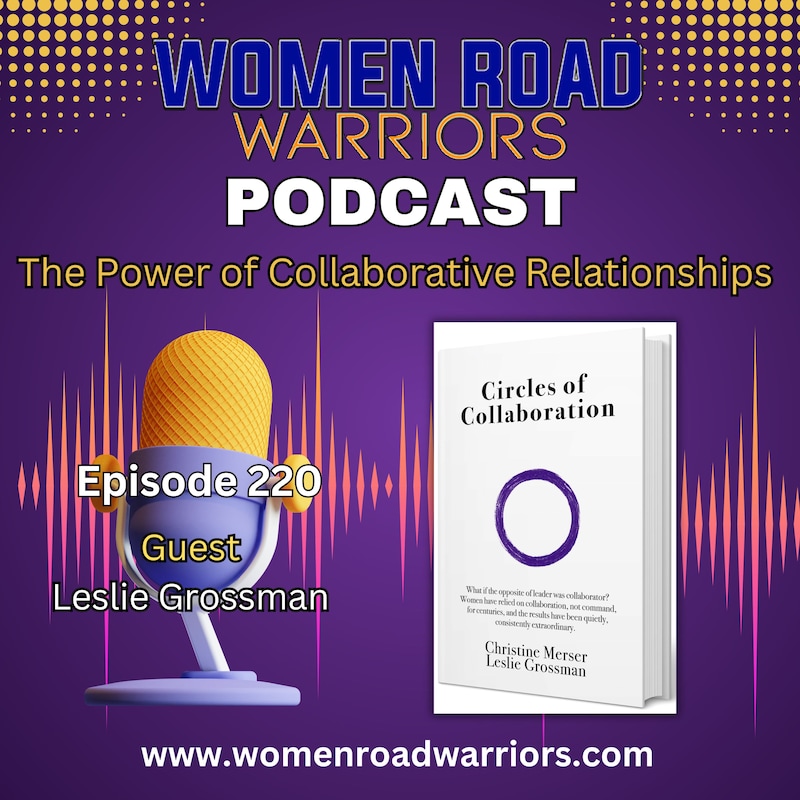
In this compelling episode of Women Road Warriors, Shelley Johnson and Kathy Tuccaro explore The Power of Collaborative Relationships with leadership expert and author Leslie Grossman. A visionary in women’s leadership development, Leslie is the Faculty Director of the Women’s Leadership Program at The George Washington University Center for Excellence in Public Leadership, a Senior Fellow, executive coach, and founder of five businesses.
For years, women have been told to push harder, compete smarter, and climb alone. Leslie offers a different path — one rooted in courage, executive presence, trusted relationships, and intentional collaboration.
Drawing from her groundbreaking book Circles of Collaboration, she reveals how women can access mentorship and sponsorship, create inclusive professional networks, and build authentic relationships that accelerate career growth. She also shares insights from her transformative framework, The 7 Habits of Highly Effective Women, showing how collaboration fuels confidence, influence, and momentum.
If you’re ready to shift from solo striving to shared success, this conversation will change how you think about leadership, connection, and power.
Because when women collaborate, they don’t just advance — they transform industries.
🎧 Listen now and discover how collaborative relationships can elevate your leadership and your life.
https://www.lesliegrossmanvision.com/
https://lesliegrossmanleadership.com/about/
https://womenroadwarriors.com/
https://womenroadwarriors.com/power-network
#WomenInLeadership, #CollaborativeLeadership, #CirclesOfCollaboration #PowerOfCollaboration, #LeslieGrossman, #LeadershipDevelopment #WomenRoadWarriors #ShelleyJohnson #KathyTuccaro
Transcripts
This is Women Road warriors with Shelly Johnson and Kathy Tucaro.
Speaker A:From the corporate office to the cab of a truck, they're here to inspire and empower women in all professions.
Speaker A:So gear down, sit back and enjoy.
Speaker B:Welcome.
Speaker B:We're an award winning show dinner dedicated to empowering women in every profession through inspiring stories and expert insights.
Speaker B:No topics off limits.
Speaker B:On our show, we power women on the road to success with expert and celebrity interviews and information you need.
Speaker B:I'm Shelley.
Speaker C:And I'm Kathy.
Speaker B:Today we're talking about habits that don't just make women effective, they make us unstoppable.
Speaker B:That's so important.
Speaker B:Today, our guest, Leslie Grossman has spent her career shaping leaders who embody courage, presence, and collaboration.
Speaker B:She's the faculty director of the Women's Leadership program at the George Washington University center for Excellence in Public Leadership, a senior fellow, and an executive coach who leads transformative programs on executive presence, building trusted relationships, and the seven habits of highly effective women.
Speaker B:Leslie isn't just a coach, she's a visionary.
Speaker B:She founded five businesses, chaired CEO peer groups for Vistage International, and for the past decade has dedicated her work to developing women and executives into confident, influential leaders.
Speaker B:Her vision?
Speaker B:A world where gender equity is no longer a goal, but simply a way we live and work.
Speaker B:And now Leslie brings that vision to her brand new book, Circles of Collaboration.
Speaker B:In it, she reimagines how women can access mentors and sponsors, create networks where they're included, and build authentic relationships that fuel career momentum.
Speaker B:Leslie Grossman is here to show us how to shift from solo hustle to shared purpose.
Speaker B:And how the seven habits of highly effective women can transform not only your career, but your entire life.
Speaker B:Welcome, Leslie, thank you so much for being on the show with us.
Speaker C:Well, thank you so much for having me here.
Speaker C:I am really excited about our conversation and sharing it with all the women out there who are right now working hard and really wanting their visions and goals to happen in the next year.
Speaker B:Oh, that sounds like a great goal.
Speaker B:What do you think, Katie?
Speaker D:I'm in.
Speaker C:I'm in.
Speaker B:Me too.
Speaker B:Me too.
Speaker C:Unbelievably long list of goals.
Speaker C:So, yes, let's do this.
Speaker C:Yes, let's do it.
Speaker B:Leslie, you've created so much momentum for women in what you do.
Speaker B:What inspired you to do this, and what's your background?
Speaker C:Thanks for asking that, Shelly, because really, it is my life that really.
Speaker C:And the experiences that I lived through that really shaped the beginning of what I teach and share with other women.
Speaker C:Add that onto the research that I did because I was a senior researcher for two years where I got to interview the most success, some of the most successful women in the country, and some of them internationally, as well as those that were executives.
Speaker C:I got to interview their bosses that were CEOs of companies and their peers to discover what was it that made these women so successful?
Speaker C:What did they do differently?
Speaker C:What were their habits?
Speaker C:Right?
Speaker C:Not so much their skills, it was more their behaviors.
Speaker C:And so those were the things that I. I learned that I was able to put into the seven habits that I talk about, you know, the seven habits of successful women.
Speaker C:However, one of the things struck me the most, and I realized that it was true not only of those women, but of my own personal life.
Speaker C:And that was the power of trusted relationships and having circles of people around me that would help me and I would help them.
Speaker C:It was started.
Speaker C:It was collaboration.
Speaker C:It was, how do we help each other?
Speaker C:And successful people never do it alone.
Speaker C:They always have people around them, but they're not just taking, they're also giving.
Speaker C:So when I look back at my life, starting with my very first job, how did I get where I got each time?
Speaker C:It was my.
Speaker C:Some people call it a network, but I call it your circle, because network kind of you think about networking, right?
Speaker C:Networking.
Speaker C:A lot of people don't want to do networking.
Speaker C:They don't like it.
Speaker C:And it's kind of the old school networking that if you've been around a while, you know, that's when you go to a big event and you go up to people and you pass out cards.
Speaker C:That's the old networking.
Speaker C:But circles, circles of collaboration are not like that.
Speaker C:So circles of collaboration are building collaborative relationships with people.
Speaker B:I like that concept.
Speaker B:Because it's a continuum.
Speaker C:Exactly.
Speaker C:It's a continuum.
Speaker C:And it's like you're surrounded by people, but you're also surrounding them and you're listening and you're having different kinds of conversations than people are having these days.
Speaker C:Right?
Speaker C:Because ever since the pandemic and technology and cell phones, somehow those deeper conversations are not happening as often and we're not learning about each other and in a position to help each other the way we could be.
Speaker C:And that's what I am bringing back.
Speaker C:That's what I'm reminding people of.
Speaker C:And that's what I'm teaching in all the courses that I teach.
Speaker C:And whenever I speak, and it does exist, women are doing it.
Speaker C:And we did it in the past.
Speaker C:Like when you go back in history, we did it all the time.
Speaker C:But something happened in those.
Speaker C:I don't know, eight years.
Speaker C:How many years is it now since the pandemic and the technology all kind of merged?
Speaker B:It feels more like eight, doesn't it?
Speaker B:Yeah, it does, yeah.
Speaker B:And I'm actually hearing that a lot of younger people, we're talking maybe 18 to in their 20s, teenagers, their friends are online.
Speaker B:They don't necessarily have a circle of people in person.
Speaker B:There's something lacking there if you can't.
Speaker B:I mean, because they're always texting and typing and that sort of thing.
Speaker C:Or gaming.
Speaker D:Right.
Speaker D:Or what gamers have.
Speaker D:They.
Speaker D:They've never met, but they just, they.
Speaker C:They play online.
Speaker C:Yeah, exactly.
Speaker C:And they're not having conversations.
Speaker C:Conversations is really what leads to trust in relationships.
Speaker C:I mean, you can know someone that you're texting to or like you said, online, but do you really know them?
Speaker B:No.
Speaker C:Do you know, you know, do you know their goal?
Speaker C:Do you know their vision, where they want to go?
Speaker C:No, you don't.
Speaker C:So how can you each other when you just have those brief conversations?
Speaker B:It reminds me of the Martin Mall song.
Speaker B:They never met, not even briefly.
Speaker B:Martin Mull was a comedian from years ago.
Speaker B:But, you know, we are not designed to be interacting in what, 10 second, 30 second or nanosecond periods of time.
Speaker B:And I think it has really made people very, very impatient and lacking in social skills and what you're talking about with a circle, we need to have those social skills too, in order to cultivate all that.
Speaker C:Absolutely, Shelley, Absolutely.
Speaker C:So we kind of have to.
Speaker C:Those of us who are older have to remind ourselves of about how do we have a really great conversation.
Speaker C:And those that are younger need to learn how to do it.
Speaker C:And I always tell people, the way we start is with curiosity, by asking each other questions and learning about each other.
Speaker C:And that curiosity is what separates us from AI and technology, Right.
Speaker C:I mean, not ask and wanting to learn about someone's background.
Speaker C:What did you do?
Speaker C:What are you doing now?
Speaker C:Just like you asked me, Shelly, about my story.
Speaker C:What's your story?
Speaker C:Finding out each other's story.
Speaker C:How do we get to where we were and what do we want now?
Speaker C:What are we?
Speaker C:What's important to us?
Speaker C:And then learning to listen to each other, which is another thing that some of us have lost patience for.
Speaker C:So.
Speaker B:Oh, yeah, Listening is a skill a lot of people don't have.
Speaker C:Exactly.
Speaker C:That is not taught in school.
Speaker B:No, there's so many things.
Speaker C:Well, people are so busy with their phones.
Speaker D:I mean, go to restaurants nowadays, right?
Speaker D:Everyone's.
Speaker D:You get family members, like, sitting at the table.
Speaker D:No One's talking to each other.
Speaker C:No, they're all on their phones.
Speaker C:They're not listening.
Speaker D:They're not interacting.
Speaker D:It's like, oh, my God, that's right.
Speaker B:I just observed that about a week ago at a restaurant.
Speaker B:And I'm thinking, do these people like each other?
Speaker D:Good question.
Speaker B:Right.
Speaker C:Question.
Speaker C:Because if they really liked each other, or even maybe do they know if they like each other?
Speaker C:They haven't given the chance to find out what's going on below.
Speaker C:Okay, we're friends, but.
Speaker C:But what's going on in your life?
Speaker C:Tell me.
Speaker C:Tell me.
Speaker B:Yeah, I saw a couple sitting there, and we say, in a hotel restaurant, actually.
Speaker B:And I'm looking at the two of them, and it was clear that they were there on vacation or maybe for the weekend or something.
Speaker B:But I'm thinking, if it's a getaway, shouldn't you be maybe chatting, spending quality time with each other instead of on your phones?
Speaker C:Exactly.
Speaker C:And take that to the professional world.
Speaker C:Right.
Speaker C:And now how do we want to succeed in our careers?
Speaker C:And we're all working.
Speaker C:Women are working so hard.
Speaker C:We have multiple jobs, meaning whether you.
Speaker C:You're in many cases, you're a mom or you're a sister, you're an aunt, you're a child of aging parents, you've got so many responsibilities in addition to the job or the business that you're running and leading.
Speaker C:So we're so busy, we don't think that we have time for those conversations.
Speaker C:But in reality, it's those conversations that lead to these trusted relationships that can make your business more successful, can help move you up into your career.
Speaker C:Because without a conversation and without finding out what the other person wants, what their goals are, how can we help each other?
Speaker A:Stay tuned for more of women road warriors coming up.
Speaker E:Dean Michael, the tax doctor here.
Speaker E:I have one question for you.
Speaker E:Do you want to stop worrying about the irs?
Speaker E:If the answer is yes, then look no further.
Speaker E:I've been around for years.
Speaker E:I've helped countless people across the country, and my success rate speaks for itself.
Speaker E:So now you know where to find good, honest help with your tax problems.
Speaker E:What are you waiting for?
Speaker E: -: Speaker E:And get your life back.
Speaker B:Industry movement.
Speaker B:Trucking Moves America Forward is telling the story of the industry.
Speaker B:Our safety champions, the women of trucking.
Speaker B:Independent contractors, the next generation of truckers and more.
Speaker B:Help us promote the best of our industry.
Speaker B:Share your story and what you love about trucking.
Speaker B:Share images of a moment you're proud of and join us on social media.
Speaker B:Learn more at truckingmovesamerica.com.
Speaker A:Welcome back to Women Road warriors with Shelly Johnson and Kathy Tucaro.
Speaker B:If you're enjoying this informative episode of Women Road Warriors, I wanted to mention Kathy and I explore all kinds of topics that will power you on the road to success.
Speaker B:We feature a lot of expert interviews, plus we feature celebrities and women who've been trailblazers.
Speaker B:Please check out our [email protected] and click on our Episodes page.
Speaker B:We're also available wherever you listen to podcasts on all the major podcast channels like Spotify, Apple, YouTube, Amazon Music, Audible, you name it.
Speaker B:Check us out and bookmark our podcast.
Speaker B:Also, don't forget to follow us on social media.
Speaker B:We're on Twitter, Facebook, Instagram, Pinterest, LinkedIn, YouTube, and other sites.
Speaker B:And tell others about us.
Speaker B:We want to help as many women as possible.
Speaker B:We're talking about habits that don't just make women effective, they make us unstoppable.
Speaker B:Our guest is Leslie Grossman, faculty director of the Women's Leadership Program at the George Washington University center for Excellence in Public Leadership, a senior fellow, executive coach, founder of five businesses, and now author of the powerful new book Circles of Collaboration.
Speaker B:Leslie's redefining leadership through Courage, Executive Presence, Trusted relationship, and what she calls the seven habits of Highly Effective Women.
Speaker B:This isn't about hustling harder.
Speaker B:It's about building circles that elevate everybody.
Speaker B:And we're diving deep into how you could do exactly that.
Speaker B:Leslie, you talk about the power of collaboration.
Speaker B:It really is powerful.
Speaker B:You have to build camaraderie, correct?
Speaker C:Exactly.
Speaker C:Exactly.
Speaker C:If you go back in history, before we had cell phones, and all the way back in history, even to prehistoric times, women were always helping each other.
Speaker C:I mean, they were the cave women that looked like they were just taking care of the children or gathering berries, but they were doing so much more.
Speaker C:And recent archeology shows that they were also collaborating on getting food out, like hunting for the small animals while they waited for the men who were just going after the big animals who would be gone for several days.
Speaker C:They were doing everything else, and they were communicating with each other, sharing responsibilities, and helping each other succeed.
Speaker C:So it was success back then.
Speaker C:Success looks different in every century, right?
Speaker C:And so now we need to go back to doing that again.
Speaker C:We need to be putting down those Phones, not having them all the time, dominating our life and going out in a group and finding out about each other and finding out how we can help each other.
Speaker B:That's so important.
Speaker B:But do the people today know how to do that?
Speaker B:Do the women today that are coming up, like you said, it isn't taught in school.
Speaker B:And we're kind of in a communication deficit, which I think that's creating an additional hurdle.
Speaker B:Because if you can't talk, you can't form this circle that is so important and of people you can trust and trustworthy relationships, that is something that's absolute.
Speaker B:If you can't trust people, then you're always in a stressful, competitive mode.
Speaker B:You think people are out to get you, and you're gonna be defensive in the workplace, aren't you?
Speaker C:Well, a lot of people are.
Speaker C:And that's why right now, it's more important than ever that we not be worried about that and instead worry about.
Speaker C:About how we can help each other.
Speaker C:And one of the things that I think people can start to do is create a list of the circles of life that they have around them.
Speaker C:Now, for instance, are you, Kathy, you've got the women that you're meeting up with in your profession and your work, and Shelli in yours, and everybody has coworkers that maybe make up one circle.
Speaker C:Then we have, like, our friends.
Speaker C:That's another circle.
Speaker C:Then we have our neighbors that might not be our friends, but they're in our community.
Speaker C:Are we a member of a professional women's organization?
Speaker C:That's another circle.
Speaker C:And if we're not a member of a professional group, maybe we should be, or maybe it's a group, a nonprofit, where we all care about changing the world in some way together.
Speaker C:We all have some commonality that brings us together in a circle, and that's where we start with those people and then individually reaching out to them and having that conversation of curiosity one by one, whether it's in person, or maybe it's a zoom call or even a phone call.
Speaker C:But we each have to take the leadership role of being the one to get it started by being curious about the people in our circle.
Speaker B:Curiosity is what makes life go around when you think about it and you learn.
Speaker B:I find when I meet people and talk to other people, I learn so much because we can't possibly know everything.
Speaker B:And when you're collaborating with other people, you grow.
Speaker B:I mean, you can't help but grow.
Speaker D:I can give a very good example of that.
Speaker C:Mining.
Speaker D:You know, I work with the same people for their last 12 years.
Speaker D:And everybody, we work two weeks on, two weeks on.
Speaker D:Everybody has the same conversation forever.
Speaker D:Oh, you know, what are you doing on days off?
Speaker D:Oh, it's steak night, you know, what's the weather like?
Speaker D:And did you go fishing like, things like that.
Speaker D:And it just, it drives me crazy.
Speaker D: So when my book came out in: Speaker D:And three days before it was about to come out, like nobody at work knew anything about me other than I was a nurse.
Speaker D:And I got hit with some anxiety.
Speaker D:I'm thinking, oh my God, this, they're going to know everything.
Speaker D:I mean these are big tough guys full of tattoos and you know, testosterone and.
Speaker C:And I'm thinking, oh my God.
Speaker D:And it took me three days to come to the conclusion that, wait a minute, don't be, don't tell me that these big tough guys don't have life issues too.
Speaker D:So what I did, I went in front of my whole crew, 110 and I said, listen, you see this book, it's not about mining, has nothing to do with about that.
Speaker D:It has to do with, you know, blah, blah, blah, blah.
Speaker D:And I kind of said, I'd rather you hear it from me than from third party party gossip.
Speaker D:Well, son of a gun.
Speaker D:Because I had the courage to do that.
Speaker B:Oh.
Speaker D:And I said, you know, I'm not asking you to read the book but however, if you know someone who's struggling with depression and anxiety and maybe suicide or health issue or whatever, sexual assault, maybe pay the book forward.
Speaker D:Well, the day after that happened, it was the most unbelievable thing because I had people coming out of the woodwork coming to pull me aside, talking about, hey, Kathy, you know, I got, I got, I got a couple daughters that are really struggling with this and that.
Speaker D:All of a sudden we're having real conversations in the workplace about mental health and about things that matter and not about superficial bs that it's.
Speaker C:So it was.
Speaker C:Oh yeah.
Speaker D:And not only that, not only from my department, from every department down all the way from Calgary to, to tailings.
Speaker C:To, to people in the office.
Speaker D:I mean it went it point where the company Exxon brought me to speak on mental health, where it was li.
Speaker D:It was aired all across Canada live in every Exxon site, every Imperial site, live talking about mental health in the workplace.
Speaker D:It was unbelievable.
Speaker D:Just because I had the courage to start talking about things that matter.
Speaker C:Congratulations.
Speaker B:Yes.
Speaker C:For doing that.
Speaker C:I mean, and, and it's.
Speaker C:And you're showing to be vulnerable, right?
Speaker C:To be willing to tell your story.
Speaker C:And when we share our story, and it doesn't have to be in a book, although you, because you wrote that book, you impacted God knows how many thousands, perhaps even lives.
Speaker C:But each of us could have an impact on each other's lives.
Speaker C:Even if we had an impact on five lives, 10 lives, that can change everything for women, for each other and for men too.
Speaker B:I really can't.
Speaker C:And like taking what you did and bringing it down to a personal level, right.
Speaker C:It's amazing whether we tell our story and we then and ask other people about their story.
Speaker C:What's your story?
Speaker C:What have you know?
Speaker C:I really want to know.
Speaker C:How did you.
Speaker C:I know you had a challenging life.
Speaker C:I want to hear more about it.
Speaker C:I want to hear how you did it.
Speaker C:How did you get through that?
Speaker C:Wow.
Speaker C:I mean, it's powerful.
Speaker C:And if we're all doing it, you can all succeed.
Speaker B:It's very validating when people are asking about that.
Speaker D:But if you're able to be vulnerable enough and be honest enough in front of people, they sense that.
Speaker D:And all of a sudden it opens them, it almost allows them, they give themselves permission to be vulnerable with you.
Speaker D:Like, it's a two way street.
Speaker D:It is the most beautiful thing I could have ever done.
Speaker D:Like, because now to this day, even like seven years later, eight years later, people are still coming to me talking about, about whatever.
Speaker D:Like a co worker, his son committed suicide six months ago and nobody knew.
Speaker D:But yet he comes to talk to me.
Speaker C:Do you know?
Speaker D:Like, it's just things that it's.
Speaker D:I feel very blessed to be able to have opened up the floodgates like that.
Speaker C:And that's what you're doing, Leslie, you.
Speaker D:Know, and I love that.
Speaker C:Yes, I'm doing it on a smaller scale, but the goal is for it to be a multiplication effect.
Speaker B:A logarithm.
Speaker B:A logarithm, absolutely.
Speaker C:And the other thing that you said, Kathy, that is so important often to tell our story, we need to be courageous, right?
Speaker C:And courage is something that is missing today.
Speaker C:We have courage as one of the seven habits of the most successful people in the world.
Speaker C:You know, of being courageous about things and being happy.
Speaker C:When we're courageous, we are also feeling fulfilled.
Speaker C:And we can have an impact on each other when we courageously speak out, when we courageously reach out to people.
Speaker C:That's why sometimes women will say to me, well, I don't really have much of a circle right now.
Speaker C:I used to.
Speaker C:I said, but those people that were in your circle 10, 15 years ago would love for you to reach out to them now and check in with them and say, how are you doing?
Speaker C:What's going on?
Speaker C:I've thought of you.
Speaker C:What's going on in your life?
Speaker C:I want to hear.
Speaker C:I have people that I have reached out after the pandemic that were people that I knew from 15 years before.
Speaker C:And I can't tell you how their life went in a certain direction that kind of complemented my life.
Speaker C:But I never would have known it had I not reached out.
Speaker C:And together we figured out ways that we could help each other grow our businesses, make introductions to people that we wouldn't have known.
Speaker C:But it requires just reaching out.
Speaker C:And when I reached out, they were so happy.
Speaker C:And when people reach out to me, I'm absolutely thrilled.
Speaker C:We all love it, don't we, when people reach out to us from our past?
Speaker C:Oh, absolutely.
Speaker B:It's a huge compliment.
Speaker B:And everybody wants to feel like we've made an impact.
Speaker B:And if somebody reaches out after years, you're like, wow, this person didn't forget me.
Speaker B:And we need that kind of validation, too.
Speaker A:Stay tuned for more of Women Road warriors coming up.
Speaker E:Dean Michael, the tax doctor here.
Speaker E:I have one question for you.
Speaker E:Do you want to stop worrying about the irs?
Speaker E:If the answer is yes, then then look no further.
Speaker E:I've been around for years.
Speaker E:I've helped countless people across the country, and my success rate speaks for itself.
Speaker E:So now you know where to find good, honest help with your tax problems.
Speaker E:What are you waiting for?
Speaker E: -: Speaker A:Welcome back to WOMEN Road warriors with Shelly Johnson and Kathy Tucaro.
Speaker B:Today's conversation is about shifting from solo ambition to shared power.
Speaker B:Leslie Grossman has spent a decade developing women into confident, influential leaders as faculty director at George Washington University center for Excellence in Public Leadership, a senior fellow, executive coach, and chair of CEO peer groups for Vistage International.
Speaker B:Her new book, Circles of Collaboration, reimagines how women access mentorship, sponsorship, and meaningful networks not by waiting to be invited in, but by building spaces where they truly belong.
Speaker B:This is leadership rooted in courage, communication, collaboration, and a mindset shift that changes everything.
Speaker B:Leslie I was real interested.
Speaker B:The 7 Habits of Highly Effective Women.
Speaker B:What are those?
Speaker B:Because I think all of us kind of Want to know what are the ladies that are out there really making things work?
Speaker B:What are they doing differently?
Speaker C:Okay, I will share with you because it is amazing, and a lot of us already have those habits, but we could use a few more, right?
Speaker C:Maybe we have three out of the seven, or we have four out of the seven.
Speaker C:The one that is the number one thing that women that have succeeded at the highest levels have, the number one is they have a vision for their life.
Speaker C:And that's bigger than even a goal.
Speaker C:The goals are set to get to the vision.
Speaker C:The vision is like looking into a crystal ball and seeing you in action two years from now, three years from now, four years from now.
Speaker C:And you're doing something that you absolutely feel fulfilled by, and you're having an impact on something in some way.
Speaker C:And all those women that I interviewed all had a vision of what they wanted to not just do, but that would change something or make it better or, you know, and.
Speaker C:And that's what the number one thing is that they had anyone.
Speaker C:And I actually wrote a book called Start with Vision.
Speaker C:That is.
Speaker C:It's a little book and tells you how to begin to look at, analyze your life, ask yourself certain questions to come up with what your vision is.
Speaker C:Because, you know, you hear about people in their jobs, they're working for money, but they're not really fulfilled.
Speaker C:What if you could be fulfilled and be successful?
Speaker C:Because quite frankly, the most successful people are the ones that are working in an area where they are living their vision and feeling fulfilled by the work that they do.
Speaker C:So that's number one.
Speaker C:Number two is having leadership presence, meaning when people look at you, you look like a leader, you sound like a leader.
Speaker C:You sound like somebody who has confidence, even if you don't have confidence yet.
Speaker C:And so they all kind of did what they needed to do.
Speaker C:They had the conversations they were awkward about.
Speaker C:They put on their happy face even when they didn't feel so happy.
Speaker C:They stood up tall, they spoke up at a meeting, even when they were afraid, and they did certain things that they were uncomfortable with.
Speaker C:And that's what often requires.
Speaker C:It's required to be a leader.
Speaker C:I don't want to keep going down the list without you, maybe have some thoughts.
Speaker C:So feel free to interrupt me along the way on any of these.
Speaker C:The third is the relationship building.
Speaker C:And to build those relationships, when you have a vision and you can talk about what your vision is, people get inspired, and they want to have a relationship with you, they want to help you.
Speaker C:And the fourth is mindset.
Speaker C:What's in our heads.
Speaker C:Do we think that we are a failure?
Speaker C:Do we think that we could be successful?
Speaker C:What are we thinking about?
Speaker C:We have to think about.
Speaker C:We can shift that mindset a little bit about that.
Speaker C:Have either of you had that experience where maybe you were feeling down and thought, I can't, and I certainly have, where I've made mistakes and I've thought, oh, my God, I made such a mess of this.
Speaker C:Am I ever going to come back?
Speaker B:Oh, yeah.
Speaker B:More than once in my life, all the time.
Speaker B:Yep.
Speaker B:Yep.
Speaker B:I could relate.
Speaker C:I learned for myself and from others is it's the mistakes that we.
Speaker C:That we learn the most from, and that's how we grow.
Speaker C:And if we try to be perfect all the time, not only will we not be perfect, but we're never gonna learn.
Speaker C:We have to stick our necks out.
Speaker C:That's where courage comes in, too, which is one of those seven tenets.
Speaker C:And be willing to make mistakes and not beat ourselves up about it, because from those mistakes, we are going to learn so much so that the next time we do it a little differently.
Speaker C:Right?
Speaker B:Very true.
Speaker B:Hindsight's always 20 20.
Speaker B:And when we make a mistake, we may not like ourselves for a while, but it's kind of like, you know, I guess I did it better because I made a mistake and realized it was oops, Which I've done plenty of those.
Speaker C:Exactly.
Speaker C:Exactly.
Speaker C:And so that courage becomes the courage to say, I'm still great, I still love myself, I made a mistake.
Speaker C:It's okay.
Speaker C:I'm human.
Speaker C:We humans, we make mistakes.
Speaker C:We are not meant to be perfect.
Speaker C:Which, by the way, as I'm sure you both know, and so does our audience, so many times women feel pushed to be perfect.
Speaker C:Right?
Speaker C:Perfect wives, mothers, this, that it's impossible.
Speaker B:We grow up seeing perfect women.
Speaker B:The cosmetic industry pushes that all the time.
Speaker C:Exactly.
Speaker C:And the media presents people as if they're perfect and they're not.
Speaker C:I mean, hear those stories enough about.
Speaker C:But I, you know, I always.
Speaker C:In my books, I talk a lot about the women who were not perfect, who made a lot of mistakes and turned those mistakes around into successful businesses, successful careers.
Speaker C:But it was in fact, those mistakes that they learned from and made them be more successful.
Speaker C:So getting away from that perfection is absolutely critical.
Speaker C:One of the exercises I do in the course that I teach is I tell the women they have to pick two things that they are obsessed about being perfect about and not do them for a week and see what happens.
Speaker C:One of them ended up not cleaning her house for a week.
Speaker C:And she said, when she came back, I asked her, so what happened?
Speaker C:Because you left your house messy all week?
Speaker C:She says, at first the family complained, and then after a while, they started to help because they didn't like it that way.
Speaker C:And now I have them contributing.
Speaker C:That worked in her favor, and she wouldn't have done it if she kept thinking she had to be that perfect mom, Right?
Speaker C:In her eyes, it was making sure the house is clean and neat all the time.
Speaker C:So we have to give up on the.
Speaker C:We have to decide where are we not going to be perfect, what are we going to give up, whether it's in our home or in our business.
Speaker C:In our businesses, often we don't delegate enough because we think other people will not do it as well as we do.
Speaker C:The women that I interviewed all were great delegators.
Speaker C:They realized that their job was not to do it all.
Speaker C:It was to guide other people to do it well and to help them, to mentor them and guide them to do it.
Speaker C:And not.
Speaker C:And it's not always gonna be perfect, and that's okay.
Speaker B:That's not easy for people to do.
Speaker B:Not everybody is able to give up that control.
Speaker B:And that's where the trust comes in, too.
Speaker B:And like you said, with the circles of collaboration, you develop trust with people.
Speaker B:And I wonder, do women have a harder time letting go and mentoring and letting other people handle the tasks?
Speaker C:Yes, they do.
Speaker C:The research shows that they do.
Speaker C:And I think it starts back in childhood for so many of us when we're little girls, looking a certain way, dressing a certain way, being the polite one.
Speaker C:Whereas boys are not expected to be as polite.
Speaker C:But we are.
Speaker C:Most girls are trained.
Speaker C:Be a certain way, speak a certain way, don't roughhouse.
Speaker C:Right.
Speaker C:And I mean, we are.
Speaker C:And I see it happening even now.
Speaker B:Act like a lady.
Speaker B:I heard that.
Speaker C:Exactly, Exactly, Shelley.
Speaker C:And then they conjure up in their mind what ladylike behavior is.
Speaker C:Right.
Speaker C:And that's where the perfection thing starts with girls and women.
Speaker C:Whereas boys do not.
Speaker C:Are not taught at those same things.
Speaker C:Most boys, of course, when I say girls and boys, you know, it's not everybody, but they're the majority.
Speaker C:And then when they go to school, even in elementary school, the teachers will often put up with a certain kind of behavior from the boys, but not from the girls.
Speaker B:Yeah.
Speaker B:Nature, double standard.
Speaker D:Exactly.
Speaker C:So it starts early, and those habits continue into adulthood.
Speaker C:Habits are hard to change.
Speaker C:They are hard to change, but they can be changed.
Speaker D:Oh, yeah, absolutely.
Speaker D:But it takes a lot.
Speaker D:It takes some very conscious thinking.
Speaker C:Yep.
Speaker C:And we can help each other do that, you know, by talking about it together in our circles.
Speaker B:That's good.
Speaker B:Yes.
Speaker B:And we could share and share perspectives.
Speaker B:You learn doing that.
Speaker B:So it really reinforces, again, we go back to the circle of collaboration.
Speaker B:We grow when we have that network, if you will, we can learn from other people.
Speaker B:So people need to do.
Speaker B:Women need to do more of that.
Speaker C:Exactly.
Speaker C:And, you know, we could each say if each of us said, look, I'm gonna put a circle together and my inner circle, the people that I trust the most from my various circles, and those are the people that we're going to all get on a zoom call if we're not located in the same place.
Speaker C:Right.
Speaker C:Let's all get on a zoom call together and let's talk about our lives.
Speaker C:Let's find out what's really going on in our lives.
Speaker C:Let's not make it one of those just surface conversations, and let's ask each other how we can support each other to move forward and reach our vision and goals and be there for each other and have that conversation, whether it's in person or on zoom on a regular basis.
Speaker C:And that can be extremely powerful.
Speaker C:And making time for it is important.
Speaker B:Very important.
Speaker B:Yeah.
Speaker B:It validates people.
Speaker B:And it's getting past the superficial because we all run into on the day to day.
Speaker B:When you're walking in the hallway in a workplace, people say, hi, how you doing?
Speaker B:They really don't care if you really stopped them and said, man, this is what's going on.
Speaker B:It's just a greeting.
Speaker B:It's superficial.
Speaker B:When you get past that superficial and you really, really reach out to someone, then you really have the human contact that makes the world go round.
Speaker C:Exactly.
Speaker C:Exactly.
Speaker C:So if each of us were to be a mini version of Kathy telling us, you know, really, we each have a story, we each have many stories, and we don't have to tell our whole life story necessarily, like we would in a book.
Speaker C:But what's going on now?
Speaker C:What's our challenge right now?
Speaker C:You know, and asking each other, how did you conquer that?
Speaker C:What's going on with you?
Speaker C:And how did you get to the job that you got to.
Speaker C:Or how are you successful in.
Speaker C:In your marriage?
Speaker C:Asking each other those curious questions to find out what's going on.
Speaker C:And I really want to learn from you.
Speaker C:Let's learn from each other.
Speaker B:Let's.
Speaker C:Those women that can have that inner circle of collaboration, of helping each other succeed, no matter what it is that we each want to do out there, and also to be happy in our lives, because that's certainly a goal for all of us, isn't it?
Speaker B:Absolutely.
Speaker A:Stay tuned for more of Women Road warriors coming up.
Speaker E:Dean Michael, the tax doctor here.
Speaker E:I have one question for you.
Speaker E:Do you want to stop worrying about the irs?
Speaker E:If the answer is yes, then look no further.
Speaker E:I've been around for years.
Speaker E:I. I've helped countless people across the country, and my success rate speaks for itself.
Speaker E:So now you know where to find good, honest help with your tax problems.
Speaker E:What are you waiting for?
Speaker E: -: Speaker E:And get your life back.
Speaker A:Welcome back to Women Road warriors with Shelly Johnson and Kathy Tucaro.
Speaker B:We're talking about what it really takes to build confidence, presence and influence.
Speaker B:Not someday, but now.
Speaker B:Leslie Grossman isn't just teaching theory.
Speaker B:She's founded five businesses, coached executives across industries, and now leads transformative programs on executive presence and building trusted relationships at the George Washington University.
Speaker B:Her new book, circles of Collaboration, challenges the old go it alone model and replaces it with something far more powerful, intentional, strategic circles that accelerate your growth.
Speaker B:If you've ever felt that you had to figure it out all by yourself, this conversation's for you, Leslie.
Speaker B:Out of the seven habits of highly effective women, I see vision, leadership, relationship building, and mindset.
Speaker B:What are the other three?
Speaker C:The other three are effective communication, courage, and confidence.
Speaker C:Did you say courage, relationship?
Speaker B:No, I had not.
Speaker B:No.
Speaker C:Courage and confidence.
Speaker B:Okay.
Speaker C:And really, that confidence is the seventh one, which actually happens when you start to practice the first six, because if you are practicing those six, you do feel confident and you know that you can accomplish what you want to accomplish.
Speaker C:And you have all these tools that you're already using.
Speaker C:Those first six are the tools that make you a confident person.
Speaker C:And you're not thrown when mistakes happen because you have a positive mindset and you know that it's okay to make mistakes, and it's okay, and I'm always growing.
Speaker C:That's the growth mindset, which is a very famous mindset that was created by a famous woman whose name I can't remember, Carol Dweck.
Speaker C:Carol Dweck created that whole concept of a growth mindset, which is that we learn from all our experiences, good, bad, and whatever, and that the most successful people, in her opinion, are those who have a growth mindset.
Speaker C:So all those habits lead to being a confident person, which we all want.
Speaker C:We want to have that confidence because then we feel happy and we know we're doing whatever we can, even when we make mistakes, which is okay.
Speaker C:I don't know about both of you, I'd love to hear, but I know that when I look back on my life, it was my mistakes that I learned the most from that helped me to move forward.
Speaker C:It was when I, starting from my very first mistake, when I quit my very first job because I didn't get a promotion.
Speaker C:I thought it was the stupidest mistake that I ever made.
Speaker C:Why did I quit my job?
Speaker C:Because I didn't get the promotion.
Speaker C:I was only 24 years old.
Speaker C:But in reality, what happened was I started my first business.
Speaker C:I learned how to be.
Speaker C:I began to learn how to be an entrepreneur, which set me on a new path.
Speaker C:So that mistake actually turned out to be a very good thing.
Speaker C:So sometimes when we look back on our mistakes, which I think is a good thing for us all to do, we might realize that those mistakes led to something really positive in our life.
Speaker B:Life does take us on those twists and turns.
Speaker B:One thing leads to another and it is true.
Speaker B:You make a choice and it sends you in another direction, which opens up a whole new avenue of possibilities.
Speaker B:You can look at it negatively or, or you can look at a whole new horizon ahead of you where you have growth opportunities.
Speaker C:Exactly, exactly.
Speaker C:So I mean, if everyone, you know, and a lot of people are having a challenge now with finding jobs.
Speaker C:Right.
Speaker C:And because of what's going on in the economy and with AI reading resumes and scanning the resumes, looking for certain words and I mean, we know.
Speaker C:I've been hearing this from so many people that are coming to me and saying, I set my resume out through this, this online job search and I got rejected by 50 people.
Speaker C:Well, those are.
Speaker C:And that's.
Speaker C:And they were rejected not because they weren't qualified, it's just because they didn't have the right words.
Speaker C:And frankly, most of those jobs are going to people that know people that are in their circle.
Speaker B:Uh huh.
Speaker B:And they don't tell you that.
Speaker B:But yeah, the keyword loading that people have to do in their application process and in their resumes, it really is ridiculous because it's going through a parser and it's.
Speaker B:You don't always get in front of a person.
Speaker B:But absolutely, if you know a person at that company, you get past that.
Speaker B:Gatekeeper.
Speaker C:Exactly.
Speaker D:That's right.
Speaker C:And the companies are.
Speaker C:Actually many companies are rewarding their own employees if they introduce them to someone for a position and they hire them.
Speaker C:Not only does the person get hired because they were introduced by an employee in that company, but the employee gets rewarded.
Speaker C:So that relationship building is critical and it's people in your circle that can open the door for you.
Speaker B:Sure.
Speaker C:So that is very relevant for what's going on in the world today.
Speaker B:So your book, Circles of Collaboration, what is that all about?
Speaker B:We have about five or six minutes here and I thought we could touch on some of the main points with that.
Speaker C:Well, we've talked about quite a few of them, but I can add to that a few more things that I think everybody will find very interesting.
Speaker C:And that is if you think back to what the word networking, which is the word that we're used to using when we connect with people in a business sense, in a professional sense, versus collaboration.
Speaker C:I want everyone to understand the differences between networking and collaboration.
Speaker C:When you're networking out there and it's surface for the most part, it's transactional, it's short term and.
Speaker C:And usually it's just one way support, maybe one person is helping the other, but it doesn't go in both directions.
Speaker C:It's casual, it's not really very eventful and often you don't ever see that person again.
Speaker C:Or maybe you'll talk to them once or twice and it's not reliable.
Speaker C:But with collaboration and having a circle of collaboration, you begin to build a relationship and a relationship lasts.
Speaker C:It is you're helping each other so that relationship continues.
Speaker C:It's long term and it's reciprocity.
Speaker C:Right.
Speaker C:We help each other in collaboration and it's actually transformational.
Speaker C:It can transform your life.
Speaker C:That doesn't happen in networking.
Speaker C:And the other big thing is trust is built between people when you are collaborating with them and they are someone in your circle of collaboration.
Speaker C:In networking, there's not really trust.
Speaker C:It's just you know each other, but there's no real trust.
Speaker C:So that's why I just want people to begin to think about the power of collaborating with people in your relationships.
Speaker C:It creates a very powerful opportunity for each person and it also creates great fulfillment and happiness.
Speaker C:Because what makes us happier than relationships with people being liked and liking somebody else.
Speaker C:That is so heartwarming.
Speaker C:And it's also gets rid of stress knowing you have people to deal with and talk to.
Speaker C:So many of us feel alone with and the burnout.
Speaker C:Yeah, people to talk to about those things.
Speaker C:And so having that circle of collaboration gives that to you.
Speaker C:You can be honest, you can be vulnerable about it.
Speaker C:You know, it is the Secret for today, for business, for success, and just for happiness, I believe.
Speaker C:I mean, I talk a lot about how to build that and in the book talks about how to have a conversation that is powerful.
Speaker C:It talks about how to.
Speaker C:How the.
Speaker C:Everything from.
Speaker C:When you hold a meeting, are you having a meeting around a square table or a round table?
Speaker C:I mean, a round table is a circle and everybody feels included.
Speaker C:When it's a square or rectangle table, people feel left out.
Speaker C:That's why when you go out to dinner, have a round table, for sure, don't sit at one.
Speaker C:Square tables, it's more inclusive.
Speaker C:You know, all those.
Speaker C:Think in circles in your life and being surrounded by warmth, information, and the possibility of collaboration.
Speaker C:So we talk a lot in the book about what the power of circles in so many areas of your life, but really at the heart of it is in your personal life and being surrounded by people that you respect and they respect you.
Speaker B:It's really important.
Speaker B:It's essential.
Speaker B:I mean, that's what human beings are all about.
Speaker B:Where do people find the book, Leslie?
Speaker B:You have a website.
Speaker B:Can they find the book there?
Speaker C:Find the book on the website and through the usual places that you can purchase.
Speaker C:You should also just think about looking for opportunities to.
Speaker C:I want to just say beyond my book, which I, of course, I would love people to read it.
Speaker C:Not because I want to sell the book so much as that I want to bring this concept into people's lives and to begin to create a shift and test it out with those around you now of being able to ask questions, be curious, but also, you know, in terms of the book itself, it can take you on that road to finding it and give you the bravery, the courage to.
Speaker C:To go out there and live life a little bit different.
Speaker C:In a circle.
Speaker C:In a circle like the world, right?
Speaker C:And the globe, and when you think about it, the solar system, too.
Speaker C:Everything that's good about life is in circles.
Speaker B:Very true.
Speaker B:The circle of life.
Speaker B:Absolutely.
Speaker B:Leslie, your website is Leslie GrossmanVision.com, am I correct?
Speaker B:That's correct.
Speaker C:Exactly.
Speaker B:So people can find you there.
Speaker B:Can people reach out with any kind of questions?
Speaker C:Absolutely.
Speaker C:And one of the things that I'm happy to do, if anyone wants to communicate with me, either through email or through LinkedIn, where I'm up on LinkedIn as well, and request a worksheet on how to start your circles of collaboration.
Speaker C:Just.
Speaker C:I'm happy to send you the worksheet.
Speaker C:So it's.
Speaker C:In addition to the book, it actually gives you a little sheet that you can keep a list and keep track of the people in your circles, because a lot of times people don't even realize they have so many people already that are in their circles.
Speaker C:So I want people to realize that.
Speaker C:So I'm happy to do that.
Speaker C:And I can be reached directly on LinkedIn or Leslie Grossman, connectmail.com wonderful.
Speaker B:And your book is Circles of Collaboration.
Speaker A:This.
Speaker B:This has been a terrific conversation, Leslie.
Speaker B:You are a wealth of information.
Speaker D:No kidding.
Speaker D:This has been fabulous.
Speaker D:I'd say a great thing to wake up to, but I haven't gone to bed yet.
Speaker D:You've been absolutely wonderful to talk to.
Speaker D:Yeah, You're a burst of energy and just a ball of fire.
Speaker D:I love it.
Speaker B:Yes.
Speaker C:I'm a reflection of both of you.
Speaker C:So thank you so much for having me.
Speaker B:Thank you, Leslie.
Speaker B:We hope you've enjoyed this latest episode.
Speaker B:And if you want to hear more episodes of Women Road warriors or learn more about our show, be sure to check out womenroadwarriors.com and please follow us on social media.
Speaker B:And don't forget to subscribe to our podcast on our website.
Speaker B:We also have a selection of podcasts Just for Women.
Speaker B:They're a series of podcasts from different podcasters.
Speaker B:So if you're in the mood for women's podcasts, just click the Power network tab on womenroadwarriors.com youm'll have a variety of shows to listen to anytime you want to.
Speaker B:Podcasts Made For Women Women Road warriors is on all the major podcast channels like Apple, Spotify, Amazon, Audible, YouTube, and others.
Speaker B:Check us out and please follow us wherever you listen to podcasts.
Speaker B:Thanks for listening.
Speaker A:You've been listening to Women Road warriors with Shelly Johnson and Kathy Takaro.
Speaker A:If you want to be a guest on the show or have a topic or feedback, email [email protected].




