Shownotes
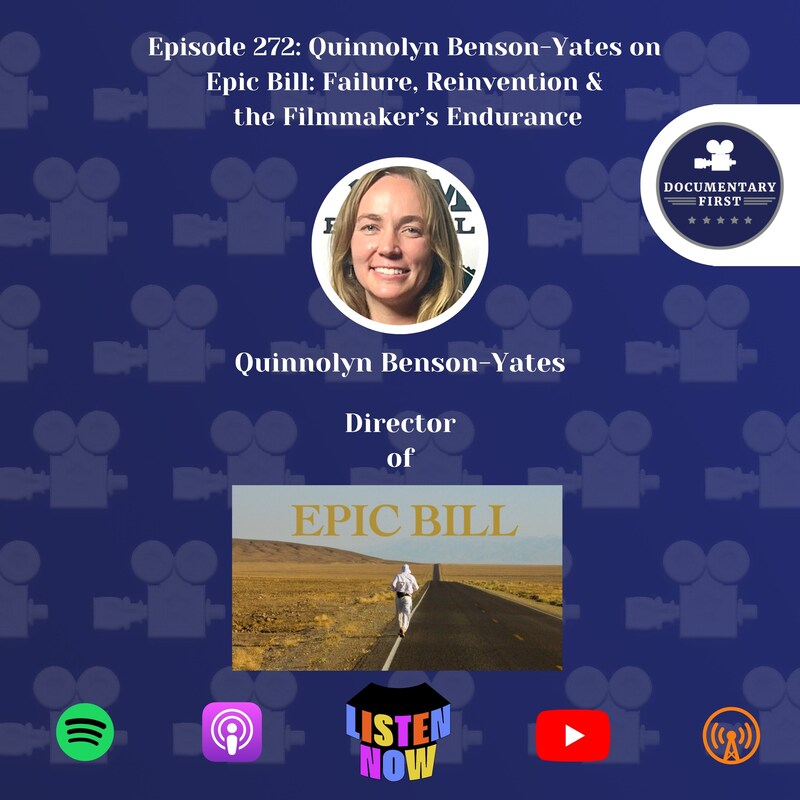
Award-winning filmmaker Quinnolyn Benson-Yates made her first feature documentary before film school—and its seven-year journey from short film concept to PBS distribution holds lessons every indie filmmaker needs to hear.
Epic Bill follows an endurance athlete who lost everything when his video rental empire collapsed (thanks, Netflix). Bill’s mantra—“show up and suffer”—became Quinn’s filmmaking philosophy as she navigated polar vortexes, battery failures in -50° weather, and the brutal realities of distribution. In this episode, she shares how she cut a 93-minute film down to 56 minutes for PBS, why credibility matters more than connections, and the uncomfortable truth about what distribution actually solves.
DocuView Déjà Vu:
Free Solo, 2018, 100 mins, Watch on on Disney + Package / Hulu, IMDB Link: Free Solo (2018) ⭐ 8.1 | Documentary, Adventure, Sport
Meru, 2015, 90 mins, Watch on Prime Video, IMDB Link: Meru (2015) ⭐ 7.7 | Documentary, Sport
Crip Camp: A Disability Revolution, 2020, 106 mins, Watch on Netflix, IMDB Link: Crip Camp (2020) ⭐ 7.7 | Documentary, History
What You’ll Learn:
- Why “fail early, fail often” should include “fail sustainably”
- How archival footage transformed a short film into a feature
- The PBS application process (NETA) and what it requires
- What intermediaries like Bitmax do for Apple TV/Amazon distribution
- Why distribution doesn’t make your career—you do
About Quinnolyn Benson-Yates
Quinnolyn Benson-Yates is an award-winning filmmaker with an MFA from USC School of Cinematic Arts. Her feature documentary Epic Bill gained nationwide PBS distribution with promotions on CNN and SiriusXM, and is now available on Amazon and Apple TV. She’s a two-time winner of Santa Barbara International Film Festival’s 10-10-10 competition, and her short film Miss River screened at Palm Springs LGBTQ Film Festival. Her most recent short, a Western comedy called Man, premiered at Austin Film Festival. She’s currently developing her first narrative feature about a middle school girl starting a punk band with her dad—inspired by her own childhood as an eight-year-old punk rock singer.
Website: QBY | Film: Epic Bill - The Film | Instagram: @quinnolyn
If you’re enjoying the show, please subscribe and leave a review!
Sponsor: Virgil Films http://www.virgilfilms.com/
Support us by buying merch or watching our films: https://documentaryfirst.com/
Follow our Substack Blog: https://documentaryfirst.substack.com/
Join our newsletter (bottom of page): https://thegirlwhoworefreedom.com/
Donate to help us tell more stories: https://givebutter.com/LivingStoriesLtd
Support us on Patreon
00:00 Introduction
04:27 Quinn’s journey: punk rocker to USC film grad
06:44 Current projects: narrative feature development
08:02 Epic Bill origin: short film becomes seven-year feature
10:08 Why documentaries take so long
13:22 Bill’s philosophy: “Show up and suffer”
17:35 Applying endurance athlete lessons to filmmaking
21:59 Filming in extreme conditions as a new filmmaker
25:26 Fail early, fail often—fail sustainably
27:01 Hardest scenes: -50° battery failures and emotional breakthroughs
30:44 Bill’s financial story: millionaire to bankruptcy
33:57 What beliefs needed to die for Bill to succeed
38:52 Leslie Murphy: the stakes character (Free Solo comparison)
43:36 The PBS path: NETA application and cutting from 93 to 56 minutes
46:33 Bitmax and Apple TV/Amazon distribution
51:02 Deliverables that surprised her
54:13 CNN and SiriusXM promotion: cold emails and pitch packets
56:45 Industry Stress Test: Plan A, B, C when nobody’s buying
1:00:04 Uncomfortable truth: distribution doesn’t make your career
1:01:01 Practical tool: scene-by-scene film study method
1:03:49 DocuView Déjà Vu: Free Solo, Meru, Crip Camp
Transcripts
And I'm going to do my little intro and then we'll jump right in.
2
00:00:06,430 --> 00:00:12,198
Now, did they talk to you about bringing a documentary to recommend to our audience?
3
00:00:13,338 --> 00:00:14,098
They did.
4
00:00:14,098 --> 00:00:16,258
I have three.
5
00:00:17,312 --> 00:00:19,164
well, I'll let you use all three.
6
00:00:19,164 --> 00:00:20,385
Usually I bring one.
7
00:00:20,385 --> 00:00:21,255
I didn't today.
8
00:00:21,255 --> 00:00:24,978
So now I'll let you use my time to share your documentary.
9
00:00:24,978 --> 00:00:26,770
So that will be great.
10
00:00:26,770 --> 00:00:28,911
So we'll do that at the end.
11
00:00:29,922 --> 00:00:30,543
All right, you ready?
12
00:00:30,543 --> 00:00:31,982
All right.
13
00:00:31,982 --> 00:00:32,768
Yes.
14
00:00:35,246 --> 00:00:37,280
And once again, there we go.
15
00:00:42,412 --> 00:00:47,055
Hi everybody, welcome to Documentary First, an inside look at documentary filmmaking.
16
00:00:47,055 --> 00:00:50,887
I'm your host, Christian Taylor, and a documentary filmmaker myself.
17
00:00:50,887 --> 00:01:01,713
This is the podcast where we sit down with documentary filmmakers and we talk to them
about real life stories, where they're capturing these stories one frame at a time so we
18
00:01:01,713 --> 00:01:04,554
can all become better storytellers.
19
00:01:04,554 --> 00:01:08,857
Today, I'm super excited to have a new emerging filmmaker with us.
20
00:01:08,857 --> 00:01:10,658
Her name is Quinnolyn Bates.
21
00:01:10,658 --> 00:01:11,244
uh
22
00:01:11,244 --> 00:01:12,236
That is not her name.
23
00:01:12,236 --> 00:01:14,601
Her name is Quinnolyn Benson-Yates.
24
00:01:14,601 --> 00:01:16,585
He loved how I like put your name together.
25
00:01:16,585 --> 00:01:20,093
uh Anyway, Quinn, we are so happy to have you with us.
26
00:01:20,093 --> 00:01:23,048
I promise I will try to get your name right from here on out.
27
00:01:24,214 --> 00:01:30,041
And don't be surprised that it's not the first time I've heard that spelling of my name.
28
00:01:30,041 --> 00:01:31,233
Yeah, not at all.
29
00:01:31,233 --> 00:01:32,564
This is probably the fifth time.
30
00:01:32,564 --> 00:01:33,475
So you're not alone.
31
00:01:33,475 --> 00:01:34,646
Don't worry.
32
00:01:34,927 --> 00:01:36,429
Um, but yeah, I'm really happy to be here.
33
00:01:36,429 --> 00:01:37,414
uh
34
00:01:37,414 --> 00:01:38,017
All right.
35
00:01:38,017 --> 00:01:42,100
Well, we're here to talk about your film, Epic Bill.
36
00:01:42,100 --> 00:01:43,661
This is quite an interesting film.
37
00:01:43,661 --> 00:01:45,594
I was delighted to watch it today.
38
00:01:45,594 --> 00:01:49,786
I saw a lot of parallels between A, my own life.
39
00:01:49,786 --> 00:02:01,596
So there's a lot of lessons to be learned here, I think personally, but I also saw a lot
of lessons that we can learn sort of in our filmmaking uh industry.
40
00:02:01,596 --> 00:02:04,514
I sort of see this as uh
41
00:02:04,514 --> 00:02:13,478
you know, I don't know, just something that we can learn, uh you know, during this, while
everything is changing in our filmmaking industry.
42
00:02:13,478 --> 00:02:20,381
So before we dive into all of that, I do want to give your bio and let you talk a little
bit about who you are.
43
00:02:20,441 --> 00:02:24,924
So Quinn is an award-winning filmmaker with over a decade of experience.
44
00:02:24,924 --> 00:02:30,656
Now, what's interesting about her experience that we'll get into is she made this film
before she went to film school.
45
00:02:30,738 --> 00:02:31,838
which is pretty cool.
46
00:02:31,838 --> 00:02:41,881
Her feature documentary, Epic Bill, now available on Amazon and Apple TV, gained
nationwide distribution through PBS with promotions on CNN and SiriusXM.
47
00:02:41,881 --> 00:02:50,924
Quinn was the head writer and producer for the series Top Voices, where she produced and
co-wrote the pilot and completed production for the first season.
48
00:02:50,924 --> 00:02:57,248
She's a two-time winner of the Santa Barbara International Film Festival's 10-10-10
filmmaking competition.
49
00:02:57,248 --> 00:03:07,101
and her first winning film, Miss River, screened at the festival, including the Palm
Screen, screened at festivals, including the Palm Springs LGBTQ Film Festival.
50
00:03:07,101 --> 00:03:11,302
And it was distributed on the global streaming platform, Reverie.
51
00:03:11,502 --> 00:03:17,524
earned her MFA in film and television production from the prestigious USC School of
Cinematic Arts.
52
00:03:17,524 --> 00:03:27,000
She is a town and gown scholar and a recipient of the James Bridges Endowed Scholarship
and the Hobson Lucas Family Foundation Endowment.
53
00:03:27,000 --> 00:03:36,286
She graduated from the University of California, Santa Barbara with honors in psychology,
a distinction in film and media studies, and the film and media studies department
54
00:03:36,286 --> 00:03:38,938
outstanding graduation senior award.
55
00:03:38,938 --> 00:03:46,583
Her most recent short film, a Western Comedy Man, which sounds quite interesting, recently
premiered at the Austin Film Festival.
56
00:03:46,583 --> 00:03:49,044
That is a lot of honors, young lady.
57
00:03:49,044 --> 00:03:51,506
That's impressive, quite impressive.
58
00:03:51,662 --> 00:03:54,442
I am looking forward to learning more about you.
59
00:03:54,442 --> 00:04:00,422
So tell me, you must be a smart cookie to garner all of those awards.
60
00:04:02,458 --> 00:04:11,743
But I think I counted that this past year was my 10th year from the very first time I
walked onto a film set um in undergrad.
61
00:04:11,743 --> 00:04:14,485
That was my very first time.
62
00:04:14,485 --> 00:04:23,630
And if you just keep working step by step, which is a message that Bill is very familiar
with, you can climb some mountains.
63
00:04:24,495 --> 00:04:25,639
That's very true.
64
00:04:25,639 --> 00:04:32,117
Did you grow up wanting to be a filmmaker or did you just kind of happen upon a film set
and decide, huh, this looks fun?
65
00:04:34,170 --> 00:04:38,432
Filmmaking, I needed an invitation into that world.
66
00:04:38,432 --> 00:04:46,315
um For me, growing up, it never felt like a thing that I could do or people around me were
doing.
67
00:04:46,315 --> 00:04:54,519
And I think that uh what I had to find was people that it was for filmmaking to feel
accessible to me.
68
00:04:54,519 --> 00:05:01,302
I think the first time it did feel accessible was when I was in at UC Santa Barbara for my
undergrad.
69
00:05:01,394 --> 00:05:08,321
And I met my friend Nick Hornung and he was like, hey, we're looking for a script
supervisor on a film shoot that's happening next week.
70
00:05:08,321 --> 00:05:09,761
Are you interested?
71
00:05:09,802 --> 00:05:13,825
And I was like, wow, yes, yes, I'm totally interested.
72
00:05:13,926 --> 00:05:17,369
And that kind of just started my filmmaking career.
73
00:05:17,369 --> 00:05:20,902
But when I was younger, I didn't necessarily have a camera.
74
00:05:20,902 --> 00:05:25,517
didn't necessarily have, you know, I wasn't making YouTube videos.
75
00:05:25,517 --> 00:05:27,378
I was actually a...
76
00:05:27,418 --> 00:05:34,118
eight-year-old lead rock star punk singer in a band with my dad, but I wasn't like making
friends.
77
00:05:34,638 --> 00:05:37,398
So the artistic urge was there.
78
00:05:37,418 --> 00:05:40,578
But yeah, I definitely had to be invited into a filmmaking space.
79
00:05:41,229 --> 00:05:54,356
Well, what I love about that story is that you uh participated in the classic improv game
of yes and, which is, and soon as somebody, you know, offers you an idea, your first
80
00:05:54,356 --> 00:05:56,487
response is yes.
81
00:05:56,487 --> 00:05:58,708
And let me, you know, keep going.
82
00:05:58,708 --> 00:06:00,439
So that's pretty cool.
83
00:06:00,439 --> 00:06:02,430
It leads to all sorts of adventures.
84
00:06:02,430 --> 00:06:05,491
And, and now here you are pretty cool.
85
00:06:05,992 --> 00:06:07,662
That's just, that's just amazing.
86
00:06:07,662 --> 00:06:11,118
So now you have finished your first
87
00:06:11,118 --> 00:06:17,746
um you know, feature documentary, you've done a couple of shorts and what are you doing at
the moment?
88
00:06:19,546 --> 00:06:34,726
Right now, I just finished producing a few different short films through USC and I just
graduated in May, 2025 and I'm doing the wonderful job searching hunt while finishing
89
00:06:34,726 --> 00:06:41,686
development on my first narrative feature script, which is based on my past as a punk
rocker.
90
00:06:41,686 --> 00:06:46,426
It's about a middle school girl who starts a punk band with her best friend and her dad.
91
00:06:46,426 --> 00:06:49,046
It's a lot about creative collaborations.
92
00:06:49,339 --> 00:07:00,556
So I'm working on that passion project as I'm, you know, coming up to filming someone
else's short film and doing some documentary developments with a professor at USC.
93
00:07:00,556 --> 00:07:02,660
So I'm keeping busy, keeping busy.
94
00:07:02,660 --> 00:07:04,562
oh
95
00:07:05,122 --> 00:07:09,102
All right, now this film, Epic Build, it's not coming out.
96
00:07:09,102 --> 00:07:12,402
It has already released, like we said, it's on Amazon and Apple TV.
97
00:07:12,402 --> 00:07:13,962
When did it release?
98
00:07:13,962 --> 00:07:16,022
In 2025, correct?
99
00:07:17,242 --> 00:07:22,422
Yes, so it released on to Apple TV and Amazon in 2025.
100
00:07:22,422 --> 00:07:27,682
It also released on PBS in 2024 in September.
101
00:07:27,682 --> 00:07:32,442
And then we first took it to festivals in 2022.
102
00:07:32,822 --> 00:07:40,442
So it's been a very long rollout and as any filmmaker knows, distribution is its own
beast, its own marathon.
103
00:07:40,962 --> 00:07:43,682
And so, you know, we started...
104
00:07:43,706 --> 00:07:46,528
uh production of this film in November, 2018.
105
00:07:46,528 --> 00:07:50,731
And uh documentaries can be notoriously long.
106
00:07:50,731 --> 00:07:59,496
And I discovered that um the very first time we met with Leslie Murphy about this film, it
was actually going to be a short film.
107
00:07:59,757 --> 00:08:04,260
And it was me, Aaron Kessler and Kyle Murphy in her office.
108
00:08:04,260 --> 00:08:06,031
were like 23 years old.
109
00:08:06,031 --> 00:08:10,505
She was like, Hey, you know, I have a brother who does a lot of extreme events.
110
00:08:10,505 --> 00:08:13,114
Would you be interested in making a short film?
111
00:08:13,114 --> 00:08:14,474
about him.
112
00:08:14,534 --> 00:08:30,154
then, so we went out and filmed him training for the Arrowhead 135 race, which is a
extreme endurance 135 mile, bill does the foot race version of it in northern Minnesota,
113
00:08:30,154 --> 00:08:33,534
which is the coldest place in the continental US.
114
00:08:33,754 --> 00:08:40,378
And we went out and we filmed with him in 2019, where of course the polar vortex hits
that's part of the film.
115
00:08:40,378 --> 00:08:43,059
uh The temperatures were freezing.
116
00:08:44,060 --> 00:08:49,383
And we were figuring out a lot of things as we went along with this film.
117
00:08:49,743 --> 00:09:02,770
And then we filmed him in Arrowhead and then we filmed him uh only like a few days later
really going up Aconcagua, one of the tallest mountains in the Western hemisphere, which
118
00:09:02,770 --> 00:09:04,231
is 22,000 feet in altitude.
119
00:09:04,231 --> 00:09:09,754
uh And again, this was gonna be a short film concept.
120
00:09:09,850 --> 00:09:21,270
And what made it into a feature film was Bill shipped us a hard drive that had like a
decade's worth of archival footage of every, almost every race he'd ever done started in
121
00:09:21,270 --> 00:09:26,830
2008 to 2018, of course, when we were filming with him.
122
00:09:26,910 --> 00:09:34,910
And that opened up a whole conversation of, we could, we totally could make this into a
feature film.
123
00:09:34,910 --> 00:09:39,650
So, you know, it's, it's getting back to that concept of like step by step, you know,
124
00:09:40,336 --> 00:09:41,951
things little at a time.
125
00:09:42,755 --> 00:09:43,615
Yeah.
126
00:09:43,615 --> 00:09:55,908
Well, you know, I just want people to understand, yes, it takes a long time for a lot of
documentaries to come to fruition from, you know, ideas, m you know, as they germinate to,
127
00:09:55,908 --> 00:10:06,921
you know, just, you know, production and trying to figure out or even development before
that, you know, development, production, pre-production, you throw in there a polar vortex
128
00:10:06,921 --> 00:10:10,782
or a pandemic or, you know, funding and financing problems.
129
00:10:10,782 --> 00:10:12,072
And then you throw in there
130
00:10:12,072 --> 00:10:14,243
know, distribution things falling apart.
131
00:10:14,243 --> 00:10:18,864
uh So this, in my opinion, is not an old film.
132
00:10:18,864 --> 00:10:22,445
And we're not going to be talking about anything old.
133
00:10:22,445 --> 00:10:34,748
um What I feel about this whole project that you've done um gives us a survival blueprint,
not only in life, but also in our film industry.
134
00:10:34,748 --> 00:10:41,774
And that's what I love about this film is that it really gave me some good things to hold
on to in my own personal life.
135
00:10:41,774 --> 00:10:43,634
also as a filmmaker.
136
00:10:44,854 --> 00:10:49,694
There's several quotes that I wrote down here from Bill.
137
00:10:50,594 --> 00:10:57,034
One of the things that he said was, when you go after your dreams, it isn't easy.
138
00:10:57,054 --> 00:11:02,154
And you can see that over and over again with Bill.
139
00:11:02,274 --> 00:11:04,034
It wasn't easy.
140
00:11:04,274 --> 00:11:07,794
And there was not a lot of success in this film.
141
00:11:09,154 --> 00:11:11,320
It wasn't like he...
142
00:11:11,320 --> 00:11:15,419
climbed K2 or Aca-cagua, how do you say that?
143
00:11:15,419 --> 00:11:16,741
Aca-nagua?
144
00:11:17,203 --> 00:11:20,229
And there were lots of parties at Aca-nagua.
145
00:11:20,229 --> 00:11:21,442
entire film.
146
00:11:22,230 --> 00:11:23,731
Yeah.
147
00:11:23,731 --> 00:11:30,517
So, it started off, mean, Bill lost everything when his um video rental store collapsed.
148
00:11:30,657 --> 00:11:42,027
And it's sort of like today, know, filmmakers are watching this streaming economy totally
uh reset, know, like growth has slowed down for films.
149
00:11:42,107 --> 00:11:49,967
The platforms are pushing their ad tiers and buyers are being so much more selective with
what, you know, tiers they're going with.
150
00:11:49,967 --> 00:11:58,594
um Ad-based streaming is surging, um and there's just a lot of new realities happening for
filmmakers.
151
00:11:58,594 --> 00:12:06,571
um And it's not as lucrative as it used to be, and there's just not a lot of opportunities
for us as filmmakers.
152
00:12:06,571 --> 00:12:09,134
And so we're questioning our identity.
153
00:12:09,134 --> 00:12:11,586
We're questioning, is this even possible?
154
00:12:11,586 --> 00:12:16,960
We're questioning, I mean, I don't know how many times I've just sat and think I'm a
failure.
155
00:12:17,166 --> 00:12:24,429
And my identity as a filmmaker, you know, I mean, I just don't even know if that's who I
am anymore.
156
00:12:24,669 --> 00:12:32,673
And so again, we'll, as we talk more, some of the things that Bill said just keep, you
know, uh reverberating in my brain.
157
00:12:32,673 --> 00:12:42,377
uh One of them uh is that uh reinvention is not a moment, it's a system.
158
00:12:42,377 --> 00:12:44,590
So he didn't bounce back.
159
00:12:44,590 --> 00:12:52,203
uh He built a repeatable practice which was showing up, enduring and adapting.
160
00:12:52,203 --> 00:12:56,450
So talk to me about that, like what his process was.
161
00:12:57,466 --> 00:13:00,666
Yeah, Bill has a lot of great catchphrases.
162
00:13:00,666 --> 00:13:03,206
One of them is show up and suffer.
163
00:13:03,386 --> 00:13:08,306
And I think in one of his early interviews, he says, you know, I have two talents.
164
00:13:08,306 --> 00:13:10,366
I show up and I suffer.
165
00:13:10,926 --> 00:13:24,966
And that, you know, it's it's fun to hear, but it's there's a really important truth to it
and something that I had to learn making the film, because when you're, you know, when
166
00:13:24,966 --> 00:13:27,012
you're told, hey, you're going to you're going to go and
167
00:13:27,012 --> 00:13:37,717
film an athlete at an event, of course you're showing up and you're just kind of hoping
and there's a sort of expectation there of like, yeah, we're gonna show the suffering and
168
00:13:37,717 --> 00:13:40,618
then we're gonna show the success and we're gonna capture that.
169
00:13:40,618 --> 00:13:45,310
We're gonna capture crossing the finish line and that's what this story is gonna be.
170
00:13:45,590 --> 00:13:50,212
And that was not at all what the story was.
171
00:13:50,552 --> 00:13:55,450
And um I find that, you know, I found that pretty interesting that
172
00:13:55,450 --> 00:13:59,810
you were also going through a moment of like, you know, am I still a filmmaker?
173
00:13:59,810 --> 00:14:01,110
Is this what I want to do?
174
00:14:01,110 --> 00:14:11,390
And that's exactly what Bill went through when he started not crossing the finishing line.
175
00:14:11,669 --> 00:14:14,930
He had a lot of success in a lot of his races.
176
00:14:14,930 --> 00:14:24,050
He was completing the Badwater 135, which is 135 mile foot race through Death Valley, the
hottest place in...
177
00:14:24,256 --> 00:14:29,574
the US that you could really do that in earlier versions of his tendencies.
178
00:14:29,574 --> 00:14:32,625
I don't mean to interrupt, but I do want to give context.
179
00:14:32,625 --> 00:14:39,488
Was that when he was younger and did he start failing when he got older or was it a
mixture of the two?
180
00:14:40,750 --> 00:14:44,752
Another one of my favorite Bill's catchphrases is, am always 30 years old.
181
00:14:44,752 --> 00:14:55,577
So in Bill's mind, he is always 30 years old, but the reality like you just asked is yes,
he was getting older and you know, there's a certain point where he had to come to terms
182
00:14:55,577 --> 00:14:56,377
with that.
183
00:14:56,377 --> 00:15:07,968
ah And it's, I think it's a beautiful thing to renegotiate ah your reality, even if it can
be really, really hard and really tough.
184
00:15:07,968 --> 00:15:11,800
And so when Bill was younger, he was doing really well in the desert races.
185
00:15:11,800 --> 00:15:15,721
Um, I think he also does really well in the heat compared to the cold.
186
00:15:15,721 --> 00:15:19,063
The cold has a lot more of like equipment management.
187
00:15:19,063 --> 00:15:21,534
can, it's like more, much more of an unsupported race.
188
00:15:21,534 --> 00:15:26,246
So there's a lot of other factors, but you did point out, you know, one of the key factors
there.
189
00:15:26,246 --> 00:15:33,049
Um, and death Valley, he also had no like time checkpoints, um, to like disqualify him for
the race.
190
00:15:33,049 --> 00:15:34,129
Like he does an Arrowhead 135.
191
00:15:34,129 --> 00:15:36,378
And so Bill's.
192
00:15:36,378 --> 00:15:40,318
amazing talent is his great mental fortitude.
193
00:15:40,498 --> 00:15:45,818
His ability to keep going and keep going, you know, if you give him endless time, he'll
keep going.
194
00:15:45,898 --> 00:15:47,678
And so he did really well.
195
00:15:47,678 --> 00:15:51,518
He did a bad water, a double bad water, a quadruple bad water.
196
00:15:51,518 --> 00:15:56,238
He was the fourth oldest person ever to, he was the fourth person ever to do that.
197
00:15:56,238 --> 00:16:00,058
And the oldest person ever to complete a quadruple bad water.
198
00:16:00,538 --> 00:16:04,098
And that was, you know, really, really wonderful success.
199
00:16:04,098 --> 00:16:06,238
And then he stopped.
200
00:16:06,340 --> 00:16:08,411
finishing at Arrowhead.
201
00:16:08,411 --> 00:16:10,151
He could not finish Arrowhead.
202
00:16:10,151 --> 00:16:17,113
And when I went to film with him, was his, you know, we counted seventh and eighth and
ninth attempt with him that we were filming.
203
00:16:17,113 --> 00:16:22,975
And he didn't realize that when we were first filming with him.
204
00:16:22,975 --> 00:16:35,138
And he later told me, yeah, when I saw that you made a map for me of how far I went every
year, but the fact that I never finished every year.
205
00:16:35,396 --> 00:16:41,668
But the fact that I kept coming back and that this is my eighth attempt and that in of
itself is admirable.
206
00:16:42,048 --> 00:16:54,971
And so, you know, us filming with him at Arrowhead started that transition of perspective
for him, which I didn't know about at the time, but that was an interesting thing.
207
00:16:54,971 --> 00:17:05,074
And, you know, it starts, it's exactly kind of where you're at, where it's like, you start
questioning, you know, whether it's a identity thing or it's a, you know, is,
208
00:17:05,338 --> 00:17:08,927
Can I have a new perspective on what I've been experiencing?
209
00:17:10,222 --> 00:17:20,042
Yeah, and I think, you know, if we're applying that to filmmaking, which is what I said I
wanted to do in the beginning, a couple of things I think could be true.
210
00:17:20,122 --> 00:17:26,662
It is important, I think, to recognize who we are and how we perform best.
211
00:17:26,662 --> 00:17:32,182
And I think oftentimes we feel like we need to be everything and do everything.
212
00:17:32,182 --> 00:17:36,882
So in the film industry, we've got to be a writer, a director, a producer.
213
00:17:36,882 --> 00:17:38,881
We've got to do all of that.
214
00:17:38,881 --> 00:17:40,192
in order to be successful.
215
00:17:40,192 --> 00:17:45,167
And I think when you're starting out, we do need to learn all of those different
disciplines.
216
00:17:45,167 --> 00:17:51,312
And I think we need to test those to see where we do succeed, where we enjoy doing things
the most.
217
00:17:51,312 --> 00:17:53,425
And I think that is a key.
218
00:17:53,425 --> 00:17:56,257
What do we truly enjoy doing the most?
219
00:17:56,257 --> 00:18:00,081
And then where do we have the most success?
220
00:18:00,081 --> 00:18:04,052
So Bill in the heat was having more success.
221
00:18:04,052 --> 00:18:09,165
And then he would distinguish himself in different ways in that environment.
222
00:18:09,586 --> 00:18:14,119
And then when he would try the cold things, he wasn't having as much success.
223
00:18:14,119 --> 00:18:26,177
So in a sense, had he learned from that more quickly and reinvented himself, um he might
have been able to have more time doing the things where he was having more success.
224
00:18:26,358 --> 00:18:28,039
That could be one lesson.
225
00:18:28,039 --> 00:18:32,721
Another lesson is exactly what he did learn, which is,
226
00:18:33,068 --> 00:18:38,758
the reframing of perspective, which is I am not a failure.
227
00:18:38,758 --> 00:18:41,124
I am showing up to try.
228
00:18:41,278 --> 00:18:43,906
And that in itself is success.
229
00:18:44,587 --> 00:18:57,036
But I do think at some point, you need to apply that uh new perspective to other things
and not keep beating your head against that same wall, for sure.
230
00:18:57,517 --> 00:18:58,798
Would you agree?
231
00:18:59,588 --> 00:19:04,131
yeah, what's interesting with Bill though, is that he had success, right?
232
00:19:04,291 --> 00:19:12,346
But success wasn't fulfilling necessarily, validating certainly, but not necessarily
fulfilling for him.
233
00:19:12,346 --> 00:19:22,582
And so I, you know, I would spend seven hours at a time interviewing Bill, cause you know,
as an endurance athlete, he could go for seven hours and we would talk a lot, but.
234
00:19:22,584 --> 00:19:31,569
What was really interesting to me and what kept me so curious over the years of making
this film was that Bill wanted to challenge himself.
235
00:19:31,569 --> 00:19:33,500
He still wants to challenge himself.
236
00:19:33,500 --> 00:19:46,647
And it wasn't even when he was crossing the finishing, the finish lines that didn't signal
to him, okay, this is what I'm good at and I'll just get better at this one thing.
237
00:19:46,647 --> 00:19:51,690
It was let me come up with new and challenging ways
238
00:19:51,738 --> 00:19:55,778
for me to go out and see if I can do.
239
00:19:55,838 --> 00:20:02,438
And so Bill himself would be idea generating of like, what's a different way I could
challenge myself.
240
00:20:02,438 --> 00:20:07,778
Like he'd made up a whole new marathon in Tahoe, a triathlon in Tahoe.
241
00:20:07,778 --> 00:20:09,278
He went to Hawaii.
242
00:20:09,518 --> 00:20:20,498
He would do things that weren't even like official events and he would invent them and go
out and challenge himself to run 250 miles and.
243
00:20:20,804 --> 00:20:27,037
Sonoma County, like it was all these events that he was curious about how far he could
push his body.
244
00:20:27,037 --> 00:20:30,418
Um, that really inspired me.
245
00:20:30,418 --> 00:20:47,175
And when I, when my path intersected with him in 2019, he was then kind of confronting a
race that he wasn't able to succeed at, but that race became the Arrowhead race had a
246
00:20:47,175 --> 00:20:49,124
community of people that
247
00:20:49,124 --> 00:20:55,289
kept coming back, even if they did finish the race, they still wanted to come back because
it was always a different type of cold.
248
00:20:55,289 --> 00:21:01,455
It was a wet cold or a humid cold or a dry cold or in different levels of cold.
249
00:21:01,455 --> 00:21:04,417
so it was always a slightly different challenge every year.
250
00:21:04,417 --> 00:21:16,378
And, you know, I think that within whatever field that you are, if there's a creative
variable there, there's a creativity to this athleticism.
251
00:21:16,378 --> 00:21:17,092
And I
252
00:21:17,092 --> 00:21:29,350
drew a lot of parallels between what interested Bill and what interested me is ultimately
the passion and the curiosity that he had to push himself and keep trying even when things
253
00:21:29,350 --> 00:21:33,946
were hard, but then to then continue on and do greater things.
254
00:21:34,663 --> 00:21:36,064
Very interesting.
255
00:21:36,064 --> 00:21:47,710
Another thing that I found very curious, since you are and were a new filmmaker at the
time, you undertook something that was extremely arduous and just as crazy, in my opinion,
256
00:21:47,710 --> 00:21:59,627
as Bill was to undertake the things that he did at his age, because um I've watched a lot
of things on the Discovery Channel or the Nat Geo channel, where there have been
257
00:21:59,627 --> 00:22:02,612
filmmakers who have filmed in the Arctic.
258
00:22:02,612 --> 00:22:05,203
or on all sorts of mountains.
259
00:22:05,203 --> 00:22:12,485
And they are filmmakers that have trained for years to film in those kind of conditions.
260
00:22:12,485 --> 00:22:21,648
it's people who have been adventurers in themselves and who already know how to do those
climbs and who have all the equipment and the gear.
261
00:22:21,648 --> 00:22:28,830
I mean, they prep as um much as the athletes themselves to do those things.
262
00:22:28,830 --> 00:22:29,952
But you're...
263
00:22:29,952 --> 00:22:35,591
a young college student or at least that age and I can't, did you have all the equipment?
264
00:22:35,591 --> 00:22:37,564
Did you have all of that training?
265
00:22:37,564 --> 00:22:40,598
I mean, how the heck did all that happen?
266
00:22:42,306 --> 00:22:43,647
That's a very good question.
267
00:22:43,647 --> 00:22:50,590
um You know, it comes back to the the improv yes and concept, right?
268
00:22:50,590 --> 00:22:58,613
It's getting that first invitation, the first opportunity and saying yes to it, even if
you're not like fully prepared.
269
00:22:58,613 --> 00:23:09,262
um I did go to a more media studies inclined undergraduate school that where I did some
student filmmaking at UC Santa Barbara.
270
00:23:09,262 --> 00:23:14,345
And that was a wonderful, everyone is kind of figuring it out together type of experience.
271
00:23:14,345 --> 00:23:23,220
So when I got the opportunity to start developing Epic Bill, I was, just bought my very
first camera.
272
00:23:23,220 --> 00:23:31,134
It was a C100 Mark II with the external recorder to get me a slightly better color
profile, color bit depth recording.
273
00:23:31,234 --> 00:23:37,077
And I was really like researching and looking at what different types of lenses were.
274
00:23:37,237 --> 00:23:38,678
so it was really...
275
00:23:38,776 --> 00:23:40,207
very, very hands-on.
276
00:23:40,207 --> 00:23:48,581
um And I recently watched our very, very first rough cut to prove that this could become a
feature film.
277
00:23:48,581 --> 00:23:50,012
And it was a mess.
278
00:23:50,012 --> 00:23:51,243
It was a total mess.
279
00:23:51,243 --> 00:23:57,946
We were really into like inner cutting, but it just kind of snarled up and didn't really
make any sense.
280
00:23:57,946 --> 00:24:07,521
And there was a lot of um scenes that were a lot of interviews from a lot of people that,
but it wasn't necessarily focused around Bill's personal story.
281
00:24:07,521 --> 00:24:08,786
um
282
00:24:08,786 --> 00:24:17,852
And, you know, it was a very important lesson of sometimes you need to ask for help.
283
00:24:17,852 --> 00:24:20,624
Sometimes you need to research on your own.
284
00:24:20,624 --> 00:24:29,540
Sometimes you need to fail so then you could learn that you have to find a new way of
doing things.
285
00:24:29,540 --> 00:24:37,095
letting yourself, like giving yourself the allowance to be bad is a huge grace, right?
286
00:24:37,095 --> 00:24:38,726
It's a grace because
287
00:24:39,094 --> 00:24:46,568
eventually slower and slower, you're gonna more and more quickly realize what is good,
what is to your taste.
288
00:24:46,568 --> 00:24:48,129
And there's always that taste gap, right?
289
00:24:48,129 --> 00:24:56,033
Of like, what you like is something that's really, really good, but it's not gonna be
something that you can immediately do at the first step.
290
00:24:56,033 --> 00:24:59,625
It's gonna be something that you do have to build your own way towards.
291
00:24:59,625 --> 00:25:02,506
ah And so that was a really...
292
00:25:02,565 --> 00:25:06,870
principle called fail early, fail often.
293
00:25:08,154 --> 00:25:12,434
Yes, you know, it's not, it's, but fails sustainably too.
294
00:25:12,434 --> 00:25:20,794
I was really lucky in this project because Leslie Murphy provided the, she was providing
the funding.
295
00:25:20,794 --> 00:25:22,774
She really believed in us young filmmakers.
296
00:25:22,774 --> 00:25:28,674
She wanted to have us and her sons, Kyle and Sean along to learn.
297
00:25:28,674 --> 00:25:33,358
And I think it's really important to have that sort of mentor figure.
298
00:25:33,358 --> 00:25:44,168
who believes in you through that process, whether it's in the context of school, whether
it's in the context of, you know, being like living at your parents and making it
299
00:25:44,168 --> 00:25:53,967
yourself, it's important to recognize that you're in a space where you can do it
sustainably and comfortably.
300
00:25:53,967 --> 00:26:00,160
And that has a lot to do with like kind of where we are now in the filmmaking.
301
00:26:00,160 --> 00:26:08,004
industry at large, it's getting harder and harder to find that sustainable practice, m
which is a big, you know, it's a big bummer.
302
00:26:08,004 --> 00:26:13,756
And it's a has real impact on what kind of stories are going to be able to be made here.
303
00:26:13,756 --> 00:26:17,048
um So yeah, it's it's tricky.
304
00:26:17,048 --> 00:26:18,358
It's a tricky time.
305
00:26:19,574 --> 00:26:22,299
It is a tricky time, that is absolutely for sure.
306
00:26:22,299 --> 00:26:30,924
uh While we're talking about how difficult it was to kind of film in the elements, what
was the hardest scene to capture and why?
307
00:26:36,602 --> 00:26:37,442
That's a good question.
308
00:26:37,442 --> 00:26:45,286
um There's the emotional answer to that question, and then there's the logistical answer.
309
00:26:45,286 --> 00:26:46,706
I will do logistical first.
310
00:26:46,706 --> 00:26:54,629
um Logistically, batteries, camera batteries in the cold do not last.
311
00:26:54,970 --> 00:26:58,551
We had a drone, it lasted for maybe five minutes in the air.
312
00:26:58,551 --> 00:27:02,153
We would tape hand warmers to it to try to keep it going.
313
00:27:02,153 --> 00:27:05,394
uh
314
00:27:05,676 --> 00:27:11,458
And when we would go from outside to inside, all the lenses would get condensation and fog
up.
315
00:27:11,458 --> 00:27:15,049
So we had, you know, we had to figure out our systems of filming in the cold.
316
00:27:15,049 --> 00:27:19,630
uh At one point it was negative 50 degrees with wind chill when we were filming outside.
317
00:27:19,630 --> 00:27:25,852
could, we got out of the car to film a bit and we would start shivering and shaking and
run back in.
318
00:27:25,852 --> 00:27:31,833
So, you know, there was this huge learning curve of just technology and how to work with
it.
319
00:27:31,833 --> 00:27:35,404
ah But then there was a, you know,
320
00:27:35,566 --> 00:27:45,371
I think emotionally, Bill had his message of, you know, don't quit, never give up and just
keep going at it.
321
00:27:45,371 --> 00:28:02,721
But I think it was interesting to try to get at it from, you know, from the why sense of
why keep going after it, why keep what happened in your past to start this cycle of, you
322
00:28:02,721 --> 00:28:04,061
know, extremity.
323
00:28:06,276 --> 00:28:11,120
There uh is a sequence that's not in the shorter version of the film.
324
00:28:11,120 --> 00:28:13,972
This is the 56 minute version of the film that's distributed.
325
00:28:13,972 --> 00:28:25,882
The longer version of the film, we have a sequence where Bill returns to his old video
store buildings and you see him reckon with the past.
326
00:28:25,882 --> 00:28:35,410
um that was a really great sequence where he's realizing he has a line in that sequence
where he's talking about um
327
00:28:35,482 --> 00:28:39,553
how you don't have to look on the past as just focusing on the failures.
328
00:28:39,553 --> 00:28:43,484
You can look at the past as focusing on the successes too, because they had a good time.
329
00:28:43,484 --> 00:28:46,725
They had a explosively wonderful community.
330
00:28:46,725 --> 00:29:01,189
And it is about letting yourself reframe that concept of, you know, letting yourself
remember the good times is sometimes hard and sometimes really necessary in order to have
331
00:29:01,189 --> 00:29:03,586
the courage to believe that
332
00:29:03,586 --> 00:29:05,109
You could have good times again.
333
00:29:05,109 --> 00:29:09,446
You could work for having a good time and that they can happen again.
334
00:29:09,446 --> 00:29:12,052
And sometimes that's hard to remember.
335
00:29:13,152 --> 00:29:13,723
It is.
336
00:29:13,723 --> 00:29:27,513
mean, you know, and apparently, I mean, his success in the video industry, it sounded like
he was a multimillionaire and then he lost it all thanks to Netflix.
337
00:29:27,714 --> 00:29:30,516
And he was bankrupt.
338
00:29:30,516 --> 00:29:42,486
Now that that's interesting to me because I didn't hear him talk about anything that he
did professionally after that, other than all of this extreme sports, which he talked
339
00:29:42,486 --> 00:29:43,336
about.
340
00:29:43,447 --> 00:29:48,288
I think taking out loan or diving into his 401k.
341
00:29:48,288 --> 00:29:54,090
Maybe he invested all of the money that he had and so he had enough to live on for the
rest of his life.
342
00:29:54,090 --> 00:29:56,670
And maybe that's what he did.
343
00:29:56,670 --> 00:29:58,291
Maybe he financed this whole film.
344
00:29:58,291 --> 00:30:04,032
But I am curious about the finances of it because um this is costly.
345
00:30:04,032 --> 00:30:05,732
What he was doing is costly.
346
00:30:05,732 --> 00:30:12,264
All of the training, all of the travel, all of the years that it took of him doing all of
those sports.
347
00:30:12,264 --> 00:30:15,828
of funding this film could not have been uh cheap.
348
00:30:15,828 --> 00:30:18,154
So can you talk a little bit about that?
349
00:30:19,448 --> 00:30:21,769
Yeah, so Bill didn't fund the film.
350
00:30:21,769 --> 00:30:27,462
His sister Leslie, she took over the family business, which is an electrical contractor,
W.
351
00:30:27,462 --> 00:30:30,484
Bradley Electric, um from their father.
352
00:30:30,484 --> 00:30:34,146
Bill wanted to uh start his own business.
353
00:30:34,146 --> 00:30:41,670
And so he took out a bunch of credit cards and uh started the Bradley video chain with his
other sister, Karen.
354
00:30:41,791 --> 00:30:44,202
And he did become a multimillionaire.
355
00:30:44,202 --> 00:30:47,214
And it was really like a self-starter experience.
356
00:30:47,214 --> 00:30:48,394
So, know, he'd...
357
00:30:49,082 --> 00:30:53,542
you know, it was literally on credit on his own 15 credit cards type of deal.
358
00:30:53,542 --> 00:30:55,342
And he had immense pride.
359
00:30:55,342 --> 00:30:59,702
He felt like a community leader and they were extremely successful.
360
00:30:59,702 --> 00:31:10,222
And then he was on that front line of Netflix coming in and the the suddenly the industry,
the video industry, it quit on him.
361
00:31:10,222 --> 00:31:12,982
He never quit on it, but it quit on him.
362
00:31:12,982 --> 00:31:16,982
And it just completely he completely went bankrupt.
363
00:31:17,218 --> 00:31:24,342
As his profits were going down, he was still opening up new buildings and because he just,
wanted it to succeed so badly.
364
00:31:24,382 --> 00:31:29,365
But what's interesting is that Bill didn't come out of that experience.
365
00:31:29,365 --> 00:31:34,227
He came out of that experience with, you know, absolutely no money.
366
00:31:34,227 --> 00:31:37,259
uh And, and he went through a divorce at the same time.
367
00:31:37,259 --> 00:31:40,041
So his, his self-confidence was completely devastated.
368
00:31:40,041 --> 00:31:46,392
His identity as a successful businessman was completely erased in such a
369
00:31:46,392 --> 00:31:49,925
very public and embarrassing way for him.
370
00:31:49,925 --> 00:31:55,328
And there was a lot of people in that community who had a hard time alongside Bill.
371
00:31:55,609 --> 00:32:02,153
And um he didn't come out of it wanting to be a successful businessman again.
372
00:32:02,153 --> 00:32:08,778
He ran that 50-miler, that very first 50-miler that he did on an absolute whim.
373
00:32:08,898 --> 00:32:14,584
And he had a little bit of that like Forrest Gump experience where it's like, oh, I just
want to keep running.
374
00:32:14,584 --> 00:32:23,777
You know, it became a very physical thing for him to build up his self confidence again
through like physical challenges.
375
00:32:23,777 --> 00:32:26,098
wasn't like a, it wasn't a money thing.
376
00:32:26,098 --> 00:32:38,041
So today, even today he's living in like, you know, a small apartment and he lives cheaply
and he works um with the family company, but he's putting all of his money, his uh 401k
377
00:32:38,041 --> 00:32:39,472
into doing these events.
378
00:32:39,472 --> 00:32:41,182
He's absolutely committed to it.
379
00:32:41,549 --> 00:32:41,951
Wow.
380
00:32:41,951 --> 00:32:43,415
he just, changed his lifestyle.
381
00:32:43,415 --> 00:32:44,477
changed his priorities.
382
00:32:44,477 --> 00:32:45,248
Yeah.
383
00:32:47,310 --> 00:32:54,513
So he's had several, I guess, reinventions, know, identity um changes.
384
00:32:54,513 --> 00:33:02,977
um know, initially his identity was in being this successful businessman that was ripped
away from him.
385
00:33:02,977 --> 00:33:11,420
um And so then his identity becomes this extreme successful athlete.
386
00:33:11,420 --> 00:33:15,746
um And then it seems like
387
00:33:15,746 --> 00:33:23,940
There were things he had to believe about himself actually that had to die in order for
him to be a little bit more successful.
388
00:33:23,940 --> 00:33:27,066
Can you talk a little bit about what needed to die?
389
00:33:27,066 --> 00:33:29,950
Things he believed about himself that weren't helping him?
390
00:33:32,058 --> 00:33:44,221
It's a really good question because, and it's a bit of a sad answer because he did have to
let go of, he never let go of his belief in himself, but he did have to let go of the
391
00:33:44,221 --> 00:33:56,455
concept of he will always be successful in these races and that failure is an
embarrassment and to hide that, you know, and not to talk about failure.
392
00:33:56,455 --> 00:33:59,756
And instead he had to embrace failure.
393
00:33:59,756 --> 00:34:01,526
And that was the big change.
394
00:34:01,710 --> 00:34:17,637
that we discovered while filming with Bill together and that good things can come out of
failure and that the realization that valuing the courage to try again is a radical
395
00:34:17,637 --> 00:34:18,838
concept.
396
00:34:19,039 --> 00:34:22,140
It is something that keeps you walking forwards in life.
397
00:34:22,140 --> 00:34:25,702
And that was something that he had to let go of and then embrace.
398
00:34:26,838 --> 00:34:32,101
Yeah, and this is the line that he said that I thought was very encouraging to me.
399
00:34:32,101 --> 00:34:34,682
Courage is a muscle.
400
00:34:35,723 --> 00:34:37,444
Courage is a muscle.
401
00:34:37,524 --> 00:34:42,767
And basically what he meant is that we must keep building that muscle.
402
00:34:42,987 --> 00:34:46,649
So we must keep challenging ourselves with difficult things.
403
00:34:46,649 --> 00:34:53,533
must, um and having courage, I think personally, is not...
404
00:34:53,533 --> 00:34:55,014
um
405
00:34:55,914 --> 00:35:02,397
It's actually moving to do something hard before we believe we can.
406
00:35:02,837 --> 00:35:08,860
It is trying in spite of the fear that we may fail.
407
00:35:08,860 --> 00:35:22,285
I think Leslie, sister says the only, and I'm not quoting her specifically correctly, but
she says that really the only failure is failing to do anything, failing to try at all.
408
00:35:22,285 --> 00:35:23,638
um
409
00:35:23,638 --> 00:35:26,547
you know, trying, you are succeeding.
410
00:35:27,694 --> 00:35:30,935
Yeah, that's actually pretty close to what she says.
411
00:35:30,935 --> 00:35:36,178
ah she, cause Leslie was with Bill for his early races.
412
00:35:36,178 --> 00:35:39,219
She was his crew chief for the very early marathons.
413
00:35:39,299 --> 00:35:46,522
And she, it's really a wonderful thing to be in Bill's presence because he's so positive.
414
00:35:46,522 --> 00:35:48,963
ah It's like, he's very, very positive.
415
00:35:48,963 --> 00:35:53,405
He dreams up big dreams, not just for himself, but everyone around him.
416
00:35:53,565 --> 00:35:55,786
And so when, you know, I was
417
00:35:55,850 --> 00:36:05,774
in my early 20s making a film that was like outside of the scope of anything I had ever
made, he would, you know, kind of yell at me, Academy Award winning director.
418
00:36:05,774 --> 00:36:17,559
And it's hard to not believe in yourself when you have someone who's doing all these great
feats, just so happy that you're there and um excited to embrace your potential and put
419
00:36:17,559 --> 00:36:25,602
forth goals that you don't even have for yourself that he wants to dream up for you
because he's so excited to see passion in anybody.
420
00:36:25,810 --> 00:36:35,457
And that, you know, Leslie saw that she was the, she was right there on the front lines
with him and she saw him keeping on going and being like, this is a story that's worth
421
00:36:35,457 --> 00:36:37,078
worthy of telling.
422
00:36:37,198 --> 00:36:51,658
And it's, kind of goes back to my concept of like having a mentor and having that
invitation into filmmaking is being around people who can see that in you and your work
423
00:36:51,658 --> 00:36:53,209
ethic and can see that.
424
00:36:53,209 --> 00:36:54,610
um
425
00:36:54,699 --> 00:36:56,382
can help you achieve that.
426
00:36:56,382 --> 00:37:05,741
um So yeah, mean, if I could describe filmmaking, I would describe it as one long
conversation with yourself and many conversations with other people.
427
00:37:07,128 --> 00:37:08,339
That's a great way to put it.
428
00:37:08,339 --> 00:37:11,061
I've experienced that in my own life.
429
00:37:11,061 --> 00:37:23,692
I started off as an actress and uh there's been definite invitations into filmmaking as
well where people deeper into the industry who've been there longer than I had um just
430
00:37:23,692 --> 00:37:24,673
extended a hand.
431
00:37:24,673 --> 00:37:25,834
Can you help me do this?
432
00:37:25,834 --> 00:37:27,005
I think you can do this.
433
00:37:27,005 --> 00:37:31,819
Particularly with my own film, The Girl Who Wore Freedom, people believed in me far more
than I did.
434
00:37:31,819 --> 00:37:32,500
Everyone did.
435
00:37:32,500 --> 00:37:35,577
People still do believe in me far.
436
00:37:35,577 --> 00:37:36,607
far more than I do.
437
00:37:36,607 --> 00:37:44,049
And I do think it's important to surround yourself with people like that and also be
incredibly grateful uh for them.
438
00:37:44,049 --> 00:37:51,391
m And then be those people for others um as you start out in the industry.
439
00:37:52,131 --> 00:38:01,433
One thing that I found interesting as you talk about Bill's sister, I found her
fascinating because on the one hand, like, I mean, it's very interesting to hear that she
440
00:38:01,433 --> 00:38:04,294
supported the film uh because
441
00:38:04,766 --> 00:38:10,550
You see her sort of being supportive in the beginning and thinking that it's really cool.
442
00:38:10,550 --> 00:38:19,675
But there's also part of her that seems like she thinks he's a little over the top and a
little crazy and okay, this is too much.
443
00:38:19,675 --> 00:38:23,417
think he's risking his life and I don't like this so much.
444
00:38:23,417 --> 00:38:25,428
Is that, am I reading it right?
445
00:38:26,742 --> 00:38:29,204
Yeah, that is the other side of it too.
446
00:38:29,204 --> 00:38:39,403
And I do want to speak a little towards something that I was noticing, something that I
learned over the course of making this film is who you are talking to, who you are
447
00:38:39,403 --> 00:38:43,416
interviewing and what they should speak on in the context of the film, right?
448
00:38:43,416 --> 00:38:53,594
And Leslie is this amazing, almost voice of reason uh in contrast to Bill's uh huge goals.
449
00:38:53,594 --> 00:38:55,930
And there's this wonderful scene where
450
00:38:55,930 --> 00:39:03,170
We're in Bill's apartment with Leslie and Bill's pointing out all of his big goals for
2030 that he wants to do.
451
00:39:03,190 --> 00:39:09,770
you know, it's like biking to South America and it's all, all of these really intense
extremes.
452
00:39:10,870 --> 00:39:15,350
His, the Bill wall of dreams, which is very famous in my mind.
453
00:39:15,350 --> 00:39:21,210
Um, and it's a great wall to have, uh, for anyone to have, you know, just put up something
to visualize.
454
00:39:21,210 --> 00:39:24,858
That's part of Bill's process is visualize, look.
455
00:39:24,858 --> 00:39:35,031
Um, it is a bit of like brainwashing as he calls it himself into, into positivity, into
believing into these big dreams, because you do have to say something in order to work
456
00:39:35,031 --> 00:39:35,561
towards it.
457
00:39:35,561 --> 00:39:37,562
You have to say something to believe in it.
458
00:39:37,562 --> 00:39:42,303
And that's, know, really a big part of his process is that kind of visualization.
459
00:39:42,303 --> 00:39:45,964
And Leslie's there just, and you just see her face like, what?
460
00:39:45,964 --> 00:39:49,265
No, like, no, don't do that.
461
00:39:49,665 --> 00:39:51,785
just rein it in just a bit, Bill, you know?
462
00:39:51,785 --> 00:39:53,815
Um, and so.
463
00:39:53,815 --> 00:39:57,729
And she says something, she's like, these are the things that you want to do.
464
00:39:57,729 --> 00:40:00,657
And he's like, no, these are the things I am doing.
465
00:40:01,016 --> 00:40:01,886
will do.
466
00:40:01,886 --> 00:40:03,328
I will do them.
467
00:40:03,328 --> 00:40:10,644
And that's something important to pay attention to in yourself too, is are you using
active tense?
468
00:40:10,644 --> 00:40:12,536
Are you going to commit yourself to it?
469
00:40:12,536 --> 00:40:16,959
Or are you still talking in the maybes and someday?
470
00:40:16,959 --> 00:40:23,345
And that's a little trick too that you can change with how you speak about your own
dreams.
471
00:40:23,345 --> 00:40:29,690
um so, so oh Leslie was a wonderful character because she was the stakes, right?
472
00:40:30,234 --> 00:40:35,679
Bill, you know, I talked with Bill about, you know, kind of the cost of these events.
473
00:40:35,679 --> 00:40:36,830
It's the cost of health.
474
00:40:36,830 --> 00:40:38,121
It's the cost of danger.
475
00:40:38,121 --> 00:40:39,342
It's the cost of risk.
476
00:40:39,342 --> 00:40:42,255
But who is going to carry that cost?
477
00:40:42,255 --> 00:40:43,536
Who's going to be most affected?
478
00:40:43,536 --> 00:40:45,528
It's going to be Bill's loved ones.
479
00:40:45,528 --> 00:40:54,375
If something tragic happens out there, ah it's going to be Leslie, who really, really
suffers that cost and everyone who knows and loves Bill.
480
00:40:54,375 --> 00:40:55,977
And that is a sad thing.
481
00:40:55,977 --> 00:40:57,598
And that's something
482
00:40:57,868 --> 00:40:59,229
important to portray.
483
00:40:59,229 --> 00:41:05,404
you um know, when you talk about mentors, I can also talk about models in filmmaking.
484
00:41:05,404 --> 00:41:08,526
So a big model for me was the film Free Solo.
485
00:41:08,526 --> 00:41:13,690
um So that I, you know, I hadn't gone to USC yet when I was making this film.
486
00:41:13,690 --> 00:41:19,474
And in post, I was really trying to figure out how to make it compelling, how
487
00:41:19,746 --> 00:41:29,974
what scenes to use, who should be speaking about what part of Bill's really long and
complex history of all these different races and the business and different like arenas
488
00:41:29,974 --> 00:41:33,517
and all these different things that he did, how to tie that all together.
489
00:41:33,718 --> 00:41:47,599
And it was really looking at the psychology of Bill and at who had the most emotion, who
had the most intense perspective of any particular subject that I was talking about with
490
00:41:47,599 --> 00:41:48,920
any particular scene.
491
00:41:48,920 --> 00:41:55,437
And Leslie was, know, in Free Solo, it was um Alex Honnold's girlfriend at the time.
492
00:41:55,437 --> 00:41:57,949
Sunny, she's the one who would carry the cost.
493
00:41:57,949 --> 00:42:05,768
She's the one who's wondering, should I commit to someone who's then just so committed to
my passion, which is dangerous, you know?
494
00:42:05,768 --> 00:42:09,271
And can I let myself be a part of that?
495
00:42:09,492 --> 00:42:12,414
you know, that was, Leslie was the right one to speak on that.
496
00:42:13,870 --> 00:42:14,990
Yeah, pretty amazing.
497
00:42:14,990 --> 00:42:18,410
I love how you bring your psychology degree to your filmmaking.
498
00:42:18,410 --> 00:42:20,610
I can see it.
499
00:42:21,550 --> 00:42:22,270
All right.
500
00:42:22,270 --> 00:42:32,998
I want to move into it is actually so, and so it was acting, you know, I mean, I think
that's a psychology degree is incredibly useful in our industry for sure.
501
00:42:33,666 --> 00:42:37,958
Okay, I want to move into our last little section here.
502
00:42:37,958 --> 00:42:44,851
I'm calling it the filmmakers reality and we're going to talk about distribution and the
money.
503
00:42:44,851 --> 00:42:51,364
uh And I want to talk about your actual path because people are going to be really
interested in that.
504
00:42:51,364 --> 00:42:57,256
It's changing all the time and it'll have even changed um from the time that you started
this process.
505
00:42:57,256 --> 00:43:02,112
uh But let's talk about you started off with PBS.
506
00:43:02,112 --> 00:43:09,090
And so I wanna know how PBS changed the film's credibility and what did it not solve?
507
00:43:10,712 --> 00:43:12,043
Yeah, that's a good question.
508
00:43:12,043 --> 00:43:23,003
um So we got into PBS through the NITA application, which is really, really wonderful.
509
00:43:23,003 --> 00:43:32,080
It's like the National Education of Television or Telecommunications Association,
something like that.
510
00:43:32,080 --> 00:43:34,482
um
511
00:43:36,406 --> 00:43:48,759
Yeah, so yeah, what's really, really heartbreaking about what's happening now is that, you
know, hopefully you have funding and oh distribution opportunities for, for films.
512
00:43:48,759 --> 00:43:56,872
And the more that shrinks, the more disheartening it is because we made this film with
Leslie and RedRap productions.
513
00:43:56,872 --> 00:44:06,354
And this was, you know, the first film to be made with a production company who was
started for this project, but we didn't have
514
00:44:06,628 --> 00:44:07,198
connections.
515
00:44:07,198 --> 00:44:10,799
We didn't make it through a fellowship or a mentorship.
516
00:44:10,799 --> 00:44:12,580
We didn't have a brand.
517
00:44:12,580 --> 00:44:14,440
I wasn't an established director.
518
00:44:14,440 --> 00:44:19,942
So we had no like huge like branding or names necessarily.
519
00:44:20,942 --> 00:44:26,304
Yeah, and I learned that credibility is a huge part of documentary distribution.
520
00:44:26,304 --> 00:44:33,226
um If we had like, Bill has had success and you know, he has
521
00:44:33,236 --> 00:44:39,569
followings on YouTube and Instagram, but not necessarily, he's not necessarily like a
household name.
522
00:44:39,569 --> 00:44:48,722
And so that was something that I had to learn is, um you know, fame, fame can go a long
way and open doors.
523
00:44:48,722 --> 00:44:51,553
And when you don't have that, it's, it's tough.
524
00:44:51,574 --> 00:44:57,266
So PBS was a really wonderful way to uh send our film out.
525
00:44:57,266 --> 00:45:02,808
And whenever we would send it out and we would screen it to family and friends, people
really resonated with
526
00:45:02,808 --> 00:45:15,622
the never giving up, the messages of the film, the reinvention, the passion, the
landscapes, the races, the excitement of it, and found it really inspiring.
527
00:45:15,622 --> 00:45:26,702
uh And that was the most gratifying, was hearing directly from audiences who watched the
film, how much they loved it, and we had a lot of wonderful reviews.
528
00:45:26,702 --> 00:45:28,403
But distribution is an art.
529
00:45:28,403 --> 00:45:31,564
It's an art that I'm still figuring out.
530
00:45:31,605 --> 00:45:33,066
So we went to PBS.
531
00:45:33,066 --> 00:45:38,288
It did not solve the great, we're successful and have a bunch of money off this film.
532
00:45:38,288 --> 00:45:39,349
No, not at all.
533
00:45:39,349 --> 00:45:46,683
um But it did at least give credibility of, look, this film can make it onto PBS.
534
00:45:46,683 --> 00:45:48,594
This is a distributive film.
535
00:45:48,594 --> 00:45:55,970
And so when we approached Bitmax, who um got us onto Apple TV and Amazon, that was a great
way of
536
00:45:55,970 --> 00:46:00,964
saying it's gone to PBS and that's important.
537
00:46:02,528 --> 00:46:02,900
Yeah.
538
00:46:02,900 --> 00:46:05,334
oh Can you tell us who Bit Mac says?
539
00:46:05,334 --> 00:46:06,578
I've never heard of them.
540
00:46:07,872 --> 00:46:30,072
Um, so there's different kinds of, um, kind of intermediaries between a distributor like
Apple TV and the filmmaker and Bitmax, kind of does the quality checks and, can basically
541
00:46:30,072 --> 00:46:34,406
is like, you know, they kind of help with distribution by
542
00:46:35,076 --> 00:46:47,394
kind of validating the film and saying the film is up to technical specs, the film is, the
rating is, you know, um good for us and they kind of walk you through then getting in
543
00:46:47,394 --> 00:46:48,915
touch with Apple TV and Amazon.
544
00:46:48,915 --> 00:46:54,958
So there's people that will, there's companies that will help with being kind of brokers
for that process.
545
00:46:55,522 --> 00:46:58,292
Do you pay them or do they get a percentage?
546
00:46:58,292 --> 00:47:00,298
it like a typical distributor?
547
00:47:03,178 --> 00:47:04,509
They're more of an intermediary.
548
00:47:04,509 --> 00:47:07,721
So we pay them for the quality check process.
549
00:47:07,721 --> 00:47:11,773
And then I don't believe they get a distribution.
550
00:47:11,773 --> 00:47:20,108
It depends on the different deals, but I don't believe they have a percentage of the
distribution that is split between Apple TV and Amazon.
551
00:47:20,108 --> 00:47:30,924
um When someone buys it off of their platforms, the Apple TV or Amazon gets half of it and
we would get the other half.
552
00:47:31,002 --> 00:47:33,760
ah But I think Bitmax is more of like that.
553
00:47:34,524 --> 00:47:36,186
or do they pay Bitmax?
554
00:47:37,495 --> 00:47:39,961
They pay us directly.
555
00:47:41,110 --> 00:47:42,472
Interesting.
556
00:47:42,615 --> 00:47:48,729
Are you able to get any uh stats or anything like that from Amazon or Apple TV?
557
00:47:49,754 --> 00:47:58,654
Yeah, yeah, you have like a kind of whenever someone purchases the film, it does like log
it.
558
00:47:58,654 --> 00:48:04,614
So we have like an account and then it kind of says like, hey, know, 15 people have gotten
your film.
559
00:48:04,614 --> 00:48:07,754
You've made $5 or less.
560
00:48:07,974 --> 00:48:18,342
And are you able to, uh I know that my distributor, Virgil Films, ding, ding, a proud
sponsor of our podcast, we thank them very much.
561
00:48:18,342 --> 00:48:34,463
Virgil Films uh is able to pitch our film for uh advertising, know, specials that they
have, whether it's Veterans Day or, um you know, they don't do D-Day, they do Veterans Day
562
00:48:34,463 --> 00:48:36,327
or they do 4th of July.
563
00:48:36,327 --> 00:48:39,343
and they'll have you know, specials during that time.
564
00:48:39,343 --> 00:48:41,817
Do you pitch your film the same way?
565
00:48:43,898 --> 00:48:50,181
um to like other distributors or to like, cause generally the film.
566
00:48:50,181 --> 00:48:54,033
and Apple, Amazon and Apple TV don't really let you advertise.
567
00:48:54,033 --> 00:49:04,259
The only way they let you advertise is they will let you pitch them for their advertising,
like promotions.
568
00:49:04,259 --> 00:49:10,132
And so they have advertising promotions for each holiday, Mother's Day, Father's Day,
Veterans Day.
569
00:49:10,132 --> 00:49:18,306
You'll see them when you turn on, you know, Amazon em and distributors are allowed to
pitch them for their films.
570
00:49:19,580 --> 00:49:20,071
okay.
571
00:49:20,071 --> 00:49:20,511
Yeah.
572
00:49:20,511 --> 00:49:31,380
Um, I wasn't hugely a part of that conversation, but I think we would have had to pay for
more advertising through their platforms.
573
00:49:31,380 --> 00:49:34,083
Um, but I'm not totally sure.
574
00:49:34,083 --> 00:49:42,710
I think that we definitely have had a pitch packet go out and, materials and upload, you
know, all that kind of press stuff.
575
00:49:42,710 --> 00:49:47,854
Um, but I don't, I, I wasn't a part of like pitching.
576
00:49:48,559 --> 00:49:58,288
I think you should look into that because I think that if your film is, you know, if your
film, let's say it's about mothers and em you think it would be a good fit for Mother's
577
00:49:58,288 --> 00:50:03,051
Day, you are able to, I think, and I'll have Virgil films back on to talk about this.
578
00:50:03,051 --> 00:50:07,474
I think that you are able to make a pitch to Amazon for, let's say,
579
00:50:07,650 --> 00:50:11,653
to have your film included in their Mother's Day promotion packet.
580
00:50:11,653 --> 00:50:22,240
So it would run for 99 cents, let's say, and the hope would be that your film would, a
bunch of people would watch your film for 99 cents and you would want them to uh so that
581
00:50:22,240 --> 00:50:25,382
they would tell their friends, hey, you should watch this film.
582
00:50:25,382 --> 00:50:29,355
It's on special right now, sort of to get the ball rolling for your film.
583
00:50:29,355 --> 00:50:31,646
And that's the point of including your film.
584
00:50:31,646 --> 00:50:35,949
And I don't think it costs you anything when you do that, uh but anyway, look into that.
585
00:50:35,949 --> 00:50:37,270
uh
586
00:50:37,270 --> 00:50:44,243
Okay, next question I have for you um is what deliverables surprised you the most?
587
00:50:44,243 --> 00:50:48,812
Closed caption, QC, art specs, E &O, music cues, et cetera.
588
00:50:48,812 --> 00:50:50,294
Anything surprise you?
589
00:50:51,322 --> 00:50:55,562
We worked with really wonderful finishing.
590
00:50:55,882 --> 00:51:02,382
So we had a really, really wonderful collaboration with Laura Cartman and Nora Krull
Rosenbaum as the composers.
591
00:51:02,382 --> 00:51:07,002
They gave us all the stems and Laura went away to work on a Marvel TV show.
592
00:51:07,002 --> 00:51:11,302
And so I was kind of music editing while editing for this film.
593
00:51:12,102 --> 00:51:17,142
And so I had stems, I had an idea of like, okay, we're gonna have different exports.
594
00:51:17,142 --> 00:51:21,146
I did short films before, so I knew the process of
595
00:51:21,146 --> 00:51:26,866
going, making a DCP, deliverables for, you know, PBS and Bitmax.
596
00:51:26,866 --> 00:51:30,046
Like PBS was really specific on the time cut.
597
00:51:30,046 --> 00:51:43,406
So the reason why Epic bill became 56 minutes is it was originally 93 and then it was 86
and PBS wanted 56 because that would be the most programmed slot that we could share the
598
00:51:43,406 --> 00:51:46,586
film out to as many as, as much as we could.
599
00:51:46,586 --> 00:51:50,458
So we actually had to cut down the film and we have like four different versions of it.
600
00:51:50,458 --> 00:51:59,161
But the 56 minute version is like, you it was painful to cut and leave darlings on the
cutting room floor, but it was, you know, the tightest and most snappy version of the
601
00:51:59,161 --> 00:52:00,121
film.
602
00:52:00,561 --> 00:52:02,872
And um that was interesting.
603
00:52:02,872 --> 00:52:04,642
That process was really interesting to me.
604
00:52:04,642 --> 00:52:10,644
um I finished the 93 minute version before I went to USC to get my master's in film.
605
00:52:10,664 --> 00:52:17,306
And I cut it down to 56 minutes in my first year of being at USC.
606
00:52:17,388 --> 00:52:26,461
and I was learning so much about storytelling and I was like, oh, this is, know, this, can
see how quickly I'm growing as a storyteller by doing this process.
607
00:52:26,461 --> 00:52:32,082
So we cut the film down to deliver it to PBS's standards.
608
00:52:32,222 --> 00:52:46,246
And um then we then of course had the different exports that Luke Cahill uh gave for our
different sound stems, the different, you know, dialogue track versus the.
609
00:52:46,698 --> 00:52:51,623
sound design versus the backgrounds and the music, of course.
610
00:52:51,623 --> 00:53:00,034
um And then we had different interlaced for television.
611
00:53:00,034 --> 00:53:02,312
It was just different formats of the film.
612
00:53:02,312 --> 00:53:05,835
So was a lot of technical stuff that we learned and went through.
613
00:53:05,835 --> 00:53:13,812
um But yeah, was definitely the cutting it down to fit a TV format was what was the
biggest hurdle.
614
00:53:14,764 --> 00:53:16,304
found that same thing to be true.
615
00:53:16,304 --> 00:53:18,365
We had an entree to PBS ourselves.
616
00:53:18,365 --> 00:53:20,586
They wanted us to cut down our film the same way.
617
00:53:20,586 --> 00:53:25,477
There was just no way we felt like we could do it with the keeping the integrity of the
film.
618
00:53:25,477 --> 00:53:26,357
So we didn't do it.
619
00:53:26,357 --> 00:53:27,928
um Yeah.
620
00:53:27,928 --> 00:53:31,078
I don't know if that was a mistake, but we had to pass.
621
00:53:31,238 --> 00:53:31,669
All right.
622
00:53:31,669 --> 00:53:32,229
Question.
623
00:53:32,229 --> 00:53:37,560
How did you learn about promotion from CNN and Sirius XM?
624
00:53:37,760 --> 00:53:42,041
And can other filmmakers uh take advantage of that?
625
00:53:42,041 --> 00:53:44,862
And then did you feel like that was helpful or worth it?
626
00:53:47,758 --> 00:53:53,832
So we had a wonderful uh marketing head called Pat Simmons.
627
00:53:53,832 --> 00:53:56,074
He did a wonderful job outreaching.
628
00:53:56,074 --> 00:53:57,405
He did a lot of cold emails.
629
00:53:57,405 --> 00:54:03,169
um We also worked with New Heights as a marketing team and they did a lot of cold emails.
630
00:54:03,169 --> 00:54:15,358
um So I wasn't directly in touch with setting that up, but uh it literally is creating a
press kit, creating a one pager, selling the film.
631
00:54:15,502 --> 00:54:21,805
You make the film many, many times and distribution is another way of making your film and
presenting your film and pitching your film.
632
00:54:21,805 --> 00:54:37,451
um I, know, Bill had done interviews with people before and it was about creating a whole
spreadsheet of contacts and who you want to send it out to and sending the film out to
633
00:54:37,451 --> 00:54:38,181
journalists.
634
00:54:38,181 --> 00:54:42,363
So I'm not totally sure how we landed the CNN and SiriusXM.
635
00:54:42,363 --> 00:54:45,146
was in the middle of doing my USC degree at the time.
636
00:54:45,146 --> 00:54:58,546
But I do know that it takes a lot of really good emails and a good pitch packet, gathering
quotes from people who have seen the film and honestly doing research of how other people
637
00:54:58,546 --> 00:55:02,346
have presented their film, have marketed their film.
638
00:55:02,346 --> 00:55:07,126
It's a of, it's a grind and it sucks.
639
00:55:07,446 --> 00:55:13,622
It totally sucks because as a filmmaker, you want to move on to your next project, right?
640
00:55:13,622 --> 00:55:22,008
And the reality is, that, you know, the project to survive and be seen, you have to keep
putting it out there yourself.
641
00:55:22,008 --> 00:55:29,288
ah So if you can find a creative way to be excited about that process, great, but you
know, it is, it is part of it.
642
00:55:29,288 --> 00:55:30,354
It is part of
643
00:55:31,512 --> 00:55:37,362
Yep, I am still doing it today in 2026 with my film, which came out in 2022.
644
00:55:37,362 --> 00:55:41,991
uh so endurance is the motto, endurance is the motto.
645
00:55:41,991 --> 00:55:48,657
Okay, so, um you know, we talked about, you we talked about a lot of things in this
episode.
646
00:55:48,657 --> 00:55:54,021
um you know, want you to think, I'm gonna give you a stress test.
647
00:55:54,021 --> 00:55:59,531
This is what I'm calling sort of a new little segment at the end, uh the industry stress
test.
648
00:55:59,531 --> 00:56:01,772
industry stress test.
649
00:56:01,772 --> 00:56:05,693
Pretend that you are finishing a doc now in 2026.
650
00:56:05,693 --> 00:56:07,094
Nobody's buying it outright.
651
00:56:07,094 --> 00:56:12,596
So you're taking it to Netflix or Amazon or Apple TV and nobody, everybody's rejecting
you.
652
00:56:12,596 --> 00:56:16,117
What is your plan A, B and C?
653
00:56:16,657 --> 00:56:17,938
What do you do next?
654
00:56:17,938 --> 00:56:19,138
Three things.
655
00:56:19,876 --> 00:56:20,566
Good question.
656
00:56:20,566 --> 00:56:22,648
uh Well, I've been there.
657
00:56:23,029 --> 00:56:24,610
Face rejection, just like Bill.
658
00:56:24,610 --> 00:56:41,153
uh And, you know, I would say that you have a list, you keep applying, you keep looking at
who is your audience, right?
659
00:56:41,153 --> 00:56:42,894
Who wants to see the film?
660
00:56:42,894 --> 00:56:44,285
You...
661
00:56:45,112 --> 00:56:46,333
keep screening it.
662
00:56:46,333 --> 00:56:51,504
So we're going to screen Epic Bill at USC on January 28th, for example.
663
00:56:51,645 --> 00:56:58,768
And you definitely, like, I would kind of go down my list on who would be interested.
664
00:56:58,768 --> 00:57:02,259
Like what are, there's different paths of distribution out there.
665
00:57:02,259 --> 00:57:06,841
There's, you know, everyone is like, no, there's YouTube and they could just release on
YouTube.
666
00:57:06,841 --> 00:57:13,784
But if you're making a film, the point is to have people watch it.
667
00:57:13,784 --> 00:57:14,456
Right.
668
00:57:14,456 --> 00:57:22,133
And there's an ego check of where it's being screened, but, you know, hopefully
ultimately.
669
00:57:24,034 --> 00:57:33,461
And sustainably is the other concept is if it's a money question of you want to have your
film make a lot of money, that's one thing.
670
00:57:33,461 --> 00:57:42,568
But then there's also the who, how many people do you want to see your film and what
platform can you put it on to be seen in the most ways?
671
00:57:42,568 --> 00:57:50,522
Like PBS, it was screened across the nation and they were, it was one of the top
performing.
672
00:57:50,522 --> 00:57:53,183
um films out there at a lot of times for PBS.
673
00:57:53,183 --> 00:57:57,465
So we had tremendous success of getting it out there and getting it seen.
674
00:57:57,465 --> 00:58:02,067
And that was really, really wonderful to hear and have people excited about.
675
00:58:02,367 --> 00:58:04,015
And that was important to me, right?
676
00:58:04,015 --> 00:58:07,449
It was in a place that people would watch it.
677
00:58:07,449 --> 00:58:12,381
And I think that at the end of the day, it's about what your priorities are.
678
00:58:12,381 --> 00:58:13,352
Is it a money thing?
679
00:58:13,352 --> 00:58:15,723
Is it a, are people looking at it?
680
00:58:15,723 --> 00:58:18,870
And I think that, you know, I've had a lot of short films that
681
00:58:18,870 --> 00:58:28,168
I sealed up away onto my private Vimeo link and have not seen the live day because I was
just waiting for them to come out and be accepted by film festivals and then be screened.
682
00:58:28,168 --> 00:58:32,201
But then I would go to the film festivals and they would have, it would be a wonderful
screening.
683
00:58:32,201 --> 00:58:35,243
um But sometimes it'd be a very small audience.
684
00:58:35,243 --> 00:58:44,891
And I would be like, you maybe it's not the right thing to just hold onto a film for a
year or two or three, just hoping it gets chosen by somebody else.
685
00:58:45,071 --> 00:58:48,574
How can you approach this in an empowering way?
686
00:58:48,780 --> 00:58:54,754
And that is being clear on what you want out of the process.
687
00:58:54,934 --> 00:59:01,639
And that is about choosing what your priorities are.
688
00:59:01,639 --> 00:59:15,169
So the best way to reframe kind of getting rejected is saying, okay, this project is not
right for this distributor, but how is it right for what I want?
689
00:59:15,169 --> 00:59:17,250
And how can I get there?
690
00:59:18,680 --> 00:59:20,931
Perfect, great answers, great answers.
691
00:59:20,931 --> 00:59:22,592
Okay, two more questions.
692
00:59:22,592 --> 00:59:23,592
Two more questions.
693
00:59:23,592 --> 00:59:28,825
uh One uncomfortable truth, one practical tool.
694
00:59:28,825 --> 00:59:31,176
All right, the uncomfortable truth.
695
00:59:31,176 --> 00:59:36,278
What do filmmakers need to stop believing about distribution?
696
00:59:39,054 --> 00:59:45,237
Distribution does not solve or make your career by itself.
697
00:59:45,237 --> 00:59:46,357
You do that.
698
00:59:46,357 --> 00:59:54,621
You figure out your process, you stick to it, you find joy and curiosity that makes you
keep creating.
699
00:59:54,621 --> 01:00:00,563
And the trick is how to keep going.
700
01:00:00,563 --> 01:00:02,564
It's not the finish.
701
01:00:02,564 --> 01:00:08,206
This film, Epic Build, does not end at the finish line, if you watch to the end.
702
01:00:08,215 --> 01:00:10,979
the film ends with the starting line.
703
01:00:10,979 --> 01:00:21,022
And that is a key part of how I made this film is figuring out that you can, you just
start again.
704
01:00:22,064 --> 01:00:23,555
So figure out that.
705
01:00:23,555 --> 01:00:26,201
love, yeah, totally love that great answer.
706
01:00:26,201 --> 01:00:35,208
And practical tool, what is one spreadsheet, document, template or online tool that you
would encourage every filmmaker to have?
707
01:00:36,602 --> 01:00:50,216
um I used something called Snapple, which is a little software where I could, know, it
kind of does a visualization digital board, like cork board a little bit, to group my
708
01:00:50,216 --> 01:00:51,816
ideas around in little boxes.
709
01:00:51,816 --> 01:00:53,066
So Snapple's a good one.
710
01:00:53,066 --> 01:01:03,730
um But there's this exercise I do that I did with Free Solo, that I did with any films
that I enjoy that are similar to the project I'm doing next.
711
01:01:03,730 --> 01:01:04,600
And I...
712
01:01:04,630 --> 01:01:07,971
sit down and I watch that film and I go scene by scene.
713
01:01:07,971 --> 01:01:19,994
I write down what each scene accomplishes, who's speaking in it, how it arrows into the
next scene, how the character is, what they're choosing, what they're faced with.
714
01:01:19,994 --> 01:01:21,965
And I really break it down scene by scene.
715
01:01:21,965 --> 01:01:30,983
And that just gets me into the rhythm of what a feature film feels like and the pace of it
and how it's all working together.
716
01:01:30,983 --> 01:01:34,102
And it's a cheat, you You're looking at what...
717
01:01:34,102 --> 01:01:38,309
someone has arrived to, their conclusion of a film, what works for a film.
718
01:01:38,309 --> 01:01:43,717
So go out there and see what works and learn.
719
01:01:43,717 --> 01:01:45,360
And that's how I did it.
720
01:01:45,360 --> 01:01:47,427
You know, just go out and observe.
721
01:01:47,427 --> 01:01:49,588
That's a great study tool.
722
01:01:49,588 --> 01:01:54,029
And I think that's particularly useful because films change every year.
723
01:01:54,029 --> 01:02:01,931
And so, you know, as a voiceover actor, a coach told me one time, go and listen to the
commercials that are out right now.
724
01:02:01,931 --> 01:02:14,414
And that will tell you what uh ad agencies are using and buying, and then train yourself
to do that sound or whatever sound that is that's in your range.
725
01:02:14,434 --> 01:02:15,148
And
726
01:02:15,148 --> 01:02:19,581
that will make you more marketable or more sellable to the buyers.
727
01:02:19,581 --> 01:02:21,012
It's true, I think, with films.
728
01:02:21,012 --> 01:02:32,221
When you're watching those, if you're studying what is out right now, what distributors
are buying, like you said, the pace or uh look at what films are on the market.
729
01:02:32,221 --> 01:02:38,015
Of course, we know the most sellable are horror or uh crime dramas or things like that.
730
01:02:38,015 --> 01:02:40,367
uh But there are other things out there.
731
01:02:40,367 --> 01:02:41,438
There are a lot of...
732
01:02:41,438 --> 01:02:42,438
uh
733
01:02:42,924 --> 01:02:45,876
You know, things like you're talking about this, you know, that you've done.
734
01:02:45,876 --> 01:02:52,039
There's a lot of epic journey stories out there, endurance sport things out there as well.
735
01:02:52,039 --> 01:02:58,043
So um I think that is, those are really good suggestions to, to watch that and emulate
that.
736
01:02:58,043 --> 01:02:58,783
Great.
737
01:02:58,783 --> 01:02:59,744
Great, great stuff.
738
01:02:59,744 --> 01:03:00,504
Great, great stuff.
739
01:03:00,504 --> 01:03:04,166
Thank you so much for all of your advice, sharing your experiences.
740
01:03:04,166 --> 01:03:10,810
And now we are going to move into everybody's favorite section so that you can share some
more ideas with us.
741
01:03:10,818 --> 01:03:15,501
We are now going to move into DocuVue Deja Vu.
742
01:03:16,182 --> 01:03:22,746
All right, here we are and you are going to share not one, but I hear three favorite
documentaries with us.
743
01:03:23,950 --> 01:03:28,691
Yes, so in light of Epic Bill, I definitely of course have to say Free Solo.
744
01:03:28,811 --> 01:03:35,703
The other one that I studied was Maru um by Jimmy Chin and Elizabeth Vasirati.
745
01:03:35,703 --> 01:03:48,137
It was really, really um similar in structure and kind of showed me the path that they
made into making a more ambitious film with Free Solo.
746
01:03:48,137 --> 01:03:51,998
um And then the last one is just a personal favorite of mine.
747
01:03:51,998 --> 01:03:53,858
It's Crip Camp.
748
01:03:54,110 --> 01:03:58,778
Um, that I really, loved crying during it.
749
01:03:58,778 --> 01:04:06,251
And it's, largely about this, the heart of community and in my opinion, and, um, yeah,
definitely Crip Camp.
750
01:04:06,251 --> 01:04:08,120
I would definitely recommend getting that to watch.
751
01:04:08,120 --> 01:04:12,552
Yeah, Crip Camp was um at the Sundance Film Festival the year I went, I think 2019.
752
01:04:12,552 --> 01:04:22,818
And it's a really good one um just about people that are, know, what is the right word?
753
01:04:22,818 --> 01:04:24,038
um
754
01:04:24,516 --> 01:04:31,895
Folks with various physical disabilities go to a summer camp.
755
01:04:32,076 --> 01:04:38,584
It's about the disability revolution and just the beginnings of that kind of stuff.
756
01:04:38,584 --> 01:04:39,245
It's great.
757
01:04:39,245 --> 01:04:40,162
Watch it.
758
01:04:40,162 --> 01:04:42,164
Yeah, very touching and heartwarming.
759
01:04:42,164 --> 01:04:46,507
Okay, how can people get a hold of you or where can they follow you?
760
01:04:46,507 --> 01:04:50,100
Tell us a little bit about what we can do to learn more.
761
01:04:50,936 --> 01:04:55,349
Yeah, there's a Epic Bill the film website.
762
01:04:55,349 --> 01:04:58,131
You can Google it Epic Bill film and you'll find it.
763
01:04:58,131 --> 01:05:04,637
um We have an Instagram and Epic Bill film.
764
01:05:04,637 --> 01:05:16,205
we also, you could find me at Quinnolyn.com is my website and my Instagram handle is at
Quinnolyn Q-U-I-N-N-O-L-Y-N.
765
01:05:16,205 --> 01:05:17,506
You'll find me there.
766
01:05:18,162 --> 01:05:20,805
All right, and we're going to put all that in our show notes as well.
767
01:05:20,805 --> 01:05:23,698
uh We uh really appreciate you being here.
768
01:05:23,698 --> 01:05:32,094
Before I go, everybody, I just want to remind you that we too have social media on
Instagram, TikTok, Facebook, uh and Twitter.
769
01:05:32,094 --> 01:05:35,407
Well, I guess we have to call it X now, although I don't like that.
770
01:05:35,407 --> 01:05:36,818
I still think of it as Twitter.
771
01:05:36,818 --> 01:05:39,681
uh We are on all of those social medias.
772
01:05:39,681 --> 01:05:46,762
We've been sort of hanging back, not posting a lot, but we are going to start sharing more
little snippets of
773
01:05:46,762 --> 01:05:50,625
our podcast guests on our platform.
774
01:05:50,625 --> 01:05:52,186
So make sure to follow those.
775
01:05:52,186 --> 01:05:57,259
We have some really interesting guests coming up this year and we are gonna start a
Substack.
776
01:05:57,259 --> 01:06:01,192
I'm gonna start writing and sharing some things I'm learning about the industry.
777
01:06:01,192 --> 01:06:06,075
So uh take a look on Substack or keep watching our social media.
778
01:06:06,075 --> 01:06:07,897
We'll put more out about that.
779
01:06:07,897 --> 01:06:13,781
If you'd like to support us, follow us on Patreon, patreon.com slash documentary first.
780
01:06:13,781 --> 01:06:16,002
We really would love to have your support.
781
01:06:16,002 --> 01:06:18,223
for you to be part of our community.
782
01:06:18,223 --> 01:06:25,815
m One of the things that we've talked about in this episode is actually, um you know, a
lot about that.
783
01:06:25,815 --> 01:06:29,046
I wanna just reiterate sort of our three takeaways.
784
01:06:29,046 --> 01:06:32,527
um Reinvention is a system.
785
01:06:32,567 --> 01:06:42,252
You know, show up and just, you know, suffer, uh iterate, endure, and then don't let
distribution be your identity.
786
01:06:42,252 --> 01:06:44,444
Don't let any one thing be your identity.
787
01:06:44,444 --> 01:06:46,926
Build purpose and have a process.
788
01:06:46,926 --> 01:06:52,230
Three, packaging, audience, and endurance are the new modes.
789
01:06:52,230 --> 01:07:01,938
You need to make sure that you are packaged beautifully for your product, that you know
who your audience is, and never give up.
790
01:07:01,938 --> 01:07:08,623
So those are the three points for our little podcast today that you filmmakers need to
take away and remember.
791
01:07:08,623 --> 01:07:10,625
Hope you've learned a lot from Quintalyn today.
792
01:07:10,625 --> 01:07:11,992
I know that I have.
793
01:07:11,992 --> 01:07:19,213
Thank you so much for joining us here on Documentary First, where we believe everybody has
a story to tell, and you can be the one to tell it.
794
01:07:19,213 --> 01:07:20,554
Bye, everybody.
795
01:07:21,764 --> 01:07:23,425
Thank you so much for having me.






