Shownotes
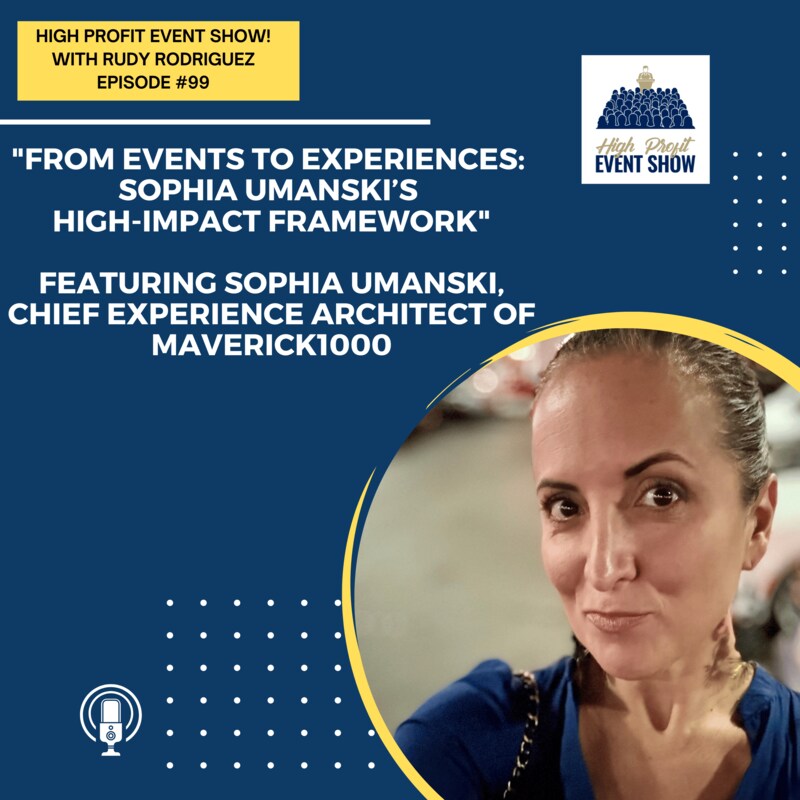
In this new episode of The High Profit Event Show, host Rudy Rodriguez is joined by Sophia Umanski, the Chief Experience Architect at Maverick1000. With more than 15 years of experience designing extraordinary, high-level adventure events, Sophia brings a rare blend of strategic thinking and heartfelt intention to the world of experiential design. From organizing bike rides with Sir Richard Branson on Necker Island to orchestrating deeply immersive retreats across the globe, Sophia’s work goes far beyond logistics—she creates transformational moments that attendees carry with them for a lifetime.
Sophia’s journey into the world of high-impact events began in hotel sales and marketing, where she learned the value of relationship building and attention to detail. But it was her desire to create deeper, more meaningful connections that ultimately shaped her path as a true experience curator. In this episode, she shares how she helps entrepreneurs, thought leaders, and communities build powerful memories by crafting environments that are rooted in authenticity, intentionality, and emotional resonance.
One of the core themes of the episode is the idea of redefining what it means to host an event. Sophia challenges the traditional mindset of planning for structure and content alone. Instead, she encourages event leaders to create experiences that evoke emotion and transformation. Her philosophy is grounded in the belief that when people feel a deep sense of belonging, connection, and inspiration, they not only remember the experience—they become lifelong advocates for your mission.
Another major focus of the conversation is Sophia’s process of designing with intention. She walks us through how every decision—from the venue to the pacing of the schedule—is made in service of the emotional arc of the event. She reverse-engineers each experience by asking, “How do we want people to feel at every stage?” Her insights reveal how details like the choice of food, amount of downtime, and flow of energy in the room can elevate an event from good to extraordinary.
Finally, Sophia dives into the power of play, tradition, and emotional connection as tools for deepening impact. Through activities like beach volleyball, cultural immersion, or simply giving guests space to bond in meaningful ways, she shows how rituals and fun can be the glue that holds communities together. These “anchor moments,” as she calls them, build trust and create continuity, encouraging attendees to return again and again.
This episode is a must-listen for any event leader ready to move beyond checklists and truly create legacy-level experiences. Sophia’s wisdom, heart, and clarity offer a blueprint for designing events that don’t just inform—they transform.
Want to connect with Sophia?
Email: [email protected]
Instagram: https://www.instagram.com/maverickdna/
Website: https://maverick1000.com/
LinkedIn: https://www.linkedin.com/in/sophia-umanski-0201b87/
Transcripts
Welcome to today's episode of our show. We have a special guest with us, Ms. Sophia Umanski. Welcome, Ma'am.
Sophia Umanski:Thank you so much. Happy to be here. Thanks for having me.
Rudy Rodriguez:Really happy and excited to have you here. I actually recently had the privilege of getting to experience one of your world-class event experiences, and it was filled with all sorts of cool, unique surprises and gifts and wow moments. Actually, it was on Necker Island. I mean, you and your cousin, Yannik, have a company called Mavericks that does these really cool adventure trips around the world. You've been doing them for like about 15 years almost, and including taking people to Necker Island every year. We've been hanging out with Sir Richard Branson, which is super cool. I heard you guys went to Antarctica during the pandemic. I think you guys went somewhere to see Santa Claus near The North Pole last year.
Sophia Umanski:Yes, we were just in Finland, actually, a few months ago in December. Yes, we did have the real Santa Claus. He is real. We've confirmed now, officially.
Rudy Rodriguez:Lapland, there we go. You've filmed the Northern Lights in Lapland and you have been in the event industry for many years, creating these unique world-class experiences and prior to that, you started in the event space, so you, sorry, in the hotel space, so in event hotels, sales, marketing. So you really got to know a lot about events even before you started creating these experiences. So for our audience here who maybe needs to be up for the first time, if you haven't picked up on it yet, she's been underground hiding out for like a while, but now she's popping up and now you're hearing about her because she is world-class and she is now actually not only helping run these world-class events, but working with event hosts and planners to teach them how to also create some of these world-class experiences that you're going to learn today. So yes, you know how to design transformative experiences with the perfect mix of tone, content, and energy that suits the unique needs of the audience. More than anything, you love surprise, connection, adventure, and anything's possible when Sophia's running an event.
Sophia Umanski:Right, you've been warned.
Rudy Rodriguez:We've been warned. Oh my gosh, so fun. So Sophia, on this show, as you know, we're interviewing experts who have experience in the event industry and the top kind of problems, challenges that people think about is one, how do I promote my event? And then how do I create an experience and how do I help them sign up for the next event? In the green room, you and I were chatting about, well, what's the one thing that you feel like you're brilliant at? You mentioned being brilliant at creating such a unique experience that people come back, like they tell their friends and they want to come back. I think that's like the best sales force you could ever have is a great raving fan client that does that. So let's just start there. I'd love to hear your golden tips here on how to create that world-class event experience and maybe we can talk about Necker Island and the recent experience that I was a part of too.
Sophia Umanski:Sure, I'd love to. Yeah, so I think that there's such a big difference between events and experiences. I think that actually just like the simple, I'm a big fan of words and word changes and frameworks and so when you look at an event as an event versus an experience, and when we're creating an experience, it's like allowing someone to really feel something and to have something happen that's going to be transformative for them in a way and really create memories. I think that's like, as event curators and designers, we have this opportunity to really help weave things together for people in such a way. It's not just about learning new information. I think that's like the icing on the cake is what they learn there, but it's like they're coming into a space where they're getting to connect with people who get them, who are like them, who are similar to them and creating, even if you're not curating long-term community, even in that small container for the three, four days, six days, whatever it is, they're feeling like they're a part of a community. They belong to something and we're creating these memories that they're going to tell. I mean, what do you do when you get together with friends? You tell stories. Oh my gosh, just one time, you know this, or like da, da, da and so like these stories, these memories end up like sort of weaving together this like, the basically story of our lives. So I think that shifting the framework from, oh, I just create events to I'm creating experiences, I think is like a really great place to start. So it's like, how do we, I love the Maya Angelou quote, like people will forget what you say and they're going to forget what you do, but they won't forget how you make them feel. I think that that's actually like a huge thing that we can be focusing on as event designers and curators.
Rudy Rodriguez:Yeah, I like that right away, reframing the thought definition of what an event is. An event is an experience, and thinking in terms of the experience and the feelings that you're wanting to leave people with throughout the experience and after the experience. I'm looking over here at my desk over here and I actually have some of the items that were part of the experience that you created on Necker Island and it's kind of an example, like these little anchors to that, from the notes to the little stickers, to the swag, to the letters. I mean, I have a cool article of clothing in my closet now from that experience. Little waves, I have a little wave bookmark now that I'm like, as I'm reading, I have a little wave that's holding the page, like all these, by the way, the theme for those of you who are tuning in was your next great wave. So there's a lot of waves that were showing up in many different places that were probably strategically planned for you.
Sophia Umanski:Yes. I think so. I mean, that speaks to the power of a theme too, is that you're able to really like take this theme and weave it into the arc of the experience. So that too is part of when you're shifting from creating an event to an experience, you think of like the arc of the entire thing. It's like, how do people kind of come in and you plant the seeds for, oh, what is this theme? They kind of think about it and usually people think about it very linearly, like, okay, here's a theme. We might like be talking about this in the sessions, but when you start to actually touch on it in like every other way, so that it's like incorporated into things that they're seeing visually, just like I've incorporated different like artwork that's related to the theme and placed it in places like at the venue where people might, some people might not even notice, but subconsciously something is happening for people when they start seeing the little touch points that tie into the overall theme. Subconsciously it's like, it's really coming into there like, okay, like this is a transformation that's happening. Like, what am I really getting out of this? You feel like you're really in something, you're in this container and in this experience, and not just from a standpoint of the content that you're kind of taking in with your mind. So, and then you get to just play so much more. I think that that's another part for me that is so important is like when you're curating and creating events, it's like, have fun with it. They're really like this blank canvas and I see a lot of people kind of go into a mode where they feel like they have to follow a formula, especially, when we're going into it with like, okay, this intention is it's like to sell people into my mastermind program or into like some continuity thing.
Sophia Umanski:So you're really focused sometimes on this formula. Like I need to get them to take in enough content on day one so that by day two, they're ready to, I'm ready to make the pitch and they're able to come in. Then I can repitch if like it doesn't land and that there's a lot of value in having obviously a structure and a formula, but there's also a lot of value in coming into like what feels right for you because when you're coming from your own integrity and your own style and your own heart space, like it's gonna be so much more impactful for people. Your results I think are gonna like totally multiply as a result of just being in your, doing it in your own way. Some people love to pitch in front of the whole room. Some people prefer to have one-on-one conversations and just being more true to yourself and your audience. So that I think is an important thing. Those little touch points along the way in the theme, like I kind of started with was, I think it really gives you an opportunity to play, and I think play is such an important element, in Maverick, that's like one of our, we have three core pillars and we incorporate all three into all of our events and their growth, impact, and fun. It's like, at the end of the day, like if we're not having fun, what is the point? So just allow yourself to play and have some fun. Like, why not?
Rudy Rodriguez:Yeah, there's several things in there that you share. I wanna make a couple of points. One, you pointed to the traditional model for like a three-day event that I'm sure many of us have been a part of or have attended. Come in, get the content, have an invitation to invite them to participate in the next event or a mastermind program of some sort, and then come back the next day, provide more content, and then invite them one more time, take them to lunch for those that join and move forward. That's a great working model. That's actually highly recommended and proven. I recommend that to most of my clients and partners. Inside of all that, what is that experience that's being created? I think, which is you're pointing to, where the creativity, where the heart, where the feelings are, because it's not just about, hey, making your offer at this day and time. No, it's like the overarching story and experience and creativity that people are remembering. I love that you mentioned the three pillars of growth, profit, and I was, it was growth, play, and impact. It's interesting because you say that, and I have found myself when I'm sharing about your experience that you curated on Necker Island, and I've been describing it to other people, I've been saying, well, they do these really cool events where they bring together high-level entrepreneurs who all have a shared value of growth, impact, and play. That's just been an easy way to remember it and to share it in a way that I think that people can resonate and connect with. So I'm glad that you brought it up because I'm like, yeah, that's literally exactly how I've been going out and talking about you and your experiences.
Sophia Umanski:Oh, thank you, thank you. I think when we come into what are our core values and then can create from that space and just literally incorporate them into everything we do, I also find that things just flow in a different way. A lot of times, like you mentioned, there's this concern about how to fill events. How are you gonna sell tickets? There's so many other events out there. There's so many competing things happening. People's schedules are really busy as it is, and it's like, I think when you're really clear about those core pillars for yourself and that this is what my events and experiences stand for and what you're gonna get out of it, again, not just an event, that really helps people connect in a different way with what you're doing. I think the referral piece, like you said, is a huge part. I mean, there's like nothing that's more complimentary than people who are coming through one of your experiences and then they wanna tell their friends or colleagues or, oh my gosh, you have to come back to this and experience it for yourself. I think a lot of that is based on just, like I said, how you allow people to feel and the connections that happen amongst the group too. That's like so much of the magic is allowing the amazing people in the room to kind of like provide value for each other and also, both personally, individually and also teaching and learning. There's a lot of wisdom typically in the room too, so.
Sophia Umanski:Yeah, oh.
Rudy Rodriguez:There you go. I was muted for a moment there.
Sophia Umanski:I was gonna say, I can't hear you.
Rudy Rodriguez:I love what you're sharing. I honestly, I just love if you would be willing to kind of peel back the veil a little bit and let us know kind of how you think about creating the event experience. Like for example, at Necker Island, here we are just a month ago and we were there for about six nights together in total and you attracted some super high level entrepreneurs who are doing great things in the world. You created an experience that had them love it and most of them had been there before. Like people keep coming back, this super experience. How did you think through that? How did you come up with your idea for that? How did, it's just, I'm just so curious how your mind works.
Sophia Umanski:Sure, sure. So my, so Necker, the Necker experience. So as you mentioned Yannik before, so he and I curate the community together. We curate Maverick together as a community and then I do event experience design. So my main contribution to what we do in the community is like the events and experiences. Then I kind of do that with other people as well for their communities. So where I always start with is like what is the intention? Anything that we're creating is like what is the intention in connecting to our why? I think a lot of times we go to like the how and the what and the then and where, and it's like, what is the why? Then creating almost like this, I'm gonna go woo on you a little bit, but go ahead and like creating this sort of like energetic container from the start of envisioning like why are we creating this and what do we want people to feel and experience? Then working backwards from that, and so then it's like, okay, the theme is like, well, before the theme, let me go to the venue. The space is like a huge part of this. I mean, Necker Island is incredible, but we don't always get like the luxury of having letting Necker Island be the space for us for the container. So it's like choosing a venue, I think is like first and foremost, the most probably the important thing you can start with because that creates the container and like the felt sense that people get, when they A, look at your sales page and like see where they're going potentially. So I think like really showcasing and highlighting the venue there is helpful and being in alignment with like the people that you're working with at the venue. Just making sure, like, are you someone who resonates with like the big brands or are you more of a boutique hotel kind of person?
Sophia Umanski:Do you want islands? Do you want mountains? Does nature matter? Are you in a ballroom? So like, what is that space? I always kind of think about and connect with that first and foremost, because that allows people to really like feel all the things and then have an openness to learn and to connect and everything else. So venue first. Then, and for me, sustainability is really important. So again, it's like coming back to what are your core values when you're creating? So for me, I work with venues that commit to not using single-use plastics and we find clean water solutions and all these different things that, again, it's like incorporating those things also are creating the environment for people to be in and they really feel that as well. So venue selection, number one. Then when I connect to the theme. That's really helpful because that will help dictate like what the sessions are kind of about and also the flow of the event. Like how much time are we spending actually in session versus how much time are we getting to play and how much of that play is curated, like play where we have structure around it, like this is what we're doing versus like just go be on your own and do your own thing because a lot of the magic happens. I mean, you see at conferences, people in the hallways, people are kind of doing their thing. It's like just allowing that and planning for it in advance versus feeling like you've planned and I've been there before, trust me. Like I've planned really packed agendas and then I noticed that people are kind of like doing their own thing and whatever else. I'm like, all right, I think I'm just like overly thinking the agenda and structuring it. So intentionally creating the free time, the free space.
Sophia Umanski:So I literally like I'll sit down and I write out like the elements that I want to include and then I write out the days and I'll just like kind of plug and play. Then I just really sit and I visualize, like I visualize and I imagine what it would feel like for somebody to go through the experience when are they feeling tired? When are they feeling energized? When are they feeling like they want to like dance their asses off? When are they feeling like they want to be in pajamas and just kind of like cuddle up a little bit more and just chill? Just knowing how that works and how people are going to feel throughout and planning accordingly, I think is my, that's sort of my process. Also for me, I think about what are they eating? Like I'm really intentional about when are they going to want like lighter food and when are they going to want like kind of more nourishing things, after maybe a late night, like what does brunch look like the next day or what is that? So just really going through the flow of the experience, I think then helps everything else kind of come into play, place as far as, okay, now it's like, what are we teaching and what are we actually, and when are we landing those points too, based on the other elements. So it's really like this pieces of the puzzle and just like putting it all together. Just really envisioning and feeling how people are going to be feeling in the different moments. I hope that's helpful.
Rudy Rodriguez:That's great. Just to kind of bring what you're sharing point to my experience that you curated, it was great to be there and to notice that, hey, on the schedule there were, yeah, there were a couple of blocks of like growth sessions, I think is the way they were described. There's a ton of free time, like before and after and around them and there's also curated play and there's curated fun. There was these like, okay, this is where we're doing the beach volleyball competition. This is where we're doing the tennis. This is where we're doing the water sports. It was a combination of intentional play and also like space to allow people to kind of find their own play. I found that really interesting because I know that oftentimes entrepreneurs that they're so busy working their businesses and travel and all these things that they rarely take the time to play and to have fun and have those experiences. I love how you didn't make it super like about, hey, this is all the things that we're gonna learn and cover and we're gonna be in session back to back all these days and you just created that flow, that balance between just enough learning and a ton of play and impact.
Sophia Umanski:Yeah, thank you. I think that there's so much that we can learn from kids. It's like, we kind of like know these things and then we forget as we get older. It's like, if you look at school, it's like they have recess and they go play on the playground and that's when they really make their friends and have their things and push their edges a little bit. So I think the more we can kind of reconnect to that essence and also like the mischief and the jokes and the pranks and just like, again, having fun. I think, Yannik, he started out doing this like internet marketing seminar many, many, many, many moons ago. A big part of it was had these elements of like surprise and pranks and jokes and even from 500 people in the room and the speakers on a stage and we're doing a flash mob and so we just like have fun with what we're doing. I think that is so, so important and just like literally scheduling it in, it's a non-negotiable. So, and also I would say being true again to yourself, like sometimes like what we do or what I would recommend is not gonna necessarily feel an integrity for you. So don't be like, I have to have this theme party with this costume thing and blah, blah, blah or do a Q and A in costume. Like it has to be an integrity for you because people obviously really feel that. Choosing something that is like, people wanna connect with you, they're there, they wanna feel you as the organizer and as the host and as the facilitator. Allowing them in to feel and experience something that's personal to you, I think is also like really important, especially if you're wanting to invite them into working with you in a deeper way throughout the year outside of just that event space is like, who are you and what are you about so that they can connect with that human side of you.
Sophia Umanski:Also being vulnerable and open is a big part. I would say, I mean, you mentioned the volleyball, it's like creating something that's like an annual, like if you're gonna have an event that you believe you're gonna do repeatedly, like every year, it's like, I would highly recommend thinking about what is something that you'd like to do every year that just becomes like the annual thing that people know is gonna happen, that they get into, they're bought in and they're looking forward to it. I just love seeing how people like iterate, allowing like your audience and your community to iterate on what you're creating is like so much fun. It's also just, they add little elements to it and make it more fun, more competitive. So we've had, yeah, we've literally had like Richard, I mean, Richard now like locks off on his calendar, he comes and watches the volleyball game because he knows it's like this annual thing that we do, and just in different events, we sort of like incorporate, regardless of where we are in the world, hosting the event, people know that certain things are gonna be the same. I think that familiarity also just like bring something back, like you're coming home to something and it's like this thread that carries through everything you do.
Rudy Rodriguez:I love that. That's great, great feedback and insight, created some kind of tradition, some kind of annual thing that people look forward to coming back to. A couple of things come to mind. One, I've been hosting an event in Cabo, Mexico now for several years, once a year and there's one element of that event that we've done every year. That was going to a local orphanage, and not an orphanage, it's a home for children. Some of them are referring, some of them are just estranged from their parents for a period of time. We would play a soccer game with them. It would be us versus them, kind of like the volleyball game that you're describing and I just now realized that people look forward to that, year after year, it's like become a tradition. It wasn't intentional, but that's what it's become and how much of a highlight that is for people to come back and see the kids year after year.
Sophia Umanski:Yes, yeah.
Rudy Rodriguez:They feed us every single year, by the way, for like the last four years.
Sophia Umanski:That's amazing.
Rudy Rodriguez:That's part of that streak. One more thing I'll mention here, which was one of the highlights from my experience on Necker Island that you guys curated, was the opportunity to actually ride a bicycle with Sir Richard Branson. I think it was like 10 guys that were up for the challenge and we rode with Richard to the top of, I think it was Virgin Gorda Island. It was a heck of a ride. I mean, it was super tough, super tough. But it's like, man, at the end of that, I look back and like, now that was a unique experience that I'll remember for the rest of my life, like riding a bike, like so neat.
Sophia Umanski:Yeah, so I mean, in that one, it's obviously, it's incredible because sharing that experience with Richard, but like, we've also done other experiences where, I was just talking to someone, we hadn't spoken like seven years basically, and kind of came back and he's like, I always think about and I always tell the story about when we did this Go Ruck challenge and we were in DC. There's this, if you're familiar with these former Green Berets, they create this thing called Go Ruck and it's this like really kind of intense physical challenge. You're carrying these rucksacks with bricks on your back. They just are telling you what to do for like seven hours straight. I mean, you're like, you're walking, you're carrying s***, we're carrying a tree. I mean, there's like wild stuff. So, in true Maverick style, we asked the Go Ruck facilitators if we could start at midnight and they're like, what? And we were like, yeah, like we're in DC and we think it'd be really cool to like start at midnight just to make it extra like Maverick-like and challenging. Then we can see the monuments at night and be quiet. They were like, that's really crazy, but like, okay, we're down to facilitate if you think. So we literally took this group, we are split up into teams and it was through the night. We started at midnight and you're literally carrying these bricks and we're carrying a log for like a mile and a half. I mean, it is a challenging experience, but it is something that people will talk about to this day and it brought such a unique bond, like the teams, the people in the teams were so close and so connected and had an experience that was truly, like they'll never forget. They have that moment that they shared. So that's what I was kind of coming back to is like creating those moments that are memories that the stories that you're gonna be telling for years to come and that you've somehow created for people and been a catalyst for. So I think that's such a gift that we have as event curators and designers that we get to play that role in people's lives.
Rudy Rodriguez:That's awesome. I love that. I remember learning from one of my mentors that one of the ways to create a friendship is actually to go through challenging things together, challenging experiences. So like the fact that you intentionally incorporate some of these bonding moments is unique because it continues the community beyond the event experience. So Sophia, and we're kind of coming towards the end of our interview here in our interview time, but a couple of things come to mind. One, for people listening to this who run events or run masterminds or run experiences and they want to create a world-class experience or maybe just get your perspective on what they're doing, I would encourage them to reach out to you and to connect with you and have a chat. Also, if there's someone here who's listening who's an event manager or supports events and you want to get some tips on how you can level up the experiences that you're managing or supporting for someone else, I'd also encourage you to reach out to Sophia. Sophia, I believe the best way for them to connect with you right now would be through Instagram, correct? I think it's Maverick DNA, is that right?
Sophia Umanski:Yeah, I'm like literally the most undercover. It's funny. So Rudy, I mean, just to be, the transparency is like, I never really say yes to doing these kinds of things and talking about what I do. I've been asked to create trainings and certifications and all these things over the years. I'm like, no, no, no, no, no, no, no, no, no, no. So thank you for creating this space. That's why it's kind of like funny. I'm like, I don't have some sales page and whatever else, but I'm super happy to connect and just chat with people about what you're really dreaming into. What are you wanting to create as far as events and experiences and seeing how, if I can help and add any of the, what we call Maverick DNA into your experiences for sure. Happy to help with that. So yes, right now it would just be going to like the Maverick DNA Instagram page is probably the best way. Connect there or shoot a good old email over and we'll get back to you that way. So that's like, that's just [email protected] is the best email to get to.
Rudy Rodriguez:Perfect, [email protected] and maverickdna on Instagram. We'll include both those here somewhere near this recording, the show notes or the video. We'll have that there people can view. But you heard it here. Sophia is basically an underground secret weapon. So if you have the privilege of getting to meet her, hear about her on this interview, you are in luck. So you now have access to the secret weapon. We're creating world-class event experiences. So reach out to Sophia if you're doing an event or if you want to upgrade your skill when it comes to creating event experiences and have a chat with her. She's awesome. Absolutely. So yeah, as we wrap up here, any final words of advice you'd like to leave our audience with?
Sophia Umanski:I think I would just say that, again, it's like such a time where we get to really all tap into what our unique kind of gift is and what our desires and what's on our hearts of what we're wanting to share and to use our gift as event curators and as experience is like using that platform to really get our message out there and to like get our heart song, like the penguins have a heart song. It's like, what is your heart song and getting that out there into the world through events. That's kind of why I've said yes to this and why I'm opening up to these possibilities because I realized it's not just about planning events and experiences. It's really about creating something bigger for humans right now. I just think we all have this beautiful opportunity to step into that together.
Rudy Rodriguez:Awesome, thank you so much for that. Appreciate it and reach out to Sophia. Go to her Instagram, Maverick DNA or [email protected], send her an email. Thank you, Sophia. It's been awesome being with you today. Thank you so much for being, coming out from the underground and being our guest. Thanks so much for having me, calling me to the light. You are bright. Thank you.



