Shownotes
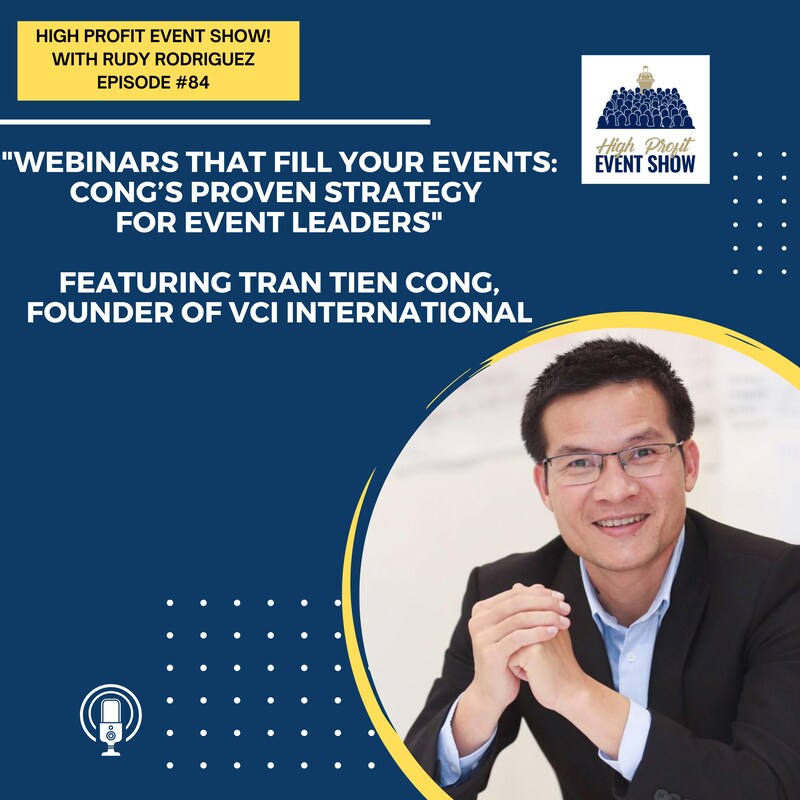
Welcome back to The High Profit Event Show! In this episode, host Rudy Rodriguez sits down with a true pioneer in the coaching industry, Tran Tien Cong, founder of VCI International. Coming to us from Vietnam, Cong has been leading the coaching industry in his country since 2012, certifying over 2,000 coaches, writing three books on the subject, and hosting over 600 webinars to build and grow his events. His journey from mechanical engineer to coach, speaker, and event leader is nothing short of inspiring.
In this episode, we dive deep into one of the most crucial yet overlooked strategies for event success—webinars. If you've ever struggled to fill your events, engage your audience, or convert attendees into clients, this conversation is a game-changer. Cong shares his proven three-phase webinar approach that has helped him double attendance rates and significantly increase conversions.
One of the biggest takeaways from this episode is understanding that webinars aren’t just a one-time sales tactic—they are a strategic tool to fill live events and establish authority. Cong explains how multi-day webinar challenges (like 3-day or 5-day formats) are far more effective than standalone presentations. These structured experiences warm up potential attendees, allowing them to engage, build trust, and ultimately commit to a live event or high-ticket offer.
Another powerful insight Cong shares is the Three-Phase Approach to Webinar Success: Before, During, and After. Most event leaders focus only on the webinar itself, neglecting the pre-webinar warm-up sequence that dramatically impacts attendance. Cong has perfected a 7-day engagement process, using email, video, and social media to boost webinar show-up rates from 30% to 60% or more. Additionally, he highlights that the post-webinar follow-up is where half the conversions happen. By implementing a simple 5-day follow-up strategy with targeted emails and personal calls, event hosts can double their sales after the webinar.
Finally, we discuss one of the biggest mistakes event leaders make: misalignment between their content, messaging, and final offer. Cong explains that too many event hosts teach one thing and sell another, leaving their audience confused and unmotivated to buy. He emphasizes the importance of structuring webinars to naturally lead into the offer by addressing key pain points, presenting a compelling promise, and ensuring that the content seamlessly aligns with what is being sold. He also shares his six essential elements of a high-converting offer, which include a clear pain point, compelling promise, payment plan, strong guarantee, valuable bonuses, and urgency.
If you’re an event host, coach, or speaker looking to fill your events, increase engagement, and maximize conversions, this episode is a must-listen. Cong’s insights into webinar strategy, audience warming, and conversion optimization are actionable and highly effective.
Want to connect with Cong?
Website: https://trantiencong.com/
Facebook (Cong personal page): https://www.facebook.com/tran.t.cong.9
Facebook (VCI page): https://www.facebook.com/vcicoach/
LinkedIn: https://www.linkedin.com/in/trantiencongcoaching/?originalSubdomain=vn
YouTube: https://www.youtube.com/channel/UCPtTRI81SV41vVLt-ygQ1aQ
Transcripts
Good morning, good afternoon and good evening, my friends. Welcome to today's episode. We have a special guest coming to us all the way from Vietnam. My good friend, Cong. Welcome, sir.
Tran Tien Cong:Happy to see you, Rudy, and happy to spend time with you to share the things that we all love about events with my audience and with the audience here as well. I'm so excited.
Rudy Rodriguez:I'm excited to have you here, my friend. For our audience who are perhaps meeting you for the first time, Cong and I actually met at a speaker training with Scott DeMoulin last year, and we're together in a mastermind program from that. But more importantly, Cong is actually the first entrepreneur to lead the coaching industry in his country of Vietnam. He's been doing it since 2012. He's helped over 2000 people become certified coaches in Vietnam and he wrote three books on the subject. You are an expert, my friend and for you also have a formal education. You have an MBA as well from Southern Columbia University in Vietnam. You are a brilliant human being. I am so excited to have you share with us today what you've learned when it's come to live events. So I'm going to you, my friend. Give us a little background on how you came to events and what you want to share with us today.
Tran Tien Cong:Yes. One thing on the bio you have not introduced yet in my background is I'm a mechanical engineer and so I work offshore. I work offshore as an engineer and at that time, 2008, I listened to Tony Robbins audio. So, oh, I said, oh, wow. The motivational industry, the speaker is great. So I want to become a speaker and then for some reason I turn out to be a coach and develop a generation of coaches. That's how my journey began, because I'm not happy with the job I have as an oil and gas engineer. So that's how my career, the chance that I come to coaching.
Rudy Rodriguez:Very cool. Ok, thanks for that adjustment from an engineer to speaker to coach and now having thousands of other people become coaches as well. I know recently you do several events per year, including a recent event called Life Mastery, a five day intensive that you were inspired by from Tony Robbins Date with Destiny event. So I'm super excited to hear your experience with events, as well as with webinars as a promotion model, because oftentimes people say, hey, how do I fill my event? How do I get more people to attend my events and webinars are events? They're single day events or an hour or two. But you have a formula when it comes to webinars that you've used to fill your events and your programs and I'm really excited to hear what you've learned.
Tran Tien Cong:Ok, cool. Right. So I think as a trainer, as a speaker, as a coach and other events, one of the most challenged, that most challenging thing that I face and also my student face. How to fill the event? And I do quite a lot of things. The Facebook ad, the linkedin ad, calling my friends for a referral. One other thing that I found that it's very effective for me is through the webinar. Not just like one shot webinar, but to create a form of three day challenge or five day challenge. But it's like two hours each day. So that's how I feel like it worked best for me, especially during the two years in the COVID. I believe that I did about five to six hundred webinars during those two years. That's why I get the skill and it's become like a proven model for me to fill the event.
Rudy Rodriguez:Awesome. Very cool. So you've refined it. You've made a proven model and share with us more. Tell me more. Ok, cool.
Tran Tien Cong:Right. So I think with the time we have here, I just said what I found, like the common mistake people make when they try to fill the event, when they try to sell things to the event, they make a common mistake to the webinar and what they should do. The common mistake and what they should do. The first common mistake, I think people think like webinar is just one shot, one time event. They just do like, oh, 60 minutes webinar or 90 minutes of webinar or 120 minutes webinar just to sell people. So they miss out on a lot with that thinking myself, oh, I just get people into the room and I close people so that's not good. For a lot of people think like webinar is just kind of a tactic. Just to sales. For me, I think of webinar is a strategic way, like a strategy because I think webinar is not just to sales, but webinar is the way to achieve. Like for me, it's four things. It's build the brand, build the authority. For example, like if I'm speaking on the topic of coaching, people see me everywhere weekly, people see me everywhere weekly. Automatic people think, oh, he is a leading in the industry here because he is speaker, he is a trainer, he coached a lot of people and I see him every day, I see him every week. So that view the brand and the authority.
Tran Tien Cong:The second thing, I think it's really good as well, because normally in the webinar, if people closing rate is good, it's around like 4% or 5%. You industry really, you know how to close in the event. What I mean is, they lose out 95% not building the relationship with them just after the webinar, if they do it wrong and it's come to one of the most common challenges, like not continuing the relationship with the audience. So I think the second one is the webinar. I treat it as like the way I can add so much value for the audience. So keep them warm. So that's how I see it. Also the third one is webinar. It's for me to practice my skill as well. Ok, it is like the skill of speaking, the skill of training and the skill of closing. So I think that's the most common mistake when people treat like webinar as just the technique. But I think it's a strategy to build a relationship, to add so much value so that to create a long term like fan of a customer. So you want to say something, Rudy?
Rudy Rodriguez:Yes, no, what I'm hearing you say is you oftentimes people don't take webinars into account strategically. They just look at them as singular events and it sounds like you have a bit of a formula to use webinars, to warm people up for the events, not just enroll them in the events, but to get them warmed up and to engage them for the events as well. So, yes, that's kind of what I'm picking up. And I know you've done a lot of these. So thank you for being willing to share some of the common mistakes that you've seen people make. I think that's actually one of the most helpful things. Yes. Please, please keep going.
Tran Tien Cong:Yes. The second comes with the second mistake. They treat like webinar is just like quite a lot of event organizers or speakers, trainers, coaches, they just think like, oh, I have some topic and I do a 90 minute webinar and I sell. That's it. Just one shot. Email to the list, too. But for me, I think webinar is three phase event. Three phase. A three to three phase. Before, during and after, because here's what I learned. So and normally the show up rate in the webinar is about like 30 percent is considered good. If don't do anything, but what I'm doing with my team is I'm do like the pre webinar, I do the warming up sequence that is seven days before that. Normally it takes me two to three weeks to introduce the webinar. So the week before the webinar happens is crucial. So I have the warming up sequence with email, with video. So the showing up rate can go up to 60 percent. If I don't do anything, it's 30 percent. If I do is 60 percent because the running ad course, we already lost the money. So I think that's crucial and also phase three, which is like after the webinar. In my experience, when I don't have the big team, I don't have a team as during the webinar, I'm closing and done.
Tran Tien Cong:I don't do anything after the webinar for the next week. Also in my experience, if we do the follow up after the webinar so we can double the closing rate. So that's treating the webinar as the event before, during, after. Because otherwise, I always say you leave money on the table. You do all the hard work for three weeks to promote the webinar, to run at the cost and you do the webinar and and you lose money on the table because you're not following up. So I think that's knowing that is crucial for my business and I train quite a lot of the other and when they implement that, they see the closing rate double just by like five day email following up and following up with one on one strategic calls for the people who attend a webinar, but not buying yet. So that's something, the second thing that I learned.
Rudy Rodriguez:Okay, before, during and after. Yes, I think all three strategically warm up what the presentation and closing is and then the follow up and conversion. Excellent. Yes.
Tran Tien Cong:Okay, so that's the second. Let me see what I have here on the third point. Okay, the third point is that for the other people who are doing the event, but the closing rate is not that high as expected, it's because the content itself. They structure the content for the webinar, for the event. But when it comes to the offer, it's misaligned like they teach something and they sell other things. So the audience doesn't feel like, oh, what they sell is connected to what they're teaching. So what I call the misalignment between the messaging, the actual content delivering in the webinar is not relevant to the offer that they sell at the end of the webinar or the challenge. So I think that's the third mistake. And the fourth is like they don't track the metrics. They don't know what the right metrics to track are. They just normally have one metric. How much sales I have at the webinar. But for me, I track five metrics. Like you and the other friends know well, like registration. So and the show up rate, we just talk about. So great. The crucial one is the retention rate. With the time we have, we don't talk about how to speak. It's so much engaging so people stay to the end. Normally, I do so well. It's just like 10 percent or 15 percent drop. Okay. And I close it during the webinar and close right.
Tran Tien Cong:The follow up. So that is the five metrics. Normally, people just track one metric. What I love about this is like. If people don't know what metric to track, so they don't know what to improve, if they just track one metrics, they said, oh, why my closing rate is low. All right. So your closing rate is low because you are not doing the writing in the front. You're not warming up the audience. You're not delivery so engaging. You're not the right content, right messaging. So that's the mistake they have. So my advice for the people who run the event is know your number. So that's the fourth thing. Yep, I think that's the common mistake that people make when running a webinar.
Rudy Rodriguez:Absolutely. Definitely want to emphasize that point you made about knowing your numbers and tracking your metrics. When I work with clients, whether it's a live event or in-person event or a webinar, the only way we can make it better is by tracking the metrics. I'm just going to recap the ones that you shared. You track the metrics of, hey, how many? Obviously, how many people are signing up to the webinar? How many people actually attended? How many stay until the end? I think that's important. How many are at the beginning? How many were at the end? It shows how engaging your webinar is. And then ultimately, what percentage of your webinar attendees convert right into the next step? In your case, it's your level one program, which leads them to your live events as well. I know you have several events that you do for your level one program members, but for some people, it's a ticket to their live event. I actually do like the format, just on a tangent that you do where you're rolling them into your programs and then your programs include events, as a way to bring them in versus just a standalone. That's another subject alone. So, yes, you track the close rate of the webinar. I think you also track rates after you want to track what closes on the webinar, but you want to try what closes after. Those are two really important different things. Oftentimes people don't look at that properly and that's the only way to know how effective you are on the webinar versus later via email, et cetera.
Rudy Rodriguez:And to your point, whatever you manage can improve. So I really want to emphasize, I know you and I are kind of engineers by education and background so we can nerd out on this stuff. But I totally respect that for many people. This is the stuff that they don't like. They avoid. They don't want to do. But it's the thing. One of the things that makes a big difference is knowing the numbers and tracking and improving over time. So for my audience, I mean, if you're in business, which I assume you are listening to this, you got to know your numbers. If you're not someone that loves numbers, you have to find someone who does. Yes. Wonderful, my friend. Anything else you would like to share on the subject of webinars as live events and a mechanism to fill events?
Tran Tien Cong:Yes, of course. I just say, like, what if they do something wrong? But here's the secret. Here's some of the the right way to do the webinar so that they attract a lot of audience and the high conversion rate. So I think the first thing is the messaging back to one to one, right back to one to one is basic, simple, basic, everyone knows it. But when it comes to implementation, sometimes people forget. So here's what I learned from my mentor, Joe Power. He said a message to market match. Three questions to answer for any webinar is who is the audience? What's the pain point and what's the promise and result? It needs to be tied in with the offer at the back. Very alignment. Because I realize that is very, very, very, very basic. But for some time, even an experienced trainer, speaker, coach, they forgot that they just come to webinars. Oh, yes, I want to teach here. I want to share without like clearly define. Right, audience, the pain point and the promise of the results. So I think that's crucial. One on one basic, but I think that's crucial. And the second, the second is when it's more about structuring the content, even with the experienced trainer, speaker, coach, my audience or your audience.
Tran Tien Cong:They do quite a lot of events, live events, webinars. But when it's come to the content, here's what I found. People struggle to organize the content. The one other thing is they put too much content. They put too much content, but actually too much content overwhelm the audience, and that's the reason they not buy because we give so much content when it's come to content. My advice, three pieces of content. It's like this is I'm not sure it's come from anywhere, but I read from Bruce Brunson books. Three piece of it. Secret one, opportunity, secret to internal challenge. Secret three, the external challenge. So the content itself is not like random content, but teaching not just for the sake of teaching, but to remove all the cells of. So that's what I found. Less is more. I think I love that. I love that.
Rudy Rodriguez:Yes, the less is more. I remember the saying that, hey, if I had more time, I would have written you a shorter letter. It actually takes effort to delete, to edit, to shorten things, to make things more valuable for people. To your point, it's like, hey, who's my audience? What is their pain point? What is my solution to them? Get super clear on that and make sure that that's in alignment and congruent with the offer and that's something that's constantly evolving and figured out. I know I work on that. I have those challenges at times I have to check in and ask myself, are these things in alignment? I do that with my clients as well, making sure that they're all that's lined up. The audience, the pain point, the solution and then the offer, that it's all congruent. Oftentimes when there's a problem with the back end, the sale, it's typically we look at one of those three things that was off. We just weren't clear on one of those components. I'm really glad that you emphasize the basics one to one, but probably one of the most important things for sure.
Tran Tien Cong:Awesome. One last point. One last point is about the offer itself. Make sure it's like the offer is sexy. Quite a lot of things on the offer. But for me, I think the crucial is six. 6 needs to be on the offer. One clear pain point. Some of them make a mistake, too many pain points, too many promises. One clear pain point. The promise, second. I think there's the third one. This good one is payment plan, because now with the high ticket product, some of them, some of the audience might not like afford and don't have the money. So payment plan will have them. And it's crucial is guarantee. I add so much guarantee during my on all my programs. After 10, three days, you feel that you're not satisfied. 200 percent. Just let my team know. Not normally. I let them experience two or three days so that they get so much value. So I don't have any refund yet. So luckily, okay, and the fifth is the bonus. It's crucial and six, scarcity and urgency. I don't really like that. Honestly, when my mentor, I do it for a long time and I don't really like to put people, oh, you got today to register. You got three days. But here's the thing. It works. I don't like that. So one of the things I think is in business, in the event we do what works, not we do what we like.
Tran Tien Cong:That's what I learned from my mentor as well. I don't like to put people in scarcity or urgency, but it's work because it triggers people to take action.
Rudy Rodriguez:100 percent do what works, not necessarily what we like. I want to add to that, obviously, do what works. That's ethical, legal. Yes. I think that's a caveat. Some people may not subscribe to that, but I know you and I do, and I think right now what you just highlighted, honestly, I think is in my perspective, the most valuable nugget of this whole interview is at the end of the day, what is it that's going to move people to take the next step, period? Whatever, whether it's registering for an event or enrolling in your program or any action step you need them to take. Because I think that people will put off making a decision as long as they possibly can until they have enough reasons to do it right there. Then I think that's where the scarcity comes in, the urgency, the guarantees, the bonuses, as you were describing. All those things are so critical to support people to make a decision right there. Then that's going to be best for them. But if we leave it open, open loop for indefinitely, people will put it off as long as they possibly can. I know I do. I am aware that I look for opportunities to have deadlines, even if there's deadlines, because otherwise I'll just keep putting things off. That's why I say it's so effective. Absolutely, man. Thank you for bringing that forward. That was a big nugget. I would go back to this recording if you're listening to this. Again, just that little segment, any offer you're making, those are principles that apply to any aspect of your business. What moves people forward.
Rudy Rodriguez:Thank you for that. Awesome, my friend. So as we're kind of coming up towards the end of our interview here, I'd love to hear from you any final words of advice or nuggets for our audience as they consider using webinars as an event to either fill their events or as standalone events. Any final words that you'd like to share?
Tran Tien Cong:My final words is like have fun with it. Add so much value to our audience when you do it, when we do it, we have people see our face, we can talk to people, we can coach to people and do it long enough until we really have the skill to convert for some of the people. They might struggle with that. But I think that's the beauty. We are in the end. We are now. So disconnect, even like we have Facebook, we have social media. I think doing the event, seeing people face to face, connect with people, sharing with people, and that's the beautiful things to do. Do more events.
Rudy Rodriguez:You have fun and keep doing it. You get better. You're right. I think those are super helpful lessons. We're over 80 episodes in recording now for this podcast and we'll be at over 100 here in the next couple of months. I remember just starting it and just not knowing what I was doing right away, but just kept doing it almost every week consistently over time and just having fun with it and now I feel like getting to episode 100. I finally have a sense for what we're doing here.
Tran Tien Cong:So I admire what you do and you inspire me to do the same. If the consistent have some fun, connect with people, sharing the knowledge. We do so many great things. Keep it up, man.
Rudy Rodriguez:All things done consistently over time lead to great results. So, yeah, thank you for being on with us today for our guests here. If you want to connect with Cong, we included a link to his Facebook here. We'll have some other links as well to some of this material. I know the majority of material is in Vietnamese. That's the market you serve. But you do have some material in English. But I think at the end of the day, if I want to connect with you, whether they speak English or Vietnamese, they can just reach out to you on Facebook. Is that right?
Tran Tien Cong:Yes, I would love to connect with people and your friends, your audience and my friends as well. I can speak Vietnamese and English so I can connect with both.
Rudy Rodriguez:So if you're considering wanting to be a coach and you speak Vietnamese or you know someone that does, Cong is your guy. He is the one who wants to become a coach, especially in Vietnam. He is the pioneer of the industry in Vietnam. So it's been an honor to have you here, my friend. Thank you again for being a guest. I look forward to connecting with you again soon.



