Shownotes
Patrick King explores how thought experiments, like Schrödinger's cat, challenge our beliefs and assumptions. Learn to question your own knowledge and open the door to new ideas and perspectives. Discover the power of systematic thinking in understanding complex issues.
⏱ CHAPTERS
0:00 Intro
1:39 The Struggle for Knowledge
3:12 Thought Experiments Overview
5:49 Virtues and Drawbacks of Thought Experiments
7:22 Types of Thought Experiments
9:57 Philosophical Implications of Thought Experiments
12:04 Historical Examples of Thought Experiments
15:12 Schrödinger's Cat Explanation
18:21 Critical Thinking Through Thought Experiments
21:29 Newton's Cannon Example
23:33 Practical Applications and Benefits
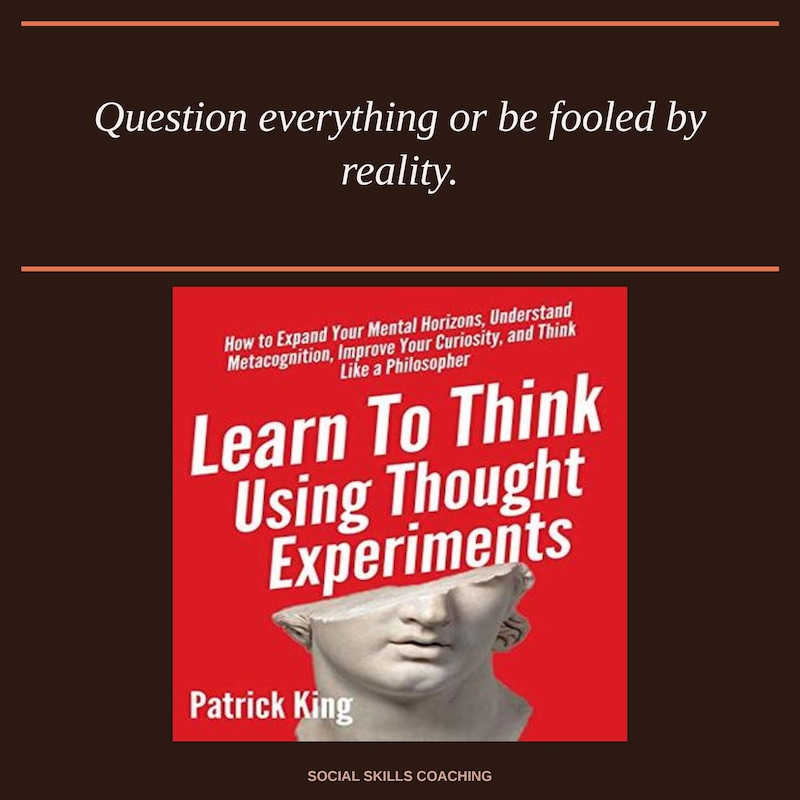
Learn To Think Using Thought Experiments: How to Expand Your Mental Horizons, Understand Metacognition, Improve Your Curiosity, and Think Like a Philosopher (Clear Thinking and Fast Action Book 5) By Patrick King
Hear it Here - https://bit.ly/ThoughtExpKing
Use the mental tools that the world's greatest thinkers used to generate epiphanies, explore the world, and hone their reasoning. In traditional education, you're taught to recite and regurgitate. Going a step farther, you might learn some critical thinking skills. But what about applying them in the most audacious, fascinating, and inquisitive ways possible with thought experiments? Philosophical and exploratory thinking pushes your boundaries and opens new worlds. Learn to Think Using Thought Experiments is about how to analyze, perceive, and interact with information and situations - all in your mind and imagination. It poses a hypothetical and forces you to engage it and answer questions and reason through arguments you've never known. This book will confuse, frustrate, and ultimately improve your thinking prowess like nothing else, on account of being thrown into the mental deep end. Challenge yourself and you will grow. Improve critical thinking by applying it in innovative and novel ways. Patrick King is an internationally bestselling author and social skills coach. His writing draws of a variety of sources, from scientific research, academic experience, coaching, and real life experience. Become more naturally curious, inquisitive, and Sherlock Holmes-like. - The curious case of two cats and what they teach us about uncertainty. - What choosing between 1 and 5 people says about you. - Why this entire world might just be a dream or simulation. - What a javelin has to do with infinite. - How Zeno's tortoise represents the point where reality and numbers diverge. - How Chinese logicians, beetles, fish, and monkeys demonstrate different angles of reality and perception. Learn to thrive in uncertain situations and contemplate more thoroughly and deeply. Thought experiments are a classic tool that everyone can use, and they enable us to explore more abstract situations and reason through them. Master thought experiments and you can master simply dealing with difficult, uncertain, impossible, or confusing questions and situations. Use the same models and tools that Einstein, Plato, Socrates, Galileo, and Lao-tzu used - and see your thinking prowess grow exponentially. This is the fifth book in the “Clear Thinking and Fast Action” series as listed below: 1. The Science of Getting Started: How to Beat Procrastination, Summon Productivity, and Stop Self-Sabotage 2. The Art of Clear Thinking: Mental Models for Better Reasoning, Judgment, Analysis, and Learning. Upgrade Your Intellectual Toolkit. 3. 10-Minute Philosophy: From Buddhism to Stoicism, Confucius and Aristotle - Bite-Sized Wisdom From Some of History’s Greatest Thinkers 4. Practical Intelligence: How to Think Critically, Deconstruct Situations, Analyze Deeply, and Never Be Fooled 5. Learn To Think Using Thought Experiments: How to Expand Your Mental Horizons, Understand Metacognition, Improve Your Curiosity, and Think Like a Philosopher 6. Take Rapid Action: Get Productive, Motivated, & Energized; Stop Overthinking & Procrastinating 7. Relentless Focus: 27 Small Tweaks to Beat Procrastination, Skyrocket Productivity, Outsmart Distractions, & Do More in Less Time If you're looking to sharpen your social skills and communication abilities with a dose of philosophy and critical thinking, Patrick King's channel is the place to be! Dive into engaging thought experiments like Schrödinger's Cat and explore how they can enhance your self-improvement journey. Join us for insightful tips on conversation and communication that will take your social interactions to the next level.
Transcripts
Did you know that your thinking about hypothetical scenarios could actually change the way you view reality?
Speaker:Hello listeners, welcome to Social Skills Coaching, where you become more likeable, more charismatic, and more productive.
Speaker:Today from Patrick King's book, Learn to Think Using Thought Experiments, we're going to explore the boundaries of thought.
Speaker:We're going to take a look at some thought experiments that will stretch your mind to its limits and making you question everything and everyone from the trolley problem to Schrodinger's cat.
Speaker:Each scenario forces new perspectives and deepens your cognitive flexibility, expanding how you see the world.
Speaker:Let's get into it.
Speaker:Chapter 1.
Speaker:Thinking About Thinking
Speaker:10 00:00:59,680 --> 00:00:59,680
Speaker:12 00:00:59,680 --> 00:00:59,680
Speaker:14 00:00:59,720 --> 00:00:59,720
Speaker:16 00:00:59,760 --> 00:01:03,600 There was a time when mankind knew so much less about the world.
Speaker:We take so much of what’s around us as a given, forgetting where it came from.
Speaker:Look around you and you’ll see that almost everything was, at some point, discovered or created by some enterprising or curious human being.
Speaker:The devices you use daily, the symbols making up the language you’re reading right now, the mechanics of the electricity powering your home, all the medical marvels that went into keeping you alive and well in this moment… (Ignore the fact that someone once had to look at a cow and decide “I will try to drink whatever comes out of these pink things.”)
Speaker:Each of these accomplishments had to be fought for and won, one tiny step at a time.
Speaker:Much of what our modern world is made of comes directly from the diligent effort of people working to understand the universe—and create their own inventions.
Speaker:All this scientific and technological progress was made not simply by sheer force of will or strength, but by using the scientific method, and seeing the world in a way that prioritizes rational argument founded on sound empirical or logical data.
Speaker:In other words, the experiment is a mental tool so immense, so valuable, and so central to the survival of our species that it’s hard to imagine where we’d be without it.
Speaker:It takes us from point A to point B, and it lets us know that we are directly affecting the world we inhabit.
Speaker:Instead of cowering in the face of the unknown, the experiment allows you to systematically and logically ask questions of the world around you, and make sense of the answers.
Speaker:It’s a tool to gradually pull back ignorance and reveal useful facts and information, unearth new possibilities, or show us where we’ve made an error.
Speaker:Of course, in this classical view, you may be thinking of the quintessential “experiment”: a scientist in a lab poking around with test tubes or wires, or a clinical trial for a new medication.
Speaker:The truth is, we conduct experiments all the time, formally and informally, consciously and unconsciously.
Speaker:Any time we deliberately manipulate conditions around us and carefully note the outcome, we are doing an experiment.
Speaker:Granted, not every experiment is going to be rigorous or perfectly sound!
Speaker:Nevertheless, experimentation is a method of patterning and understanding our encounters with the world.
Speaker:The concept behind this book is that some of the best experiments can be done with nothing more than your mind.
Speaker:Eons ago, humans had to learn things the hard way: if you wanted to know if a berry was poisonous or not, you ate it and hoped for the best.
Speaker:But, if you survived, everyone could learn from your actions without having to incur any risk themselves.
Speaker:Gradually, people could build on what they already knew so that less and less had to be done concretely, out there in the world.
Speaker:This is somewhat less efficient, and such experiments cannot always be seen.
Speaker:Thought experiments are conducted in a similar spirit.
Speaker:If we explore new ideas, arguments and scenarios mentally rather than literally, we’re freed from so many limitations.
Speaker:What would be impossible or impractical to do physically is possible with nothing more than careful thought.
Speaker:Thought experiments are not subject to any moral or natural laws, can be done relatively quickly and have (for the most part!)
Speaker:no real-world consequences.
Speaker:Their strength is that they give us the opportunity to fully flesh out certain hypothetical possibilities without committing to them practically.
Speaker:They allow us to discover aspects of ourselves we might not have otherwise, and think of the ramifications of certain possible acts long before we are technologically capable of them.
Speaker:There are countless innovators who, if asked where their inspiration came from, will point to speculative sci-fi from centuries prior, or whimsical “what if” questions that spurred their curiosity.
Speaker:The thought experiments we’ll be exploring in this book have all served a particular purpose in their historical context.
Speaker:However, in learning about them, we teach ourselves to reach outside our own habitual thoughts and beliefs.
Speaker:What philosophy in general, and thought experiments in particular, can teach us is twofold: firstly, that we are inhabiting a way of thinking at all, and secondly, that our way of thinking can be changed.
Speaker:As you read on, the hope is that you’ll develop your own critical thinking skills, mental agility and self-awareness.
Speaker:You’ll get comfortable thinking about thinking—perhaps the most valuable and transferable skill there is!
Speaker:By learning to carefully consider the virtues and drawbacks of the very process of thinking itself, you give yourself the opportunity to spot bias, question assumptions, more deeply understand your beliefs and—if you’re lucky—open the door to a completely new idea.
Speaker:Thought experiments are like a grand arena where you can take your brain out to play, to explore and to learn about itself, to grow larger and more robust.
Speaker:The ability to see not just what is but also what could be is fundamental to any endeavor that requires creativity or problem-solving acumen.
Speaker:It also helps you shift perspectives if necessary and consider something we seldom do: that we might be wrong!
Speaker:Manipulating thoughts, information, multiple variables, and coming up with an answer (for which there is no true right or wrong—a learned ability in itself) is something that can be applied to every walk of life.
Speaker:Throughout history, thought experiments have allowed great thinkers and philosophers to see beyond their immediate grasp, to ask far-ranging questions and push the limits of human knowledge.
Speaker:Using thought experiments in your own life, however, will make you a more focused, more robust thinker with a cognitive and intellectual scope far wider than if you’d never challenged yourself in this particular way.
Speaker:Finally, perhaps the most important benefit to engaging in thought experiments is that you give yourself the chance to chew over questions for which there simply isn’t an answer, even with infinitely advanced scientific, technological or philosophical tools.
Speaker:Training your brain to confidently engage with these sorts of questions is enriching beyond the quick satisfaction of solving a problem or optimizing what you already know.
Speaker:So, let’s look a little closer: what exactly constitutes a thought experiment?
Speaker:Is it merely a question, simply asking “what if?”
Speaker:Well, yes and no.
Speaker:The spark of wonder and curiosity is certainly the beginning, but a well-conducted thought experiment is also about the careful analysis of your answer, of other peoples’ answers, and how to interpret them.
Speaker:A big part of a thought experiment is thoroughly considering the consequences and implications of certain conditions, actions or choices.
Speaker:It’s more along the lines of, “What happens IF such-and-such is true?” Thought experiments are completely fabricated “conditionals”—they are fictions which can obliquely bring us around to truths, or at the least illuminate our limitations, assumptions or errors.
Speaker:A truly great thought experiment often spurs further questions—a sign that your mind is mentally exploring an entirely new theoretical space.
Speaker:You may get surprising answers to questions and the opportunity to completely change your worldview—without the bother of having to actually do anything!
Speaker:Thought experiments require us to apply our imagination, to entertain hypotheticals, and follow through potential outcomes and ramifications without actually trying them out for “real.” When people encounter new scientific, political or cultural developments, they extrapolate and may start to think about possible future worlds—what would it look like if the DNA for every plant was owned by a corporation?
Speaker:If we take some commonly held tenets and follow them to their full conclusion, where do we land?
Speaker:In our mind’s eye, we see our best guess of the outcome, or a predicted conclusion, modeled on what we know now.
Speaker:We take our time to contemplate circumstances that aren’t the case, can never be the case, or which we don’t wish to be the case.
Speaker:Essentially, a thought experiment allows us to carry out “tests,” but in the laboratory of our minds.
Speaker:The Problem of the Runaway Trolley
Speaker:74 00:09:45,720 --> 00:09:58,720 Consider a seemingly simple hypothetical situation: you are standing and watching a train that’s headed right for five people tied to the tracks, who will certainly be killed if the train continues.
Speaker:If you pull a lever, the train will divert and head down another track, killing instead just a single person tied to that track.
Speaker:So, if you fail to act, five people die, but if you do act, only one person dies.
Speaker:The question is, would you pull the lever?
Speaker:Why?
Speaker:Now, the idea is not to say, “That would never happen, so who cares?” The situation, obviously, is contrived.
Speaker:But it forces us to think outside the box and take a closer look at our default mental models.
Speaker:It invites us to have a conversation beyond what is immediately and concretely in front of us.
Speaker:Simply by asking the question, you have participated in one of philosophy’s classic thought experiments, the so-called Trolley Problem.
Speaker:You may be spurred to think all kinds of new thoughts, strengthening different modes of reasoning just as an athlete trains different muscles of their body:
Speaker:You may wonder, if we think a single life is important, does it imply that five lives are five times as important?
Speaker:Here you’re grappling with utilitarianism.
Speaker:You may believe most people would act to minimize harm if given the chance, considering what you know of how people normally behave (deductive reasoning), or you may wonder if not acting in this case completely absolves a person of guilt (now you’re thinking about moral philosophy).
Speaker:You may wonder, what if the single person was your child or parent?
Speaker:What if you had to physically push a person in front of the train to stop it?
Speaker:What if each of the five people had cancer and was going to die within the next year?
Speaker:What if there were five babies, yet the lone person standing was akin to Albert Einstein or some other genius?
Speaker:What if you had the power to sacrifice yourself in their places?
Speaker:What plea would you make if you were the single person?
Speaker:Now you’re practicing switching perspectives and views.
Speaker:If you ask yourself whether saving a family member versus a stranger is any more ethical, you’re actively seeking and evaluating support for this argument.
Speaker:You might think the whole situation over and decide that it’s implicitly OK to do wrong if it prevents a larger wrong from occurring.
Speaker:Congratulations—you’ve made a hypothesis.
Speaker:You could “test” this hypothesis (not an opinion) by asking whether pulling the lever should result in being punished by the law.
Speaker:You could make a prediction about what would happen if this was actually the case, in the real world, and on and on…
Speaker:As you can see, one hypothetical situation can stimulate a whole new world of critical thinking, in every direction.
Speaker:In fact, people have been chewing over the trolley problem for years, teasing apart what it can tell us about how we think about culpability, the value of human life, moral behavior and psychology, the limits of a utilitarian approach in philosophy, and more.
Speaker:Many variants have been dreamt up too—for example, what if the single person was a villain?
Speaker:While such thought experiments might seem glib—and perhaps a little unsettling—they do serve a useful purpose.
Speaker:They are used by philosophers to investigate what beliefs we hold to be true and, as a result, what kind of knowledge we can have about ourselves and the world around us.
Speaker:Sometimes, that process will be a little bizarre or unpleasant.
Speaker:But sometimes, it can also push us beyond our limits and open up new and different perspectives.
Speaker:Long story short, thought experiments teach us to think.
Speaker:In the chapters that follow, we’ll delve into famous thought experiments that have been carried out throughout history, and their surprising ramifications.
Speaker:We’ll look at ancient and modern philosophers alike, as well as physicists and great thinkers from all over the world.
Speaker:Many classical thought experiments have had profound effects on the way we think about ourselves in the modern world, so at the very least, learning about what each one implies will give you a richer insight into mankind’s philosophical development through the ages.
Speaker:The Zombie Cat
Speaker:112 00:14:13,080 --> 00:14:20,160 Let’s begin with the famous but often-misunderstood thought experiment of Schrodinger’s cat.
Speaker:To understand the point that physicist Erwin Schrodinger was trying to make, we need to know a little about the state of theoretical physics at the time, including the Copenhagen Interpretation.
Speaker:Niels Bohr and Werner Heisenberg were proponents of this interpretation of quantum mechanics in the 1920s, and used it to explain and conceptualize some strange results found in quantum mechanics experiments.
Speaker:Under this interpretation, physical systems demonstrate what’s called “wave function collapse,” which simply means that their properties are only definite once measured—and quantum mechanics can only show us the probabilities of a certain outcome.
Speaker:Importantly, the Copenhagen Interpretation is only one of many interpretations of quantum theory, each with their own support and criticisms, of which Schrodinger’s cat is also only one.
Speaker:The thought experiment goes like this: imagine there is a cat placed inside a box for an hour.
Speaker:Inside the box is a Geiger counter (which can measure radioactive particles), a small container of radioactive material, a hammer and a little vial of cyanide that will kill the cat if broken.
Speaker:The radioactive material is set up in such a way as to allow for a 50 percent chance that after the hour has passed, a single atom of the material will decay (it’s not important to understand radioactive decay, only that radioactive elements are unstable and liable to emit particles, i.e.
Speaker:radioactivity).
Speaker:The setup is such that if a particle is emitted, the Geiger counter records it and the hammer drops, breaking the vial and killing the cat.
Speaker:Schrodinger argued that, using the Copenhagen Interpretation, you could say that the cat is literally both dead and alive before you open the box to confirm the case.
Speaker:In other words, it exists in some strange state where it is simultaneously living and deceased, and only opening the box collapses the uncertainty.
Speaker:If this sounds kind of weird to you, that’s the point.
Speaker:Schrodinger used this thought experiment to highlight how uncertainty at the subatomic level could have strange implications for bigger objects—like cats.
Speaker:This thought experiment forms just a small part of a large and complex conversation in theoretical physics, and is beyond the scope of this book.
Speaker:However, even without understanding the details, one can see why the experiment has been so useful.
Speaker:In this branch of physics, measurement of phenomena itself was under question—so normal experimentation was out of the question.
Speaker:When trying to understand things like probability distributions, whether light is a particle or a wave, what constitutes measurement and so on, we have to resort to thought experiments.
Speaker:Schrodinger thus used a purely hypothetical situation in lieu of a real-world experiment to make his point.
Speaker:He took a premise from an accepted model and asked, “What happens if we think this way for large objects?” This scenario, like the Trolley Problem, has inspired many subsequent thought experiments.
Speaker:Indeed, much of theoretical physics plays out in this abstract, purely mathematical space, far outside the lab.
Speaker:What can this thought experiment teach the layperson about critical thinking?
Speaker:Often, the flaws in our arguments or beliefs can be found if we merely follow our own models to their full conclusion.
Speaker:In other words, we use thought experiments to fully consider all the implications of our perspective—i.e., if such-and-such is the case, what does it mean for everything else?
Speaker:In Schrodinger’s case, the sheer implausibility of the outcome was an implied criticism.
Speaker:In considering any argument or point of view, ask yourself: How would the world have to be if my theory were true?
Speaker:Is the world that way?
Speaker:What does my argument imply?
Speaker:Are the implications desirable/logical/true?
Speaker:And if not, does it invalidate my original argument?
Speaker:This might appear to epitomize one of the loudest criticisms of philosophy, that it is a bunch of circuitous thinking with no real ending or purpose.
Speaker:However, this endless analysis and prodding of your thoughts is the real purpose in enriching yourself.
Speaker:Physics First
Speaker:146 00:18:59,800 --> 00:19:15,720 Before we delve completely into thought experiments that are more about how we think and how we can finetune our thinking abilities, let’s take a brief look at two other instances in which thought experiments helped advance science in very real ways.
Speaker:Thought experiments were one of Einstein’s superpowers.
Speaker:He could imagine a scenario, play it out mentally with shocking accuracy and detail, and then extract the subtle conclusions that lay within.
Speaker:One of Einstein’s most famous Gedankenexperiments (literally German for “thought experiment”) begins with a simple premise: What would happen if you chased and then eventually caught up to and rode a beam of light through space?
Speaker:In theory, once you caught up to the beam of light, it would appear to be frozen next to you because you are moving at the same speed.
Speaker:Just like if you are walking at the same pace as a car driving next to you, there is no acceleration (the relative velocities are the same), so the car would seem to be stuck to your side.
Speaker:The only problem was that this was an impossible proposition at the turn of the century.
Speaker:If you catch up to the light and the light appears to be frozen right next to you, then it is inherently impossible that it is light, because of the difference in speeds.
Speaker:It ceases to be light at that moment.
Speaker:This means one of the rules of physics was broken or disproved with this elementary thought.
Speaker:Therefore, one of the assumptions that underlay physics at the time had to change, and Einstein realized that the assumption of time as a constant needed to shift.
Speaker:This discovery directly laid the path for the theory of relativity.
Speaker:The closer you get to the speed the light, the more time becomes different for you—relative to an outside observer.
Speaker:This thought experiment allowed Einstein to challenge what were thought to be set-in-stone rules set forth by Isaac Newton’s three laws of energy and matter.
Speaker:This thought experiment was instrumental in realizing that people should have questioned old models and fundamental “rules” instead of trying to conform their theories to them.
Speaker:Before Einstein came Isaac Newton, of course known for discovering the concept of gravity and putting forth the three laws of motion.
Speaker:A corollary to these tenets was thinking through the specifics of how gravity could create something like a standard planetary orbit.
Speaker:This is generally known as Newton’s Cannon, and it proceeds like this:
Speaker:Suppose you fire a cannon horizontally from a high mountain.
Speaker:The cannonball will obviously fall to earth at some point, because of the pull of the earth’s gravitational forces, directly toward the center of the earth.
Speaker:As you shoot the cannonball with more force and velocity, it will of course travel further and further before being dragged back down to earth by gravity.
Speaker:What if the cannonball was fired with the exact right amount of velocity and force, such that it would travel completely around the earth and be perpetually falling, as it was still caught in earth’s gravitational pull, but never quite falling before it reached the earth’s horizon?
Speaker:This is an orbit!
Speaker:And this is how Newton, hundreds of years ago, deduced that the orbit of the earth’s moon functioned: it continuously fell in its path around the earth.
Speaker:(He was right!)
Speaker:Practical applications aside, we’ll now begin to explore the depths of our thinking.
Speaker:Takeaways:
Speaker:• A thought experiment is much more than a “what if” scenario played out to its logical or philosophical end.
Speaker:It’s a grand arena where you can take your brain out to learn, explore, grow, and play.
Speaker:It’s how you can truly learn to think and conceive of the world outside of your own perspective.
Speaker:Some thought experiments will force you to expand your mind in certain ways, while others will encourage you to utilize novel perspectives and lines of thought.
Speaker:Using thought experiments in your own life will make you a more focused, more robust thinker with a cognitive and intellectual scope far wider than if you’d never challenged yourself in this particular way.
Speaker:Learn to search for an answer, even when there is no true correct or wrong way of thinking.
Speaker:Stretch your thinking capabilities and boundaries and see how things look afterwards.
Speaker:• A prime example of mulling around solutions and perspectives for which a million variables exist is the Trolley Problem.
Speaker:Would you rather allow one person to die or five?
Speaker:This is a classic thought experiment that forces you into a series of escalating moral dilemmas.
Speaker:It makes you consider who you are, and what you value, and why that is.
Speaker:In the end, nothing is solved or clarified, except your own thoughts.
Speaker:There is no answer except to systematically learn and explore.
Speaker:• More practical applications of thought experiments come in the form of Schrodinger’s cat (molecular structure), Albert Einstein’s riding a wave (relativity and the speed of light), and Newton’s Cannon (gravity and orbits).
Speaker:These theories mostly concerned hard sciences, and explored them in a way that was impossible at the time (and still is currently).
Speaker:Today, we might have computers to map out simulations and projections, but thought experiments are still able to touch the unknown and the unquantifiable.
Speaker:• Get comfortable thinking about thinking, because that’s what we’ll be doing throughout the book.
Speaker:The thought experiments we’ll be exploring in this book have all served a particular purpose in their historical context.
Speaker:However, in learning about them, we achieve the broader goal of teaching ourselves to reach outside our own habitual thoughts and beliefs.
Speaker:These thought experiments are powerful tools for personal growth and intellectual exploration.
Speaker:They encourage us to question our assumptions, challenge our perspectives, and expand our understanding of complex issues in a way that mere abstract thinking cannot.
Speaker:By engaging with these mental exercises, we not only deepen our curiosity, but also enhance our ability to think critically and creatively.
Speaker:Today's quote is a familiar one from Albert Einstein, but think about it closely and how it relates to the topic at hand.
Speaker:Einstein said, We cannot solve our problems with the same thinking we used when we created them.




