Shownotes
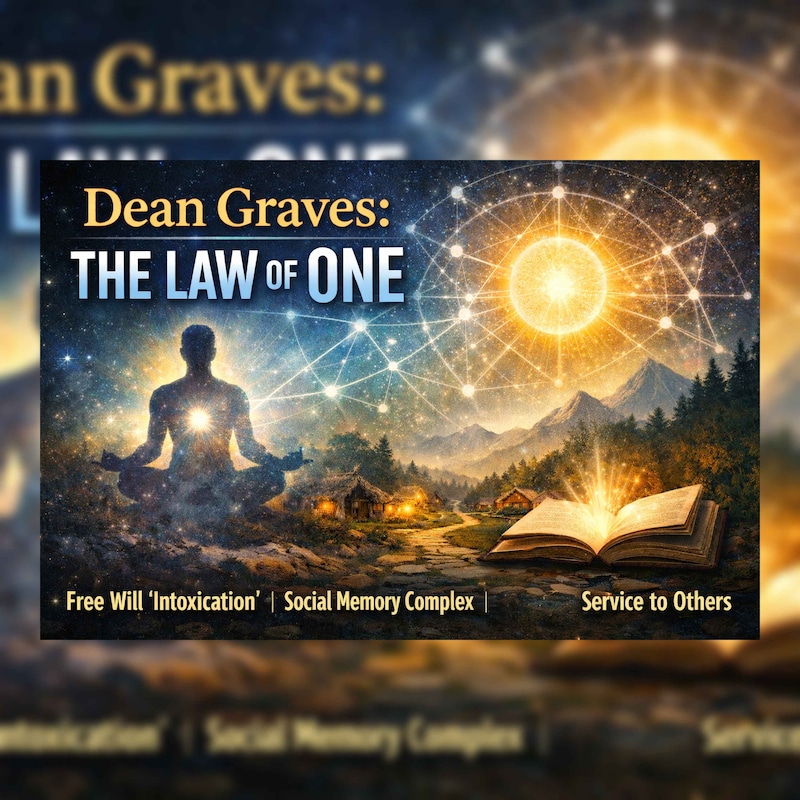
In this episode of The Living Conversation, we’re joined by Dean Graves, who shares a framework drawn from his ongoing contact with a non-incarnate teacher described as a social memory complex. We explore the Law of One (“all is one”), the idea that consciousness is “creativeness intoxicated with free will,” and how the spiritual path is a gradual sobering back into unity.
We also move into practical terrain: emotional baggage as “unfinished lessons,” why meditation is the inversion of awareness, and how to take the meditative mind “back into the village” — real life, relationships, and responsibility.
Guest: Dean Graves
Website: deangraves.org (DeanGraves.org)
In this conversation
- What a social memory complex is, and how “individuality” changes as consciousness evolves
- The Law of One and why “all of consciousness is conceptual”
- “Free will intoxication” (the whiskey metaphor) and the enlightenment path as sobering up
- A provocative take on emotion: one spectrum (like/dislike), applied thought-by-thought
- Awakening as turning awareness inward and seeing how the “false self” perpetuates unhappiness
- Service to others vs service to self as a critical evolutionary choice
- Why meditation works, why it’s hard, and how motivation shifts from “running from the stick” to “chasing the apple”
- Bringing practice back into the village: maintaining inner freedom while living ordinary life
- Closing takeaway: “Be the change you want to see in the world.”
- 00:00 Intro + Dean’s ongoing contact with his teacher
- 01:05 Social memory complex + archetypes / structure of the universe
- 05:20 “Intoxicated with free will” + Creator / subject-object framing
- 10:03 Emotional baggage + what “emotion” is
- 12:07 Awakening = inverting awareness inward
- 15:46 Service-to-others vs service-to-self (polarization)
- 20:46 Meditation + “bite of the apple” + healing
- 23:11 Bringing meditation “back into the village”
- 25:39 One thing to practice: Gandhi / be the change
Law of One, social memory complex, free will, consciousness, meditation, mindfulness, awakening, emotional baggage, service to others, spirituality, nonduality.
Transcripts
I'm Anthony Wright and I am your co host today on the Living Conversation with Adam Dietz.
Speaker A:Welcome.
Speaker A:And we're talking with our guest, Dean Graves.
Speaker A:And you have been, Dean, you have been outlining to us some very interesting and intriguing structures of how we develop.
Speaker A:And one of the things that I had understood from our last segment was that you got in touch or your teacher got in touch with you in a pre incarnate way.
Speaker A:And is your, are you in touch with your teacher on an ongoing basis?
Speaker B:Daily.
Speaker A:Daily.
Speaker A:Okay.
Speaker B:Yeah, I have a daily conversation with them.
Speaker A:Oh, that's really, that's very interesting.
Speaker A:And if I might, I'd like to get the understanding of what is the basis of reality or the ontological primitive for your teacher.
Speaker B:Well, they are not incarnate.
Speaker B:Right.
Speaker B:They are a social memory complex.
Speaker B:They are as, as we evolve through these ranges of consciousness, we are surrendering.
Speaker B:We, we first of all, from our range of consciousness, we essentially outgrow the limitations or the structure of the archetypical mind that we were referencing before.
Speaker B:We simply outgrow it.
Speaker B:It no longer has sway on our processes.
Speaker B:We are also surrendering significantly this perception of separation so that our social memory complex becomes cemented as what we would perceive to be a more vast individual.
Speaker B:And the individuality becomes defined by the universe that we participate in.
Speaker B:Right.
Speaker B:Okay.
Speaker B:Every universe is, has a design.
Speaker B:And of these 32 archetypes of the Creator, every universe is a different mixing and matching of these inherent characteristics and our end distortions of those inherent characteristics.
Speaker B:Our particular universe is comprised of nine of those archetypes, the five inherent characteristics, the free will distortion, and three other distortions.
Speaker B:As our universe has expanded, it has expanded in groups of nine stars.
Speaker B:Each star is home to an archetype.
Speaker B:Both that's true for inherent characteristics as well as the distortions.
Speaker B:So we participate in a nine star system.
Speaker B:And the higher consciousness of those nine stars are the ones that guide our experience.
Speaker B:They begin new populations, they retire old populations that aren't functional or disperse them to other planets that are being more productive.
Speaker B:And so all the other universes have also been created with some mixing and matching of those archetypes.
Speaker B:Some universes have all 32.
Speaker B:And our task is to explore uniquely from this mixing and matching of the archetypes of the Creator, creation itself.
Speaker A:So that brings me to the question about.
Speaker A:You have spoken about the Creator and also about in one of your videos on your, on your website about the releasing of emotional baggage.
Speaker A:But I want to get into that in just a moment.
Speaker A:Is The Creator, as your teacher understands it and is guiding you to understand it, is the Creator also a social memory complex?
Speaker A:And can we.
Speaker A:Is our evolution towards becoming unified with that social memory complex as the Creator is that.
Speaker B:Well, yeah, let me.
Speaker B:Let me clarify that.
Speaker B:The purpose of creation is so that the one infinite Creator might know itself by experiencing itself.
Speaker B:And this is a determination from the wisdom of the Creator of how it needed to explore itself.
Speaker B:And if you understand that the one infinite creator at one point in time was all that there is and still all that there is.
Speaker A:Right.
Speaker B:If you're all that there is, you have no concept of self because you have nothing.
Speaker B:Nothing.
Speaker B:There's no mirror to reflect.
Speaker A:Right, right.
Speaker B:And so the beginning of creation was a projection by the one in the originating one infinite Creator of itself as an analog projection with one difference.
Speaker B:The analog projection was intoxicated with free will.
Speaker B:It perceived itself as separate from the Creator.
Speaker A:Yeah.
Speaker B:And so the Creator had a mirror in order to interact with.
Speaker B:Since it was an analog projection of the one infinite Creator, had the same desire as the originating one infinite Creator.
Speaker B:Creator.
Speaker B:But that first step created the one infinite Creator, which is the Creator as the object, and also created the Creator as the subject.
Speaker B:So it developed the first subject object relationship.
Speaker A:And yet that subject object relationship is conceptual.
Speaker A:Conceptual.
Speaker A:And it's not necessarily reality.
Speaker A:Is that correct?
Speaker B:Well, it's reality to perception.
Speaker B:Well, right, but there isn't.
Speaker B:There is no reality other than what we perceive there to be.
Speaker C:Can I ask a quick question here, please?
Speaker B:Sure.
Speaker C:Just.
Speaker C:My Western philosophy is rusty.
Speaker C:That was my undergrad, so I wanted to check in real quick.
Speaker C:Was subject object an important piece of Kant?
Speaker C:Am I remembering correctly?
Speaker C:Was Kant involved in a lot of subject object type of analysis?
Speaker B:Not that I recall.
Speaker C:Okay, I'm misremembering.
Speaker B:Thank you.
Speaker C:And Anthony, you had a question.
Speaker C:So sorry about that.
Speaker A:Oh, I continue to.
Speaker A:To be intrigued by what your teacher has for us through you and to understanding what is the basis of consciousness.
Speaker B:And the Creator is the subject, the Creator that is consciousness.
Speaker B:We are consciousness.
Speaker B:Everything that we experience is consciousness, which means all of consciousness is conceptual.
Speaker A:Okay.
Speaker A:So there's no consciousness beyond concept.
Speaker B:That's right.
Speaker B:There's.
Speaker B:There's no real other than the concept or the.
Speaker B:There is no real other than the one infinite Creator.
Speaker B:That's called the law of One, which is the one irrefutable law of all of creation.
Speaker B:All is one.
Speaker B:All right.
Speaker B:Well.
Speaker A:And I. I do appreciate that.
Speaker A:I wanted to come back, though, to.
Speaker A:To continue to.
Speaker A:To try to grasp or get A sense of the Creator as social memory complex.
Speaker A:Is that a correct way to put that?
Speaker B:Well, it is.
Speaker B:You and I are the one infinite creator, experiencing ourselves at this range of consciousness.
Speaker A:Right.
Speaker B:It's just we are extremely intoxicated with free will.
Speaker B:You can define consciousness as our creator ness intoxicated with free will.
Speaker B:What has made the hierarchy of creation possible is the increasing degree of intoxication of free will.
Speaker B:And it works very much like whiskey.
Speaker B:The more whiskey that you drink, the more foolishly you behave and less like your authentic self.
Speaker B:And so we are extremely intoxicated with free will.
Speaker B:The evolution of consciousness, which is synonymous again with the enlightenment path, is the process of sobering from our free will intoxication.
Speaker B:The Buddha was extremely sobered from his free will intoxication.
Speaker B:Who was the Buddha?
Speaker A:The Buddha.
Speaker A:Oh, okay, okay.
Speaker A:Because on your website also you talk about this range of entropy that there are eight steps and at the bottom is chaos and at the top is stability.
Speaker A:And the stability is the same as the Creator.
Speaker A:Is that correct?
Speaker B:Well, the.
Speaker B:The 8th Ranger, the 8th density is the Creator is the subject.
Speaker B:The analog projection of the.
Speaker B:The creator as the object is.
Speaker B:Is not chaotic.
Speaker B:It is everything.
Speaker A:And yet beyond subject object.
Speaker A:Is there a creator beyond subject object?
Speaker B:Yeah, well, yes, because that was.
Speaker B:That was the initiating creator that projected itself as an analog projection.
Speaker A:Oh, I see.
Speaker A:In order to understand itself.
Speaker A:Right, okay.
Speaker A:And then I would imagine that in.
Speaker A:In the way that you've been speaking about intoxication of free will, that's part of the accumulation of emotional baggage.
Speaker A:Is that right?
Speaker B:Well, emotional baggage contributes to that.
Speaker B:We are the range of consciousness that experiences emotional baggage.
Speaker B:And emotional baggage is nothing more.
Speaker B:We interpret every experience with emotion.
Speaker B:Right, right.
Speaker B:Emotion, again, is another misunderstood concept.
Speaker B:We perceive that there are hundreds, if not thousands of different emotions and there's actually only one emotion.
Speaker B:That is the spectrum that emotion is.
Speaker B:Either this thought that I'm processing right now feels good and I like it, or it doesn't feel good and I don't like it.
Speaker B:If you don't like it, it's a negative emotion.
Speaker B:If you do like it, it is a positive emotion.
Speaker B:That's the only emotion that there is.
Speaker B:But we are obligated to make that choice before we can proceed to the next thought.
Speaker B:Every thought in and of itself is a complete emotion.
Speaker B:I mean, a complete experience.
Speaker B:We perceive because of our low level of awareness that an experience will last some period of time, 30 minutes or an hour, whatever.
Speaker B:But that's comprised of dozens of thoughts.
Speaker B:And with each individual thought within that perceived experience, we are obligated to make and adjudicate every thought whether it feels good or doesn't feel good.
Speaker B:That's the only emotion there is.
Speaker A:Yeah.
Speaker B:We have experiences for the sole purpose of learning.
Speaker B:We perceive erroneously that we're learning about other people in the world around us.
Speaker B:But what we're actually learning about is ourselves in relation to people, places and things.
Speaker B:And so the people, places and things provide us with the opportunity to be.
Speaker B:To become more aware of ourselves by virtue of this process of interpreting the thoughts that are provoked by the interaction.
Speaker C:Dean, is the Enlightenment Awakening experience.
Speaker C:Is that a sense of understanding the Creator within and perceiving these emotions and thoughts from the standpoint of the Creator within?
Speaker C:Is that a way of describing it?
Speaker B:Well, it is.
Speaker B:But understand, we are the Creator experiencing ourselves at this range of consciousness, which means we are very intoxicated with free will and have limited capacities.
Speaker B:But we all have awareness.
Speaker B:We are designed to begin this process of living by pointing the awareness outside of us.
Speaker B:Because we're in the process of creating an individual identity, a hierophant, a false perception of self.
Speaker B:And we do that for the sole purpose of getting more of what we like.
Speaker B:No one is motivated to get more of what they don't like.
Speaker B:We're all motivated to get more of what we like.
Speaker A:And.
Speaker B:And so our awareness has to be pointed outside of us.
Speaker B:So I can observe you and make adjustments to my hierophant in order to find.
Speaker B:Try to trick you more successfully in giving me more of what I like.
Speaker B:Awakening is nothing more than realizing that.
Speaker B:That whether you're.
Speaker B:You're able to define that experience, that process or not, that you're not getting happier by virtue of behaving in that way.
Speaker C:Okay.
Speaker B:The awakening is the.
Speaker B:The inverting of that awareness inside to start becoming aware that you're not happy, number one.
Speaker B:But then to find out what it is that you have created by virtue of this perception of self that is perpetuating your unhappiness.
Speaker B:And it is through that inwardly directed awareness that you begin to fulfill the purpose of creation by exploring yourself.
Speaker A:Wonderful.
Speaker A:Yeah.
Speaker A:Well, we are coming up on a another break and I'm Anthony Wright and I am your co host today on the Living Conversation with Adam Dietz.
Speaker A:Dietz.
Speaker A:And we're here with our guest, Dean Graves.
Speaker A:And how can people contact you, Dean?
Speaker B:On my website, the initial D. DeaN-E-A-N Graves.
Speaker B:G-R-A V E S.org Great.
Speaker A:All right, we'll be right back, so stay tuned.
Speaker A:Anthony.
Speaker A:I'm Anthony Wright and I'm your host today on the Living Conversation with my co host, Adam Dietz.
Speaker A:Welcome back.
Speaker A:And we are here with our guest, Dean Graves.
Speaker A:And before the break, Dean, you had answered Adam's question about the enlightenment experience.
Speaker A:One of the things that I would like to in our, in this last segment of our show today is begin to explore what might be of use to our listeners in their daily experience from the structure and the points of awareness that you have in transmission from your teacher.
Speaker B:Okay.
Speaker A:Because on the website you speak about stress and suffering, mental health, happiness, certainly emotional help.
Speaker A:And I guess part of what I'm interested in, one of my abiding points of interest is how to assist our young people from getting their nose out of their phone.
Speaker A:You know, and, and I do appreciate that, you know, are.
Speaker A:It's by design that people are, are drawn to that.
Speaker A:But that's one of the perennial things that I hold in my own practice as something that I want to assist people to become more free of that.
Speaker A:What are your thoughts about that?
Speaker B:Well, one of the critically strategic choices that we need to make in order to prepare to evolve beyond this range of consciousness.
Speaker A:Right.
Speaker B:Is to choose whether we are going to polarize service to self or service to others.
Speaker B:Those choosing the service to others path are choosing to align with the Creator.
Speaker B:And that's considered to be the direct path that will lead us through the evolutionary process with the least distraction developing this identity.
Speaker B:This hierophant provides us with the opportunity to choose to have a choice, to choose to service to self path.
Speaker B:Most of the deviant behavior that we perceive in our world, narcissism, sociopathy, psychopathy, are nothing more than the individual's choice over a series of lifetimes in order to follow the service to self path and develop the identity which is the path of separation from the Creator.
Speaker B:And so consequently, that evolutionary path can go a long way.
Speaker B:But it's considered to be the indirect path because you eventually hit a roadblock.
Speaker B:You can't go any further.
Speaker B:You can't be in unity and in separation at the same time.
Speaker A:Yeah, it's a paradox.
Speaker B:So they've got to come back and start the evolutionary process all over again.
Speaker B:But that notwithstanding, because they can develop along that path a long way, they become the antagonist for those along the service to others path.
Speaker B:Because we are fed constantly by what is called intelligent energy, we cannot continue to participate in creation without this flow of intelligent energy which is provided by our higher self, just ourselves.
Speaker B:In the future, if you're choosing the service to self path, then you're choosing to separate yourself from that, but you still have to have the energy.
Speaker B:And so the only other place that you can get it from is others participating in creation that are getting this flow directly from their intellect, their higher self.
Speaker A:And you don't get it directly in.
Speaker B:Service to self, even service to self.
Speaker B:You give it up.
Speaker B:You, you, you, you choose to, to divorce yourself from that source of the energy, but you got to get it from somewhere as a separated identity.
Speaker A:Right?
Speaker B:Right.
Speaker B:But our range of consciousness is like Goldilocks's porridge.
Speaker B:We have enough energy to make it worth their while to steal it, but we're not smart enough to know we're not supposed to give it away.
Speaker B:And so they greatly interfere in our experience of creation.
Speaker B:And they are not of our higher consciousness, our higher self being, but they are significant as we would perceive it to be more powerful.
Speaker B:Most of the UFOs or UAPs that we see historically are nothing more than those service to self individuals that have graduated to the next range of consciousness, but not beyond that.
Speaker B:In order to instill fear in our daily life.
Speaker B:When we feel fear, we're giving away that energy.
Speaker B:Right?
Speaker B:Right.
Speaker B:When we have a war, we're giving away that energy.
Speaker A:And so they is the, the individualities that are in service to self, Right?
Speaker B:Exactly.
Speaker B:Okay, exactly.
Speaker B:Those individuals that have for the most part dominated our politics and development as populations are strongly influenced by the service to self beyond this range of consciousness.
Speaker B:They have a philosophy.
Speaker B:The philosophy is they have great integrity, but the integrity is towards themselves.
Speaker B:Right.
Speaker B:The commitment, not towards others.
Speaker A:So to come back then about the teenagers with their nose stuck in the phone is, and I, at, at a basic level, I have the understanding that there is no separation and that, that this individuality is an illusion.
Speaker A:And how can we assist people in coming back to this non separate perception, Non separated experience?
Speaker A:Well, I would say beyond beyond perception.
Speaker B:Well, the things that the Buddha taught are the most effective by far.
Speaker B:Meditation.
Speaker B:All we're doing in meditation is inverting that awareness.
Speaker B:Yeah, that's what a meditation is.
Speaker B:We're inverting that awareness inside of ourselves.
Speaker A:So.
Speaker B:But there is difficult to do that.
Speaker B:I've taught meditation now for 25 years.
Speaker B:And so I know the difficulty that people have in doing, and it was difficult for me when I first began as well.
Speaker B:But everyone, almost without exception comes to meditation running away from the stick.
Speaker B:Something in their life hurts and it doesn't feel good.
Speaker B:And so they want relief from that if they're persistent enough.
Speaker B:To stay there long enough that they develop some proficiency with meditation, then they will get what I described as the bite of the apple.
Speaker B:And I had a student that said, I don't care for an apple.
Speaker B:I like lasagna.
Speaker B:Okay, well, you got a bite of lasagna, it doesn't matter what you got.
Speaker B:You got something that you like out of that, and it's at that moment your motivation transforms from running away from the stick to chasing the.
Speaker B:The apple.
Speaker B:Right.
Speaker B:And so that's when you really begin to make significant progress with your meditation practice as well as the healing is what we're really looking for from these false perceptions of self and the liberation of that emotional baggage that you had alluded to right before.
Speaker B:Emotional baggage is nothing more than the experiences that we have had during the course of our lifetime that we did not learn, the lessons that were brought to us in that experience.
Speaker B:And so we get to keep that in the form of emotion.
Speaker A:Yep, yep, yep.
Speaker A:So in a manner of speaking, then, the answer is to invite these young people who've got their notes stuck in the phone to begin to interact with one another.
Speaker A:Interact with.
Speaker A:With one another, and yet also to attend to a meditative practice when ideally.
Speaker B:Yes.
Speaker B:Yeah.
Speaker B:Okay.
Speaker A:All right.
Speaker A:And would you say that that's also for us adults who are working through our daily lives?
Speaker B:Sure.
Speaker B:You've been.
Speaker B:As adults, we've just experienced more of what we don't like longer.
Speaker A:So it's.
Speaker A:And that's also where you come to this mindfulness practice.
Speaker B:Absolutely.
Speaker B:Mindfulness is.
Speaker B:Is a misnomer, too.
Speaker B:It's nothing more.
Speaker A:Right.
Speaker B:Then having developed a meditative practice and learning how to take that frame of mind, that experience of being in meditation with you back into the village so that you maintain that perception of.
Speaker B:Of separateness from the problems of the village while you're.
Speaker B:You're still maintaining that mindset of being in the guru's cave.
Speaker A:Okay, so I've been talking a lot.
Speaker A:Adam, do you have anything?
Speaker A:13?
Speaker B:Yeah.
Speaker C:One of the biggest things that comes up for me is when we're talking about the meditation and we're talking about bringing it back into the village and service to others is really enlivening.
Speaker C:It reminds me of when Confucius, a student, came to Confucius and asked him, confucius, Confucius, what happens after death?
Speaker C:Confucius told him, you don't yet know life.
Speaker C:Why are you asking about after death?
Speaker B:Yeah.
Speaker C:So when we're talking about this meditation, there's so much in our own internal mind that we have to work through and patterns we have to understand to be of better service to other people.
Speaker C:And there's so much for us to learn in that path.
Speaker C:And that when you're, when you're speaking to those points is really enlivening.
Speaker C:I appreciate you.
Speaker C:So I just wanted to say that.
Speaker B:Yeah, good.
Speaker B:Thank you.
Speaker B:Well, understand that our authentic self is already stress free.
Speaker B:It is always already blissful.
Speaker B:And it is only our creation of this false perception of self that perpetuates our stress.
Speaker B:But we have to learn what we don't like in order to know what we do like when we encounter it.
Speaker B:If you decided that chocolate ice cream is your favorite flavor of ice cream, in order to determine that you had to taste most of the other 149 other flavors available to you in the ice cream store.
Speaker C:We just had this debate on our previous maybe two, two interviews ago with the Sonoma State Philosophy Club and one of the students actually put it, made a clip of this and put it onto the social media, different social medias at the way between.
Speaker C:But he said, well, you know, I don't.
Speaker C:I love chocolate ice cream.
Speaker C:Do I really need to taste shoe flavored ice cream to know that I like chocolate?
Speaker C:We had the counterpoint.
Speaker C:Yeah.
Speaker A:So I think we're coming to the end of the show and is there.
Speaker A:If there was just one thing that you had to offer to our listeners about this path that you are offering us, what would that be?
Speaker B:Well, my, my recommendation to people to begin as well as to further themselves is to follow Mahatma Gandhi's admission to be the change that you want to see in the world.
Speaker B:And as you do that, then you will bring to you the experiences that you need in order to further your capacity for service to the world as being and also your success in.
Speaker B:In changing the world.
Speaker A:Ah, this has been quite a.
Speaker A:Quite a conversation.
Speaker A:Any.
Speaker A:Do you have anything, Adam, before we're done?
Speaker B:No.
Speaker C:Those are great words to end on.
Speaker C:Oh, I will say, I will say that Dr. Wu, our teacher and mentor did mention this in terms of having a concerned mind that you live your life to have a concerned mind for others and for this world.
Speaker C:And when you're acting out of that concerned mind, then I think Dean makes the point that you know, to be the change you want to be the change you want to see in this world, you have a concerned mind for other people and you see what needs to be worked on and you work on it in yourself.
Speaker A:Excellent.
Speaker A:Yes.
Speaker A:Yep.
Speaker A:Well, I'm Anthony Wright and I've been your host today on the Living Conversation with my co host Adam Dietz.
Speaker A:And our guest is Dean Graves.
Speaker A:And how can people contact you, Dean?
Speaker B:On my website, the initial D dean Graves, all1word.org and all my books and pad Kaiser listed there.
Speaker A:Great.
Speaker A:Well, I really appreciate your being here with us and appreciate everyone who has tuned in and thanks for listening and we'll see you next time.
