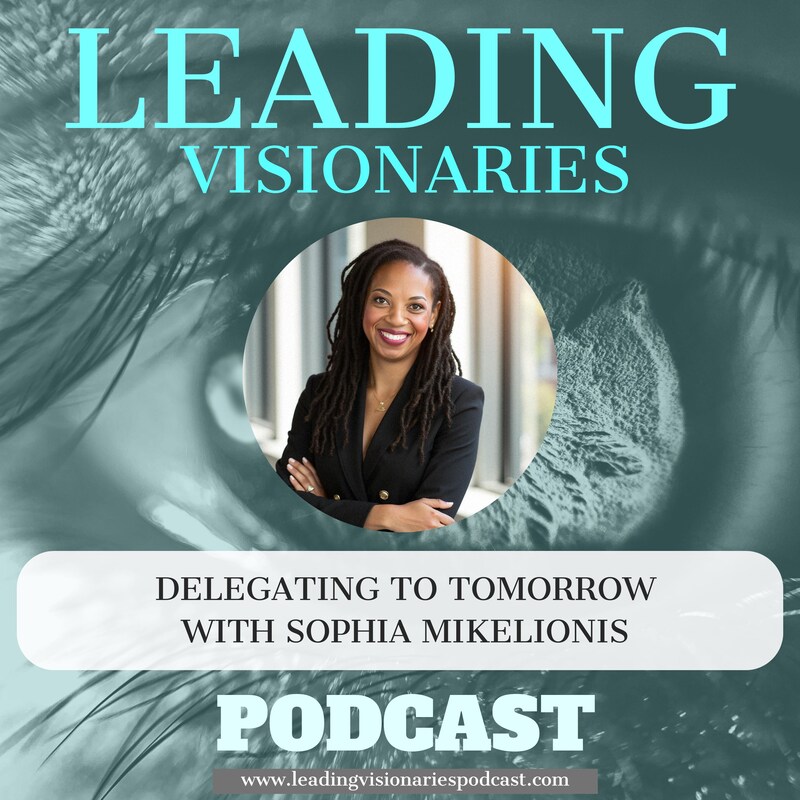
Shownotes
What if burnout isn’t a personal failure, but a leadership signal asking for something different?
In this episode of the Leading Visionaries, host Anjel B. Hartwell sits down with Sophia Mikelionis, self-leadership expert and founder of Gearing Together. Sophia shares her journey from thriving in corporate leadership to realizing that success without alignment was costing her relationships, health, and joy.
If you lead a team, run a business, or feel the quiet exhaustion of always being the reliable one, this conversation will give you language, permission, and tools to lead differently.
What You Will Learn:
Why burnout is often a systems and leadership issue, not a personal weakness.
How self-leadership differs from traditional leadership models.
Why empathy is a strategic leadership skill, not a soft one.
How constant availability and smartphone culture contribute to chronic burnout.
What it means to “delegate to tomorrow” and why it is a form of self-trust.
How middle managers become trapped between senior leadership pressure and team burnout.
Why high performers struggle to slow down even when success is costing them personally.
How emotional flatness can be an early warning sign of burnout.
What physical cues like tension, fatigue, and irritability reveal about overextension.
How to identify energy leaks in your calendar and daily routines.
Why sunk cost fallacy keeps leaders stuck in misaligned roles, systems, or strategies.
How small, intentional habits can prevent burnout before it escalates.
Why leaders must create space for strategic thinking instead of living in execution mode.
How teams can address burnout together instead of in isolation.
What sustainable leadership looks like in a fast-moving, high-demand world.
Resource:
Sophia Mikelionis
Join the Leading Visionaries Community
Transcripts
LVP 119 Sophia
===
Ad: [:Now here's your host, Anjel b Hardwell.
Anjel: Welcome to another episode of the Leading Visionaries Podcast, where we celebrate the ingenious, insightful, innovative, and inspired leading visionaries of our time, and provide our listeners with world class examples of the kind of courage. Clarity and confidence it takes to bring visions into reality.
uest, Sophia Celonis. Sophia [:With the tools to lead themselves differently without quitting their careers. Through workshops, keynotes, and her signature liberated leader experience, she helps organizations retain top talent by shifting the culture from overwork into alignment. Sophia blends real world strategy with emotional intelligence to turn burnout, recovery into bold, sustainable leadership.
I'm excited to have you here today. Welcome to the show, Sophia.
Sophia: Hello, hello.
ve started your own business [:Or has vision been something that has been maybe mentored? Or, you know, cultivated in you through your corporate career.
Sophia: Yeah. You know what? I have always been a dreamer, even when no one else understood like what, what I was dreaming of or what I wanted to do or become. That's always been the core of who I am, to be honest.
in, was leadership something [:Sophia: I was the bossy kid on the playground. I remember my mom would say, the school, call me again, you're not the teacher. Pretty quiet. So yes, always the leader or the person trying to organize or facilitate or take charge.
Anjel: Yeah. Beautiful. So I think we're in a time where leadership is asking to be.
Transformed or has been in a process of transforming to become more emotionally literate. And we're still, it's like we're in this time where there's still a lot of entrenched old authoritarian kind of leadership style that, you know, is slowly dying off, but. Slowly. And then this emergence of more emotionally intelligent, more people-centric, shall we say, leadership.
o I'd love to have your take [:Sophia: Yeah. I think you said it best when you said there's a mid a mismatch, right? Between the awareness of the worker bees, right? Or the doers, the individual contributors and leadership. Most of leadership has things done for them, so they don't really understand or appreciate the nuances that are surrounded by, you know, some of their unreasonable or last minute request.
And I think a lot of it stems from these smartphones, right, that we have because leadership knows that they could reach you. Technically at all hours. It ki it's kind of like this circular reference where you feel like you have to be on and it's really tough to lead yourself differently. It's tough to eat lunch away from your desk.
say with how the individual [:Anjel: Mm. And so I'd love to have you speak a little bit about maybe how you've seen leadership evolve in your own career.
Like you obviously spent some time in in corporate and yeah, now you have your own business, but like in your own career, what has, have you witnessed? Like where are the big challenges right now to help people actually work together better?
Sophia: It's really tough. 'cause I talked about a circular reference, right?
So leadership, I understand. 'cause I, I was at a, a director role, like I understand the pressure from the top right. And in order to do that, you need a killer team. You need a team that's gonna crush it regardless. And in order to do that, you have to lead with empathy. Because empathy is how that, that, that fuels or feeds retention.
ime, when you're a leader at [:You're like a baby shower. Who has time for that? But my, what I've seen in corporate is my best managers, they led with empathy. When we all had to stay late, they didn't just leave the office, you know, so that that way they could eat, eat dinner at home with their family. They stayed with us and that's how I try to leave my team with empathy first, you know, would I want someone to call me at 6:00 PM for an unrealistic request or.
sure, especially like middle [:They're like out of, they're like, they're stuck. They're like a rock in a hard place, seriously, because they're getting it from both ends. You know, the individual contributor who is stressed, and then leadership, senior leadership that's stressed. So leading with empathy is definitely where I start. Even if it as a manager, as a business owner, makes me uncomfortable.
I have to look out for my people first.
Anjel: Hmm. I love that. Okay, so let's talk about your journey into self-employment, because obviously that required self-leadership and self-leadership is, you know, where you have your expertise. So let's speak a little bit about maybe in general, what you see self-leadership is like.
How would you define self-leadership and then in particular, how you self-led yourself into starting your own business and following your vision?
h, I'm just gonna give it to [:But sometimes, you know, based on your schedule or your calendar, you need to delegate your groceries to grocery delivery. Sometimes you need to delegate your groceries to eating out, but knowing when to delegate and delegating efficiently, delegating in a way that empowers you instead of. Slows you down and my journey into entrepreneurship, let me tell you, every day I have to ask myself, are you delegating appropriately, right?
Yes. I wanna stay up late and, you know, get this website relaunched or get this workshop, you know, like run of show, you know, from start to finish, just do another dry run. But work will always be here. So now I need to delegate this to the. To tomorrow, I need to push it to tomorrow so that way I can get a good night's sleep.
So I would say that those are the tools that I brought from corporate to what I do now as an entrepreneur is just delegation. It's really, really critical.
Anjel: Beautiful. [:What like tipped you over the edge and said, yep, I'm doing it. Like, talk a little bit about that for our aspires out there.
Sophia: Yeah, so I didn't, so in my corporate role I was crushing it, promotion after promotion, climbing, just climbing the ranks and I enjoyed it. I enjoyed being the hero. But at one point I looked around and I realized that my loyalty wasn't being rewarded, right?
Like, yes, I was working late nights. Yes, I was getting the, the, you know, the quiet applauses in the corner. Yes. Sophia, you know, got the project, you know, across the finish line once again. But when I looked at my life, my personal life, I, it was, I was really angry with myself, like I was a jerk to my friends.
I was [:At one point, do I take my foot off the gas and pivot to something else? And to be honest, I had no clue what I was going to do. But I knew that the pace that I was going at, it wasn't sustainable. Not for my family, not for me. I'm a social person. I need my friends. I need my family. I need someone to eat lunch with.
ing people. Let me give this [:Anjel: Mm-hmm.
Sophia: And so that's kind of where it started. And then I noticed I was kind of good at it and I'm like, okay, this is, this is where I need to be. So.
Anjel: Yeah. Well, and one of the biggest challenges that can happen for entrepreneurs, especially after they've come out of corporate is underestimating all the stuff.
Like you, you're the one that has to go buy the staples at Staple. At the Staple. You know, at Staples you have to go buy the staples at Staples. It's not like the structure is not there anymore like it was in corporate. And so I'd love to have you speak about as you stepped into your entrepreneurial venture, like what were the big challenges that you faced and what was your first big win?
tup, or it's a shared drive, [:I had defined what system work for me and a system that was affordable. Right. And I had to make sure that. Because of course you get recommendations from everyone else, right? But what is really working for me and what shows up for me, and I had to give myself permission to pivot, to quit some things, even if I paid for an annual membership, if I wasn't using it and it wasn't helping me or moving my business forward.
You know, I, I have to pivot. And sometimes that was hard. Sometimes there are a lot of sunk costs, you know, the sunk cost fallacy, like, oh, I have to stay with it. So knowing when to quit that, and I would say my biggest success would be truly like getting a win from a client, like hosting a workshop from start to finish and seeing those.
are pretty e well, they were [:Anjel: Hmm. Well it's fascinating. This is the third time, in the last 24 hours that sunk cost fallacy has come up. You know, you and a previous guest and then something, something else that I was doing for my own business. So I'd love to have you speak about that because there are many people who are listening who.
Are maybe at that moment of investing in themselves and their dream and their vision, or maybe they've already done some investing in themselves and their dream and their vision and they are, you know, kind of grappling with this from a mindset perspective. Yeah. Like what would you wanna say to them?
Sophia: [:We always think of, sometimes we mention the new Coke quote unquote recipe. You know, in passing is a joke as a learning lesson. But all we know is the Coca-Cola that we use. You know, all we know are like the products that are successful. But as a, an owner, as an entrepreneur. We need to expect losses.
And when they happen, we need to be comfortable enough to pivot. 'cause that's the beauty of being an entrepreneur. You have the agility to pivot you. You can make the decision, hey, when this subscription is over, or when, you know, renewal, time comes up, we're done. Think about it. In corporate, you have to go through how many.
focus group wasn't right or [:Sometimes if you don't go forward now, if you don't move forward, now you can lose that opportunity. And for what? Because of your ego. So I would say move forward without it. Let it go. Expect some losses and keep it moving.
Anjel: Yeah. Beautiful. Well, and I love that, that you said that you have to go through some losses to get to the win.
And frankly, for, for most of us who are entrepreneurial and visionary and in are, you know, taking risks like we do the loss is as much of a win as a win is generally speaking because we take the lesson and we apply it right away. We're gonna take a quick break and right now, we're gonna let you know.
r community and sharing your [:The best support is found in collaboration with other leading visionaries, which is why we've created. The Creative Age Leader Lab. Discover more about this [email protected] slash Creative Age Leader Lab, or click the connect with Anjel button on the website to apply and qualify for consultation for more personalized access and support.
Be sure to share this show in your own spirals of influence with the people who you think might benefit from our content. And I wanna say a big. Thank you to all of our listeners who are downloading a rating and reviewing. We're welcoming thousands and thousands of downloads from all over the world.
ght back with Sophia Celonis.[:Ad: The Leading Visionaries Podcast is brought to you by the Creative Age Consulting Group. Are you the one who thinks differently, who is called to create a significant conscious change in the world? Who is seeing and dreaming of a better way for your industry, your community Humanity Creative age consulting group is hired to guide leading visionaries just like you, who want to break through the static in order to clearly express and confidently enroll support for their vision in a way that makes it inevitable that it will come to pass.
release in three categories [:The book is yours by visiting gift dot Leading visionaries podcast.com.
Anjel: And we are back with Sophia Celonis. You can find out more about Sophia and her business at Gearing Together. Com, that's gearing together.com. We will have that for you in the show notes. So Sophia, let's talk to our listeners now about exactly what gearing together does. Like what, what does your company do, who do you do it for?
Like, what's your favorite thing to do? Tell us a little bit more about gearing together.
who run small teams, you are [:So I host workshops about 60 minute workshops in person or virtual to help us with burnout. And in, in these workshops in 60 minutes we go through. Prompts, thought prompts and exercises so that way you can weave small, tiny habits into your day, into your week, so that way you don't continue to deprioritize yourself.
And by doing that, just these small incremental changes, you're able to beat burnout, you're able to prevent it because you know what it looks like before it happens.
Anjel: Well, one of the things that I mentioned when I introduced you is that you help teams address burnout. So, you know, a lot of people talk about personal burnout, but I'd love to have you speak a little bit more to the whole idea of an entire team burning out.
eah. I like to work with the [:What went wrong? What's what is building up your energy and what is draining it? And how do we make those processes better? And let's look at it together. Because by looking at our gearing together and how we're gearing toward these projects and processes together, we're able to reboot together. We're able to reclaim our time and energy together.
We're able to rise together. So that's why I love working with teams and commun like in community because you are working in isolation. It's kinda like a book club, right? When everyone reads a book at the same time and you bring it all to the table, there's so many insights and things that come up, especially through some of the thought exercises or.
ions in the back of the book [:Anjel: Mm. Beautiful. So what's your vision right now for gearing together? Like what do, what do you see yourself going next with this, with this initiative?
Sophia: Yeah, continuing to host more workshops in person for employee resource groups or for small businesses, and jumping in like 10 toes in like. Let's do in, instead of let's doing 60 minutes, let's do a half day intensive. Like let's truly roll up our sleeves. Because one thing I know for sure is that the world is getting faster and faster.
I mean, forget the 24 hour news cycle. I mean, before you can digest anything. There's, there's so many things happening on coming from different directions, and unless we bridge that gap that we talked about earlier, the gap between senior leadership and the individual contributor, right? That pressure.
Right. And we can find. [:Anjel: Symmetry.
Sophia: Yeah.
Anjel: Synergy. Synergy.
Sophia: Yeah. Good
Anjel: word.
Sophia: Yeah. A, a good synergy. It's almost impossible to change and a lot of us have so many thoughts and ideas, and unless we can prevent burnout, we can't get those diverse ideas and thoughts to the table, to a seat at the table, especially if we're all burning out.
Anjel: Hmm. All right, so if somebody was listening to this who happened to be running a team or part of a team, what would be some signs that it make might make sense for them to reach out to you right now?
Sophia: I would ask. Okay, so, so many different things pop up. Is anyone on the team for the leader? Right?
handle it. And then I would [:'cause often with burnout you'll see emotional flatness. Like, yay, we, you know, we, we finished that project. What's next? What's next? Right? Because you're always in go mode. You don't know how to relax, you don't know how to appreciate space or downtime. And if either one of those things like your body tensing up or just not experiencing any celebratory emotions when it comes to work happen, we need to talk.
Anjel: All right. And who usually hires you? Is it usually an individual that hires you or an organization that hires you? Who would bring you in? Because you know, when we think about these circumstances, they're in that container that's causing this problem.
Sophia: Yeah, yeah.
The
the problem that it created.[:Sophia: Yeah. You know, sometimes it's small business owners who have maybe like a 20, 30 person team and they're like, look, I know people were burned out, but I don't have time to stop and I don't have time to fix it. And guess what? I'm hr, I, the, the person who technically has on the HR hat, they only do payroll.
So if we can have someone come in to do some sort of team building, that would be great. So tho that is one source, one person. Who comes to me, one type of client. Another type of client that comes to me is an employee resource group lead. You know, sometimes they wanna have like a women's day or they're looking for panel speakers.
And I have like a fresh perspective, a new perspective on burnout prevention. So just planting those seeds or those different ideas, it, you know, it multiplies amongst the people that are listening.
Anjel: Beautiful. And is there any particular industry that you really enjoy working in or would you work with small businesses that have 20 to 30 employees across any industry?
you gonna work with farmers [:Sophia: Yeah, my, my work really shines in corporate or anything that kind of touches like a more of like a white collar role. So sometimes I go into like, realtors like a company, like a group of realtors sometimes, you know, they work under the same team umbrella or the same team name, but they don't really get together often unless it's in competition. That's one example. I was just I just had a call earlier today with a plumber who has many different plumbers, but he's something's gotta give and I don't know what it is.
Mm-hmm. Because these tips, I mean, often it's like adding movement to your day. Often it's, you know, giving your phone a bedtime, get off your phone. But to your point, I think more corporate facing, more white collar roles or positions really work.
Anjel: Talk about the signature liberated leader experience.
I'm curious about that.
ferent gears in life, right? [:We, in our mind, we just see all of those gears moving and operating at the same time, the same space. So I walk you through four different weeks or four different weeks for us to one, realize how do you reboot, how do you recharge, and often. People don't even know how they recharge. You know, they're like, I recharge by, you know, making sure all my kids are fed.
I recharge by going to work, like work and sleep, work and sleep. So we spend a lot of time trying to identify that. Then the second gear we look at is how, how do you set, what are your values? And then how do you set boundaries around those values, right? Because if you don't know what it is, it's really hard to put up a fence or an imaginary fence.
hmm. So that way people know [:So you get space to think strategically instead of being always in go mode.
Anjel: Mm. Well I think that last point, getting space to think strategically is absolutely essential to anybody who's either leading visionary themselves or leading other visionaries. So let's talk about that aspect, thinking strategically and if you could or would apply it to how you're operating your own business right now.
hang the shingle outside, I [:Measures of success is being able to delegate efficiently and again, sometimes it's not necessarily delegating it to another person, but I'm delegating it to tomorrow. Because if you are always in go mode and you never give yourself space to think strategically, you have such a narrow focus, you can't see or even appreciate the vision, right?
ow up more efficiently in my [:How to connect on a sales call. But you can't do that if you're always in the copy. You know, always looking at or
Anjel: even to, to see whether or not it's actually working or not. Yeah. Yes. When, when you get super attached to something that you've created, that's the, we're back to the sunk costs thing again.
So you need to create that strategic space to be able to, to, you know, be what do I wanna say? Neutral, like neutrally examining what's actually going on in your business. The one thing I really, really wanted to take away from this conversation and encourage our listeners to take away as well is this huge idea of delegating to tomorrow.
y time and making the choice [:Damn, I didn't get the thing done, you know, and the self punishment. So I want our listeners to just really take that in and think about delegating to tomorrow. Listeners, we do love feedback. Please let us know what you think of this show by joining our community, sharing your takeaways, asking questions, or submitting guest suggestions.
You can weave your visionary thread into our fabric by opting in on our website at. Leading visionaries podcast.com or by interacting with us on social, look for the handle at Leading Visionaries Podcast on all the major platforms. Thanks so much for tuning in. Keep your eyes, ears, and hearts open. And remember, you are here.
To create conscious change.
Ad: Thanks for [:And know that now is the best time to welcome wealth and cultivate a web of collaborative support to bring their vision to life. We invite your feedback and guest suggestions and invite you to subscribe to our mailing list to be notified of new [email protected].
