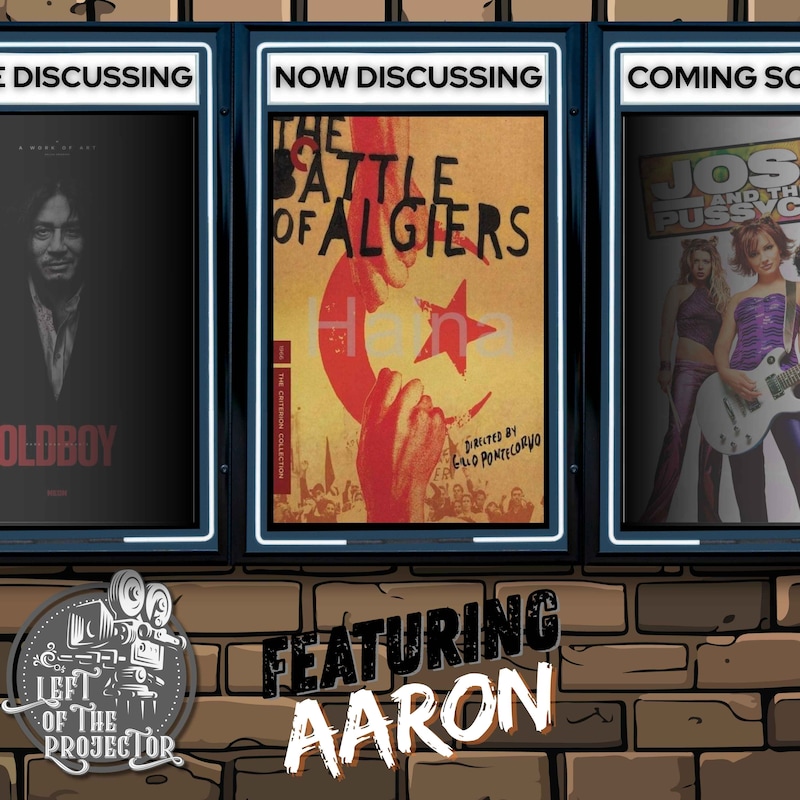
Shownotes
This week we discuss one of the most important revolutionary films ever produced, "The Battle of Algiers." Directed by Gillo Pontecorvo and staring Jean Martin, Saadi Yacef, Brahim Hadjadj and Tommaso Neri, the film was released in 1966 and portrays the actions undertaken by rebels during the Algerian War against the French occupation of Algeria.
Released only four years after the Algerian War and the successful revolution and independence of Algeria from the French, and less than a decade after the events of the film itself, "The Battle of Algiers" was shot on location and is cast almost entirely with members of the Algerian community who were participants in the revolution or lived through it. We discuss the impact the film had on society at large, the way in which it starkly portrays the violence of revolution while perfectly capturing the inherent humanity of those of us who want to bring about a better future for all even though we must use the tools of violence to do so.
To discuss the film we are joined by Aaron, a good friend of one of our hosts, an activist, an organizer, and a man with more to say about this film than we could ever fit into a single episode.
Left of the Projector Links
https://leftoftheprojectorpod.threadless.com/
https://www.instagram.com/the_red_gobbo/
https://www.instagram.com/millennialmarxist1/
Transcripts
Bill: Hello, and welcome to Left of the Projector. I'm your host, Bill,
Speaker:Bill: back again with another film discussion from the West.
Speaker:Bill: If you'd like to support the show for as little as $3 a month,
Speaker:Bill: you can go to Patreon forward slash Left of the Projector pod.
Speaker:Bill: If you like the dress and style, we've got shirts, and at leftoftheprojectorpod.threadless.com,
Speaker:Bill: show everyone you've got the best taste to orient.
Speaker:Bill: Wherever you're listening, give us a rating and subscribe so you'll get notified
Speaker:Bill: of our weekly episodes that drop every Tuesday. Now, on to the show.
Speaker:Bill: This week on the show, we are going to be discussing one of the greatest depictions
Speaker:Bill: of revolution ever put to film, the Battle of Algiers.
Speaker:Bill: It was released in 1966, written and co-directed by Guillaume Panticorvo.
Speaker:Bill: It was filmed on location in Algeria and was received to glowing reviews,
Speaker:Bill: winning the Golden Lion at the Venice Film Festival.
Speaker:Bill: It was initially banned in France, for obvious reasons.
Speaker:Bill: The film only features several actors, primarily Jean-Martin as Colonel Philippe Matteau.
Speaker:Bill: It remains one of the most important films depicting the struggles against colonialism.
Speaker:Bill: With us to discuss the film tonight is my friend, Aaron, a very good close friend
Speaker:Bill: of mine, real life, the real meat space. Aaron is a political organizer.
Speaker:Bill: He's a fan of the show of his own admission. He's excited to be here.
Speaker:Bill: He watched this film in high school. It helped radicalize him,
Speaker:Bill: especially from his family.
Speaker:Bill: When his father taught him about decolonization movements from a young age,
Speaker:Bill: taught him about leaders such as Nkrumah, Suku Ture, Maria Cabral, and Lumumba.
Speaker:Bill: As well as the Algerian War of Independence and the FLN. Aaron,
Speaker:Bill: welcome to The Left to Projector.
Speaker:Aaron: Hello, thank you for having me. I'm really excited to be on, I'm not going to lie.
Speaker:Ward: Happy to have you.
Speaker:Aaron: Thanks.
Speaker:Evan: Welcome.
Speaker:Aaron: So, especially when I talk about this film,
Speaker:Aaron: I always have to bring up the historical context because
Speaker:Aaron: what we see in the Battle of Algiers
Speaker:Aaron: is approximately four years of
Speaker:Aaron: 130 long year colonial occupation by france and algeria and i'm going to point
Speaker:Aaron: out two different like sort of events comparable events to give scale as to
Speaker:Aaron: how long and how close after the independence of algeria this movie was made so,
Speaker:Aaron: For how long the colonization, French occupation of Algeria was,
Speaker:Aaron: we can look at the U.S. and Hawaii.
Speaker:Aaron: And actually, it's scary how close it lines up because France was in Algeria
Speaker:Aaron: from 1830 to 1962 and about 132 years.
Speaker:Aaron: And so the Queen of Hawaii was ousted in a coup backed by the United States
Speaker:Aaron: in 1893 and the islands were annexed in 1898.
Speaker:Aaron: So do you want to know what year
Speaker:Aaron: 132 years is from 1893 that's 2025 that would have been this year yeah.
Speaker:Bill: That really yeah.
Speaker:Aaron: And then that.
Speaker:Bill: Really puts in perspective.
Speaker:Aaron: If it was eight if you're looking at 1898 it would have been 2040 so imagine
Speaker:Aaron: if you will and this is how the french viewed algeria they didn't see it like
Speaker:Aaron: a colony they saw it as a state like they call it a department similar to how
Speaker:Aaron: the United States views Hawaii.
Speaker:Aaron: So imagine indigenous Hawaiian people starting an armed struggle and basically
Speaker:Aaron: bombing resorts and, uh, uh, you know, attacking the military bases in Hawaii.
Speaker:Bill: We can only wish, we could only be so lucky. We could only ask for such a thing.
Speaker:Aaron: And then by 2040 or so, cause 2025 has already passed.
Speaker:Aaron: They, they liberate Hawaii and then, you
Speaker:Aaron: know four years later a film is made about you
Speaker:Aaron: know the final final days and to give
Speaker:Aaron: an even more like prescient example um we look at october 7th right and how
Speaker:Aaron: close this film was to the actual battle of algiers you know from uh 56 to 60
Speaker:Aaron: to the uh early 60s you know,
Speaker:Aaron: If you're going off of 2023, right, the difference in time would be,
Speaker:Aaron: this would be like if a movie was directed,
Speaker:Aaron: from the perspective of the Palestinian Liberation Forces about October 7th and released in 2032.
Speaker:Aaron: That's how close it would be.
Speaker:Aaron: And that gives you kind of an idea of how just controversial and like,
Speaker:Aaron: absolutely upended the political landscape in
Speaker:Aaron: the 60s and you had the vietnam and i have honestly
Speaker:Aaron: so much to talk about this film like for example
Speaker:Aaron: in 2003 uh the u.s state the u.s pentagon actually screened this film to study
Speaker:Aaron: it before the invasion of iraq because they felt it was one of the best depictions
Speaker:Aaron: of both insurgency and counterinsurgency it's been studied by the ira in ireland plo.
Speaker:Bill: That's an interesting point because we see you know
Speaker:Bill: as as using as an example of counterinsurgency considering
Speaker:Bill: the fact that you know they very point you know pointly says
Speaker:Bill: at one point like oh and we will see victor despite
Speaker:Bill: the fact that uh the colonel himself points
Speaker:Bill: out that the in indochina they did
Speaker:Bill: the same tactics and they lost there and then
Speaker:Bill: what do we see in this it's like yeah they they quote unquote
Speaker:Bill: win and like four years later it's algerian
Speaker:Bill: independence but i i want to i
Speaker:Bill: want to rewind just a little bit and do what we always do
Speaker:Bill: which is talk about our everybody's experience
Speaker:Bill: or their history with the start you know
Speaker:Bill: and since aaron you have the most to talk about in terms of like your history
Speaker:Bill: with the film i'm going to leave you for last because i know you have to have
Speaker:Bill: a lot to say about that so evan ward uh either of you want to give us your history
Speaker:Bill: your personal history with the
Speaker:Bill: film you know how when you first saw it you know what we always do here.
Speaker:Ward: I'll go first so i've seen
Speaker:Ward: this movie probably like a handful of times um a couple times before i was really
Speaker:Ward: political and i was like oh sick ass war movie you know didn't really think
Speaker:Ward: too much about it just pretty sick war movie and then now being political it's
Speaker:Ward: like god this movie is fucking great really really accurate depictions and just
Speaker:Ward: what the struggle actually entails,
Speaker:Ward: And I love it. And now it's to the point where I try to watch it at least once
Speaker:Ward: a year, but that's still pretty, pretty relevantly new thing to me.
Speaker:Evan: Yeah, for me, I've seen this maybe, I want to say like four,
Speaker:Evan: four or five times, you know, maybe a handful, as you said, Ward.
Speaker:Evan: I think the first time I saw it was near the time that I started.
Speaker:Evan: My political ideology was drastically changing.
Speaker:Evan: I was watching a lot of Soviet films and films that weren't just kind of your typical American fare.
Speaker:Evan: And i just remember being struck every time
Speaker:Evan: i watched this there's no portion of the
Speaker:Evan: film that's more i don't know
Speaker:Evan: uh just i'm just i feel like i'm like
Speaker:Evan: sweating and my blood pressure is rising when they're when the three women
Speaker:Evan: are planting the various bombs in the different locations my
Speaker:Evan: like i feel like my heart my like my my blood
Speaker:Evan: pressure is rising as probably theirs were in doing this in real life like during
Speaker:Evan: the real struggle and I just think that it's such an important film that anytime
Speaker:Evan: I watch it I then tell everyone else who hasn't seen it that they should watch
Speaker:Evan: it regardless of your political perspective but definitely if you're on the left and it's,
Speaker:Evan: I don't own it on, uh, on, uh, I do collect, you know, some physical media and
Speaker:Evan: this is what I don't have the criteria collection, a copy of,
Speaker:Evan: but I need to change that soon.
Speaker:Bill: So this is actually, this was my first time watching it.
Speaker:Ward: Oh, Bill.
Speaker:Bill: Listen, this has more to do with the fact that, you know, I don't,
Speaker:Bill: I don't sit down and watch.
Speaker:Bill: There's certain things I just, I just don't like, you know, get around.
Speaker:Bill: I, I mean, I have read about this, uh, which is relevant to this in a lot of
Speaker:Bill: ways. But yeah, this was actually my first time watching it.
Speaker:Bill: And one of the things that really struck me was the manner in which this contrasts
Speaker:Bill: with war or like movies depicting conflict from an imperialist perspective made
Speaker:Bill: by imperialist media or Western meat.
Speaker:Bill: What this was in which that the, it was the way the victims of violence throughout
Speaker:Bill: this film were humanized by both sides at the direction of, you know,
Speaker:Bill: people who were making this film at the behest of and in celebration of Algerian independence.
Speaker:Bill: And yet they still humanized the victims of violence,
Speaker:Bill: the French victims of violence in a way that you don't see in Western media
Speaker:Bill: when they show movies of Western, you know, military, you know,
Speaker:Bill: bombing countries and, you know, murdering innocents or civilians.
Speaker:Bill: And they never once even like give them any credence or any,
Speaker:Bill: they pay no attention to them. They just move on.
Speaker:Bill: Um, and it really struck, you know, it really stood out to me that in terms of like just the, uh.
Speaker:Bill: Almost like the ideology but the core philosophy
Speaker:Bill: of like humanization and how starkly
Speaker:Bill: that stands in in contrast to the western ideology of just dehumanization of
Speaker:Bill: anybody that isn't from the imperial core um but um now i know i touched on
Speaker:Bill: it very like lightly in your introduction but you know aaron your history with
Speaker:Bill: this movie and what it's meant to you i.
Speaker:Aaron: First watched this when I was in high school. And this,
Speaker:Aaron: I mean, my family had always talked about decolonization, but it never really
Speaker:Aaron: registered in the same way before this film is after, because like everybody has said, it feels real.
Speaker:Aaron: It is very real. And it, it does not glorify violence, which I think is really important.
Speaker:Aaron: Neither the deaths of the Algerians nor the French, like
Speaker:Aaron: you see the french stumbling and you see uh the
Speaker:Aaron: paint and i want to highlight something especially important especially talking
Speaker:Aaron: about the bombings uh depicted in the film um many of the cast were fln members
Speaker:Aaron: during the algerian war of independence like these are not people divorced from what happened,
Speaker:Aaron: and you know the actually the the the actor who plays jafar um yes of saadi
Speaker:Aaron: he was one of the political his character is basically what he did during the
Speaker:Aaron: battle it is based on his memoirs and so he knew Ali Lopuant he knew,
Speaker:Aaron: according to.
Speaker:Aaron: Algerian newspapers I saw apparently his nephew was Petit Omar you know this is not,
Speaker:Aaron: this is very real to them. And especially with Ponte Corvo,
Speaker:Aaron: as Bill will say, Ponte Corvo is one of my favorite directors because he absolutely
Speaker:Aaron: hates using professional actors.
Speaker:Aaron: He'd much rather take people from the communities that he's depicting, right?
Speaker:Aaron: And you see this in the battle of algiers where the only formerly trained
Speaker:Aaron: actor is jean martin as the
Speaker:Aaron: colonel who's actually his character that wasn't
Speaker:Aaron: a real person it's just an amalgamation of different french leaders
Speaker:Aaron: but the the actor who plays ali
Speaker:Aaron: la pointe uh brahim hadiji hadaji
Speaker:Aaron: he is you know that
Speaker:Aaron: was his first acting role pretty much and he
Speaker:Aaron: didn't really become an actor afterwards like he
Speaker:Aaron: did a few films afterwards but he didn't
Speaker:Aaron: make it his career and ponte corvo does
Speaker:Aaron: this in all his films especially one i've i hope y'all will do on the left of
Speaker:Aaron: the projector kimada which means burn which has marlon brando in it by the way
Speaker:Aaron: and he basically got indigenous people from columbia people who are living there
Speaker:Aaron: and was like yeah this is a movie about a slave revolt on a you know.
Speaker:Aaron: 16th of 17th century island in the caribbean and we want people from the caribbean here and it's.
Speaker:Bill: It's a really it's a really interesting thing because you
Speaker:Bill: know we we laud i mean we just had the critics choice awards and like you know
Speaker:Bill: people were given awards for acting it's like we laud actors and yet these people
Speaker:Bill: are not actors but as like evan you know like you said like watching that bombing
Speaker:Bill: scene like that's intense acting like they brought that to life in a way,
Speaker:Bill: And it's just like, you know, we, we,
Speaker:Bill: We hold actors up to such, you know, in the West, like we hold them up to such
Speaker:Bill: like high esteem and throughout history, you know, and, and yet these are not,
Speaker:Bill: they're not trained actors and yet they brought it to life in a way that you
Speaker:Bill: would think that they were, you know,
Speaker:Bill: actors that have been spent, you know, decades on screen bringing characters to life.
Speaker:Bill: And, and it's, you know, it's more likely because they were still,
Speaker:Bill: you know, because to them, this is real, you know, or was real.
Speaker:Evan: They're almost reenacting something as opposed to acting.
Speaker:Bill: Yeah.
Speaker:Ward: I mean, they, these aren't trained actors giving such a real performance that
Speaker:Ward: there are certain American releases of this movie that had to like have a disclaimer
Speaker:Ward: saying that like no portion of this film is newsreel because American audiences couldn't understand.
Speaker:Aaron: And especially to like all the extras are actual Algerian people from Algiers,
Speaker:Aaron: like, and they did an interview with Pontecorvo and he said he wanted to create the chorus of the Cosmo,
Speaker:Aaron: right? He wanted it to feel real.
Speaker:Aaron: And you hear it with the, with the, the, especially like one of the most horrific
Speaker:Aaron: parts of the film, in my opinion, is when the French, uh, police commander, it's, it's, it's funny.
Speaker:Aaron: Cause he's not even given a name, at least not to my knowledge in my rewatchings.
Speaker:Aaron: He goes into, I don't think so. He goes into the.
Speaker:Bill: Oh no, he very briefly, he's referenced like, not that it's,
Speaker:Bill: this doesn't even, but he is referenced by his name.
Speaker:Bill: Like when they leave that like party, which I think is important,
Speaker:Bill: which is an important point.
Speaker:Bill: Like that man, he is literally at like a party.
Speaker:Bill: Like, and then they're just like, Oh, I'm going to leave this party where I'm
Speaker:Bill: like, just like living my life. and that's like how divorced these people are from like,
Speaker:Bill: their humanity in a lot of ways. Like he's at a party and he's just like living
Speaker:Bill: his life and he's like, oh, we have to go bomb somebody.
Speaker:Bill: Like just casually, just like, just leaves a party where they're drinking and
Speaker:Bill: hanging out with kids and just playing cards and shit.
Speaker:Aaron: Especially the, the noise. And it's, it's constantly referenced the chorus of the caspa.
Speaker:Aaron: It's called ululation. You know,
Speaker:Aaron: the, the noise the community makes is a symbol of the community pain.
Speaker:Aaron: And I remember the very first time I watched it, because I had some familiarity
Speaker:Aaron: with the subject matter, people were like, why are they doing this at the end of the film?
Speaker:Aaron: They've only done it during periods of pain, like when it talks about the independence of Algeria.
Speaker:Aaron: And it's sort of like happy that they've won, and it goes to the point of what cost.
Speaker:Aaron: And that's like a constant point in the film.
Speaker:Aaron: And I, one of my favorite things that I noticed on this rewatch is that Petit Omar's, um,
Speaker:Aaron: first lines in the film when he makes contact with Ali LaPointe is men have
Speaker:Aaron: two faces, one smiles and one cry, the other cries, which is revolution in a nutshell.
Speaker:Aaron: You know, one smiles at the thinking what we, what can, where we can go,
Speaker:Aaron: what heights we can achieve.
Speaker:Aaron: But one face cry is seeing what's lost, all the death, the destruction,
Speaker:Aaron: the pain inflicted by the occupation onto the people living there.
Speaker:Aaron: And I also would like to say, you know, this is something that I thought about
Speaker:Aaron: and I never really thought about before, too, in the movie, the use of the guillotine
Speaker:Aaron: at the beginning, right? In the West, it's a symbol of liberation.
Speaker:Aaron: But, you know, and especially as I did research on this, in a lot of parts of
Speaker:Aaron: Africa, and especially in the Pacific,
Speaker:Aaron: in the French colonies in the Pacific, it's seen as a symbol of brutal occupation
Speaker:Aaron: and almost the exact opposite of what we think of it here.
Speaker:Bill: We should probably stop celebrating the guillotine in general,
Speaker:Bill: especially if you're a leftist and you understand that the French Revolution
Speaker:Bill: was not a true revolution. It certainly wasn't a leftist revolution,
Speaker:Bill: and it was a bourgeois revolution.
Speaker:Bill: Yeah, agreed. It really does change the way it is thought about or what way
Speaker:Bill: should be thought about or seen.
Speaker:Aaron: I mean, I could just keep going on stuff. I, we could talk about the, um,
Speaker:Aaron: in the film itself, how Ali LaPointe, and I think I saw some of the show notes,
Speaker:Aaron: you know, he's not some military, like he's not some politically educated guy.
Speaker:Aaron: He is the Algerian equivalent of Joe Everyman. He's been in and out of prisons.
Speaker:Ward: Not even educated.
Speaker:Evan: Yeah, can't read.
Speaker:Ward: He's illiterate.
Speaker:Aaron: Well, no, that's the thing. And I looked this up for the recording.
Speaker:Aaron: At the time of the occupation, roughly 10% of indigenous Algerians were literate.
Speaker:Aaron: So he is literally Joe Everyman. Like most of the men could not read.
Speaker:Aaron: The people could not read.
Speaker:Bill: Do we, this is never covered in the movie.
Speaker:Bill: But like, how did he become involved with the FLN? like what led him to that
Speaker:Bill: entirely like do we know do we have that information.
Speaker:Aaron: It's it's subtext it's they it
Speaker:Aaron: Jafar kind of alludes to it he's
Speaker:Aaron: like oh lots of Algerians come to us in the prisons because
Speaker:Aaron: a lot of FLN are in prisons and it's the same like bringing
Speaker:Aaron: it full circle to Palestine like it's the same you
Speaker:Aaron: know a lot of these revolutionary people are
Speaker:Aaron: imprisoned and they make contact with people in
Speaker:Aaron: the prison system and it's like well we got to
Speaker:Aaron: prove that you know and he says this in
Speaker:Aaron: the sense of like well we got to make sure you're not that works but yeah um
Speaker:Aaron: and i love how the film shows that you know we'll he's like why didn't you have
Speaker:Aaron: me go after the shop owner or anything else and he's like because the french
Speaker:Aaron: would never risk another frenchman They would risk an Algerian person,
Speaker:Aaron: but they would never allow like a French officer to come under risk.
Speaker:Aaron: And it's important to note too that, you know, LaPointe is told by,
Speaker:Aaron: you know, Petit Omar to just casually like assassinate him.
Speaker:Aaron: He doesn't do that. He makes a big spectacle of it. He unleashes his rage.
Speaker:Evan: He wants to look him in the eye, too, I think, is part of it,
Speaker:Evan: right? He was supposed to shoot him in the back, but he wants to shoot him from the front.
Speaker:Aaron: And not just that, too. He beats the man when it's a blank. He's like,
Speaker:Aaron: oh, I don't have bullets.
Speaker:Bill: Yeah, when he can't.
Speaker:Aaron: Yeah. Oh, let's go.
Speaker:Bill: Not even blanks. It's not even blanks.
Speaker:Ward: It's just empty.
Speaker:Bill: Oh, yeah.
Speaker:Aaron: It's got nothing in there.
Speaker:Bill: Just click.
Speaker:Ward: This thing's empty.
Speaker:Bill: It's got nothing in there.
Speaker:Ward: It's still got some weight to it. Let me smack you with it.
Speaker:Bill: Yeah.
Speaker:Aaron: Yeah, and.
Speaker:Bill: For those who have not seen the movie, just to like totally clarify,
Speaker:Bill: what happens is that LaPointe is given the task to assassinate a French police
Speaker:Bill: officer after making contact with a rat,
Speaker:Bill: an Algerian rat, like a coffee shop owner, who is giving information on the FLA and resistance.
Speaker:Bill: He is given the task to prove himself to the FLN. He is given the test to assassinate this officer.
Speaker:Bill: So for those who have not seen, that's exactly what we're discussing is he is given that task.
Speaker:Bill: And then it turns out it's all a test.
Speaker:Bill: The proof is that he's not a narc. It's to prove that he is really one of them.
Speaker:Aaron: It's phenomenal acting on on behalf of the uh brahim hadagi you know the actor
Speaker:Aaron: who plays because you you feel his his rage and frustration you know and this is not just he's.
Speaker:Bill: An intense person.
Speaker:Aaron: Yeah and uh it i mean you'll see this in a lot of ponte corvo's work you'll
Speaker:Aaron: see these amazing people acting in his films and then they just you try to find
Speaker:Aaron: other work that they're in and they're.
Speaker:Evan: Nothing else i think what what also strikes me i mean you were you're asking
Speaker:Evan: bill like sort of how is laplante sort of radicalized how does he sort of get
Speaker:Evan: you know um involved with the struggle and i and i think one of the things in
Speaker:Evan: my notes that i kind of or in my own personal notes too is.
Speaker:Evan: It's sort of like the i lost my train of thought it was like the he was right
Speaker:Evan: you know he was he was not like this well-educated person that was radicalized
Speaker:Evan: by reading and learning about press revolutions.
Speaker:Evan: He was simply radicalized by his life on the street in a colonial empire.
Speaker:Evan: The French colonial empire in Algeria.
Speaker:Evan: And he is very willing, clearly, to do whatever it takes to be part of.
Speaker:Evan: He obviously knows about the FLN and what they are and who they are.
Speaker:Evan: And so joining them to me is simply just kind of the, I don't know,
Speaker:Evan: I don't want to say like the rest is history, but you know, you live this and
Speaker:Evan: you want to do something about it, you're going to find a way to join the struggle.
Speaker:Evan: And then I think I put a couple of quotes from Franz Fanon from Wretched of the Earth.
Speaker:Evan: And one of the quotes when he was sort of talking about the type of people that
Speaker:Evan: are involved in revolutions, he says, the peasantry is systematically left out
Speaker:Evan: of most of the nationalist party's propaganda, but it's obvious that in colonial
Speaker:Evan: countries, only the peasantry is revolutionary.
Speaker:Evan: And we can maybe decide whether that's fully accurate or not.
Speaker:Evan: But I think people like LaPont are crucial to the success of these organizations.
Speaker:Evan: And we see it later on, sort of post and sort of the epilogue of the film is
Speaker:Evan: these guys start the revolution or start this uprising in this battle.
Speaker:Evan: And while maybe they lose the battle, they're able to win like the hearts and
Speaker:Evan: minds of all the people in Algiers and eventually succeed in their revolution.
Speaker:Aaron: I'm really glad you brought up Fanon because Fanon, as those who've read his
Speaker:Aaron: work know, was in Algeria during the struggle, the Algerian War of Independence.
Speaker:Aaron: And he was so close to the FLN. He was basically like an ambassador,
Speaker:Aaron: like a guy going out talking on their behalf because, you know,
Speaker:Aaron: they have to go to ground.
Speaker:Aaron: They can't do anything. And to speak to the just the reality of this situation,
Speaker:Aaron: too, because this is another thing in my notes that I wanted to bring up.
Speaker:Aaron: So for those who may not be familiar with French politics, Marine Le Pen is
Speaker:Aaron: the head of this far right nationalist party, the National Rally in France.
Speaker:Aaron: And her father fought in the Algerian war and he was scathing in his attacks on this film.
Speaker:Aaron: He hated it. I mean, obvious, but just to give you an idea of how real this is.
Speaker:Aaron: And, you know, even to this day, like between the relations of France,
Speaker:Aaron: France and Algeria, like to give you an idea on December 24th,
Speaker:Aaron: so like two weeks prior to this recording out the Algerian parliament passed
Speaker:Aaron: the law criminalizing the glorification of the colonial regime.
Speaker:Aaron: And in 2021, this is actually, this actually drove me up the wall when I heard this.
Speaker:Aaron: The Emmanuel Macron said that Algerians have rewritten the history quote,
Speaker:Aaron: based on a discord course of hatred towards France.
Speaker:Aaron: Like that's how tone deaf and like how, how segments of the French population
Speaker:Aaron: see this as like, you know, this, this lost cause sort of fantasy.
Speaker:Aaron: Exactly like the confederacy like this lost cause sort of fantasy this what-if-ism.
Speaker:Ward: But counterpoint everybody hates the french so like who gives a fuck what they think right yeah like.
Speaker:Bill: France i mean come on,
Speaker:Bill: Actually, nobody cares.
Speaker:Aaron: But yeah. And, um, just progressing through the film as well.
Speaker:Aaron: One thing I also really wanted to highlight is that the film does not portray that FLN is saints.
Speaker:Aaron: And I think that's really important too, because, um, well, obviously like F
Speaker:Aaron: the French, I don't know if I can swear on the podcast, but.
Speaker:Ward: Oh, absolutely.
Speaker:Aaron: You know, fuck the French. But even in terms of like what they're doing in terms
Speaker:Aaron: of sort of administering Algiers, right?
Speaker:Aaron: They have this cleanup campaign of like, we need to remove any potentially subversive
Speaker:Aaron: elements. And what does that mean?
Speaker:Aaron: That means getting rid of junkies. And it says it in the film,
Speaker:Aaron: junkies, drunks, prostitution. And some of this is seen liberatory,
Speaker:Aaron: you know, when Ali Laplante guns down the pimp, the brothel owner.
Speaker:Aaron: But some of it is, it makes you feel a little uncomfortable when you see the
Speaker:Aaron: kids, literally, there's a scene in the film where there's kids just beating
Speaker:Aaron: a drunken man on the street.
Speaker:Aaron: And it's, it's from the perspective of the FLN and a lot of revolutionary forces,
Speaker:Aaron: you know, you can't have these elements cause they can be corrupted.
Speaker:Aaron: They could be used to, to, to counter infiltrate, you know, our space,
Speaker:Aaron: you know, we have to be united.
Speaker:Bill: Yeah, that was a very interesting, um.
Speaker:Bill: I mean, like on one hand, like criminal, like the direct criminal element,
Speaker:Bill: it's like, that's kind of like on one hand, but like the like drunk,
Speaker:Bill: I mean, but at the same time, it's like,
Speaker:Bill: if we look at a history of the way colonial forces have introduced those elements
Speaker:Bill: to a population that they are, uh,
Speaker:Bill: colonizing and oppressing, you know, if we look at America,
Speaker:Bill: you know, that the United States got deliberately introduced alcohol to the
Speaker:Bill: indigenous population and fostered and pushed it and created a.
Speaker:Bill: Chemical dependency amongst a lot of people uh in
Speaker:Bill: an effort to weaken that group to some degree you
Speaker:Bill: know and it's yeah it's it's hard but again
Speaker:Bill: we return to like how like this like you said like they don't present them as
Speaker:Bill: saints and i think that this is again like when we come back to it's like there
Speaker:Bill: is a stark difference that between the left and marxists marcus marcus londonists
Speaker:Bill: who call for revolution and want,
Speaker:Bill: change, but we also acknowledge, nobody here, we all here acknowledge that to
Speaker:Bill: have a true revolution in which we will see a better future will require violence, correct?
Speaker:Ward: Mm-hmm.
Speaker:Aaron: Yeah.
Speaker:Bill: But do, do any of us want that? Do we, are we eager for it?
Speaker:Aaron: No.
Speaker:Ward: No.
Speaker:Aaron: And the film shows that.
Speaker:Bill: Exactly and it's like and it's the same thing
Speaker:Bill: when it comes to that it's like none of them are like oh this is like great
Speaker:Bill: we have to do this it's like yeah they're like another like yeah we gotta do
Speaker:Bill: this it's like fuck we gotta do this now it's like fuck suck this sucks like
Speaker:Bill: we don't want to have to do this and it's like if this was presented from if
Speaker:Bill: this was written by what's his face the mil,
Speaker:Bill: Red Dawn. What's his, I forget his name.
Speaker:Ward: Milieuse.
Speaker:Bill: Milieuse, yeah. If this was written by Milieuse, Milieuse would be like, oh, this is awesome.
Speaker:Bill: We're going to glorify all of this violence. It's going to be great.
Speaker:Bill: It's awesome. And we're going to kill the drunks. And we're going to hold it
Speaker:Bill: up as a monument to moralism.
Speaker:Bill: And it's such a stark contrast.
Speaker:Ward: Could you imagine like seven scenes in Battle of Algiers where the Ephelon just
Speaker:Ward: stops what they're doing, raises their guns up in the air and goes,
Speaker:Ward: Ephelon, like Wolverine style.
Speaker:Aaron: And I'm sorry. I just want to bring up two quick things. First,
Speaker:Aaron: this movie actually was an inspiration partly for Red Dawn.
Speaker:Evan: Yeah, unfortunately.
Speaker:Bill: Which is horrifying.
Speaker:Aaron: Yeah. And then number two.
Speaker:Bill: Yeah, we know that. It's terrible.
Speaker:Aaron: And number two is, I just want to bring up the counterpoint of the real sort
Speaker:Aaron: of rallying cry moments are just people in the streets or people in the prisons.
Speaker:Aaron: Like you see in the prison where the guy goes, long live Algeria.
Speaker:Aaron: And the prisoners respond so vehemently.
Speaker:Aaron: And it's not the French that silences them. It's the guy who says,
Speaker:Aaron: we got to see if he's going to have any last words.
Speaker:Aaron: We got to see him before they guillotine him. You know, we have to give him
Speaker:Aaron: the chance to say his last words.
Speaker:Aaron: And especially too on violence and on the glorification of it,
Speaker:Aaron: it's important to really know it's, I always highlight this.
Speaker:Aaron: The FLN is never the party that really drives the escalation, right?
Speaker:Aaron: The, the beginning part, the, and we, they were told at the beginning of the
Speaker:Aaron: film, there's been fighting in the mountains. There's been skirmishes.
Speaker:Aaron: They only really attack the police and it's really only to just get their weapons.
Speaker:Aaron: I don't think they even like ensure that they kill them. They just ambush them,
Speaker:Aaron: steal their rifles and guns and then flee.
Speaker:Aaron: But once the, and this is another scene that happens in the film,
Speaker:Aaron: once the, the residential complex is bombed in the Caswa and the FLN and the
Speaker:Aaron: people are angry and, you know, they see the FLN as these protectors, these civic guardians,
Speaker:Aaron: you know, they're presiding over weddings. They're doing good things for the community.
Speaker:Aaron: The people are like what are you going to do they just
Speaker:Aaron: bombed our homes and you know jafar
Speaker:Aaron: the supposed head even makes a visible
Speaker:Aaron: appearance when you know by all rights that would be really dangerous for someone
Speaker:Aaron: in his position and says we will avenge you don't worry we can't just storm
Speaker:Aaron: the european quarter and fight them like this because we'll all die and then
Speaker:Aaron: you start to see the the bombings of cafes the bombings of the airports the
Speaker:Aaron: civilians so they didn't start attacking civilians.
Speaker:Aaron: It's more of a rising of the escalation ladder.
Speaker:Evan: Yeah, exactly.
Speaker:Evan: That's a really good point. And part of, in going back even slightly further
Speaker:Evan: for when Jafar meets LaPont for the first time,
Speaker:Evan: and I think he's kind of, after he explains to him sort of the reason for his
Speaker:Evan: test, he specifically calls out that first we have to organize and then we can take action.
Speaker:Evan: And so they focus so heavily on the organization of the FLN to actually be that
Speaker:Evan: support system for the community.
Speaker:Evan: And as you said, it's only because of these other incidents that they sort of
Speaker:Evan: escalate their violence. And I want to just read one other Fanon quote from Wretched of the Earth.
Speaker:Evan: It kind of goes back to, you know, the idea of violence. And it's from just
Speaker:Evan: the page three, first paragraph of the book for anyone who is reading at home.
Speaker:Evan: In its bare reality, decolonization reeks of red hot cannonballs and bloody knives.
Speaker:Evan: For the last can be the first only after a murderous and decisive confrontation
Speaker:Evan: between the two protagonists.
Speaker:Evan: This determination to have the last move up to the front
Speaker:Evan: to have them clamor too quickly some say the
Speaker:Evan: famous echelons of the organized society can only
Speaker:Evan: succeed by resorting to every means including of course violence and so you
Speaker:Evan: don't necessarily want that violence but it isn't inevitable when you have a
Speaker:Evan: protagonist or a colonizer whose only method is violence so you know that's
Speaker:Evan: what you end up getting and.
Speaker:Aaron: Yeah and we we look at parallels today
Speaker:Aaron: you know in israel palestine you know the the the cries for justice of the people
Speaker:Aaron: in gaza in rafa in remote even in the west bank as well in east jerusalem you
Speaker:Aaron: know we we see the the the deliberate,
Speaker:Aaron: It's like Bill said, like you could, if you took off the grainy filter and, you know,
Speaker:Aaron: change the architecture a little bit, you probably couldn't tell the difference
Speaker:Aaron: between Ramallah or East Jerusalem and Algiers in this film.
Speaker:Evan: And on top of that, as the violence starts to escalate, we see the police's
Speaker:Evan: response is to essentially seal off the Arab quarter and creating,
Speaker:Evan: and everyone in my notes like apartheid, like this is the apartheid.
Speaker:Evan: This is Jerusalem, as you just said.
Speaker:Evan: So it's forming the same structures to blockade the undesirables,
Speaker:Evan: as the colonizer would say,
Speaker:Evan: into a region so that they can be more easily maintained and dealt with.
Speaker:Ward: Yeah, it's that escalation that we see from the colonizers first before the FLN has to respond.
Speaker:Aaron: Yeah, I would say this, like, I typically divide the film into three parts.
Speaker:Aaron: And when I watch it, the first part being like the sort of the organizing of
Speaker:Aaron: the FLN, we see the backstories, what's going on.
Speaker:Aaron: And then this is the second part, the sort of like,
Speaker:Aaron: the FLN has the manpower and
Speaker:Aaron: everything and to give you an idea in the
Speaker:Aaron: actual like algerian war about like
Speaker:Aaron: just to show how brutal it was
Speaker:Aaron: i believe 1.5 million algerians died
Speaker:Aaron: in throughout the course of this and
Speaker:Aaron: you know it is it is a horrifically brutal
Speaker:Aaron: occupation it is it
Speaker:Aaron: is violent it it does not hide its
Speaker:Aaron: violence it does not pretend i mean one of
Speaker:Aaron: the generals who was in
Speaker:Aaron: charge of the french military in algeria the real generals he even said on a
Speaker:Aaron: 60 minute interview um if you don't mind give me a second to get his name he
Speaker:Aaron: said on a 60 minute interview that yeah we use torture we tortured them we murdered
Speaker:Aaron: people like this is what it took to keep algeria.
Speaker:Bill: Matto is very he's very upfront about that. He was like, there's no, he does not like,
Speaker:Bill: No bones about it. He's like, yeah, this is what you do. This is what you have to do.
Speaker:Evan: He doesn't use the word torture. He basically was like, we used enhanced interrogation.
Speaker:Evan: Like he used his little metaphor to make it sound or his, yeah. Anyway, sorry.
Speaker:Bill: Very straightforward. It says, like, do you want to, when they have that press
Speaker:Bill: conference, he says, it's like, do you want to keep Algeria?
Speaker:Bill: Oh, then we got to do this. Did we have to be barbarous? We have to be monsters.
Speaker:Bill: Like he's straight up just like, do you want it? Do you want it?
Speaker:Bill: Then all right, this is what we're going to do.
Speaker:Aaron: Yeah.
Speaker:Ward: Slings you have to go to.
Speaker:Aaron: And I also bring up, now that we're talking about Mathieu, I also always bring
Speaker:Aaron: up, we don't see Ali LaPointe first in the film. We see Mathieu first.
Speaker:Aaron: We don't see the resistance first. We see the occupation.
Speaker:Aaron: We see a man being tortured. Our first thing is not to draw a parallel. This was Red Dawn.
Speaker:Aaron: The first thing we'd see is an American flag and a guy with a fist raised up
Speaker:Aaron: in defiance. But no, in this, the folk and it speaks to the focus of the film.
Speaker:Aaron: The focus of the film is not violence for the sake of violence.
Speaker:Aaron: It is about the earth, like some sort of bombastic violence,
Speaker:Aaron: the way it's portrayed in Western media. But it's it's a tragic thing.
Speaker:Aaron: It is something that is a last resort and people feel they have no choice.
Speaker:Aaron: And also the guy is paul i don't want to attempt his name i'll sorry i'll so
Speaker:Aaron: rest is i don't fucking know but this guy it's.
Speaker:Bill: Okay to butcher french names remember it's okay and.
Speaker:Aaron: To give you guys some context on this dude he's a real piece of
Speaker:Aaron: work he went to work with the um with the brazilian um military dictatorship
Speaker:Aaron: he went to work with the u.s military this is not a a guy we want to be celebrating
Speaker:Aaron: by any stretch of the imagination somehow.
Speaker:Evan: He lived to age 95 like all these fucking war criminals do.
Speaker:Aaron: Yeah yeah,
Speaker:Aaron: I just want to bring up, you know, Mathieu's first thing is about the counterinsurgency.
Speaker:Aaron: He has this footage of people, random people, and he's like,
Speaker:Aaron: is Algeria our enemy? Of course it's not.
Speaker:Aaron: And we, the audience, are kind of like, are you sure about that?
Speaker:Aaron: Because it seems like the whole of Algeria is your enemy at this point.
Speaker:Aaron: And he's saying, like, we have to live with these people, but we have to be suspect of everything.
Speaker:Aaron: And there's the fruit merchant who
Speaker:Aaron: spills his stuff and everybody in the thing laughs
Speaker:Aaron: at him but Mathieu who's portrayed as this guy who served in Indochina
Speaker:Aaron: who was in the resistance and for the record the actual actor was part of the
Speaker:Aaron: French resistance against Nazi Germany so even he has radical background you
Speaker:Aaron: know he protested the Algerian war from metropolitan France and so which is.
Speaker:Bill: It's such an interest out of everybody. Like, I know that he chose him partly
Speaker:Bill: because he was a stage actor and like he wanted to keep like,
Speaker:Bill: it's like, oh, he's an actor, but also he's a stage actor.
Speaker:Bill: So he's not like quite as known. But the fact that he was blacklisted, as you said earlier,
Speaker:Bill: for his defiance and his stance against it, like there is no part of this that
Speaker:Bill: isn't thought about radically, you know, and in opposition to the empire.
Speaker:Aaron: And just to highlight like because
Speaker:Aaron: i love guillo pontocorvo's movies right like
Speaker:Aaron: to give some context on this dude like this man
Speaker:Aaron: was part of the he was part of the italian communist party in 1941 he was he
Speaker:Aaron: was uh definitely like part of the resistance part of the resistance there pontocorvo
Speaker:Aaron: yeah pontocorvo sorry the director
Speaker:Aaron: of the film he is his politics shines through in everything he does.
Speaker:Aaron: And he always makes it a point like in these films that he does to get actors
Speaker:Aaron: who quote unquote, get it right.
Speaker:Aaron: For those who know Marlon Brando, you know, he is a very politically active
Speaker:Aaron: actor, you know, they're less savory things about the man too,
Speaker:Aaron: but, um, his standing up for indigenous peoples,
Speaker:Aaron: um, in the United States.
Speaker:Aaron: And he's in one of Ponte Corvo's main
Speaker:Aaron: movies uh kimada burn the other big
Speaker:Aaron: one besides the battle of algiers and it's funny because
Speaker:Aaron: on a separate side tangent columbia pictures
Speaker:Aaron: offered to make a movie about you know
Speaker:Aaron: like i think like uh like a dramatization
Speaker:Aaron: of the sort of indian wars in the united states with uh brando and ponte corvo
Speaker:Aaron: and brando refused columbia pictures because they wouldn't give political rights
Speaker:Aaron: to the film to indigenous people he said i want them to have creative control
Speaker:Aaron: over this film and colombia obviously said no.
Speaker:Aaron: And Ponte Corvo was like, yeah, if he's not doing it, I'm not doing it.
Speaker:Aaron: And the film never got made.
Speaker:Aaron: But yeah. And going back to the movie,
Speaker:Aaron: you know, it's like now that Mathieu has entered the spotlight,
Speaker:Aaron: we see the occupation becomes even more brutal and how the FLN has to respond even more so.
Speaker:Aaron: And also i just want to highlight even matthew says like id checks are pointless
Speaker:Aaron: because who is going to have their papers in order yeah the resistance he's
Speaker:Aaron: like this is a stupid practice i.
Speaker:Bill: Love how during that whole scene they actually they show her they show one of
Speaker:Bill: the women that bob like they she's right there.
Speaker:Aaron: Yeah there she is.
Speaker:Ward: Okay yeah no i like that too because it's like
Speaker:Ward: it's very much how like
Speaker:Ward: western western societies operate where
Speaker:Ward: it's like okay guys let's have our hr meeting on how to
Speaker:Ward: fucking be colonizers okay and it's like yeah it really churches up like how
Speaker:Ward: they should be doing things but it's only in that meeting for that moment that
Speaker:Ward: they talk about oh they need to do it the right way but then we immediately
Speaker:Ward: see the reality is no they just got more brutal.
Speaker:Evan: They were just aiming to get more permission, essentially, from France to be
Speaker:Evan: more brutal during this time.
Speaker:Evan: And one of the things I wrote as they were kind of showing that video of the
Speaker:Evan: checkpoint is sort of like pre-surveillance state monitoring of insurgencies.
Speaker:Evan: Obviously, now we have cameras and drones and AI, you know, insanity in Gaza and other places.
Speaker:Evan: And they didn't have that, but they still had this understanding of how these
Speaker:Evan: groups work with the sort of the pyramid structure where not everyone knows each other.
Speaker:Evan: But if they can get to one person, they can get to the person above him and
Speaker:Evan: slowly move their way up the chain.
Speaker:Evan: Like the way that he describes their plan to the sort of people living in Algeria is, I don't know.
Speaker:Evan: You may not agree with what he's doing, but it's a very well-crafted scene.
Speaker:Aaron: And I just want to bring up, you know, Mathieu, he's questioned, too, by the press.
Speaker:Aaron: And he says, at some point, people were like, aren't you guys being a little brutal?
Speaker:Aaron: Like, aren't you guys being a little fascist-y? And he gets visibly offended,
Speaker:Aaron: saying that, you know, I fought Nazis.
Speaker:Aaron: If you think we're Nazis, then like, he's basically like, I'll fight you right
Speaker:Aaron: here. If you think I'm a Nazi. Okay.
Speaker:Aaron: And it really speaks to how close, how similar this is, how this is fascism
Speaker:Aaron: and how the interfascist sort of confrontation in a sense between like France
Speaker:Aaron: and Nazi Germany, right?
Speaker:Aaron: It strikes a chord because you're being identified as the enemy.
Speaker:Aaron: Like you're no different from them.
Speaker:Evan: I mean, it reminds me also now of situations where like Benjamin Netanyahu has
Speaker:Evan: had press conferences where he responds to people calling, you know,
Speaker:Evan: the things that Israel is doing as related to Nazis.
Speaker:Evan: And, you know, then he's, of course, like, oh, it's Hamas that are the Nazis
Speaker:Evan: or the fascists or the people waving Palestinian flags.
Speaker:Evan: And it's the true ironic sense of the fascist calling the people trying to protest
Speaker:Evan: and, you know, free themselves.
Speaker:Evan: They're apparently the fascists, you know, as depicted only by the fascists.
Speaker:Aaron: And as we move through the film,
Speaker:Aaron: you know, one thing I want to always bring up during to people's attentions
Speaker:Aaron: to the use of lighting is really important because the Algerians never like
Speaker:Aaron: not until the very end when they're desperate, don't really strike at night.
Speaker:Aaron: It's always during the daytime they're in the populace but the French,
Speaker:Aaron: and it's flipped are usually in the dark until the very end of the film where
Speaker:Aaron: you know the final raid that we see at the beginning and at the end just another thing I thought of.
Speaker:Evan: That's interesting. I hadn't, I hadn't, what do you think the reason for that?
Speaker:Evan: Is it easier to get around because they have curfews in the evening for,
Speaker:Evan: you know, anyone who's, you know, Arab?
Speaker:Aaron: Well, not just that, but, well, I think that is absolutely a part of it,
Speaker:Aaron: like in a, in a real sense.
Speaker:Aaron: But when you think about it, right, like Algerians going into,
Speaker:Aaron: and this actually, thank you. Thank you.
Speaker:Aaron: Um, uh, Evan for, for bringing this up.
Speaker:Aaron: It segues nicely into the next part of the film.
Speaker:Aaron: Um, the Algerians have to be in the French spaces.
Speaker:Aaron: They have to work there. They have to go there. And so they can choose whenever they want to go.
Speaker:Aaron: So, and they got to blend it back into the populace as, you know,
Speaker:Aaron: revolutionary movements do.
Speaker:Aaron: But the French going into the Casbah is unheard of.
Speaker:Aaron: Like, why would a French person go into the Algerian quarter?
Speaker:Aaron: Why would you lower yourself?
Speaker:Aaron: As is one of the colonizers, we see how powerful this, this ability to go between
Speaker:Aaron: quarters is during the strike,
Speaker:Aaron: the UN strike where the FLN says, brothers and sisters do not go to the French quarter.
Speaker:Aaron: Do not open your shops. Do not do anything. uh we
Speaker:Aaron: want to show the u.n what happens and
Speaker:Aaron: in the real u.n vote the u.s abstained they saw
Speaker:Aaron: that this the french were on their way out they were like and
Speaker:Aaron: we see this like in the suez crisis which is mentioned a few times in the film
Speaker:Aaron: which for those who may not know is when france and britain had their last hurrah
Speaker:Aaron: in an attempt to to maintain their colonial power when And they tried to overturn
Speaker:Aaron: Gamal Abdel Nasser's nationalization of the Suez Canal,
Speaker:Aaron: working through their best friend of Israel,
Speaker:Aaron: you know, and try to seize the canal by force.
Speaker:Aaron: And it was defeated. And the U.S. basically scolded them and said,
Speaker:Aaron: no, see, we're in charge now.
Speaker:Aaron: We're the leaders of the capitalist, you know, imperialist bloc now.
Speaker:Aaron: You guys don't get to make these decisions anymore.
Speaker:Bill: I did find the, it really was like, it's just like, oh, look,
Speaker:Bill: the UN, as useless as it is today, it was then.
Speaker:Bill: The UN, a history of not doing anything for anybody being oppressed by the West.
Speaker:Bill: Good for you. At least you're consistent.
Speaker:Aaron: Well, the actually the really interesting thing, too, is at the beginning,
Speaker:Aaron: obviously the UN is a joke now, but at the very beginning in this stage of it,
Speaker:Aaron: you know, the 50s and 60s, it had a lot of weight to it because they'd just
Speaker:Aaron: come out of the World War Two.
Speaker:Aaron: And the US took it very seriously. They didn't veto things as much.
Speaker:Aaron: They didn't try to be like the bully that they are now in the UN because they
Speaker:Aaron: recognized all these countries are getting independence.
Speaker:Aaron: And if they try strong earning people, they will, the Soviet Union's waiting
Speaker:Aaron: with the, you know, hey, you hate these guys. And that's why they abstained.
Speaker:Aaron: They saw like, if we vote in favor of France, we look horrible.
Speaker:Evan: One of the other things I wanted to note, because we've brought up a few times
Speaker:Evan: that the press conference and a couple other mentions of, you know,
Speaker:Evan: when they're sort of putting to them, you know, oh, you know,
Speaker:Evan: don't you want us to stay here? You know, obviously we need to do this.
Speaker:Evan: There's something else that I found that maybe there's some like subtext or
Speaker:Evan: maybe it's obvious as I'm watching it is it's very clear that the French want
Speaker:Evan: to or Matteo wants to control the narrative that the press is also using.
Speaker:Evan: There's sort of the moment where they're sort of outside and entering in the
Speaker:Evan: press conference or they're maybe he's like leaving and they're all sort of
Speaker:Evan: crowding around him asking him questions.
Speaker:Evan: And it's very clear he wants them to portray this in a way where he's claiming,
Speaker:Evan: oh, like, you know, unbiased, like the way you want to do it.
Speaker:Evan: But it's like if you guys do your jobs, meaning for empire, the people around
Speaker:Evan: the world will know what's happening.
Speaker:Evan: And it's very clear that if
Speaker:Evan: they lose the press and they lose the narrative as
Speaker:Evan: part of this general strike and everything that's going on the the world will
Speaker:Evan: change their perspective i think that's also extremely relevant to palestine
Speaker:Evan: where you know maybe five years ago the national or the the global perception
Speaker:Evan: of the palestinian struggle was far lower than it is now after seeing.
Speaker:Evan: The genocide that Israel has committed and all of these things and seeing what's
Speaker:Evan: going on and they can't hide what they're doing anymore.
Speaker:Evan: And it did seem like from my reading is that the world was starting to see what
Speaker:Evan: the French were doing in Algeria more than they had ever had before.
Speaker:Aaron: Well, also, too, and this is mentioned a lot in this sort of press conference part of the film,
Speaker:Aaron: the Battle of Dian Ben Fu had just happened and the French were absolutely routed
Speaker:Aaron: in what was called Indochina,
Speaker:Aaron: now Vietnam, Cambodia, and Laos.
Speaker:Aaron: And for those who may not be familiar like because
Speaker:Aaron: this battle was so decisive this is the
Speaker:Aaron: equivalent of like oh well why don't you guys have uh
Speaker:Aaron: guns and we don't have the same guns and bombs and stuff
Speaker:Aaron: well the vietnamese did and they trounced the
Speaker:Aaron: the french and that's part of the because the pr was so bad france withdrew
Speaker:Aaron: and said okay we're out we're leaving you guys win okay and And that's where
Speaker:Aaron: kind of Mathieu is afraid because it's mentioned a lot that he's a veteran of the Indochina War.
Speaker:Aaron: And, you know, he was at Dimdenfu and he's trying to prevent that sort of PR
Speaker:Aaron: spiral of like, oh, well, we really don't have control of the situation. Maybe we cut our losses.
Speaker:Aaron: And to give an idea of what's happening in metropolitan France at this point,
Speaker:Aaron: this issue was so divisive.
Speaker:Aaron: It brought down the Fourth Republic of France. like soldiers from algeria went
Speaker:Aaron: to corsica and were basically like because they were taught debating about withdrawing
Speaker:Aaron: and they were like you will withdraw over our dead bodies.
Speaker:Aaron: And it almost sparked a civil war and charles de gaulle had to come out of retirement
Speaker:Aaron: and was basically like okay guys you win i'm back let's figure this shit out
Speaker:Aaron: and that's that's how like Because this is like when I brought up the Hawaii
Speaker:Aaron: point, that's what I mean.
Speaker:Aaron: This is the equivalent of like a state, like for all the bluster,
Speaker:Aaron: like this less revolutionary example.
Speaker:Aaron: But if Texas left the United States, like that would be the sort of psychological
Speaker:Aaron: damage it would do to the U.S. psyche.
Speaker:Aaron: If Alaska became independent or Hawaii became independent, there would be elements
Speaker:Aaron: of people who would be like, no, I'm from here.
Speaker:Aaron: And like to give a more historical perspective,
Speaker:Aaron: like at the time, so as the film goes on, we might be fast forwarding a little bit in the sixties,
Speaker:Aaron: France basically decided to dismantle its colonial empire in 1960,
Speaker:Aaron: 1961 on its own terms, quote unquote,
Speaker:Aaron: really shifting to a neocolonial model.
Speaker:Aaron: And they gave independence to every territory in Africa, except for three of them.
Speaker:Aaron: The first being French Somaliland, which is now Djibouti.
Speaker:Aaron: The second being the Comoros, which is a small archipelago in the Indian Ocean, and Algeria.
Speaker:Aaron: That's they gave political independence to everybody
Speaker:Aaron: else except those three and to to
Speaker:Aaron: give an idea i i looked
Speaker:Aaron: at the populations of these places at the time you know jibouti had a population
Speaker:Aaron: of 86 000 people right at the time the comoros had 198 000 people these are
Speaker:Aaron: not huge like places not to say that colonialism is justified when there's small
Speaker:Aaron: amount of people but You can see where I'm getting at.
Speaker:Bill: You heard it here first. Baroness and Fabian. As long as, listen,
Speaker:Bill: under 200,000 population, totally okay.
Speaker:Ward: But Valentine.
Speaker:Aaron: In Algeria, there was 11 million people, and metropolitan France had 47 million people.
Speaker:Aaron: And of those 11, approximately 1.1 million were basically colonizers from France.
Speaker:Aaron: Like, they would not surrender. And as the war became more desperate,
Speaker:Aaron: these colonizers formed their own military organizations, their own militias,
Speaker:Aaron: and basically did their own...
Speaker:Aaron: Pogroms and it got to the point where even today like macron basically in the
Speaker:Aaron: sort of you know macronist way said we committed war crimes in algeria and did not apologize for it,
Speaker:Aaron: which is basically this is not an apology no he said this explicitly this is
Speaker:Aaron: not an apology We're just acknowledging that it happened.
Speaker:Aaron: And that's how this whole relationship defines. And there are still the descendants
Speaker:Aaron: of these people who live there.
Speaker:Aaron: I mean, there was a mass migration. They're called the Pid Noir who left after the independence.
Speaker:Aaron: But a lot of them stayed and remained part of Algeria, you know,
Speaker:Aaron: because they felt it was part of their home.
Speaker:Aaron: And, yeah, that's why I bring up the point.
Speaker:Aaron: This is not just, we see colonial, especially when it comes to Africa,
Speaker:Aaron: we see, we think of the metropolitan areas as seeing this as far flung provinces
Speaker:Aaron: with like, oh, we lost it.
Speaker:Aaron: Oh, well, like how Britain viewed India. But this, this one was different.
Speaker:Aaron: This is like how the US views Hawaii or Puerto Rico or, you know,
Speaker:Aaron: to an extent, indigenous territory, uh, indigenously held territory in the United States.
Speaker:Aaron: Like they would rather destroy the country than give it up for the same reason
Speaker:Aaron: that we, we, we, for the same reason, you know, we say sovereignty for the Algerian
Speaker:Aaron: people. they say is it not our sovereignty to keep our territory united.
Speaker:Bill: It is even.
Speaker:Aaron: Though it was obtained through horrific means.
Speaker:Bill: It just you know i can i cannot help but anytime like seeing it it's just like
Speaker:Bill: like oh we're here and it's just like go home like you it's not yours like they act,
Speaker:Bill: so the attitude of presumed,
Speaker:Bill: It's the entitlement. It's just a constant sense of entitlement.
Speaker:Bill: It's like baked in and it just, no matter how cynical and jaded I get,
Speaker:Bill: no matter how old I get and how, you know, how much time I spend on this planet watching this shit,
Speaker:Bill: there's a little part of me that's still just like,
Speaker:Bill: wait, like why do you think you're entitled to this? Like, where do you get off with this?
Speaker:Bill: Like, you show up and you're just like yeah this is ours now it's like what
Speaker:Bill: in what way why do you think that what makes you think that why do you think you're so fucking.
Speaker:Aaron: Speaking of entitlement i want to bring up
Speaker:Aaron: something very poignant it's about this is
Speaker:Aaron: not the french this is the portuguese but the portuguese if you
Speaker:Aaron: think the french were brutal based on this film the portuguese were much
Speaker:Aaron: worse in angola in
Speaker:Aaron: mozambique but what i really want to bring up is portugal
Speaker:Aaron: used to have a province in the indian
Speaker:Aaron: subcontinent called goa and the
Speaker:Aaron: the indian after indian
Speaker:Aaron: independence you know joe aral nehru the indian government
Speaker:Aaron: said okay thanks thanks guys you
Speaker:Aaron: know the rest of you also have to go france had some possessions
Speaker:Aaron: in portugal so france i i'm not
Speaker:Aaron: as familiar with how france left uh they called it
Speaker:Aaron: pondicherry but in goa portugal was
Speaker:Aaron: like what do you mean go this is
Speaker:Aaron: our this is a state this is a part of portugal like we
Speaker:Aaron: will fight you to the bitter end and they all
Speaker:Aaron: they tried to call in like nato over this
Speaker:Aaron: and they said nato like our our sovereign territories being attacked back us
Speaker:Aaron: up here and that's where the the corollary of only territories north of the
Speaker:Aaron: tropic of cancer will be defended because they're not the u.s was basically
Speaker:Aaron: like we're not defending your colonial empires.
Speaker:Aaron: This is stupid and.
Speaker:Bill: You're going to.
Speaker:Aaron: Give up doha to india.
Speaker:Bill: I mean and that's it we have to that is most likely a political choice on the
Speaker:Bill: part of the u.s with like this would serve us very well if their colonial uh
Speaker:Bill: properties you know we're not defended there's no way.
Speaker:Aaron: Yeah and to go back to the film i want to bring up as the strike is going on
Speaker:Aaron: um at a certain point at the end of the strike Like when the conflict heats up,
Speaker:Aaron: they capture a guy, Ben Meadie.
Speaker:Aaron: This is the guy with the glasses and handcuffs in the press conference with Mathieu.
Speaker:Aaron: And I just want to bring up a really quick thing. Because in the film,
Speaker:Aaron: and this was a real controversy in French-Algerian relations,
Speaker:Aaron: one of the reporters asks, you know,
Speaker:Aaron: well, this is after when news of his death arrives.
Speaker:Aaron: And one of the reporters is like, so we know you keep FLN prisoners bound.
Speaker:Aaron: And you're telling us he ripped up his shirt and hung himself. Like, how?
Speaker:Aaron: And it took until Macron's presidency recently to admit, yes,
Speaker:Aaron: French paratroopers killed Ben Midi.
Speaker:Aaron: That's how long it took for france to basically talk about this and and say
Speaker:Aaron: things about this you know.
Speaker:Bill: Yeah that felt very uh epstein coded
Speaker:Bill: like there was a media came to
Speaker:Bill: i was like oh this is epstein like this is an epstein moment like this is you
Speaker:Bill: know one day we're gonna come back to this and it's gonna be well maybe i don't
Speaker:Bill: you know but i i definitely i would like you to talk more about uh the media
Speaker:Bill: like the the real life individual that he you know,
Speaker:Bill: and you know like his his position exactly you know um and like what you know his role was.
Speaker:Aaron: So to give you all an idea, like a lot of the, we don't, we see very little Ben Meadey in the film.
Speaker:Aaron: But he is part of like the executive committee of, because the FLN is not just
Speaker:Aaron: in Algiers, as they reference in the film, they're in the mountains,
Speaker:Aaron: they're in the deserts, they're everywhere.
Speaker:Aaron: And he was part of the leadership committee in Algiers at the time.
Speaker:Aaron: And so he is one of the political heads, one of the political and military heads in Algiers.
Speaker:Aaron: So he's pretty much the equivalent of an Ali Leprunt, a Jafar in terms of rank
Speaker:Aaron: and influence amongst the people.
Speaker:Aaron: And you know he was captured in the same way that and he was more politically.
Speaker:Aaron: Radicalized like he had more formal education than Ali LaPointe he went to a
Speaker:Aaron: French school he was more but he,
Speaker:Aaron: He's seen as a hero to the Algerian people. The same as Ali Leprante, the real man.
Speaker:Aaron: Like, there's statues of him throughout there. The same as Petit Omar.
Speaker:Aaron: These are all real, like, especially the FLN people, are usually real people.
Speaker:Aaron: And if they're not, like Jafar, they're played by the people they're supposed to be acting as.
Speaker:Aaron: Because you're not going to have Yosef Sadi, the guy who's the actor,
Speaker:Aaron: being like, yeah, I'm Yosef Sadi. I'm also playing myself here.
Speaker:Aaron: You know, they had to give them a different name, but yes.
Speaker:Aaron: So Ben Meadie was, was captured and they, they did the interview and everything.
Speaker:Aaron: And everyone is like, basically the French were like, Oh, we don't know.
Speaker:Aaron: We don't know what happened. You know, we, we, he, he was alive one minute. He was dead the next.
Speaker:Aaron: And that's pretty much their, their sort of position on the thing.
Speaker:Aaron: They tried repeatedly to do it to because this would be like and guess who was in his guess who was,
Speaker:Aaron: who had custody of him before he died our good friend Paul I was sorry whatever
Speaker:Aaron: his fucking name is that guy who went to Brazil like the this is the level of
Speaker:Aaron: brutality of it and people were saying that you know.
Speaker:Aaron: Everyone, one, Islam, he's a devout Muslim man, and Islam is very clear about
Speaker:Aaron: not committing suicide.
Speaker:Aaron: And two, like it says in the film, most of these people, given the chance, would rather flee.
Speaker:Aaron: They're not going to kill themselves because they see, but they know they'll have a chance.
Speaker:Aaron: Like, if they can just get that one chance to escape, to go back to the struggle, they'll do it.
Speaker:Aaron: You know like and we see that like literally in the
Speaker:Aaron: first in the opening of the film that the guy who is
Speaker:Aaron: literally crying crying out free algeria which
Speaker:Aaron: honestly if you take out algeria and you put in palestine i
Speaker:Aaron: would not it would sound so prescient to today like roaring through the prisons
Speaker:Aaron: roaring through the streets of the old city roaring through this all of all
Speaker:Aaron: of historic Palestine and so.
Speaker:Aaron: He's a very influential figure. We could talk a lot about him,
Speaker:Aaron: but I especially want to talk about, you know, as the film, the post-climax
Speaker:Aaron: of the film, you know, when we see the net closing in on Jafar,
Speaker:Aaron: on Ali LaPrente, and Mathieu's strategy is working, right?
Speaker:Aaron: And this is also why counterinsurgents love to use this film.
Speaker:Aaron: They're like Matthew's thing of like the cell structure is what organizations
Speaker:Aaron: use, revolutionary organizations use.
Speaker:Aaron: In places like Vietnam, it's mentioned like people from the IRA in Ireland, the PLO in Palestine.
Speaker:Aaron: This is revolutionary science, as best the word can describe.
Speaker:Aaron: And we see the net closing in and we see how people react differently to this.
Speaker:Aaron: And this is where they start attacking at night, like with the ambulance and
Speaker:Aaron: where the strategy is kind of lost a little bit because everything is dying around them.
Speaker:Aaron: But as the movie tells us, you know, everything, it's not dead and buried, but it is struggling.
Speaker:Aaron: And it's important to know you know sadi yosef
Speaker:Aaron: was was captured and the same fucking
Speaker:Aaron: general the same asshole the real life
Speaker:Aaron: general said that oh like trying to
Speaker:Aaron: disparage the memory of the
Speaker:Aaron: man said oh he betrayed ali la point he was our
Speaker:Aaron: informant when you know there are historians who say no that that doesn't track
Speaker:Aaron: at all like this is this makes no sense and you know we see how different people
Speaker:Aaron: are responding differently like some are are going out you know to the.
Speaker:Aaron: The French are blasting over the air raids. Imagine hearing this,
Speaker:Aaron: like your comrades, like where he's like, um, Simurad, Jafar,
Speaker:Aaron: all of them have been captured and just listing all the people.
Speaker:Aaron: And, you know, the guys who hear that, and I'm talking about the scene where,
Speaker:Aaron: they're like, we need a letter of a fair trial from you, Mathieu.
Speaker:Aaron: We want to make sure that our rights will be respected. And they basically use
Speaker:Aaron: it as time to prep, you know, a bomb.
Speaker:Aaron: And we see you know there are
Speaker:Aaron: people who just will not be taking and another another quick thing uh because
Speaker:Aaron: we i kind of uh sped past that a little bit um also the sacrifices especially
Speaker:Aaron: of the algerian women cannot be underestimated the fact that like such a the veil the veil the
Speaker:Aaron: hijab is such an integral part of their identity and
Speaker:Aaron: they shed it in the sake of for the fight of revolution
Speaker:Aaron: to look french to take on the visage of
Speaker:Aaron: the colonizer such a powerful scene and it shows the length that they'll take
Speaker:Aaron: for freedom to to basically sacrifice their culture for others and and i saw
Speaker:Aaron: especially poignant where jafar talks to the elderly woman who is less French
Speaker:Aaron: looking, quote unquote, whatever that means.
Speaker:Aaron: And she's like, I need to be part of this. I'll bring my son.
Speaker:Aaron: We will make it work. That's how driven these people were.
Speaker:Aaron: And the brave women and people who.
Speaker:Aaron: Were in this in the struggle and you
Speaker:Aaron: know for i also want to bring up because sometimes people
Speaker:Aaron: poo-poo the film about oh it uses child soldiers like
Speaker:Aaron: look at petit omar and i kind of
Speaker:Aaron: push back at that because occupation touches every part
Speaker:Aaron: of life and so they don't
Speaker:Aaron: give him a gun and send them to the to to go kill
Speaker:Aaron: french people they use him in roles that they know subversive roles like passing
Speaker:Aaron: information like i love the political intelligence when he takes the microphone
Speaker:Aaron: during the checkpoint and he's like the fln has not forgotten you we will win
Speaker:Aaron: we will we will survive this i.
Speaker:Bill: Think that that is a especially in the west that is a a um often used it's similar
Speaker:Bill: to the um The excuse that, you know,
Speaker:Bill: Israel uses like human shields and it's like, it is both a...
Speaker:Bill: Tacit like admittance of
Speaker:Bill: the actual like criminality and the
Speaker:Bill: barbary barbarity of the west and how
Speaker:Bill: like how they use that as an
Speaker:Bill: excuse while simultaneously continuing to
Speaker:Bill: do things that put those people put people
Speaker:Bill: in positions they claim are human shields which
Speaker:Bill: is not true um but they're still going
Speaker:Bill: to do whatever they claim you know do um and
Speaker:Bill: then the idea that like also like people don't
Speaker:Bill: treat children as humans with
Speaker:Bill: like full life experiences that with
Speaker:Bill: agency exactly they don't treat them as if
Speaker:Bill: they are full people with their
Speaker:Bill: own minds and thoughts and who have been
Speaker:Bill: affected by things it's as if they they act like
Speaker:Bill: because somebody is a because a person as a child
Speaker:Bill: they are incapable of
Speaker:Bill: understanding things or being impacted by
Speaker:Bill: like they they take the notion of western childhood
Speaker:Bill: and apply it to you know and in the west childhood is treated as basically like
Speaker:Bill: a bubble it's like they're just totally insulated from everything and they just
Speaker:Bill: take this like naive presumption and apply it to like a child like petite omar
Speaker:Bill: who is his circumstances are.
Speaker:Bill: Vastly different than the average child on the streets of you know new york
Speaker:Bill: city you know or in the suburbs or anywhere within the you know like it's just wildly different.
Speaker:Aaron: It is this mentality of segregating adult things yeah and child things like
Speaker:Aaron: i i mentioned i grew up learning politics
Speaker:Aaron: in my in my in my household growing up if
Speaker:Aaron: you if you weren't sharp on
Speaker:Aaron: your politics you would get clowned on even as
Speaker:Aaron: a kid and you know that's that spoke to
Speaker:Aaron: how my parents obviously we're not literally treating they're not
Speaker:Aaron: literally treating people as kids as adults but like they're
Speaker:Aaron: not infantilizing them you know saying oh you're
Speaker:Aaron: too young to understand this like no you need to
Speaker:Aaron: understand we are under occupation and
Speaker:Aaron: some children they they chose like petit omar
Speaker:Aaron: in this too and so it's important to make that distinction versus like the often
Speaker:Aaron: characterized depiction in western media of oh we're just giving this like 10
Speaker:Aaron: year old boy a rifle which is the fln would not do that which is done totally.
Speaker:Bill: For shock value and as a means of ginning up response from the population that you're looking to,
Speaker:Bill: basically manufacture consent with that's why they do that that's why they make those claims.
Speaker:Aaron: Exactly and so as the film closes
Speaker:Aaron: we see the net closing on ali la plant and
Speaker:Aaron: i want to bring up he does not at no
Speaker:Aaron: point in the film is he like fearing for his
Speaker:Aaron: life he's like oh i'm like he knows how
Speaker:Aaron: this ends on some level like you
Speaker:Aaron: you see the determination in his face he's not afraid
Speaker:Aaron: to die yeah exactly and what really
Speaker:Aaron: speaks to the character and i like this in the portrayal is
Speaker:Aaron: he gives no qualms to anyone who wishes to
Speaker:Aaron: surrender he says if you choose to to
Speaker:Aaron: leave and also i love just as a side note
Speaker:Aaron: in terms of filmmaking the the the chekhov's
Speaker:Aaron: gun of making the the wall like hide
Speaker:Aaron: out and because we saw it at the beginning and we see them making
Speaker:Aaron: it and it's like oh we know this is coming back oh yeah we know how this ends
Speaker:Aaron: and he says to the woman there when he's basically talking to what's left of
Speaker:Aaron: the fln in algeria from from our perspective he's like if you want to surrender
Speaker:Aaron: that's okay you you can go and he says but i'm not going.
Speaker:Aaron: And like the real Aledepunt, like the real person, he dies. He dies fighting.
Speaker:Aaron: And he is seen as a martyr and a symbol of the Algerian defiance.
Speaker:Aaron: And one thing I really, really absolutely want to highlight is after they blow it up and he dies.
Speaker:Aaron: And not to mention, and also I just want to make a quick side note. in this
Speaker:Aaron: in the real life version of this i believe 16 other people died
Speaker:Aaron: so it's not just he died and they
Speaker:Aaron: just got him this this kills many other
Speaker:Aaron: algerians um there's a french soldier saying you know what what do we do now
Speaker:Aaron: we've we've won right and he's like oh we've gotten along for 130 years before
Speaker:Aaron: this and even that is just a whitewashing of the history because if you look,
Speaker:Aaron: Like even if you just do a cursory look at the Wikipedia page of colonial Algeria,
Speaker:Aaron: French Algeria, you'll see there are rebellions.
Speaker:Aaron: Throughout the history of the thing it's not what we got along that's from your
Speaker:Aaron: perspective from their perspective it's like okay this attempt may not have
Speaker:Aaron: succeeded but we will try again.
Speaker:Bill: Yeah it's it's it always comes back to that it's like that that notion of that
Speaker:Bill: the colonizers notion of it like you know um well it didn't affect me so we got along fine.
Speaker:Ward: Yeah back to.
Speaker:Bill: Brunch i've been benefiting i've been.
Speaker:Aaron: Benefiting we got.
Speaker:Bill: Along fine it's been it's been great it's been you know it's been wonderful
Speaker:Bill: i love it it's you know meanwhile.
Speaker:Aaron: I can't help but bring up the hawaii example like
Speaker:Aaron: imagine if something like this happened in hawaii how many
Speaker:Aaron: americans would say oh well i mean hawaii was like what's
Speaker:Aaron: we've never had issues here yeah like indigenous
Speaker:Aaron: hawaiians what are you what are you talking about like while
Speaker:Aaron: hawaiian people and i've met hawaiian people who stand by
Speaker:Aaron: their culture and someday wish to
Speaker:Aaron: to be free there to see their kingdom restored you know this is not some distant
Speaker:Aaron: thing for them and it's really important to talk about the ending of the film
Speaker:Aaron: because the ending of the film is the most Beautiful way to encapsulate it because
Speaker:Aaron: it doesn't just say, oh yeah, but the Algerians won. Hooray.
Speaker:Aaron: No, it shows them like, and it's so beautiful because it says,
Speaker:Aaron: oh, everything was quiet.
Speaker:Aaron: And then everything just erupted. Like we don't understand.
Speaker:Bill: Again, it returns to like, I thought we were fine. Like everything's fine.
Speaker:Ward: Was it not business as usual? I thought we were back to business as usual.
Speaker:Aaron: And then we get this amazing scene. And I love the description of the Algerian
Speaker:Aaron: flag is, you know, the star and crescent on a green and white background.
Speaker:Aaron: And they're like, they just tore bedsheets.
Speaker:Aaron: They took whatever cloth they could find and made a flag out of it, out of defiance.
Speaker:Aaron: And in those protests in 1960, hundreds of people died.
Speaker:Aaron: A lot of people died. but they refused to to surrender and it it culminate and
Speaker:Aaron: it it's it's not some like,
Speaker:Aaron: bombastic thing like a red dawn sort of like we fought them off at the end it
Speaker:Aaron: is it is a very somber thing that it says you know after years of struggle algeria
Speaker:Aaron: is finally independent in 1964 There's no great glorification.
Speaker:Aaron: The film recognizes the sacrifices of all the people throughout this film and
Speaker:Aaron: throughout revolutionary struggle.
Speaker:Aaron: Revolution cannot glorify violence. It accepts that it's necessary in its places and times.
Speaker:Evan: There's one quote I wanted to bring up that we kind of went past this before,
Speaker:Evan: but I think it's relevant to the end of the film and sort of you don't see into
Speaker:Evan: the future. It doesn't give you the post.
Speaker:Evan: Again, it only was filmed in 1966.
Speaker:Evan: But I believe this is when the conversation with Lepland, he is being told sort
Speaker:Evan: of, or educated, I guess you could say.
Speaker:Evan: And I'm blanking now on the character.
Speaker:Aaron: Oh, Ben Meade.
Speaker:Evan: Yes, Ed Meade.
Speaker:Aaron: Ben Meade.
Speaker:Evan: He says, um, it's hard enough to start a revolution, even harder to sustain
Speaker:Evan: it and hardest of all to win it. It's only after the revolution,
Speaker:Evan: only after we've won it, that's the real difficulty begins.
Speaker:Evan: And I think it's like a very poetic way to describe sort of the ever so difficult
Speaker:Evan: nature of each step in the way.
Speaker:Evan: And you see throughout the film as sort of like the organization and the start
Speaker:Evan: of the revolution, but you don't really see the end of it.
Speaker:Evan: But the way they depict the end of it is, as you said, it's just a beautiful
Speaker:Evan: way to kind of show the culmination of their efforts.
Speaker:Aaron: And yeah like your point is absolutely
Speaker:Aaron: right about the this is where the real work begins
Speaker:Aaron: and i love that quote you know because when
Speaker:Aaron: you look at algeria like the referendum to to give independence i said 62 64
Speaker:Aaron: sorry it's 62 um first 99.72 percent of the people voted for independence So
Speaker:Aaron: it was pretty much unanimous.
Speaker:Aaron: But, you know, there you look at the history after the fact and you see like
Speaker:Aaron: literally the first thing you see on the I pulled up the Wikipedia page because
Speaker:Aaron: I can't like actively look for sources right now.
Speaker:Aaron: But the first thing after independence is the 1965 coup.
Speaker:Aaron: Right. Like literally a few years later, there's political struggles like this
Speaker:Aaron: is the real work of figuring out a real Algeria.
Speaker:Aaron: What do we do with the Pinot, the French who choose to stay?
Speaker:Aaron: You know, what do we do about the inhomogeneity of Algeria? You know,
Speaker:Aaron: Algeria is not just Arabs.
Speaker:Aaron: There are Berbers and Tuaregs and other ethnic groups here. Like, how do we build a state?
Speaker:Evan: And there's multiple parties within Algeria. Like the FLN isn't the only,
Speaker:Evan: you know, the only party.
Speaker:Evan: There's the Communist Party there. I think the.
Speaker:Aaron: Exactly.
Speaker:Evan: The, I don't know what, I don't know what the initials are, but like the national
Speaker:Evan: movement, you know, those are, which I think was founded by,
Speaker:Evan: I actually don't have it open at the moment.
Speaker:Aaron: I think it's disaffected people from the FLN.
Speaker:Evan: Yeah, probably right. Exactly.
Speaker:Bill: Split. Split.
Speaker:Aaron: Yeah. And this is the difficulty. I mean, we see revolutionary projects like,
Speaker:Aaron: you know, Cuba, China, Vietnam and say and think, oh, yeah, look at it. There you go.
Speaker:Aaron: That's it. But we what we like, I love the quote of like, you know,
Speaker:Aaron: they talk about the failures of socialism, but look at the failures of capitalism
Speaker:Aaron: in Somalia and in, you know, Afghanistan and all these places.
Speaker:Aaron: But, you know, we also have to look at, you know, the struggles post-revolution
Speaker:Aaron: of a lot of these societies because, you know, these revolutionary movements are not homogenous.
Speaker:Aaron: You know, they're not just one hive mind operating, you know, as one mind, right?
Speaker:Aaron: People have different opinions and they put aside those opinions for the sake
Speaker:Aaron: of the independence struggle.
Speaker:Aaron: But what happens when that unifying force is gone?
Speaker:Bill: It really makes me think of, and this was in reference to something completely
Speaker:Bill: different, but Ward and I were discussing the other day, a completely different thing.
Speaker:Bill: And how Ward said, you know, how it's like, how liberals hate leftists because
Speaker:Bill: leftists are unwilling to just gloss over things.
Speaker:Bill: How we're going to point out that it's not real, that you have to confront the
Speaker:Bill: difficult parts, that you can't just gloss over it. You have to confront it. And like...
Speaker:Bill: In a world in which we watch media, which co-ops revolutionary struggles,
Speaker:Bill: like we are fed it by the state.
Speaker:Bill: Watching this is such a profound difference.
Speaker:Bill: There is no glossing it over. There is no hand-waving it away.
Speaker:Bill: There's like, no, this is what it is. this is
Speaker:Bill: a lesson you need to learn we are
Speaker:Bill: going to give you it in a movie but this
Speaker:Bill: is a lesson you need to learn if you want to
Speaker:Bill: see successful struggle against things you
Speaker:Bill: need to take this seriously you need to really move forward with this and you
Speaker:Bill: can't gloss over things you can't ignore things because it makes you feel uncomfortable
Speaker:Bill: because you don't like it you can't You have to take care of it.
Speaker:Bill: You have to struggle with it. You have to internalize it.
Speaker:Aaron: Yeah. I agree 100%, Bill. And for my own personal experience with this film,
Speaker:Aaron: my fiance, ironically, when we started dating, this is months ago.
Speaker:Aaron: Into our relationship i was like you need to watch this movie to understand like how i see the world,
Speaker:Aaron: because i can't not see the world through this lens and this is the easiest
Speaker:Aaron: way to show you i mean i could go all the live long day about books and like
Speaker:Aaron: theory and things like that but what is more impactful than watching the brutality
Speaker:Aaron: of a colonial regime before your eyes,
Speaker:Aaron: presented in such graphic detail and you know it basically forces you to confront
Speaker:Aaron: it and i want to bring up a comparison i don't i i there's a lot of episodes
Speaker:Aaron: of left of the projector i don't know if y'all have covered this movie the patriot
Speaker:Aaron: you know with mel gibson and all them,
Speaker:Aaron: and and it's i always because i mean,
Speaker:Aaron: I hate, it's my, as a leftist, it's my guilty pleasure movie.
Speaker:Aaron: I enjoy the filmmaking, the making of the movie, blah, blah, blah.
Speaker:Aaron: But I contrast that quote unquote revolutionary film with the Battle of Algiers.
Speaker:Aaron: How Mel Gibson is portrayed as this mythic, heroic figure and everything falls on him.
Speaker:Aaron: Whereas in the Battle of Algiers, yeah, we know Ali LaPante,
Speaker:Aaron: but we don't know. we we've we get only get passing lines about the rest of
Speaker:Aaron: the people but they're so integral.
Speaker:Bill: I think that you
Speaker:Bill: are not giving those other people enough credit like
Speaker:Bill: like not that i'm not giving them enough credit but like
Speaker:Bill: i honestly don't think the film puts that much
Speaker:Bill: more on ali than jafar like
Speaker:Bill: the other ones like really like they don't
Speaker:Bill: there is no like the only reason LaPont is given like any kind of like even
Speaker:Bill: like I feel like any more like slightly it's just because like he's the audience's
Speaker:Bill: like he's the audience's proxy but the way it is presented is very much like he's not,
Speaker:Bill: He's not the hero. He's not, you know, he's not great man. There's no great
Speaker:Bill: man theory in this at all. Yeah, no. It's not present.
Speaker:Ward: I really like that too. It's very matter of the fact, like cutting through and
Speaker:Ward: it's like, there's parts of the whole film where it's like cut like a newsreel
Speaker:Ward: where it's like this day, this day, this day.
Speaker:Ward: And it's not like anything like the Patriot, like how you mentioned where it's
Speaker:Ward: like, oh, his personal relationships.
Speaker:Ward: Let's get you invested as the viewer emotionally into this person and his family.
Speaker:Ward: So that that way he seems more righteous when he does things.
Speaker:Ward: And there's none of that. It's just very matter of fact.
Speaker:Aaron: I apologize for not correctly conveying this, but like, I agree with you, Bill.
Speaker:Aaron: Like, and that's sort of what I meant. There's so many characters,
Speaker:Aaron: so many Algerian characters.
Speaker:Aaron: And yes, we get, you know, Petit Omar, we get Jafar, we get Ali LaPointe as
Speaker:Aaron: our sort of like pseudo main characters of the thing. but how many different
Speaker:Aaron: men and women are active?
Speaker:Aaron: Like we never really get a name of the guy from the beginning of the film.
Speaker:Aaron: The first Algerian we see.
Speaker:Bill: God, that, we don't, man, that is, oh, that's a rough scene.
Speaker:Bill: And you start off with that.
Speaker:Bill: You cut the tear, the whole thing.
Speaker:Aaron: The horror of just seeing literally the, the, the torture sequences.
Speaker:Aaron: And I will say there is like a, I think there's a version of the film without
Speaker:Aaron: it when it was first released because it was so graphic for audiences of the day.
Speaker:Aaron: I mean, now with the hyper violence of today, you know, I fear people have become
Speaker:Aaron: desensitized, but when it's portrayed like this, it shocks you.
Speaker:Aaron: Like when they put the electric clamps on the guy, when they have the guy curled
Speaker:Aaron: up on like a bar and like, like it is.
Speaker:Aaron: And they drop and they like do the forced drowning of people.
Speaker:Aaron: Like they do horrific things to these people.
Speaker:Aaron: And I, I, the, the, the film, it needs to do that. You need to reconcile.
Speaker:Aaron: Like Matthew said, if you want Algeria, this is what it will take.
Speaker:Aaron: And thank, God, the French didn't push any further.
Speaker:Aaron: Yeah.
Speaker:Bill: Apology not accepted.
Speaker:Aaron: But yeah, but this, this film is, is especially relevant in this day and age.
Speaker:Aaron: Cause I know one thing in the show notes was about Venezuela and it's so poignant
Speaker:Aaron: to talk about because if you want the fruits of empire, this is what it takes to maintain empire.
Speaker:Aaron: Like like matthew said like you know
Speaker:Aaron: if you want to keep all the the happy you know privileges of being a superpower
Speaker:Aaron: and there are no privileges for the working class let's get that straight um
Speaker:Aaron: it's for really the ruling class it's it's like well you got to deal with this and just like how,
Speaker:Aaron: maduro was unjustly and viciously kidnapped from his home country you know like
Speaker:Aaron: we're dealing with the fallout today like like how the,
Speaker:Aaron: bill said you know oh the tendency to
Speaker:Aaron: gloss over things like no like we've we've entered a new phase of of history
Speaker:Aaron: we've entered a new phase of of relations between countries the same way in
Speaker:Aaron: algeria algerian independence the end of decolonization it's just the world
Speaker:Aaron: keeps spinning and you know did.
Speaker:Evan: You have any last uh last thoughts or anything you uh didn't get to.
Speaker:Aaron: Oh yeah well one quick thing i i'm
Speaker:Aaron: gonna officially start this and i'm gonna comment on every video
Speaker:Aaron: y'all post but do kimada do more
Speaker:Aaron: of ponte corvo's work bill knows this
Speaker:Aaron: i have been ranting at him to watch more
Speaker:Aaron: of this dude's work because it is honestly phenomenal
Speaker:Aaron: um i wanted to thank y'all
Speaker:Aaron: all for having me and to share
Speaker:Aaron: my love of this film you know i i love film it's
Speaker:Aaron: one of the best ways to convey political feelings
Speaker:Aaron: because you know a picture is worth a thousand words like the ability
Speaker:Aaron: to to show revolutionary struggle and
Speaker:Aaron: not just read about it but see it from people who
Speaker:Aaron: were there who were participants and it
Speaker:Aaron: especially because the movie is made is
Speaker:Aaron: the script was written by uh yes of saadi the
Speaker:Aaron: guy who plays jafar who was one of the political heads
Speaker:Aaron: of the fln during the
Speaker:Aaron: battle of algiers he was there he was basically doing
Speaker:Aaron: what jafar was doing and so to
Speaker:Aaron: it's it's so powerful like one one can't even call it acting in the same way
Speaker:Aaron: we call acting in movies here because acting in like a DiCaprio movie is pretending
Speaker:Aaron: to be someone. These people aren't pretending.
Speaker:Aaron: This is what they live for.
Speaker:Bill: It's funny you mentioned DiCaprio considering what he just won a bunch of awards for.
Speaker:Evan: Well, I think what you did do, Aaron, actually, is volunteer to return to do
Speaker:Evan: another Pontecorbo film.
Speaker:Aaron: Oh, I will absolutely. If y'all ever want to have me come back,
Speaker:Aaron: I will. I love talking about movies. Bill knows.
Speaker:Evan: I haven't seen Bird, and I've heard of it, and I almost feel like,
Speaker:Evan: yeah, I need to see that very soon.
Speaker:Aaron: If you think there were good quotes in this movie, that movie is just completely,
Speaker:Aaron: it will drown you in great revolutionary quotes.
Speaker:Aaron: Like, it is such a good film. And the guy, I gotta look him up.
Speaker:Aaron: I gotta do him justice. Like I want to, I want to explore, I want to just show,
Speaker:Aaron: um, how just antithesis of, uh, actor he is.
Speaker:Aaron: Uh, if you'll bear with me for a second, um, the man is named,
Speaker:Aaron: he plays the, the, like, like we've discussed, there's no like titular characters.
Speaker:Aaron: There's no traditional protagonist, but his name is Evaristo Marquez and he
Speaker:Aaron: plays the character Jose Dolores.
Speaker:Aaron: And just to go off his Wikipedia page, before being involved in the film.
Speaker:Aaron: Like this is just from his Wikipedia page, so take it with a grain of salt.
Speaker:Aaron: He was a herdsman and illiterate and he was approached, he was in three movies,
Speaker:Aaron: I think it was like extras after the film.
Speaker:Aaron: Um, but he was his, you see, you think of that and then you watch the movie
Speaker:Aaron: and, you know, Marlon Brando talks about how, how much he loved working with
Speaker:Aaron: him, how, how great he was.
Speaker:Aaron: And he basically said, like, he was, they tried to make him into a,
Speaker:Aaron: like, they tried to get him in movies and he went back to being a herd, a herdsman.
Speaker:Aaron: Like that is the character of this man's films. And there's actually a documentary,
Speaker:Aaron: a return to Algiers that Ponte Corvo did decades later about the filming of the battle of Algiers.
Speaker:Aaron: So if you want me back, I haven't seen that.
Speaker:Evan: So this is sort of unrelated, but just, I thought would be like a nice bow in
Speaker:Evan: the 1966 Academy Awards battle of Algiers was nominated for best international film.
Speaker:Evan: It lost to a french film and i just i feel like that's just like a sorry guys you are not gonna slap.
Speaker:Ward: In the face.
Speaker:Evan: And it's also the only film to ever be nominated for academy awards in three
Speaker:Evan: consecutive academy awards it was nominated for the feature film in 66 i think
Speaker:Evan: uh screenplay in 67 and then best director in 68 which is crazy didn't win any of them.
Speaker:Aaron: Yeah no it that the battle of Algiers has been absolutely mistreated by the
Speaker:Aaron: academy. But then again, we're working class people.
Speaker:Bill: Yeah.
Speaker:Aaron: What do we care about?
Speaker:Evan: The academy is a joke. we, we, I.
Speaker:Ward: Only care if we can use it to talk shit.
Speaker:Bill: Yeah. Exactly. But like earlier tonight, I was talking about the house sinners
Speaker:Bill: got just absolutely shafted.
Speaker:Bill: And Jackie's like, I've, she's like, you never care about this stuff.
Speaker:Bill: I'm like, I only care because sinners got shafted.
Speaker:Bill: I don't give a fuck. I'm mad because I love this that's it I'm only because
Speaker:Bill: of that movie that's all like I.
Speaker:Aaron: Well, you got to tell Jackie, this is fueling my fire right here.
Speaker:Aaron: I already hated the Academy. This is just giving me more reasons to hate me.
Speaker:Bill: Yeah, exactly. I'm so fucking-
Speaker:Aaron: Why are you trying to rain on my hate parade?
Speaker:Ward: Also, I love Andor. So anytime Andor loses to Severance for the pit,
Speaker:Ward: I put off watching those shows for several months.
Speaker:Bill: Severance is good. Severance is good.
Speaker:Ward: Well, it needs to stop winning over Andor or else I'm never going to watch it.
Speaker:Ward: The ticker just keeps adding.
Speaker:Aaron: Yeah i'm i'm grateful you all gave me the opportunity to be here i'm always
Speaker:Aaron: willing to come back uh bill knows how to hit me up maybe i'll get a yeah maybe
Speaker:Aaron: i'm a ghost actually i'll tweet.
Speaker:Bill: But that's like it's like how at the end when it's like a hot word how do you know joy.
Speaker:Aaron: Maybe next time I'll get an actual camera so you all see my face.
Speaker:Evan: All good well Aaron I really appreciate you uh coming on and talking about this
Speaker:Evan: always important and also incredible film so much.
Speaker:Aaron: Appreciated yeah absolutely this was great having me yeah.
Speaker:Evan: And uh Bill and Ward we will uh catch everyone next time on left of the projector.
Speaker:Bill: Have a good night, everybody.






