Transcripts
Welcome to Live With The Pricing Lady.
Speaker:I'm Janene, your hostess.
Speaker:This show is all about helping you build a sustainably profitable
Speaker:business while making an unbelievable impact on your world.
Speaker:Learn from my 20 years of experience and from my guests as we discuss their pricing
Speaker:challenges, failures, and successes.
Speaker:Pricing is a way of being or behaving in your business.
Speaker:My mission is to help you confidently charge for the value you deliver.
Speaker:Pricing is either hurting or helping your business.
Speaker:Let's make sure it's helping you reach your dreams.
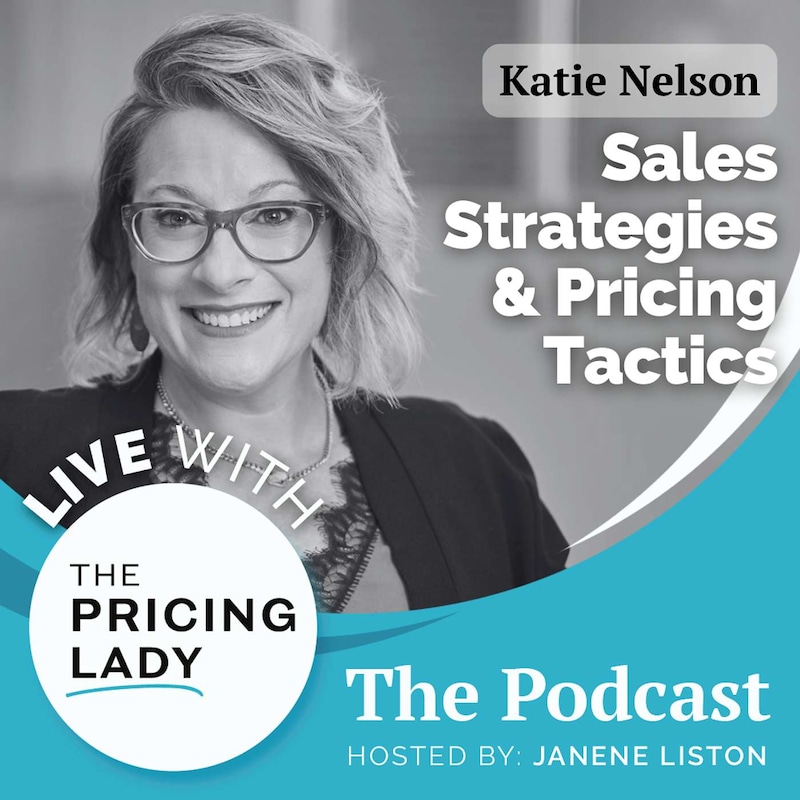
Speaker:In this episode of Live With The Pricing Lady, I sit down with
Speaker:Katie Nelson from Sales Uprising.
Speaker:Katie is a sales expert and we're gonna be talking about sales and Pricing.
Speaker:Sit back, relax, and enjoy the episode.
Speaker:Hello and welcome to Live With the Pricing Lady.
Speaker:I am Janene Liston, your hostess.
Speaker:The show is all about helping you build a more sustainably profitable
Speaker:business by understanding the tactics of strategies of pricing, and how
Speaker:to use them in your business today.
Speaker:I'm super excited to have special guests, Katie Nelson with me.
Speaker:Hi Katie.
Speaker:Hi, Janene, super excited to have you here with me today.
Speaker:Where are you joining us from?
Speaker:My office the United States, about 40 minutes outside of the capitol.
Speaker:Katie, what would you describe as your superpower?
Speaker:My superpower is creating businesses that.
Speaker:Can sell easily.
Speaker:Not like exit easily, but like the business itself has
Speaker:something to sell easily.
Speaker:Super.
Speaker:That is a very important skill for every business owner out there to have,
Speaker:but probably not even business owners.
Speaker:Just people understand how to sell themselves.
Speaker:They can probably use the same skills as well, I would guess.
Speaker:You'd have to ask them, but I would say a resounding yes to that.
Speaker:Super.
Speaker:What is one interesting thing most people don't know about you that
Speaker:you'd like to share with us today?
Speaker:That's super difficult, Janene, because most people know all things about me.
Speaker:I don't have a whole lot of hidden things.
Speaker:I ran away to get married.
Speaker:I, I called all my people Uhhuh and said, hi, you're not invited.
Speaker:I'm going to go get married.
Speaker:Bye.
Speaker:I, I don't, most people probably don't know that about me unless they're like my
Speaker:family and it was a while ago, you know?
Speaker:So interesting.
Speaker:I'm sure.
Speaker:Maybe they forgot, but I, I think that's something
Speaker:that people don't know why.
Speaker:Okay.
Speaker:Okay.
Speaker:Yeah.
Speaker:And most people wanna have the big, the big party, the big bang and whatever,
Speaker:but I can, I can appreciate that.
Speaker:Well, you know, I come from a huge family.
Speaker:Mm-hmm.
Speaker:My husband does not.
Speaker:I live my life really loudly and.
Speaker:My husband does not.
Speaker:And so I thought it would be like a nice present for him that
Speaker:it could just be the two of us.
Speaker:Yeah.
Speaker:Just low key.
Speaker:Yeah.
Speaker:Yeah, yeah.
Speaker:Well, that's lovely.
Speaker:Excellent.
Speaker:So maybe you can tell us a little bit about your business and what you do and
Speaker:the value that you bring your clients.
Speaker:Thank you for asking.
Speaker:A little bit about me is that I'm a third time business owner, so
Speaker:sales uprising is my third business.
Speaker:It will turn nine years old this year.
Speaker:So I've hit the, you know, five year mark.
Speaker:Like all of the things.
Speaker:The last business I grew, I grew to a. $6 million run rate in under three years.
Speaker:So for those of you that are out there listening, wondering if it can
Speaker:happen, it can happen can you clarify
Speaker:what you mean by run rate for those who might not be familiar with it?
Speaker:Thank you, Janene.
Speaker:Run rate is like an ongoing, this is how I would explain it as a salesperson.
Speaker:Mm-hmm.
Speaker:And what you guys will hear is that I will always say, I don't know, math or
Speaker:finance, which isn't really true, but I kind of couch everything under sales math.
Speaker:So a run rate is basically you're going throughout the year Q1, you have
Speaker:an average of sales that you've made.
Speaker:If you made that same amount of sales over the rest of the year,
Speaker:you would, that's your run rate
Speaker:uhhuh.
Speaker:Okay.
Speaker:So it's kind of like a continual projection.
Speaker:Right.
Speaker:So by the time I left the company in August, we had an like.
Speaker:By all rights and means because we had recurring revenue
Speaker:mm-hmm.
Speaker:We should hit six mill or more.
Speaker:Right.
Speaker:Right.
Speaker:Okay.
Speaker:Does that make sense?
Speaker:Yeah, yeah.
Speaker:Absolutely.
Speaker:Okay.
Speaker:You know, it's funny because when we had our original call with each other,
Speaker:we were kind of talking about some similarities between us, and I was
Speaker:typically, well, I'm not a finance guy.
Speaker:I know
Speaker:you know the number of times I've reported and worked in finance
Speaker:over the years and the number of times I've done financial plans.
Speaker:Right, but, and so, and I don't know where that comes from because the definition of
Speaker:finance can be wide and varied, and when you own a business, it's the same way.
Speaker:You know, the reason why I couch it as sales math is because that's the
Speaker:lens in which I see everything first.
Speaker:Right, right, right.
Speaker:Having been boots on the ground salesperson for 30 plus years.
Speaker:Everything is like profit first, like literally what's the profit on this
Speaker:deal and then how does it roll up?
Speaker:It, depending on how you get paid as a salesperson, you may need to
Speaker:keep your own expenses in check.
Speaker:Mm-hmm.
Speaker:Mm-hmm.
Speaker:And all of these things.
Speaker:So, which are all functions of a business also.
Speaker:Right,
Speaker:right,
Speaker:right.
Speaker:So tell us a bit more about what you do with your clients and
Speaker:the value that you can bring.
Speaker:So thank you for asking.
Speaker:You know, the value that I bring to my clients business runs on sales.
Speaker:A business doesn't exist without a sales function in it.
Speaker:Mm-hmm.
Speaker:They're kind of part and parcel, and my clients have a tendency to
Speaker:care about everything, but they're sales or revenue generation.
Speaker:Mm-hmm.
Speaker:They know that it's important, but they don't wanna be salesy.
Speaker:They don't wanna be pushy.
Speaker:These are words that I cringe when I say them because I don't identify sales
Speaker:with those functions or being at all.
Speaker:The value that I bring to business owners is like owning
Speaker:that inner salesperson, right?
Speaker:When you are a solopreneur, specifically, the CEO should be the
Speaker:number one salesperson in the business.
Speaker:Mm-hmm.
Speaker:And if we focus on selling first, everything else is affordable, which I
Speaker:think is another thing that people miss.
Speaker:And so I just kind of work with my clients to tweak their understanding of business.
Speaker:From a foundational perspective.
Speaker:Mm-hmm.
Speaker:And then sales wholly.
Speaker:Mm-hmm.
Speaker:Mm-hmm.
Speaker:I'd like to dig into that more.
Speaker:'cause I have to admit, confess I've struggled with that
Speaker:relationship of sales, you know?
Speaker:'cause I always think of this sleazy sort of seventies dude with his
Speaker:shirt and buttoned down to his.
Speaker:Satin shirt un buttoned down to his navel.
Speaker:Lots of gold chains kind of tering up to you at the, the use.
Speaker:Like, I don't know, right?
Speaker:I don't
Speaker:know if we're on video, but if you guys could see my face, I'm like, oh,
Speaker:eh, eh, that's so gross.
Speaker:Yes.
Speaker:So I mean, that's sort of the image that I have of when it, when it comes to sale.
Speaker:So, you know, why, why is that?
Speaker:Why, why do we, especially, I think women struggle with that aspect of selling
Speaker:or that vision of selling as well.
Speaker:Why?
Speaker:Why do you think that is?
Speaker:Well, why
Speaker:don't I ask you, why is that?
Speaker:Why, how can you?
Speaker:Cute as a button, right?
Speaker:Wildly professional looking woman.
Speaker:Fantastic makeup, very well dressed.
Speaker:Why do you think of yourself as a satin shirted, hairy chested?
Speaker:Oh, I don't
Speaker:think of myself that way,
Speaker:dude.
Speaker:Right?
Speaker:Like from a sales perspective.
Speaker:Right.
Speaker:I think, I think that marketing has done a great job of creating an image
Speaker:of a used car salesman in our head.
Speaker:Mm-hmm.
Speaker:Mm-hmm.
Speaker:Like just overall.
Speaker:And I, you know, what I tell people, like right off the bat is that
Speaker:pushy salespeople still make sales.
Speaker:Mm-hmm.
Speaker:They may not have you as a client.
Speaker:Mm-hmm.
Speaker:Mm-hmm.
Speaker:And but they make a living.
Speaker:Right.
Speaker:Right.
Speaker:People buy from them.
Speaker:Right.
Speaker:Now there's probably something in their personality that puts them forward a
Speaker:little bit more, because at the end of the day, a pushy salesperson may also
Speaker:just be one who's wildly confident.
Speaker:Mm-hmm.
Speaker:Mm-hmm.
Speaker:About what they do.
Speaker:Mm-hmm.
Speaker:Mm-hmm.
Speaker:So, and because it's all really perspective dependent and you're gonna get
Speaker:a different perspective for every person.
Speaker:Right.
Speaker:I do think that.
Speaker:A challenge, especially in the beginning and even throughout the entirety of a
Speaker:business, if A CEO isn't comfortable with their sales voice mm-hmm.
Speaker:It is a place where they should look to invest.
Speaker:Mm-hmm.
Speaker:Because , the success of your business.
Speaker:Rides on that.
Speaker:I was thinking about our call earlier.
Speaker:And what I mean by like the sales will always catch up with
Speaker:you is that even if you grow a business on referrals only mm-hmm.
Speaker:So even if it is so much easier for you to talk about what you do and
Speaker:the value that you bring and the testimonials that your clients have,
Speaker:and so everybody refers you business.
Speaker:Mm-hmm.
Speaker:That's wonderful.
Speaker:To the point in which your phone stops ringing.
Speaker:Right , in down times, in times where bandwidth becomes questioned, it's harder
Speaker:for somebody to pick up a phone and think about anybody other than their own,
Speaker:like p and l, the profit and loss sheet.
Speaker:Right.
Speaker:Like so you will need to know these skills anyway.
Speaker:Mm-hmm.
Speaker:If we know them upfront, then we can pass it on and we always have the ability
Speaker:to afford whatever we need to afford.
Speaker:Right.
Speaker:Right.
Speaker:Versus.
Speaker:Putting expense out there in the hopes that a sale will come our way.
Speaker:Mm-hmm.
Speaker:Yeah.
Speaker:I'm curious.
Speaker:So one of the things that I've noticed with a lot of, especially women is they
Speaker:don't see themselves as a business owner.
Speaker:I. Yeah, they just see, okay, I'm trying to make some money.
Speaker:I do this, you know, I do this cool thing, or I make this cool thing, or
Speaker:I can help people in this way and they just wanna help people, but they don't
Speaker:have like their business owner hat on or they don't see themselves in that light.
Speaker:Which I obviously affects their pricing.
Speaker:I'm guessing it also has a big impact on their ability to sell.
Speaker:Yeah.
Speaker:I would say for any woman who owns a business who doesn't understand that
Speaker:they're a business owner, well, one, I would question what is their goal, right?
Speaker:Everything is contextual.
Speaker:, if you're looking to make a hundred K and it's like just fun money for you and
Speaker:the fam, or it's to pay for a specific vacation or whatever the case is.
Speaker:Mm-hmm.
Speaker:Great.
Speaker:Go do that.
Speaker:You don't have to think like no harm, no foul.
Speaker:You don't have to.
Speaker:It's not this hardcore thing.
Speaker:If your business is created and you want to run it so that you can
Speaker:mm-hmm pay your mortgage, pay your rent, pay your car payment, pay
Speaker:your kids school, like whatever your expenses for the household are.
Speaker:Mm-hmm.
Speaker:Then considering yourself a business owner is a priority.
Speaker:Right, right.
Speaker:I think when you, when you think of yourself in that
Speaker:context, you behave differently.
Speaker:And that's where I see, you know, when.
Speaker:When clients come to me and they say, oh I don't really care about the money.
Speaker:To me that's like an indicator that, okay, you, obviously you do and
Speaker:you should, you must, if you wanna hit you the targets that you have,
Speaker:especially if they're financial targets.
Speaker:Right.
Speaker:Now I lost my train of thought.
Speaker:Well that's
Speaker:probably because of my face, right?
Speaker:Like who?
Speaker:Why?
Speaker:Why even be in business if you don't care about the money?
Speaker:There are multiple charities that would love your time, treasure, and talent.
Speaker:There are places in your own community that need the help and support.
Speaker:Mm-hmm.
Speaker:So why couch it under business?
Speaker:Like what is, what's the purpose of that business is its own function.
Speaker:Right.
Speaker:What I see is that they, they say that because they, on some level,
Speaker:they feel like they're going to be judged if they are perceived
Speaker:to be, to care about the money.
Speaker:I.
Speaker:Oh, then I would say, is that who you wanna be targeting?
Speaker:Like Right, and I get it.
Speaker:So here's the thing.
Speaker:Mm-hmm.
Speaker:I get it.
Speaker:When I first went into this space, mm-hmm.
Speaker:So I came out of professional services and staffing for small to
Speaker:mid-size government contractors.
Speaker:So businesses that had already made between five and $18 million
Speaker:that were looking to grow to 25, to 50 to a hundred million dollars.
Speaker:Mm-hmm.
Speaker:Mm-hmm.
Speaker:How business owners of that size talk about business is vastly
Speaker:different than how smaller business owners talk about business.
Speaker:And I think that smaller business owners would benefit if they talked about
Speaker:business, like bigger business owners.
Speaker:Because at the end of the day, there's another thing that you
Speaker:said that really caught my ear.
Speaker:Mm-hmm.
Speaker:Is.
Speaker:They really need to care if they wanna hit their targets.
Speaker:Well, let's start with targets.
Speaker:If you're a business owner and you don't actually have a goal for revenue
Speaker:for your business, then what is your goal and is it the right goal?
Speaker:Right, right.
Speaker:I think one of the things that we have a tendency to do, especially in the age
Speaker:of like social media and you know, all of this crazy stuff, is we conflate, we
Speaker:can take a look at Gary V. Gosh, I, I hope he hears this, or maybe I don't.
Speaker:We can take a look at Gary V. He has capital enough to create
Speaker:whatever the heck he wants and say he doesn't care about money.
Speaker:Right.
Speaker:And that's true.
Speaker:That's super true marketing for him.
Speaker:He doesn't have to care about it.
Speaker:He can, he can give wine away for free.
Speaker:Is that your instance, I guess is the question?
Speaker:If that is not your instance, right.
Speaker:Why would, would Gary V have ever said that?
Speaker:When he was starting?
Speaker:Probably
Speaker:and looking, I'm pretty sure the man's like he curses a lot, which I won't
Speaker:do on here, although I totally would.
Speaker:And he says, you know, I was on the hustle, I was grinding, I was a hundred
Speaker:percent looking to make cash like.
Speaker:That's the point of business ownership.
Speaker:You can make money a gazillion different ways.
Speaker:Right.
Speaker:They don't all have to be couched under, I own a business.
Speaker:Right.
Speaker:That is in and of itself that isn't going to get you any more
Speaker:or any less than anyone else.
Speaker:Mm-hmm.
Speaker:As a matter of fact, as a business owner, all it's gonna
Speaker:do is give you yet another job.
Speaker:So for example you have a coach, a speaker, an author, even you,
Speaker:my pricing lady friend, right?
Speaker:So in what you do, what you're an expert in, how what you sell for
Speaker:your business is one thing, and then there's the whole business.
Speaker:I think this is where people get.
Speaker:Confused.
Speaker:Especially when it's, you know, I'm a solopreneur too.
Speaker:I have a great team that works for me, but at the end of the day,
Speaker:I am the one who owns the joint.
Speaker:Mm-hmm.
Speaker:So I am a business owner and I'm a sales and business coach.
Speaker:These are two separate functions, right.
Speaker:That I as one person have to perform.
Speaker:So I do think it can get confusing the smaller you are.
Speaker:Yeah.
Speaker:Yeah.
Speaker:Yeah.
Speaker:I agree.
Speaker:I. For most solopreneurs, you kind of have to wear a lot of different hats
Speaker:and do different, different things.
Speaker:I think oftentimes,
Speaker:certainly did it myself.
Speaker:You know, we put our effort oftentimes in the wrong things.
Speaker:And the right things at the wrong time maybe is a better way to put it.
Speaker:You know, it couldn't be a combination of both.
Speaker:But I was always very appreciative.
Speaker:I was in a coaching program and they're like, 80% of what you do every week
Speaker:should be selling 80% of what you do.
Speaker:And we're not talking business cards, we're talking websites.
Speaker:We're not.
Speaker:We're not talking networking.
Speaker:We're not talking
Speaker:one-on-one, we're not talking, right?
Speaker:So whoever that like those people are speaking my language.
Speaker:At the end of the day, the most important thing you can do to keep your business
Speaker:going and keep you as the business owner or solopreneur happy and healthy is sell.
Speaker:Mm-hmm.
Speaker:Yes.
Speaker:The more, and look at it this way, you know, there's so many ways to couch
Speaker:it so that it could be seen as a hack.
Speaker:But the more you do it, the more data you get to know what is successful
Speaker:so that the more you go forward, the more successful you are at it.
Speaker:If for no other reason, the longer you put it off, like the longer you like,
Speaker:push it away or say, no, no, no, no.
Speaker:Or my marketing is gonna make it happen for me, or whatever you're saying.
Speaker:Mm-hmm.
Speaker:The f the the less time you have to be successful.
Speaker:At the end of the day, the majority of solopreneurs are bootstrapped
Speaker:businesses, meaning we pull from our own bank account mm-hmm.
Speaker:To make this thing go.
Speaker:Mm-hmm.
Speaker:If a business owner is so wildly stressed out about cash, the likelihood
Speaker:of their business succeeding goes down in direct correlation to that.
Speaker:That's when it starts to feel pushy, right?
Speaker:When you need that deal, like, Judy, I need you to buy from me.
Speaker:You know, like, I need to make my phone payment.
Speaker:Like it's that pressure.
Speaker:Yeah.
Speaker:That I think makes people feel like They would be abnormal to themselves.
Speaker:Right,
Speaker:right, right.
Speaker:So as long as we can make sure that that never happens, and how we can do
Speaker:that faster is to concentrate on the very thing, like your answer is in
Speaker:the thing and you're, it's not gonna get easier until you go through it.
Speaker:No, no.
Speaker:That's the only way through.
Speaker:So Katie, I'd like to ask you, when you first started your own business, what
Speaker:was it like for you setting prices?
Speaker:for all three of the businesses that I've started mm-hmm.
Speaker:Pricing was dependent on industry.
Speaker:Mm-hmm.
Speaker:So, for example, in my staffing spaces, we already knew what.
Speaker:Industry standard margins.
Speaker:And now for those that of you that know, don't know, margin is the
Speaker:difference between cost and price.
Speaker:Mm-hmm.
Speaker:So it's your profit margin is also a, a word for profit.
Speaker:So we already knew standard profit margins mm-hmm.
Speaker:To put on top of prices, no problem.
Speaker:Mm-hmm.
Speaker:Or the cost of a candidate.
Speaker:Right.
Speaker:When I became a coach, that was such an interesting thing.
Speaker:When I first became a coach, I fell into every single trap.
Speaker:Every single coach I've ever met has fallen into unless they had
Speaker:friends who were like, don't do it.
Speaker:For example.
Speaker:For example, I charged by the hour.
Speaker:Mm-hmm.
Speaker:The appropriate price is 250 bucks, right?
Speaker:Like, I took my salary, I wanna make my salary, plus I have some extra cost
Speaker:when it comes to my time and things.
Speaker:So that seemed about right.
Speaker:I, because I can sell, it's not like I didn't have a full practice.
Speaker:I had an absolutely full practice and then I did some sales math I'd never had to do
Speaker:before, and I times the amount of hours.
Speaker:In like a day, a week, a month, a year at $250 an hour, and figured out
Speaker:how many hours I would have to work.
Speaker:Mm-hmm.
Speaker:And do all of the other functions of my business.
Speaker:The non billable
Speaker:stuff.
Speaker:Right.
Speaker:All your non bill, all of your expense stuff.
Speaker:So any marketing, any business development, any.
Speaker:Administrative things, paying the company's bills.
Speaker:You know, every moment that I wasn't delivering, I had another
Speaker:function, and so that left business development time super, super tiny.
Speaker:It also left my paycheck and the amount of revenue my business
Speaker:could ever generate, ever.
Speaker:Right?
Speaker:Right to be wildly, wildly small.
Speaker:And so I'm like, how am I doing so great?
Speaker:I'm literally looking around to an empty room.
Speaker:How am I doing so great?
Speaker:I have this full client roster and I have it so very wrong.
Speaker:I have owned service-based businesses before, like they're just little
Speaker:interesting things about owning a business that can catch you.
Speaker:Mm-hmm.
Speaker:And what did you do?
Speaker:Oh, I hired a coach.
Speaker:I met an amazing woman who no longer does coaching.
Speaker:She's gone on to do mm-hmm.
Speaker:Strategy for B Corps, which, if you've never heard of them, I
Speaker:highly recommend looking into them.
Speaker:Mm-hmm.
Speaker:But at that time she was like, oh, well, here, this is where you're, you're wrong.
Speaker:And it was so simple after that.
Speaker:Mm-hmm.
Speaker:It all, I was like, oh my gosh, yes.
Speaker:You are so right and well, so I created packages.
Speaker:Right.
Speaker:I was like, as a solopreneur.
Speaker:Even if so, think of lawyers, poor lawyers.
Speaker:The majority of lawyers are also business development people.
Speaker:Mm-hmm.
Speaker:The, their companies don't hand them clients, they have to
Speaker:go out and get their clients.
Speaker:Mm-hmm.
Speaker:So while lawyers never think of themselves as salespeople, all they do all day long
Speaker:is sell the fact that they're lawyers, that is what they should be doing so they
Speaker:can have a full and healthy practice.
Speaker:Right.
Speaker:Right.
Speaker:If they work in a firm, it's fantastic.
Speaker:When they bring in clients, potentially they have paralegals
Speaker:and people to help them with admin.
Speaker:Mm-hmm.
Speaker:Someone else is going to bill them.
Speaker:So there are things as an employee or as a lawyer of a
Speaker:firm that they don't have to do.
Speaker:Mm-hmm.
Speaker:Selling is still one of them, however, so then, and they charge by the hour.
Speaker:Now you can say it's 500 bucks an hour.
Speaker:I don't care.
Speaker:Do the math people, it doesn't matter if you're 500 bucks an hour.
Speaker:So lawyers go out, put up their single shingle, which is awesome, go
Speaker:entrepreneurial humans of the world.
Speaker:Mm-hmm.
Speaker:And they think they have to build it like they know, knew it in
Speaker:their industry or in their firm.
Speaker:Mm-hmm.
Speaker:Yeah.
Speaker:And unfortunately.
Speaker:It doesn't pan out for them.
Speaker:Now you can talk about retainers and retainers as a package, but
Speaker:ultimately if you look at the function of a retainer, it literally is,
Speaker:it's time-based.
Speaker:It's time-based.
Speaker:Yeah.
Speaker:It is.
Speaker:So it's a really big challenge to overcome.
Speaker:Mm-hmm.
Speaker:Especially when you're like, but Katie, I'm not a coach, so how would I ever
Speaker:put together a package of something?
Speaker:Yeah.
Speaker:Right.
Speaker:That's
Speaker:possible.
Speaker:You can package a anything.
Speaker:Yes ma'am.
Speaker:Like this doesn't have any, one does one thing, doesn't have
Speaker:anything to do with the other.
Speaker:It's very frequent that you will see coaches with packages.
Speaker:You will also hear them say they do one-on-one things.
Speaker:But literally everything is packed.
Speaker:What are some
Speaker:of the, I'm curious, 'cause I, I've heard a few over my, my time.
Speaker:I'm curious, what sort of reasons have coaches given you that
Speaker:they can't create packages?
Speaker:Some of them are valid.
Speaker:Mm-hmm.
Speaker:So for example, if you're newer in business, you may just
Speaker:not have enough to package.
Speaker:Right.
Speaker:But you got at least something.
Speaker:Mm-hmm.
Speaker:So packaging that something, whether it's that spreadsheet, that assessment that
Speaker:like fill in the blank with a chunk of time is still in and of itself a package.
Speaker:Right.
Speaker:Right, right,
Speaker:right.
Speaker:We're not talking about an entire program.
Speaker:Right.
Speaker:We're talking about a package of what you've got going on now.
Speaker:Right.
Speaker:And so these will change throughout the life cycle of your business,
Speaker:depending on what you start with and where you're looking to grow.
Speaker:Right?
Speaker:Right.
Speaker:Other reasons are, so for example in the coaching sphere,
Speaker:having a group program, right?
Speaker:So one to many versus one-to-one.
Speaker:Mm-hmm.
Speaker:Provides lots and lots of time freedom in your business and saying, oh,
Speaker:but I never want to host a group.
Speaker:Mm-hmm.
Speaker:Is also a thing.
Speaker:Yeah.
Speaker:Which valid.
Speaker:If you don't like groups, you don't like groups, if you.
Speaker:I would challenge you that if you say everything is so specific
Speaker:for the target market that you help, that's gonna be a challenge.
Speaker:You know, that's when I hear
Speaker:quite often they're like, oh, I don't have a fixed process.
Speaker:I'm like, you don't have to have a fixed process.
Speaker:In order to make a package out of it you can still, you know, have a
Speaker:package price, but have the process be adaptable depending on the
Speaker:specific client and their needs.
Speaker:Yeah, so here's what I think I heard a lot.
Speaker:Oh, this is where it gets really good.
Speaker:So anytime a business owner says, it depends, you are losing money.
Speaker:It depends.
Speaker:Why does it depend?
Speaker:I would challenge anyone who's sitting here going Janene's.
Speaker:Right.
Speaker:It does depend.
Speaker:My process is different.
Speaker:I would ask you Great.
Speaker:I totally get that.
Speaker:I want you to boil it down.
Speaker:I literally want you to put all of your things in a pot, and I want
Speaker:you to boil it down like chefs do to create a really yummy sauce.
Speaker:I want you to think about across the board, regardless of what prospect
Speaker:you are talking to, what is the same?
Speaker:In your process.
Speaker:Mm-hmm.
Speaker:Because it is the things that are the same, that start to create growth,
Speaker:sustainability, and ultimately should you choose to go down that path - scalability.
Speaker:Right, right.
Speaker:Well, I also think of like, if you have a, a process that you use and
Speaker:let's say there's six steps in it.
Speaker:Within that process.
Speaker:So one client might need more time and emphasis on two, three, and
Speaker:five and less on one, four and six.
Speaker:Yeah.
Speaker:And so by describing that, there's a process there it helps clients
Speaker:to understand the value better and understand what to expect and,
Speaker:and how you help them get results.
Speaker:But it doesn't mean you have to.
Speaker:Spend the same amount of time or put the same amount of effort into every
Speaker:step if the client doesn't need it.
Speaker:What I've also found with a lot of time is that people
Speaker:say, oh, I don't need step one.
Speaker:I'm like, well, we touch on it.
Speaker:If there's nothing to do there, then we know we've checked that
Speaker:box and we've taken a look on it.
Speaker:We can move quicker to the next step.
Speaker:That's fine.
Speaker:But then we get into the conversation and we realize, wait, actually there's
Speaker:quite a bit of work that needs to be done.
Speaker:In step one, you're like step one.
Speaker:Whereas I had not.
Speaker:Put that in there, then we would've missed that completely.
Speaker:So I think that there's, you know, there's something to be said for having
Speaker:a process like a, a high level process to help you to explain to people, help them
Speaker:to understand the value, help you to be able to sell it better, price it better.
Speaker:I was gonna
Speaker:say, you're talking about a sales process, right?
Speaker:Mm-hmm.
Speaker:So ultimately, the reason why you have step one is because you as the
Speaker:expert of whatever it is, you do know that step one is like the killer.
Speaker:If you don't have step one down.
Speaker:Two through six aren't going to come together.
Speaker:It's not gonna work how often.
Speaker:So there's this portion of selling that I think people either don't understand
Speaker:quite appropriately or they miss entirely, and that's this whole educational piece.
Speaker:Mm-hmm.
Speaker:Education can be a part of your sales process and most oftentimes
Speaker:it is depending on the target market that you deal with.
Speaker:Yes.
Speaker:And what I mean, I literally just got off a call with a woman who is
Speaker:looking to go into a new target market.
Speaker:And so she is going to have to have a ton of calls so that she can understand what's
Speaker:important to this client, what like the language that this target market uses so
Speaker:that they, and she needs to know enough about their industry in relation to hers.
Speaker:To be able to educate them mm-hmm.
Speaker:On the, probably like the top three places where they're losing cash in this right.
Speaker:Exchange.
Speaker:Right.
Speaker:Right.
Speaker:So there's a lot.
Speaker:It's so often new business owners make it all about them.
Speaker:Mm-hmm.
Speaker:It's not about you boo.
Speaker:Like it's not Right.
Speaker:Like it's not about, it's never about me.
Speaker:No.
Speaker:Now, as my company grows, I need to make sure that my company gets what my
Speaker:company needs so my company can grow.
Speaker:Right.
Speaker:But it's still.
Speaker:About my client, my customer, the value and benefit to them, the
Speaker:solutions that I provide them and the education that I provide them.
Speaker:Right,
Speaker:right.
Speaker:So I'm curious.
Speaker:Step one is where you're gonna educate your people back to the step one thing.
Speaker:Step one is where you say, I totally understand, and let me
Speaker:ask you a couple of questions.
Speaker:And those are gonna be the questions where, you know, they're not gonna have
Speaker:the answers, but they're directly related to step one that you're like, okay.
Speaker:So these are the things that Step one covers for you.
Speaker:Yeah.
Speaker:Yeah.
Speaker:Exactly.
Speaker:Exactly.
Speaker:So I think in terms of, you know, feeling that you can't offer packages,
Speaker:packages are a great tool in selling.
Speaker:They're a great tool in pricing.
Speaker:They.
Speaker:They make it easier or they should make it easier on you.
Speaker:And I think that using, you're saying that, oh, you can't have
Speaker:that 'cause you don't have a fixed process is actually doing, you and
Speaker:your cus clients often a disservice.
Speaker:Yeah.
Speaker:100%.
Speaker:Like how many I, I work a lot with marketing companies.
Speaker:Mm-hmm.
Speaker:Right.
Speaker:Every single marketing company that you ever talk to ever will tell you that it's
Speaker:going to take a minimum, and that is like the bare thinnest margin of a minimum of
Speaker:90 days to get any kind of understanding as to whether or not the current marketing
Speaker:strategy you've put forward is working.
Speaker:Mm-hmm.
Speaker:Mm-hmm.
Speaker:Mm-hmm.
Speaker:And yet, how many marketing companies sell their services by the month?
Speaker:Yeah.
Speaker:I've had this conversation recently with quite a few of my own clients because
Speaker:they wanna have membership programs and then they want it to be just a month.
Speaker:And I, I don't understand if you're, you're starting the membership
Speaker:program, you want people to go through some sort of transformation.
Speaker:What is, is it realistic to think that a month is long enough for
Speaker:them to get the transformation that they're actually looking for?
Speaker:Or did what they create was something that they felt really comfortable at?
Speaker:$97. Per month selling.
Speaker:Right.
Speaker:So what they did is they backed into the price that they're comfortable
Speaker:with and then created something around it instead of actually supporting
Speaker:the customer with the end result that they're looking to provide.
Speaker:Right, right, right.
Speaker:I think it's super, super interesting.
Speaker:We could talk about this forever, all day.
Speaker:Janene, I do have another question for you, because I'd like to make sure that
Speaker:we talk about this connection between.
Speaker:Selling and pricing.
Speaker:So I'd like to understand from your perspective, what do you see
Speaker:as like the key elements or the things that people should really
Speaker:understand about this connection between the price and the selling?
Speaker:Okay.
Speaker:So you and I, when we first had a conversation and had a fantastic
Speaker:conversation about the concept of charging what you're worth.
Speaker:Mm-hmm.
Speaker:And like, what does that even mean?
Speaker:Like, I am worth a million dollars in my brains, you know?
Speaker:So the, the concept of charging what you're worth can be a complex
Speaker:one as can sales and pricing and then their relationship, right?
Speaker:So what I would say, first and foremost, I think what everybody, I'm going to
Speaker:give people permission for something.
Speaker:Exciting if it is needed, and that is you guys give yourself a break.
Speaker:Like progress, not perfection.
Speaker:First and foremost, if you are planning on being successful in selling your
Speaker:solution or your product, or your service, or however you couch it, mm-hmm.
Speaker:You have to be comfortable first and foremost.
Speaker:Period.
Speaker:So if, if what that looks like for you mm-hmm.
Speaker:Is underpricing your stuff so that you can just get practiced in your sales
Speaker:voice and saying that this is your price, then do it, but have an end date to it.
Speaker:And hold.
Speaker:That's the key.
Speaker:Yes, yes.
Speaker:The key is the key and work it, right?
Speaker:Like you don't get to say, I have a $37 per month offering at infinitum.
Speaker:Never call anybody about it.
Speaker:Never try and actually sell anybody that thing.
Speaker:Like if you are going to do that, understand that that is a
Speaker:very specific period of time for you and your business growth.
Speaker:Mm-hmm.
Speaker:And it ain't, it ain't gonna be around forever because it's not, it's not
Speaker:for, it's not gonna pay your mortgage.
Speaker:Mm-hmm.
Speaker:It's not gonna.
Speaker:Pay much.
Speaker:It's right.
Speaker:It's just there specifically.
Speaker:So that you have the ability to have the courage so that you can make the calls
Speaker:and then gain competence in what you were doing in a new skill if selling is new for
Speaker:you, so that ultimately you are confident.
Speaker:Mm-hmm.
Speaker:Mm-hmm.
Speaker:Right now I am.
Speaker:I am a little backwards.
Speaker:So for those of you out there who are like, well, Katie, I appreciate the
Speaker:per permission, but what I really need you to do is, dare me, please tell
Speaker:me you have people in your community that are like, I, I'm like a dare
Speaker:me kind of gal. Yeah, yeah, yeah.
Speaker:I'm right.
Speaker:So for those of you who need a dare, I'm gonna need, I, I'm daring you
Speaker:for 30 days to put the heaviest price on what you're offering out there.
Speaker:Mm-hmm.
Speaker:And again, it doesn't have to stay that way and be reasonable, right?
Speaker:So this is within the realm of what you have seen being sold before.
Speaker:We're looking to set you up for success, not for failure.
Speaker:So be as bold as you can be.
Speaker:I dare you.
Speaker:Be as bold as you can be.
Speaker:Be go out, make the calls, gather the data, see how much
Speaker:you sell, and then be like, oh.
Speaker:I can do
Speaker:it.
Speaker:Look at that.
Speaker:That's amazing.
Speaker:I mean, I, I'm a big believer in having some tension around your pricing, it
Speaker:being a bit of a stretch for you, and also a bit of stretch for the client.
Speaker:I. With that said, when you're starting out, of course maybe the definition
Speaker:of what that is is different than when you're further down down the line, but
Speaker:I think that that's really important because if you don't ever step outside
Speaker:your comfort zone a bit, then you never really see what's possible.
Speaker:Or the growth,
Speaker:right?
Speaker:So, or the growth uncomfortability is where growth happens.
Speaker:None of us grew anywhere because we were complacent or super comfortable,
Speaker:right?
Speaker:Which means that if you wanna own a business, get really.
Speaker:Comfortable being uncomfortable.
Speaker:Yeah.
Speaker:At times it can be a daily thing and then other times you don't see
Speaker:uncomfortable for months on end.
Speaker:Right?
Speaker:Yeah.
Speaker:Yeah.
Speaker:If, if you live long enough in your business so from a tension place, you
Speaker:and I could probably have a whole other podcast on the concept of tension for you
Speaker:and tension for your client in pricing.
Speaker:Mm-hmm.
Speaker:I find that to be a. Like a senior level class mm-hmm.
Speaker:In pricing as far as concepts go.
Speaker:It, oh, really?
Speaker:Like, that's a whole rabbit hole for me.
Speaker:Yeah.
Speaker:So thanks for that, Janene.
Speaker:At the beginning it really is, you know.
Speaker:Where this concept came from was everybody would come up to me and
Speaker:say, Katie, I need to work with you just because you love selling so much.
Speaker:Mm-hmm.
Speaker:And I just need to be as confident as you when I sell.
Speaker:And you don't, like, I've been doing this for a really long time, like 35
Speaker:years I've been selling something.
Speaker:Mm-hmm.
Speaker:And that doesn't include like when I was a campfire girl and like
Speaker:knocked door to door and sold candy or whatever, or baked goods at the,
Speaker:you know, at any given function.
Speaker:Mm-hmm.
Speaker:So.
Speaker:You know,
Speaker:was that different for you, Katie?
Speaker:If, if I remember correctly when we first spoke , when you stepped out into your
Speaker:own business you found it different.
Speaker:Oh, selling for yourself as opposed for selling for someone else.
Speaker:Yes.
Speaker:You know, when you own your business, you are so close to every piece of it that
Speaker:when you get a note, it can feel like,
Speaker:yeah,
Speaker:like clutcher pearls, people hate me.
Speaker:Mm-hmm.
Speaker:And that's not true.
Speaker:Like feelings are not facts just because Right.
Speaker:One doesn't have anything to do with the other.
Speaker:Right.
Speaker:But I absolutely did feel like I was on a completely different planet.
Speaker:Mm-hmm.
Speaker:Mm-hmm.
Speaker:Even from my other two businesses.
Speaker:Right.
Speaker:And I think that's important for people who are listening to understand.
Speaker:Also, for me, with the pricing, it's much easier to price other people's stuff than
Speaker:it is, it is my own to a certain extent.
Speaker:Of course, I, I have the tools and the know-how to be able to, when
Speaker:I, you know, when I'm find myself falling into some of the, the.
Speaker:Poor behavior.
Speaker:Yeah.
Speaker:Which happens from time to time, especially when I'm
Speaker:pushed outside my comfort zone.
Speaker:But I know the tools and the tactics and the strategies I have them there in my
Speaker:ruck sack of, or backpack of of tools and strategies and say, I know what to do.
Speaker:Yeah.
Speaker:And I'm guessing for you it's similar when it comes to selling, you have this toolkit
Speaker:of knowledge that you can rely on, but it doesn't mean that it's, you know, just
Speaker:'cause I do pricing that it's super easy for me to always do in my business either
Speaker:at 100%.
Speaker:Right.
Speaker:So this is why coaches I think, have.
Speaker:Gotten to the level that they've gotten to.
Speaker:Mm-hmm.
Speaker:Is because there really is, especially for CEOs, business owners, leaders
Speaker:of large agencies, there's a place where the rubber meets the road.
Speaker:Right.
Speaker:I am amazing at what I do for other people.
Speaker:And I have a coach, right?
Speaker:Like I work with a coach because it's never going to end.
Speaker:Mm-hmm.
Speaker:It's literally the bleeding edge between the knowing and the doing
Speaker:and the holding yourself accountable.
Speaker:And when you hold yourself accountable in a vacuum.
Speaker:Mm-hmm.
Speaker:Meaning there is no one else there.
Speaker:Right.
Speaker:Everything can get in your way.
Speaker:Right.
Speaker:Right.
Speaker:And it and it all makes sense as to why it exactly happened that way and mm-hmm.
Speaker:Why it stayed that way.
Speaker:And you know, and then, and we'll
Speaker:continue to do so if you don't Yeah.
Speaker:We'll continue to do so until you decide to
Speaker:do something different.
Speaker:Yes.
Speaker:So yes.
Speaker:Yeah.
Speaker:Okay.
Speaker:This is
Speaker:alright.
Speaker:Yes, ma'am.
Speaker:So I'd like to start wrapping this up.
Speaker:What's.
Speaker:One thing you'd like people to remember from our conversation today, what do you
Speaker:think is most the most important takeaway?
Speaker:I don't think that we talked about it yet.
Speaker:I mean, we probably went around it but didn't say it.
Speaker:Mm-hmm.
Speaker:There is no easy button for either pricing packaging or selling.
Speaker:Closest thing to an easy button is setting it.
Speaker:And going for it and having your date to move on, like that's
Speaker:the easiest part about it.
Speaker:Mm-hmm.
Speaker:Mm-hmm.
Speaker:If you need support with that, have somebody else provide you the answer.
Speaker:Mm-hmm.
Speaker:And you just be down to say yes.
Speaker:Right.
Speaker:Everything else is a learning process.
Speaker:If pricing is something that you're unfamiliar with, if selling is
Speaker:something that you're unfamiliar with, these are actual skill sets that your
Speaker:business requires to be successful.
Speaker:So you're going to have to learn them sooner or later,
Speaker:get comfy with it or make enough money to hire someone else to do it for you.
Speaker:Girl, this is what I'm trying to tell people.
Speaker:They don't listen to me.
Speaker:But if you sell, if the only thing you do in your business is sell, you can afford
Speaker:every other thing for your business.
Speaker:It's a beau.
Speaker:It's beautiful.
Speaker:You get paid, your business gets paid.
Speaker:You can hire other people.
Speaker:It's lovely.
Speaker:Yeah.
Speaker:Yeah.
Speaker:And so, you know what, to that point, can I give them like a little extra?
Speaker:Sure.
Speaker:So when we're talking about hiring and you're like, yes,
Speaker:Katie, I wanna hire a, a business.
Speaker:I wanna hire a salesperson.
Speaker:Mm-hmm.
Speaker:If you do not sell yourself, you cannot provide the answers that your
Speaker:salesperson will need to be able to sell.
Speaker:Yeah.
Speaker:So it will still bite you in the bum if
Speaker:you don't sell.
Speaker:You still have to understand the value.
Speaker:You still have to understand how to, you know, you have to.
Speaker:Have the information to provide them to be able to do their job, in a sense, right?
Speaker:A absolutely
Speaker:think about any training process or hiring process ever, right?
Speaker:Mm-hmm.
Speaker:If I, I, if I was not a business owner, I would be a very expensive salesperson,
Speaker:and so the, when getting a position, I would be asking business owners, right?
Speaker:So what's your traditional conversion rate, right?
Speaker:What is the number one reason people buy from you?
Speaker:Right?
Speaker:What are the top three reasons they don't buy from you outside of time and money?
Speaker:Mm-hmm.
Speaker:Because those aren't real.
Speaker:No.
Speaker:Those are just priorities usually.
Speaker:Yep.
Speaker:And so if, if a business owner can't answer that for me, why
Speaker:would I ever take that job?
Speaker:Yeah.
Speaker:Boy, we could have a whole nother episode just on priorities too, couldn't we?
Speaker:Okay.
Speaker:We're gonna have lots of fun to me.
Speaker:Not right now.
Speaker:Okay.
Speaker:Fair.
Speaker:Okay.
Speaker:So what is next for you and your business in terms of growth or strategy?
Speaker:Where are you headed with things?
Speaker:So growth, definitely.
Speaker:You know, right now is a time in the world that feels like it.
Speaker:Doesn't have opportunity.
Speaker:And in my experience statistically times of challenge bring wild
Speaker:opportunity for businesses.
Speaker:Mm-hmm.
Speaker:Mm-hmm.
Speaker:If you can stay focused on the business and stay outside
Speaker:of the feeling of a thing.
Speaker:Mm-hmm.
Speaker:So right now, you know, I am newly taking on consulting clients, right.
Speaker:I have larger clients that are now like, Hey Katie, so here's the deal.
Speaker:This target market, I. May or may not be there anymore.
Speaker:And I know I have this great stuff, but I have no idea what to do with it.
Speaker:Go with it.
Speaker:So they engage with me and we start a sales strategy for
Speaker:a brand new target market.
Speaker:So fun.
Speaker:Mm-hmm.
Speaker:And it takes all of this.
Speaker:You know, you have this beautiful business.
Speaker:Mm-hmm.
Speaker:You've given so much to your clients.
Speaker:My guess is other clients need it too.
Speaker:So let's take a look at everywhere you've been and how you can go
Speaker:ahead and make some money faster.
Speaker:So that's, you know, making money faster has always been what I've been about.
Speaker:Gonna stay, gonna stay about that.
Speaker:Excellent.
Speaker:So, Katie, how can people reach you if they're interested to know more?
Speaker:LinkedIn,
Speaker:Katie Nelson, the sales catalyst, Uhhuh.
Speaker:Okay.
Speaker:I say the sales catalyst 'cause Katie Nelson.
Speaker:You know, that could be anybody.
Speaker:There's lots of us I think.
Speaker:But I'm known as the sales catalyst on
Speaker:LinkedIn.
Speaker:I
Speaker:love it.
Speaker:Alright, we'll put your contact details in the show notes.
Speaker:Katie, thank you so much for joining me today.
Speaker:It's been a real pleasure.
Speaker:Janene, thanks for having me.
Speaker:I really appreciate it.
Speaker:All right everybody, thank you so much for listening today.
Speaker:It's been great being here with you.
Speaker:If you have any questions, please reach out to Katie or I we're
Speaker:happy to get you some answers.
Speaker:All the best and as always, enjoy pricing everyone.
Speaker:Thank you for listening to this episode of Live with The Pricing Lady, the podcast.
Speaker:If you enjoyed the episode, rate, review, and subscribe to it, then share
Speaker:it with your friends and colleagues.
Speaker:I love hearing back from you listeners.
Speaker:If you've got comments, questions, or topic ideas, go on over to thepricinglady.
Speaker:com and contact me there.
Speaker:Not sure where to start when it comes to improving pricing and profits?
Speaker:At ThePricingLady.
Speaker:com you can download a copy of my Self Assessment Pricing Scorecard.
Speaker:Find out where it's going well and where you can begin improving.
Speaker:Or just simply book a discovery call with me.
Speaker:There we can discuss what's up with pricing in your business and
Speaker:how I might be able to help you.
Speaker:Thanks once again for joining.
Speaker:Remember, pricing can hurt or help your business.
Speaker:Let's make sure it's helping you reach your dreams.
Speaker:See you next time and as always, enjoy pricing.