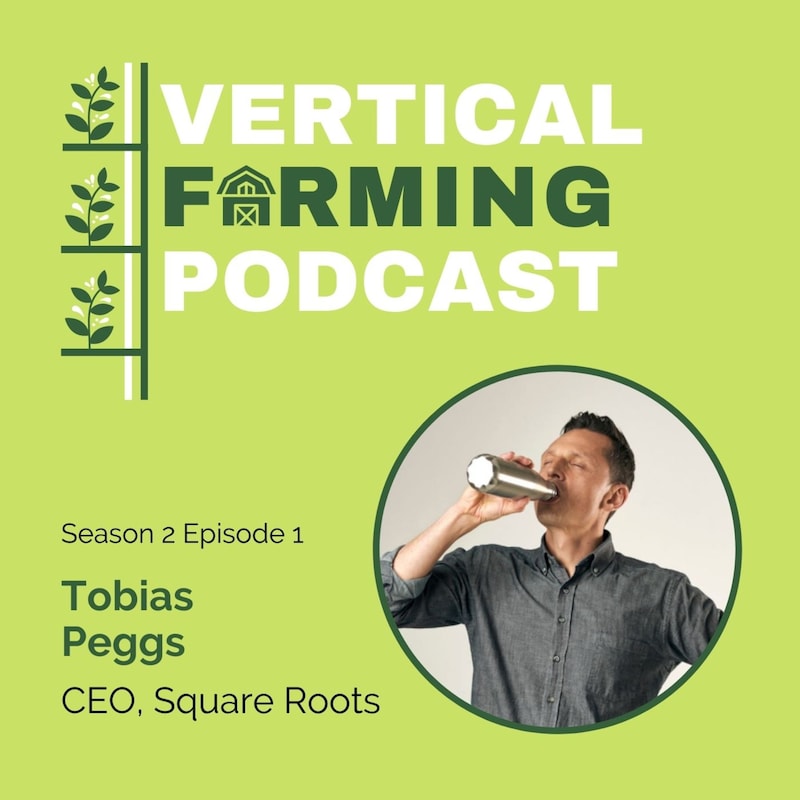
Shownotes
Join Harry Duran, host of Vertical Farming Podcast, as he welcomes to the show co-founder and CEO of Square Roots, Tobias Peggs. Square Roots is an indoor urban farming company that connects people in cities to local, real food. In this episode, Harry and Tobias discuss the growing demand for a more efficient global food system. Tobias speaks to the importance his organization places on transparency and visionary thinking as well as future initiatives he and his team are currently planning.
Special thanks to our Season 2 Sponsor
Key Takeaways
01:34 – Harry welcomes Tobias Peggs to the show to share his background as a data scientist, the genesis of his company Square Roots, and the impact Covid-19 has had on the industry
08:17 – Tobias recalls the vertical farming landscape back in 2016 when he initially launched Square Roots and how his past experience helped him to scale his business
16:24 – The value Tobias and Square Roots place on transparency and forward-thinking
22:21 – Trends Tobias has observed from the overall AgTech industry, including collaboration between organizations and the role of technology and software
32:18 – The evolution of Square Roots’ Farmer Training program
36:52 – How Tobias has grown personally and professionally during his tenure at Square Roots and mentors who have influenced him throughout his career
43:38 – Tobias speaks to the differences in how Americans and Europeans receive and consume their food
47:27 – What is something Tobias has changed his mind about recently and a tough question Tobias has had to ask himself recently
50:33 – What excites Tobias most about the future of vertical farming and where listeners can learn more about Square Roots
Tweetables:
Links Mentioned:
Ceres Greenhouse Solutions
Website | Facebok | Pinterest | Instagram | YouTube
See omnystudio.com/listener for privacy information.
Mentioned in this episode:
2025 Precision Ag Report by iGrowNews
2025 Precision Ag Report by iGrowNews
Transcripts
$680 million poured into precision ag last year.
Speaker:Autonomous weeding robots dominated, and John Deere made 2 acquisitions in 3
Speaker:months. A food company, not an equipment maker, bought a
Speaker:robotics startup to protect its own supply chain. The deals are
Speaker:accelerating, the money is moving, and the winners are already separating from the
Speaker:pack. If you're investing, building, or buying in this space,
Speaker:you need the full picture before your competitors get it. The 2025
Speaker:Precision Agriculture Intelligence Report from iGrow News is now
Speaker:available. Get your copy today at
Speaker:igrownews.com/precision. The average age of
Speaker:a farmer in the US is 58. The average age of a farmer in
Speaker:countries like Japan is 68. You've got this demographic time
Speaker:bomb that is about to detonate on the food system, which is,
Speaker:you know, when these people retire, like, who the hell is going to grow all
Speaker:the food, right? We need to find pathways for young
Speaker:people to enter the agriculture industry. And that was
Speaker:what we decided to kind of tackle
Speaker:Welcome to the Vertical Farming Podcast, weekly conversations
Speaker:with fascinating CEOs, founders, and agtech
Speaker:visionaries. Join us every week as we dive deep into the
Speaker:world of vertical farming with your host, How are you doing?
Speaker:Vertical Farming Podcast, welcome back. Season 2, episode 1.
Speaker:If you are new to the show, I highly recommend checking out all the season
Speaker:1 episodes. We've had some great conversations with fantastic
Speaker:founders and CEOs. And now for season 2, we
Speaker:are taking this to the next level. I didn't think it could get any better,
Speaker:but it did, and it will. As a bit of a sneak peek, we have
Speaker:conversations coming up with leaders from Bowery Farms, Plenty, Unfold,
Speaker:and much more. I couldn't be more excited to announce
Speaker:our partnership with Ceres as a sponsor for this
Speaker:episode and several of our episodes this season.
Speaker:Ceres combines smart greenhouse design with customized climate
Speaker:control technology to build sustainable grow environments for year-round
Speaker:protection. They work with their customers and clients every step of the way,
Speaker:from helping to secure funding to providing growing data. Whether you're
Speaker:a commercial entrepreneur, an educator, or someone looking for a rewarding
Speaker:hobby, visit ceresgreenhousesolutions.com and that's That's
Speaker:spelled out C-E-R-E-S
Speaker:greenhouse-solutions.com, and get started today on your
Speaker:greenhouse goals. To kick things off in grand style, this week's
Speaker:conversation is with none other than Tobias Pegg,
Speaker:CEO of Square Roots. For those unfamiliar with
Speaker:Square Roots, it's an indoor urban farming company that connects people in
Speaker:cities to local, real food. And in this episode,
Speaker:Tobias and I discuss the growing demand for a more efficient global food system,
Speaker:and he speaks to the importance his organization places on transparency and
Speaker:visionary thinking, as well as future initiatives he and his team are currently
Speaker:planning. Tobias takes us back to the vertical farming landscape in
Speaker:2016 when he initially launched Square Roots and
Speaker:talks about how his past experience has helped him scale this one. We learn
Speaker:about the value Tobias and the team place on transparency and forward
Speaker:thinking and the trends he's observed from the overall agtech industry, as
Speaker:well as the collaboration between organizations and the role of
Speaker:technology and software. We learn about Square Roots farmer training
Speaker:program and how Tobias has grown personally and professionally during his
Speaker:tenure at Square Roots. Couldn't think of a better way to kick off season
Speaker:2. I'm so excited to share this episode with you guys. If you have
Speaker:enjoyed this episode or past episodes, I'd love it if you leave a rating and
Speaker:a review at ratethispodcast.com/vfp.
Speaker:That's VFP for Vertical Farming Podcast. I'll make sure to read out those
Speaker:reviews on future episodes. So let's kick off season 2 with
Speaker:Tobias. So Tobias Pegge, co-founder and CEO of Square Roots, thank you
Speaker:for joining us on the Vertical Farming Podcast.
Speaker:Super happy to be here, thank you. So Tobias, just to date stamp where we're
Speaker:at, it's first week of October 2020, what many people
Speaker:would probably say is one of the strangest years on record
Speaker:so far. And just when you think things can't get any
Speaker:crazier, all you have to do is check your newsfeed. So I'm just wondering
Speaker:how the year's been for you, if there's a couple of words you could use
Speaker:to summarize what you've what you've been experiencing as a business
Speaker:owner and personally, what comes to mind?
Speaker:Intense. But also I think
Speaker:at the beginning of COVID
Speaker:if you look at it purely from the perspective of vertical farming or
Speaker:indoor farming or food systems, right at
Speaker:the beginning of COVID there was a very
Speaker:big affirmation that what we're doing, what everybody in the industry is
Speaker:doing is the right thing. On the one hand, we had
Speaker:supermarket shelves that were just empty. You couldn't even find
Speaker:staples to eat. And on the other hand,
Speaker:you just read stories every day of mountains
Speaker:of food being left in industrial fields to rot because those farmers
Speaker:couldn't get farmers safely to those fields to get the food out. I
Speaker:mean, it just really shone a spotlight on how fragile
Speaker:that industrial food system is. Not only is it terrible for the planet,
Speaker:in terms of pesticides and runoff and the impact of
Speaker:transport and the litany of issues
Speaker:goes on and on and on, greenhouse gases and all that stuff. But at the
Speaker:end of the day, it also turns out it's not a particularly resilient
Speaker:system. It's not guaranteed to get food on your plate in
Speaker:instances like this. And
Speaker:so I think what we're all doing here, building the
Speaker:infrastructure and the business models and the teams to enable
Speaker:a distributed farming solution that is
Speaker:able to provide quality local grown food,
Speaker:you know, very consistently in a very resilient way.
Speaker:Like, it became very obvious quite early that the
Speaker:world really needs this, and that has acted as
Speaker:a very kind of galvanizing and
Speaker:energizing focus through
Speaker:what, to your point, has been the
Speaker:craziest year any of us could ever
Speaker:possibly imagine. When did this vertical
Speaker:farming, indoor agtech, this idea of getting the
Speaker:food sourced locally to where people need
Speaker:it, when did these ideas appear on your radar,
Speaker:if you can think back? On my personal radar? Yeah. On your personal radar.
Speaker:Yeah. So I had an
Speaker:early social media analytics company. My
Speaker:background's tech. I'm an AI PhD and I sort of spent
Speaker:a bunch of my early career in Silicon Valley and had this early
Speaker:social media analytics company that was acquired by Walmart, of all people.
Speaker:And as part of those deal terms,
Speaker:I went to work at Walmart for 12 months. And to cut a long
Speaker:story short, while I was inside Walmart, I studied—
Speaker:one of the projects that I did was to study global grocery buying behaviors.
Speaker:And I sort of came at it from a data science perspective, which is my
Speaker:background. But really what I ended up seeing was this map of
Speaker:the global food system with millions of people
Speaker:around the world buying food from around the world, which then
Speaker:required a lot of shipping. And I just saw a map of
Speaker:like food flying all over the planet. And I thought, this is insane. There's got
Speaker:to be a better way to do this. And you dig in and as I
Speaker:said, the impact of that transport is horrific, but also
Speaker:the quality of the food at the end of that chain. If the food has
Speaker:been traveling for a number of weeks, then the nutrients are breaking down and the
Speaker:quality of food isn't so good at the end of it. So there are a
Speaker:bunch of problems there. And I started looking at it and thinking, okay, well,
Speaker:everyone's got to be eating locally grown seasonal food. And then It's like,
Speaker:well, okay, it's hard to change that
Speaker:mass consumer behavior. People want food from all over the
Speaker:world all year round. So is there a better way to do that?
Speaker:And instead of shipping food from one part of the world
Speaker:to the other, can you ship climate data from one part of the
Speaker:world to the other and basically recreate climates from all around the
Speaker:world, but do that local to the end consumer? And then you can
Speaker:grow food from all around the world, but now you're doing it in the same
Speaker:zip code as where they live, right? And now all of a sudden, you can
Speaker:take out the impact of transport, you can get food to the end consumer the
Speaker:same day of harvest rather than 2 or 3 weeks after it's harvested.
Speaker:So the quality of food is better. And that was kind of the aha moment
Speaker:for me. I had been working with a guy called Kimbal
Speaker:Musk on some technology projects up until that
Speaker:point in parallel. He had also gone very deep in the food world.
Speaker:And I picked up the phone to him and started talking about this idea.
Speaker:And he was like, well, okay, there's a missing element in what you're saying
Speaker:here, which is who's going to grow the food? Mm-hmm. They're like, food is—
Speaker:plants are not just widgets, right? They don't just grow on demand. You need a
Speaker:person in there willing these plants to come to life. And he was sort of
Speaker:explaining to me that it's the farmer that's at the center of the system that
Speaker:gives the love to the food that makes it taste so good.
Speaker:And you start thinking then about, okay, well, eventually with a
Speaker:company like Square Roots, we'll need millions of farmers. How do we hire those people?
Speaker:And then you find out they don't exist. The
Speaker:average age of a farmer in the US is 58. The average age of
Speaker:a farmer in countries like Japan is 68.
Speaker:You've got this demographic time bomb that is about to detonate on
Speaker:the food system, which is When these people retire,
Speaker:who the hell is going to grow all the food? We need to find
Speaker:pathways for young people to enter the
Speaker:agriculture industry. And that was what we decided to
Speaker:tackle first at Square Roots. How do we create a pathway,
Speaker:create a program that makes it really exciting and
Speaker:compelling for a young person to say, you know what, I'm actually going to grow
Speaker:up and be a farmer. This is going to be awesome. And, uh,
Speaker:that was, that was kind of the genesis of Square Roots.
Speaker:So as you started entering the space, you know, this is— we're talking now
Speaker:about 2016. What did— if you could paint a
Speaker:picture for folks, because I think people that are just getting into vertical farming, indoor
Speaker:agtech, you know, they see, they just see the, the, the money coming in,
Speaker:the investments, how the industry is growing. But can you
Speaker:wind the clock back a little bit and talk about what What was the landscape
Speaker:like in 2016 as you were getting off the ground? Yeah, that's
Speaker:a really good question, actually. So I remember putting the
Speaker:first pitch deck together and talking to an investor.
Speaker:And Square Roots, for those people who don't know, we have a modular
Speaker:architecture system. So we've got farms that are built inside refurbished
Speaker:shipping containers. People will be somewhat familiar with that model. But
Speaker:I remember saying to an investor, okay, we're going to take a young person with
Speaker:no experience of growing plants, and put them in a metal box right in
Speaker:the middle of Brooklyn, and they're going to grow the best food you've ever tasted.
Speaker:And people thought we were absolutely insane.
Speaker:Absolutely insane. And I probably talked
Speaker:to like 200 people to pull the seed round together.
Speaker:Wow. And we got it off the ground, right? And the first thing that we
Speaker:had to prove was that we can actually take a young person with no
Speaker:experience and get them up to speed very quickly to grow food.
Speaker:You know, we figured that out. Once we had done that, we sort of started
Speaker:investing in a bunch of, you know, technology,
Speaker:hardware, software, et cetera, to really sort of, you know, scale
Speaker:things up, commercialize it, figure out different business models.
Speaker:You know, how would we sell this food at, you know, the right price
Speaker:to what customer? That led us to do deals with companies like
Speaker:Gordon Foodservice, who are the 4th or 5th biggest food distributor
Speaker:in the country. We now sell to grocery retail stores like
Speaker:Whole Foods and in the Midwest, Spartan Nash and Meijer and Fresh Thyme, you know,
Speaker:big, big regional chains, you know, but sort of every
Speaker:step along the way, there's been a different, a different challenge, right? But
Speaker:to answer your question right at the beginning, the challenge
Speaker:was trying to convince people that we weren't crazy.
Speaker:And so as you start as the CEO, As you start
Speaker:to think about how— what's the right team that can
Speaker:move this vision forward? What's the right team? How fast do you scale?
Speaker:What experience, or how did your past experience that, you know, you've done some work
Speaker:in AI, you've worked at Adobe, you were CEO at Aviary—
Speaker:did some of those experiences in terms of how you build a team and how
Speaker:quickly you build a team color your thought process, you know, as you're starting to
Speaker:scale? Yeah, it's a good question, actually.
Speaker:So I think most of the stuff I did before Square Roots was software,
Speaker:where you can scale very quickly. There's
Speaker:incremental cost to scale. And that's the beauty of software
Speaker:from an investor perspective. And sort of dropping into the
Speaker:food world was to rewire my brain
Speaker:completely. In software, you can have an idea
Speaker:in the morning and it's in the market in the afternoon being used by millions
Speaker:of people. Yeah. In indoor farming, you can have an
Speaker:idea, what if I change the climate? What will happen? Well, sit around for
Speaker:6 weeks and you might find out. It's like a completely
Speaker:different timescale here. And
Speaker:then of course, just delivering a software
Speaker:service to a consumer is an entirely different
Speaker:universe with entirely different unit economics
Speaker:than getting a physical good from seed
Speaker:to shelf. Oh, and by the way, that's perishable. So if you don't look after
Speaker:it at every single step of the way, it's destroyed.
Speaker:Massively different. So I think there are certain things that I think have been
Speaker:an advantage, the Silicon Valley cliché of
Speaker:move fast and break things. And we have pushed and pushed
Speaker:and pushed at a hell of a pace at Square Roots, and I'm extremely
Speaker:proud of the way we've done that, got
Speaker:to a really good place in a very short period of time. But frankly, I
Speaker:think there were probably disadvantages in the way my brain was wired as a
Speaker:software guy, and I just didn't know what I should have known
Speaker:about food. So I probably had to get educated
Speaker:on the job, which might not have been ideal.
Speaker:Kimbal running a restaurant company,
Speaker:he knows, right? Unless there's a good GM, and a fantastic
Speaker:chef, you don't have a restaurant company, right? So we were
Speaker:able to make sure that we hired, you know, great operators and fantastic
Speaker:farmers on day one, right? There's the analogy. So, um, Yeah.
Speaker:You know, when I didn't know what I was doing,
Speaker:I have people around, you know, me who did,
Speaker:mercifully. Uh, yeah, I mean, it's been fun. It's easily been
Speaker:the most fun I've I've ever had. Easily the most fun
Speaker:product. You know, the other wonderful thing is when you're stressed in a software company,
Speaker:you stay stressed. When you're stressed in a farming company, you just go wander around
Speaker:the farm for half an hour and look at some flowers. You go pick the
Speaker:lettuce. Oh, it's so nice. Yeah. You can see
Speaker:the fruits, the literal fruits of your labor and the fruits. It's so—
Speaker:it's the fact that you can touch it is something probably different
Speaker:than to your point, speaking from software as well. Yeah, I think that's right. I
Speaker:think the other thing as well, you know, this is probably unique to our model.
Speaker:You know, we think about ourselves as growing food, but like growing people, right? Growing
Speaker:the next generation of leaders in the industry, you know, and you see,
Speaker:you know, a young person coming with no experience, you know,
Speaker:maybe in a, you know, not such a privileged background,
Speaker:you know, and they want to change the food system, right? They share
Speaker:that mission with you and they got that passion and they lean
Speaker:in and learn and they work hard. And then
Speaker:2, 3 years later, they're the farm manager at the
Speaker:new farm that you're opening on the other side of the country. That is
Speaker:amazing. I love seeing that. So yeah, I feel
Speaker:very, very fortunate to be in my current position for sure.
Speaker:How did it feel the moment you stepped into
Speaker:your first fully functional unit There's something
Speaker:where someone can paint a vision of this is what it's like, this is what
Speaker:we want it to be, this is the experience you want it to have, this
Speaker:is the look and feel. And that's different than when you're actually in one,
Speaker:you're seeing it functioning, you're seeing it producing a harvest.
Speaker:Well, and you're smelling. What is that like? And you're smelling. You walk
Speaker:into a beautifully farmed zone with, again, this farmer
Speaker:that's put all the love in it. Oh my God, it smells amazing.
Speaker:Yeah, no, I completely agree with you. Um, you know, on the—
Speaker:you know, we have a really, you know,
Speaker:fantastic, efficient sales and marketing
Speaker:team right now. And, um, you know, one of the things that I—
Speaker:you know, they're running rings around me now. In the early days when I was
Speaker:trying to bring them up to speed with this new thing, I was saying, listen,
Speaker:Square Roots is a business where you show, don't tell. Right.
Speaker:You can get on the phone and talk until the cows come home about what
Speaker:we're doing, right? But bring someone to the farm, have them look
Speaker:at what we're doing, have them talk to a farmer, have them
Speaker:feel that energy and that love and then taste that food and
Speaker:the sell is done. Yeah, it's a very
Speaker:tangible experience that we're producing here for sure.
Speaker:And then we play that further forward, right? Yeah. sort
Speaker:of more regular marketing events that we do is a
Speaker:very community-focused farm tour event, right, where we
Speaker:literally throw open the doors every 2 weeks. Yeah. This is
Speaker:pre-COVID. When we built the farms, we put floor-to-ceiling
Speaker:windows in them, right? So we kind of like, you know, open the door and
Speaker:then you can like look through the window and,
Speaker:um, you know, see, see what's going on,
Speaker:right? And, and I love doing those farm tours both in
Speaker:Brooklyn and in Grand Rapids where we've got another farm. And, you know, that
Speaker:minute where you kind of swing the doors open on the farm and people see
Speaker:the pink lights and the magic, and, you know, it's a, it's a really
Speaker:wonderful experience. That's a beautiful segue. Uh,
Speaker:when you talk about the, uh, the floor-to-ceiling windows, it's this idea of
Speaker:transparency, right? And one of the things that's touted on the site is the
Speaker:obviously high standards with everything you do and, you know, educating
Speaker:people that vertical farms, free of pesticides, free of GMOs, but
Speaker:also the important thing that's, and it's something that you make a point highlighting Is
Speaker:this idea of tracking the food from seed
Speaker:to store. And why is that important? Yeah. I
Speaker:mean, I think we're the only company out there that can offer
Speaker:every consumer on every single package a complete
Speaker:story of where that food has come from, from seed to shelf. Every
Speaker:step in the process, every farmer that touched it along the way,
Speaker:photos of what the food looked like when it was being harvested yesterday, even down
Speaker:to which of our battery-powered tricycles took this
Speaker:to the store that you're in right now. We've got the whole thing, and
Speaker:you were able to get that data thanks to the operating system
Speaker:that we built at Square Roots, the software system, the Square Roots Farmer Tool Belt.
Speaker:Yeah. Which is, you know, I guess you were talking earlier about where some of
Speaker:my software, you know, my background, how has that helped with Square Roots, right? I
Speaker:think we have got a world-class software team here, and that is
Speaker:incredible. Yeah, this idea, you nailed it, right? The whole idea was
Speaker:The consumer wants transparency in the food system. Where does my
Speaker:food come from? Who grew it? You know, what techniques are being used?
Speaker:And so, yeah, like the original idea was to have a completely
Speaker:see-through farm, right? So that anybody could, you know, anyone
Speaker:walking through the neighborhood could have that question answered for them, like
Speaker:immediately. And that also sort of influences where we put the
Speaker:farms as well, right? So we put the farms right in the middle of the
Speaker:city. It's not the cheapest rent. Yeah. But in
Speaker:New York, for example, again, pre-COVID, like 8 million people
Speaker:could just jump on the subway and come see the farm. The
Speaker:idea is to be completely transparent. And if you
Speaker:can't get to the farm, then at least at the retail shelf, you can scan
Speaker:the package with your mobile phone, and that pops
Speaker:open a mobile webpage with all of that information from seed to shelf.
Speaker:So it gives that retail consumer this connection with
Speaker:the people that were involved in growing that food and getting it to the store.
Speaker:One of the things that's apparent to me when I'm in a
Speaker:supermarket or when I'm in a grocery store is the amount of plastic
Speaker:that's used in the delivery of leafy greens, for
Speaker:example. And I'm wondering how you think about that. There's
Speaker:certain challenges of where the market is now, but are you
Speaker:forward-thinking in terms of how much you know, companies like Square
Speaker:Roots can actually help come up with a solution that could be
Speaker:better for the environment? Yeah, it is a great question. Right.
Speaker:So some days I come to work and I'm like, my, we've done so
Speaker:much in a short period of time. This is awesome. And then some days I
Speaker:come to work and think, oh, we've still got so much to do. And, you
Speaker:know, one of the things that will make me think like that is when I
Speaker:look at plastic packaging, right? It's like, come on. Yeah. Can we
Speaker:not solve this? But, you know, to your point, very, very, very
Speaker:difficult and expensive challenge.
Speaker:I'm pretty excited actually by some of the stuff I'm seeing in
Speaker:the paper industry, you know, where you're getting paper
Speaker:coated with, you know, sort of
Speaker:molecular level vegetable extract, right, which then
Speaker:turns that paper see-through, but it's also impermeable to oxygen. And there's
Speaker:like potential there to use that as packaging in a way that, you know, we'll
Speaker:make sure there's still a barrier so the food remains fresh,
Speaker:which again is important because, you know, if you solve
Speaker:plastic packaging by not using it, but massively increase food
Speaker:waste because you've got no way to, you know, keep that food fresh for a
Speaker:couple of weeks, you know, you're kind of robbing Peter to
Speaker:pay Paul there. That might be an English expression. I don't know what the American
Speaker:translation would be, but yeah. Okay. Yeah. We use that. We use that as well.
Speaker:Yeah. Yeah, it's a very, very
Speaker:difficult problem to solve. And then frankly, I
Speaker:think it gets solved with purchasing power.
Speaker:And so you look at a company, I'm very, very, very proud of everything that
Speaker:we're doing at Square Roots. And we're 60 people now up from 15,
Speaker:12 months ago. And this is great. We're tiny as far as the
Speaker:wider food system is concerned. And you had the experience
Speaker:of working at Walmart to have the
Speaker:Both sides of the spectrum in terms of what you can do at scale.
Speaker:Well, totally. And so that's kind of where I was going. I saw at
Speaker:scale when Walmart said, okay, we're going to get
Speaker:serious about sustainability. How can we do that at
Speaker:scale? And as an employee in the company,
Speaker:there are no trash bins in the offices. You take your trash home.
Speaker:That's the way that it gets recycled. When you print something
Speaker:out, on a piece of paper, it's always double-sided, you know, and these
Speaker:things might seem really small, right? But when you've got 2 million
Speaker:employees doing this stuff, like, it adds up, not to mention everyone on their
Speaker:supply chain. Yeah. Who's held to those same standards, right? So yeah, I've
Speaker:seen how you can impact, you know, positively impact things at
Speaker:huge scale. You know, I kind of won't reveal too much there, right?
Speaker:But that's one of the many advantages that I think
Speaker:we've got with this you know, very deep relationship with Gordon
Speaker:Foodservice, you know, is that they are a, you know,
Speaker:multi-billion-dollar food company. They're a big player
Speaker:and they can have different types of conversations than we can,
Speaker:right? Yeah. So yeah, you know, I feel like I'm answering this rather like
Speaker:a presidential candidate or a VP candidate by not
Speaker:really answering the question in a debate. But yeah, I mean, we've got to figure
Speaker:it out. It'll be an industry-wide thing. I'm seeing some really
Speaker:cool technology emerging. And, you know, have
Speaker:faith, I guess, right? Yeah, so that's interesting. You mentioned the industry
Speaker:on a whole. How have you seen
Speaker:all the players in the space? And you have folks that you would consider
Speaker:competitors or doing something similar to what Square Roots is doing.
Speaker:And then people focusing on lighting. And we had a couple of great
Speaker:conversations with David Farquhar of IGS in terms of all the different moving
Speaker:parts and what you're able to control within this environment.
Speaker:There's so many people doing so many interesting things. What have you seen
Speaker:from an ecosystem as all these players
Speaker:start to talk to each other? You know, I would imagine you run into each
Speaker:other at conferences when there were those as well. What's the
Speaker:relationship between, you know, these companies, and do you find that you
Speaker:look for opportunities to engage or partner or collaborate at
Speaker:some level? Yeah, mostly it's really good. And
Speaker:there are probably lots of parallels with the sort of green energy
Speaker:or alternative energy industry. We are all in it to
Speaker:solve a massive problem for the planet and for people. Everyone
Speaker:who's in it is kind of mission-driven to a certain extent.
Speaker:Values tend to be somewhat aligned and that really helps.
Speaker:I think everyone also recognizes we're in very early innings here, right?
Speaker:You know, I started my career in the mid-'90s building,
Speaker:you know, websites, internet stuff, you know, Internet 1.0.
Speaker:And, you know, I remember kind of the meetups that used to happen there. I
Speaker:was in London. You'd go to like the First Tuesday Club or whatever it was
Speaker:where, you know, all the internet entrepreneurs were there. Yeah. And,
Speaker:you know, everybody knew that this thing was
Speaker:inevitable, but no one could quite yet
Speaker:articulate what shape it would take. You know, Facebook was still 10 years
Speaker:away. Twitter was still 10 years away. You know, yeah. And as a consequence, everyone
Speaker:just wanted to make it work and bring it to as many people as possible,
Speaker:right? And there was lots of sharing of ideas and people offering to
Speaker:help each other out. It was really, really beautiful. I'll use that word. And, and
Speaker:I think indoor farming right now feels quite like that, actually.
Speaker:It feels like the mid-'90s internet, right? Again,
Speaker:it's, you know, it's inevitable, and COVID has probably accelerated
Speaker:that. Yeah. You know, what's the— you know, there are certain kind of
Speaker:formats emerging now, are kind of, you know, very scalable, capital-efficient models.
Speaker:modular approach. Obviously there's a lot of great work going on with the plant
Speaker:factory formats, Bowery and, you know, those guys.
Speaker:You know, frankly, some greenhouse growers are just like execution machines right
Speaker:now. Like, I'm watching Gotham Greens march across the country, like, hats off to those
Speaker:guys. Oh yeah. You know, but as an, as an example of that,
Speaker:you know, like Irvin at Bowery, you know, there's a guy I can pick up
Speaker:the phone to and we talk about what's going on, right? Uh, Viraj at Gotham
Speaker:Greens, was so helpful to
Speaker:us in the early days and so generous
Speaker:with his time. And, you know, I've always been very inspired
Speaker:by their story and their brand and, you know, the whole thing. And I think,
Speaker:you know, it's very illustrative of quite a
Speaker:collaborative environment. Of course, you know,
Speaker:there are a couple of players who, you know, protective of their IP or
Speaker:whatever and don't want to play nice, but In the main, yeah, it's a
Speaker:really— oh, nice is a word that I tend
Speaker:to steer away from, but I would say this is a really nice space
Speaker:to be in, actually. Collegial, maybe. Yeah, that's a much better
Speaker:word. Well, it's interesting, your background coming from software,
Speaker:because what's worked there is this idea of
Speaker:open source Linux, these projects where everyone— there's a
Speaker:collaborative effort for people getting together for the greater good. And
Speaker:you alluded to it a little bit, but I don't know if there's something like
Speaker:that that exists now within indoor agtech vertical farming, or if that's probably
Speaker:still a ways off, but I think there's some benefit from that sort
Speaker:of open source. Yeah, to my knowledge, I don't think it's
Speaker:as formalized as that. I
Speaker:think the kind of Open Ag thing at MIT,
Speaker:they were talking about that, right? It never happened. And then obviously
Speaker:that whole program was discredited anyway. Yeah, I mean, there's lots of
Speaker:collaboration. If I think about universities, right, which is, you
Speaker:know, sometimes where some of that effort springs from, you know,
Speaker:we talk, you know, as much with
Speaker:Cornell and sort of what's going on in Michigan as we do with
Speaker:Wageningen in Holland. So yeah,
Speaker:I mean, I would say there is a lot of informal
Speaker:sharing right now. Yeah, maybe, you know, maybe someone
Speaker:does need to kind of formalize you know, an
Speaker:open indoor ag initiative. I, I don't know.
Speaker:Being a child of the '80s myself, I'd be remiss if I didn't ask you
Speaker:what your first computer was. A
Speaker:ZX Spectrum 128K. I don't know
Speaker:if that was a US thing, uh,
Speaker:the inventor of that, Sir Clive Sinclair, very British guy.
Speaker:Okay. It was about kind of 8 inches wide, nice
Speaker:rubber keys. Yeah, I learned to program BASIC on that
Speaker:thing. Yep. I had a Texas Instruments
Speaker:with a cassette deck as the— Yeah, exactly.
Speaker:Yeah, that's, that's the only way you
Speaker:capture information. Yeah, and then when the cassette kind of warped, it wouldn't load the
Speaker:software properly. And, you know, on a hot day, you might, you might
Speaker:struggle to load whatever, you know, game you wanted to play or whatever.
Speaker:Yeah, those are the days. We've come a ways since then.
Speaker:But I think on our hardware team, the sort of brains
Speaker:of the farm, we actually call it the farm brain, sort of where everything plugs
Speaker:into. And I'm looking at that, it's like a supercomputer, right?
Speaker:Versus my little ZX Spectrum. It's remarkable.
Speaker:Well, to that point, one of the benefits of as you
Speaker:bring more of these online is the fact that they're all cloud connected. And I'm
Speaker:wondering what you're able to see and learn learn
Speaker:and improve on as a result of having this
Speaker:information in the cloud? You mentioned working with data scientists, and that becomes a
Speaker:very important job function when you need to crunch this much data.
Speaker:Yeah, completely. So again, at the software layer that we've built, the
Speaker:operating system for the company, the Square Roots Farmer Toolbelt, we call it,
Speaker:and there are kind of 3 elements to it, right? The first is instruction. So
Speaker:if you're a farmer, you might open the app,
Speaker:version of the farmer tool belt. And, you know, the app is going to be
Speaker:context aware, right? It's going to— okay, you're Farmer Harry, you're on farm number 3
Speaker:in Brooklyn, today is basil harvest day, here are the 10 things that you've got
Speaker:to do. And it will kind of guide you through that and then prompt
Speaker:you to capture data as you're going through that workflow, right? In
Speaker:parallel to that, data is being captured ambiently through that workflow and that
Speaker:process, right? Well, how long did that process take, right? What happened here?
Speaker:The second part of it then is, you know, is that
Speaker:sort of additional data capture. So,
Speaker:you know, ambiently, we're capturing climate data, you know, nutrient
Speaker:data, light, you know, spectrum intensity, you know, the
Speaker:million and one different sort of environmental things that are there.
Speaker:And then at the end of every harvest, the system is then able to say,
Speaker:okay, well, what happened in the climate? Mm-hmm. and
Speaker:what happened in terms of farmer workflow and how long did
Speaker:things change for this particular harvest and what happened in this harvest? Was the
Speaker:yield above what we thought or below what we thought or, you know, et
Speaker:cetera, et cetera? And so the system then is able to, you
Speaker:know, determine insights, which we're then able to push back out across
Speaker:the network so that everybody gets to benefit from it, right? And that
Speaker:might be, oh, it turns out If the temperature is
Speaker:0.001 degrees warmer than what you're doing,
Speaker:that actually helps. Or it could be, huh,
Speaker:Farmer Harry's actually developed a completely new way to
Speaker:get the basil off the rack. And here are the photos of Farmer Harry doing
Speaker:it. And oh my God, it used to take 20 minutes and now it takes
Speaker:18. And if everybody is following that instruction,
Speaker:boom, that adds up, right? So the whole system is kind of learning very, very
Speaker:rapidly. Interesting. Whether it's workflow, or
Speaker:environment, climate. So yeah, there's
Speaker:lots of rapid learning cycles going on, actually.
Speaker:Yeah, as the AI guy, I get super geeked out about that for sure.
Speaker:And is there a community that you've built in, not necessarily Facebook, maybe
Speaker:like a farm book? Is there something where everyone's sort of
Speaker:sharing best secrets with clients?
Speaker:Yeah, I mean, not outside of our company, right? So the way
Speaker:our company works, we own and
Speaker:So we build them, then we have a farm team and they farm, and then
Speaker:we pack and distribute and we kind of go seed to shell. So
Speaker:we've probably got 30
Speaker:farmers, I would say, right now, and maybe sort of
Speaker:10 folks in engineering and continuous improvement,
Speaker:software, hardware. And so that as a community—
Speaker:Yeah. Is extremely active. either
Speaker:asynchronously on Slack throughout the day
Speaker:or in regular kind of
Speaker:cross-farm sort of collaborations. And the continuous
Speaker:improvement team works across all of those functions, right? Hardware, software,
Speaker:farming, kind of stitches it all together and is constantly looking for the
Speaker:next improvement. So yeah, that's a pretty high-powered
Speaker:setup, actually. That's fun, right? When you watch that team in
Speaker:full flow and the insights that they're coming up with. And then like how quickly
Speaker:they're implementing them and rolling that out, that is,
Speaker:yeah, that's something to really behold actually. And one of the things you
Speaker:highlight, that's highlighted on the website is the farmer training. And given what you
Speaker:just said, like how does that continue to evolve? Because I imagine,
Speaker:you know, a couple years ago you would do some of the farmer training, probably
Speaker:looks a little different now than it did back then. Yeah, it kind of
Speaker:changed in March. Yeah, I mean, you know, we did, we used to sort
Speaker:of bring in what we would call cohorts of farmers.
Speaker:several people would go in a class together, right? And, you know,
Speaker:on day 1, they're in the farm sort of learning how to do it hands-on,
Speaker:but there was a lot of kind of classroom time,
Speaker:you know, and that stuff is obviously
Speaker:difficult today, right? And so we've done a lot of
Speaker:work very, very quickly this summer to get
Speaker:a lot of the training content to be able to be delivered
Speaker:digitally through a learning management system. Yeah.
Speaker:The software team, you know,
Speaker:thought very rapidly in April
Speaker:about how do we give our farmers more eyes in the farm.
Speaker:It's sort of, you know, I'm saying that quote unquote, right? How do we give
Speaker:a person more eyes in the farm, even if they can't
Speaker:physically be there with another person all the time, right? So what extra
Speaker:sensors, what extra data, how do we present that
Speaker:in kind of actionable ways that would allow a farm manager
Speaker:to, you know, manage farmers across a, you know, a
Speaker:system without, or in a way that they're able to respect
Speaker:social distancing and not get too close. So yeah, I mean,
Speaker:you know, as I'm hearing myself explaining that, it doesn't sound particularly
Speaker:coherent. And some days I do have to kind
Speaker:of stop myself because we are running at 150 miles an
Speaker:hour, like figuring all this stuff out right now. Yeah. But I think that's the
Speaker:whole point of it because a lot of this has caused
Speaker:CEOs and leaders to really rethink
Speaker:the way, what you call business as usual.
Speaker:Yeah. And the folks, we've seen a lot of restaurants are
Speaker:closing left and right and
Speaker:people's access to food is as bad as it was before. It's almost
Speaker:even worse now in the interim. So people have to Rapidly iterate. And
Speaker:I think, you know, to your point, seeing what you thought was
Speaker:needed to meet the needs pre-COVID has changed now.
Speaker:And I think all these things that you're doing that you've put into place where
Speaker:you've had to adjust, given more eyes into what's happening,
Speaker:I would imagine now are actually going to play out in the long term
Speaker:being even more beneficial because they forced you to think about
Speaker:things that maybe hadn't even been on your roadmap. No doubt. Yeah, no,
Speaker:I think that's right. And there's another angle to this as well,
Speaker:frankly, which is we're in
Speaker:and will be for a while a horrific recession
Speaker:with millions of people unemployed. And that
Speaker:is going to change what consumers want to
Speaker:buy. And so we've had to adapt to that very rapidly as
Speaker:well. Bigger pack sizes, kind of more sort of
Speaker:broader appeal, products. We've
Speaker:done a fantastic job there. It's also going to impact how investors think
Speaker:about what companies to back in the future. Maybe
Speaker:2 years ago, we could stand in front of the pink lights and wave our
Speaker:hands around and tell people how awesome it was going to be.
Speaker:Today, people want to look at the ROI. Yeah.
Speaker:And so our
Speaker:team has put a incredible focus
Speaker:on bringing to life all the ideas and
Speaker:concepts that we had around driving efficiency that, you know, like,
Speaker:yeah, we'll get to that, we'll get to that, right? There's still a lot more
Speaker:cool stuff that we want to do. All of a sudden, those ideas
Speaker:became the priority. And we've
Speaker:become this like super well-functioning
Speaker:machine. And so yeah, I think you're right.
Speaker:Would I have chosen to go through a
Speaker:global pandemic to get the company to be
Speaker:this super efficient? Probably not.
Speaker:But does it set us up to be much
Speaker:more resilient and a
Speaker:much stronger operation? Frankly,
Speaker:stronger investment opportunity for the future, like 1
Speaker:million percent. 1 million percent.
Speaker:Naturally, every company that you've run
Speaker:has had its separate challenges given the industry that you were in.
Speaker:In the years that you've been CEO of Square Roots, how have you
Speaker:grown as a leader? Yeah, I mean, I'm probably the
Speaker:wrong person to ask, I guess.
Speaker:I guess the question is, what's the personal journey been like for you?
Speaker:Yeah. I mean, for me, it's certainly very humbling.
Speaker:That is for sure. I think for me,
Speaker:having been CEO 3 times previous
Speaker:to Square Roots, I'd like to
Speaker:think I've probably just— I'm continuing on the pathway
Speaker:where things I have done previously
Speaker:that coworkers have said, this is good, please do more
Speaker:of that. I've tried to do more of that. And things I've done previously where
Speaker:people said, that sucks and you make life miserable when you do that, I've tried
Speaker:to do less of that, right? So I guess that would be the way that
Speaker:I would try and answer that question, I think.
Speaker:I mean, listen, one thing that I will say is, you know, that the sort
Speaker:of team, the executive team that we've got here running the company,
Speaker:when COVID hit, I tend to be quite, you know, like a sort of
Speaker:body language manager. Like I get a lot of cues just by,
Speaker:you know, observing people and seeing the vibe. and, you know, kind of almost that
Speaker:sixth sense of what's going on. And, you know, over 20
Speaker:years of running companies, you sort of hone those skills and like that
Speaker:suddenly went. Yeah. Right. I'm now talking to everybody through a
Speaker:Zoom call. And so, you know, there are certain things
Speaker:that, you know, I started to have to do. Okay, how do you kind of
Speaker:replicate the, or sort of, you know,
Speaker:kind of provide a facsimile for, you know, the chat over coffee,
Speaker:you know, the random bump into you in the corridor.
Speaker:Exactly. Come walk with me down the hallway. Yeah, how do you
Speaker:do that in this world? So yeah, it's been really interesting actually, sort of
Speaker:figuring out just new techniques to try and, you know, catch the
Speaker:vibe. And, and it's important, right, because the,
Speaker:the folks that you're working with, you know, they're busting their ass as well, and
Speaker:they're also under extreme pressure from the
Speaker:anxiety that this whole situation has put on them, right? Oh yeah. So
Speaker:you, of course, like, you want everyone to develop in terms
Speaker:of career and learn skills and all this, but like you love them as humans
Speaker:and you just have to like look after each other. And
Speaker:so maybe through all of this, I've become a more empathetic leader. I
Speaker:don't know. I guess that would be a nice upside. Yeah. Is there anyone that
Speaker:comes to mind that was helpful for you as you
Speaker:were, you know, learning the ropes as a CEO, a mentor come to mind?
Speaker:Yeah, I think there've been a number of people actually. I mean, I'll say
Speaker:my mom first of all, right? She, you know, was a sort of small
Speaker:business entrepreneur when I was growing up in England. She ran a chain of retail
Speaker:optical shops and— Okay. You know, I used to go work there during the school
Speaker:holidays and learned a lot about, you know,
Speaker:operations and teamwork and, you know,
Speaker:culture building and sort of got the bug there, I think. You know, I
Speaker:remember the first technology company that I worked for in London, in England,
Speaker:I was, you know, project manager building websites and the guy that founded the company
Speaker:tapped me on the shoulder one day and said, hey, we want you to move
Speaker:to India. In 2 weeks from now. Wow. And set up
Speaker:a software development center and go hire 500 people and like figure it out.
Speaker:And I was like, what? Wow. And he was like, listen, we believe you can
Speaker:do it. You will fall on your face and make big mistakes,
Speaker:but, you know, pick up the phone and we'll support you through it.
Speaker:Right. And that sort of confidence, right, that someone has
Speaker:in you makes you feel 100 foot tall. And, you know, by the
Speaker:way, makes you the most loyal person ever. Right. Because you do not want to
Speaker:let that person down. So, you know, that was interesting. And then moving to the
Speaker:States, obviously being around Kimbal Musk is phenomenal.
Speaker:Yeah. You've got a guy there who is amazingly successful in
Speaker:his own right, has done that by putting
Speaker:values and impact alongside
Speaker:scale at the center of every single business he's been involved
Speaker:with. He has got the ability to
Speaker:operate at 30,000 feet where we're talking about what the company's going to look like
Speaker:in 2030, And then at the next minute, boom, we're
Speaker:talking about how to increase the yield by 3 panes in farm number
Speaker:4 in Brooklyn. Wow. Sometimes your job is just trying to keep up
Speaker:with him as he's oscillating through these levels. And you can't
Speaker:help but be informed and sort of
Speaker:frankly want to push yourself to be better when you're in that environment. So
Speaker:yeah, I feel very, very, very fortunate with the
Speaker:people that I work with. For sure. I've certainly worked for a couple of,
Speaker:you know, people that weren't as good as that and lasted about 4
Speaker:months and then left. Yeah, you learn from those
Speaker:folks as well. Yeah. It reminds me of the Jim Rohn quote, you are
Speaker:the average of the 5 people you spend the most time with. Right. And
Speaker:I imagine what's the short version of
Speaker:the story when you and Kimbal met for the first time?
Speaker:Uh, how did that happen? Actually, you
Speaker:know what, it's funny. So I was, uh, in the US selling,
Speaker:um, speech recognition software by a British company,
Speaker:and this would have been 12, 13 years ago or something, right? So I mean,
Speaker:everyone knows how terrible Siri is today. You can't— she doesn't understand anything.
Speaker:Yeah, well, imagine how bad that technology was 12 years ago,
Speaker:and then imagine how difficult it was trying to sell that with an
Speaker:English accent talking to this, you know, American system.
Speaker:Forget it. And then someone introduced me to Kimbal and I was like, okay,
Speaker:he's done some really cool stuff. The company he was setting up was in Boulder,
Speaker:Colorado. I'm a big snowboarder. I was like, well, that sounds good. Very
Speaker:compelling guy. And the week later, I moved out of New York and I was
Speaker:living in Colorado. There wasn't too much thinking about it.
Speaker:Where's home for you now? New York City is
Speaker:home. I find myself temporarily right now in
Speaker:Florida. Okay. You know, one of the million pandemic
Speaker:stories. Yeah. You know, different family things and people get displaced.
Speaker:And my wife and I are here in Florida for a couple of months looking
Speaker:after her parents. For the benefit of the listener, we're on camera and I
Speaker:can see a reflection of a palm tree. And I said, well, I thought he
Speaker:was in New York. And I'm like thinking, where in New York is that palm
Speaker:tree? Not too many palm trees in Brooklyn, that is for sure. Oh, actually the
Speaker:botanical garden, That's true, yeah. Yeah.
Speaker:And I grew up in Yonkers, New York, just outside. Ah, okay, great. Yeah. So
Speaker:I've— I've cycled up there many times. Yeah. So growing up in
Speaker:London and then living in, in the States, is there anything that
Speaker:you can think of in terms of the relationships that people have
Speaker:to like their food, having it available local,
Speaker:you know, access to farmers? Did that change or just were you going just from
Speaker:city to city, you know, London to New York, so there wasn't much of a
Speaker:No, I mean, it's quite remarkable actually, right?
Speaker:So when I left the UK 20 years ago, a lot of the
Speaker:food that we ate was local, right? And just the geography of the country,
Speaker:it takes you 6 hours to drive from one end of the country to the
Speaker:other, right? So everything you eat, broadly speaking, is local.
Speaker:Yeah. And then when I came to the US, I remember this very clearly, went
Speaker:into a supermarket, I saw this row of
Speaker:watermelons all the way down the supermarket. It felt like it was like 10
Speaker:miles long. And all these watermelons were huge, these
Speaker:massive bowling balls that were perfectly round and shiny. I was
Speaker:like, wow, America is amazing. And then I took
Speaker:one home and it didn't taste of anything. And then I was like, hold on,
Speaker:what season is this? Like, where the hell have these things come from? You know,
Speaker:and then you eat strawberries that are ginormous but just taste like
Speaker:water. Yeah. And then, you know, oh my God, you know, and you kind of
Speaker:dig in and look at the industrial food system that we've got and it is
Speaker:horrific. Yeah. So yeah, lots of differences actually.
Speaker:That being said, and I think it's what the consistent thread as I've had
Speaker:conversations with folks on the podcast is what people don't
Speaker:understand, consumers don't understand how fresh or what a
Speaker:strawberry is supposed to taste like, or to your point, or what really fresh greens
Speaker:that were just picked the day before. And then even varieties
Speaker:and all the different varieties of basil, for example. I think I'm wondering if you
Speaker:saw that as well, just the education Of, or sort
Speaker:of re-energizing or re-educating your palate. Yeah, it's
Speaker:hard. Or retraining your palate. I'm not going to name the
Speaker:person or the retailer, but I was in conversations with a
Speaker:big retailer, big grocery retailer about Square Roots
Speaker:produce. And he was like, hey, Tobias, all you indoor farmer guys, you all talk
Speaker:about taste and develop taste, but my customers don't care about
Speaker:taste because you know, they just douse their
Speaker:salad in salad dressing anyway, which again, by the way,
Speaker:I'd never even seen salad dressing until I moved to the US.
Speaker:And he was like, you know, my customers equate
Speaker:freshness with like crunch. You know, I don't care about
Speaker:taste, I care about texture, right? Give me something crunchy because
Speaker:that's what my customer thinks is fresh food.
Speaker:Very Very interesting, right? And then again, then it illustrates, well, okay,
Speaker:well, hang on. Taste equates to
Speaker:nutrient value, right? Broadly speaking, right? The tastier it is,
Speaker:the better. It's like, how, how have we moved so far away
Speaker:from that that people aren't actively seeking the
Speaker:tasty food? Because that is the quickest way to eat
Speaker:healthy food. You don't have to be a bloody nutritionist to figure this
Speaker:shit out, right? If it smells great and it tastes great and it looks great,
Speaker:it's It's going to be good for you. It's not a
Speaker:huge amount of education that we need to sort of get that message out,
Speaker:but apparently it is, right? Yeah, it still kind of blows my
Speaker:mind a little bit, right? But again, that just brings you back to, okay,
Speaker:well, what we're doing is kind of important. And more to the point,
Speaker:it's not just going to be Square Roots that sort of fixes this, quote unquote,
Speaker:right? It is going to take thousands of companies like Square Roots
Speaker:and That's back to the collaboration then, right? I think that the
Speaker:sort of problem here is ginormous. You can translate that to the market
Speaker:opportunity here is ginormous. There will be way more than one
Speaker:winner. And we can all kind of afford to help each other out a
Speaker:little bit. Couple questions as we wrap up. What's something you've
Speaker:changed your mind about recently? That's a really good question.
Speaker:I mean, listen, I'm going to change my mind on stuff every
Speaker:single day, right? What I can't What's the line? Like,
Speaker:have strong convictions, but hold them loosely, right?
Speaker:Yes. If you have an idea, make sure you're running at it 100 miles an
Speaker:hour, but always be prepared to switch tack, right?
Speaker:And one of the sort of lines some of my
Speaker:coworkers will get sick of me saying is, I don't care about what
Speaker:I care about. I care about the data.
Speaker:Meaning, our opinions and, you know, the sort of positions that we
Speaker:hold, like, they have to be loose. Like, if the data is telling us to
Speaker:do something, do it. Yeah. So yeah, I'll probably change my mind 5
Speaker:times a day. No, actually 6.
Speaker:What's, um, what's a tough question you've had to ask recently?
Speaker:A tough question I've had to ask? Yeah. On a personal
Speaker:level, how are you doing today? We had, unfortunately,
Speaker:You know, in our immediate family, we've had a death, which is
Speaker:the first time I've been through that. And that, you know, seeing people that you
Speaker:love around you just broken is tough
Speaker:and you have to show up every day and ask that question, you know, and
Speaker:then translating that back to the, you know, the company, right? As I was
Speaker:saying, people, you know, the environment we're in is fucking nuts.
Speaker:Yeah. And, you know, if I'm having a one-on-one with
Speaker:people, you know, I might go in thinking, okay, we're gonna talk about KPIs or
Speaker:this week's sales target. or whatever, but I will frequently look
Speaker:at the person and go, hey buddy, are you okay? Like, yeah, do we, do
Speaker:we just need to talk? Really important. Really
Speaker:important. Yeah, I, I think so. And I, I don't know
Speaker:what the long-term impact here is. Nobody does. All right,
Speaker:we can all kind of deal with it in the moment, and you know, we're
Speaker:probably all running on adrenaline and trying to hold it together now, but you
Speaker:know, there is going to be a big emotional crash at some point in the
Speaker:future, and, uh, Yeah,
Speaker:it's almost like adrenal fatigue is how I've, you know, made the
Speaker:analogy. Cabin fever and just stressed. I lost a
Speaker:best friend from high school to COVID. He's my age. Oh, I'm so sorry.
Speaker:We had drifted apart, but to have someone that's your age,
Speaker:you know, go through that and you think he's gonna pull, pull out of it,
Speaker:that's when it hits home. And then it's that times, you know, here in the
Speaker:States, it's not just the 210 10,000 deaths,
Speaker:apparently someone did an analysis and every death impacts like 7
Speaker:lives. So now we're talking like 1.5 million people
Speaker:affected mentally by what's happening. Yeah. And I think people are not
Speaker:understanding, to your point, asking that question, because at the end of the day,
Speaker:we're all human beings trying to get through the day.
Speaker:And you can't see some of that now since we're all remote now. And
Speaker:before you'd be able to pick up on body language or or something like that.
Speaker:So now you have to actually work harder as a leader to make sure that
Speaker:the team is mentally holding it together as
Speaker:well. Yeah, completely agree. So as we wrap
Speaker:up, Tobias, what has you excited about the
Speaker:industry and what are you looking forward to?
Speaker:So I think pre-COVID, everyone in the industry knew,
Speaker:right? We all had the sort of similar thought that we've gotta have this distributed,
Speaker:resilient food system where we're bringing local food to people and technology can enable that.
Speaker:cost-effectively year-round. Hundreds of people
Speaker:probably understood that narrative. And then COVID happened
Speaker:and all of a sudden millions of people understand that narrative,
Speaker:right? There is a desperate need
Speaker:to figure out a more resilient food system where people are
Speaker:eating healthier food and doing that all year round. And indoor
Speaker:farming can be a big part of that solution, right? So
Speaker:I've always been excited by what we're trying to do. I think I'm even more
Speaker:excited now, right? It's kind of a horrible way to have that
Speaker:kind of accelerated. Yeah. But this is what we're living through, right?
Speaker:And there's not just a sort of opportunity,
Speaker:that sounds a bit crass, right? I feel like there's an obligation and a
Speaker:responsibility here to give it 110%
Speaker:every single day and make this happen. Yeah. Let's do something good for
Speaker:the world. Well, yeah, that's
Speaker:one of the best ways I can think of to wrap up this conversation, to
Speaker:end on a high note, to demonstrate and
Speaker:have people believe what we can collectively do,
Speaker:humanity, to kind of lift ourselves up. Rising tide lifts all boats and all.
Speaker:And I think what you're doing at Square Roots and what the team is doing
Speaker:is doing your part and leading the way and showing
Speaker:that there is an alternative future for us.
Speaker:And I think it's important, like, the more stories we have
Speaker:that are feel-good stories, to be quite honest, and we need more of those,
Speaker:I think, in this day and age. So, I just want to congratulate you on
Speaker:the success of the company so far. And I see, from
Speaker:where we're standing, we see a lot of good things happening, just the industry as
Speaker:a whole. Thank you. And the energy and the enthusiasm.
Speaker:behind what you're doing is obvious in the industry as well. So I want to
Speaker:applaud you on that and thank you for all the work you've done so far.
Speaker:Thank you very much. And thanks for what you're doing, providing a platform where, you
Speaker:know, more of us can tell this story. It's really fantastic what you're doing. Thank
Speaker:you. And so is there any initiatives coming up or best place for folks
Speaker:to learn more about Square Roots? Yeah, we're super
Speaker:active on social media, especially Instagram and Twitter. You can find us
Speaker:@squarerootsgrow. We got new farms opening in New York
Speaker:and in Michigan and a couple of others that I probably can't talk about
Speaker:right now. Okay. We are hiring farmers right now. Okay. And
Speaker:all of that information will be on those social channels at Square
Speaker:Roots Grow. Okay. And we'll make sure we have all those links, uh, in the
Speaker:show notes as well. So thanks again, Tobias. I really appreciate your time and telling—
Speaker:you're sharing your story as well. Thank you. Thank you so much for listening.
Speaker:To read the full show notes for this episode, which include a summary, timestamps, and
Speaker:any links mentioned in this episode, Please visit
Speaker:verticalfarmingpodcast.com. There you'll find the information
Speaker:from this episode and any past episodes. Special thanks to this
Speaker:week's sponsor, Ceres Greenhouse Solutions. Ceres is
Speaker:combining smart greenhouse design with customized climate control technology
Speaker:to build sustainable grow environments for year-round production. Be sure to
Speaker:visit ceresgreenhousesolutions.com, and Ceres is
Speaker:spelled C-E-R-E-S
Speaker:greenhousesolutions.com, to get started on your greenhouse
Speaker:goals. And if you're enjoying this podcast, please leave us a rating and a review
Speaker:at ratethispodcast.com/vfp.
Speaker:We'll be sure to read those out on future episodes. Until we meet again next
Speaker:week, here's to your health. Thanks for
Speaker:listening. To read the full show notes for this episode, which includes
Speaker:any links mentioned in the episode, as well as a full show transcription,
Speaker:visit verticalfarmingpodcast.com. There,
Speaker:you can sign up for our email list to be notified when new episodes are
Speaker:published.
Speaker:$680 million poured into precision ag last year.
Speaker:Autonomous weeding robots dominated, and John Deere made 2 acquisitions in
Speaker:3 months. A food company, not an equipment maker, bought a
Speaker:robotics startup to protect its own supply chain. The deals are
Speaker:accelerating, the money is moving, and the winners are already separating from the pack.
Speaker:If you're investing, building, or buying in this space, you need the full
Speaker:picture before your competitors get it. The 2025 Precision
Speaker:Agriculture Intelligence Report from iGrow News is now available.
Speaker:Get your copy today at
Speaker:igrownews.com/precision.




