Shownotes
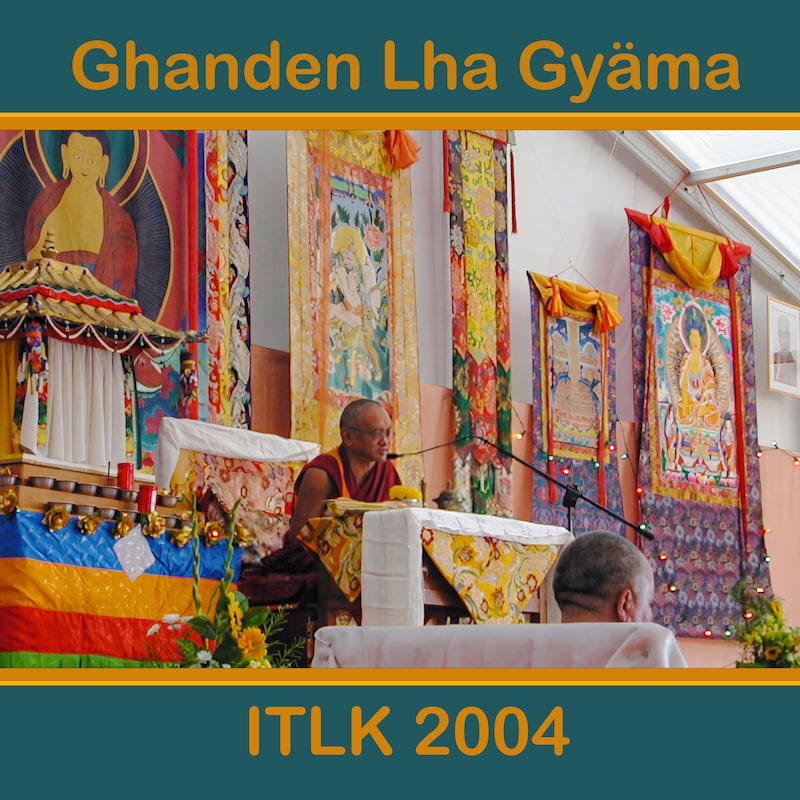
This teaching was given by Lama Zopa Rinpoche at Lama Tsonkhapa Institute in Italy as part of the Ganden Lha Gyama retreat between September 3-30, 2004.
00:00:00 The purpose of the preliminary prayers is to pacify obstacles to achieving full enlightenment and the complete qualities of cessation and realization, for oneself and others.
00:11:14 Lama Tsongkhapa emphasized bodhicitta in every teaching. Seeking enlightenment for oneself alone results in a limited realization. One must seek enlightenment to benefit all sentient beings.
00:43:52 Buddhas liberate sentient beings by revealing the ultimate truth and reality, which is the teaching of the perfection of wisdom. This is the heart of the 84,000 teachings of the Buddha.
01:21:15 Practicing kindness, forgiveness, tolerance, and rejoicing in others’ happiness keep the mind peaceful and joyful. Even without deep realizations, these basic practices make one a good human being and bring peace to the world. Ultimately, realizing emptiness—the heart of the Heart Sutra—leads to liberation from samsara.
01:41:16 Without depending on the guru appearing in ordinary aspect, even if there are countless buddhas, they cannot guide you to enlightenment. The guru in ordinary aspect is most precious.
02:47:42 In daily life, practice mindfulness of looking at the nature of phenomena as empty. This helps control delusions from arising. Even if one doesn't have realizations, strong faith in Lama Tsongkhapa's explanation of emptiness gives hope to realize it in the future.
03:27:07 In this retreat, even if one is unable to finish 100,000 migtsemas, if one achieves realization of guru devotion, one will have succeeded. That’s the main goal, the main objective of doing this Lama Tsongkhapa Guru Yoga. We’re not looking for the number of mantras; we’re looking for realizations.
04:07:03 Rinpoche leads extensive dedications.
Find out more about Lama Zopa Rinpoche, his teachings and projects at https://fpmt.org/
Transcripts
So the purpose of, so these prayers, these preliminary prayers, so basically to pacify the obstacles to achieve the full enlightenment, the complete qualities of cessation and complete qualities of the realization, works for self and works for others, so that, for success of this. So that means, just recently saw this great lama, Je Drubkangpa, Kachen Yeshe Gyaltsen’s guru, Je Drubkangpa, this great lama, unbelievable his, even a few words of his teachings, whenever he says, one who, every time when he begins teaching, first he talks about bodhichitta every time, begins with that. Even he says a few words, advice is like dynamic, it’s so effective. So in his teaching, so the motivations before the taking bodhisattva vow, this lama starts, every time there’s a tsog offering then disciples, then there’s bodhisattva vow, seems that style or seems does so much of that, so I think to benefit for sentient beings, so one of the motivations it’s mentioned that, so if you are seeking enlightenment for yourself, Je Drubkangpa explained, then what result you will achieve is solitary realizer, arhat, because you are not seeking for other sentient beings seeking enlightenment but for oneself, so rang sangye, it’s the solitary realizer, the arhat. I haven’t heard from other, haven’t seen other teachings, I mean that I have seen, that doesn’t mean that I have seen all the teachings, all the texts of teachings or, I mean, how to say, how much, I mean the texts didn’t exist, I mean what I’ve seen is almost nothing, so but I haven’t heard that, but this great lama has said like that.
However, so to achieve the full enlightenment, completed quality of cessation and the complete qualities of realizations, so that’s for the benefit of one’s own kind mother sentient beings. So however, so that’s the ultimate success. So to pacify all the obstacles up to that. And to collect merit, to pacify obstacles up to that, so obstacles which interfere to have this success. So therefore, reciting the Heart of the Wisdom.
So, the heart of the whole entire Buddhadharma, 84,000 teachings taught by Buddha, that’s the Buddha’s teaching on the Perfection of Wisdom, which Buddha cherished so much, that cherished, told Kungawo, his attendant Ananda, Kungawo, that doesn’t matter even other teachings degenerate, but don’t allow to degenerate the teachings of the Perfection of Wisdom, even a small corner of it. Even a small corner of it, don’t allow to degenerate. So, and wherever this teachings Perfection of Wisdom will be, I will be there. So this is what Buddha, ?because, similar that Buddha said that, the way Buddha liberate sentient being is not by washing with water, the negative karma, the cause of the suffering, with water, not that way. Like the Hindus believe that you go to River Ganga and then put, even the person died, put, I think put water on the feet, wash the feet, something like that, so then they believe all the negative karmas are purified.
So, what is normally mentioned, Thub nam dig pa chhu yi mi thru zhing, the Mighty Ones, buddhas, their way of liberating, not by washing the negative karma or the cause of the suffering with water. Dro wäi dug ngäl chag gi mi säl la. So sufferings of, the eliminating the sufferings of the transmigratory beings with hand, not that way, like taking thorns out of, like if the thorn went inside the flesh then taking thorn with the finger, out, not in that way, with the hand, eliminating suffering with the hand, not like that.
Not only, Nyi kyi tog pa zhän la po mi nü, one’s own realization, by transplanting in the others, within others, so like monkey’s heart, transplanting into a human body or somebody’s heart, a person who died, then just died then the heart moved, transplanted into somebody else, so not like that, not in that way. Buddha’s realization, [Tibetan] Buddha’s realization transplant in others, also not in that way. Transplant in others and then Buddha has nothing, so not like that.
So, then how it is Buddha liberates sentient beings, Chhö nyi den pa tän pä dröl war gyur, the ultimate reality, the truth, by showing that, then liberate sentient beings, by showing the ultimate reality, the truth, then liberates, the sentient beings get liberated from the oceans of samsaric suffering and, that and the cause, the delusion and karma, so like that. So, what is that? That is the, how Buddha reveals that, that is the teaching that already Buddha taught, the teachings of the Perfection of Wisdom, so this is what it’s.
So as Kirti Tsenshab Rinpoche explained that the basic preliminary practice is studying the teachings on the Perfection of Wisdom, Abhisamaya-lamkarika, Madhyamika, all this, teachings of the Perfection of Wisdom. So, what is studied in the monasteries for, going on quite a number of years, so similar here, in the Masters Program, there are these subjects to study, so doing extensive study on this is, on those, complete study on these scriptures, so teachings of the Perfection of Wisdom, so this is the best preliminary.
Then, the middle preliminary is reciting the Eight Thousand Stanzas, Gye Tongpa, one hundred times. So there are, there’s one, there are people, monks who recite this many times, Eight Thousand Stanzas. I met one, one Tibetan, one doctor, he’s a monk from Shelkar Monastery in Tibet, branches of Sera Me, so it’s, I think, a very good monastery.
Shelkar Monastery is situated on a very high rocky mountain. When I was in Tibet when I very small and saw the monastery way up there, I thought, “How could this happen? How did this monastery come to be so high up?”
Rinpoche Tells About His Childhood
I was with my two uncles, who had taught me the Tibetan alphabet. So, they were my relatives, my uncles, and also my gurus. I had two alphabet teachers because I was naughty. The first one, Ngawang Lekshe, had a beard. He carved many mantras on rocks. A sponsor would request him to carve the mantras on huge rocks in the road. It would take him a few months to carve the mantras, and then he would paint the mantras black. They were very beautiful, the black mantra against the carved white. The idea is to benefit the many people and other sentient beings who do circumambulation of the rock. When they come down they come around the rock one way; then when they go back they go round the other side, so it becomes a circumambulation. There are many rocks like that to circumambulate. They are made to benefit many sentient beings, to purify their negative karma and to collect extensive merit while they are traveling. So, my uncle carved many like that in his life.
He lived in Thami Monastery, the monastery very close to the village of Thami, where I was born. It takes maybe thirty minutes to walk up the mountain to the monastery. I escaped a few times from the monastery to the village. My uncle was teaching me the alphabet, and as soon as he went inside the house to make food—we ate three times or four times a day—the thought would come to escape, then I would immediately run down to my home. I think it was because at home I got to play all the time; there was nothing particular I had to do.
After two or three days, my mother would then send me back up to the monastery. Somebody would carry me up on their shoulders. One time there was snow everywhere. I was playing again in the courtyard, blowing through a plant and pretending I was playing a trumpet in a puja. I had some friends I would play with at home. One of my best friends was mute; he couldn’t speak. He was my permanent friend, the one who played with me every day. And there were a few other children. Many times when we played, I would sit on a higher seat and pretend to be a lama and my friends would pretend to be disciples or benefactors. I would give initiation to them, putting things on their head. Sometimes we wouldn’t know the prayer but we would just make some noise. Then the one pretending to be the benefactor would make an offering of food by mixing some earth with water and putting it on a small piece of flat stone. We would pretend to do pujas and things like that.
So, one time when everything was covered with snow, I was playing like this when the thought came to escape from my teacher. So I ran down the mountain. At that time, I was wearing some pants that my mother had given me. I hadn’t had pants before. These pants were all in one and made of the very cheap cloth used to make prayer flags. At that time in Solu Khumbu good cloth was very rare. This cheap cloth had then been dyed red. Inside where the top and bottom met, there were a lot of lice. Not the eggs, but the big lice. Actually, it was full of lice and full of eggs.
Anyway, I didn’t know how to use the pants. I didn’t know how to open the pants to go to the toilet. So that day when I ran down, I came down with kaka in my pants, from the monastery all the way down to my mother’s house. When I arrived there, my mother was outside with some people around. She then took off all my clothing and cleaned everything. Well, that’s one thing that I remember.
Because the monastery was too close to my home, this problem happened. I ran away a few times. So, my mother sent me to a more isolated place, which was extremely kind of her. I mean, looking back at it now, I can see it was unbelievable kindness. So, I was sent to Rowlaling, a place that takes three days to reach, crossing snow mountains. There was no such thing as a road, but people know how to cross the mountains. There are many avalanches and other obstacles while you were crossing the mountains. You can’t really predict an avalanche; it can happen any time. When an avalanche happened, a person could completely disappear inside many, many feet of snow. And rocks would fall down from the high, rocky slopes. When it was hot during the day, big rocks and small rocks would fall down from the mountains. However, you don’t hear many stories of people being killed. I think something happened a long time ago. Before they cross the dangerous parts (though I don’t remember so much going down), the Sherpas usually....
When you’re coming up from that very isolated, hidden place. Those areas are actually regarded as hidden places of Padmasambhava. Also around Rowlaling, there are many Padmasambhava caves and Padmasambhava’s throne. It is a very beautiful area, with one of Padmasambhava’s caves a little higher up. If you clean and offer incense inside, nectar comes from the ceiling of the cave, even in dry weather. I went there one day for a short time, and there was a mark like wax on the rock where the nectar falls down. Many meditators, mostly ngakpas, came there.
Ngakpas are not monks; they are usually lay tantric practitioner, with long hair rolled up, carrying a skull or something. They came from Tibet and lived a wandering life. They would spend some time there, then go to another place.
It is a very beautiful place, with many holy sites of Padmasambhava, such as Padmasambhava’s footprint. I think there must have been many meditators there in the past, as there are many caves with hand and footprints on the rock. I think the stories have been lost. Due to tantric realizations, they achieved power to control their chakras, winds, and drops. Somehow the feet are very small feet. The footprints in the rock are not carved; it’s actually a print made by putting their feet there.
So, I lived at Rowlaling for seven years. This part of Solu Khumbu is much more primitive than the Namche Bazaar part. On the Namche Bazaar side of Solu Khumbu, the people are more intelligent; the people on the other side are not like that.
I was there for seven years with the second uncle. I may have learned the alphabet for one day from the first uncle, the one with a beard. The second uncle’s name is Aku (which means uncle) Ngawang Gendun. We sometimes had to read all the 100,000 stanza Prajnaparamita scriptures for benefactors who requested us to read it. The past lamas in Solu Khumbu, who were from the Nyingma tradition, were very skillful. They would give an initiation, and they let the lay people come, because of course they had much devotion. Generally, only the monks can read and have some understanding; they could follow the text and do all the preliminaries and the deity’s retreat. It seems that the tradition up in Solu Khumbu is that with each deity retreat, you do the four major preliminary practices—mandala offerings, Vajrasattva practice, guru yoga, and the refuge-bodhichitta—even if you have already done them with another deity. You do all the preliminaries again. With each deity you have to do all the preliminaries.
In The Lama Tsongkhapa Tradition The Most Important Thing Is Living In Pure Morality
In the Lama Tsongkhapa tradition, the preliminaries are something that you do as a practice all the time, every day, and the most important thing is living in pure morality. If you don’t live in pure morality, there’s unending purification; you never finish your purification. You always have to purify because you continuously collect negative karma, vices, and the negative karma never becomes less. You purify but you then continuously collect negative karma. So, whether you are a lay or ordained person, living in pure morality or living in the samaya of secret mantra, if you have taken Highest Tantra initiation, is the main emphasis. The emphasis is not on the preliminaries but on living in morality, living in samaya—perhaps you could say, living in the three levels of vows. Here you can understand the importance of this point. Otherwise, there is no end for confession, no end for purification, because you are continuously obscuring your mind.
So, in the Lama Tsongkhapa tradition, the traditional advice is that, on the basis of living in pure morality, or pure samaya, whether lay or ordained, you then do the preliminary practices. You then purify the negative karma of this life and of all the past lives. This is the best way, the most fruitful way, to do preliminary practice.
Of course, this doesn’t mean that there are no good practitioners in Solu Khumbu.
There have been many yogis who achieved very high realizations, on the basis of living in the lay vows, if they were lay, and on top of that, also living in the bodhisattva vows and pure tantric samaya. Otherwise, you cannot achieve high realizations of tantra. But I’m saying here that the general emphasis in the Lama Tsongkhapa tradition is like that.
So, my teacher let me to read. We would get up at dawn, recite our prayers, then read texts. One time it was the Diamond-Cutter Sutra; we had to read it over and over, many times. Another time is was [Do Dupa], which is all in verses, so it’s difficult to read. If you could finish reading many hundreds of pages from those large volumes in one day, you were regarded as having very great qualities. Reading this many times enables you to read other texts quickly. This is another teaching on emptiness. Sometimes benefactors would ask us to read the whole Prajnaparamita. I don’t remember reading the whole Kangyur.
Anyway, in the past the old lamas would give an initiation. The lay people couldn’t read or write anything, but they came to the initiation with much devotion. At the end of the initiation the lama would give a huge mantra commitment, to recite many millions of OM MANI PADME HUNG or Padmasambhava’s mantra, for example. So, the lay people go for the initiation and receive this huge commitment to recite mantras. They’re actually supposed to do the commitment themselves, but sometimes they come to my teacher or to the other monks or ngakpas, bringing an offering of a bamboo basket filled with potatoes or the radish with a terrible smell or of a bowl of rice. Nowadays money has become common because there has been so much business from trekking, but before it wasn’t like that. So, they then request to my teacher or to other monks or ngakpas, “Please recite all these mantras for me.” I think they didn’t understand that the lama gave them the commitment because they have to purify their negative karma and collect merit. Maybe they didn’t quite understand this.
So, except for meal times and when I would go outside for peepee, when I would hang around a little bit, I read texts almost all day long. We would read the whole afternoon, stopping some time before sunset. One time I thought my teacher had gone a long way away, so I stopped reading, then turned some pages over. When my teacher came back after ten or fifteen minutes, he could see I hadn’t actually been reading. I had been sitting there just playing around but not reading. So then he beat me. One of the normal things was to beat with dried bamboo, but when my teacher hit me on the head with the dried bamboo, the bamboo shattered into pieces. Then he spanked me and beat me here and there, the normal things.
I don’t remember what I had done, but one time it was raining and he made me take off my clothes then put my mouth on the water where it had collected on the flat stones in the courtyard. Outside of the house there’s a courtyard, with piles of wood all around as a wall, and there was a toilet. Outside of the toilet door, some nettles were growing. Another time, again I don’t remember what I did, my teacher took me outside and rubbed my backside on the nettles. But I don’t have much memory of feeling much pain or really suffering. I don’t remember. But beating with bamboo was the normal one.
Anyway, looking back now, I think I experienced unbelievable purification from my teachers letting me read all these texts over and over and from beating me. I had no understanding, but just had to repeat the texts over and over for many months. One time one text; another time, another text. Even though I had no idea of the meaning, I definitely think that it left a positive imprint on my mental continuum.
Due to the kindness of those teachers in my childhood, their kindness in letting me read these texts over and over, so many times, and thus leaving positive imprint and all their beatings, I think there was a lot of purification; I purified many heavy negative karmas.
Of course, realizing emptiness is not easy, but even if there is no realization of emptiness, but. I’ve forgotten the exact term in The Three Principles of the Path by Lama Tsongkhapa. I tried to revise the translation when I was giving a teaching in the Kadampa Center in North Carolina, but I didn’t finish it. I reached that particular term. I wanted to make each word very precise, as it seems some words were missing. But now I’ve forgotten the term. However, even if there is no realization of emptiness at all, you can have definite, unshakable faith in Lama Tsongkhapa’s explanation of emptiness. Even though there are many other explanations of emptiness, but you can have strong faith in Lama Tsongkhapa’s way of explaining what things are empty of. You can have strong faith that the meaning of the teaching on emptiness there in The Three Principles of the Path is correct, so at least you don’t have to be puzzled by the way all the different traditions and all the different schools talk about emptiness. You can have total faith in the way Lama Tsongkhapa has explained it.
Therefore, in that sense, I think I was very fortunate to have done so much preparation from childhood. I was lucky to start that early, and it was the kindness of those first teachers. The unshakable, unchangeable faith that I have in the meaning of these few precious words of Lama Tsongkhapa gives me hope for realization in the future.
The Heart Of The Whole Entire Teaching Of Buddha Is Teachings On The Perfection Of Wisdom
So, the heart of the whole entire teaching of Buddha, the 84,000 teachings, the heart, so that is teachings on the Perfection of Wisdom. So, and then before that I was mentioning that, how Buddha’s way of liberating sentient beings by revealing the ultimate reality, the truth. So, that is these teachings on, Buddha’s teaching on the Perfection of Wisdom, already Buddha has taught, left in this world. That, being very extensively studied in monasteries; same here in the seven-year Masters Program, that due to Lama’s, whose name is extremely difficult to express, Lama’s kindness, so here and then Geshe Jampa Gyatso put that into practice, what Lama planned, and because Geshe-la was that time, when Lama was making this plan, so and same class and very close friend, so put, Geshe-la put the Lama’s wish, actualized, fulfilled. So then, so that’s how it happened here at Lama Tzong Khapa Institute, so Geshe-la, when he was at Kopan with Lama, so when Lama was making this plan, Geshe-la was there, discussed together. So then it happened to be Geshe-la, Geshe Jampa Gyatso to be here at Lama Tzong Khapa Institute, so then he put, wanted to accomplish or fulfill Lama’s wishes.
Then, so students here, you have put, came to learn, which fulfilled Lama’s wishes, came to learn and now completed, except the retreat, to, making it more meaningful, rather keeping it intellectual, like computer, collect information in the computer, rather mind become just computer, somehow to actualize that meaning into the heart, from the intellect computer, the brain computer, or brain, I’m not sure, anyway, so rather becoming computer, then somehow to actualize, to have some experience, to get close, heart to get close to that, what one has studied in those seven years, so, how to say, so, to have some transformation in the life, the heart, the mind, that which has Buddha-nature, all the potentials you can transform and liberate yourself from all the oceans of samsaric suffering and cause and somehow make closer to the path, closer, in this life. However, sooner or later, to end the unbearable, the oceans of samsaric suffering, which continuation has no beginning, which continuation has no beginning. However, to finish this, to end this suffering, no more circling, no more circling in samsara. So, of course, how urgent that is, no question. More we meditate on, more we meditate especially the suffering of samsara, what samsara is, evolution of samsara, more we meditate, more we meditate on the shortcomings of delusions, how they’re harmful, that they have been harming to oneself from beginningless, time without beginning they have been harming, up to now, right up to this second. So, this issue about oneself to get liberated, to be free from samsara become more and more urgency, more and more urgency, can’t wait, more and more urgency, emergency.
And the other emergency is if we, if the practice didn’t happen in this life, while you have this perfect human rebirth, have all these incredible, fully qualified masters, gurus, including His Holiness, so many others, top in the world, have met and you are in the, amongst, filled with opportunities, to practice and to have realization in this life. So, while there’s all these conditions one has, so to have realization, at least even to make closer to have realization near future, next life or near future, so however, close, easy, close, to have achievement. So however, so incredible, all the opportunity is there, so if it didn’t get done this time, if it didn’t get done this time, life got distracted with meaningless things and just the pleasure of this life, which is nothing new, we had this pleasure numberless times from beginningless rebirth, nothing is new, samsaric pleasure, nothing is new in this life, whatever we, there’s nothing new, we had numberless times from beginningless rebirth.
Whatever suffering we experience, this is not the first time, relationship problem, this is not the first time, we experienced numberless times, all those emotional pains, whatever, depression, numberless times. And any pleasure we had numberless times, so even we are born in the, we achieved the, through shamatha, calm abiding, those precise continual concentration, four levels of concentration, sam ten zhi, we achieved those realms, higher realms of samsara, form realm, even formless realm, we born in those realms where there’s no suffering of pain, formless realm where there’s no suffering of change, we born there numberless times, and I think it is said that even wheel-turning king, born even like that, the wealthiest, the most powerful in the world, also numberless times. So if we didn’t get done to practice in this life, even to make closer, mind closer to that, realization of the path, then not sure when, as it is mentioned in the teachings, then before, such, to receive such this perfect human rebirth again is extremely, with all this, especially like this now, with all this opportunity, with all these spiritual masters, like that, to find such this perfect human rebirth like this next lives, extremely difficult, because, we can understand by examining the attitude, in our daily life attitude, even we’re trying to practice Dharma, but mind that which become virtue it’s very rare even in one day, even we’re trying to practice Dharma but the mind that actually become virtue, the practice that really become pure Dharma, it’s very rare. Not for all the time, twenty- four hours, whatever we do become Dharma, pure Dharma, even the practice. So, like myself, us, so like that, it’s very difficult, not like that. So attitude, the twenty- four hours a day, our attitude is disturbing thought, delusion, obscuring, ?ngon monpa, obscuring, disturbing thought, so what it does is, what it affects to your mind, is by following delusion it only obscures the mind and also it disturbs, it never gives any peace on our mental continuum, so that’s how I translate “ngon mongpa,” I added the word obscuring disturbing thought.
So, even there’s no anger all the time but there’s normal habituated one is attachment clinging to this life, and that attitude is non-virtue. So then any action, whatever action we do is become nonvirtue, so then of course the result is only suffering. Then rebirth in the lower realms. So, when one is going to do the practice? Lamrim, actualizing the path, transforming the mind in the path, when it’s going to happen? So, do we want, do I want, if one question to oneself, do I want continuously suffer, die and reborn, die, reborn, in samsara, suffer continuously in each realm? Do I want that? Do I really like that? Of course, doesn’t, of course one wouldn’t like, of course wouldn’t like to suffer. So then there’s no other choice except to actualize the path, so this, so use the Buddha-nature that one has to actualize the path to liberation, to enlightenment.
So the other question is, if one doesn’t engage in the practice in this life, then when? So that become a huge question. Then when it will happen? When one is going to, when will have the opportunity? So that’s a huge question, so one has to think very seriously, from the bottom of the heart, it’s a very serious matter, decision, that, so question of, of course, if one want suffering, if one’s goal is to have suffering of samsara, if one’s interest, look for, is suffering of samsara, lower realms, suffering of the lower realms, hell realms, of course that is, of course in that case it’s very different. Then, doesn’t need to practice, doesn’t need to learn Dharma, doesn’t need to practice, so in that case. But if that’s not the wish, so wish is to never suffer, experience lower realm sufferings and the whole suffering of samsara, then no choice without practicing, without meditating on the path, so like that.
So, what, I’m losing again. Getting lost, getting lost again.
So, middle preliminary practice is reciting Eight Thousand Stanzas, this text, one hundred times.
Then the lower, the lowest, the lower preliminary practice, the last or the lower preliminary practice, that’s the nine preliminary practices, the four, what you regard, normally regard major ones, then the other, the refuge-bodhichitta then the mandala offering and then the Vajrasattva, the guru yoga, like that. The Vajrasattva and then the prostrations by reciting the Thirty-Five Buddhas’ names. This, the rest others, so the nine preliminaries that’s the lower one.
So, therefore, must rejoice having gone through these studies, teachings of the Perfection of Wisdom, that one had opportunity to study, so one must rejoice by thinking of all the benefit, skies of merit, incredible purification that happened by studying these things, so as it’s explained in the teachings, like that. So the, so it’s unbelievably fortunate, incredible fortunate, yeah, so left so much positive imprint to realize emptiness, like that, and planted so much seed to actualize the path, and that is explained in the Madhyamika or the Abhisamaya-alamkarika, those path to enlightenment. So, must, so there’s so much to rejoice, so much to rejoice.
So all this, of course, His Holiness’s kindness, then particular, after that, then Lama’s, all this incredible fortune that all the students here who are studying the Masters’ Program, so we have to realize that it’s Lama’s, Lama Yeshe’s kindness, all this, that he made this plan. Then, of course, it’s actualized by Gen, Geshe Jampa Gyatso, so this again become meditation on the guru’s kindness. And then, so even didn’t see Lama Yeshe directly, but received the guidance, received help, received the guidance, even one didn’t actually directly see Lama Yeshe, but received the guidance, the benefit from Lama Yeshe.
So, so Lama’s, so goal, Lama’s goal, establishing such this, that is to benefit for, students’ life to be benefit for sentient beings, to be highly beneficial for sentient beings, to liberate the numberless sentient beings from the oceans of samsaric sufferings and cause, to help others, to bring peace in this world, by educating Dharma to others, by causing others to practice compassion, wisdom. So that, then that of course you have to become example, then of course then that, to do that oneself has to be example, teach the words but also one has to be example to the world, starting from the family, starting to one’s own family, the nearest person, from there to the rest of the world, able to bring peace and happiness, able to cause, able to become example of good heart, to inspire them to develop compassion. Very good example of a human being. That, even at least, everyday life able to, everyday life practicing to be kind to others, that’s, perhaps that may not be special thing about Buddhism. To be kind to others may not be special thing about Buddhism; it may be also Christian, about, even a Christian might, I think, maybe, there may be, like Saint Francis or there are many priests, monks, nuns, from Christianity, there may be, to be kind to, everyday life to animals, to human beings, so may not be special thing about Buddhism.
Rejoicing
So, everyday life able to practice kindness, to be kind to, not only human beings, even the animals, the sentient beings that you can see and able to practice forgiveness, those who are angry to you, those who badly treat you, able to practice forgiveness to them, able to practice tolerance, and so instead of holding a grudge for whole life, for many years, and that makes us so unhappy and tortures you, tortures you and makes you angry to the other, to the person for years and years, so create, then destroy your merit. Even a little merit one has collected then destroy, so like that. However, then, with these things daily life practice then also rejoicing. Whatever we see good things happening to other sentient beings, they are able to achieve happiness, however, any comfort, whatever success they achieve, you see that they achieved, somebody has great knowledge, somebody has better, greater knowledge of Dharma, rejoice. Somebody doing a lot of practice, rejoice.
Somebody doing a lot of retreat, rejoice. Somebody’s wealthy, rejoice. Somebody has a beautiful car, rejoice. Somebody has a very nice motorbike that makes a lot of noise, maybe especially from Germany, anyway, I’m joking. Anyway, I’m joking. Anyway, anyway, rejoice. So anyway, whatever comfort or happiness, pleasure they achieve, they enjoy, rejoice. Doesn’t mean to be attached, doesn’t mean yourself also to look for that, it doesn’t mean that. It’s rejoice. How wonderful that they have this comfort, rejoice. It doesn’t mean to attach to, oneself to look for, it’s not that. It’s different.
So whatever good thing happens to the others, rejoice, practicing rejoicing everyday life. So then that constantly keeps your mind, that keeps your mind constantly in a happy state, no jealousness, no other, no these other troubling minds, so no other these emotional troubling mind rise, so there’s always peace. So in your life there’s always peace in your heart and always joy in your heart if you, if one is able to practice these very basic things, these very basic things in our daily life. Even we don’t have actual realization of bodhichitta, right view and so forth, but at least by practicing these things then it makes a very beautiful human being; it makes a very good human being, person. Very useful. Whether you have a little understanding of Dharma, whether you are a great scholar, but if these practices get done. Everyday life if you’re able to practice this, these simple things, so it makes a very good human being, very kind of everybody, so then brings, definitely brings peace, definitely brings so much peace, because you don’t harm others and on top of that then you try to benefit others, so therefore then you don’t receive harm from others. As a result, you don’t receive harm from others, and as a consequence, and also result of karma, then you receive only help. Instead of receiving harm, you only receive help from others, now and in the future, all the coming future lives, because karma is expandable. So you can enjoy the result for so many thousands, thousands, thousands lifetimes. So and including this life, so success of this life, so your life, success of your life, today, tomorrow, next week, next month, next year, this life, so success comes from these practices. So, so much success, life becomes so much easier, no problem, then comes from this, these basic qualities, these basic practices, that I have just mentioned. So, I think bring peace, this one person who practices this, brings so much peace in the center, meditation center, where the person is staying and at home, even one’s family, so in the world, in the country, in the whole world, and then life to life to all sentient beings.
So the, so this, in the universal education that, like a vow, like a pratimoksha vow to achieve liberation for oneself, then bodhisattva vow to achieve enlightenment for sentient beings, then tantric vow to quickly achieve enlightenment so that one can liberate sentient beings quickly, so similar in the universal education there’s the, not quite exact number but, however, the ten divine virtues, then the sixteen human Dharmas, so that can be sixteen or can be fifteen, however, that embodiment of Chenrezig, the Songtsen Gampo, Dharma King of Tibet, he made this constitution, these practices as a constitution the whole of Tibet. So this is kind of like a vow, something concrete to practice, basic thing to make a good human being. Then, the other one, this which I have just mentioned, practicing kindness in everyday life, then forgiving, practice of forgiving and rejoicing and tolerance also, like that.
So anyway, so what I was saying before, so the Heart of the Wisdom, now here Sherab Nyingpo, the heart of the wisdom, so this one is the teaching of the Buddha by blessing the, that happened through Buddha blessing Maudgalypu [Shariputra], then through Chenrezig and Maudgalypu, Sharipu, just ?jing gyi lab kyi ga, then at the end Buddha, legso, legso, responded, Yes, yes, that directly came ?from the holy mouth, so this teaching is the heart of all the teachings of the Perfection of Wisdom that Buddha has taught, left in this world, twelve volumes, the One Hundred Thousand Stanzas; then Twenty Thousand Stanzas, nyi tri, three volumes; then Eight Thousand Stanzas, so this one, Heart of Wisdom, Heart Sutra, this is the heart of all that.
So now, so here physical location, the heart, here, heart here is the main place of the mind. So, from the very beginning the support where consciousness took place, and also the very last, when the mind leaves the body, so leave from the heart, from the indestructible, which is in the indestructible seed. So the very last, the ?chi sum tarmo, at the death time the very last mind of death is the clear light, then again from there become gross, then intermediate stage being, except the formless realm. So, like that, if the heart stopped, if the physical heart stopped functioning, then everything, all the organs doing function, whatever, everything stops, so like that. However, so the, like that, so this is the, this teaching is the heart, all the teachings of the Perfection of Wisdom, and even the Heart of the Wisdom, so even that, more specific even that is, the ultimate nature of the mind, nature of the mind, clear light, ultimate nature of the mind, the emptiness, that which is the emptiness. So by realizing this heart and developing this wisdom, then, through that then having direct perception, wisdom directly perceiving the emptiness of the mind, then able to cease disturbing-thought obscuration, ngön drib, then with the support of bodhichitta, collecting merits with the six paramitas, those bodhisattva’s path, that, then one is able to cease even the subtle defilements, then able to achieve this continuity of this mind, then become dharmakaya, so achieve dharmakaya and then that time also one achieve rupakaya, so like that. Besides totally liberate oneself from oceans of samsaric suffering. So Heart Sutra, the heart, even more specific the realizing the very nature of your mind, the clear light, that which is emptiness. So, by realizing that, liberate yourself, you get liberated from oceans of your own samsara, which continuation has no beginning, but it gets ended.
Yeah, sorry, this become side talk, very long talk, sorry. So now we do Heart Sutra, so what I was saying, so as I mentioned before, how to pacify obstacles oneself to achieve enlightenment and to enlighten all sentient beings, so that’s one thing.
Then, so that’s the normal purpose why we recite these prayers, do these practices. Then, particular, dedication to Ribur Rinpoche, Kyabje Ribur Rinpoche to pacify obstacles, to show us perfect health and long life, as well as all other virtuous friends, can do like that. Then, also for, yeah Lama Tzong Khapa Institute here, all the, to be most beneficial to sentient beings and Dharma activities and as well as, developing Dharma activities and as well as condition, to do Dharma activity you need, that depends on material conditions, facilities, so for both success, for all the needs for that, to benefit for sentient beings, all the material needs, so for both, the inner Dharma activity as well external, all the conditions, the finance and all the external needs, so to be, to receive without any effort, or even without thinking, to receive all the needs, so like that. Then, all the wishes to serve the teaching of Buddha, the sentient beings, all the wishes to be succeed. And then as well as whole entire, whole organization, all those various projects, which I explained before, including Maitreya Project, like that, all the projects, including those to fulfill His Holiness’s holy wishes, so to actualize as quick as possible, so like that.
So now we’re going to really recite. Really going to recite Heart Sutra, actually engage.
[Recitation of the Heart Sutra]
Teachings On Emptiness
So, just merely reciting the words, the Heart of Wisdom, of course it becomes very powerful means to pacify obstacles, but the main thing that, how this pacifies obstacles to achieve enlightenment and to be able to enlighten all sentient beings, now as we’re going through the prayer, it involves meditating, as I explained the other days, I, action, object, all these phenomena, the forms, sound, smell, taste, tangible objects, all these, the six sense objects, including the six senses and sense bases, however, all these, the aggregates, the I and the base, the aggregates, which, even what they are and how they exist is merely imputed by the mind, [Tibetan] exist, everything exists being merely labeled by the mind, so that’s what, because of that then everything are empty of existing from its own side. Everything is empty of the real one, in the sense existing from its own side, something existing from its own side.
So, that is reality. How many, all these phenomena that we have just recited, we have gone through these phenomena just now, and all the rest, how many, all those different phenomena they’re, that even when we look at here, different colors, different shapes, various forms, all sorts of things here, so many different, even the form, the objects of the sense of the eye, so many things, different shape, different color, all these has different name, yeah, everything whatever we see here, so but all this, very nature is emptiness, so everything are manifestations of emptiness, came from emptiness, manifestations of emptiness. While everything is empty and they exist, they function, they exist in mere name, they function in mere name, so like that. And harm or help in mere name. Experience in mere name, so everything like that.
So, looking at their nature, that it’s emptiness, so it’s just one thing, emptiness. So, even the ?cho nangpa, the view, the empty by, which view is the empty by other phenomena, the absolute truth is empty of conventional truth, so however, what I think is that even though there may be confliction, how to say, in regards words, maybe even not, in regard words, so presenting that way that’s the right view, however, but if we’re able, in the practice if we’re able to meditate, able to always practice mindfulness, look at the nature of the phenomena, emptiness, so if we’re able to always think the very nature of the phenomena, emptiness, so it helps, that mindfulness helps to not get angry, there’s nothing to get angry and it helps, there’s nothing to be attached to, when we practice mindfulness in that concentration, if we’re able to bring to that always, then it helps, yeah, nothing to get attached to, there’s nothing to be jealous of, so I think it helps very much to control, it helps very much to stop rising delusion, as far as meditation, I think, that’s what I think. Maybe philosophically, I mean the, there’s confusion, but if we, for meditation, just to control your, for your peace of mind or your, still helpful to stop rising delusion.
So however, if these phenomena, as I mentioned before, which have been appearing, they are empty but which, of existing from their own side, but they have been appearing to our hallucinated mind from beginningless rebirth as truly existent, not empty but truly, instead of empty, seeing empty, truly existent, existing from its own side. And so now when we recite the Heart Sutra we look at them empty, as they are, according to their nature, we look at them empty as they are empty. Empty of, empty of, from birth, from this morning, from birth, from beginningless rebirth, how we have been believing all these things, empty of this, every day from birth, from beginningless rebirth that what how we have been believing, apprehending the object, real one in the sense existing from its own side, so every, including that noise, [Buffina the dog making a scratching noise] he scrubs, how do you hear that noise? How do you hear that noise? Oh, he’s continuing, you see. She’s continuing. So, how do you hear that noise? We don’t hear that noise merely imputed by mind, merely imputed by your mind, you don’t hear that. You hear sound, crrrr, like this, or even my noise to you, so you hear noise not merely labeled by mind, you hear. Even though your mind has labeled that, that name, crrr crrr, like this, name, what is called crrr crrr like that, name, name for this, I hear a sound, I hear a noise, dog scratching, I hear a sound, so your mind give name, what is called sound, what is called sound is name, given by your mind. What is called sound is name given by your mind. So form, sound, smell, taste, all these are name, what’s called, all these name, so given by, imputed by your mind.
So, you see, first [Tibetan], so the sense of the, the object what the sense of ear hears, so after that, after that, first, yeah, so anyway, first, the definition of sound is [Tibetan], the object what the sense of ear hears, that’s the definition of sound, in dura, so the very first, learning the philosophical subject, debating subject, so [Tibetan] so object the sense of ear hears, so that is the, that definition is the base, that’s the base, then after that base, your mind label sound. After that base your mind make up the label, sound. Your mind makes up the label “sound,” so then whether it’s good sound, bad sound, interesting sound, horrible sound, sweet sound, all that, so mind to be able to make up the label, good sound, bad sound, all that, first you have to hear something. To put the, what kind of label you’re going to put, before you put the label “sound,” what kind of sound, all that, you have to hear something. Otherwise you cannot, how are you going to label? Good sound, bad sound, how you’re going to label, without hearing? There’s no way! And no reason. No way and no reason to, your mind to label good sound, bad sound, all this, even it’s the sound, there’s no reason. So in order to make up the label, first you have to hear something, the object, your sense of ear has to contact the object, the particular object for, relating to us ordinary beings, not other senses, but the particular object, sense of ear meet. So that, so what, so the thing that, meeting the sense of ear, appearing the object, so that is the base and that is the reason, causes the mind to make up the label “sound,” what kind of sound, interesting, blah, blah, blah, all that, beautiful sound, good sound.
So now here you can see, sound is a label, what you hear that’s the basis to be labeled, that is the basis to be labeled. Base to be labeled. So the base has to exist first before and then label comes after. Any phenomena like that. So, what is sound?
Nothing, except what is merely imputed by the mind. What is sound is nothing except what is merely imputed by mind, relating to this object, the sense of, what the sense of ear hears. So therefore, first of all, the first, sense of ear meet the object, but the particular object, hear, then after that, mind merely impute “sound.” Right after that second, the sound appears back to you. It should appear merely labeled by mind, but due to the negative imprint left on the mental continuum by the ignorance, by the concept of true existence, so that immediately, right after your mind has made up the label then that negative imprint decorates, projects, true existence. So then that’s how when the sound appears back to you, it appears to you truly existent sound, sound existing, real sound in the sense existing from its own side. That’s very clear. So you don’t hear, when you hear the sound, when the sound appears back to you, it doesn’t appear back to you merely labeled by one’s own mind right now, the second before, the second before your mind merely imputed, so that doesn’t appear that way, doesn’t have that awareness, that right after that second that, right, the second before mind merely imputed, the awareness ?is ?there.
So therefore, the sound, dog scratching or whatever, the tent sound, whatever, so we hear billions of sounds in the tent, billions of sounds, various cree, cree and tor, tor and kor, kor, like that, billions of sounds, so every sound we hear, we hear real sound in the sense existing from its own side. So all these are hallucination, total, object to be refuted, gak-cha, the Prasangika school view, gak-cha, appearing not merely labeled by mind, so all these are hallucination, all these are totally nonexistent. All these totally nonexistent, totally nonexistent right there, right there, from where you hear you sound, existing from its own side, it’s totally nonexistent right there, so there’s no such thing. There’s no such thing. So that’s totally empty, the sound is totally empty of existing from its own side. Of the real sound that we have been believing, that one has been believing, not only today, from birth, from beginningless rebirth, I mean I’m talking the general sound, but I didn’t mean hearing these tent sounds from beginningless rebirth. This tent only, it only begins right at the beginning of the course. So, but I mean, so like that.
So empty, so empty, this, so this real sound appearing to you is, that’s totally nonexistent, empty, right there. Or empty, so far from beginningless rebirth up to now, the sound what you have been believing, apprehending, real sound, a real sound existing from its own side.
So here now when we recite the Heart Sutra, when we meditate on emptiness, something new, something totally new to our mind, so looking at it totally opposite, totally something else, totally empty. Then, every day, every day what you believe, the way our mind apprehends, so this is totally opposite to that. So it’s wrong to think, when we recite or when we meditate on emptiness, something else than this, something else than, emptiness something else than the way things appear and the way our mind apprehend, believe, hold on or believe to, emptiness something else than that or this is there, this is true, but emptiness is somewhere inside, like a chocolate box, you know, the box and then the chocolate inside or something, this is there, this is nothing wrong, but the emptiness is somewhere inside this. Not like that. So emptiness of this, so this, then this is correct meditation, something totally opposite than what you have been believing from beginningless rebirth, this is it.
Now we look at, now then totally opposite to that.
So, while we are meditating, practicing mindfulness in this, so the negative emotional thoughts, delusions do not rise, then motivating karma, creating the cause of samsara doesn’t happen. Then, especially, then this leads actually to realize all these are really empty of existing from their own side, so to actually realize this, then by developing that it leads to directly seeing, wisdom directly, going through imaginary then directly seeing, conceptualization then directly seeing emptiness, so it leads to that. Then that ceases, directly ceases the defilements, the disturbing- though obscurations, then there’s no, first of all there’s no new karma creating, then later totally, even the seed of delusion, imprint, is totally ceased. So the ultimate nature of the mind, that which is separation from, so these defilements, the nirvana or the, like that.
So this is how, by reciting Heart Sutra, the real obstacle is delusion, so this is how reciting Heart Sutra eliminate, the main obstacle, by reciting Heart Sutra eliminate is this, disturbing-thought, eliminate delusion and karma, the negative imprint. Then even the subtle negative imprint, subtle defilements, it ceases. So this is the main obstacle to achieve liberation and the other one, to achieve enlightenment. So like that, how it works.
So now we’re going to finish. Where did we reach?
[Ven. Sarah: Rinpoche just finished “no aging and death, no extinction of aging and death.”]
[Rinpoche completes recitation of the Heart Sutra; then Extensive Dispelling of Hindrances, Lion-Face Dakini.]
Then read the Lama Tsongkhapa, in English. This time read in English. [Group reads LTKGY in English, short mandala, request for the three great purposes, IDAM GURU RATNA]
We Should Always Remember That Guru And Buddha Are One
So, last night, as I was going through the secret visualization, I elaborated on the guru devotion meditation, which is the most important protection in life, the most important protection to you and to your mind, from now until enlightenment. It protects you from the wrong concept, or non-devotional thought, toward the guru, which brings obstacles to success and happiness even in this life, to the happiness of future lives, to liberation from samsara, to enlightenment. This non-devotional thought is the obstacle to achieving all the realizations of the path to liberation and to enlightenment, to being able to do the perfect work to free the numberless sentient beings from the oceans of samsaric sufferings and bring them to full enlightenment. Non-devotional thought toward the guru includes heresy, anger and all the other things that break the samaya with the guru and create the heaviest negative karma, which results in longest, heaviest suffering. In particular, besides the heaviest suffering in the hell realm, even later when one is born in the human realm, one has to experience so many very heavy obstacles.
As an example, when Vajrapani asked Buddha what the suffering result would be, Buddha told Vajrapani, “If I really explain the suffering results of having done the opposite to devoting to the virtuous friend, the bodhisattvas might pass away.” This means that the suffering result is so heavy that the bodhisattvas couldn’t stand to hear about it; they might vomit blood and become unconscious, or they might pass away. Buddha then said, “I will give you a little idea of it. If one has committed one of the five uninterrupted negative karmas, one will be reborn in the hell realm. Those who have done the opposite of devoting to the virtuous friend will also reincarnate in those hell realms that I explained.”
However, when Kyabje Choden Rinpoche was explaining Lam Rim Chenmo at Land of Medicine Buddha, Rinpoche said that this is the vajra hell, [dorje ngelwa], not the eighth hot hell, Inexhaustible Suffering, [ngelwa nyame]. According to Rinpoche, the vajra hell is something separate from that, and the suffering there is even heavier. Rinpoche said that one is reborn in the vajra hell.
A tantric text, [Pal nang gata nyen pai gyu lai], mentions that if one breaks the guru’s advice, one will fall down into the hell realm and that thinking that the vajra master is very angry creates the same heavy karma as having killed 100,000 Sangha. It says, “One should not break the guru’s advice; if one did break it, one will fall into hell. And if one thinks, ‘This vajra master has great anger,” that is equal to having killed 100,000 Sangha. It is only a cause of reincarnating in Unbearable Suffering, the eighth hot hell, which has the heaviest suffering.
So, the three meditation techniques I mentioned last night give the greatest protection to you and to your mind. Until you achieve enlightenment, they protect you from all the heaviest obstacles and also protect you from creating all those heaviest negative karmas and from experiencing all those unimaginable sufferings for the longest time in the hell realm or the vajra hell. I mentioned the key points of the meditations last night to stop the arising of the thought of mistakes. When the thought of mistakes does arise, even though the guru appears to you as having delusions and suffering and making mistakes in his actions, you have to use that appearance so that it doesn’t disturb or make you to lose your stable guru devotion.
The second technique is to think, “This might have a special purpose for me or for those sentient beings.” You think about how a buddha can manifest in various forms and do various types of activities, because sentient beings have various types of mind and various karma. Buddha is so skillful in bringing sentient beings from happiness to happiness, to enlightenment, that he can do things that fit exactly the karma of sentient beings, without the slightest mistake. First of all, Buddha has completed training his mind in compassion for every single sentient being, including oneself, without discrimination. Then, Buddha has omniscient mind. Not only that but Buddha has perfect power to reveal methods.
As I mentioned yesterday, we should always remember that guru and buddha are one. They are not two separate beings; they are one. Buddha means guru, guru means buddha. We should always have that recognition, that understanding, that faith. So, when we actualize the guru devotion realization, we have this understanding in our heart all the time. This experience or this devotion that the guru is all the buddhas comes from the very depths of your heart. No matter what the external appearance, one guru is all the buddhas and one buddha is all the gurus that you have. Lama Atisha, for example, had 157 gurus. Lama Atisha correctly devoted himself to all these 157 gurus, though he regarded Lama Serlingpa as one of his main gurus, because it was through Lama Serlingpa that Lama Atisha found the bodhichitta realization. He received the entire teaching on bodhichitta from Lama Serlingpa. Another of his main gurus was Dharmarakshita.
So, one guru is all the buddhas and one buddha is all the gurus. There is no separation between these two. With stable realization of guru devotion, this is how one feels all the time. There is not the slightest doubt in your heart.
Yesterday I also mentioned a third technique. In essence, our mind is now heavily obscured, so leave aside seeing buddha, we have no karma even to see as aspect that is purer or has more qualities than what we now see. Therefore, there is no other way to guide me to enlightenment, to free me from the oceans of samsaric suffering and bring me to full enlightenment. There’s no other way to guide me directly except through showing an ordinary form, one having delusions, such as anger, desire, selfishness, jealousy, pride, and so forth; having suffering; and making various mistakes in the actions. That aspect fits exactly my impure mind. My mind is impure and obscured, due to my impure karma.
If it had shown and aspect lower than the one I see now, such as that of an animal, I couldn’t recognize it or receive teachings. And I don’t have to karma to see as aspect better than this. This aspect is exactly what suits my present impure mind and impure karma. Therefore, this ordinary aspect with mistakes is the most precious one in my life.
As I mentioned yesterday, think over and over, “How precious it is,” and even count it like a mantra for a mala or half a mala.
Then think, “How kind it is.” With this aspect, it is teaching me Dharma, protecting me from the sufferings of the lower realms and showing me the methods to achieve the happiness of the upper realms. Not only that, but this aspect reveals to me the teachings that show the path to liberation and brings me to liberation. This aspect also reveals to me the teachings that show the Mahayana path, which brings me to enlightenment, and by revealing the tantric teachings, this aspect brings me to enlightenment in the quickest way, so that I will then be able to enlighten all sentient beings as quick as possible. This aspect helps me to accomplish this work. Yesterday I listed, in essence, the kindness. With this ordinary aspect, it is giving teachings and guiding me in many different ways. Showing various forms and various means, it brings me to enlightenment.
Without showing me this ordinary aspect, having delusions and suffering and making mistakes in the actions, it cannot guide me. Without showing this ordinary form, it cannot guide me. Then what happens to me? I’m totally lost, like a child left alone in a hot desert or left alone at night in a jungle with a lot of vicious animals.
There is nobody there to help. So, I myself would be like that, left alone with no refuge, no guide. I would be totally lost and in great danger. I would be exactly like that, without the showing of this ordinary aspect, which is only aspect that can help me. Only this aspect can free me from the oceans of samsaric suffering and bring me to enlightenment. Only this aspect can free me from the dangers of samsara and even the lower nirvana. Without this aspect, I’m totally lost, totally without a guide or refuge. So, we have to think, “If I didn’t have this aspect, what would my life be like?”
As I mentioned last night, every second of showing me this ordinary aspect in order to guide me is so precious, and I could not repay the kindness of showing that aspect for even one second even by offering the whole sky filled with not only gold, diamonds, and billions of dollars, but wish-fulfilling jewels. I can never finish repaying that kindness.
Again, this ordinary aspect is so precious in my life, bringing me my happiness, up to enlightenment, and enabling me to do perfect work toward bringing all sentient beings to enlightenment.
So, I don’t have the karma to see Guru Shakyamuni Buddha in that aspect. I don’t have the karma to see Tara, Maitreya Buddha, Manjushri, or Vajradhara in the aspect of a buddha. I don’t have the karma to see any of these buddhas in the pure aspect of a buddha. So, how do they guide me? Guru Shakyamuni Buddha guides me with this aspect. Manjushri, Tara, Yamantaka, Vajrayogini—all the buddhas guide me with this aspect. There are numberless buddhas; they are working for me, guiding me. But there’s no other way for them to guide me except with, or through, this form, this ordinary aspect. So, again, this ordinary aspect becomes so precious. This ordinary aspect showing mistakes becomes an extremely important object of refuge.
Sakya Pandita uses the example of needing a magnifying glass in order to use the rays of the sun to burn tinder. In Solu Khumbu, they didn’t have matches in the past, so they made a fire by using a flint and a stone to give a spark, which would make some dry grass or leaves catch fire. Smoke would come, then fire. By putting more grass and other things, you could then slowly make a fire. Sakya Pandita used a slightly different example, a magnifying glass. You need a magnifying glass to burn the tinder. No matter how hot the sun is, if you don’t have a magnifying glass, the sun cannot make a fire. But if you have a magnifying glass between the sun and the tinder, you can burn it. Like that, here, without the guru in this ordinary aspect, no matter how many buddhas there are and no matter how many qualities and how much power they have, they cannot guide us, they cannot liberate us, because we cannot see them in that aspect of buddha. No matter how many qualities and how much power they have, they have to depend on this ordinary aspect, this guru in ordinary aspect. Only through this aspect can they cease the delusions, the cause of suffering, and the defilements on our mental continuum, then bring us to liberation and enlightenment. Every one of those buddhas has to rely on this ordinary aspect; they guide us only through this aspect.
Therefore, again, this aspect is the most precious, most important one in your life.
And again, think of its kindness.
Another example is to think of yourself as having fallen down into a hole, where there’s a fire, which can be an example of being in samsara and constantly suffering. There are strong, powerful people on the ground above the hole, but they can’t do anything. They can’t save you. They then send a rope down to you. Even though those people are very big (even gigantic) and very strong, to save you they have to rely upon a rope. Without depending on the rope, they cannot save you. No matter how strong they are, they can’t liberate you from that fiery hole without a rope. So, the guru is like that rope. Those gigantic, powerful people holding the rope are like the numberless buddhas. Without the rope, they can’t do anything to save you. By depending on the rope, they can help you; they can bring you out from that hole where there’s fire. The guru is like the rope, so how important it is. From your own side, you have to grab that rope without hesitation and hold onto it with one- pointed mind. All those powerful people, by depending on the ordinary form, the guru, can then communicate with you and are able to work to liberate you. These powerful people can then take out of the hole.
So, in our daily life, we should be mindful that the guru is not only Guru Shakyamuni Buddha, Manjushri, Chenrezig, Vajrapani, Guhyasamaja, Yamantaka, Chakrasamvara, or Kalachakra, but all the buddhas. In this form all the buddhas are guiding me, working for me, liberating me from every suffering of samsara and granting me all happiness, up to enlightenment. Whether you are far from the guru or around the guru, live your life with this mindfulness, this guru devotion. Mindful of this, do the practice of carrying out the advice of the guru.
Not only that, but every single pore of the holy body is all the buddhas. In monasteries, they begin with the refuge prayer that is at the start of the Medicine Buddha puja, the middle-length version. I asked a professor to translate the long version of the Medicine Buddha puja, but they haven’t done it yet. The middle- length version was translated quite a few years ago by one translator in America. There at the very beginning is a common refuge prayer that they recite the very first in the monasteries.
I don’t remember the verse word by word, but you take refuge in the guru, who is all the buddhas of the three times and ten directions, the Dharma, and the Sangha.
This is the essence of what it says. To all these embodied into one, the guru, I go for refuge. This way of reciting the refuge prayer, “embodied into one,” is a very, very powerful meditation.
So, mindful of this, you then follow the guru’s advice, whether it’s studying, doing commitments, offering service, either alone or in a community, such as a Dharma center. As I mentioned before, even each pore of the guru’s holy body is everything, then manifested this for me, to liberate me from all the fears of samsara and even of the lower nirvana and to bring to enlightenment. It manifested in this form to me.
Mindful of this, you then do the cooking, cleaning, washing, or whatever. That is very, very powerful. It is said in the guru devotion teachings, that by putting perfume on even one pore of the guru’s holy body, you collect more merit than having made offering to all the numberless Buddha, Dharma, and Sangha of the ten directions. That includes having made offering to all the numberless statues, stupas, scriptures, and other holy objects of the ten directions. All that merit is small, compared to offering perfume to one tiny pore of the guru. You then collect more merit. You can then understand with all the rest of the offerings and service that you do how much merit you collect not only in every day, hour, and minute, but even in every second. While you are following the guru’s advice, with every second you collect merit far greater than from having made offering to all the numberless Buddha, Dharma, and Sangha of the three times and ten directions, to all the holy objects. So, with every second you become closer to enlightenment. This happens not only by following the advice but simply by making an offering or serving the guru, as I mentioned the example of the merit from offering perfume to one tiny pore of the guru. So it’s unbelievable how you make your life most meaningful, getting closer to enlightenment every second, and more distant from samsara.
So, yesterday I mentioned that by listening to a teacher in school or university and not being lazy, you get a good education, a good degree. It is similar here. By obeying the guru, you achieve the whole path, not only to liberation but even to enlightenment. Here, all these paths that the guru shows us are totally new. We have never been there before; we have never experienced them before. But all the samsaric things you learn from a teacher and all the other things you have learned in the past, you accomplished numberless times in the past. You have accomplished every samsaric perfection, every samsaric happiness, numberless times in the past. They are nothing new to experience. You have learned about and accomplished them numberless times. But here, with this path to enlightenment, you have never had experience of this in the past. This is also something to be aware of, in relation to how precious it is and then the kindness of the guru.
Next comes the reasons for developing devotion, but maybe I will explain them tomorrow.
I thought to go through the second visualization with the migtsema, but I think, sooner or later, I might fall asleep while I’m talking about it. So maybe we will do it tomorrow.
In this retreat, even if you are unable to finish 100,000 migtsemas, if you achieve realization of guru devotion you will have succeeded. That’s the main goal, the main objective, of doing this Lama Tsongkhapa Guru Yoga. We’re not looking for the number of mantras; we’re looking for realization. That’s one thing to be understood. Therefore, the guru devotion meditation is important.
During the practice, the explanations will be repeated over and over. Of course, those who have been here from the beginning don’t need thing to be repeated again and again, though it might still be helpful to be reminded as you might forget the meditation that goes with the prayer. But some people are leaving and other new ones are coming. If the instructions aren’t repeated, the new people won’t know the meditations and won’t be able to meditate. Therefore, even though you yourself might have been here from the beginning, you have to understand that there will be new people who need to hear the explanations that go with the practice. So, I just thought to mention those things.
Yeah. So what’s next? [Ven. Sarah: Maybe one migtsema?] Okay. Can do. But already today four times, no? With the Lama Chöpa recited migtsema, then before lunch you have recited migtsema, and before dinner you did two times, no? You did two times migtsema, two times Lama Tsongkhapa Guru Yoga. So, I’m giving you wrong liberation, wrong liberation to not recite migtsema.
Anyway, we recite twenty-one times. Twenty-one times. [Recitation of migtsemas]
There’s torma offering. I don’t have the text here, so you can recite. From His Holiness Zong Rinpoche’s. [Ven. Sarah: Page 30.] So there’s fruit here, there’s many drinks, there’s fruit and there’s many drinks there, so can offer to, can be, there’s also something very interesting things in the package there. Anyway, so we can bless and offer to Guru Tsongkhapa. [Blessing the torma, offering the torma, outer offerings, inner offering, prostration]
Four-Arm Mahakala. [Group chants Nagarjuna’s Praise in English, then Palden Lhamo Prayer, tea offering and other protector prayers.]
[Ven. Sarah: Page 77 in the Lama Chöpa-Jorchö.]
Read straight. [Group reads the lamrim prayer from Lama Chöpa to LC114, then Maitreya Buddha mantra (7x), Dedication of Merits in English, Verses of Auspiciousness in Tibetan.]
Due to the three-time merits collected by me, collected by others, may the bodhichitta be generated in the hearts of oneself, one’s own family members, all of us here, all the students, benefactors in the organization, as well as in the hearts of all the sentient beings. And second time, particularly to be generated in the hearts of everyone in this world. Third time, may it be generated in the hearts of all the leaders of this world, and then as well as all the terrorists, all the people who are giving so much harm to others, bodhichitta to be generated in all their hearts, without delay even a second. And bodhichitta generated in the hearts of the, who have generated bodhichitta, may it be increased.
Jang chhub sem chhog rin po chhe
Ma kye pa nam kye gyur chig
Kye pa nyam pa me pa yi
Gong nä gong du phel war shog
May the precious supreme bodhichitta
Not yet born arise.
May that arisen not decline,
But increase more and more. (3x)
Gang rii ra wä kor wäi zhing kham dir
Phän dang de wa ma lü jung wäi nä
Chän rä zig wang tän dzin gya tsho yi
Zhab pä si thäi bar du tän gyur chig
In the land encircled by snow mountains,
You are the source of all happiness and good.
All-powerful Chenrezig, Tenzin Gyatso,
Please remain until samsara ends.
Päl dän la mäi ku tshe tän pa dang
Kha nyam yong la de kyi jung wa dang
Dag zhän ma lü tshog sag drib jang nä
Nyur du sang gyä thob par jin gyi lob
May the glorious gurus’ lives be long and stable.
May all beings equaling the extent of space have happiness.
May I and others without exception accumulate merit and purify negativities,
And may we be blessed to quickly attain buddhahood.
Due to all the past, present, future merits collected by me, three-time merits collected by others, may myself and family members and all the students, benefactors in this organization and all the rest of sentient beings, may we be guided in all the future lifetimes Lama Tsongkhapa being direct guru and never separate away from the path that which is highly admired by all the buddhas.
Due to all the past, present, future merits collected by me, three-time merits collected by others, that which are merely labeled by mind, may the I, who is also merely labeled by mind, achieve Lama Tsongkhapa’s enlightenment, which is also merely labeled by mind, and lead all the sentient beings, who are also merely labeled by mind, to that Lama Tsongkhapa’s enlightenment, which is also merely labeled by mind, by myself alone, who is also merely labeled by mind.
I dedicate all the merits, this is the stanza which contains all the bodhisattva Samantabhadra’s prayer, King of the Prayer, which contains ten numberless bodhisattva’s prayer.
I dedicate all the merits to be able to follow holy extensive deeds of the bodhisattva Samantabhadra, Manjugosha as they realized.
I dedicate all the merits same way three-time buddhas dedicated their merits.
And due to all the three-time merits collected by oneself, by others, may all the fundings be received and all the various projects to fulfill His Holiness’s holy wishes to be accomplished immediately and then all the fundings be received without delay even a second and able to continue, able to construct and complete as quick as possible the 500-feet Maitreya statue and to abide in this world until Maitreya Buddha comes and to be most beneficial to all sentient beings, causing them to achieve enlightenment as quick as possible. Then all the fundings be received to have all the Sanghas in the West and then rest of the countries, as well as in the East, them to be able to preserve Dharma, all the conditions for that. And then the fundings to build various holy objects in different parts of the world, easiest way for sentient beings to collect merit and purify their defilements and cause them to achieve enlightenment as quick as possible. To be successful all this, and then also to receive all the fundings, then to do various social service, including universal education, and social service in different parts of the world, and then even they cause them to meet Dharma, benefit not only to the body but benefit especially to the mind, in that way then to be able to bring to enlightenment as quick as possible. And then all the fundings, all the centers who have debts, then to help, that, yeah, then, easy, without much pressure, easy way of running the organization, so I guess, so more space in the mind to meditate. So then all the centers then to be most beneficial, causing to generate faith in Buddha, Dharma, Sangha and generate bodhichitta in the hearts of all sentient beings and particular spread Lama Tsongkhapa’s teachings in the hearts of all sentient beings and bring them to enlightenment as quick as possible and then all the projects whatever they have, may it be succeed immediately.
And general teaching of the Buddha, particularly Lama Tsongkhapa’s teaching, may it be spread in all the directions, may it be flourished forever in this world by completely actualizing within one’s own heart and within all of us, in the hearts of all the students and benefactors, even, so those who give up their life to the organization, doing service to sentient beings, teaching of Buddha.
Chhö kyi gyäl po tsong kha päi
Chhö tshül nam par phel wa la
Geg kyi tshän ma zhi wa dang
Thün kyen ma lü tshang war shog
For the Dharma king Tsongkhapa’s
Way of Dharma to flourish,
May all signs of obstacles be pacified
And all conducive conditions be complete.
Dag dang zhän gyi dü sum dang
Drel wäi tshog nyi la ten nä
Gyäl wa lo zang drag pa yi
Tän pa yün ring bar gyur chig
Due to the two types of merits
Of the three times of myself and others,
May the teachings of the victorious one, Losang Dragpa,
Shine resplendent forever.
I think, if you have visualized Lama Tsongkhapa, then didn’t enter. [Ven. Sarah: Yeah, we didn’t do that.] Maybe tomorrow. Ask Lama Tsongkhapa to stay there until tomorrow.
Pal den la mai.... (3x)
[Recitation of multiplying mantras]
Due to the blessings of eminent buddhas, bodhisattvas, may the, unbetrayable dependent arising, may all my pure prayers, special attitude, may all of my pure prayers succeed immediately. [In Tibetan]
[short mandala] Okay, finished.
[Short LZR long-life prayer (3x)] Good morning, good night.