Shownotes
Show Notes:
Episode Summary:
In this episode, Rick dives deep into one of the most talked-about trends in weight loss today: GLP-1–based appetite control.
With prescription options grabbing headlines and natural alternatives gaining ground, how do you decide what’s right for you? You’ll learn what GLP-1 actually does, why it's so effective at curbing cravings, and how both the clinical and natural routes tap the same hunger hormone—just in very different ways.
Whether you’re looking for rapid results or sustainable change, this episode gives you the tools to choose your path with confidence.
Key Takeaways:
- GLP-1 is a gut hormone that tells your brain you’re full. Both prescription meds and natural foods can raise it.
- Prescription GLP-1 injections work fast—but come with high costs and common side effects. Nausea, muscle loss, and rebound appetite are real risks.
- Natural GLP-1 support through fiber, fermented foods, and plant compounds offers a gentler approach. It’s slower but more sustainable, with bonus benefits like gut health and muscle preservation.
- The best path depends on your budget, timeline, and tolerance for trade-offs. One isn’t better—it’s about alignment with your lifestyle.
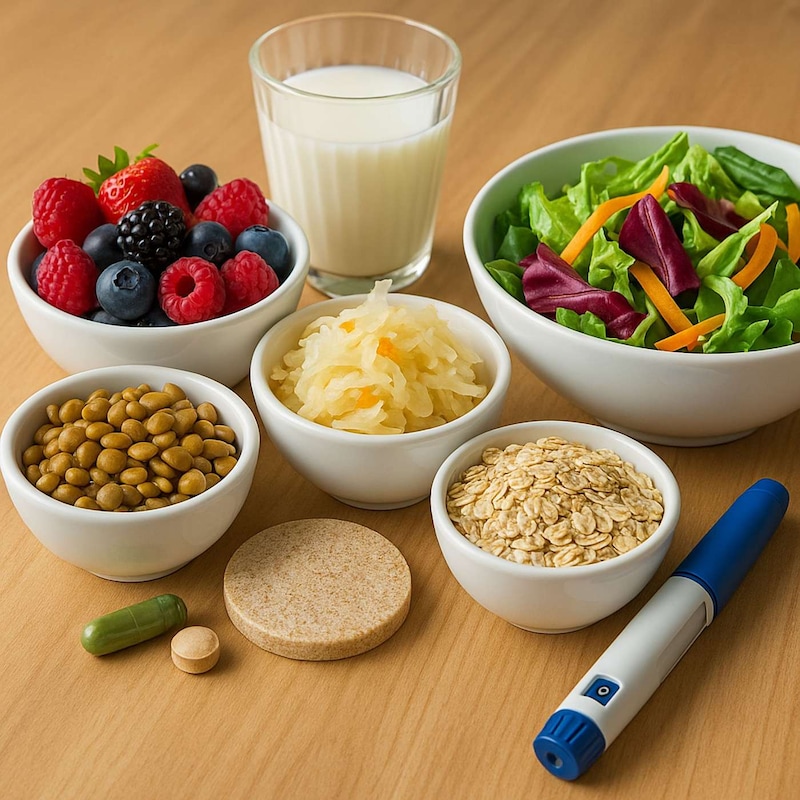
- The Natural GLP-1 Stack offers a real-world, food-first strategy—including psyllium, kimchi, berberine, resistant starch, and strength training for lasting appetite control.
Pick your path—then commit to it for six consistent weeks.
If you’re going the natural route, start with one habit from the GLP-1 stack today.
Transcripts
Natural vs Prescription: Which Appetite Strategy For Weight Loss Really Works?
You’ve seen the headlines. You’ve heard the buzz. Maybe you even know someone who’s dropped serious weight with those once-a-week injections that seem to shut hunger off like a switch.
But what if you’re not ready to spend over a thousand dollars a month? What if the idea of nausea, digestive issues, and a long list of unknowns makes you pause?
And most of all—what if there were a natural way to trigger the same satiety hormones… without the needle?
Today’s episode is about clearing the noise. Because here’s the truth: those injections work by mimicking a hormone your body already makes. It’s called GLP-1, and it tells your brain, “Hey, we’re full. We’re good. Stop eating.”
So here’s the real question: Can you boost GLP-1 naturally—using food, supplements, and a few smart habits—without relying on a prescription?
Spoiler: yes, you can.
And the data backs it up. Soluble fiber, fermented foods, and even certain plant compounds have been shown in clinical trials to raise your body’s own GLP-1. That means gentler appetite control, better blood sugar balance, and fat loss without the side effects.
In this episode, you’ll learn:
What GLP-1 is and how it controls hunger (without naming brands)
Why prescription injections work fast—but come with real costs
How to use natural strategies—fiber, fermented foods, smart stacking—to get sustainable results
So if you’ve been wondering whether you need medication to get results, or whether nature still has something to say—you’re in the right place.
Let’s dive in.
1: What Is GLP-1—and Why Is Everyone Talking About It?
Let’s start with the basics—because before you decide what strategy to use, you need to understand what you’re actually working with.
GLP-1 stands for glucagon-like peptide-1. That may sound complicated, but its job is simple: it’s a hormone released in your gut when you eat. And when it shows up in the bloodstream, it sends a powerful message to your brain:
“You’re full. Stop eating.”
Think of GLP-1 as your internal appetite brake. It slows down how fast food leaves your stomach, helps stabilize blood sugar, and reduces the urge to keep snacking after a meal. In short, it’s your body’s natural portion control system.
Now here’s where it gets interesting: this hormone doesn’t just influence hunger—it also affects cravings, insulin levels, and even how much energy you burn. That’s why researchers have been studying GLP-1 for years in the treatment of diabetes and obesity.
Dr. Kevin Hall, a leading obesity researcher at the National Institutes of Health, explains it like this:
“GLP-1 acts directly on the brain’s appetite centers—specifically in the hypothalamus—to reduce food intake and improve metabolic control.” Source: NIH.gov - Dr. Kevin Hall
So when someone takes a GLP-1–based medication, what they’re doing is mimicking this natural hormone. They’re hitting the same receptors—just harder and longer.
ource: NEJM - Wilding et al.,:But that doesn’t mean the only path to triggering GLP-1 is a syringe.
Your body already knows how to produce it. You just have to give it the right inputs.
That’s what the rest of this episode is about—how to stimulate your own GLP-1 through natural tools like soluble fiber, fermented foods, and specific compounds that boost gut signaling.
Because whether you're taking a prescription or going fully natural, the goal is the same: trigger GLP-1… and keep it working in your favor.
Coming up next: the pharmaceutical fast lane—how synthetic GLP-1 works, and what you give up to get those quick results.
2: Prescription Route—Fast Results, Real Trade-Offs
Let’s not sugarcoat it—prescription GLP-1 medications work.
They’re powerful. They’re fast. And for many people, they’ve been life-changing.
Trial, Wilding et al.,: : Nature - Jastreboff et al.,:That’s the big draw. You don’t have to fight your cravings—they just disappear.
But what most headlines skip over is what it costs—financially, physically, and metabolically.
Let’s start with the money. Without insurance, GLP-1 injections can cost anywhere from $1,000 to $1,800 per month. Some patients get coverage, many don’t. And even with insurance, co-pays can stack up fast. Source: GoodRx
AMA Network - Wharton et al.,:Here’s what Dr. Spencer Nadolsky, a board-certified obesity physician, says:
“You’ve got to monitor protein and resistance training carefully. These meds work fast—but if you’re not strategic, you risk losing muscle, not just fat.” Source: Dr. Nadolsky - via Obesity Docs Podcast
nce. Source: Obesity Reviews,:And then there’s this: what happens when you stop?
Source: JAMA - Rubino et al.,:So yes—this path can work. It’s fast, it’s effective, and it’s backed by science. But it also demands close monitoring, consistent exercise, and an exit strategy for when the injections stop.
Still interested?
Then great—just know what you’re signing up for. Because next, we’re shifting gears and exploring the slower, steadier path: how certain foods and compounds can tap the same hormonal levers—without needles, side effects, or the four-figure price tag.
3: Natural GLP-1 Support—Slower But Smarter?
Here’s the part most people don’t expect:
You don’t need a prescription to boost GLP-1.
Your gut already knows how to do it. The real question is: are you feeding it what it needs to get the job done?
Let’s talk soluble fiber. When you eat foods rich in viscous fiber—think barley beta-glucan, psyllium husk, inulin—your gut bacteria ferment it into compounds called short-chain fatty acids. These signal the release of GLP-1 and PYY, another satiety hormone that helps regulate appetite and reduce food intake.
ical Nutrition - Tosh et al.,:And it doesn’t stop there. Fermented foods like kimchi, kefir, sauerkraut, and kombucha can elevate GLP-1 levels by improving gut diversity and stimulating enteroendocrine cells—the cells that make GLP-1.
A:And then there’s berberine—a bitter compound found in plants like barberry and goldenseal.
Pharmacology - Zhang et al.,:Put these pieces together—fiber, fermented foods, and select plant compounds—and you get a slow, sustained appetite shift that works with your body, not against it.
No daily nausea. No lean muscle loss. No $1,200 bill.
Sure, it takes consistency. You won’t drop 10 pounds in a month. But the weight you do lose is more likely to stay off—and you’re building real metabolic resilience in the process.
Want proof?
Leah, 38, started her own version of the “natural GLP-1 stack.” She added psyllium before meals, swapped soda for kombucha, added leafy greens to lunch, and took berberine with dinner. Four months later, she’s 14 pounds down—and says she hasn’t felt this calm around food in years.
That’s not hype. That’s biology on your side.
So what’s better—fast or sustainable? That’s your call. But next, we’ll put them head-to-head, so you can compare timelines, trade-offs, and results without guessing.
4: Who Wins? Depends on Your Timeline and Tolerance
So—needle or nature? Prescription or produce? Which path actually wins?
Here’s the honest answer: it depends on what you value more—speed, cost, or sustainability.
Let’s break it down:
If your top priority is speed
Prescription GLP-1s like semaglutide deliver fat loss fast.
Clinical trials show an average 10–15% reduction in body weight over 12 to 16 months.
People often lose 1–2 pounds per week—without grinding in the gym.
Cravings fade quickly, and portions shrink automatically.
That’s powerful. Especially if you’re dealing with obesity-related health risks and need aggressive, medically supervised weight loss. Source: NEJM - STEP 1 Trial
But that speed comes with costs:
High monthly expense ($1,000–$1,800 without coverage)
Side effects—up to 44% report nausea, vomiting, or GI discomfort
Lean-mass loss—without resistance training and enough protein, 30–35% of lost weight may be muscle
ace Source: Obesity Reviews -:If your goal is long-term sustainability
Natural GLP-1 tools take a gentler route:
You’ll likely lose ½ to 1 pound per week—modest, yes, but consistent
The weight you lose comes mostly from fat, not muscle
No side effects. No withdrawals. No supply-chain drama.
Foods like psyllium, kimchi, oats, and inulin cost less than $40 a month
In one randomized trial, participants who increased their beta-glucan fiber intake and added fermented foods saw improved satiety and better insulin sensitivity in under four weeks. Source: European Journal of Clinical Nutrition
There’s also the bonus of metabolic flexibility:
You’re strengthening your gut microbiome
Supporting blood sugar stability
Creating routines that outlast trends or prescriptions
As Stanford nutrition researcher Dr. Christopher Gardner says:
“Sustainable change favors approaches you can live with for years—not just drop weight for a season.” Source: Stanford Nutrition Studies Group
So—who wins?
If you need fast medical intervention, and you’re prepared for the cost and side effects, the pharmaceutical route delivers a hard reset. If you want to build lasting results, with more flexibility, fewer risks, and stronger habits, the natural GLP-1 stack gives you tools you can carry for life.
Still unsure?
Then stay with us—because in the next section, we’ll lay out the downsides of each path and how to avoid common mistakes before they trip you up.
5: Common Downsides—And How to Solve Them
Every path has its potholes.
Whether you're using prescription medication or building a food-first routine, the road to weight loss comes with friction. The trick isn’t avoiding it—it’s knowing where the bumps are and how to smooth them out.
Let’s start with the pharmaceutical route.
Prescription GLP-1s: What Can Go Wrong—and How to Fix It
ource: JAMA - Wharton et al.,:How to manage it: • Eat smaller meals more frequently • Avoid fatty, greasy foods during the adjustment phase • Sip ginger or peppermint tea for nausea relief • If symptoms persist, talk to your provider about dose tapering
sue. Source: Obesity Reviews,:How to counter it: • Aim for 0.8 to 1 gram of protein per pound of goal body weight • Prioritize resistance training 3 times per week • Track not just the scale—but also strength, energy, and waist measurements
Source: JAMA - Rubino et al.,:How to prepare: • Build your own sustainable eating plan alongside the meds • Practice food journaling, movement routines, and fiber-based meals • View the medication as a bridge—not a forever plan
Now let’s talk about the natural path. It’s safer—but not friction-free.
Natural GLP-1 Support: Where It Can Go Sideways—and What to Do
1. The pace is slow. You won’t lose 10 pounds in a month—and that can feel discouraging when others are shedding fast.
Solution: Track more than weight. Journal your appetite, energy, digestion, mood, and inches lost. Small shifts add up. You’re not chasing drama—you’re building momentum.
2. You’ve got to be consistent. Psyllium, kefir, and berberine work—but only when taken daily.
Solution: Pair each step to an existing habit:
Fiber with your morning coffee
Kimchi or kefir at lunch
Green tea with your 3 p.m. break
Resistance starch (like cooled lentils or potatoes) with dinner
3. Rapid fiber increases can cause bloating. Suddenly adding 10+ grams of inulin or psyllium can overwhelm your gut bacteria.
Solution: Start low—5 grams per day, then increase by 2 grams every 3–4 days. And hydrate—fiber soaks up water. Aim for 2–3 liters daily. Source: Dr. Barbara Rolls - Penn State
4. There’s a learning curve. You’ll need to read labels, prep meals, and understand basic nutrition. That takes effort.
Solution: Use templates like the Plate Method (½ veggies, ¼ protein, ¼ starch). Follow simple routines, not complicated rules. And don’t aim for perfect—aim for consistent.
5. No built-in medical supervision. If you're not working with a coach or dietitian, it’s easy to miss gaps in protein or micronutrients.
Solution: Check in with a registered dietitian at least once if you’re going solo—especially if you have a medical condition or are taking other medications.
Bottom line?
The prescription route brings faster results—but with more risks, higher costs, and a sharper rebound if habits aren’t built. The natural route requires patience—but it’s gentler, cheaper, and builds habits that are harder to break.
So what’s next?
In the final section, we’ll give you a clear, step-by-step “Natural GLP-1 Stack” you can start right now—no guessing, no gimmicks, just real food and real results.
6: The Natural GLP-1 Stack—A Real-World Plan
No needles. No side effects. No guesswork.
Just a straightforward, science-backed routine to help your body make more GLP-1, curb cravings naturally, and shift your appetite in the right direction—without extreme dieting or expensive prescriptions.
Here’s your Natural GLP-1 Stack: six daily steps that support satiety hormones, stabilize blood sugar, and build momentum.
Step 1 – Morning Fiber Load: Psyllium or Barley Beta-Glucan
Start your day with 10 grams of psyllium husk mixed in water, or a bowl of steel-cut oats or barley.
These fibers slow digestion and ferment into short-chain fatty acids, which boost GLP-1 production.
re. Source: Appetite Journal,:Tip: Start with 5 grams and build up to avoid bloating. Always pair with at least 12–16 oz of water.
Step 2 – Midday Fermented Boost: Kimchi, Kefir, or Sauerkraut
With lunch, add 1 cup of fermented food—like kefir, kimchi, or sauerkraut.
These support gut bacteria that stimulate enteroendocrine cells (the GLP-1 producers).
A:Tip: Rotate sources—try miso, natto, kombucha, or pickled veggies to keep things interesting.
Step 3 – Afternoon Metabolic Assist: Berberine + Green Tea EGCG
Take 500 mg berberine with your largest carb-based meal, and sip 2 cups of strong green tea or take 300 mg of EGCG.
Berberine activates gut bitter-taste receptors, which stimulate GLP-1 release.
e: Frontiers in Pharmacology,:Tip: Take berberine 5 days on, 2 off, to avoid GI adaptation and maintain its effect.
Step 4 – Dinner Plate Method: Volume, Protein, Carbs
Build your plate like this:
½ non-starchy vegetables (leafy greens, broccoli, zucchini)
¼ lean protein (chicken, fish, legumes, tofu)
¼ intact starches (quinoa, sweet potatoes, lentils)
This layout supports satiety, preserves muscle, and avoids post-meal spikes.
Bonus: High-volume, high-fiber meals stretch the stomach and extend GLP-1 activity. Source: Harvard Healthy Eating Plate
Step 5 – 80% Full Rule + Overnight Resistant Starch
Stop eating when you’re about 80% full—a habit from the Okinawan practice of hara hachi bu. Then finish with ½ cup of cooled lentils, rice, or potatoes to boost overnight resistant starch.
n. Source: Nutrients Journal,:Tip: Cook and cool your starches for maximum resistant fiber. Reheat gently or eat cold.
Step 6 – Resistance Training 3× Per Week
GLP-1 helps with fat loss, but muscle protects your metabolism. ‘
Regular lifting or bodyweight training improves insulin sensitivity and helps your body burn fat—not muscle.
nce. Source: Sports Medicine,:Tip: Focus on full-body movements—pushups, squats, rows, deadlifts—whatever suits your fitness level.
Real-World Example: Nina’s Results
Nina, 40, followed this routine for eight weeks:
Morning psyllium
Lunch with kefir
Afternoon berberine and green tea
Protein-packed dinners • Resistance starch at night
Simple strength workouts three times a week
She lost 9 pounds, dropped two inches from her waist, and reported fewer cravings—even on travel days. “It’s the first time I’ve lost weight without feeling like I was fighting my body,” she said.
Key Tips for Success
Ramp fiber slowly: start at 5 g and increase by 2 g every 3–4 days
Hydrate generously: 2–3 liters daily supports digestion and fiber absorption
Track fullness, not just calories: use a 1–10 satiety scale to guide portions
Cycle supplements: berberine 5 days on, 2 off; rotate fermented foods weekly
This is not a detox. Not a diet. It’s a biological strategy—a way to trigger appetite control with foods your body already understands.
And if you stay consistent for 6+ weeks, you’ll begin to feel what prescription users often describe:
A calmer appetite
Less urgency to snack
Smaller portions that actually satisfy
Up next: we’ll wrap it all up with a final decision-making guide—so you can walk away confident about which path is right for you.
Conclusion—Pick Your Path, Then Own It
You’ve got the full picture now.
We’ve cut through the hype and the hashtags. We’ve laid out the science, the benefits, and the trade-offs. And we’ve shown you that no matter what the headlines say, appetite isn’t just something you “fight”—it’s something you can train, support, and shift.
Let’s recap:
Prescription GLP-1s offer speed, medical oversight, and powerful hunger suppression. But they also come with a hefty price tag, potential side effects, and the risk of muscle loss and rebound if you stop without a plan.
Natural GLP-1 support gives you a slower but smarter option: fiber, fermented foods, targeted supplements, and strength training that coax your body into doing what it’s built to do—on its own terms, and at a fraction of the cost.
So which path wins?
The one that fits your life.
If you need fast, supervised intervention—and you’re prepared for the costs and complications—the clinical route may be your launchpad. But if you're ready to build something sustainable, with fewer risks and more long-term resilience, then the natural stack is already in your kitchen.
Here’s the key: decide, then commit.
Don’t jump between methods hoping for a shortcut. Don’t wait for motivation to show up at your door. Pick your path—and give it six consistent weeks.
Because sustainable change doesn't come from the perfect plan. It comes from daily action on the plan you choose.
So what’s next?
If you’re choosing the natural route, scroll back to the GLP-1 stack and start building your routine today. Make one change, then layer in the next. No overwhelm. No perfection. Just progress.
If you want to read the full transcript of this episode and get all the references mentioned, then go to the site at weightlossmindset.co and find this episode.
Don’t just hope for change. Design it. Own it. Live it.




