Shownotes
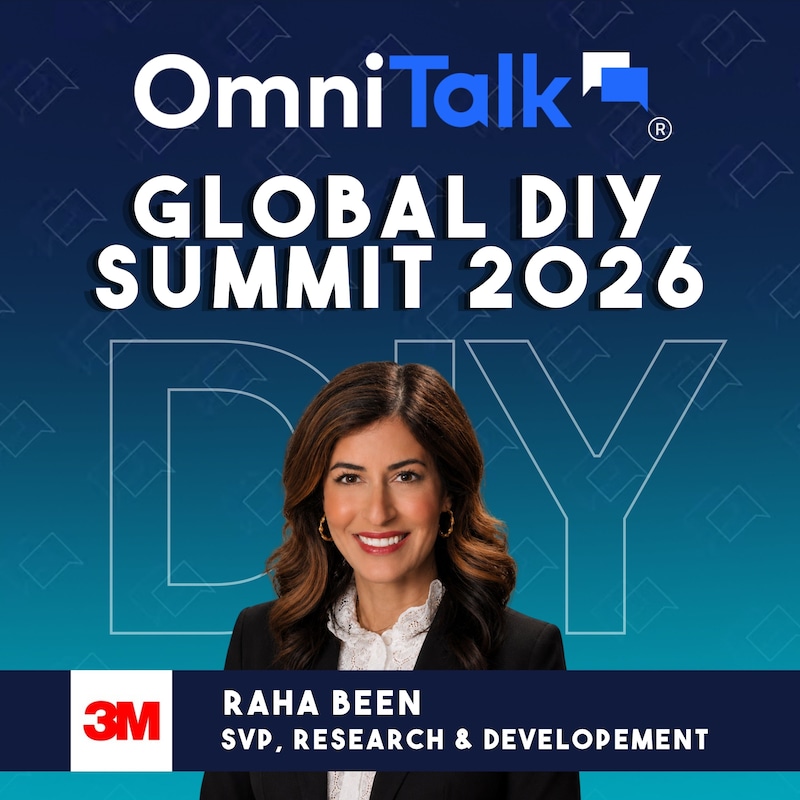
In this Omni Talk Retail interview, recorded live from the Global DIY Summit 2026 in Amsterdam, Chris Walton talks with Raha Been, Senior Vice President of Research & Development and Commercialization, Consumer Business at 3M, about innovation, consumer behavior, and how one of the world's most recognizable brands is adapting to a rapidly changing market.
Raha shares her unique journey from cancer research and molecular biology to leading innovation for 3M's Consumer Business, and explains how the company is accelerating its innovation pipeline while maintaining the rigor and accountability that have defined 3M for more than 120 years.
She discusses how 3M evaluates new product opportunities, the role partnerships play in bringing innovation to market, and why successful innovation requires balancing speed, creativity, and disciplined execution.
Raha also explores how younger consumers are reshaping product development. As Millennials and Gen Z gain purchasing power, expectations are shifting beyond functionality toward personalization, self-expression, and experience. Using Scotch-Brite as an example, she explains how even everyday household products are evolving to reflect changing consumer preferences and lifestyles.
Key Topics Covered:
• Raha Been's journey from molecular biology and cancer research to retail innovation
• How 3M is accelerating innovation under CEO Bill Brown
• Balancing speed, agility, and accountability in product development
• The role of 3M's stage-gate innovation process
• Organic innovation versus partnerships and external collaboration
• How 3M evaluates new product opportunities and risk
• Why Millennials and Gen Z are reshaping consumer expectations
• The shift from utility-driven purchases to experience-driven purchases
• How Scotch-Brite products are evolving for a new generation of consumers
• Why innovation requires both technology expertise and customer understanding
Thank you to Vusion for supporting Omni Talk Retail's live coverage from the Global DIY Summit 2026 in Amsterdam.
This podcast uses the following third-party services for analysis:
Podcorn - https://podcorn.com/privacy
Transcripts
Hello, this is omnitalk Retail.
Speaker A:I am Chris Walton, and we are here once again in the Fusion podcast studio at the DIY Summit in Amsterdam.
Speaker A:And now joining me is a fellow Minnesotan.
Speaker B:Yes, hello.
Speaker A:Yes, fellow Minnesotan, Raha Bean.
Speaker A:She is the SVP of R&D at 3M Consumer Business Group.
Speaker A:Raha, how you doing today?
Speaker B:Oh, I'm doing super.
Speaker B:So happy to be here.
Speaker B:Thanks for having me.
Speaker A:Yeah.
Speaker A:No, it's so funny.
Speaker A:Before we got started, I was like, are you from Minneapolis?
Speaker A:Are you from Minnesota?
Speaker A:Because, you know, you meet a lot of 3m people, but they're not always from Minnesota because it's a very international company.
Speaker B:Yes, you're right.
Speaker B:We are a global organization.
Speaker B:But I am definitely Minnesotan.
Speaker B:But I have figured out how to hold back my accent.
Speaker A:You have.
Speaker A:It's better than me.
Speaker A:You hold it back better than I do.
Speaker B:For sure, if I communicate with friends, the ya bechas and the boats come out.
Speaker B:But when I'm on stage, I learn how to keep at the center of my pronunciation and to keep people guessing.
Speaker B:Where is she from?
Speaker B:Where in the globe is she from?
Speaker B:And it's actually helpful.
Speaker A:Yeah.
Speaker A:Well, you said.
Speaker A:You said you dropped a word on stage this morning that almost gave you away.
Speaker A:What was the word?
Speaker B:It was the.
Speaker B:Oh.
Speaker B:The.
Speaker B:Oh.
Speaker B:It was a word that the long O slipped out on stage.
Speaker B:But because we're at the DIY Summit in Amsterdam, we don't have a ton of Minnesotans here.
Speaker A:No.
Speaker B:So they don't necessarily recognize when the Minnesotan slips out, which is what happened.
Speaker A:Yeah, right.
Speaker A:The Minnesota slipped out.
Speaker B:They caught it quickly.
Speaker A:Yeah, right.
Speaker A:Good, good, good.
Speaker A:You covered it.
Speaker A:You covered it.
Speaker B:I pulled back.
Speaker A:So I've.
Speaker A:I've interviewed a number of Minnesotans before on this program, but, you know, I've never interviewed anyone, I have to say, who has a PhD in Comparative and molecular bioscience.
Speaker B:Oh, thank you.
Speaker A:So tell us about yourself.
Speaker B:Does that make me sound fancy?
Speaker A:It does.
Speaker A:It does actually make you sound very fancy.
Speaker B:I will take it as a compliment.
Speaker A:It makes you sound very, very fancy.
Speaker A:Intelligent.
Speaker B:Thank you.
Speaker B:I will take that.
Speaker B:Thank you.
Speaker B:I take compliments.
Speaker B:I. I take them freely.
Speaker B:My PhD is in essentially, molecular biology.
Speaker B:I spent the first nine years of my career doing cancer research.
Speaker A:Okay.
Speaker B:And so when I first joined 3M, they hired me as a general molecular biologist.
Speaker B: ,: Speaker B:And it was at the time when they had a healthcare business.
Speaker A:Okay.
Speaker B:Since then, they have spun that healthcare business off, and it is now a separate public entity.
Speaker B:But I did start with 3M Healthcare, using my fundamental degree to do product development in our advanced wound care business.
Speaker A:Wound care, Wound care, wound care.
Speaker A:Okay.
Speaker B:Yeah.
Speaker B:So it was my research degree, it was product development, and it was 3M, and it's how I started my career.
Speaker B:And it was a very charmed period of my career.
Speaker A:Is there one thing about wound care that the general populace probably doesn't know?
Speaker B:Yes.
Speaker B:Is that it's an increasing problem.
Speaker A:Really?
Speaker B:Yes.
Speaker B:Because wound care, chronic wounds specifically, are very challenging.
Speaker B:Chronic wounds means you cut yourself, and rather than healing in a stereotypical way or way that your body is meant to heal, you have delayed wound healing.
Speaker B:So instead of the wound closes, it can remain open and get bigger.
Speaker B:And chronic wounds are oftentimes related to other comorbidities, such as diabetes, other cancers, increased age.
Speaker B:And so these are disease states and chronic conditions that are increasing across the globe, which means open wounds and chronic wounds are also increasing.
Speaker B:So this is an area where the research is needed.
Speaker B:And when I was in the field, I felt very motivated by the impact you can make on somebody's quality of life with a new product.
Speaker B:And I was so grateful to Therem for giving me that experience.
Speaker A:Wow.
Speaker A:Right.
Speaker A:That's why you tune in, folks at omnitalk, because you never know what you're gonna learn when you tune into this podcast.
Speaker A:Wow, that was really fascinating.
Speaker A:All right, so you have under CEO Bill Brown.
Speaker B:Yes.
Speaker A:You all at 3M have made a concerted effort to increase the innovation pipeline.
Speaker A:So I'm curious, what has actually changed in terms of the approach to doing that?
Speaker B:That's a great question.
Speaker B:Bill talks a lot about this, and we're really fortunate to have Bill Brown as our CEO.
Speaker B:He's come in and he has done a fantastic job of understanding the rich history of 3M, which is 124 year history history, foundation.
Speaker A:Wow.
Speaker A:I didn't know it was that old.
Speaker B:Yeah.
Speaker B:So we have a long tenure, but if you look at the fundamentals of what makes 3M unique, it's our technology and it's how we bring the innovation to life with products.
Speaker B:And so we marry those two together.
Speaker B:Technology without a product solution isn't going to make an impact.
Speaker B:And so our expertise is that innovation, the cross section.
Speaker B:And so what Bill has come in and done and said, you guys, let's get back to the basics of what has made 3M rich with a long history of growth.
Speaker B: ovation was very different in: Speaker B:And he has empowered the organization to understand and work within the markets that we have.
Speaker B:The market is ever more dynamic.
Speaker B:Our customers, our consumers, our partners are ever more dynamic.
Speaker B:You know, if you look five, 10 years ago, when you looked at innovation cycles or large corporations, smaller corporations, you could set a vision for five to 10 years.
Speaker B:You could focus on two to three things and stay consistent to that.
Speaker B:Now the market dynamics are changing so much, you have to manage quarter to quarter, five to six initiatives, and make sure that you remain agile.
Speaker B:And so underneath Bill's leadership, it's simply about how do you understand the fundamentals of what makes us unique, modernize our existing processes to meet the moment.
Speaker B:And that is with speed, agility and a balanced view of short, medium and long term.
Speaker A:So how do you do that without getting sloppy?
Speaker A:Like, one thing I worry about as a CEO would be like, okay, I'm mandating that, that I want people to create more innovation.
Speaker A:I want to greenlight more projects.
Speaker A:And some people could run that and run with that and be like, yeah, I can just, it's a license to do anything.
Speaker A:So how do you make sure that that doesn't happen in your role?
Speaker B:That's a great question.
Speaker B:So 3M does have a proprietary staged gate new product introduction process.
Speaker B:That was a lot of words, staged gate.
Speaker B:Did you catch that stage gate process that we use internally?
Speaker B:And what it does is it provides a standardized filter to go from an idea, a concept, a consumer need, and then follow it all the way through from your initial hypothesis to asking very critical questions on what is the problem that you're solving?
Speaker B:Are you differentiated?
Speaker B:What is the value proposition?
Speaker B:And then making sure that as you go through each stage gate, what you need to do is just validate your certainty.
Speaker B:So you start with a hypothesis and you have a gist.
Speaker B:And let's just say that if you initiate a new program, you should believe in it.
Speaker B:So let's just say greater than a 50% likelihood that it will add value to your customers and partners.
Speaker B:But as you go through the stage gate process, what we expect and what we use the process to do is to standardize how we de risk our innovation.
Speaker B:It is a process that allows empowerment and creativity.
Speaker B:While the aspects of innovation, which is quality, how to go from idea lab scale up to commercial scale.
Speaker B:There are certain things that are part of innovation that are rinse in repeat.
Speaker B:And what the process does, it gives guardrails.
Speaker B:So we can create the rinse and repeat in a linear fashion.
Speaker B:And therefore individuals on the Teams can focus on what they need to be successful.
Speaker B:The creativity, the differentiation, the go to market model.
Speaker B:What do the consumers need?
Speaker B:And so that's the power of 3M.
Speaker B:So we preserve our history, but we're very agile and understand that innovation means creativity and empowerment as well.
Speaker A:Right.
Speaker A:And it sounds like there's a lot of accountability along the way.
Speaker B:A lot of accountability along the way.
Speaker B:But what does accountability mean to you?
Speaker B:Accountability means ownership.
Speaker B:The ownership to solve a problem.
Speaker B:If you hit a failure point, you don't stop, you don't give up, you pivot.
Speaker B:And that is fundamental to our culture, and that's why we've had such a long tenure of innovation.
Speaker A:Got it, Got it.
Speaker A:All right.
Speaker A:We've moved from wound care to stage gates.
Speaker A:I wonder what other cool words we're going to talk about in the remainder of this podcast.
Speaker B:Really technical stuff I can throw at you?
Speaker B:You tell me.
Speaker A:Oh, God, no, no.
Speaker A:I'm standing next to a molecular biologist.
Speaker A:I'm not going to do that.
Speaker A:All right, so your remit covers pot particularly, too, on the innovation side.
Speaker A:The R and D side particularly covers organic and inorganic growth opportunities.
Speaker A:So I'm curious, when you're evaluating what to do next, how do you decide between what do you build yourself and what do you go acquire?
Speaker B:That is such a great question.
Speaker B:So 3M does look at organic and inorganic.
Speaker B:My role is.
Speaker B:Actually, I have a very long title.
Speaker B:We said a short version of it.
Speaker A:Yes, we did.
Speaker B:At the beginning.
Speaker A:Yes, we did.
Speaker B:I'm head of R and D. Thank you for that.
Speaker B:You're welcome.
Speaker B:That is oftentimes the easiest way to cover it.
Speaker B:But I also lead strategic development, which means partnerships.
Speaker B:So in my function, we do do ma.
Speaker B:We do inorganic, but I do more semi organic or semi inorganic.
Speaker A:Okay, what is that?
Speaker B:Yes, that's a great question.
Speaker B:So 3M fundamentally finds differentiation for our customers through technology.
Speaker B:We know what we're very good at.
Speaker B:We have the 3M periodic table.
Speaker B:We are processing experts, materials experts, adhesives experts.
Speaker B:But we also know that we don't need to be the expert in everything.
Speaker B:And so what we do is we love to offer the best innovation for the consumers.
Speaker B:And if there is an area where somebody has a competitive strength or right to win that's greater than ours, we are humble enough to say that's wonderful, and we would love to partner.
Speaker B:And that partnership is where you can create semi inorganic, and that's what falls within my realm.
Speaker B:So you're looking at partnerships, and it could be a white label, it could be a Licensing deal.
Speaker B:But it's fundamentally rooted in what do you need to commercialize this technology?
Speaker B:And we find the right partners to do so.
Speaker A:And do you take them back through that process you discussed in the last question too, when you do that?
Speaker B:Yes, we marry them in our process.
Speaker B:We have a different view of looking at the process depending on how much of the innovation is done internally versus externally.
Speaker B:And it looks at the risk.
Speaker B:When you're doing new to world technology, there's greater risk.
Speaker B:And so you make sure that you have to de risk it at the appropriate phase stage gate.
Speaker A:Right.
Speaker B:So when you scale it, you have a product that you can reproduce at scale.
Speaker A:Okay.
Speaker B:And reproduce consistently.
Speaker B:And that is extremely important to us, whether we launched fully organically or semi organically.
Speaker A:Okay, got it.
Speaker B:And so we adhere to that quality level and that rigor of innovation to the same degree, but we have a slight tilt on it.
Speaker B:When you're working with partners.
Speaker A:With partners.
Speaker A:Okay, that makes sense.
Speaker A:That makes sense, I think, fundamentally.
Speaker A:Okay.
Speaker A:One thing we haven't talked about is really the consumer yet at this point, at this point in time.
Speaker A:And so, you know, one thing I'm learning at this conference is the DIY consumer, like, seemingly every consumer is changing very significantly.
Speaker A:Like, and the way I would sum it up is there's a lot more people that are less skilled at DIY projects but are trying to do them for the first time.
Speaker A:So I'm curious for this industry in particular, how does that impact, if at all, how 3M approaches, product innovation and product development.
Speaker B:It aligns perfectly with us.
Speaker B:A big aspect of how we innovate is that we take highly technical solutions and we make them as seamless as possible to the consumer.
Speaker B:We will do the technical part.
Speaker B:We just want to solve your problems, make your life easier with our products.
Speaker B: rchasing power will reside by: Speaker B:Gen Z and millennials view their homes differently.
Speaker B:They're investing differently than some of the previous generations, such as baby boomers, Gen Xers, or even elder millennials.
Speaker B:Home ownership is delayed.
Speaker B:We're seeing at the age 30, it was almost double the amount of homeowners when you were looking at the previous generation versus when you look at today's 30 year old.
Speaker B:And so we have to think of, we have to meet the consumers where they're at and think about how do we solve their problems.
Speaker B:They're looking to spend their Time differently.
Speaker B:You know, they're.
Speaker B:You know, when you look at baby boomers, the main value proposition when they were seeking products, whether in the DIY segment or any aspect of their life, was primarily focused around utility.
Speaker B:You know, the younger generations want to experience more.
Speaker B:They want their uniqueness to be felt and experienced in the products that they buy and in the experience that they create when they're using their products.
Speaker A:Huh.
Speaker B:And we have to make sure we shift along with them.
Speaker B:And so we are very aware of the shift.
Speaker B:And we want to respect our heritage and continue to support the dynamics of the consumers that we've had for many years while bringing in more consumers into our categories.
Speaker B:And we think we have the right products and we're well positioned.
Speaker B:But you have to be honest with yourself because the brand awareness and the grassroots way, we have created a lot of franchises.
Speaker B:We're gonna have to speak to a new consumer and start again.
Speaker B:We're ready to do it.
Speaker B:But you have to be open and honest and know that that's the task at hand.
Speaker A:Right.
Speaker A:What got you there is not gonna get you there.
Speaker B:That is correct.
Speaker A:Got you here is not gonna get you there.
Speaker A:That's really interesting though.
Speaker A:I'd never thought about that.
Speaker A:So what you're saying is the older generations were more focused on utility.
Speaker A:I just got a job I need to get done.
Speaker A:I need the confidence the products that I'm going to buy is going to do that.
Speaker A:But you're saying that the younger generations are attaching things like the experience that they feel around the product into their purchasing decision.
Speaker A:What is all that goes into the experience of the product in their purchasing decision?
Speaker B:So of course we're making generalization.
Speaker B:Then of course there's a gradient or a degree.
Speaker B:So I want to make sure I say that.
Speaker B:So we're looking at.
Speaker A:Spoken like a true scientist.
Speaker B:Yes.
Speaker B:Yes.
Speaker B:I just want to make sure that, you know, we're speaking high level for the purpose of this conversation, but we know there's nuance, nuance, geographically nuance, even the subsets of the generations.
Speaker B:So let's talk about, you know, we're at the DIY summit, but the easiest one for me to speak about is Scotch Brite.
Speaker A:Okay.
Speaker B: ty sponge that we launched in: Speaker B:It is, I hope you have one.
Speaker B:It is a green non woven.
Speaker A:Yep.
Speaker B: laminated it was launched in: Speaker A:I've got more than one.
Speaker B:I hope you do.
Speaker A:Thank you.
Speaker B:Please.
Speaker B:Thank you for supporting us in multiple.
Speaker A:Rooms of the house.
Speaker B:Yes.
Speaker B:And I could bore you to death or excite you by walking you through the advanced technology and the innovation that went into that.
Speaker B: In the: Speaker B:At the time, consumers either had aluminum scrubbing pads or they had washcloths.
Speaker B:And so they needed to use multiple tools or if they wanted to adjust how they were cleaning an element, they had to use again, switch out what they were using.
Speaker B:So what Scotch Brite did was they innovated and they created this non woven heavy duty scrubbing pad.
Speaker B:And what the non woven does is it allows the surface area to have multiple contact points and allows you to apply pressure.
Speaker B:And that pressure allows the controllability of how heavy duty you want to scrub.
Speaker B:And of course, if you want to wipe, you flip it over to a cellulose sponge and it works great.
Speaker B: That product was launched in: Speaker B:I have been in our retailers.
Speaker B:When I see an individual, they'll walk by the scouring planogram.
Speaker B:They won't even look at the shelf.
Speaker B:They will reach out, they will grab.
Speaker A:Their Scotch Bright, know it that well.
Speaker B:They throw it in.
Speaker B:Yes.
Speaker A:Because it's generational.
Speaker B:They know it works.
Speaker B:They know 3M is quality.
Speaker B:And therefore why are they going to evaluate the planogram they have what they have.
Speaker A:Yeah.
Speaker A:Now, I have no idea where you're going with this at all.
Speaker A:Keep going.
Speaker A:This is great.
Speaker B:I have a great.
Speaker A:No, this is great.
Speaker A:No, this is great.
Speaker A:No, you're doing great.
Speaker A:No, it's more.
Speaker A:No, it's more like I just have.
Speaker A:No, I can't consist of.
Speaker A:Conceptualize where it's going.
Speaker A:You're weaving a good yarn.
Speaker B:To be fair, I am jet lag.
Speaker A:So you would be both you and me.
Speaker A:Both.
Speaker B:But we most recently launched in January, a new scouring system.
Speaker A:Okay.
Speaker B:Looking at new abrasives, new non wovens, new sponge material.
Speaker B:And it's rather than the green and the yellow that many of our consumers want to see, they don't want us to change it.
Speaker B:The younger generations, they want to feel more uniqueness.
Speaker B:So we launched in brighter colors, purple, pink, green.
Speaker B:We have more modernized handles.
Speaker B:Oftentimes when you shop the Scotch Brite aisle, you'll see that the handles are more toward a utility purpose.
Speaker B:You have white handles.
Speaker B:You can have soap control.
Speaker B:Not soap control, but when you're looking at the younger generation, we're doing more Modern looks that people are proud to keep on their counter versus how hiding underneath your counter.
Speaker B:If you look at the older generation, they have a loyalty to Scotch Brite, and we look at the newer generations up and coming, we want to give them a different experience.
Speaker B:And they may not necessarily.
Speaker B:Some of them do, and we're happy if they do.
Speaker B:They may not necessarily want their green and yellow sponge.
Speaker B:They want something new, fresh, more expressive.
Speaker B:And so we're leaning into that.
Speaker A:Wow.
Speaker A:Okay.
Speaker B:Did I get there?
Speaker A:No, you totally did.
Speaker A:And I was.
Speaker A:And I was just.
Speaker A:No, I was.
Speaker A:I say that as a comment because I was like, I cannot.
Speaker A:You know, usually I can kind of, especially on the merchandise and the product side can usually envision where you're going to go next.
Speaker A:And I was like, I was not thinking that you're going to tell me you were adapting the products for the younger generations to make them feel more, I guess, proud, for lack of a better word, of displaying the products, you know, on their countertops or whatever in their home by way of color.
Speaker A:I wasn't anticipating that at all.
Speaker A:So that's very, very interesting.
Speaker A:All right, well, let's get you out of here on this.
Speaker B:Thank you.
Speaker A:Have you been to this conference before?
Speaker B:Nope.
Speaker B:This is my first time.
Speaker B:I'm so happy to be here.
Speaker B:It was a positive experience.
Speaker B:I hope to come back again.
Speaker B:I was also a speaker here, which I felt.
Speaker B:I felt honored to be invited, but our retailers are here and the openness, the candid conversation, the connections that I made, I'm very excited.
Speaker B:I leave energized.
Speaker A:This has been a really great conference.
Speaker A:Yeah.
Speaker A:A lot of high level executives here, too, which I think is really, really important as a line of differentiation for the DIY Summit, too, so.
Speaker A:Well, thank you.
Speaker B:Yes, thank you.
Speaker A:Thank you for doing that.
Speaker A:That was fun.
Speaker A:We had a good time.
Speaker A:Yep.
Speaker A:Fellow Minnesotan, again, won't say where you're from or where I live because I know there's fighting words between us.
Speaker A:But anyway, thanks to Vuzion and to the DIY summit for asking us at OmniTalk to be here to bring you coverage with all these great executives in and around retail.
Speaker A:And as always, be careful out there.