Shownotes
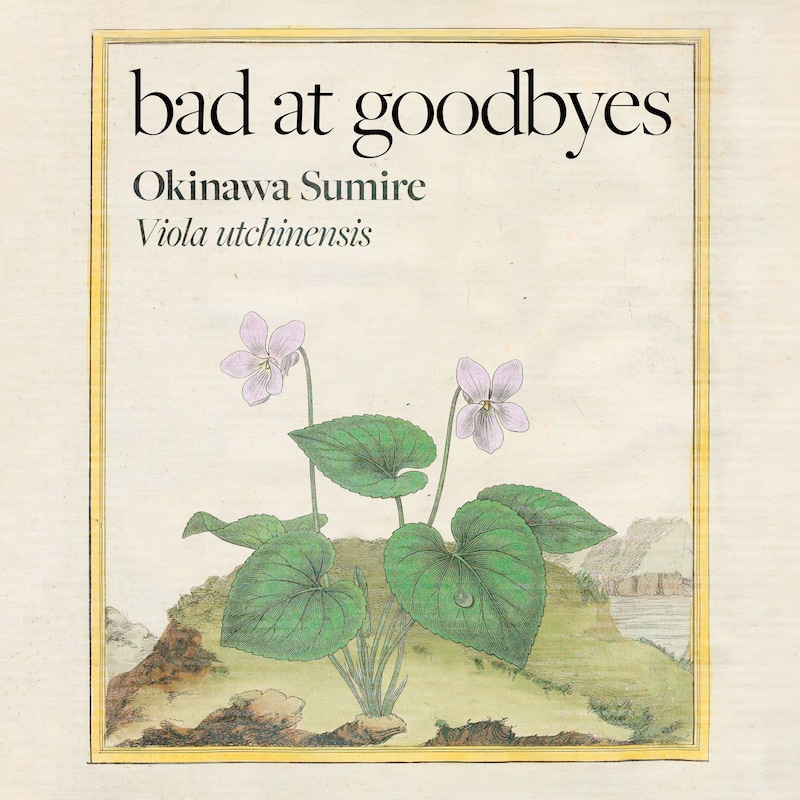
Okinawa Sumire :: Viola utchinensis
Bad at Goodbyes :: Episode 080
On today’s show we learn about the Okinawa Sumire, a critically endangered flowering plant native to the Ryukyu Islands of Japan, in the Pacific Ocean, specifically, the island of Okinawa, roughly 400 miles southeast of the Japanese mainland. Its scientific name is Viola utchinensis and it was first described in 1938.
- (00:05) Intro
- (02:05) Species Information
- (17:56) Citations
- (19:47) Music
- (24:53) Pledge
Research for today’s show was compiled from:
- Beattie, A. J., and N. Lyons. 1975. "Seed Dispersal in Viola (Violaceae): Adaptations and Strategies." American Journal of Botany 62, no. 7: 714–722. – https://doi.org/10.1002/j.1537-2197.1975.tb14104.x
- FamousFix. n.d. "Flora of the Ryukyu Islands." FamousFix. Accessed June 3, 2026. – https://www.famousfix.com/list/flora-of-the-ryukyu-islands
- iNaturalist – https://www.inaturalist.org/observations?captive=false&nelat=26.527232454&nelng=127.974081399&quality_grade=research&subview=map&swlat=26.42028461&swlng=127.849111916&verifiable=any&view=species
- Karnish, A. (2024). "Seed dispersal by ants: A primer". International Journal of Plant Sciences, 185(5), 403–411. – https://doi.org/10.1086/730787
- Koidzumi, G. (1938). "Contributiones ad Cognitioem Florae Asiae Orientalis". Acta Phytotaxonomica et Geobotanica 7 (2): 112–117 [113]. – https://doi.org/10.18942/bunruichiri.KJ00002594478
- Marcussen, T., Ballard, H. E., Danihelka, J., Flores, A. R., Nicola, M. V., & Watson, J. M. (2022). A Revised Phylogenetic Classification for Viola (Violaceae). Plants 11(17), 2224. – https://doi.org/10.3390/plants11172224
- Ministry of the Environment, Japan. 2016. Viola utchinensis. The IUCN Red List of Threatened Species 2016: e.T54081377A54081585. – https://dx.doi.org/10.2305/IUCN.UK.2016-1.RLTS.T54081377A54081585.en
- NYAN. 2026. "Viola utchinensis." Violet Chamber of Flower Photo Gallery. Last updated March 19, 2026. – https://www.io-net.com/violet/violet2/okinawa(e).htm
- Shinmoto, Mitsutaka, Xiaohe Xinli, Anri Nerio, Nagaken Ishigaki, and Lishio Wu. 2011. "Research on Resource Botany of Natural Forests in Subtropical Okinawa." The Science Bulletin of the College of Agriculture, University of the Ryukyus 52. – https://agriknowledge.affrc.go.jp/RN/2030722825
- Sutton, Sharon, and Clara Benecke. 1985. "ARGS Members Visit Japan." Bulletin of the American Rock Garden Society 43, no. 2 (Spring). – https://www.nargs.org/sites/default/files/free-rgq-downloads/VOL_43_NO_2.pdf
- U.S. Forest Service. n.d. "Visual Cues." Celebrating Wildflowers. Accessed June 3, 2026. – https://www.fs.usda.gov/wildflowers/pollinators/Plant_Strategies/visualcues.shtml
- Yousefi, N., S. S. Mehrvarz, and T. Marcussen. 2012. "Anatomical Studies on Selected Species of Viola(Violaceae)." Nordic Journal of Botany 30: 461–469. – https://doi.org/10.1111/j.1756-1051.2011.01266.x
- Wikipedia. n.d. "Viola utchinensis." Wikipedia. Accessed June 3, 2026. – https://en.wikipedia.org/wiki/Viola_utchinensis
Please find us on the web at Bad at Goodbyes and on instagram. Please subscribe and rate/review Bad at Goodbyes wherever you listen to podcasts. Please help spread the word about the show and about the species we feature. Please take care of each other, and all of our fellow travelers.
A note on accuracy: I strive for it! These episodes are well-researched and built from scholarly sources, hoping to provide an informed and accurate portrait of these species. That said, I’m a musician! I am not an academic and have limited scientific background. I may get things wrong! If you are using this podcast for scholarship of any kind, please see the cited sources and double-check all information.
Transcripts
Welcome to Bad at Goodbyes.
On today’s show we consider the Okinawa Sumire.
Species Information:The Okinawa Sumire is a critically endangered flowering plant native to the Ryukyu Islands of Japan, in the Pacific Ocean, specifically, the island of Okinawa, roughly 400 miles southeast of the Japanese mainland. Its scientific name is Viola utchinensis and it was first described in 1938.
The Okinawa Sumire is a small, evergreen perennial in the Violet family with a creeping, low-growing form, reaching heights of roughly eight inches, but many individuals, specifically those most exposed to wind and saltspray in their coastal cliffside habitat, only reach two to four inches in vertical height. So instead the plant grows laterally, spreading horizontal along the rockface, with thick branching roots that snake into cracks and fissures in the stone, anchoring against powerful ocean winds.
The Okinawa Sumire grows clusters of thickened, deep green, heart-shaped leaves, with a waxy sheen, an adaptation to help prevent water-loss, transpiration, and providing protection from harsh sunlight and saltspray. They are an evergreen, they do not shed leaves in autumn or winter, instead retaining chlorophyll and photosynthesizing all year long.
They bloom from February to April, producing light blue, pale purple, purplish-white flowers each about an inch in diameter, with five petals growing from the ends of long slender stalks.
The Okinawa Sumire is likely pollinated by bee, or small butterfly and moth. Its pale petals are lined with darker purplish nectar guides. Nectar guides are veins or patterns or markings on a flower's petals, visual signals that help pollinators quickly locate the flower's nectar. Like directions, like a simple map that indicates where to find nectar, and in doing so, the bees and butterflies also inadvertently collect and distribute pollen.
So, once pollinated, the Okinawa Sumire produces small rounded dehiscent fruit, full of tiny black seeds. Deshiscent describes how the fruit, when mature, dries out and splits open to release its seeds. The seeds fall into the cracks and crevices of the limestone cliffside where they are further distributed by ants. This is called myrmecochory, ant seed dispersal. The seeds have an elaiosome, a small nutrient rich appendage, and worker ants will drag the seeds to their nest to share this food with their colony. They consume the elaiosome, but the seed coat is too thick and tough for the ants to crack, so they simply discard the seed, now underground and ideally in good conditions for germination.
————
In the dream,
A limestone cliff, a kind of monument,
A stone record of a millennia of ocean life,
Raised from the sea by incomprehensible forces.
The rock is kissed by the ocean's salty spray
and to the west a blue dress, unbroken waves and sky.
And there on the cliff face, a button of purple,
A tiny soft violet flirting with the bees
Serving supper to ants,
at the edge of the world.
In the dream.
————
The Okinawa Sumire is native to the island of Okinawa, in the Ryukyu archipelago, roughly 400 miles southwest of the Japanese mainland. Okinawa is fairly small, roughly 65 miles long by about 10 miles wide. The northern half of the island is relatively undeveloped and sparsely populated, while the southern parts are quite urban, housing over a million people.
Our Okinawa Sumire is found in just one location in the middle section of the island, right on the western coast. It grows on limestone ocean cliffsides, in the crevices of raised coral reefs. So raised coral reefs; let's do a little geology:
Coral reefs are bustling underwater colonies built by small invertebrates called stony coral polyps, who extract calcium carbonate from seawater to construct hard, protective skeletons around their soft bodies. As generations of these stony coral polyps live and die, their skeletal remains accumulate, layer upon layer, gradually building up the structures we call coral reefs. This process can take thousands, even millions of years, as the reef slowly grows upwards and outwards.
Over time, the spaces between the coral skeletons become filled with sediments: sand and the remains of other marine animals, becoming more densely packed. Simultaneously, dissolved minerals in the seawater seep into the porous framework, then crystallize and bind the sediments and coral skeletons together. Meanwhile the weight of these accumulating layers, combined with the pressure of the water above, compresses the coral structure, gradually transforming this loose, porous, once-organic material into solid limestone rock.
In the case of Okinawa, the once-coral/now-limestone formation began developing roughly 1.5 million years ago, and then roughly 450,000 years ago tectonic activity lifted the seabed in this region raising the formation above the water's surface, creating islands, the Ryukyu Islands.
So then exposed to the air, the limestone is weathered and eroded by rain, wind, and waves carving the rock, and creating jagged crevices, cliffs, and caves: raised coral reefs. And in the cracks of that limestone, grow the tiny purple blooms of our Okinawa Sumire.
The climate in this coastal region is subtropical, with hot, humid summers and mild winters. Summer highs reach the low 90s°F, while winter lows rarely dip below 50°F. Rainfall is abundant, averaging 80-100 inches per year, with a rainy season from May to June.
The Okinawa Sumire shares its coastal habitat with:
Sago Cycad, Warbling White-Eye, Common Moorhen, Slender Green-winged Grasshopper, Rice Field Frog, Sea Hibiscus, Sword-tailed Newt, Japanese Fig, Western Honey Bee, Ryukyu Flying-Fox, Korean Mulberry, Okinawa Tree Lizard, Plains Cupid, Asian House Gecko, Small Indian Mongoose, Crimson Marsh Glider, Wild Boar, Screw-Pine, Umbelled Rockjasmine, Okinawa Thistle, Joro Spider, Blue Rock-Thrush, White-flowered Black Mangrove, Giant Asian Mantis, Coastal Hog Fennel, Green Sandpiper and many many more.
The Okinawa Sumire faces two anthropogenic, human-caused threats. First poaching, the Sumire has historically been illegally collected from the wild for cultivation in ornamental gardening and for medical use. Today, the plant's rarity and beauty continue to make it a target for illegal extraction.
And human induced climate change, resulting from a persistent over-reliance on fossil fuels, is a looming threat. The Okinawa Sumire's limited range and low population are at risk from extreme weather events, which are increasing in frequency and severity due to global warming. A single extreme weather phenomenon, a strong tsunami, a rockslide, could abruptly drive the Sumire to extinction.
Fortunately the habitat of the Okinawa Sumire is considered a national monument by the Okinawa prefecture, and its entire range is protected in the Okinawa Kaigan Quasi-national Park. Collecting and trading the wild species is illegal.
There are off-site seedbanking and cultivation programs at the Okinawa Churashima Foundation Research Institute and at the Tsukuba Botanical Garden outside Tokyo, with living collections under active study.
ed on the IUCN Red List since:Our most recent counts estimate less than 200 Okinawa Sumire remain in the wild.
Citations:Information for today’s show about the Okinawa Sumire was compiled from:
Beattie, A. J., and N. Lyons.: ,: .: Karnish, A. (: Koidzumi, G. (: cola, M. V., & Watson, J. M. (: ry of the Environment, Japan.: NYAN.: aken Ishigaki, and Lishio Wu.: n, Sharon, and Clara Benecke.: ,: . Mehrvarz, and T. Marcussen.: ,: Music: Pledge:I honor the lives of all Okinawa Sumire. I will commit their name to my record. I am grateful to have shared time on our planet with this being. I lament the ways in which I and my species have harmed and diminished this species. I grieve.
And so, in the name of the Okinawa Sumire I pledge to reduce my consumption. And my carbon footprint. And curb my wastefulness. I pledge to acknowledge and attempt to address the costs of my actions and inactions. And I pledge to resist the harm of plant and animal kin and their habitat, by individuals, corporations, and governments.
I forever pledge my song to the witness and memory of all life, to a broad celebration of biodiversity, and to the total liberation of all beings.




