Shownotes
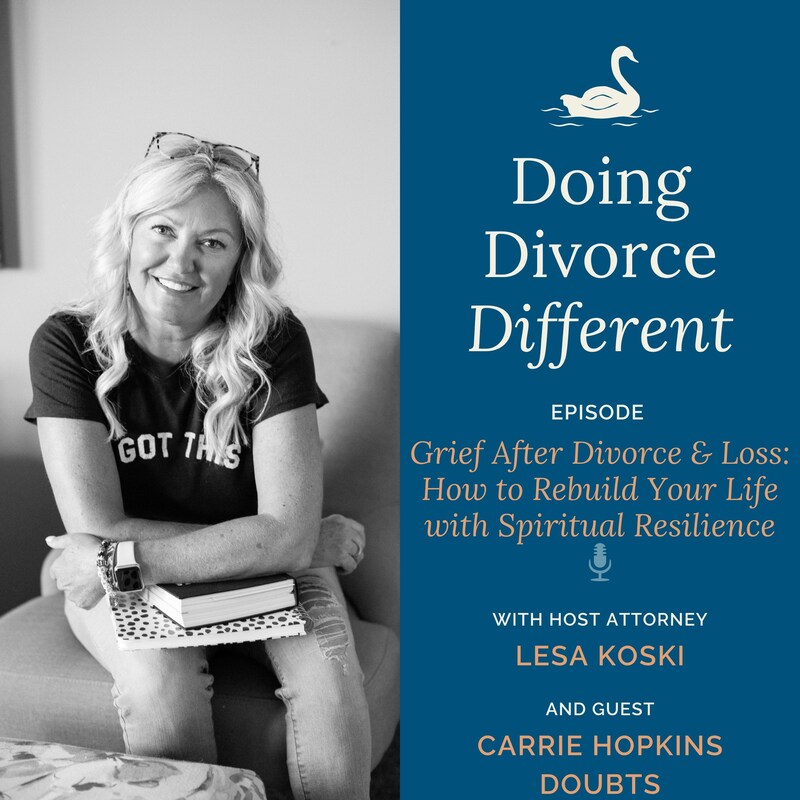
Grief after divorce and loss is real. Learn how to rebuild your life with spiritual resilience, process grief, and move forward after major life transitions.
In this powerful conversation, Lesa Koski sits down with spiritual resilience coach Carrie Hopkins to explore grief beyond death—including divorce, life transitions, and identity shifts. If you’re navigating grief after divorce or loss, this episode will help you understand how to process emotions, create a safe space for healing, and begin rebuilding your life.
Together, they unpack the early stages of grief, why avoiding emotions can make things harder, and how spiritual resilience allows you to move forward—not move on—with strength and clarity.
Timestamps:
(00:00) Introduction to grief beyond death
(02:15) Carrie’s story: loss, divorce, and becoming a grief coach
(05:40) Understanding grief in life transitions
(08:30) Grief after divorce vs grief after death
(11:10) Why we avoid emotions and what happens when we do
(14:25) Step 1: Creating a safe space to feel your emotions
(18:10) Naming emotions and why it matters
(21:05) Step 2: Radical self-care during grief
(24:30) Why neglecting yourself makes grief harder
(27:15) Step 3: Making peace with the past
(31:20) Letting go of judgment and limiting beliefs
(35:10) The danger of idealizing relationships after loss
(39:00) Moving forward vs “moving on”
(42:00) How to begin rebuilding your life
Key Takeaways:
Grief is not just about death—it includes divorce, identity shifts, and life transitions
Avoiding emotions can intensify grief and lead to emotional or physical consequences
Creating a safe space to feel and express emotions is the first step toward healing
Radical self-care is essential to build capacity during difficult seasons
Healing comes from making peace with the past—not staying stuck in it
Guest Bio:
Carrie Hopkins is a spiritual resilience coach and founder of Life’s Next Chapter Coaching. She specializes in helping individuals rebuild their lives after loss, including divorce, bereavement, and major life transitions. Through her Rebuilding Your Life After Loss program, Carrie guides clients to reconnect with their inner strength and create a life they love after grief.
Resource Links:
Carrie Hopkins Coaching: Life’s Next Chapter Coaching
Rebuilding Your Life After Loss Program
Contact: [email protected]
Lesa Koski Mediation & Coaching: Lesakoski.com
Tags/Keywords:
grief after divorce, grief after loss, spiritual resilience, divorce healing, life after divorce, rebuilding after loss, emotional healing, grief coaching, midlife transitions, women over 40, divorce recovery, loss and healing
Transcripts
Welcome listeners.
2
:I am so happy that you're here today.
3
:I have Carrie Hopkins doubts with
me, and it's going to be a really
4
:fun conversation, we're going to
get to know Carrie more through this
5
:episode and Carrie is, well, she's
a spiritual resilience coach, and I
6
:think she helps people a lot of times
through life transitions or difficult
7
:times, kind of rebuilding after loss.
8
:So that's what this episode is about.
9
:grief isn't just about death, it is
about death, but grief can be about.
10
:Divorce going through a different way
of life It can be a lot of different
11
:things So it affects us all even if we
don't realize it even if it hasn't been
12
:someone close to us who's died There
are things that have Moved and changed.
13
:So Carrie, welcome.
14
:I'm so happy that you're here.
15
:Can you just help us get to know you
better and what led you to do this work?
16
:Sure, Lisa Yeah, this is
such a great conversation.
17
:And like you said not a welcome
subject for a lot of people,
18
:but I love talking about this.
19
:I started out as a grief coach, actually.
20
:I had, before becoming a coach done
all the training to become a marriage
21
:and family therapist and got into
my internship and just decided this
22
:was not the career path for me.
23
:It was really to.
24
:clinical too much for me.
25
:I love therapists.
26
:I think therapy is great, but
it just wasn't great for me.
27
:and then I decided to go into
coach training and I got myself
28
:trained and certified as a coach.
29
:I thought, well, why don't I use this
as my specialization in coaching?
30
:And so I started out doing that
just because it's, I'd lost my
31
:mom during the time that I was
in the coach training program.
32
:That was a big loss for me.
33
:My relationship with my mom was,
let's just say, a little tense.
34
:So I loved her, she loved me, but
we didn't get along that well.
35
:So there was a lot of ambivalence in the
relationship, that ambivalent attachment.
36
:And when she died, it really hit me hard
because there was no chance for me to get
37
:the love that I was thinking I was ever
38
:going to get from her
because, the chance was over.
39
:So when I went through that and
decided to focus on grief, I also found
40
:myself focusing on divorce because
that was also part of my background.
41
:I was divorced in 1992 and that was
one of the most challenging, difficult,
42
:painful situations that I'd been
through at that point in my life.
43
:So I found myself working with
people going through divorce, through
44
:bereavement, through job loss, any
of these things where there's an
45
:ending of some normal part of your
life and where grief will come in.
46
:it's really important just to have
somebody to talk these things through.
47
:And then, about three and a half
years, my second husband died suddenly.
48
:Oh, jeez.
49
:Yeah.
50
:so it was not only, okay, I'm
certified as a grief counselor, I
51
:know the territory, I know the maps,
but I got to walk the territory this
52
:time, and sometimes on my hands and
knees, it was incredibly painful.
53
:And to this day now, you know, fast
forward to today, I worked through my
54
:own process using my own program and also
the help of my own coach and I really
55
:adapted to and created a life that I
love on the other side of that huge loss.
56
:So I'm still working with people in
those arenas, but I've recontexted
57
:the work that I do calling it
spiritual resilience, because
58
:that's what we're really going for.
59
:To know yourself as capable, creative,
resourceful, and whole, even when
60
:you're going through grief and loss.
61
:So that, that's my story.
62
:One is if you have a parent that passes
that maybe you weren't, you didn't
63
:get along with, There's still grief
there, you know, and then, the other,
64
:I have someone really close to me
who I have a, several people who have
65
:lost their spouse and, I really want
to help people who go through that.
66
:And you know, yes, you lose
them in divorce and death,
67
:you know, however that works.
68
:But I know in particular, this one
that's very close to me, I think she
69
:has just, Come to the conclusion,
you know, she's handling it.
70
:She's gotten therapy, which I love I
do want to say the difference between
71
:therapy and coaching and I think therapy
is so helpful We all need talk therapy
72
:now and then when I think of coaching I
think of as moving forward of how you're
73
:going to maybe change things in the future
74
:She's a little bit older than me
and they were very, very close.
75
:And I don't know that she has
a lot of hope for the future.
76
:I think there's a lot of feeling like,
well, I'm kind of looking forward to,
77
:to being there with him at some point.
78
:And, and I don't know, maybe that's okay.
79
:And maybe that's normal,
80
:Man, I sure would love
to see her happy, joyful.
81
:And I know with grief, I
think I understand Carrie that
82
:we always carry it with us.
83
:It's always here.
84
:It's that little piece that's
there, but you can still find
85
:joy and yeah, you're changed.
86
:And yeah, there's something different
and you know that that loss is there
87
:I can go and enjoy things as well.
88
:Does that sound right?
89
:Absolutely.
90
:And it depends also on the amount
of time that has passed between the
91
:person's death and now because it does
take time to process through this.
92
:We can still hold that person in our
hearts because they'll always be there.
93
:You know, the love that we felt for
that person, we can feel it still.
94
:You know, I still feel
that for my husband.
95
:I just, it's not in the here
and now and in the present, you
96
:know, and it is important, you
said something very important.
97
:We want to start moving forward
in our lives, not moving on.
98
:You know, a lot of times people
say, Oh, it feels disloyal to move
99
:on because that almost, signifies
that you're leaving them behind.
100
:You're moving on without them.
101
:And so I say, no, we move forward, sort
of adapting to the loss and incorporating
102
:the grief into our lives because
like you said, it doesn't go away.
103
:It will show up as a grief trigger.
104
:All of a sudden you hear a song that
you used to love or, you know, you go
105
:to a restaurant and it's like, Oh yeah,
we used to go here, I've been here.
106
:You know, just, we get a memory
triggered and then the grief can.
107
:Wash over us again.
108
:So it's just, it's sort of I, you know
I am not surprised when that happens.
109
:I just take a breath and it's
like, oh here's grief again.
110
:It's okay.
111
:Just take a breath.
112
:Just cry my tears, you know, do what
I need to do to take care of myself.
113
:And then, you know, I
pick myself up and I've.
114
:rebuilt my life after that great loss.
115
:And I moved from, we lived in Arizona.
116
:That was the place he wanted
to retire after he was gone.
117
:It's like, I don't want to live here.
118
:So I moved back to the Los Angeles
area and I'm right around the
119
:corner from where my daughter lives.
120
:And so, you know, I, I've created a new
life for myself and one that I love.
121
:Yep, that's that's fantastic.
122
:And so I kind of want to as I'm sitting
here listening to you I want you to help
123
:me if we can I know we don't have a lot of
time But can we talk about okay, so in the
124
:beginning stages when this is brand new
now the friend I'm telling you about it's
125
:You know, over a couple of years, right?
126
:Which who knows?
127
:We're all different.
128
:I don't know how long it takes, but
I know, I understand that there has
129
:to be a time where you have to sit.
130
:And what I love that you said is
that you'll get a wave of grief
131
:and you sit and you feel it.
132
:I don't know if this is normal,
but I feel like I would run away
133
:from those feelings all the time.
134
:Oh, I can't feel this way now.
135
:Cause we don't want to,
who wants to feel that?
136
:So just for the audience to realize
if you're like me and you run
137
:away from those feelings, cause
you don't want to feel them.
138
:They are going to be worse or come out a
different way So feel them feel them and
139
:then it's almost like they can dissipate.
140
:I know sometimes it's hard if
you start You know reeling in it.
141
:That's where you can kind of have
issues But okay So what I'm kind of
142
:thinking of let's go through some stages
like if someone's brand new into this
143
:brand new into a loss I mean, I know
when I've gone through something hard.
144
:I sit and cry You And I think, I don't
know, even when my oldest daughter
145
:went to college, I was like, I don't
know if I'm going to get over this
146
:but what do people do in that, in
the early beginning stages of either
147
:divorce or death or, diagnosis that
scares them and change, whatever it is.
148
:Right.
149
:Well, that first stage is exactly, you
know, the first step in my Rebuilding
150
:Your Life After Loss program, which
people going through divorce, people
151
:going through bereavement, you
know, all kinds of people take this.
152
:It's a program, just designed for
grief, no matter what the context.
153
:But the first step is creating a
safe space, a safety net for yourself
154
:to feel, to heal your feelings.
155
:And I shouldn't say heal your feelings
because we don't really heal them, but
156
:we experience them, we bring them in, we
welcome them, say, Oh, here's sadness.
157
:Sadness is here.
158
:we feel it, we name it, you know,
so it's really important to name it.
159
:A lot of times people, you know, just
slowing down and naming it helps the
160
:brain sort of integrate what's going on.
161
:So you feel it, you
name it, you express it.
162
:And so that's where another, a safe other.
163
:really comes into play.
164
:You need a place, a person, a vehicle
for you to express, you know, safely,
165
:without any judgment, without people
needing to fix you, without people
166
:needing to minimize your feelings.
167
:often a coach or sometimes it's just
a trusted friend, maybe somebody
168
:who's gone through something like
this, and they know how to companion
169
:with you and just be there for you.
170
:while you express it all.
171
:and so that's a very important first step
because like you said, Lisa, if you don't
172
:do this, if you try to shove it away
or avoid it or numb it or, do all those
173
:things that we do, it's not going away.
174
:So what it will do is it hangs out
in our subconscious, our unconscious,
175
:comes up in these really overblown
reactions that we have to life where,
176
:you know, road rage, something like that.
177
:it also can go into body.
178
:So it can go into the, the tissue of
the body and somaticize, become illness.
179
:There's lots of research about,
unresolved or unmet grief, can
180
:lead to a person's illnesses.
181
:So it's really important, like you said,
to have a safe place, a safe container.
182
:to feel, to release these emotions.
183
:And like you said, once you've released
it, once you've really given it that
184
:safe space inside of you, like you invite
it to tea, like come sit down, talk,
185
:what have you got to share with me?
186
:It has a message for you.
187
:And then once it's delivered its
message, it goes on, and then you have
188
:the next feeling, whatever that is.
189
:Right.
190
:Okay.
191
:You said that is the first
step to your rebuilding steps.
192
:How many steps do you have?
193
:I have a nine step process.
194
:Boy, I don't know if we're going
to be able to get through all nine.
195
:Yeah, we probably won't, you
know, but that's okay because,
196
:you know, even just the first few
steps is an important, you know.
197
:It's just realizing, bringing awareness
can sometimes, be all you need.
198
:Mm hmm.
199
:I know.
200
:Yes.
201
:Just knowing that first step is, I
really need to create a safe space
202
:for me to feel all of these feelings.
203
:You know, grief, it's
going to bring them all.
204
:It's going to bring,
you know, sadness, hurt.
205
:anger, relief, you know, we have so
many feelings, and they're all normal,
206
:Yeah.
207
:And I want to say, and this on
my, divorce, I have lisakosky.
208
:com.
209
:If you want to go there,
I have a Facebook page.
210
:Feelings wheel.
211
:And sometimes I look at that so
you can grab it there that you
212
:can probably find them online too.
213
:But sometimes if you're having trouble
naming it, that can be helpful.
214
:That's right.
215
:You know, when people say,
well, how are you feeling?
216
:You know, and their answer is I feel good.
217
:Right.
218
:That's not a feeling that's a label.
219
:Okay.
220
:So that's the first step.
221
:Mm hmm.
222
:What's number two?
223
:Second step is creating capacity
through what I call radical self care.
224
:You know, because when you're grieving
any kind of loss, often if you are
225
:having to help your kids through this
as well, say with a divorce, or you
226
:know, you're now a single parent.
227
:You know, where you had the, the help
of your spouse before in raising kids,
228
:it's often so common, really, for
you to neglect your own self care.
229
:And so we start to talk about,
well, how is grief affecting
230
:you on the physical level?
231
:A lot of times it's,
I'm not sleeping well.
232
:I'm not eating well, I'm not
exercising, I'm not doing all those
233
:things that, we all know we should
do to take care of ourselves.
234
:But what people don't recognize
is if they don't take care of
235
:themselves first, they don't have
the capacity to take care of others.
236
:It's like putting your own oxygen
mask on first before, you know, like
237
:they say on the airplane, right?
238
:You have to have your own oxygen
before you can help other people.
239
:I think that is something that we
all know, but that we rarely do.
240
:when you're grieving, you're
even more physically depleted
241
:than you would be normally.
242
:Yeah.
243
:And then, yeah, we forget, you
know, to take care of ourselves.
244
:Okay.
245
:Third?
246
:Third is making peace with the past.
247
:And so when we are sort of unpacking what
has led us to the present moment where
248
:this person, either through a divorce
or bereavement, is no longer part of our
249
:lives, it's going to bring up Some of the
250
:memories, the, the things that were
unresolved in those relationships.
251
:And this is where we take, really
slow things down and look at that.
252
:You know, what judgments am I holding
against that person or myself?
253
:And this is where we get free of these
limiting beliefs that we've got going
254
:on about the nature of relationships,
the nature, you know, it's like we
255
:make up meaning, about, well, I guess
I'm just not cut out for marriage
256
:because I failed at it three times,
whatever, you know, and people really
257
:hurt themselves by hanging on to these,
untruthful, beliefs about themselves.
258
:So we really take a look at the past,
not as a way of ruminating about it
259
:or anything like that, but just to
look at the dynamics that perhaps
260
:maybe created the relationship
issues that you were having.
261
:Sometimes, also, it's, helpful in a
divorce, but also when somebody passes,
262
:for instance, for myself, looking at
all the judgments that I held against
263
:my mom or myself and, forgiving myself,
forgiving myself for the judgments
264
:I placed against her, that I placed
against myself as not being a good
265
:daughter, not being a good enough
daughter, you know, all of those things.
266
:So we really free up a lot of
that energy that is going on.
267
:gotten stuck in the past.
268
:I remember hearing people telling
me that sometimes you can.
269
:Remember them as perfect, perfect in every
way and not really see them how it was.
270
:Is that anything?
271
:Yes.
272
:That's really smart.
273
:I like that you brought that forward
because, you know, if you've ever had
274
:children and you go through childbirth
and then, you know, you have this
275
:baby and, oh, it's so wonderful.
276
:And you forget about all that.
277
:That's what our minds do.
278
:we, we tend to minimize or
forget the painful things.
279
:So that's often what happens.
280
:You also like enshrine this person.
281
:Yeah.
282
:Put them up on a pedestal.
283
:You know, he was the love of my life.
284
:She was the only one for me,
you know, and you're right.
285
:It's like we have forgotten about
the fights we used to have or
286
:that this person wasn't perfect.
287
:So it is important to be honest and
you're looking back in the past.
288
:And, you know, it's like, well, this part
of it drove me crazy, but, it doesn't.
289
:If you enshrine that person,
it really makes it difficult to
290
:move forward in any other kind of
intimate relationship because you
291
:feel like it would be a disloyalty.
292
:Yeah.
293
:that's interesting.
294
:And I'm thinking, even when I think
about my grandpa, he was a King.
295
:He was perfect now
296
:and maybe that was okay that I
felt that way when I was young.
297
:And then as I have grown, I can see there
were things that he did that weren't
298
:amazing and great and that's okay.
299
:And I can still love him.
300
:But.
301
:I wondered how that would play in
if you, for future relationships, if
302
:you did have them on that pedestal,
you can still say, Hey, I'd take him
303
:chomping his gum in my ear in a second.
304
:But that it wasn't all just to be real.
305
:Just to be real, you know, when we shine
a light on something and then we put
306
:that spotlight of perfection on somebody,
we're forgetting that there's shadows,
307
:there's gonna be shadow, you know?
308
:And so it's really important that we
look at somebody with the light and with
309
:the shadow, that we look at ourselves
with the light and with the shadow.
310
:Because often what we'll do if we
find that we have objectionable
311
:traits or behaviors That we don't
accept about ourselves, we can
312
:project them onto that other person.
313
:Similarly, we can do
a positive projection.
314
:We take all the, the things that
we haven't owned about ourselves
315
:that are really wonderful.
316
:Oh, this person was so smart.
317
:He was so gorgeous.
318
:He was kind.
319
:It was like, and these could be
unowned aspects of ourselves that
320
:we're projecting onto that person.
321
:We're not seeing the person
as they truly are or were.
322
:We're seeing our projection.
323
:So that's part of what we look at
in this third phase of the program.
324
:We look at owning and accepting
those projections and bringing
325
:them back home and go, I sometimes
treat myself like this too.
326
:If it's a negative projection, or
I treat other people like that.
327
:And it's interesting because
isn't that unconditional love.
328
:is loving their shadows too?
329
:Unconditional love is not
easy to do in a relationship.
330
:You know, that's the spiritual
level of unconditional loving.
331
:the loving of the universe, of God,
whatever people's spiritual beliefs
332
:are, that's where unconditional love is.
333
:But we have conditioned love in
relationships, but the more that we can
334
:do our own work in relationship, whether
it's a current relationship or a past
335
:relationship, The more that we can own our
own stuff and take responsibility for it,
336
:the more that we can have happy, really
productive and loving relationships.
337
:Now.
338
:Yeah.
339
:Now.
340
:Yeah.
341
:Yeah.
342
:So good.
343
:Yeah.
344
:So good.
345
:And so I'm looking at the time, Carrie.
346
:I can't wait.
347
:Like I'm actually talking.
348
:Oh my gosh, look at that.
349
:I know.
350
:I think I'm talking
more than I usually do.
351
:Ooh.
352
:And this is what I'm wondering.
353
:Would you come back on?
354
:I'd be happy to.
355
:And then we could talk about
the, so did we get through three?
356
:We got through three, you know,
cause that, that's really a good
357
:place because that's setting
the foundation for what's next.
358
:All right.
359
:I won't say what's next.
360
:All right.
361
:Well, we'll be sitting here
anticipating what's next.
362
:And I'm going to see if I can get us
scheduled here when we're done on this,
363
:but I just have to, I so appreciate this.
364
:And I get, I got lost in it because
it was so fun to learn from you.
365
:So thank you.
366
:Thank you for going through something
hard and using it to help the world.
367
:That's such a blessing.
368
:And I want you to know that I see that.
369
:And I'm very, very grateful.
370
:So and then Keri, if our listeners
want help from you, we'll have
371
:your information in the show notes.
372
:But how's the best way?
373
:What's the best way to get,
reach out and work with you?
374
:Oh, the best way to reach me is my company
is called Life's Next Chapter Coaching.
375
:And that's really what we're
doing is we're creating your
376
:life's next chapter after chapter.
377
:you know, whatever you're going
through has, is, is, resolving itself.
378
:So they can reach me at, Carrie
at Life's Next Chapter Coaching.
379
:They can visit me on my website.
380
:There's lots of resources.
381
:There's information about my Rebuilding
Your Life After Loss program.
382
:And so, yeah, that's the
best way to reach me.
383
:Wonderful.
384
:So listeners, if you need a little help
in this area, at least go look at those
385
:free resources or reach out to Carrie.
386
:So Carrie, I'm so excited that
you're going to come back and
387
:thank you so much for being here.
388
:Well, Lisa, thank you for
this great conversation and
389
:for having me on your show.
390
:I really appreciate it.
391
:My pleasure.
392
:You take good care.
393
:Yeah, you too.