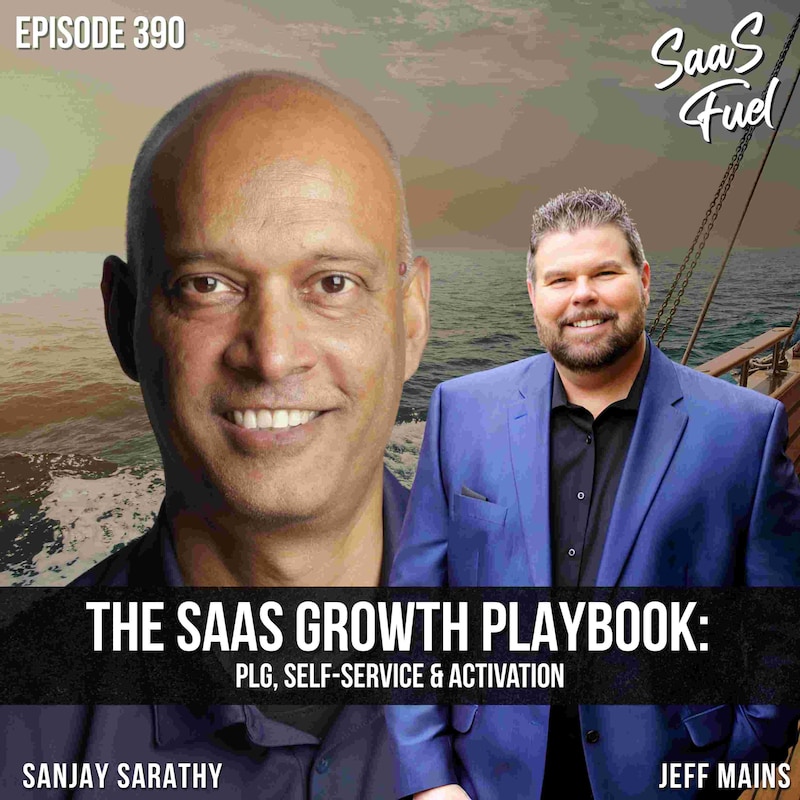
If your SaaS product delivers genuine value fast, growth takes care of itself. That's the core thesis Sanjay Sarathy has spent 8+ years proving at Cloudinary, where he oversees a self-service business representing nearly a third of the company's revenue across 11,000+ paying customers in 150+ countries — without feet on the ground in most of them.
In this episode, Sanjay breaks down what product-led growth actually looks like when it's executed well: not just free trials and clever onboarding flows, but building such a frictionless, valuable experience that developers naturally tell other developers. He shares why Cloudinary invested in technical support before marketing, how they redefined "activation" to mean real value (not just uploading a file), why discoverability is a non-negotiable pillar of their growth strategy, and how they're now rethinking the developer experience for a world where AI agents and LLMs are writing the code.
This is a masterclass in developer-led PLG from someone who has lived it at scale.
Key Takeaways
4:07 — The Growth Levers Have Changed SEO, outbound, and paid are still valid, but word of mouth (especially in developer communities), AEO, and agentic discoverability have become powerful new growth engines — when they're earned as a byproduct of value, not engineered as a primary goal.
8:28 — Why PLG Before Enterprise Cloudinary was built by developers for developers. They started with self-service because that's what their founding team would have wanted. Only after PLG proved itself did enterprise customers come knocking — and it was far easier to layer on security, SLAs, and support than to bolt on a product that developers already loved.
13:46 — Great Product Isn't Enough Without Distribution Cloudinary is in 150 countries with no boots on the ground in most of them. SEO, developer relations, and a docs site that functions as a discovery engine are what made global reach possible. Distribution and product must go hand-in-hand.
15:36 — Discoverability Is a Strategy, Not a Tactic "Discoverability" is a recurring internal theme at Cloudinary — constantly asking how to ensure the right people, in the right context, can find and experience the product's value.
16:03 — The Cannibalization Trap Cloudinary made the mistake of launching a new product without considering its impact on existing products — and cannibalized their own business. They now use a two-track product strategy: "mature" products with full go-to-market support, and "invest" products being validated for product-market fit before scaling.
19:24 — Invest in Support Before Marketing One of Cloudinary's earliest and most impactful decisions: invest heavily in technical support first. Happy, successful developers become word-of-mouth advocates. That bet paid off across an entire community.
21:06 — Developer Experience in the Age of AI Tooling Developer experience today means meeting developers where they work — VS Code, Cursor, Claude, Windsurf. Cloudinary built a VS Code extension and is working to minimize hallucinations by giving LLMs accurate, context-rich instructions for using Cloudinary correctly.
24:03 — Redefining Activation Uploading a file to Cloudinary is not activation. Doing something with that file — transforming it, tagging it, delivering it — is activation. Reframing their metric around genuine value changed how they prioritized onboarding.
33:25 — The Seven-Day Activation Window Data shows clearly: if users don't activate within the first 7 days, a second surge doesn't come. Most activation happens in the first 4–5 days. This insight shapes everything about how Cloudinary approaches onboarding urgency.
27:01 — Speak Use Cases, Not Features "We have automated image optimization" means nothing. "Your images are 40% lighter and you'll save X on bandwidth" means everything. The language of outcomes and use cases is what drives adoption and expansion.
36:39 — Pricing Must Communicate Value Cloudinary's self-service pricing has remained largely flat for years while the product has added enormous capability — intentionally improving the value/price ratio over time. They also offer pay-as-you-go flexibility for seasonal businesses.
44:28 — The 90-Day PLG Focus: Build Trust For founders building a PLG motion right now, Sanjay's single most important recommendation: engender trust. Do what you say. Follow up when you say you will. Make your product deliver on its promise. Trust is the flywheel.
Tweetable Quotes
"We never set out to get word of mouth. We set out to create value. Word of mouth was the byproduct." — Sanjay Sarathy
"If your product genuinely helps people win, growth becomes a natural byproduct." — Sanjay Sarathy
"Distribution is equally as important as the product itself. You can have a great product and go nowhere." — Sanjay Sarathy
"Discoverability isn't a campaign. It's a strategy." — Sanjay Sarathy
"Uploading a file isn't activation. Doing something valuable with it is." — Sanjay Sarathy
"If a developer doesn't activate in the first seven days, don't expect another surge. It won't come." — Sanjay Sarathy
"Stop talking about your features. Start talking in the language of your customer's use cases." — Sanjay Sarathy
"We're okay with free users who are actively using the product. They pay us back in word of mouth." — Sanjay Sarathy
"In a PLG motion, trust is the flywheel. Without it, everything else breaks down." — Sanjay Sarathy
"We fell in love with our own capabilities and forgot that customers don't care. Use cases are what drive adoption." — Sanjay Sarathy
SaaS Leadership Lessons
1. Build Distribution Like You Build Product Cloudinary reaches 150+ countries without sales reps in most of them — through SEO, developer relations, documentation, and community. Great products disappear without intentional distribution. Your discoverability strategy is a growth strategy.
2. Earn Word of Mouth — Don't Engineer It The moment you prioritize getting word of mouth over generating it as a byproduct of genuine value, you've lost the plot. Build something that makes people win, then step back and let them talk. The data will tell you if it's working.
3. Start Narrow, Validate, Then Scale Cloudinary's "invest vs. scale" product framework exists because they once cannibalized their own product line by expanding without rigor. Validate product-market fit in a controlled way before committing the full go-to-market machine. Repeatability before scale.
4. Redefine Your Activation Metrics Around Real Value Ask yourself: is the action we're measuring actually a moment of value, or just a moment of presence? Cloudinary stopped counting uploads and started counting transformations. The metric you optimize shapes the product you build.
5. Invest in Customer Success Before You Think You Need To Cloudinary prioritized technical support ahead of marketing in their early days. Counter-intuitive — and it was exactly right. Successful users become advocates. That investment compounded for years through word of mouth and developer trust.
6. Speak the Language Your Customer Thinks In "Automated image optimization via F-Auto" is internal language. "Your images are 40% lighter and your site is faster" is customer language. The translation layer between what your product does and what your customer achieves is where adoption lives or dies. Build that bridge deliberately.
Guest Resources
[email protected]
www.cloudinary.com
https://www.linkedin.com/in/sanjaysarathy/
https://x.com/guffnuff
Episode Sponsor
The Futureproof Series - https://www.youtube.com/playlist?list=PLfkXKUPZ5xuOqMPR7_gzGybncTtavyR1N
The Captain's Keys
Small Fish, Big Pond – https://smallfishbigpond.com/ Use the promo code ‘SaaSFuel’
Champion Leadership Group – https://championleadership.com/
SaaS Fuel Resources
Website - https://championleadership.com/
Jeff Mains on LinkedIn - https://www.linkedin.com/in/jeffkmains/
Twitter - https://twitter.com/jeffkmains
Facebook - https://www.facebook.com/thesaasguy/
Instagram - https://instagram.com/jeffkmains