Shownotes
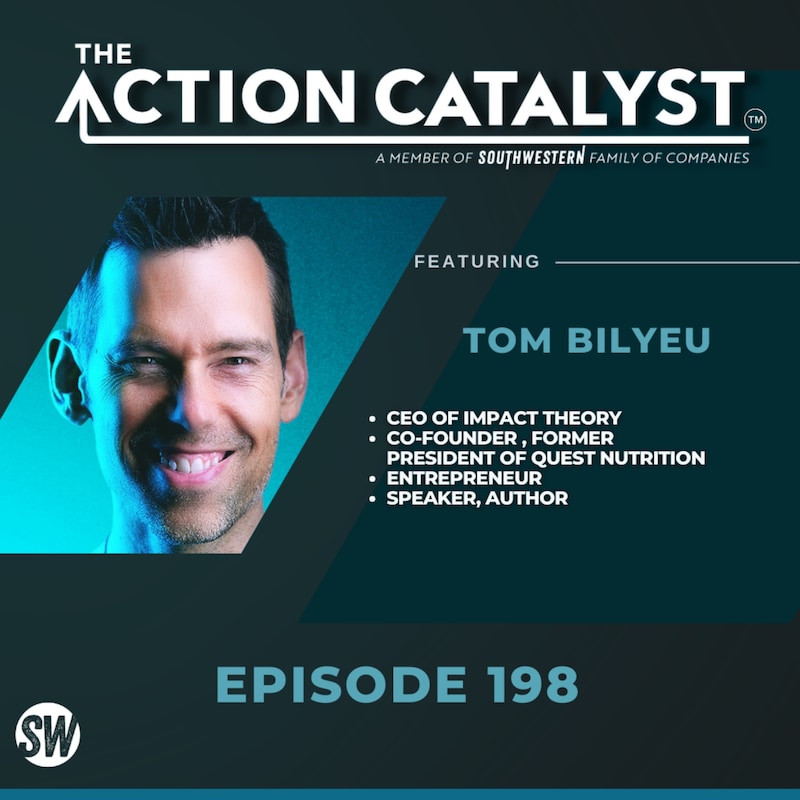
Tom Bilyeu, co-founder of unicorn company Quest Nutrition and CEO of Impact Theory, lays out the impact of acting for ONE vs many, talks about making their own manufacturing equipment, pulling people out of The Matrix, becoming the new Disney and adopting a Jedi mindset, and waxes poetic on the impossibility of impossibility.
Transcripts
He's the co founder of a company called Quest Nutrition,
Tom Bilyeu:to do the hard work to execute, there is surprisingly little that's actually off limits. So that was a big thing for us and and the on the marketing side. The real step forward was recognizing that social media wasn't just a distraction, that it was really something that was going to powerfully allow us to build community, which we believed was just going to be at the core of what we were doing, because we were coming off the back of building a technology company. It was really about money. And certainly, I'll speak for myself, I was showing up every day chasing money. That was it. My goal was to get wealthy. And I wasn't thinking about, you know, who I was trying to become as a human being, or what I wanted to do for the customer. I was just thinking about, you know, how do we make a lot of money? And I totally burned out on that. And I went into my partners, and I quit, and I said, Look, I can't do this anymore. Like I need to be passionate. I need to do
Tom Bilyeu:something that makes me feel alive. I need to love what I'm doing every day. And so they felt the same, and it ends up being this really cathartic, beautiful moment. And we decided that we're going to sell that company and that we're never going to chase money again. We're going to build something that's predicated entirely on delivering value to the income. Tumor and that that's going to be our filter, that's going to be the driving force. So we're going to put a mission at the center of our business. We're going to think about that. We're not going to worry about, you know, maximizing every dollar. We're going to play the long game and really do something that we thought was beautiful for humanity, and once that was our driving force, once we could wake up every day and feel good about what we were doing. We could ignite our passions. I could show up thinking about, you know, my mom and my sister was so intimate. It was so personal for me. Then it became very easy
Tom Bilyeu:to fight through all the things that we have to fight through, to make the hard decisions, to go in and learn manufacturing, which is a massive undertaking, and all of that, that confluence of all of that, of building community, being our own manufacturer, making something that had never been made before, really, really wanting good things for our customers, you just put that all together with the right timing, and it just went crazy.
Host:There was something in your voice when you said your mom and your sister, man, that really seemed to be the essence.
Tom Bilyeu:Definitely. And there's a quote that's often attributed to Mother Teresa. I can't confirm that it was actually her that said it, but whoever said it is very powerful, which is, nobody will act for the many, but people will act for the one. So once you have, you know, like you're saying, once you have that name at the top of the page, and you know exactly who you're talking to, you know exactly who you're trying to help or touch, you know, whatever it is like when it's real, when it's somebody you love and somebody you care about, like, all of a sudden, putting in the hard work, showing up, fighting through difficulties, it becomes so much easier because you know why you're doing it.
Host:Tell us how did you end up making your own equipment?
Tom Bilyeu:Well, we just assumed we were always going to be using a contract manufacturer. You know, we were marketers, and that's what we knew how to do. And so we thought, okay, we'll go, we'll do the formulation. We'll take it to a manufacturer. They'll make it for us, nice and simple. And we went to manufacturers, and they also the same thing, which is this bar can be made. So if you want to make it, you have to make some concessions, because it just isn't going to run through the equipment. And so at that moment, I realized, Okay, I think a lot of people have heard this before. A lot of people have formulated a bar that is what we're trying to make, which is delicious, but also good for you. But when they hit that obstacle, they didn't even think anything other than to change the product to fit the equipment. And when my partner suggested that we instead change the equipment to fit our product, which actually, in fairness, the first step was just, oh, we should do
Tom Bilyeu:it ourselves, because almost certainly they're just not working hard enough. And, you know, they can't make it profitable, and that's really the problem. And so we bought traditional equipment first and found out, hey, they're actually right. It actually won't run through this equipment. And my other business partner was looking at the equipment. He's an Iowa farm boy. He's looking at and he's like, You know what? I actually think I know how to re engineer this to make it work. And so he himself cut it apart, put it back together, and it worked. And that's when we realized, whoa, like, if you're really willing to go all the way to figure out what you have to do to re engineer like there is nothing you can't do. And so we started, instead of just buying equipment off the shelf, we started either building things from scratch, working with engineers. I mean, this isn't like us with CAD this is, you know, we're going out finding engineers that can help us do this, but designing our
Tom Bilyeu:own equipment, or buying equipment off the shelf and then restructuring it, re engineering it so that it'll work for our product. So that was that was really a big breakthrough moment, and was one of the things that excited me most about working with my partners, was just that mindset that we could do anything that we put our minds to and and that's always been intoxicating for me, and has been something that I've routinely like even now with my new company, Impact Theory. It's about surrounding myself with people that think like that, because when you have people that are ready to dream big and are prepared to actually do the difficult things that need to be done to execute on a massive dream, that's when really interesting things start to happen. I think the most interesting thing that came out of that, it's not only that that gave us a competitive advantage, which it certainly did, because nobody else you know, we had years worth of Head Start because we knew
Tom Bilyeu:anybody else is going to have to go figure all that out as well. They're going to have to figure out the equipment side. But it really changed the company. So we ended up by being in manufacturing. We were in low income areas. We were dealing with people that really grew up hard as employees. And again, speaking for myself, that really changed me. So I had worked in the inner cities on a one on one basis, with a kid that I worked with had to be like about eight years and because I went to USC. So USC is literally in the heart of South Central Los Angeles, absolutely atrocious neighborhood, but they do really cool outreach programs. And so for one of my classes, I actually went and taught oceanography, which was my first introduction. Into the LA public school system, which was terrifying, and then for another class, they had us do one on one mentoring. And that's a long story, but I really connected with this kid, and it was very clear that he was struggling in in a
Tom Bilyeu:profound way that I'd never seen before. So I mean, this was just crazy. So I made him a promise. I said, as long as I live in Los Angeles, I will, I will help you. And so that ended up being an eight year relationship, until he moved out of Los Angeles that really began this transformation in me of realizing how powerful mindset is, and that the biggest difference between me and this kid was I believed I could do anything I set my mind to. So even though I was undereducated, even though I didn't come from money, I just believed I could make all those things come true in my life, and he didn't. And then manufacturing and being back in the inner cities again and touching all these amazing people, but they had these really limiting mindsets. It just really brought it home for me that my truest mission in life is to pull people out of the matrix, which is how I think about it. So the matrix to me, I mean, forget the movie for a second. The Matrix to me is really we all have
Tom Bilyeu:this veil of lies that we pull over our own eyes about limiting beliefs, things that we think we could never do or accomplish. And maybe society teaches us, maybe our parents teach us, maybe failure causes us to believe something that isn't true. And it's not until you can get rid of all those limiting beliefs and see just how powerful and adaptive the human mind is that you realize what you're actually capable of. And so that was a huge breakthrough, and that certainly wouldn't have crystallized, certainly not as quickly had I not spent as much time actually working a production line. I mean, I literally so, because we had a technology company that we were that we kept for quite some time to make sure that this whole protein bar thing was going to work. And I was the first one to leave and go full time. So I was spending every day, you know, in a lab coat, wearing a hairnet and actually making protein bars. So I'm, you know, the way I saw it, I'm fighting
Tom Bilyeu:side by side with these amazing human beings who have these limiting mindsets, and my job is to help them see a bigger, better, brighter world where they can do anything they want to, with quest or without. Like, it didn't matter to me. I just wanted to see, like, beautiful things happen for them. And it became very clear that the real fight I was fighting was mindset. And so I told people, look, making protein bars is just how you pay your tuition, but think of this as quest University, and you can become anything you want to become, and I'll teach you anything and everything that I know you just have to come in and work really, really hard. And so that became like our rallying cry, and we just attracted some incredible human beings. So for that reason alone, I am insanely grateful for the fact that we had to become our own manufacturer.
Host:Let's talk about the limiting mindset for a second, The Matrix, as you call it. How do you get out of that?
Tom Bilyeu:At the end of the day, man, the hard truth that I've had to realize is that I'm a filtering mechanism. So somebody that doesn't want to change, they're not going to change. And for me to spend my time and energy on that person means I'm not helping somebody who's actually ready to change. So leading by example is the biggest and you just look for people that respond to that, and then that's where you apply your energy. I make sure that at all times the door is open, so anybody that hey, that morning they woke up and they realized actually are ready to change. They can still walk through. It's not some exclusive club, man, I will take all comers, but at the end of the day, you've got to want to make that change. You've got to want to walk through that door. You've got to want to do the hard work of becoming a new person, of really developing your mindset around things that are advantageous. And I'll define advantageous as they move you towards your goals. So if you
Tom Bilyeu:know you're trying to be a linchpin employee, and if you've read Seth godin's book, linchpin like that, to me, really sums up what I think every human being should be striving towards, which is, no matter what you do with your life, be great at it like I am. I am so freakish about that. And people that sort of zombie their way through life and just punch in and punch out, like I legitimately don't understand. Like, one of the most beautiful things about being a human being is that you can learn anything. And so for people to not want to be great like, and I'm talking about greatest of all time to really put in the energy to say, okay, look, yes, sure, maybe you need to pay the bills, and maybe that's why you have a job. I get it. But if you need to be there, then you might as well be there in the extreme. You might as well commit totally to that, to becoming great at that, because it's fulfilling, like, just for you. Like, forget about your boss, forget about anything
Tom Bilyeu:else for you to become great at something is absolutely intoxicating. So I'm putting that out there. I'm showing people what that looks like. I'm showing them the benefits of hard work. I'm showing them what it means to be proud of yourself, to really take pride in maximizing your potential. And for me, that's the name of the game. Like the name of the game is the human animal is an adaptation. Machine, like you can get good at whatever. You can get good at tennis, you can get good at business, you can get good at art, like whatever. But you've got to dedicate yourself to that, and you've got to understand that the there's a huge difference between having potential and actually expressing that potential. So that was what we were really trying to do. But you know, to bring it all back to your initial question, some people will, some people won't letting people see it, right? And so when people are around people that make them feel better about themselves, that make them
Tom Bilyeu:feel like they're capable of the extraordinary, like they want to be around that. And so you have to lay that out first. You've got to show them what that looks like. They've got to see somebody working hard. They've got to see somebody improving. And when you see that, and you can believe that there's no difference between you and that person other than they put in the time to acquire the skills, that's when it gets really interesting. And the thing that always scared me is, you know, so often people try to write that off. They try to say, well, you're just good at that that comes easy to you. It's not easy like that for me. And so helping people understand, like, don't make me or anyone else extraordinary as a way to let you off the hook, like at the end of the day, assuming, look, there are minimum requirements to be sure. And if somebody is struggling with IQ so profoundly, you know, let's say they're below 70 or something. But like Richard Branson, I think,
Tom Bilyeu:has like a, oh god, it's low. It's like 80 or 90 IQ, and the man is absurdly successful. So there's minimum requirements, but once you meet those minimum requirements, and I promise everybody listening to this show, meets minimum requirements, so once you stop trying to make other people extraordinary as a way to like, let yourself off the hook, that's when things get interesting and you really take responsibility, and you, you know, you put in the effort.
Host:Where do people go to learn about you and learn about Impact Theory? And what about connecting with Tom?
Tom Bilyeu:I'm super active socially, so go to anything at Tom Bilyeu. So Facebook, Instagram, Twitter, YouTube, it's all the same. Tom bilyeu and my last name is spelled B, as in, bravo, I, L, Y, e, u, it really is me. So if something is attributed to me, it's actually me. So yeah, I'm I am on a mission right now to build just a huge community. I think that that is absolutely the future of getting something done. And the whole idea behind Impact Theory is me answering the question, okay, here I am in the inner cities. I'm working with all these people that have these limiting beliefs. How do I scale that? Like, how do I pull as many people out of the matrix as humanly possible? And that's why it's called Impact Theory. It is literally my theory about how to impact the world from a mindset perspective. And so our goal is to become a bigger studio than Disney. And the reason I use Disney is one, just to give people a sense of the scale that we're aspiring to. And then two,
Tom Bilyeu:Disney, I think, understood things that no other studios ever replicated, which is like, one of the first things you told me about your podcast is, hey, look, we're family friendly, and so no swearing. Okay, fantastic. Like, you know what your ethos is. You know you and you gave me a ton of detail about the people that listen to this. I'm like, wow. Like, this guy really knows who his audience is, and he's really trying to deliver value. And so if I say to you, hey, I'm gonna go see a Warner Brothers movie you don't know anything about that could be a horror film, could be a comedy, could be a drama, could be uplifting, could be depressing, but if I say I'm going to see a Disney movie, you know something about it. So Disney was, is the only studio, in my opinion, that's ever been disciplined enough to let every piece of content that they make feed up into the ethos of the overarching brand. And so that's our goal. Is every piece of content that we put out will it'll
Tom Bilyeu:be entertaining. Middle question entertainment first, but that underlying each and every piece of content that we ever put out will be introducing people to a growth mindset, showing people that you can do anything you put your mind to. And, you know, look, it's not going to be preachy. It's got to be something that's in the background. But movies that I wish we had made, I wish we had made Star Wars. I wish we had made the matrix things, movies that literally changed my life, like looking at the way that, as silly as this may sound, looking at the way that Jedis think is empowering to me, looking at the way that Neo transforms himself is empowering to me. So wanting to create pieces of content like that, and then we use the social side. Using social commentary is a way to show people how to extract the meaning from the mythology.
Host:Nice. Tom, I just I'm inspired by your heart for service. Keep doing what you're doing, brother.
Tom Bilyeu:Thank you. Appreciate you having me on the show, man, it means a lot.






