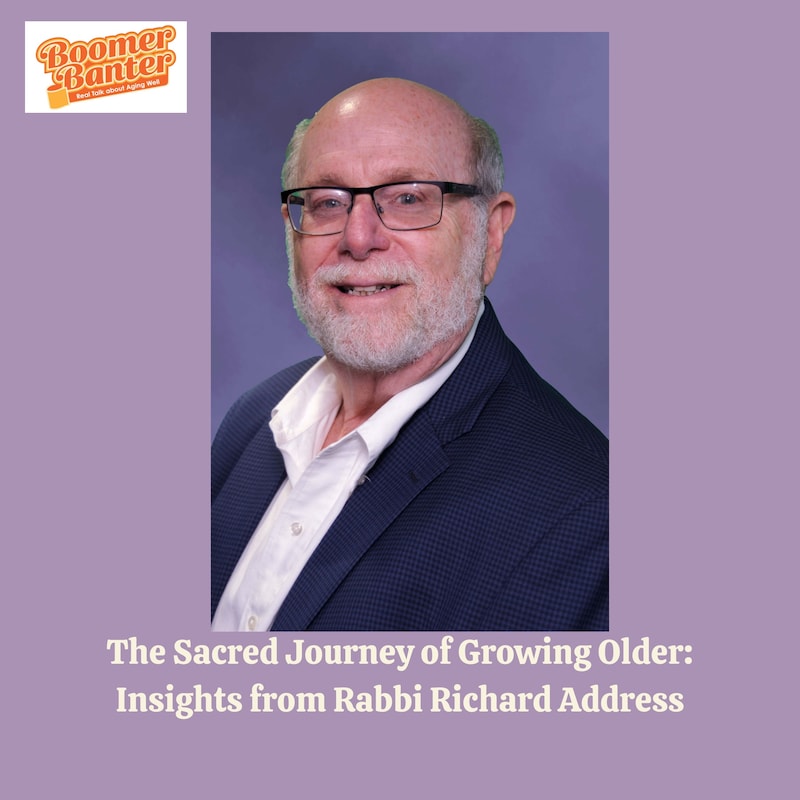
Shownotes
This episode invites listeners to confront the realities of aging through a thoughtful lens, facilitated by the insights of Rabbi Richard Address. The dialogue, led by host Wendy Green, highlights the importance of acceptance in the face of life's inevitable changes. They pose a critical question that resonates deeply: 'What do I do with the time I have left, knowing I cannot control the time I have left?' This inquiry opens the door to meaningful reflection on how we choose to live our lives as we age.
Rabbi Address expounds on the Jewish tradition of gratitude, advocating for a daily practice of recognizing the gift of life each morning. This foundation of appreciation is vital for fostering a sense of purpose and connection in our daily interactions. The discussion also emphasizes the significance of giving back, suggesting that those blessed with the capacity to reflect on their lives have a moral obligation to extend their blessings to others.
Moreover, the episode addresses the emotional complexities of aging, including the challenges of caregiving and the evolving nature of relationships. As individuals navigate the process of growing older, the podcast underscores the necessity of maintaining connections that enrich our lives. Ultimately, it champions a proactive approach to aging, inviting listeners to embrace their journey with compassion, joy, and a commitment to making a positive impact on the world around them.
Takeaways:
- The essence of aging well lies not in resisting time, but rather in accepting it and finding peace with the inevitable changes that come with it.
- The question we must ponder is: "What do we do with the time we have left, knowing we cannot control the time we have left?"
- In navigating the challenges of aging, it becomes paramount to share our blessings and give back to our communities, nurturing connections that enrich our existence.
- By cultivating gratitude each morning, we set a foundation for our day, prompting us to consider what actions we can take to contribute positively to the world.
Links referenced in this episode:
- Find Rabbi Address on the JewishSacredAging website & the Seekers of Meaning podcast.
- Join the Boomer Banter community and receive our weekly newsletter.
- Find Jane Leder's writings and the Older Women & Friends podcast
Transcripts
What if the key to aging well isn't found in fighting time, but making peace with it? My name is Wendy Green, and I am your host for Boomer Banter, where we have real talk about aging well.
And today we are taking a deeper look at something many of us wrestle with. You know those moments when your body feels unfamiliar, your role in the world has shifted, or another birthday is already here?
What if the most courageous thing you can do is accept it? Not give up, not settle, but genuinely accept what is, so you can more fully live into what could be?
My guest today is Rabbi Richard Address, and he has spent years helping people navigate the spiritual side of growing older. Not just the losses, but also the celebrations.
And together, we'll explore what it means to accept and surrender, not as defeat, but as a pathway to wisdom, self compassion, and even joy.
So whether you're navigating a new diagnosis, you're feeling invisible in a world that prizes you wondering your kids got so old, this conversation is for you.
wish Institute of Religion in:Rabbi address served congregations in California, New Jersey for over 25 years, and he also served on the staff of the Union for Reform Judaism for over three decades as the regional director for the Pennsylvania Council, and then as founding director for the URJ's Department of Family Concerns. He continues to teach and consult with congregations in areas related to the impact of longevity on congregations, families, and organizations.
He has edited numerous articles and books dealing with issues of aging and is the author of Seekers of Meaning, Baby Boomers, Judaism, and the Pursuit of Healthy Aging. So let's get into it. Join me in welcoming Rabbi Richard Address to Boomer Banter. Hi there.
Rabbi Richard Address:Hi, Wendy. How you doing?
Wendy Green:I'm good. I'm so glad that you could join us today.
Rabbi Richard Address:Thank you. Thank you for the invitation.
Wendy Green:Oh, for sure.
So when we first met, actually, I don't remember this exactly whether we talked about this or whether I read it in something that you wrote, but you, somewhere along the line, talked about this wonderful movie with Norman Lear, Mel Brooks and Carl Reiner.
Rabbi Richard Address:Oh, yeah, yeah, yeah, yeah, yeah, yeah. If I'm not in the obituaries, I eat breakfast.
Wendy Green:Something like that. Right, right.
Rabbi Richard Address:On Netflix. It's a. It. It's. It's really delightful. Especially since Norman Lear and Carl Reiner passed away.
Wendy Green:Exactly. Yeah. Yeah, it is. It's a great Movie.
But I mention that because, you know, as part of the Jewish tradition, we're reminded that when we wake up in the morning, as we open our eyes, we're to take a moment and say, I'm thankful that I am alive. Why do you think that's important? Especially as we grow older?
Rabbi Richard Address:Well, so, first of all, again, thank you for the invitation. The Hebrew for that is I give thanks. It's a thank you to God.
No matter how you define that word or concept that you've been given another gift, another day.
And the, the, the thrust of Jewish tradition to try to encapsulate the last 3, 500 years in a short amount of time is, is really that we're, we are given a gift every single day of life.
And when we go to bed at night and there's a prayer, a nighttime prayer, which basically talks about this, there's no guarantee that we'll wake up in the morning. This literally just happened with a friend of ours two weeks ago.
So when you wake up in the morning, you basically say, in essence, as we would say here in New Jersey, thanks, God, I got up, you know, I have, I have another day. And so the tradition basically says, okay, well, what, what are you going to do with that day? What are you going to do with it?
And there's a whole Jewish ethic and about how to do that. And the concept of choice. It's probably a longer class, but it goes into this whole philosophy of the most precious thing we have is life.
You only have it once. There's no, this is not spring training. This is it. And the concept of what you're going to do with it.
And, and, and as we get older, that, as we become more, more aware of our own mortality, that focus on here's the day becomes more and more important, Much more important.
Wendy Green:So many people, though, as they age, find that gift of life not so much a gift because they're, you know, they're tired, they're achy, they feel like they have no purpose anymore. So how do you frame that? How do you go deeper on, you know, we're talking acceptance. How do you go deeper on accepting again?
Rabbi Richard Address:You know, I. What. Today's Monday, so last week, and I forget the day, I was sitting with the friend. Two friends of mine married, oh gosh, maybe close to 50 years.
They're in their 80s and they're, they're experiencing. We were talking about this and we were. They were.
They're experiencing changes in their bodies, significant changes in their bodies which affected their, has affected A little bit of their mobility, a little bit of their lifestyle. And we were. And they were very, very open of saying, you know, we're now realizing that I. We can't do what we used to do. We're in our 80s. The.
The amount of time ahead of us is way shorter than the amount of time behind us. And their attitude was. An attitude is extremely important. All the literature supports this. Yes, I can't.
Wendy Green:I'm.
Rabbi Richard Address:I'm. My body is changing. It's impacting us. But we have all this life to live and classes to attend and our. Be with our grandchildren. And.
And this is, I think, a conscious choice that people make of how to approach as the natural processes of getting older hit.
If we're blessed with longevity, and it is a blessing considering the alternative, if we're blessed with it, there are people who embrace it and understand and as you would say, accept it. This is who I am now. I'm 80 years old. I'm not 20 years old. What I could do in 30, I may not be able to do as well at 80 or 75.
And I can choose how to do that. That's why the element of choice. And there are some people who give up.
Have you lined up every clergy person, regardless of the denomination, and said, have you had these conversations with people in your congregation who basically have that diagnosis or have that infirmity or dealing with significant chronic illnesses? Which is. Which is many of us, they say, you know, I can't do it anymore. I'm just. I'll just sit here. That's not the Jewish approach. But.
And I think that the way people make that choice, and I'll make it a social. Is based upon, in many cases, their genetics. Because I think people are wired certain ways and to their.
The messages that they've received from their family of origin, the.
All those messages from mom and dad and the environment that shaped us, some of those messages were, you know, just go out and live your life and go for it. And some of them, be careful, be careful, be careful. And they become more important as we age because we're more aware of our own mortality.
Wendy Green:That's so interesting.
I think you're right about the messages because I see the differences in so many people that even in couples where one grew up in a family where it was like, yeah, let's just, you know, have fun, live life, and the other grew up in the family with a lot of caution, and even living together for 50, 60 years, it doesn't seem like it impacts the other person. They Just.
Rabbi Richard Address:No, you know, I think with Shera Newland's book How We Die, I think was, which is a, an 80s book. I think it's, it's over there on that shelf.
But he basically says, you know, we, we die as we lived and, and we revert back to that core of who we are. And I think there's a lot of truth in that.
Wendy Green:Okay, so it, so it's hard. So we can make a choice, but it's hard to change our.
Rabbi Richard Address:Oh, it's very hard early teaching.
Wendy Green:So.
Rabbi Richard Address:Oh, no. And it's a, you really have to do it consciously. That's why we teach a lot of this, what I call the theology of relationships.
And I'm now convinced 100% that the most important thing that we have as we grow older, and there's a difference between getting older and growing older. The most important thing we have are the relationships that we have with other people.
And, and they get more profound and meaningful as we get older because we're more conscious of when they, when they, when we lose those relationships. Much more conscious of it. But we need people, society.
We need people to help define us, help give our lives texture, how to help give our lives meaning and purpose. This is no big, you know, bolt of wisdom.
Every research project, every, you can go to Barnes and Noble, read all those books, they're all going to wind up basically saying the same thing. Yeah, you need to be out there with people.
So when we have this epidemic of isolation and loneliness now, especially post pandemic, it really shines a light on this in, in very stark terms.
Wendy Green:And that's something that we talk about here a lot, that relationships are so important. And this month we're talking about relationships. And I think it starts with the relationship we have with ourselves, though.
Rabbi Richard Address:Absolutely right.
Wendy Green:So if we're going to be putting ourselves out there with this woe is me, life is awful kind of demeanor, we're not going to attract the kind of friends that are going to help lift us up.
Rabbi Richard Address:No, we do send out messages. Subtle and not so subtle. And there is a difference between existing and living.
Wendy Green:Yeah.
Rabbi Richard Address:And some people are content to just exist. And other people, regardless of age, it doesn't make any difference of age. They say, I, I, I have life to live. I have a cruise to go to.
I have a class to attend. I have, I have, I may have to fit my chemotherapy into this schedule, but that's okay because I can't stop living.
Wendy Green:Yeah. Yeah. And I saw my dad do that. You know, he was taking Dialysis three times a week, and he had copd, so he.
I mean, he knew the end was coming, but he was working on writing a play.
Rabbi Richard Address:Yeah.
Wendy Green:Right before he died, so. Yeah. So you also talked about surrender. And. And I have a harder time with that word, you know, acceptance. Yeah.
I can accept that my body is changing and I have wrinkles, but I'm using a nice little thing on my screen right now. Yeah. Makes me look better.
Rabbi Richard Address:Why can't I say I didn't know that they had that.
Wendy Green:But we also surrender, to me, sounds like giving up, right?
Rabbi Richard Address:Yeah.
Wendy Green:So what do you mean when you use that word?
Rabbi Richard Address:I. I have a lot of trouble with that word, too. I mean, I'll be honest with you, because surrender has the connotation of I give up.
Some people give up, by the way.
Wendy Green:Oh, for sure.
Rabbi Richard Address:Some people give up. Some people in their acceptance, surrender to the reality of where they are in life or the end of life.
And I don't know, I guess maybe I have to come up with another word.
Maybe surrender is not the right word, but it was the word that came into me when I was playing around with all these tensions that we teach as part of our Jewish sacred, aging work. The. But surrender. Surrender can be both positive and negative, I think. And it goes to. Without giving you a long sermon, which. No, I'm. Nobody wants.
I'm actually thinking right now, this. This friend of ours who had ALS and passed away died three weeks ago. Yeah. And he.
At the end, when we were talking and he was writing things on a pad because he couldn't speak, wanted to ask some, you know, basically, what do I do now? And then. And I. The long story short, he was a musician, and he had friends of yours, a musician. And he called them all together.
We had this conversation. Why don't you do this? And he called them all together to his house, and they had, like, this big, you know, jam session. And With. For him. For him.
Wendy Green:Yeah. Yeah.
Rabbi Richard Address:And two days later, he. It was like he's. Almost as if his subconscious said, okay, it's now. Okay, now. Did he surrender? I don't know. I know that there are people again.
Every clergy person, every nurse, every doctor has walked this walk who will at the end of their life, stay alive so that their children can come in and say goodbye or. I remember the first time I ever ran across this when I was a kid. Rabbi.
When I started out in Los Angeles, a man in my congregation was dying of cancer, and he knew he was dying of cancer, but his son was scheduled to be bar mitzvah in a couple of months. He. I'm convinced of this. If you say prove it. Scientific, I can't. He stayed alive.
We had the bar mitzvah on at Cedars Sinai Hospital in Los Angeles, in. In his hotel, in his hospital room.
Wendy Green:Is that right?
Rabbi Richard Address:And right after the bar mitzvah, he. He died. And I'm convinced. And I've had cases like every. Every rabbi, minister, priest, surgeon.
Wendy Green:I've seen that happen, too. Yeah.
Rabbi Richard Address:Is it surrender? Or is it say, I accept who I am now or where I am in life, and I'm just going to deal with it? Some people can continue to try and throw and do.
And there are people who do surrender and say, okay, Josh, I'm ready to die. And again, that's part of the genetics. It's part of the messaging. I think it's part of how we deal with a lot of things. And, and it's.
It's fascinating because every person is different. There is. You. You can't quantify. Every person looks at this because every individual is so unique.
Wendy Green:I think as I've listened to you describe it, though, that does make sense.
I certainly have seen what you just described, too, but I think there is a sense of almost a peacefulness to the surrender when we get to the end of life and you just finally let go. And it. It's almost. It's almost comforting to the family, you know, that.
That you have reached that point of peacefulness with yourself where you can say, okay.
Rabbi Richard Address:You know, if you're lucky.
When you deal with sudden death, you don't get that if you deal with anticipatory grief, dealing with Alzheimer's, dementia, when people start grieving sometimes a year ahead of time because they know it where it is. And that's a different kind of grief. It's a different type of surrender. It's a different type of acceptance. So.
And this is why this is so in many ways complex, because it's. It really is individual. Hard to make a. A blanket statement about this. It's like. It's like caregiving. We do a lot of work in caregiving.
And, and the fact. The podcast this week is featuring the. The guy from Barry Jacobs, who's AARP's caregiving guru. We're.
You can go to Barnes and Noble to read every single book on caring for your aging parents. Caring, it doesn't mean anything. I mean, because everybody does it differently and every situation is unique. That's.
That's why in a lot of these conversations, it's Hard to make generalizations.
Wendy Green:Yeah.
And that leads me into, you know, we've been talking about accepting the changes in ourselves, some surrender, but we also have to think about the acceptance of aging parents, an aging spouse, or a spouse that has some kind of, you know, end of life illness and, you know, caring for them. Of course, you hopefully are doing it in a loving way, but it's also frustrating. It's also difficult to see the changes happening.
And I'm wondering in your courses and in the teachings that you've learned in the study of Judaism and the Torah, if there are specific guidance for caring for accepting our aging loved ones.
Rabbi Richard Address:Oh, yeah. Did you have, like, two hours? Because.
Wendy Green:Well, we did talk about that initially.
Rabbi Richard Address:The reality is, the beauty of the Jewish tradition is it really handles this.
It comes from the fifth commandment, which is honor your father and mother or respect your mother and father, which is repeated three times in the Torah in Exodus, Leviticus, and Deuteronomy.
And then in the Talmud, which is basically 5th, 6th century of the common era, there's a whole discussion in the Talmudic section called Kedushin on what does it mean to honor and what does it mean to respect? And their guidance that usually talks about even how. Who pays for things, you know, but we pay for time.
There are explanatory stories like we call midrash, that even talk about the rewards and punishment of caring and what you're supposed to do. There are questions raised in the tradition about you're commanded to honor and you're commanded to respect. You're not commanded to love. Yeah.
And what happens if. If you're dealing with an abusive parent, you know, really, are you. Does that concept of honor and respect still hold true?
So there's the discussions in the tradition up to the. Up to right where. And this being still we talk about this a lot in the caregiving workshop is very, very real. I mean, it is very, very, very present.
You know, what does it mean to honor and what does it mean to respect the concept of dignity? That you're never allowed to take away a person's dignity.
Very relevant in the contemporary world because you could go to a nursing home probably within two or three blocks of where you are, and definitely where I am in Southern New Jersey. And there are people who are very, very, very much alone and whose dignity has been really compromised.
And so the tradition talks about what is the concept of dignity.
And when you add in all the discussions of end of life, and now that you add in where I live in New Jersey, and there's 10 other jurisdictions of medical aid in dying, which is now being in the state legislature in New York. These, these concepts are not ancient.
They, these conversations are very, very, very real, and our tradition speaks to them and with great sense of humanity and sensitivity and with the understanding always that the idea that we're being created in a sacred image takes precedence. But also the concept of. And this is a contemporary. The challenge of autonomy.
How much control do I have over my own body, my own health, or is it totally up to God? So it's very. Contemporary Judaism is fascinating, though. It's unbelievably relevant to what people are living through.
Wendy Green:You talk about the commandments. You know, we in the Jewish faith are very good at Jewish guilt.
I think a lot of people that I've been friends with in the Catholic faith also deal a lot with Catholic guilt. But, you know, I know that there are times when I can be very patient and there are times that I can be like, ah, this is so frustrating.
How do you, how do you reconcile that so you don't feel guilty about not always being kind and respectful? And you know what you want to be? You want to be. That doesn't happen 100 of the time.
Rabbi Richard Address:There, there's. There's a passage in the, in the end of the mission. This is a book that we, we assigned to around 200 of the common Era.
And there's a section of it called Pirke avot, which means in English, the sayings of the fathers or ancestors. And they're little pithy sayings, ethical sayings, and they talk a lot of it about. Sometimes you just, you keep your.
You don't say things or do things in the, In a moment of crisis, in a moment of anger. And if you look at some of these concepts in some of these. And it's not just in that book. There's. They're scattered all over Jewish tradition.
But the understanding that there are times and places where don't say anything, you don't make any judgments, you don't make any in anger or when you're a tremendous amount of stress, because a lot of times those conversations, statements or decisions are the wrong ones. And it's very, very fascinating. That's why the tradition is so cool, because everybody, everybody goes through those moments.
And that's why in the contemporary world, so many congregations offer, through their care and community programs, they talk about respite, care of getting, allowing, allowing the caregiver. Because, as you know, caregiving can last years, and it is its own life stage now.
I really do believe that, that sometimes you need just to say, I, I, I, I need to get out of here. And there are systems and procedures in place in most communities.
And certainly it's one of the benefits of belonging to a faith community because a lot of these communities, synagogues, churches, mosques, et cetera, have people who are, or have circumstances or programs that allow something. Take. To take a time out. You need to go out for lunch. Go ahead. In a very.
Wendy Green:That goes back to the acceptance, right? Except that you are exhausted, you are at a wit's end.
Rabbi Richard Address:It's very difficult.
Wendy Green:Take this break. It's okay.
Rabbi Richard Address:Oh, it's very much okay. In fact, ethically, morally, you can't, you shouldn't be doing anything that would put your loved one in danger.
If you're stressed, if you're sick, if you're overwhelmed, you may miss something. So almost to, to go to the higher value, you need to make sometimes. Take some time. Take some time. For me, I just need to, I need to go out for lunch.
I need to get my hair done. Not that I have to worry about that, but. Or, you know, and, and so, and that's why this is all very, very personal. Very personal.
Wendy Green:So tell me a little bit about you. What brought you to this kind of. What, what brought you to this kind of work?
To working with longevity and aging and Jewish sacred aging, all of that.
Rabbi Richard Address:So, long story very short. I started to get interested in this when I was just out of this, out of school, my first congregations in Los Angeles.
I was asked to do some work by the director of the region. I started to do some writing about this research.
When I went to work for the Reform movement, they asked me to create programs around caring communities in synagogues. That led to organizing three or four committees for the movement around caring community, older people, bioethics.
That led then to the idea of starting a whole department just around family issues, which they eventually allowed me to do after some lobbying. And so we were creating these programs for the movement.
We started to look at the trends in synagogue land and in the Jewish world which were trending older again. That led to a whole series of conferences. A book on aging for congregations to honor and respect led to the.
The book that I did write, a bunch of other books that the movement produced.
ve been running with it since: ccording to the pew report of:A little over 50% of our entire community in the United States of America are people over the age of 50. And. And we're aging faster than the American population. We. Oh, yeah. Oh, yeah. Oh, yeah.
We're not reproducing replacement at the same level that we should be. So. And the majority of synagogues and Jewish institutions don't want to deal with that reality.
Wendy Green:So that's interesting that you started this work as a young man.
Rabbi Richard Address:Yes, I remember. I think I remember being a young man. I have pictures.
I have pictures somewhere that I think people have told me, yeah, that's who you were when you were 30.
Wendy Green:Wow. Well, so maybe you felt very prepared to get older then because you've been studying it.
Rabbi Richard Address:It's, It's. It's actually a lot of fun because the variations and, and the. Just the whole. Look, the baby boomers have restructured American Judaism.
They've restructured what it means to grow older regardless of the age. You know, you have people who are 89, 90. They're, they're not sitting at Shady Acres waiting to die.
They're playing golf, probably near you right now. They're on their way to a cruise or they're at some, you know, at some university in their OSHI or their adult learning centers.
Wendy Green:That's right.
Rabbi Richard Address:It, it's. It's. The whole thing has been restructured in, basically in the last half century.
Wendy Green:So what do you think is the spiritual or the emotional cost of resisting aging?
Rabbi Richard Address:Well, first of all, you can't resist it because we're all going to die. I mean, unless you know something that no one else knows. I don't know that, you know.
Wendy Green:You know what I mean by that? Right. Like, we're always trying to look younger or we're.
Rabbi Richard Address:Look, a lot of people.
Wendy Green:A lot of people lie about their age.
Rabbi Richard Address:Oh, no, no. Look, they. I'm very. It's very interesting.
There's a whole new trend now of people actually accepting, you know, their age, going gray, stopping coloring their hair and.
Wendy Green:Everything that happened during COVID Yeah.
Rabbi Richard Address:The last statistic I saw that Americans spend over 60 billion, that's with a B every year on anti aging creams, things like that, which Is a lot of money.
Wendy Green:That's a lot of money.
Rabbi Richard Address:And, and, you know, and it doesn't work, you know, so, I mean, you're gonna die. So, I mean, that's the word. So the spiritual. And we do a lot. Obviously, I'm not a doctor, a medical doctor.
I have a doctor, but it's not in, in medicine. The spiritual component of this is where is the ballpark that we play in all the time?
And as, as I, as, as the foundation of a lot of the classes we teach, Wendy, is this is the spiritual. The spiritual question, I think, for, for my generation and certainly for me. And that question is very simply.
And it evolves out of a whole series of understanding texts which we don't have the time to go into. What do we do with the time we have left, knowing that we cannot control the time we have left? That's a circle. That's a spiritual question.
And it involves choice. It involves all the tensions, the acceptance, surrender, the idea of living versus existing.
And the idea, the one that control, that is concerning to a lot of people, me included, is this tension of holding on and letting go. And because no one, the one thing that we cannot. We can control just about everything else in our life.
The one thing that none of us can control, and this is why it's the spiritual question, is time. Every, Everybody who's listening to this, watching this, everyone knows somebody who thought they had more time.
So knowing that you can't control that, which is a whole other randomness thing, which we don't have time to go into.
Wendy Green:Say that again. What do I do with the time I have left?
Rabbi Richard Address:Knowing that you cannot control the time you have left. And I, I believe that.
So that's why people, this tension of holding on and letting it, that's why so many of our generation have reached a point in our lives where we come to understand, I don't need more stuff. I got enough stuff.
But what I don't have or what I want more of, maybe for the first time in my life, are those things that really give my life texture, meaning, definition, purpose, and joy, which is a whole other, again, thing we talk about a lot. The difference between joy and happiness.
Wendy Green:Yeah, for sure. Yeah, I talk about that too.
Rabbi Richard Address:Yeah. So. And, and, And I, I almost, you.
Wendy Green:Know, I can see where that's a spiritual question, but I almost think, what do I do with the time I have left? If.
If you don't add the end of it, no, I can't control the time I have left, then you can make A whole list of things that you want to do, and you just keep doing them until you don't have any more time.
Rabbi Richard Address:You can. And who's this? And if you're lucky, you'll be able to do them.
Or if you get that bad diagnosis, or if there's a random act of something and an accident happens, or, or you fall on the throw rug in the bathroom and all of a sudden you break your hip and that list gets put over there.
Wendy Green:It does. But does that, if you are thinking about the end of that question, I can't control it.
Does that stop me from doing the things that would bring you joy or bring you purpose?
Rabbi Richard Address:I hope not. I hope not. And here's the other wild card in this thing. The other wild card.
It has to do with socioeconomic class and the ability to even think this thought because the majority of people in America don't have the luxury of, of having this conversation regardless of their age. Regardless of their age. They have to, they're. They're struggling just to make it through the day.
And, and so one of the blessings, if you're, if you're privileged enough to be able to have this conversation and make these choices, it is a blessing. It is a bless. So the tradition then says, then you have to share that blessing. You, you just can't keep it for yourself. Whether.
How, however, you give back to society, you make donations, you get involved. But if you're.
And the, And I was having this conversation with a class last week, and somebody like, got this way, and I said, look, you can, you can, you're going to leave this class, you get in your car and you'll drive home. And if you're hungry, you go to your refrigerator and there's a ton of stuff to.
And if you don't like it, you can get in your car and you drive to the supermarket, which is just down the street. Then you turn on your tv, relax, do whatever you want, plan the next trip. The majority of people in the world can't do that. We think they can.
But you've traveled and, oh, there's a certain amount of privilegeness, which is a code language now, which probably is. Then, you know, but there's a, that's part of the gift.
If you're, if, if you've been blessed with the ability to have these conversations, to make these choices, our tradition says, then you have the obligation to, to share some of it.
Wendy Green:So it's back to the beginning. Wake up with gratitude. To be alive.
Rabbi Richard Address:Yes.
Wendy Green:And then what you can give Back while you are still here with the time you have left. And, and not only give back, but also give to yourself because you're giving.
Rabbi Richard Address:It to you because you're. Because it redounds back to you. This. To close the circle.
That couple that I was having a cup of coffee with last week, the wife, Jamie, when we were talking about this, and she's dealing with some stuff, physical stuff, you know, body stuff, and she said, you said, richard, when I get up in the morning and after I do my, you know, I thank God that I'm alive. The next thing I do, because I don't want to dwell on, you know, I got this, I got that. The next thing I feel it is, what can I ask myself?
What can I do today to make the world a better place? And, and she does, by the way. She's not theoretically, she and her husband, they actually put into practice exactly what she's talking about.
But that's a beautiful thing. And it's, you know, what can I do to make the. It may be it, it may very well be, I don't know, just being kind.
Just being kind to another person that you, that you bump in. Especially in this day and age when nobody's kind to anybody. But if you walk into a store and you smile, it changes, you know, changes the demeanor.
A lot of times of the, you know, teach some people in Washington to do that. We may be in better shape.
Wendy Green:But you're right, that was one of the things my mother said yesterday when we were meeting with my grandkids. She said, my motto in life is just to be fine.
Rabbi Richard Address:You know, it's. Speaking of being kind, I should have mentioned to everybody on here that you are on Seekers, a Seekers of Meaning podcast.
We're trading podcasts, and your podcast is going to post on Friday, June 27 on Jewish sacred aging dot com.
Wendy Green:Oh, good.
Rabbi Richard Address:I'm sure you'll let people know, but I wanted to make sure that people knew as we're talking now.
Wendy Green:Oh, well, thank you so much. And I am just so grateful for what you have shared with us. And, you know, I want people to go and look at this website, Jewish Sacred aging dot com.
Whether you're Jewish or not, some of the podcasts on there, some of the articles that you write on there are just, they make you think they're not so long that it's like, oh, my gosh, I can't read this whole article. But they're, they're thought provoking and they're kind and.
Rabbi Richard Address:Well, thank you very much. Thank you.
Wendy Green:Yes. So I really appreciate that. Before we go, just a few things if this episode resonated with you, so certainly share this with your friends.
Leave a comment, tell me what you're taking away from the conversation. You know, it's always good to hear from you and if you are thinking, wow, this is definitely a community that I want to be part of.
I want you to go to HeyBoomer Biz and click on the link that says Age well with us. And then I will send you a weekly email with fresh insights, inspiring episodes and sometimes a couple of new surprises.
You know, I'll get creative so it might be could be your favorite email of the week. So that's heyboomer Biz and click on Age well with us. I also wanted to recommend a podcast that a friend of mine does.
It's called Older Women and Friends. And the host, Jane Leader, award winning author and she talks to women about the joys and challenges of being an older woman.
And her goal is to set the record straight, dispel the myths and explore the many contributions older women make. So it's a great show. I highly recommend it. You can find it anywhere. You listen to your podcast casts.
And as a special bonus, Jane is going to be my guest co host, whatever. Next week, you know, I'm doing the second part series of Friendship.
We talked about what we learned as early friends and now we're going to talk about the loneliness and how difficult it is to make friends as we age and losing friends as we age and you know, all of that. As Richard was saying, you know, we need those relationships. It should be really interesting. Jane's turning 80 in July. I'm turning 72 in August.
So we'll have two different perspectives of how that works and why making friends feels harder and how to build some of those connections. So I hope you will join us there. Rabbi address. Thank you so much.
Rabbi Richard Address:Thank you, Wendy. Thank you for the invitation, this invitation. Stay safe and stay healthy and be kind.
Wendy Green:See you all next week.
Rabbi Richard Address:Bye bye. Thank you.



