Shownotes
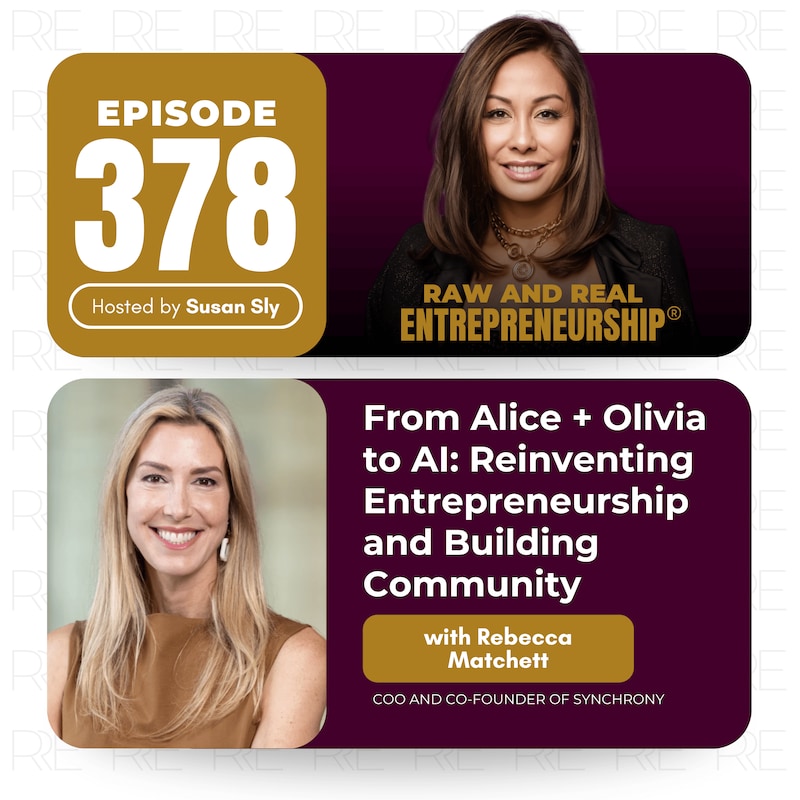
This episode features a conversation with Rebecca Matchett, co-founder and COO of Synchrony, about the grit, courage, and resilience required to build a business—even in the face of deep personal and professional reinvention.
Rebecca shares her entrepreneurial journey, starting with a volume-focused lemonade stand and later co-founding the iconic fashion brand Alice + Olivia, where she learned the importance of differentiation by using unique materials for pants.
The discussion covers Rebecca's powerful story as a lawyer, mom, and cancer survivor, including her decision to have a prophylactic mastectomy after learning she was BRCA positive, her cancer recurrence, and going through a full hysterectomy (flash menopause). She explains that her resilience stems from her ability to compartmentalize and focus only on actionable challenges.
Rebecca details how a dinner conversation led to her latest venture, Synchrony, a self-funded social ecosystem designed to connect verified neurodivergent young adults, combating loneliness and building community. She explains the user journey, where members are matched based on shared interests and communication preferences. A key feature is Jesse, an AI assistant who acts as a "wingman slash Mom Dad" to help users decode messages, start conversations, and foster social independence.
Finally, Rebecca provides a raw look at the realities of building deep technology, discussing the high costs of development, the variability of AI tokenization, and the challenges of App Store and Google Play fees and approval processes. She reveals that Synchrony is looking toward building a Progressive Web App (PWA) to mitigate these platform risks.
Rebecca Matchett is a seasoned entrepreneur with over two decades of experience building and scaling businesses across fashion and technology. She is the co-founder of Alice + Olivia and has launched multiple brands, including Rebecca & Drew and TrioFit, where she developed a patented approach to women’s sizing. She is now co-founder and COO of Synchrony, an AI-driven platform designed to foster connection and community for neurodivergent individuals.
Connect with Rebecca:
Website: https://joinsynchrony.com/
LinkedIn: @synchrony-app
Susan Sly is the maven behind Raw and Real Entrepreneurship®. An award-winning AI entrepreneur and MIT Sloan alumna, Susan has carved out a niche at the forefront of the AI revolution, earning accolades as a top AI innovator in 2023 and a key figure in real-time AI advancements for 2024. With a storied career that blends rigorous academic insight with astute market strategies, Susan has emerged as a formidable founder, a discerning angel investor, a sought-after speaker, and a venerated voice in the business world. Her insights have graced platforms from CNN to CNBC and been quoted in leading publications like Forbes and MarketWatch. At the helm of the Raw and Real Entrepreneurship® podcast, Susan delivers unvarnished wisdom and strategies, empowering aspiring entrepreneurs and seasoned business veterans alike to navigate the challenges of the entrepreneurial landscape with confidence.
Connect With Susan:
Website: https://thepause.ai/
Website: https://susansly.com
LinkedIn:@susansly
Transcripts
This transcript has been generated using AI technology. There may be errors or discrepancies in the text. The opinions expressed by the guests on this podcast are their own and do not necessarily reflect the views of the show or its hosts.
Susan Sly:Well, hey, there, your friend Susan here. I have a question for you. Have you ever thought like, oh my gosh, I would love to try something, but then your brain starts to come up with all of these, but you've never done that before, and you don't know anything about that, and what if you fail? Well, my guest today doesn't think like that, and in her 20s, she threw herself into fashion, and now she's throwing herself into technology, and this show is all about what it looks like to be courageous and confident, even in the face of adversity, and to go out there and build something meaningful. And I promise you, you will be inspired.
Before we get into the show, there's a couple of quick announcements that I have. Number one is we have been working so hard on our women's midlife health app, thePause®, and so right now we can do everything from tracking symptoms and mood and your best friend Harmoni®, our AI companion, can have conversations with you about it. And one of the things she picked up about me is, okay, I like red wine. I will be very honest. I'm also a disclosure investor in Une Femme Wines. Love, love, love wine. But Harmoni® noticed that my mood was not very good the days after I had wine, and so she and I had that conversation. So Harmoni® is amazing, and the app has been this labor of love.
Building an app, and you're going to hear about this in my interview today, there are so many things to consider, and so my request of you is, if you are a woman 30 plus, because perimenopause actually starts now in your 30s, please download the thePause® app. Go into the App Store or into the show notes, or go to www.thepause.ai and download the app. It's available in the U.S. and Canada. We would love to get your feedback. We'd love to get your support as female founders. It is absolutely incredible, and we will never sell your data. And so I would love to invite you to do that. That would be incredible.
The next thing, head over to susansly.com. For those of you who don't know, yes, I host this show, Raw and Real Entrepreneurship®, with hundreds and hundreds and hundreds of interviews of incredible entrepreneurs, whether they're 12 years old or billionaires. Just amazing people who are out there doing incredible things.
And I am doing a lot of shifts in my life and in my brand and so go to susansly.com and definitely take literally 15 seconds and jump on my list, because I'm going to be doing some community events. I am going to be doing some more ways of bringing together entrepreneurs to add incredible value. I have been at the bleeding edge of AI for almost a decade, and not as an AI influencer, but as someone who's deployed AI. Large multinational companies fly me in to train their executives on AI, and I want to bring the AI world and the human connection together for entrepreneurs so they can help to go courageously into the future and build something that's amazing. So head on over to susansly.com. It'd be incredible.
My guest today is a seasoned entrepreneur, and she brings over two decades of experience into her most recent company, which is called Synchrony. And what Synchrony is, is a platform that brings together neurodivergent young people, young adults, so they can connect and build friendships, build community, share resources.
And then this founder didn't come from a world of building technology. In fact, she was the co-founder of one of my favorite fashion brands, Alice + Olivia. And if you follow me on Instagram, one of my biggest fashion moments recently was wearing this Alice + Olivia suit that I got so many comments on and thousands and thousands of views on this particular 15 second Reel I did wearing the suit.
And when she co-founded Alice + Olivia, she named it after her mom who passed from cancer, Alice, and her partner's mom, Olivia, and she's going to talk about how they looked at fashion in a very different way.
And she went on to grow other incredible brands, including Rebecca & Drew, Sophie Hudson for HSN, Install Essentials for Install Magazine, and TrylFit.
And after going through a double mastectomy, after going through recurrence of breast cancer, after going through a full hysterectomy, and then deciding she was going to reinvent her entrepreneurial life, she goes out for dinner with a new friend, and the idea for Synchrony is born.
So I invite you to listen to this episode because I know there's something in it for you or someone you know. If you have someone in your life who's neurodivergent, my son is neurodivergent, please share this episode with them and share Synchrony with them.
And I would love it if you would tag me on social, on @susansly on Instagram. And most importantly, if this episode, or any of my episodes, resonate for you, I would love a five star review and a great review, because this show is really and truly my gift to all of you to inspire you to have the courage to go out there and start and scale a business.
So with that, let's take it into this incredible interview with my friend, co-founder and COO of Synchrony, Rebecca Matchett.
Voice Over:This is Raw and Real Entrepreneurship®, the show that brings the no-nonsense truth of what is required to start, grow and scale your business. I am your host, Susan Sly.
Susan Sly:So I'm sitting here with my new friend Rebecca and going we have a show to do. Rebecca, you are so fascinating. You're a lawyer, a cancer survivor, a mom and building this new venture. And one of the big questions that we seek to answer on this show is, are entrepreneurs born, or can anyone become an entrepreneur? So what was your first business that you ever started.
Rebecca Matchett:So my first business was like, I'm sure many people a lemonade stand. And I grew up in Boston, so I would set up shop with a friend who lived downtown, and we had a couple of famous customers, famous by Boston standards, because they were Boston Celtics players. But those were my idols back then, very into sports, very into Boston sports. And then we would summer in Nantucket, and that was the perfect place for a lemonade stand. So, you know, we always kind of actually cut the price a little below what our competitors did, because I was, I was sort of had my my eye on the volume, and it always worked. And we would kind of create a sign that said $1 and then it would be with a slash through it, and it would say 75 cents. So people thought they were getting a deal. So it all started there. But I did come from a family of entrepreneurs. My father created a very successful real estate business. So that was in the blood. And you know, a lot of our dinner conversations were around the struggles and the successes of starting your own company,
Susan Sly:When you think about that. And plus, I'm a Boston sports fan, I'm a huge New England Patriots fan, and people said about the 2026 Super Bowl. Are you disappointed? I'm like, Are you kidding? The quarterback is my son's age? Like, you know he looks like he needs pimple patches. Like, hello. I was not disappointed. We haven't been to a Super Bowl in a long time. The listeners, long time listeners know I've run the Boston Marathon six times. I'm a graduate of MIT Sloan and the engineering school, so yes, high five all day Boston sports. That is outstanding.
The the thing when I'm thinking about the lemonade stand, because we have, we have a lot of our listeners will listen to show driving with their kids in the car. And the we've had entrepreneurs on who are 12 years old. I've had two very different verticals, amazing. And when I think about you going into accessible fashion and the work that you did with various brands, because you just, you even said, you know, with the lemonade stand, it was a volume play, right? And if we look at couture, a $25,000 dress is not a volume play. But when I look at your body of work in fashion, it was very, you know, and I've worn those brands. I wear those brands. It was very much something that was aspirational, accessible, but also a volume place. So what took you into fashion? It wasn't the Celtics.
Rebecca Matchett:It was not the Celtics, and it was really not by design. No pun intended. I mean, it was something I kind of fell into, I'd run into an old friend from college maybe five years after I graduated, and we wanted to work together, and we didn't have any business experience. We didn't have any fashion experience, manufacturing experience. We just kind of started trying different things and landed on pants, and it was something that we knew we needed a differentiator. And this is one of the key things I kind of bring with me to my different ventures, is filling a gap and really having a differentiator. Main differentiator that is associated with the launch, because there are so many competing companies out there, it is so hard to break through the noise, to grab attention, to grab market share. I'm not trying to make just a slightly better widget. I want to make something completely different. So why fashion? It just I was in my 20s. It sounded fun. I lived in New York. I loved, you know, okay, I love fashion, and I thought I would make a go at it. I don't know I would have done it again for sure, but there's a reason I'm not in fashion anymore. It's incredibly difficult business.
Susan Sly:Yeah, absolutely. You know, Rebecca, I was recently asked to be a mentor at it's an annual mentorship event for women. And you have very young women. You have women who are in their 50s and 60s, and you just said that you didn't really know anything about fashion, but you, you know, you went all in. We're gonna talk about what you're building now. I mean, this is going into artificial intelligence, going into this whole arena, digital marketplace. I mean, it's that that's, again, a new frontier. So someone who's listening right now, who's thinking, I don't really know about that, but I'm curious about that. What is the thought process for you about diving in, because this is your entire career decades, where you're like, I don't really know, but I'll figure it out. Like, how do you go about that process to shift from hey, I don't really know, and where a lot of people would be paralyzed with fear, my experience of you and my research of you is you go in with courage and curiosity, like, how does that happen?
Rebecca Matchett:Yeah, exactly. And I think it takes some confidence, and it takes some understanding that you might take a misstep or you might fail altogether, but if you believe in what you're doing, I just, I really do feel like that is such a motivator, and it can overcome a lot of the insecurity around not knowing specifically what you might be doing. I, as I said, I really if I feel like there is a hole in the marketplace that overrides everything, and so that means there's not necessarily a right way to do it, because it hasn't been done before. So everybody would be in the same boat that's trying to sort of fill that market gap, right? And, and if I build the team, a team around me that I'm confident in, that I feel like can sort of fill in the pieces where my knowledge is lacking, you know, I don't have a problem with that. I don't need to own 100% of every part of the process, I do need to own, sort of the overarching where is this heading? What direction are we going in? What are we prioritizing? Because that's all part of the larger vision, which is, is the whole reason I'm involved to begin with,
Susan Sly:Well and starting with pants. So for our Australian listeners who are laughing, or in the UK, right there, we're talking about trousers friends don't get all crazy. As a funniest side. So I had these friends who moved to Canada from the UK, and their little boy, Harry, when he went to school, it was a snow, super snowy day, and the teacher said, remove your, you know, remove your pants, the snow pants. And Harry started rolling around with laughter, because it means undies, right? Sure. So what did? I'm so curious. I love fashion. And when I, before I went to college, I was either going to be a fashion designer or a surgeon, and so I prepared the whole portfolio to go to art school. Then I decided to go into science. But let me ask, what did you learn about pants that the listeners might find very unexpected. Well.
Rebecca Matchett:The big lesson, at least with Alice + Olivia, was that our entire differentiator were the fabrics we used. And it was a time when, you know, it was black pants or jeans and and you sort of showed your style and your individuality through your your sweater or your top or your blouse. And we kind of wanted to flip that on its head and say, let's make a statement with the pants, and we did that through using upholstery materials. The biggest learning lesson is that there's a reason upholstery materials are used on couches and on for curtains and not for pants, because they chafe you, because they don't launder well, because they split and, you know, it is, it was a huge, you know, sort of eye opener, but it put us on a map and and the textures and the patterns and the colors were unlike anything that had been out there before. So I, and I learned everything about pants because I knew nothing, you know, we we fit. The first two styles were based on my body and my partner's bodies, not necessarily the most average body. So we had tweaks to do there with the fitting and actually hiring a real fit model, you know, huge learning curve. But at the end of the day, the eye grabbing styles and colors and patterns are what got us our customers, and then they loved the look, and we tweaked, you know, the fabrics we were using and the cut we were, you know, basing it off of but we got the initial hook was enough,
Susan Sly:And to be that that brand ethos for Alice + Olivia carries through today, which is because I don't believe the pants are upholstery material. I just wore on stage for a keynote, an Alice + Olivia suit, and it was white, and it had all these rhinestones on it. It was heavy. My husband was lifting it and the garment bag. Rebecca dang,
Susan Sly:and I said, I know, babe, I'm getting a workout, and, you know, I'm doing this.
Susan Sly:But it had, you know, 1000s and 1000s, 1000s of views on Instagram and then so many comments, because it was, it was really beautiful, it was really different. And to create something and say that ethos is still out there in the marketplace today. It speaks volumes of you and who you are. I want to ask you so as a woman, fellow woman to woman, mom to mom, driver like entrepreneur, go, go, go, go, go. You got diagnosed with breast cancer, and I had my own breast cancer scare last summer, and how did you first know that something wasn't right, really?
Rebecca Matchett:So I'm BRCA positive my mother, grandmother, great grandmother, all had breast cancer, and I knew I had to be I was always very closely followed. And then I had to decide, do I want definitive answer in terms of what my risk is. And I did, you know, knowledge is power, as far as I'm concerned. And, and so I found that out, and I decided to have a prophylactic mastectomy, and, and let's just, you know, bring my risk down as far as it can possibly go. So I did that in between. It was it that was that was a hard decision, because I did it between my second and third children, and which meant I wasn't going to be able to nurse my third child, which, you know, I know many, many people choose not to, but I had done that for my first two so that was something that took a little bit of consideration. It was actually my father, who one day on a walk. Said, let me get this straight. You'd rather nurse your third child than and run the risk of not being alive, than just bottle feeding your third and I said, you know? Well, she put it that way, you know, I guess I'll just go through with the surgery right now. And I did. They found stage zero DCIS actually when they did it, which I didn't know about prior to but the mastectomy was enough. Four years later, it came raging back right after I was told I had less than a 1% chance, which statistically, I'm sure that's true for me, it was 100% that I did have it right? And it was had spread, and it was in my lymph nodes, and it was everywhere. And at that point, I actually had felt something under my arm, because I was not being screened anymore, right? I had already had the mastectomy, and I was told I didn't need any more screening. And so I found it myself. I went in and they found it, and it was in my lymph nodes, and it had spread, and the there were, you know, it became a whole other, whole other issue, which now, thankfully is, is all resolved, and it's been more it's been six, seven years at this point, but I was still sort of monitoring myself, and so I discovered I. Discovered through self exam, really? Yeah, when it came back,
Susan Sly:And that's a, it's a, it's a big decision. We in the, in the, in the startup I'm building now. We talk a lot about breast cancer. We talk a lot about hysterectomies, instant menopause. My partner went into instant menopause at age 32 as a health practitioner, she passed out while she was in the ER working, and she woke up and they one thing was leading to another, and then, you know, she ends up having this hysterectomy, going into instant menopause with two little girls. And, you know? And I think when we have these events, they're transformative. And one of the big pieces is, I wouldn't want anyone, and I know you wouldn't either to be listening to this or watching this on YouTube and thinking like, Oh, I think I might have something on going on, but I'm just going to push it under the rug, and then after my next funding round, or after we get to so many customers, or whatever, I'll deal with it. How did you drop everything and prioritize
Rebecca Matchett:that absolutely? I mean, I so when it came back, I had three small children, and I actually found it a blessing in disguise to have that responsibility and to be pulled in so many directions. I couldn't lie in bed all day and feel sorry for myself or sick or whatever. I just couldn't I had a lot of things to do. I was also working. I just, you know, it pushed me through, and I think I was able to mentally just sort of put myself outside of the emotional experience of it. And actually, I didn't, it's funny, I was just talking to my husband recently about this. I didn't, I wasn't that emotional until I started losing my hair, and I had to try on a wig, and the wig, and it's really because it reminded me of my mother who had passed away from cancer, and so it wasn't I, I'm kind of skilled at deflecting things or Not really internalizing things that don't serve me well. And that was so that was something that kind of brought it home in front of my eyes. Me looking in the mirror and seeing that, you know, but you know, I How did I go on it? I had no other choice. And and then from there, yes, I had the hysterectomy and all that. Because why not just take it all out, right? I was told my risk was less than 1% before, and it was actually 100% probably, you know, for reality for me. So just take it out and and the flash menopause is, is not fun.
Susan Sly:This is Raw and Real Entrepreneurship®. We talk about everything. And so let's go there just for a moment. So, yeah, it's flash menopause is no joke, because there's more time spent preparing you for the surgery than there is in the post op, and suddenly it's, it's, it's also an identity, right? When women go through menopause, sort of, quote, unquote, naturally, there's a time and then suddenly, here you are, boom, what? What if, for those people who haven't had that experience, what was that like for you?
Rebecca Matchett:It was, thankfully, it was more just sort of an inconvenience than anything really life impacting. I did not go on HRT, you know, I didn't want to put estrogen in me, but it was something that I just, I guess, I put my head down and I just kept going, you know, throwing the covers off in the middle of the night, needing to change my T shirt. You know, different things like, yeah, I mean, they're annoyances. But, you know, the the other side of it is, thank God, thank God. I got to the point where that that was an issue for me. And, you know, it's just one of those things, I feel like I got it, got it over with before the rest of my peer group did. So now they might be going through it, and I'm over it,
Susan Sly:Yeah, and that, and that's the reason you have been so successful, and you are going to soar with the company you're building now, is it does. It's in interviewing hundreds of entrepreneurs, in being an entrepreneur since I was 11 years old. I have this image Rebecca of I call it my silver box. So when you said, you know, I'm excellent at compartmentalizing things. So anything that I'm, you know, I'm like, this is a not now, I envision myself putting it in a silver box, and it goes up on a shelf, and I'm like, okay, when I when I choose to, because I'm not a victim in my life. I'm a victor when I choose to, and I will clean that up or deal with it. Then, then that's when it gets to happen. And, yeah, and, and you obviously have the ability to do that, and all great entrepreneurs do, because to to be resilient as an entrepreneur means a, you know, a double mastectomy, having children, having a full hysterectomy, going into instant menopause, that I had Glen Sterns on the show. Glen was the first billionaire on Undercover Billionaire who's a friend of mine. No one knows he did it on this interview, he said he was during that show. He had a feeding tube. He had been to MD Anderson. He had had cancer. He can't eat and but he didn't want the producers at Discovery to know he's like because I'm very mission driven. And this is my, this is my focus for you going to this dinner. So let's, let's talk about, you go out for dinner with your girlfriend, Jamie, and you're having this conversation about life and about kids. Some people have these conversations. They have a cocktail, and then they're like, okay, that was a fun night, but this was not that kind of a conversation for you. What happened?
Rebecca Matchett:The time? It was a completely social dinner. Jamie and I have two daughters who are very close friends, and we didn't know each other, so we went out socially with our husbands. And Jamie was telling me how she just had sold her company, and she's trying to think of what to do next. And you know, she has an autistic son, Jesse, who, at the time, was 20, and she was telling me about Jesse and and how she's been sort of preoccupied with his so what his social life looks like, and how she can support it, and how the, you know, the supports, the institutional supports that used to be available as an adolescent were kind of dwindling, especially around the social piece. And so she was considering some sort of social app, and I was interested, and I was asking her to tell me more about it. And then we went our separate ways, but after we left that dinner, I just couldn't get it out of my mind, what an unbelievable opportunity to serve this community that deserves everything that everybody else has right? There's absolutely zero reason why everybody shouldn't have access to these social platforms and feel comfortable and confident in making social connections, and so I just kept thinking about it. I had closed my most recent company down, and I was looking for what my next move was, and I didn't know what it was. I had zero idea. I just knew I needed to keep my ears open and I needed to be talking to people, and I didn't want to only take meetings in fashion, because that's what my you know, entrepreneurial history had been in. So I started thinking, well, you know, Jamie has this idea. I think I can potentially help bring it to fruition and, and so I reached out to her, and I said, Jamie, not for nothing like these are some thoughts I've had recently. You talked about, you know, launching a social app. I can actually see it branching out into this category or that category, or or approaching it from a different angle. And I just wanted to let you know you're onto something. Good luck. You know, it's, it's incredible. And, you know, she immediately responded and said, hey, interested in talking more about your ideas. And really, it was very, very quick, you know. And then we had another coffee, and she sort of asked if I wanted to come on board. And at the time, she had already had another partner, our third partner, Brit, who's an autism specialist, and, and, and, you know, it was, it was just very organic. We're three women with very different backgrounds that bring something different to the table, which, in my in my history of starting companies, I've realized how important it is to have very distinct roles and responsibilities. It serves no one to be stepping on each other's toes and over look, you know, looking over each other's shoulders all the time. So it's really been fabulous.
Susan Sly:I love that. I mean, the I I think about. Well, firstly, since Jesse is a. The same age as my son Andreas, and this whole what Andreas struggled with he when we moved to Arizona. One of the reasons we moved is Arizona is one of the top states in the United States for support for kids who are on the spectrum, and there are a variety of special schools that are incredibly supportive, that range from kids who are nonverbal all the way up to kids who are high functioning, which my son is, but where he really struggled. His whole friend group Rebecca were friends from school, and I used to coach their cross country team, and I would be in the car with all these sweaty, stinky boys and and and they would tell me stories about how they were bullied in in traditional schools, and how they they were beaten up. And my son had been bullied. My son had been beaten up, and then now going out into, say, the world of my friend Gregory Shepherd, who we talked about, who's been on the show twice, is a billionaire has had all these exits. He, you know, normies, going out into the world of his words, like going out in the world of normies and feeling very disconnected. And I'm watching my son, even his friends date, and they're on all the traditional dating apps and and so when I was researching Synchrony and the origin story and these moms coming together and going, it doesn't have to be this way. It's like, yeah, that's, that's pretty amazing. And so my burning question, sister, I really want to know, is, here yet again, you're like, you were in your 20s. Like, I don't really know anything about building an AI app. And you know, I'm not on the spectrum. Well, we're all on the spectrum personally. But you know what I mean? And you kind of jump in head first to doing this. What was your thought process?
Rebecca Matchett:My thought process was, this is going to be an incredible challenge with incredible payback, personally, and, you know, publicly, and I I felt like I had the support with Jamie and and Britt, our third partner. I, I thought that we together. I, I have, there's safety in numbers for me. If I feel like I can bounce ideas off people that I trust and that I know will defer to me when I have the expertise and that I feel comfortable deferring to them when they do. I am not that intimidated. I knew that we could, we would need to hire an app developer. That was terrifying, because that is everything, right? That is the golden nugget right there. We can have the idea. We can very specifically outline and describe what we want it, what how we want it to happen, but we don't know how to make it, so that's a huge leap of faith. Like that, for me, was the scariest thing. And we found, we found a development team that is incredible and that they've been able to not only put their technical expertise in, but really their heart and soul and and to your point, I mean, everybody is on this spectrum, right? Everybody is under has a know somebody or is themselves incredibly impacted. And everyone on our, every team that we have worked with, has an ND person themselves married to one child, everybody, and so the personal connection has been paramount, and is so evident in the products that we were able to put out, in the marketing that we do, you know, in the in the end product itself, all of it is incredibly informed by ND voices directly, and also, really by one degree of separation,
Susan Sly:The to your point, the the app development team can be terrifying, especially if you're not technical. And we, we personally went through a couple of teams, and then I hired everyone in house and a big Rebecca, a big stretch for me, was actually trusting myself, because I had, as I shared with you before we started the show, like I had come out of CPG consumer packaged goods in the wellness space, like all day long. I'm your girl, like two in the morning. Susan, can you divide design a woman's health vitamin? Okay, yeah, let's put this, you know. But to to go and do this, even though my last startup was an AI startup in very deep tech, it still wasn't an app it was used in the retail sector. Was computer vision. And so here I was, you know, looking at app development teams and making these decisions. And then I decided. Okay, screw it. I'm going to take a leap of faith. I'm going to hire everyone internally, and, to your point, strength in numbers and reach out to someone I knew who was a brilliant technologist, and say, can you come along and be a ride or die with me and help to oversee getting that prototype out is a really messy process. How long did it take you to go from this is our idea to, it's on a Figma board, or however it exists, to it's actually something we can play with and use.
Rebecca Matchett:Really took 18 months, and it really took a day before launch to a girl, really in its entire iteration. I mean, we had pieces of it, and we were testing it, certainly along the way, but, but, but actually, part of the problem as well was App Store approval, Google Play Store approval. It's an absolute nightmare, something that you know, and this is where my lack of experience and knowledge kind of caught up with me a bit, because I had to, we all had to rely on our dev team. And what they said the process was and, and not that they were wrong, but that things are ever changing and ever evolving. And maybe we should have started the application earlier than, you know, then we did. And, but, you know, it is what it is. And I don't even know if we want to be in the App Store and Google Play given their unbelievable rates, you know, 30%
Susan Sly:Yeah, we can. We can say it. So we'll commiserate. So, so for people who don't know the App Store and the Play Store, they have very they have different requirements. So you could have something a release. It's called your release could be approved for this has happened to us, the App Store with the pause, but then the Play Store kicks it back for some stupid reason. And so you could have users who are on Android devices having a different experience than users who are on Apple devices. And then there's the 30% which has been thought when you're a new startup, then it's 15% but it can be sometimes you can get a release through quickly. Sometimes it takes longer. It depends. And I've learned all of these things because we're about the same length of time, like, you know, where our prototype is in the market, and we're getting the feedback, and we need the users, it's the exact same thing. And sometimes I will want to change, and it's like, okay, we want to attach it to a branch of code so the big release can happen all at once, and sometimes I'm like, No, we get to release something small, like we did today. There's a release, because I just want a different user experience. So yes, this can be our next startup where we're like, No, we're bypassing both of those.
Rebecca Matchett:I know, but we and we are and we are considering we are building a PWA or progressive web apps to try and bypass both of those sorts. Because also, at the end of the day, Google has been very finicky, and we've been told we can be kicked off there at any time, anyone can right and and then what? Where do your users go? And so in addition to the 30% fees, you also have a risk of just having a platform that doesn't exist all of us or is not accessible, I guess I should say so the more we can migrate our members to our PWA, the better, the more secure I will feel. But it's a slightly different experience. And you know, some people have their hesitance, their resistance to, you know, being on what should be an what is an app, but is not available through app stores. So, you know, there's a lot to consider there. But yeah, I'm not the biggest fan of of these, these two organizations at the moment.
Susan Sly:And listen to you. I celebrate you our PWA. I'm like, Girl high five from pants to PWA, like you're, you're on fire. I want to, I want to understand the user experience. So you have the we don't have to give away. Obviously, the secret sauce that like coming out of an AI background. So you have Jesse, right, who is the AI coach, which is awesome. Talk about the user experience. So people you know, listening, they download the app. Ignore our rant on App Store, Play Store, just ignore it, or do what you want with it, whatever. Align. Don't align. But what happens with that user journey when they're first onboarding? So what we
Rebecca Matchett:are trying, what we have created, is this online experience connecting neurodivergent adults. So it's a social platform. Really a social ecosystem, is what we are going for, and a user. We'll first download the app and then go through a verification process. So one of the main differentiators is this verified community that we have, because we want to make sure that our community members are authentic to that community. Otherwise, they can go on any other social app, there would be no reason for them to come to Synchrony. So what we ask is for ID verification of themselves, as well as a referral. It can be from a parent, a teacher, an employer, a therapist, someone who says, Yes, this person is appropriate for our platform. And once they're verified, they're on the app, they fill out a bunch of questions about their interests. What do you like to do? Who are you interested in meeting, same sex, opposite sex, both? Are you interested in friendship, romance? Are you just are you just looking to meet somebody? What are your communication preferences? Do you prefer? Do you need some time to process usually when you receive a message, do you like texting? Do you like being on the phone? Do you like quiet spaces? And there are a litany of questions. And then Jesse, our AI assist, Jesse, will create a little bio paragraph based on all of your interests and your preferences. You upload your picture, and once you're verified, you you get chatting. And so it's just like any other chat feature that you'd be you'd be used to on any other platform, you're matched with other members, we call sync mates, and you're matched based on those interests. So you know, with this community, we found, if you have a shared interest, that is everything, right? So you both like baseball, that's an instant connection, and it instantly puts you at ease and makes you feel, you know, less vulnerable. And so we're trying to create this platform where there's independence, it's combating loneliness, and it's providing this social connection in as easy and accessible a way as possible. And then what you're what you mentioned with Jesse, and the AI is Jesse's there as a little assist if and when you need it. It is not in your face. You don't ever need to use Jesse if you don't want Jesse, but if you're in a conversation and you're a little bit unclear, what was the tone, what was the you know, are they insinuating something? You click on Jesse and say, Could you please help me decode this message? What are they really saying? You could ask Jesse. I'm not sure what to say next. I know I want to talk to this person, but how do I start the conversation? Or you can say, you know, Jesse, they just said something that makes me a little uncomfortable. Can you help me tactfully move on or get out of this conversation? And so Jesse's there to to teach those sort of or help support those social skills. And in in order to create social independence, where you feel like, this is my conversation, my relationship, I own it.
Susan Sly:That's fantastic. And the to use AI in that way as like we call harmony a companion, right? She's she's not there to to take over your life. It's like, interpret, right? What does this symptom mean? Like, how is there a natural way to handle it? You know, that kind of thing so that that's fantastic. The I, when I think about the community that you get to create and the lives you get to change, what does, what does success look like if someone is is writing a glowing review in the App Store a year from now? What does it say?
Rebecca Matchett:I think it's about bridging the gap that exists currently. It's combating loneliness and building community, and the app addresses that directly. I would I felt very isolated and lonely before I downloaded Synchrony, I didn't know how to meet people, and when I did, I didn't know how to successfully communicate them into and make it into a lasting relationship. And if we're able to do that, if we're able to combat the loneliness and make these real, authentic connections, then that is absolute success. And that independent piece that the piece of saying I am now, I own these relationships and and I know how to foster and grow and sustain them, is wonderful, and ultimately bringing those social the what they've learned off at right? I mean, they should be able to be translated to in person meetings, and having that sense of independence offline as well. And what
Susan Sly:I'm what I'm getting as well as this. Is this additional confidence, because. When I think about my son, and I think about the school he went to, and I think about now these young people are out there in the world doing things, and a lot of them, Rebecca, live at home, right? My son still lives at home. And all of my girlfriends whose kids went to school with my son, all of these boys to look at all and I almost imagine Jesse is like, you know, Mom slash dad in your pocket, in a way.
Rebecca Matchett:Yeah, exactly. It's supposed to sort of be a wingman slash Mom Dad, absolutely. And they're there when you need them. And they're not there, and they want to watch you grow and flourish, and, you know, succeed on your own when you're not needed. Yeah. So what?
Susan Sly:What are you doing to capitalize the company? Because it's Raw and Real Entrepreneurship®. We talk about funding almost every episode. It's like the burning question. It's not cheap to build technology that I want to dispel a rumor so we can also add this to our ranting. No Rebecca and Britt and Jamie did not hire an overseas developer for five cents an hour and build a prototype in a week with Vibe coding like, every time I hear that, I'm like, Are you kidding me? Like this is expensive to do it, right? There are a lot of considerations. So how are you guys funding it?
Rebecca Matchett:I appreciate you saying that, because some of you know, the initial pushback has been that we are charging for the app right, right now it's self funded. Jamie and I are funding it, 5050, and and we are charging. And, you know, I would love for it to be free. I would love for the only barrier to entry be that verification process, which, which can be daunting for some people, uploading an ID, trusting that, you know, and there's a whole trust aspect there, of course, that that we're dealing with as well. What are we doing with that personal information? Where is it stored? How long is it stored for? And I understand all of that. So we have that hurdle, and then we have the hurdle of paid membership and but it is self funded. To your point, this is a very costly endeavor, especially to do it correctly, and especially because we are always, we are very interested in member feedback and user feedback. And so we will be iterating this app constantly, right, dealing with resubmissions to the Apple Store and Google Play, because, because we are that the platform is the product, right and and so it's self funded. I will see how long we continue along that that path, you know, but another major arm of this endeavor is through enterprise and through our business to business relationships that we've been developing with universities or other nonprofits, quasi governmental agencies, to try and get this platform overlaid into their current communication systems, and try to replace it whatever they're using right now. And a lot of it is very unstructured. You know, a lot of a lot of the platforms being used by universities in places or discord or or just text chains, and it's very unmanaged. So that, and to your
Susan Sly:point, this is the thing that that drives me bananas, is like, there's a lot of things out there that are adjacencies like so in in the neurodivergent world, is like, oh, we have this thing for students, but let's just tack this on like it's, it doesn't, it doesn't work like that you what you're building is very, very focused, which is beautiful. We see the same thing. The leading period app was selling women's data, and now they're doing perimenopause. Because now we just are doing perimenopause, okay, because they but they got sued, and we charge two and I don't mind saying this to anyone, when we started doing the free trial, we actually made less money. And so now I'm contemplating pulling it back, not because our app isn't great, but people don't value what they don't pay for. And so there's a cost to this. And the other thing for everyone listening, if you're ever maybe Rebecca and I are talking you out of building something, but the other thing to know are, is tokenization. So your your whatever the foundational LLM you're using every time there's an interaction, there's a token cost to that. There's the cloud costs, like, whether it's AWS or whatever it is, and it depends on your provisioning, like, how many nodes you have. I mean, the list goes on and on, yeah, and and so the cogs, the cost of goods sold for the app, by the time you cleave off the 30% the tokens, the everything else. It is like Rebecca's lemonade stand. It is very much a scale play, but we're talking big unit economics of scale in order to really hit those numbers. And so I commend you on that. I get it, yeah,
Rebecca Matchett:and I think that's one of the in our pricing. I mean, the AI, the tokens you're talking about, that is a huge unknown for us. We have no idea how many people are going to want to use Jesse. How often are they going to use Jesse, and what are they going to use Jesse for? Is it going to be a question, or will they be asking? Can you please summarize the last conversation I had with this sync mate, which the tokens required for that are great, right? I mean that that is a big cost, and it's so variable, and, and maybe one member will use Jesse every conversation, and one will never use Jesse, and, and so that unknown number there is so variable, but so for the moment, we have our membership fees, and we'll see we really it's going to be a big learning curve for us at the beginning,
Susan Sly:Absolutely and and there are so many to your point, like those variables when you think you know, or if you add voice to it, for for people who would like To interact with voice, because typing isn't something native, you know, my son, it took a long time for Andreas to to, you know, be writing, right? And so he's not someone who likes to read. So when you add voice, and do you charge different tiers, yeah, this is the every day, every day. And so my final question for you is, firstly, I acknowledge you for for what you and the girls are building. It's it's needed, it's impactful. I acknowledge you, Rebecca, for jumping in to this next chapter of your career and going, Okay, I'll figure it out as I go. And which is awesome the most successful entrepreneurs do. What for you is the one of the things I'm always curious about, about entrepreneurs who are as successful as you are, who are resilient as you are. What do you do when you have a wall kicking moment. How do you handle that? Because we all have them, and we're talking more than the App Store like 30% we're talking like, yeah, yeah.
Rebecca Matchett:What do I do? I try to put things in perspective, and it's a lesson that I feel like I'm constantly teaching my children when they come home and to them, whatever happened at school is the biggest thing ever, and I respect that, right? You can't just say, Oh, it doesn't matter. Don't worry. You'll forget about that in a year from now. But the general message is the same thing that I try to live by, which is, all right, two things, one is, is is worrying about this and stressing out, losing sleep and losing a stomach lining going to change the outcome? If yes, and if there's something actionable that can happen, okay, let's lean into it. Let's dig into it. Let's figure out what it is. If not, it doesn't deserve another moment of my of my time, and I really and truly try to block it out and just say, Well, that was horrible, right? Let's, let's now move on. But I you know, going back to the source, if it is actionable, going back to the source, let's, let's not look at it just on this surface. It looks like x might be to blame, but really, I don't know. Let's back up even further and really try to find the source of what the issue is. Why did things go off the rails so drastically, and be honest about it, right? Not, not, not the easy answer, not the fixable answer, necessarily, but the Honest, honest answer. And and trying to get other people's perspectives, because sometimes you're in such and you're so in your lane, and you know, you don't, you can't really see outside of it. So, so getting other perspectives, for sure, is helpful,
Susan Sly:Which is exactly what you've built into Synchrony, which is what Jesse does, which is to give perspective, because we sometimes we're so in it, or how we see the world is not necessarily how the world is. And when we get to shift out of that and drop into our hearts and who we're being, that's when we come from our power. Rebecca, girlfriends, you are a rock star, and we will be including all of the information about Synchrony in the show notes. And my request for everyone listening, if you have someone in your life, or you are ND, post, share this episode, give us a five star review, because, yes, iTunes works like the App Store too. And. And and download the app, get the app and and lastly, be supportive, because this is raw and real. Entrepreneurship is gritty. It we only see, as Natalie Cole once said, we only see the glory. We don't know the story. And Rebecca and Britt and Jamie are in it every single freaking day. So Rebecca, thank you again for being here.
Rebecca Matchett:Thank you for having me. This has been wonderful.
Susan Sly:All right, everyone. Well, I encourage you to go check out previous episodes. Check out Gregory Shepherd's episode. You love this episode. This one will align as well and share the show, rate the show. We would love that. And with that, go out there and rock your day, and I will see you in the next episode. Well, hey there. If you resonate with this episode with Rebecca, if you got something out of it, don't forget to subscribe to the show. Don't forget to share the show. And please, I would love a five star review and a heartfelt review on iTunes or wherever you listen to podcasts, and please head on over to Susan sly.com I have some incredible resources for you. Jump on my list, and I would love to connect with you. So with that, I wish you the most incredible entrepreneurial success, and know, as Wayne Gretzky said, a great Canadian, we miss 100% of the shots we never take. So I wish you Happy, happy entrepreneurial pursuits, and I will see you in the next episode.
This transcript has been generated using AI technology. There may be errors or discrepancies in the text. The opinions expressed by the guests on this podcast are their own and do not necessarily reflect the views of the show or its hosts.






