Shownotes
The trades don’t have a shortage of interest — they have a bottleneck at the point of entry.
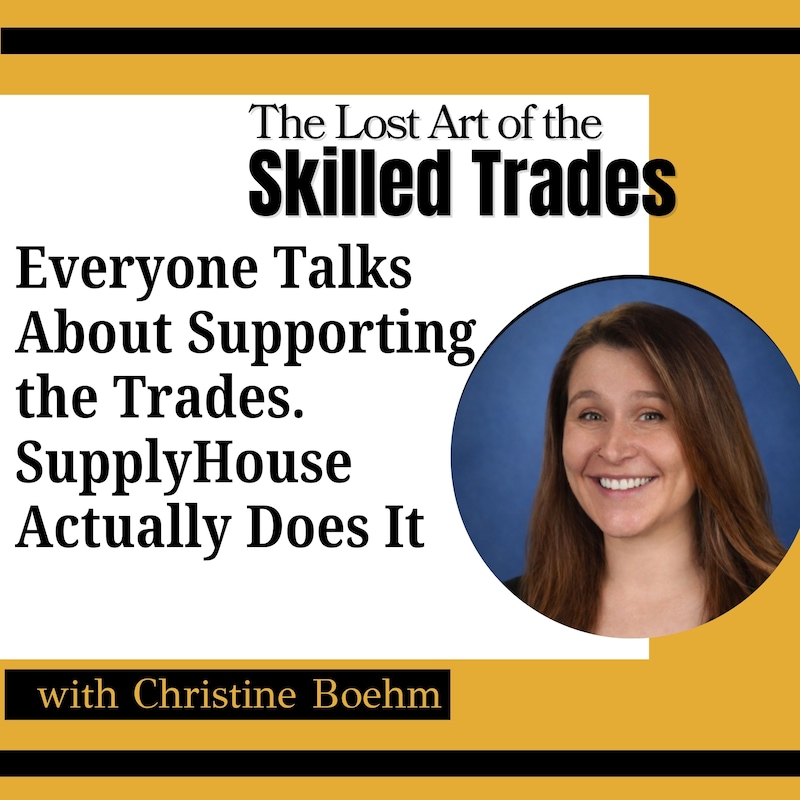
Christine Boehm of SupplyHouse.com breaks down how skilled trades scholarships and trade school scholarships are removing the barriers most people never see — and opening doors that were never accessible to begin with.
For years, workforce development in the trades has focused on awareness: getting more young people to consider careers in HVAC, electrical, plumbing, and construction. But interest isn’t the problem. The real gap shows up after someone decides they’re in — when cost, access, and lack of support stop them before they ever get started.
Christine leads communications and content at SupplyHouse.com and works closely with the Supply House Foundation to expand access into the trades through scholarships, partnerships, and industry advocacy. Her work focuses on building a system that doesn’t just attract attention — but clears the path for people to actually enter, stay, and build long-term careers.
This conversation is for contractors trying to hire in a tight labor market, for career changers looking for a real path into the trades, and for companies trying to understand what it takes to turn interest into a workforce.
In This Episode
(00:00) – Beyond Awareness
Andrew introduces Christine Boehm and reframes the trades conversation: the issue isn’t attention — it’s access.
(05:18) – How the Scholarship Model Started
The origin of SupplyHouse.com’s skilled trades scholarships and why financial barriers stop more people than lack of interest.
(11:22) – The Access Gap
Why career changers struggle to enter the trades — and how workforce development efforts often miss the people who need them most.
(18:40) – Women in the Trades
What’s driving growth, what’s still missing, and how representation directly connects to opportunity.
(26:55) – Building an Ecosystem
How the Supply House Foundation is expanding beyond trade school scholarships into partnerships, nonprofits, and long-term support.
(36:10) – Mentorship and Momentum
Why mentorship, contractor involvement, and real-world guidance determine whether someone stays in the trades or leaves early.
Key Takeaways
- Access — not awareness — is the real barrier into the trades.
Interest in trades careers is growing, but without financial support and structured entry points like skilled trades scholarships and trade school scholarships, most potential workers never make it past step one.
- Workforce development requires more than recruitment.
Bringing people into the trades is only the beginning — long-term success depends on support systems, mentorship, and clear pathways that help individuals build sustainable careers.
- Expanding participation strengthens the entire industry.
Increasing representation, especially among women in the trades, is not just about inclusion — it directly impacts the size, resilience, and future of the workforce.
- Scholarships are a starting point, not the solution.
Programs like the Supply House Foundation show that real impact comes from combining financial support with partnerships, education, and ongoing industry engagement.
About the Guest
Christine Boehm is the Communications and Content Team Lead at SupplyHouse.com, where she leads initiatives focused on strengthening the skilled trades through scholarships, storytelling, and workforce development programs. She works closely with the Supply House Foundation to expand access into the trades, support women entering the industry, and build partnerships that help the next generation of tradespeople succeed.
Keywords
skilled trades scholarships, trade school scholarships, workforce development in the trades, Supply House Foundation, women in the trades, skilled trades, trades careers, contractors, workforce pipeline, advocacy, education, HVAC, electricians, plumbers, construction, craftsmanship, problem-solving, Andrew Brown, Christine Boehm, SupplyHouse.com, Lost Art of the Skilled Trades
Resource Links
LinkedIn: https://www.linkedin.com/in/christine-boehm-marketing/
SupplyHouse.com: https://www.supplyhouse.com
Foundation Contact: [email protected]
Support the Show
If you found value in this episode, please leave a review on Apple Podcasts and share it with someone who needs to hear it. Your support helps us keep telling the stories of the skilled trades.
Transcripts
What Supply House is doing, uh, from a scholarship standpoint.
Speaker:I, I think there are these pools of students that have those core qualities.
Speaker:If given the opportunity and what we'd see such different results
Speaker:when that, what do you wanna do with your life, Christine Boehm?
Speaker:Supply house.com communications and content team lead.
Speaker:So every distributor talks about the skilled trades.
Speaker:Mm-hmm.
Speaker:And I see this quite often, but Supply house is doing
Speaker:something a little bit different.
Speaker:No, I, the trades is actually where I'm gonna get the most fulfillment
Speaker:out of my life and my career journey.
Speaker:'cause the percentage of of women in the trades is quite low.
Speaker:So every distributor.
Speaker:Talks about the skilled trades.
Speaker:Mm-hmm.
Speaker:And I see this quite often.
Speaker:They put it on the About Us page.
Speaker:Sometimes they put it on social about how much they're
Speaker:supporting the skilled trades.
Speaker:But Supply House is doing something a little bit different.
Speaker:They're giving back.
Speaker:To the men and women in the trades, especially plumbing,
Speaker:hvac, and some other trades.
Speaker:Tell me a little bit about what Supply House is doing, uh,
Speaker:from a scholarship standpoint.
Speaker:Absolutely.
Speaker:Yeah.
Speaker:Giving Back is always been a part of the supply House mission.
Speaker:That's one of our core values is generosity, it's grit at
Speaker:large, generosity, respect, innovation, and then teamwork.
Speaker:But that generosity piece has been at the core of what we do for forever really.
Speaker:So.
Speaker:In being a little bit a part of that trade ecosystem and having
Speaker:spent so many years listening to to tradespeople, we realized there's much
Speaker:like a lot of us in this community, there's that workforce gap, right?
Speaker:There's something needs to be done.
Speaker:How do we approach the situation and.
Speaker:One of our first concerted efforts was the track to the trade scholarship,
Speaker:which we started two years ago.
Speaker:This summer will be our third year.
Speaker:Um, and with that we have students apply that are on the road to their
Speaker:trades education or currently enrolled, enrolled in a trades institution.
Speaker:And we provide funding directly to the trade school from Supply House, um,
Speaker:after a brief application process and.
Speaker:Our, our goal here is to uplift and empower the trade students specifically.
Speaker:Um, so that's how attracted the trades was born and roughly 600 applications later.
Speaker:Wow.
Speaker:We've given away, uh, roughly $75,000 in funding just these
Speaker:last two years, and are looking at increase that funding moving forward.
Speaker:Assuredly, what does that initiation and, you know, where does that come from?
Speaker:Yeah.
Speaker:Internally, like who said, yeah, we should start to, you know,
Speaker:give scholarships back because.
Speaker:Um, I know of industrial distribution.
Speaker:I came from that world.
Speaker:Yeah.
Speaker:So I understand, um, look, I understand margins, I understand all this stuff,
Speaker:sort of, sort of behind the scenes, but, um, where did that come from?
Speaker:Did that come from.
Speaker:Upper management, like who said like, we should start doing this?
Speaker:Well, our CEO and founder Josh Morowitz, uh, generosity is at the
Speaker:heart of who he is as a person.
Speaker:And I think anybody who knows Josh in the industry knows that that is the case.
Speaker:Um, so it was under his guidance that we had giving back initiatives to begin with.
Speaker:Um, and in partnership with the work of our CMO Kailyn Staub,
Speaker:that's where this foundation.
Speaker:You know, which I'm alluding to a little bit down the line.
Speaker:I know we'll talk about it, but that's where this foundation of, of giving back
Speaker:sort of was solidified and it was made part of not only the work that we do in
Speaker:storytelling in the marketing department, but at large, giving back as a company.
Speaker:That's the main emphasis of, of what we do as a service industry as well,
Speaker:is we're finding different ways, consistent ways to serve the community.
Speaker:And on our purposes, it's the trades community and.
Speaker:Based on feedback that we've heard from the industry.
Speaker:This is where there's white space.
Speaker:It's this, this bridge, this, this initiation into the trades
Speaker:that needs support and this access gap that needs addressing.
Speaker:Yeah.
Speaker:And it's extremely important.
Speaker:Um, from the plumbing standpoint, we need about 550,000 plumbers.
Speaker:I mean, I can preach to Oh, totally.
Speaker:Here until, you know.
Speaker:Yeah.
Speaker:Um, HVAC, 42,000 HVAC technicians, we need every single year to replace that gap.
Speaker:So.
Speaker:Each piece helps that new person who's looking to go down that road, right.
Speaker:Um, start their career.
Speaker:Now, as far as, uh, the scholarship, it goes directly to the trade school.
Speaker:Yes.
Speaker:It doesn't go necessarily to the person directly.
Speaker:Right, right, right.
Speaker:Now it functions, it's a direct contribution to the trade
Speaker:school that they're enrolled in.
Speaker:But down the line, we are looking to diversify the ways we give back, you know?
Speaker:There's this giving to the student and then there's also
Speaker:giving to the school too.
Speaker:We wanna make sure these institutions have the materials they need to have
Speaker:successful programs and convert, excited, energized students into the field
Speaker:with all these individuals.
Speaker:What's the mixture of, uh, women versus men who are coming through
Speaker:This is percentage wise, is it mostly.
Speaker:Men who are combing through versus women.
Speaker:'cause the percentage of, uh, women in the trades is quite low.
Speaker:Yes.
Speaker:It's four or 5% depending on which trade that you pick.
Speaker:Right.
Speaker:What is, what is the makeup of that?
Speaker:That's pretty reflective of the scholarships that we've gotten
Speaker:in those last couple of years.
Speaker:Thankfully, we saw an increase in scholarships from our first year to
Speaker:second year that were submitted by women, young women in the, that are.
Speaker:Interested or at the beginning of their careers, but definitely
Speaker:still a lower percentage.
Speaker:I think out of our winners, um, this past year, three of them, we were able
Speaker:to afford, uh, those scholarships to women $2,500, um, to, to their trade
Speaker:education, which was awesome to see.
Speaker:And we wanna look for those candidates to, especially the ones
Speaker:that don't fit the stereotypical mold, but have so much to offer.
Speaker:What does that look like from my, I'm interested because if, if I am
Speaker:just starting out right, I'm 18, 19 years old and you know, I wanna go
Speaker:to trade school, but it's expensive and I do submit for this, right?
Speaker:What is, what do you, what do you look for?
Speaker:That kind of says, yeah, that's the right person.
Speaker:Totally.
Speaker:What kind of qualities you look for?
Speaker:The stories that we hear are.
Speaker:So expansive.
Speaker:We see students coming that are the sole support of their family, and
Speaker:they're submitting an application.
Speaker:We also have students that it's, they're making a career shift 20, 30
Speaker:years into a career and have decided, no, I, the trades is actually where
Speaker:I'm gonna get the most fulfillment out of my life and my career journey.
Speaker:So.
Speaker:Above all, we see grit.
Speaker:We see those supply house core values of grit as a word itself.
Speaker:Yeah.
Speaker:But also that we're, we're looking for generous people, people who lead with
Speaker:respect, people who are looking to innovate the field, and folks who are
Speaker:ready to jump in and learn, not just from their schooling, you know, and what, what,
Speaker:what their educational career looks like.
Speaker:But are they.
Speaker:Ready to work as a team with other members of this trades community,
Speaker:looking for that mentorship, looking for that drive to contribute to
Speaker:the A sustainable trades ecosystem.
Speaker:Now did you say that some people have been in the.
Speaker:Uh, a different career.
Speaker:Yeah.
Speaker:And a career changer.
Speaker:So tell me a little bit about a career changer so the audience
Speaker:kind of understands like, what were they doing before?
Speaker:Totally.
Speaker:So I can think of an application I read last year where the
Speaker:gentleman was in a finance career.
Speaker:Oh wow.
Speaker:Just let's wait.
Speaker:Totally different field, right?
Speaker:But, you know, was in a finance career, was not receiving the kind of.
Speaker:Gratification that he wanted from that trajectory and really wanted to pivot to
Speaker:working with his hands, working, being an immediate problem solver in a space.
Speaker:And I think that is a quality that so many trades people have.
Speaker:You're on the spot, on the job.
Speaker:Every job looks different and there's a freshness and there's invigoration
Speaker:that comes from that too, that you might not get from other career fields.
Speaker:It's interesting that you said that, uh, somebody is, uh, a. Um, a problem solver.
Speaker:Mm-hmm.
Speaker:And I ask this quite often when I'm sitting down with someone in trade.
Speaker:You a problem solver.
Speaker:Yeah.
Speaker:I'm a problem.
Speaker:I was always a problem solver.
Speaker:And that, that's a, uh, you know, one of the top qualities when
Speaker:it comes to somebody, someone who has mechanical ability Sure.
Speaker:Is got a technical spark about going back to your example, the
Speaker:person that was in finance Yeah.
Speaker:That has decided that, that he wants to go in a completely different career.
Speaker:And in some respects, you're starting.
Speaker:All over again.
Speaker:Right.
Speaker:I'm even thinking about, uh, a family member of mine who has worked for Trader
Speaker:Joe's for 15 years in the corporate world.
Speaker:Now he's becoming an electrician at 36 with two kids.
Speaker:Wild.
Speaker:Right.
Speaker:He's taking a big step back.
Speaker:Mm-hmm.
Speaker:To big, a bigger step forward.
Speaker:That's exactly right.
Speaker:It's, it's the inve, the investment in that initial investment is such, um,
Speaker:an overlooked piece of this journey.
Speaker:It's people, I think.
Speaker:There's this gap that we have about the perception around the trades
Speaker:and entering it, what it looks like.
Speaker:But then once we move beyond that perception gap, we enter
Speaker:this access gap where folks underestimate the initial investment.
Speaker:You need to flush a a truck out.
Speaker:You need to flush.
Speaker:You got your tools out, all the introductory equipment that you
Speaker:need, not to mention your cece's.
Speaker:Beyond your initial education apprenticeship.
Speaker:So it's, there isn't an a consistent lifelong investment that also couples
Speaker:in, so it's, there's a lot of these gaps that tradespeople are facing that more,
Speaker:more light just needs to be shed on, on the extent of their journey, not Yeah.
Speaker:Yeah.
Speaker:And I, I think it's, I think it's shifting, and I have this
Speaker:conversation quite often about.
Speaker:Blue collar, white collar.
Speaker:Right.
Speaker:A lot of people like to stack up now.
Speaker:I think it's kind of switching in a sense that blue collar, um,
Speaker:there's a spotlight on it now.
Speaker:Sure.
Speaker:Because of ai, because of disruption, because Yep.
Speaker:Kids are coming outta school, who've gone to four year degrees,
Speaker:they're not necessarily getting the work that they should.
Speaker:And there were kids, especially Gen Z Yes.
Speaker:Who are ages 13 through 28 or saying, well, you know, maybe
Speaker:this trades thing is right.
Speaker:Right.
Speaker:Exactly.
Speaker:There was, um, I recently went to, uh, another nonprofit
Speaker:organization, uh, is First Robotics.
Speaker:Okay.
Speaker:And those students are, you know, from elementary school, there's first robotics
Speaker:programs all the way up into high school.
Speaker:And the career trajectory there is engineering, engineering,
Speaker:engineering, computer engineering, software engineering.
Speaker:But recently attending the Long Island regionals for the first robotics.
Speaker:I was looking around at these students and.
Speaker:They're learning how to weld.
Speaker:They're learning how to use power tools.
Speaker:They're learning how to construct and build things with their hands.
Speaker:Yeah.
Speaker:Why is nobody talking to these students about how valuable a
Speaker:trades career could be for them?
Speaker:Not everybody is that type of student that thrives in a four year
Speaker:institution that thrives in, in a standard high school education.
Speaker:So how do we popularize these kinds of careers to students that we're not?
Speaker:We're not speaking to.
Speaker:Generally you're thinking, oh, it's a robotic student that's a four year,
Speaker:you know, computer engineering career.
Speaker:My dad's an engineer, my brother's an engineer, so no ill will to engineers.
Speaker:Yeah.
Speaker:But these are also students that have the same sort of drive problem
Speaker:solving skills that can very, very easily thrive in a trades based career.
Speaker:Yeah, I was actually down in Texas a couple years ago.
Speaker:Um, it was a called a Y Texas event and it was all about businesses in
Speaker:Texas and I had met a couple kids who in robotics, I interviewed them.
Speaker:Sure.
Speaker:And, uh, one of, 'cause I'm now.
Speaker:Escaping me, the, the name of the individual, it'll come to
Speaker:me after the podcast is over.
Speaker:Right.
Speaker:Um, he was talking about his dad and his dad was very proud mm-hmm.
Speaker:Of what he's doing.
Speaker:'cause his dad was in the trade, but different side of that.
Speaker:Sure.
Speaker:I think he was more an hvac, but his son is now thinking or working on robotics.
Speaker:Sure.
Speaker:And, uh, the importance of obviously that line of work mm-hmm.
Speaker:And working with your hands.
Speaker:Right.
Speaker:Uh, his, his parents were super proud of him.
Speaker:Of course, and it's, it, there's more connection than there is not.
Speaker:And I, I do think the more you learn and listen to the trades community and the
Speaker:message, message that they share and how they approach work, it's not dissimilar
Speaker:to how all of us who appreciate.
Speaker:The hard work that goes into whatever our field might be.
Speaker:Uh, there's, there's this connection that exists across, um, and it's, it's about
Speaker:that pride in what you're doing as well.
Speaker:I think the trades community has a beautiful sense of pride and relationship
Speaker:to the artistry of their work.
Speaker:And again, I, I think there are these pools of students that have those
Speaker:core qualities that if given the opportunity and given the time to really.
Speaker:Experiment with this type of education earlier on, would we'd
Speaker:see such different results and in.
Speaker:When that, what do you wanna do with your life?
Speaker:Conversation comes up, down the line in their, in their under,
Speaker:you know, uh, pre-college career.
Speaker:Yeah.
Speaker:I mean, I've had this, again, I had this conversation quite often.
Speaker:I, I was standing in front of, um, 150 contractors, the Master Builders of
Speaker:Iowa conference in February, and we were talking about how to reach sort of
Speaker:the younger generation and the earlier you can go to speak to kids, right.
Speaker:At least to get them interested.
Speaker:And potentially working with their hands, but going to these schools with intention.
Speaker:Mm-hmm.
Speaker:Right.
Speaker:Kids have short intention spans.
Speaker:I have two young kids, if I'm not saying something specific or like
Speaker:hit them in the first five or 10 seconds, they're looking, you know?
Speaker:Right.
Speaker:So I always say that when you're speaking in front of kids to make it.
Speaker:Um, make it impactful.
Speaker:Mm-hmm.
Speaker:An example would be, I was speaking at a, a technical school in Paramus a
Speaker:couple years ago, and I had, and I had just started doing this, and ISI was
Speaker:like, I don't know how to really connect.
Speaker:Mm-hmm.
Speaker:Like, I'm not really sure, like.
Speaker:Different audience.
Speaker:And I said, how am I gonna connect with the younger generation?
Speaker:I said, why do I speak to my own kids?
Speaker:Why do I ask them, what would these kids be interested so they can connect?
Speaker:Well, right?
Speaker:And and I said to my son, Ethan, I'm like, how do I do this?
Speaker:He's like, dad, you gotta talk about cell phones.
Speaker:You gotta talk about Fortnite, you gotta talk about Xbox.
Speaker:I'm like, Ethan, are you sure?
Speaker:He's like, a hundred percent.
Speaker:So I got up in front of like.
Speaker:2 50, 300 kids.
Speaker:And I said, by show of hands, who plays Fortnite, who plays mm-hmm.
Speaker:Xbox, and they're all looking at each other.
Speaker:They're like, and they started giggling.
Speaker:And then I started talking about, well, what would happen if the power went out?
Speaker:Mm-hmm.
Speaker:What would happen if you can't access your game consoles, your servers?
Speaker:Wait.
Speaker:You're right.
Speaker:And I said, do you know who, uh, supports that?
Speaker:Electricians and linemen?
Speaker:And I knew that it worked because I had 10 or 15 kids come up
Speaker:to me after asking me about.
Speaker:That trait.
Speaker:So when I stood up in front of the master builders, I, like I, I said, I used
Speaker:this example of being intentional about what you're doing, not just showing up.
Speaker:But obviously having the right conversation and, and being able to pull
Speaker:them in that first five or 10 seconds.
Speaker:Totally.
Speaker:That intentionality is huge.
Speaker:And the authenticity piece I think is huge as well.
Speaker:Oh yeah.
Speaker:You know, meeting people where they're at and showing up grounded
Speaker:in who you authentically are.
Speaker:I think that's another piece too, that you just can't over skip, but
Speaker:your, your son brings up a good point about using the cell phones too.
Speaker:I do think social media has been a landscape where we've been.
Speaker:Able to listen to more of the community than ever in the common
Speaker:sections in, you know, the dms, where, wherever the case might be, we have.
Speaker:The trades community reaching out to us in all these different ways.
Speaker:Um, and what's super exciting is we have younger tradespeople reaching out.
Speaker:We have these younger influencers in the trade space too.
Speaker:It's, we're seeing a lot more light shine because of the hard work that
Speaker:these young people are doing to amplify the artistry of their work.
Speaker:It's, it's been incredible to see, and we do our best to try to highlight
Speaker:those voices as well, or at least make sure that they feel heard.
Speaker:And respected for the work that they're doing.
Speaker:Yeah.
Speaker:Look, that that's what it's all about.
Speaker:Yeah.
Speaker:You wanna see the, the industry do well, um, and you want them to flourish.
Speaker:Absolutely.
Speaker:When it comes to supply house, is it more so.
Speaker:Focused on plumbers, hvac, electrical.
Speaker:What's like the number one trade for?
Speaker:Great question.
Speaker:We started in plumbing some 20 odd years ago.
Speaker:It was just plumbing goods.
Speaker:Um, and we've since, so that's been our bread and butter, but we've since
Speaker:expanded, like you mentioned to the hvac, the heating, the electrical, the tools.
Speaker:You know, we're, we're continuing to grow.
Speaker:To again, answer the question and call of what our customers are asking for from us.
Speaker:You know, you, you wanna, we wanna be the one-stop shop.
Speaker:The easiest Yes.
Speaker:That they say throughout the day.
Speaker:Yeah.
Speaker:Is just the convenience, the ease.
Speaker:You pull up our spy app, you make your purchase.
Speaker:And it's, it's as easy as that.
Speaker:And we want that simplicity and ease of relationship and trust to be through
Speaker:everything we are, which is why we wanna show up in these spaces and stand
Speaker:alongside the community that we serve.
Speaker:Yeah, and obviously when you're a plumber or hvac, you need products.
Speaker:Totally.
Speaker:You have a job and sometimes you don't.
Speaker:Always plan ahead.
Speaker:Right.
Speaker:And you need something right away and you need to overnight something.
Speaker:Again, I come from, came from that world a long time ago.
Speaker:Yeah.
Speaker:So I understand what the, what the needs are.
Speaker:Um, you know, but I, I speak to different plumbers.
Speaker:I don't know if you know Roger Wakefield.
Speaker:Absolutely.
Speaker:So I'm friendly with Roger Wakefield.
Speaker:Sure.
Speaker:I've, I've spent some, some time with him and obviously he does a good job
Speaker:for the, for the plumbing industry.
Speaker:Mm-hmm.
Speaker:But, you know, he talks about the importance of, um, sharing.
Speaker:What you can do in the trade, what the money that could be made in the trade
Speaker:that you can be an entrepreneur one day.
Speaker:Right?
Speaker:And everybody's got their own journey and they want different things.
Speaker:If you want to be a journey in your trade, that's perfectly fine.
Speaker:You wanna be a master in your trade.
Speaker:That's perfectly fine.
Speaker:If you want to be an entrepreneur, there's a lot of different
Speaker:opportunities, right, for people.
Speaker:And he constantly, you know, talks about all the options.
Speaker:Love that, that are available.
Speaker:It's, it's.
Speaker:Important information to share that it doesn't look like one thing, it it,
Speaker:it can be a different culmination of strengths dependent upon the person.
Speaker:Just like any career trajectory, you know, the trades is this umbrella term that.
Speaker:You can find creative ways to be a member that is thriving and
Speaker:successful, but it can feel authentic and true to who you are as a person.
Speaker:You don't have to sacrifice that by entering this field.
Speaker:Yeah.
Speaker:And especially if that's what you want to do.
Speaker:Right.
Speaker:And you know, a lot of times people.
Speaker:Realize that they have this mechanical ability.
Speaker:Mm-hmm.
Speaker:I always say mechanical ability, technical spark, but like you, you really do at a
Speaker:young age, you know that you can tinker with things, you know, that you can fix
Speaker:things, but there is, uh, a great career that you can have working with your hands.
Speaker:Mm-hmm.
Speaker:And you can take it as far as.
Speaker:You want to take it?
Speaker:Absolutely.
Speaker:And even just as a life skill, I mean, I didn't know how to change a flush valve
Speaker:until I started working at Supply House.
Speaker:Yeah.
Speaker:And I, you have to learn about the products and you're, you're ask,
Speaker:answering these questions, being a support system for customers.
Speaker:And you, it was, you know, I, I thank my dad a lot for instilling that education
Speaker:in me of the importance of learning how to work with your hands to a certain extent.
Speaker:And then from that, you'll also learn when to call a professional.
Speaker:Yes, there's that fine line of like, exactly, I can do this,
Speaker:but should I, but should I might cost me more in the long run.
Speaker:Right.
Speaker:I wanna shift over to the foundation Sure.
Speaker:For a quick moment because not every, uh, again, distributor one gives
Speaker:back from a college standpoint, but not every organization.
Speaker:Uh, we'll start, um, talking about a foundation.
Speaker:Tell us a little bit about the foundation, some of those
Speaker:initiatives that you're looking to.
Speaker:Totally.
Speaker:It.
Speaker:It's, we are so excited.
Speaker:Our foundation's gonna be launching April 22nd, 2, 20, 26.
Speaker:It is built on the work of programs like Track to the Trades where
Speaker:we, we learned a lot from that.
Speaker:We learned a lot about the impact on the trajectory of the individual student
Speaker:and realize as the company continues to scale, we need to make sure that the way
Speaker:we're giving back to the community that we serve continues to scale in kind so.
Speaker:Track to the trades will be one arm of the foundation's mission
Speaker:and support supporting education and work workforce development.
Speaker:Beyond that, it's also we're, we're starting a grant process
Speaker:to give back to schools as well.
Speaker:So these non-pro and other non-profit based trade.
Speaker:Organizations across the country.
Speaker:You know, it's, we've got this sort of tri pillar approach of the education,
Speaker:the schools, you know, the education of the student, the school that they're
Speaker:attending, and the communities that they're serving, and across the board, you
Speaker:know, that's, that's where that funding's going towards is a sustainable trades
Speaker:ecosystem in this country that folks can rely on and feel good about, and feel
Speaker:comfortable and confident celebrating.
Speaker:So who's on the foundation?
Speaker:Yes.
Speaker:Our president is, uh, Kaylyn Stab.
Speaker:She is the C uh, the president, and again, the CMO at Supply House.
Speaker:Um, I serve as the secretary, and then we have our board of directors, which
Speaker:consists currently of senior leadership at Supply House, but looking to grow, evolve,
Speaker:incorporate a, eventually, hopefully more.
Speaker:Voices from our Trade Master customers, which is our, our
Speaker:loyalty program at Supply House two.
Speaker:Um, but incorporate those voices, those individuals that built this industry,
Speaker:and make sure that their voices are represented and heard, and, uh.
Speaker:Celebrated in the work the the foundation does.
Speaker:How long is the, I guess, that foundation like been talked about internally
Speaker:before you decided that Yeah, it's time to, because it takes time to set.
Speaker:I know I'm on a nonprofit as well, so like I understand sort of, it takes
Speaker:time to, to set that up, so Totally.
Speaker:Was this in motion for, for quite a while.
Speaker:It was in discussion.
Speaker:My, um, uh, I, I pursued a, a master's in nonprofit leadership and
Speaker:management outside of supply house and night classes sort of thing.
Speaker:And I love my work at Supply House so much.
Speaker:I love that storytelling aspect and those two pieces, you
Speaker:know, in conversation with.
Speaker:Calin, our CMOI.
Speaker:It was, it just sort of came up, this idea of sustainable giving, of
Speaker:continuous giving and how it makes sense for supply to have this formative
Speaker:arm extension, if you will, that.
Speaker:Its sole purpose is investing in the future of the trades that is
Speaker:so part of Supply House that's authentically who we are as people.
Speaker:We want to show our gratitude, and this was a way that felt.
Speaker:Like a strong direction for us, but probably about a year ago is
Speaker:when conversations really started formalizing about the foundation.
Speaker:Yeah.
Speaker:I mean, it takes time to, to totally set up the foundation and it's great
Speaker:that, you know, it's, it's here.
Speaker:Mm-hmm.
Speaker:Absolutely.
Speaker:After a, a lot of thoughts, work, consideration, um, and most, mostly the
Speaker:groundwork so that we can continue to grow it in a way that feels authentic
Speaker:to who we are and, and our customers.
Speaker:Yeah.
Speaker:Um, as far as the, the scholarship goes underneath this, are you
Speaker:going to expand the scholarship?
Speaker:Very much so, yes.
Speaker:We're looking to continue increasing that dollar amount year over year,
Speaker:um, as we validate the amount of students that are applying the um.
Speaker:What the application process looks like, what, what we're learning from
Speaker:the students, applying how to make it easier, convenient, and accessible.
Speaker:Um, we wanna continue pouring as much as we can into that because it is such
Speaker:a strong pillar of, of the work that we wanna do in such a necessary, uh.
Speaker:Piece, it's that access gap that we talked about.
Speaker:It helps close that access gap for students who are excited
Speaker:about this and this opportunity.
Speaker:Yeah.
Speaker:Can you share a success story?
Speaker:I would love to hear success stories.
Speaker:Yep.
Speaker:And if, if you could share the name, it's great.
Speaker:If you, if you don't then it's, it's totally cool.
Speaker:But, uh, love to hear a success story from, from the scholarship.
Speaker:Yeah, absolutely.
Speaker:So we had one, um.
Speaker:Our first year, and maybe it's the seasonality because we announced
Speaker:winners around December, but.
Speaker:He, a gentleman named a, uh, Adam from a trade school in Minnesota.
Speaker:Um, he sent us a reaction video after finding out, finding out that he won.
Speaker:He had come home, uh, uh, a 12 hour shift on a job site below zero
Speaker:temperatures and opened up his email, saw the notice that he won, and for
Speaker:him and his wife, that meant not having to choose between Christmas gifts
Speaker:for their kids that year and paying for tuition the following semester.
Speaker:Wow.
Speaker:And that.
Speaker:I was like, I was leveled by that.
Speaker:That's you.
Speaker:You hope for that kind of an outcome.
Speaker:You hope for that kind of of an impact.
Speaker:And to see somebody take the time to record their reaction to this and share
Speaker:that it's, it was exactly the sort of support we wanna be providing and exactly
Speaker:the kind of story that makes it worth.
Speaker:Uh, anything that goes into it, which it's, you know, like I said, we're
Speaker:wanting to grow it, wanting to scale it further and further, and that
Speaker:sort of example, that outcome is, is more than you could ever ask for.
Speaker:And what is, uh.
Speaker:What is his aspirations?
Speaker:Like?
Speaker:What, what, yes.
Speaker:Uh, lineman is lineman.
Speaker:Yep.
Speaker:That was the, the tra his trajectory.
Speaker:Okay.
Speaker:Mm-hmm.
Speaker:Yeah.
Speaker:I'm always curious what, 'cause there's so many different trades, right?
Speaker:Absolutely.
Speaker:So there's a hundred plus different trades.
Speaker:What, you know, you narrow it down, you know, I was curious
Speaker:like, why did he say lineman?
Speaker:That's a great question.
Speaker:All of the applications have such different stories that they're coming
Speaker:from such different backgrounds.
Speaker:Yeah.
Speaker:Um, it's, I mean, I broke down percentages of, of career aspirations.
Speaker:Plumbing's a big one for us.
Speaker:Um, that, and a lot of that has to do with generational influence as
Speaker:well, which is kind of interesting.
Speaker:The, the grandfather to father to child pipeline of how.
Speaker:They were inspired or what, what was, what said, this would be your,
Speaker:this, this should be your trajectory.
Speaker:Uh, it's interesting to see how fam, how much family comes into play.
Speaker:Um, and again, also kind of speaks to the trades community at large too, right?
Speaker:Uh, family is such a, seems to be such a theme in a lot of these generational.
Speaker:Companies that we see across the country, it's passed down from generation
Speaker:to generation with the a growing customer base, with that committed,
Speaker:you know, their committed customers.
Speaker:That's the only reason that they can grow and scale is because of how good they
Speaker:are to the people that they work with.
Speaker:So it's been really informative to see the expansive backgrounds of
Speaker:individuals coming in and, and what they.
Speaker:Hope to do with, with their, with their future assuredly, but also
Speaker:what got them there and family was one that came up quite a bit.
Speaker:Yeah.
Speaker:Not everybody came from a background in the trades that
Speaker:their father or grandfather.
Speaker:Right.
Speaker:Some do.
Speaker:Some are, yeah.
Speaker:You know, some have, uh, uh, uh, joined a union because their father is in the
Speaker:union or a grandfather is in the unit, or some people have, I've these stories like.
Speaker:My, my father was an accountant.
Speaker:Sure.
Speaker:Like I, I just want a completely different direction.
Speaker:I think you need to decide what's best for you.
Speaker:Mm-hmm.
Speaker:In a sense, um, if you like working with your hands and you want
Speaker:obviously that type of career.
Speaker:Um, but you know, I also believe that parents need to be open to Yeah.
Speaker:'cause not everybody Look, let's be honest, sometimes, um.
Speaker:A parent might not say like, Hey, maybe you should go to college.
Speaker:Right.
Speaker:And maybe not, and just be honest, like, you know, maybe not do the trades Right.
Speaker:But I, I do think about, you know, 'cause I have my own kids
Speaker:about being open-minded mm-hmm.
Speaker:About the, the opportunities that, you know, your kids can take.
Speaker:And I always think that a trade is, is a great obviously path.
Speaker:Yes.
Speaker:Yeah, a hundred percent.
Speaker:And it's, I, I think it also starts with popularizing more trade-based
Speaker:education, like we were saying earlier in a child's learning
Speaker:journey, earlier in their education.
Speaker:The, the working with your hands element.
Speaker:I, I'm, I mean, I think I took one tech class that was, that was required in my
Speaker:middle school, high school education, but I wonder how more consistent
Speaker:attention to the technical arts earlier on, what that would do to change.
Speaker:Perceptions of students.
Speaker:You know, I, I might not be acing this class.
Speaker:I might not feel totally confident in, you know, in public speaking, whatever
Speaker:the case may be, but I can, I know that when I put this and this together, it
Speaker:makes this, and I know when I do that with my hands, I. I'm making something
Speaker:with consistency and I'm making something that I can be proud of there.
Speaker:There might be other soft skills that I'm not feeling totally confident with at this
Speaker:age, but I know these things go together in this way and it works every time.
Speaker:Yeah, and that's, that's so rewarding for a young child too.
Speaker:It is.
Speaker:Is that, that sense of fulfillment?
Speaker:Yeah.
Speaker:Is that sense of film?
Speaker:It and when I, I, I remember I was at a, um, an event in Denton, Texas, and
Speaker:uh, it happened to be a welding event and someone was showing me their work.
Speaker:Right.
Speaker:They, they.
Speaker:I dunno.
Speaker:They did these like custom gates in the, like he was flipping through
Speaker:the, the book and he was just lighting up as he was talking about
Speaker:it because he's passionate about it.
Speaker:Right.
Speaker:And when you ask someone who's in the trades about their work, they'll point
Speaker:and they'll say, I worked on that bridge.
Speaker:Yes.
Speaker:And I worked on that tunnel.
Speaker:I did that, uh, commercial building.
Speaker:Mm-hmm.
Speaker:And there's that sense of pride that comes along with it.
Speaker:Absolutely.
Speaker:We do this, uh, series on our social media called, uh, trade art, where we have, we
Speaker:just had such an influx of individuals sending us their work, and it's gorgeous.
Speaker:You can frame this stuff.
Speaker:It's so beautiful.
Speaker:Um, you know, the, the laying of the pec pipe, the mm-hmm.
Speaker:Positioning of the pumps.
Speaker:It, it is just.
Speaker:Obviously takes so much time and attention, and so we started just
Speaker:resharing them, tagging their company, but even those tiny little conversions of.
Speaker:Hey, we are, we're encouraging you.
Speaker:We see what you're doing.
Speaker:It's amazing work.
Speaker:So if nobody else is telling you today, but you know, the, your
Speaker:customer or homeowner, whoever it might be, is looking at a job site
Speaker:and it's like, well, looks good.
Speaker:But you are sitting there going, but it looks really good, doesn't it though?
Speaker:It's, this is beautiful.
Speaker:We wanna be the, the champion that says it looks gorgeous and here it
Speaker:is, we're sharing it out on our, our platform because we believe
Speaker:in the work that you're doing.
Speaker:Yeah, but I love it as well because other people can take a look at.
Speaker:Somebody who's doing that work, who is thinking about getting into
Speaker:plumbing or electrical or HVAC and say, wow, you know, they can do it.
Speaker:Yes.
Speaker:Right.
Speaker:I can do it.
Speaker:And that's what I'd love to see when, um, I guess I call 'em influencers, right?
Speaker:Who are doing, who are doing the work, but they're showcasing their work.
Speaker:And it just gives somebody the, the, the, you know, the
Speaker:inspiration inside to be like, yeah.
Speaker:I can do that as well.
Speaker:And it's a different way to sort of view mentorship too.
Speaker:Mm-hmm.
Speaker:Because I, that's another gap that's currently in this
Speaker:industry is that connection gap.
Speaker:You know, you get past the perception, past the access, and
Speaker:then all of a sudden there's this.
Speaker:Piece of connection where I don't know where to get that mentorship.
Speaker:I don't know where to post these questions.
Speaker:I don't know who to ask.
Speaker:I'm two, three years into my career, like we said before,
Speaker:there, every job site's different.
Speaker:You're seeing different things every single day.
Speaker:Has anybody seen this particular issue?
Speaker:How do we get a pool of engaged mentors in the trades community as well?
Speaker:That I, maybe I'm towards the end of my career, but I know.
Speaker:I want my legacy to be helping the next generation and
Speaker:investing in the next generation.
Speaker:So it's, that's another element too, is that.
Speaker:Those influencers, I think have helped bridge that gap just a little bit by
Speaker:at least highlighting and showing what community can look like when it's not
Speaker:necessarily in a, the same shared space.
Speaker:You know, codes may be different, but there are certain principles
Speaker:that are just the case regardless of where you are in the country.
Speaker:Yeah.
Speaker:Some of them are showing up as mentor.
Speaker:Right.
Speaker:And you brought up a good point about mentorship and how important that Yeah.
Speaker:Portion is.
Speaker:You know, it's one thing to be in your apprenticeship, that's the foundation.
Speaker:You learn, but it doesn't necessarily keep you there.
Speaker:I always feel that it's mentorship, the people that help with your
Speaker:trajectory in your career.
Speaker:Because, and again, I was, I was running a breakout session at, at just
Speaker:thinking about the Master Builders of Iowa when I was there, and like I, I
Speaker:said, how many people have had a mentor?
Speaker:And they all went like this.
Speaker:Mm-hmm.
Speaker:And then I said, tell me.
Speaker:Specifically who it was.
Speaker:And I, I called out four or five people and each of them said one or two people.
Speaker:Mm-hmm.
Speaker:And they've been in the career for quite a while in their, in their trade.
Speaker:Sure.
Speaker:And they said, I still keep in touch.
Speaker:Mm-hmm.
Speaker:With that person who really helped me.
Speaker:And they still learn.
Speaker:They're still learning.
Speaker:Yeah.
Speaker:And it was, it was interesting to see how impactful those
Speaker:people were in their career.
Speaker:Yes.
Speaker:And people could always say that that was that one or two people that said,
Speaker:you know, that really helped me.
Speaker:And also people who are in the trade who are going through an
Speaker:apprenticeship may be having a hard time.
Speaker:Right.
Speaker:And I've seen instances where somebody wanted to quit because it was getting
Speaker:too hard, but their mentor mm-hmm.
Speaker:Kind of, kind of pulled them back and kind of worked out some, some issues that
Speaker:they were facing and then they ended up.
Speaker:Staying and thriving.
Speaker:So I think mentorship is extremely important.
Speaker:Absolutely.
Speaker:And that's a brilliant example too about the culture shift as well, of the
Speaker:culture of what it is to work in the trades and work amongst tradespeople
Speaker:and it really leaning into this.
Speaker:Leaning into that respect element that we see in the trades community too.
Speaker:It, you have to have a certain element of respect and reverence for
Speaker:the individuals that have been doing this for 40, 50 years of their life.
Speaker:Um, so it's bridge and, and also keeping these younger generations
Speaker:engaged with the work and understanding the importance of the work.
Speaker:So it's that.
Speaker:That flow, that part of the ecosystem.
Speaker:I don't know if we have a perfect solution to it yet, but it's something
Speaker:that I'm excited to try to figure out how to make those connections, um,
Speaker:regardless of what it might look like.
Speaker:But I, I think that's a question that still needs to be explored
Speaker:as well, is how do we keep that connection gap as small as possible?
Speaker:How do we make it so easy to get?
Speaker:Support and, and maybe even just like you were saying, encouragement too,
Speaker:that you've got this, it's tough.
Speaker:It's a tough day.
Speaker:There are tough days, there's no doubt about it.
Speaker:And you can keep going and you can, you can get to the other side.
Speaker:You're, you can figure this out.
Speaker:You can be a problem solver like the rest of us.
Speaker:Yeah.
Speaker:And you need that support system behind you.
Speaker:You need those resources behind you.
Speaker:Um, and I think it's a. An important piece that not every company is doing.
Speaker:Sometimes they're, they're busy, sometimes they don't have the resources.
Speaker:Sure.
Speaker:But the ones that really double down on mentorship with the right mentors mm-hmm.
Speaker:They'll see an increase in retention.
Speaker:Yes.
Speaker:When it comes to somebody new who's starting that will s. Stay there.
Speaker:Yeah.
Speaker:For a while.
Speaker:Absolutely.
Speaker:And that's, that's the sustainable ecosystem we we're looking for.
Speaker:It's that knowledge passing, that information sharing, it's
Speaker:learning so that you can teach and listening so that you can learn.
Speaker:All of those elements are so pivotal in, in the ecosystem as well.
Speaker:That, and it's been exciting to see.
Speaker:A lot of that workout itself in different kinds of conversations that I both
Speaker:overheard on the trades floor, on the trade show floor or in the comment
Speaker:section on like a Reddit thread.
Speaker:I, I love to, to look in the, the plumbing, Reddit and just
Speaker:kind of see the way individuals are working with each other and
Speaker:partnering in problem solving it.
Speaker:It is a community that had.
Speaker:Grows to whatever Glass Bowl I think they're put in.
Speaker:And it's been cool to have more insight on where those growth
Speaker:moments have taken place.
Speaker:But definitely the mentorship piece is that, that that culture shift
Speaker:has been exciting to watch unfold.
Speaker:Yeah.
Speaker:Well that c, the community or Reddit or Yeah.
Speaker:You know, whether it's on social media, whether it's on TikTok.
Speaker:You know, even, uh, being on TikTok for me and being on these lives Yeah.
Speaker:And bringing in these individuals who are younger, they have questions.
Speaker:Sure.
Speaker:And they're just, they may not have the right people in their network.
Speaker:They might not just, they don't have a, a neighbor who's in the trades.
Speaker:Right.
Speaker:They don't have a family member who's in the trades and they look
Speaker:at communities like a Reddit, like a, a TikTok and other mm-hmm.
Speaker:Uh, ways to really get their information because they don't necessarily, you
Speaker:know, it's out there, but it's scattered.
Speaker:Totally.
Speaker:There's no real consolidated.
Speaker:Search alls or catchalls.
Speaker:And that's, that's an interesting opportunity too.
Speaker:Um, but like you're saying, it exists in tiny little pockets, pretty scattered
Speaker:about and, and centralizing the conversation, you know, in, in common
Speaker:sections like this podcast too, and we're, we're amplifying the voices and
Speaker:sharing the voices of the people that matter most in this industry, which are.
Speaker:The tradespeople that have been doing this for decades and decades
Speaker:and giving them the opportunity to publicly share that information as well.
Speaker:Amplification, I think has been huge with social media too, especially
Speaker:around popularizing this information on the workforce gap too, this
Speaker:labor shortage, it's, I've been.
Speaker:An unmatched tool in getting the word out there, that's for sure.
Speaker:And now we're starting to see publications pick up these stories and
Speaker:talk a little bit more consistently about younger people, the importance
Speaker:of getting into this, this field, but also the gratification about getting
Speaker:into this field and the hardships about getting into this field as well.
Speaker:'cause I don't think that those should be brushed over as.
Speaker:At all.
Speaker:We learn from those moments.
Speaker:And that's a good point.
Speaker:Not, it's not for everybody.
Speaker:Mm-hmm.
Speaker:I mean, you're sometimes you're working in the cold, you're working in the hot,
Speaker:you're working in harsh environments.
Speaker:Sometimes, you know, you're underneath in a crawl space.
Speaker:Yeah.
Speaker:It's not for everybody.
Speaker:And that's okay.
Speaker:That might filter out the people.
Speaker:It's not right for them.
Speaker:Right.
Speaker:And that's, that's quite all right.
Speaker:Uh, but you're right, there is, there is a shortage in each of these trades.
Speaker:Yep.
Speaker:Um, and I think it's about.
Speaker:Obviously the awareness, but also, um, reaching down to the younger generation.
Speaker:Mm-hmm.
Speaker:And also making sure that the people that do show up right.
Speaker:That there is a plan for retention and mentorship.
Speaker:Absolutely.
Speaker:And if you can, you can get them through the first handful years, four
Speaker:or five years in their apprenticeship, and they see the path, they see the
Speaker:clarity, they know the expectations.
Speaker:When they show up, there's a higher percentage that they'll stay
Speaker:with the trade that they're in.
Speaker:Which I, I think that makes total sense and is true of any career path.
Speaker:You, you know, you, if you're showing up, ready to learn, ready to work, ready
Speaker:to observe at those introductory points in your career, you are setting yourself
Speaker:up to succeed to that is so the case.
Speaker:It's, it's the individuals that, that hard work is.
Speaker:A quality that leads to success regardless of where you fall.
Speaker:But especially in the trades, it's the showing up, the listening and
Speaker:the being ready to, to jump in.
Speaker:Yeah.
Speaker:So somebody who's listening to this and says, I wanna be a
Speaker:plumber, I want to be an hvac.
Speaker:Yes.
Speaker:And they want to apply for this scholarship, where, where do they go?
Speaker:We host a scholarship through bold.org.
Speaker:Um, so we'll post, start posting about it, follow us on social media.
Speaker:First and foremost, you can find us at Supply House.
Speaker:Um.
Speaker:Instagram, Facebook, TikTok.
Speaker:Uh.
Speaker:We will post when it's open in July, but normally it's about mid-July.
Speaker:We open up applications.
Speaker:We stay open all the way through November, so you have quite
Speaker:a long time to, to submit.
Speaker:Um, and then we'll, we'll seek out those top winners.
Speaker:End of November and announce in December.
Speaker:So we're looking about 20 scholarship recipients this year,
Speaker:but again, that number we wanna continue investing in and growing.
Speaker:Um, but yeah, best way to find out information, follow us on social media,
Speaker:um, or subscribe to our email list.
Speaker:We also have emails that go out weekly to, but, um.
Speaker:Especially, I know younger folks love to be on socials.
Speaker:I love to be on socials, so follow us there.
Speaker:We post frequently about it.
Speaker:We, um, talk, we give testimonials, share testimonials of past winners too.
Speaker:But, uh, you can also always reach out to me at [email protected] too.
Speaker:And, uh, I, I'll be able to answer any questions that
Speaker:students might have as well.
Speaker:Yeah.
Speaker:And from the foundations, just so people understand Sure.
Speaker:If they want to be connected to the foundation, obviously you're,
Speaker:you're launching very shortly.
Speaker:Um, should, who should they reach out to?
Speaker:That'll be me.
Speaker:That'll be, so you can get me at [email protected].
Speaker:Okay.
Speaker:That's great.
Speaker:Um, any.
Speaker:Advice that you can give to somebody that is just kind of starting out mm-hmm.
Speaker:In the trade.
Speaker:So, 18, 19 years old.
Speaker:Yeah.
Speaker:Um, wants to, wants to be a plumber.
Speaker:Mm-hmm.
Speaker:Um, what can you tell them?
Speaker:Ask as many questions as you need to.
Speaker:I think that's a big piece m. That helps you plot out your next step is
Speaker:by getting as much information as you can and making a decision that feels
Speaker:right for you based on that information.
Speaker:The best career piece.
Speaker:My, you know, this career advice I've ever been given as what makes you feel
Speaker:fulfilled and what makes you feel.
Speaker:Good about your contributions, and the only way to find that out is by asking
Speaker:as many questions as you can, um, and understanding what the threads look like.
Speaker:And that, that comes from many resources too, from asking not, you know, not just
Speaker:Googling questions either, but looking for opportunities to get involved with.
Speaker:Hands-on work, whether that is through programs like Skills, USA or First
Speaker:Robotics, uh, there are opportunities that exist, but it's, in order
Speaker:to find them, you do have to ask.
Speaker:So don't be afraid to ask questions.
Speaker:One of my least favorite things people say is, oh, this is a dumb question.
Speaker:Listen some questions, you know, the answer might be a little bit more
Speaker:apparent than others, but in this field.
Speaker:I'd much rather somebody ask a question, figure it out, double check, take the
Speaker:extra time to find out what it is.
Speaker:That makes them feel good before acting on that.
Speaker:So I think ask the questions, listen and act in a way that feels good to you.
Speaker:I love that.
Speaker:Ask questions.
Speaker:Be curious.
Speaker:Mm-hmm.
Speaker:Be curious.
Speaker:Be curious.
Speaker:Yeah.
Speaker:Like you said, there are no dumb questions, right?
Speaker:They're dumb answers, but it's dumb questions.
Speaker:Um, Christine, this has been a blast.
Speaker:You know, just kind of listening, sort of the initiatives and what you're
Speaker:doing at Supply House and I, you know, I love to hear these success stories.
Speaker:I love to hear that you're taking it a step further with the foundation.
Speaker:You know, we'll keep on top of it, please and see what happens.
Speaker:So thank you so much for coming on the show.
Speaker:Thank you, Andrew.
Speaker:Thank you for the work that you do.
Speaker:Thank you so much.
Speaker:You got it.