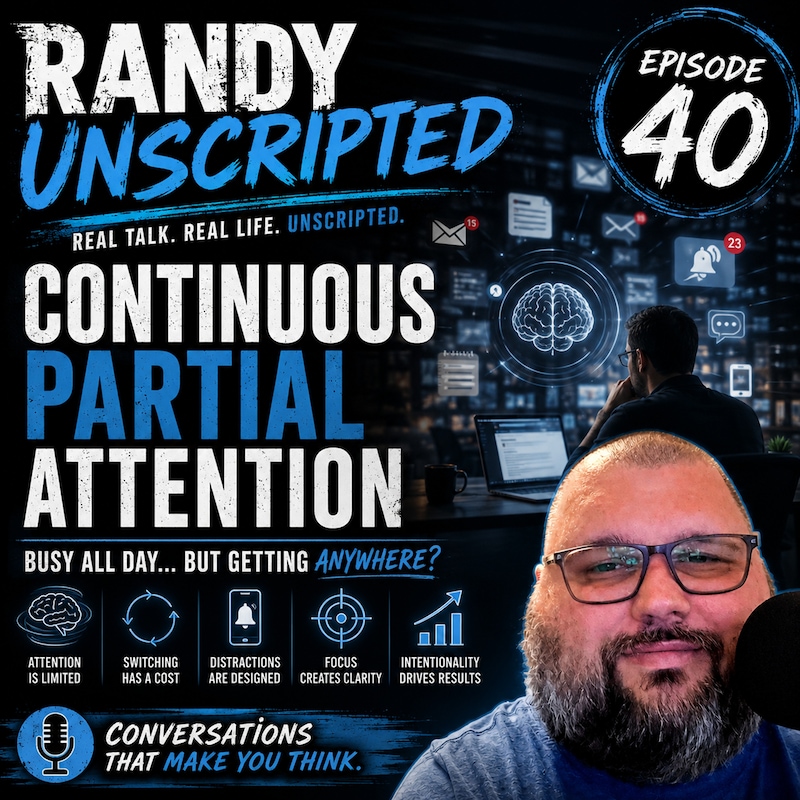
Speaker:
00:00:00
Randy Black. Randy Black. Randy Black. Randy Black. Randy Black.
Speaker:
00:00:04
Randy Black. Randy Black. Randy Black. He's a troublemaker.
Speaker:
00:00:07
Welcome back to Randy Unscripted. I'm your host, Randy Black,
Speaker:
00:00:11
and this is a podcast where I just talk about whatever happens to come across
Speaker:
00:00:14
my brain whenever it happens to come across it.
Speaker:
00:00:18
So today, let me ask you something.
Speaker:
00:00:22
Have you ever had one of those days where you're busy the entire time,
Speaker:
00:00:26
but at the end of it, you couldn't really point to anything meaningful that you accomplished.
Speaker:
00:00:31
Not that you did nothing. You answered emails, you responded to messages,
Speaker:
00:00:37
you handled little tasks all day long.
Speaker:
00:00:41
But the important thing, the thing that you meant to get done,
Speaker:
00:00:46
it's still sitting there.
Speaker:
00:00:49
I've had more of those days than I
Speaker:
00:00:50
care to admit. And what I've started to realize is it's not a time issue.
Speaker:
00:00:57
It's an attention issue. And there's a concept that I came across recently that
Speaker:
00:01:03
really helped me put language to that. And I want you to hear about it.
Speaker:
00:01:08
This idea is called continuous partial attention.
Speaker:
00:01:13
Before I try to explain it in my own words, listen to how it's defined by Linda
Speaker:
00:01:17
Stone, the woman who coined it.
Speaker:
00:01:20
Continuous partial attention is about the kind of attention that we've been
Speaker:
00:01:24
paying the last 20 years with all of these different devices and possibilities
Speaker:
00:01:31
that allow us to be always on, 24-7,
Speaker:
00:01:36
responding to everything, working around the clock.
Speaker:
00:01:40
What stands out to me in that definition is that it's the always on,
Speaker:
00:01:43
the always scanning, the always, always being involved.
Speaker:
00:01:49
We're not focused. We're constantly scanning.
Speaker:
00:01:54
We're always looking for what's next. What else is coming in? What might I be missing?
Speaker:
00:02:02
And if you think about it, that's how a lot of us live now. We're rarely doing just one thing.
Speaker:
00:02:09
We're doing one thing while we monitor three others. And over time,
Speaker:
00:02:15
that becomes our default state.
Speaker:
00:02:18
The problem is, you can't do deep, meaningful work in a state of constant scanning,
Speaker:
00:02:25
constantly looking for other things.
Speaker:
00:02:27
Your brain never fully settles in.
Speaker:
00:02:30
So, even though you're active all day, you're rarely fully engaged.
Speaker:
00:02:37
And this shows up in subtle ways. At least it does for me.
Speaker:
00:02:43
I'll sit down with every intention of focusing and within minutes,
Speaker:
00:02:47
I've shifted my attention multiple times.
Speaker:
00:02:49
Not because I had to, but just because something pulled at me.
Speaker:
00:02:53
And each time it feels small, but it's not.
Speaker:
00:02:59
So Iris Furstenberg breaks this down of what's actually going on,
Speaker:
00:03:04
what it is that's happening when we do that.
Speaker:
00:03:07
What is continuous partial attention? It's not multitasking.
Speaker:
00:03:11
You can multitask. You could sit, eat dinner, have a conversation.
Speaker:
00:03:15
You were doing a few things at the same time, maybe butter your bread and chew
Speaker:
00:03:20
and talk all at the same time.
Speaker:
00:03:22
That's tasking. I'm talking about attention. I'm talking about thinking.
Speaker:
00:03:27
Your brain can only focus and pay attention to one thing at a time.
Speaker:
00:03:31
But what we're trying to do all day, every day, is pay attention to one thing
Speaker:
00:03:37
while monitoring the periphery just in case. So how many of you sit in meetings?
Speaker:
00:03:41
You don't have to raise your hand high, but we know who you are, right?
Speaker:
00:03:45
You sit in meetings, you're supposed to be paying attention,
Speaker:
00:03:47
you need this information, you theoretically are listening, but you have your
Speaker:
00:03:51
communication devices under the table checking. Did I get that email from Colorado?
Speaker:
00:03:56
Do I have to respond to this one? And we're monitoring any incoming buzzes and
Speaker:
00:04:01
pings while we're trying to pay attention, okay?
Speaker:
00:04:04
What the brain is actually doing, as we think we're paying attention to a couple
Speaker:
00:04:10
of things at the same time, we can't.
Speaker:
00:04:12
So what we're really doing is we're switching back and forth.
Speaker:
00:04:14
There are switching costs.
Speaker:
00:04:16
Every time you switch, A, it takes more time.
Speaker:
00:04:21
And what were some of the costs? How many of you found yourself making mistakes?
Speaker:
00:04:26
Yep. You find yourself making mistakes. How many of you found yourself also,
Speaker:
00:04:31
I don't know, more mentally drained?
Speaker:
00:04:33
It's like you were using more cognitive resources. You had to put more resources
Speaker:
00:04:38
to try and get through this.
Speaker:
00:04:40
That's the part that changed how I think about this.
Speaker:
00:04:43
Every switch has a cost. Even if it's just for a few seconds,
Speaker:
00:04:47
your brain has to disengage and then re-engage.
Speaker:
00:04:50
And it doesn't snap back instantly.
Speaker:
00:04:53
There is a lag that takes place.
Speaker:
00:04:55
So what happens is you spend more time recovering focus than actually using it.
Speaker:
00:05:02
And when you repeat that over and over throughout the day, you end up mentally exhausted.
Speaker:
00:05:08
But you have no results to show for what you've done that day.
Speaker:
00:05:13
And for a long time, we've just called this multitasking.
Speaker:
00:05:17
We've almost worn it like a badge of honor. I can juggle a lot at once.
Speaker:
00:05:21
But here's the reality according to Linda Stone. We don't ever do anything simultaneously.
Speaker:
00:05:27
We are just rapidly task switching.
Speaker:
00:05:29
We're not great at doing it. That really reframes the whole thing.
Speaker:
00:05:34
We're not multitasking. We're task switching.
Speaker:
00:05:38
And not only that, we're doing it constantly.
Speaker:
00:05:41
So instead of giving one thing your full ability, you're giving five things
Speaker:
00:05:46
a fraction of it. And that's where quality drops.
Speaker:
00:05:49
That's where the Mistakes creep in. That's where things take longer than they
Speaker:
00:05:53
should. So it's not just inefficient.
Speaker:
00:05:56
It actually works against you.
Speaker:
00:06:00
And we can't talk about this without acknowledging the environment that we're
Speaker:
00:06:03
in. Because this isn't happening in a vacuum.
Speaker:
00:06:07
We are surrounded by inputs, notifications, messages, updates, alerts.
Speaker:
00:06:12
Everything is designed to get your attention and keep it. And this really puts
Speaker:
00:06:17
it into perspective. Here's Ivan Meisner on it.
Speaker:
00:06:20
By driving us to stay live on our online social media sites,
Speaker:
00:06:25
This desire to connect digitally causes us to miss out on the opportunity to
Speaker:
00:06:30
connect with the person directly in front of us. It's a fact.
Speaker:
00:06:36
Continuous partial attention can hamper your efforts to build relationships
Speaker:
00:06:41
with the people you want to connect with.
Speaker:
00:06:44
I believe a price is certainly being paid because of how this constant connectedness
Speaker:
00:06:50
is negatively affecting our real-time relationships. Wow, that's the bigger issue.
Speaker:
00:06:58
It's not just about the personal habits we establish. It's the constant access.
Speaker:
00:07:04
We're always reachable. We're always connected.
Speaker:
00:07:08
We're always one notification away from being pulled, either off task or away
Speaker:
00:07:12
from whatever's happening in front of us. And if we don't set boundaries,
Speaker:
00:07:17
then our attention just gets divided by default.
Speaker:
00:07:20
And when our attention is divided, your thinking becomes shallow.
Speaker:
00:07:24
You lose the ability to set with something or someone long enough to really
Speaker:
00:07:28
develop whatever is there.
Speaker:
00:07:31
So what do we do about all this? Because the answer isn't to throw your phone
Speaker:
00:07:35
away and disappear. It's to take control of how and when you engage.
Speaker:
00:07:39
Here's what I've been trying. And I'll be honest, this is still 100% a work in progress.
Speaker:
00:07:45
Focusing on one task at a time, actually finishing it before I move on.
Speaker:
00:07:50
I create short windows of uninterrupted time, maybe 20 or 30 minutes.
Speaker:
00:07:54
And that makes a difference.
Speaker:
00:07:57
I've tried to physically remove distractions because if it's within reach,
Speaker:
00:08:02
if my phone is right there, if the alerts on the computer are right there,
Speaker:
00:08:06
then it's always within temptation.
Speaker:
00:08:09
You have to take the time to take real breaks, and I've tried that,
Speaker:
00:08:12
where your mind actually rests instead of shifting inputs.
Speaker:
00:08:16
And probably the biggest one I've seen is deciding ahead of time what matters most for that day.
Speaker:
00:08:23
Because if you don't decide, everything else is going to decide for you.
Speaker:
00:08:27
And your attention is going to get spent on things that feel urgent,
Speaker:
00:08:31
but actually aren't that important.
Speaker:
00:08:35
So here's the question I've been setting with, and I think it's worth asking yourself too.
Speaker:
00:08:42
What would your days look like if you consistently gave your full attention
Speaker:
00:08:47
to what matters the most?
Speaker:
00:08:49
Not occasionally, not when it's convenient, but intentionally.
Speaker:
00:08:55
Because I really believe this. Most of us don't have a productivity problem.
Speaker:
00:08:59
We don't even have a time problem. We have an attention problem.
Speaker:
00:09:04
And until we address that, nothing else is ever really going to improve.
Speaker:
00:09:10
I'm working through this just like you are and I've noticed even small changes make a difference.
Speaker:
00:09:16
When I protect my attention, even for a short time, I think more clearly.
Speaker:
00:09:21
I work more efficiently and I feel less scattered at the end of the day.
Speaker:
00:09:26
So maybe that's the goal. Not doing more.
Speaker:
00:09:30
Not cramming more into of the schedule, but giving more of the attention we
Speaker:
00:09:34
have to fewer things that actually matter.
Speaker:
00:09:39
Hopefully we can all find a way to do that very soon. So thanks for taking a
Speaker:
00:09:43
few minutes to walk with this idea of continuous partial attention with me today.
Speaker:
00:09:48
I really appreciate it. And until next time, I'm Randy.
Speaker:
00:09:51
And when I come back, you'll know that this podcast will definitely be unscripted.