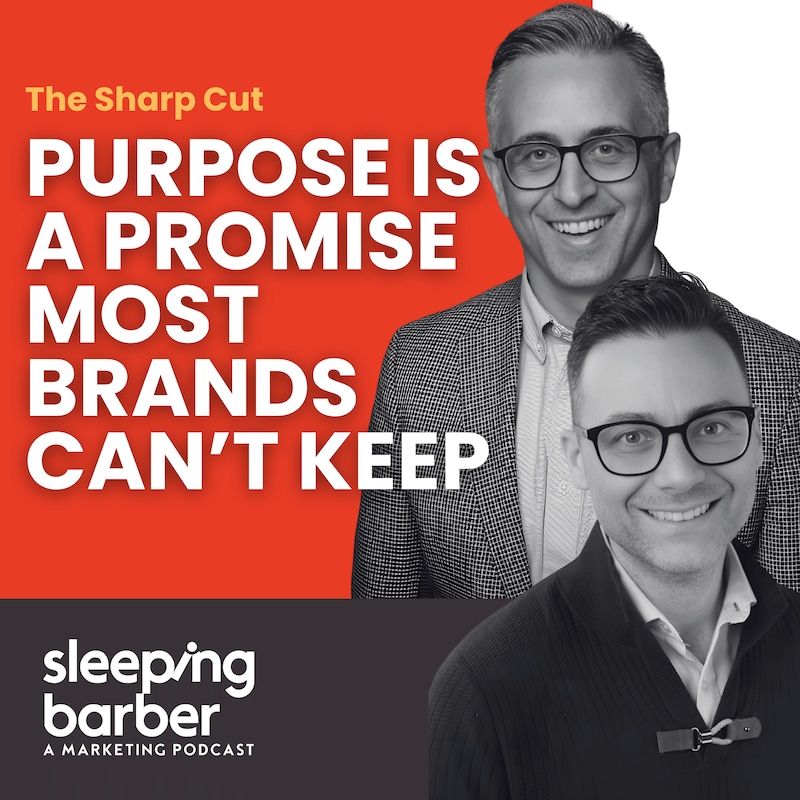
Most marketers believe brand purpose drives growth.
The data says otherwise.
In this episode of The Sharp Cut, we take on one of marketing’s most widely accepted ideas and put it under a microscope. Drawing on research from the Ehrenberg-Bass Institute, Peter Field’s IPA databank analysis, and perspectives from Mark Ritson and Roger Martin, we unpack a simple but uncomfortable truth:
Brand purpose works… rarely.
We explore why purpose has become so dominant despite weak commercial evidence, how industry incentives have turned it into a “comfort blanket,” and why the outliers like Patagonia and Dove don’t translate to most brands.
Along the way, we break down:
- The “say–do gap” between what consumers claim and how they actually buy
- Why most purpose strategies show little to no impact on market share
- The hidden downside of poorly executed purpose campaigns
- How purpose often replaces the harder work of real positioning
- The three conditions required for purpose to actually work (and why most brands don’t meet them)
This is not a takedown for the sake of it. It’s a reframing.
Because the real question isn’t whether purpose is good or bad.
It’s whether your organization has earned the right to use it.
If not, you may be trading growth for a story that simply sounds good.
Enjoy the show!
Takeaways
- Consumers often express a desire for brands with purpose, but this doesn't always translate to purchasing behavior.
- Brand purpose has become an unfalsifiable idea in marketing, often lacking robust evidence.
- The say-do gap highlights the difference between consumer sentiment and actual buying decisions.
- Purpose campaigns can generate emotional engagement but may not lead to increased market share.
- Most brands adopting purpose strategies do not see meaningful commercial outcomes.
- The effectiveness of purpose campaigns varies significantly based on execution quality.
- Patagonia and Dove are often cited as successful purpose-driven brands, but their models are not easily replicable.
- Real purpose requires genuine commitment and often involves sacrifices.
- Purpose can enhance employee satisfaction and brand loyalty, but it is not a direct marketing strategy.
- The industry often conflates purpose with marketing effectiveness, leading to misconceptions about its value.
Chapters:
00:00 - Introduction
02:29 - The Evolution of Purpose in Marketing
06:31 - Research Findings on Brand Purpose
10:51 - The Complexity of Purpose Campaigns
14:40 - The Outlier Problem: Patagonia and Dove
20:00 - Understanding the Value of Purpose
23:16 - Conclusion: The Reality of Brand Purpose
References
Tait, V., Beal, V., Dawes, J., & Sharp, B. (2025). Brand purpose awareness: Evidence from 14 leading purpose brands. Ehrenberg-Bass Institute for Marketing Science.
Dawes, J., Tait, V., Beal, V., & Sharp, B. (2026, March 31). Does having a brand purpose actually lead to growth? Marketing Week. https://www.marketingweek.com/purpose-brands-actually-grown/
Ritson, M. (2022, January 19). Good purpose, bad purpose: Marketers shouldn’t oversimplify the arguments. Marketing Week. https://www.marketingweek.com/mark-ritson-good-purpose-bad-purpose/
Ritson, M. (2019). Brand purpose doesn’t require a commercial excuse. Marketing Week. https://www.marketingweek.com/ritson-brand-purpose-commercial-excuse/
Ritson, M. (2019). A true brand purpose doesn’t boost profit, it sacrifices it. Marketing Week. https://www.marketingweek.com/mark-ritson-true-brand-purpose-doesnt-boost-profit-sacrifices/
Field, P. (2021, October). The effectiveness of brand purpose [Conference presentation]. IPA EffWorks Global 2021. https://ipa.co.uk/news/power-of-brand-purpose
Shotton, R. (2021). Critique of IPA purpose methodology. Twitter/LinkedIn commentary, October 2021. As reported in The Drum, 14 October 2021.
Field, P. (2019). The crisis in creative effectiveness. IPA / WARC. https://ipa.co.uk/knowledge/publications-reports/the-crisis-in-creative-effectiveness
Sharp, B. (2010). How brands grow. Oxford University Press.
Sinek, S. (2009). Start with why. Portfolio/Penguin.