OVERVIEW
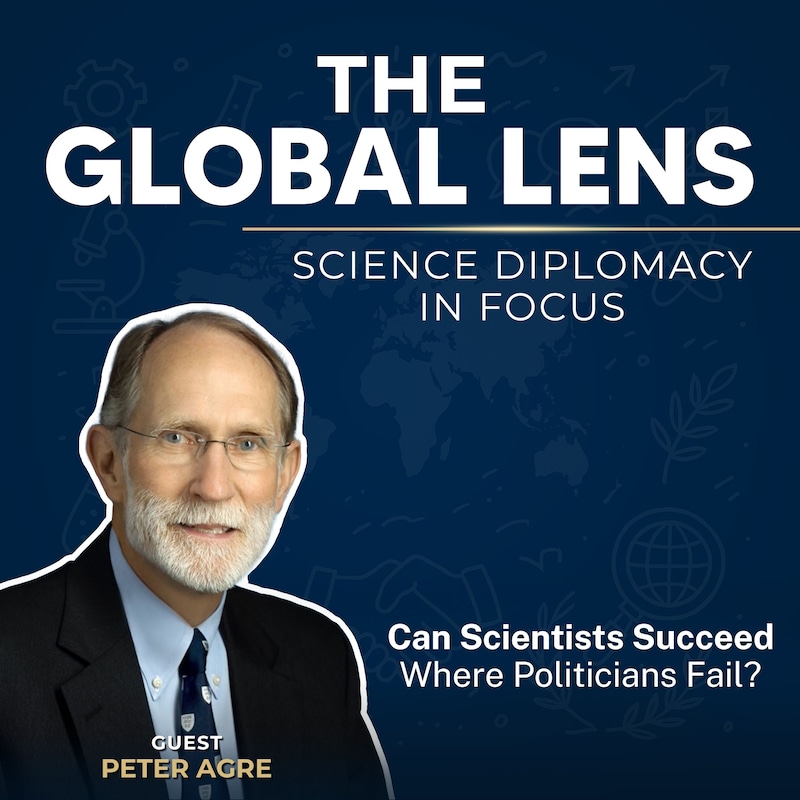
Science Diplomacy takes center stage in this episode of The Global Lens, where Nobel Laureate Dr. Peter Agre of Johns Hopkins University reflects on how scientific collaboration can advance international relations in ways politics cannot. Through his remarkable experiences in global engagement and research, Dr. Agre reveals how empathy, evidence, and dialogue remain the most powerful tools for bridging divides.
EPISODE SUMMARY
In a moving conversation with host Daniella Sussman, Dr. Agre recounts his extraordinary journey from molecular biologist to global envoy for peace. Drawing from his new book Can Scientists Succeed Where Politicians Fail?, he shares personal stories from North Korea, Cuba, and Iran—moments where shared scientific curiosity opened channels of trust amidst deep conflict. He discusses how science diplomacy can protect researchers, strengthen international partnerships, and foster hope even in divided times. Listeners will gain insight into how education, compassion, and persistence can turn science into a force for global cooperation.
In this episode, we discuss:
00:48 - Curiosity and empathy as foundations for a life in science and global engagement
03:34 - How recognition in science can evolve into a platform for dialogue and cooperation
05:29 - Science as a language of trust in politically divided places like Cuba and North Korea
07:44 - Lessons in humility and respect from diplomatic exchanges across geopolitical divides
13:55 - Institutions protecting openness and collaboration in global research
17:12 - Mentorship and education shaping the next generation of globally minded scientists
20:41 - Science diplomacy as a bridge for peace, understanding, and shared progress
ABOUT THE GUEST
Peter Agre, awarded the 2003 Nobel Prize in Chemistry for discovering aquaporins, is a physician, molecular biologist, and Director of the Johns Hopkins Malaria Research Institute. As former President of the American Association for the Advancement of Science (AAAS), he has led scientific delegations around the world, advancing cooperation across political divides to address shared global scientific challenges. Dr. Agre champions science diplomacy as a vital tool for international cooperation.
MENTIONED IN THE EPISODE:
⚇ (Book) Can Scientists Succeed Where Politicians Fail? by Dr. Peter Agre and Dr. Seema Yasmin - https://www.amazon.com/Scientists-Succeed-Politicians-Hopkins-Wavelengths/dp/1421452995
⚇ (Studies or Research) Discovery of the Aquaporins and Their Impact on Basic and Clinical Physiology - https://pmc.ncbi.nlm.nih.gov/articles/PMC7129575/pdf/main.pdf
⚇ (Website) Johns Hopkins Malaria Research Institute - https://publichealth.jhu.edu/malaria-research-institute
⚇ (Website) American Association for the Advancement of Science (AAAS) - https://www.aaas.org/
⚇ (Reference) Science Magazine - https://www.science.org/
————
This episode is brought to you by Global Signals, a curated bi-weekly paid newsletter for globally minded policymakers, international researchers, strategic industry leaders, and investors.
Subscribe here: https://tinyurl.com/Global-Lens
————
CONNECT WITH DR. PETER AGRE:
⚇ Website: https://bdp.jhu.edu/bd-professors/peter-agre/
CONNECT WITH DANIELLA:
⚇ Podcast Website: https://the-global-lens.captivate.fm/
⚇ LinkedIn: https://www.linkedin.com/in/daniellasussman/
⚇ Instagram: https://www.instagram.com/daniellasussmanglobal/