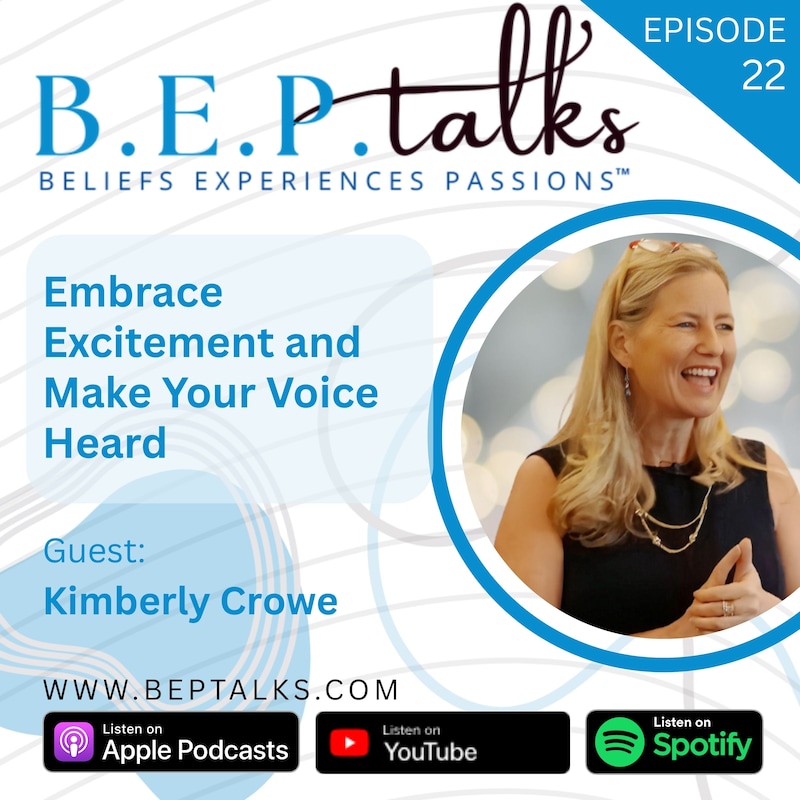
Shownotes
On today’s BEP Talks, I sat down with Kimberly Crowe, master of the stage and founder of Speakers Playhouse, who shared how you can find your voice, amplify your message, and get booked on hundreds of stages—even if you’ve never spoken before. We explored the four key types of speaking opportunities, conquering stage fright, and why your story matters now more than ever. Ready to get started? Check out Speakers Playhouse every Thursday and take that first step toward becoming impossible to forget. Your audience is waiting—step up and share your brilliance!
Want to take your first step? Join Kimberly’s Speakers Playhouse—free, virtual, and packed with opportunities for speakers and stage hosts. Thursdays, 10:30am–noon Pacific Time. Find out more at speakersplayhouse.com!
---------------------------------
B.E.P. Talks makes it possible to connect with those who most resonate with your own personal or professional life – or both. Follow-up in the moment or come back to them when you need them most, attend their events, read their books, participate in their courses.
Visit often! Meet experts from the cross section of the world. Let them motivate, inspire and educate you.
🎤Interested in telling YOUR story?
Visit https://www.beptalks.com/ for all the info you need.
Schedule an interview. Expand your reach and influence. Begin to change the lives of others by changing your own.
You’ll love the experience and your audience will appreciate you.
🔎Explore the MeetN Platform: https://meetn.com/features?x=94034
▶️Subscribe to our Channel: / @beptalks
Follow Us on Social:
Facebook: / thegsew
LinkedIn: / johnstonbeth
Transcripts
Well, hey there and welcome to today's edition of Bev
Speaker:Talks, where fabulous people from all around the world, all
Speaker:industries, professions, as I say, all ages and stages
Speaker:of career, come to share their beliefs,
Speaker:their experiences, their passions in just an off the
Speaker:cuff authentic conversation. Today's
Speaker:no exception. I'm going to introduce you, and I know many of you already
Speaker:know her, to someone who truly personifies everything that she
Speaker:does professionally in her personal life as well. The
Speaker:master of the stage, who helps others amplify
Speaker:their voice and amplify it by taking the stage
Speaker:become easy to remember and impossible to
Speaker:forget. And that's what happens when you work with today's
Speaker:wonderful guest. So please welcome Kimberly Crowe.
Speaker:Hi, Beth. I'm super excited to be here. I am super excited to see
Speaker:you on the other side of my zoom. Thank you so much for joining us
Speaker:today. Absolutely. I'm excited to speak about you
Speaker:and to you because of what it is that you do and
Speaker:that what you seem to do is get everybody excited about what it is that
Speaker:they do. So much so.
Speaker:So much so that you want them to be on stage and to find their
Speaker:voice and to spread it and to share their story, which is kind of what
Speaker:we do here on Bev Talks. And I see this behind you.
Speaker:Speakers Playhouse. Would you talk to us about
Speaker:Speakers Playhouse? Absolutely, Beth. Well, I'm delighted to be here. Thank you
Speaker:so much for having me. And yes, many of your audience may think
Speaker:I'm not a speaker yet or I'm not ready to be a speaker, but
Speaker:I am here to uplift the voices of everyone who
Speaker:has a message to share. And that message is probably
Speaker:inside you. That magic that's inside you that can help somebody else
Speaker:needs to be shared out there. So Speakers Playhouse is a free
Speaker:event. It happens virtually every single Thursday from
:30am to noon. It's the best 90 minutes of your
:week. And you have a chance to be able to come on and the
:stage host will come to the mic and share the name of their stage,
:the types of guests they're looking for, and how to quickly and easily apply
:for their show. So it's a connection opportunity to find
:stages and speaking opportunities. If you're a stage host, of course, it's also
:bragging rights to be able to talk about your show and come on and
:share that. And then during the event, we give away a program that's
:beneficial to a different program every week from one of my joint
:venture partners. And so it's sort of like a surprise every week
:of what we're giving away. You get one and you get one, and you get
:one, like Oprah. And everybody gets
:some sort of major gift
:during the event. And then at the end, we have
:everybody come up to the mic and share their name, what
:they want to speak about, and the types of audiences they'd ideally
:like to get in front of. So it's a great networking event, but you
:get a chance to take the stage. And so it's not just breakout
:rooms where you're passing cards. What do you do? What do you do? And trying
:to sell each other's stuff. It's really about the stage connection.
:So you have an opportunity to brag about your stage or get on other people's
:stages.
:I'm sorry, I didn't catch that. Just saying being on stage
:right in that moment. Yeah, yeah. So you get it. We'll bring you up to
:the mic in a very structured way. We'll share with you, like how to
:introduce yourself. And if I would demonstrate being a
:speaker, I would say, I'm Kimberly Crowe, and I speak about the four types of
:stages every entrepreneur should get on. And I'm looking for stages in
:front of coaches and authors, and my information will be in the chat. And so
:they get to share what. What they speak about and come on the mic and
:just do a little presentation. Not a full presentation, but a little introduction.
:And same with the. With the stage host. So I might say I'm Kimberly Crowe.
:I have a stage called Speakers Playhouse. We're looking for speakers and authors
:to come and share about their stages or their speaking opportunities.
:And our audience is full of coaches and
:healers. And my information is in the chat. So
:that's. It's kind of this big exchange of
:stages and speaking opportunities. And. And a lot of people will
:have booked hundreds of stages just by coming to Speakers
:Playhouse every week. We've been doing it now for coming up on
:five years as we're recording this. Wow. Every
:Thursday, 9:30 to noon. What time zone are we in?
:It's 10:30 to noon Pacific. 10:30 to noon Pacific
:time zone. 10:30 to noon Pacific. I'm writing that down. You
:know, I think there's, like a misnomer maybe about, I'm just here waiting to
:be discovered, and I hope somebody finds
:me. What a wonderful path to
:just go and put yourself on stage and have
:yourself be discovered in that decision to do that. And then, as you
:said, people have booked thousands or hundreds, I think you said, stages
:to speak on. Yeah. We have one person who started with Speakers Playhouse early
:In early days. And he decided he was just a speaker, and he
:actually had a speech. I don't know if he calls it a speech impediment. He.
:He. But he has a bit of a speech
:affectation, I'll say. And he wanted to get on
:stages, and about three months in, he decided to launch
:his own stage. And then he launched a podcast,
:and his goal was to get 100 people interviewed in a year.
:And he did it in about seven months. And so he just kept going.
:And now he's interviewed over 500 people. Many, many, many
:of them have been from Speakers Playhouse meets. How
:satisfying is that for you? It must be overwhelming to know that
:you played a role like that in somebody's life. That is a very exciting
:story to tell. That is a wonderful. It's such a generous way to
:help people help themselves, I guess, is a good way to put
:it. Is it true we've heard this. I think everybody's heard it,
:that people are more afraid of public speaking than
:they are of death and itself. That's true. Which
:means that you'd rather be in the casket than giving the eulogy,
:which is a little weird. Right. But I will tell you that,
:honestly, nobody has ever died on my stage. We're not starting today,
:so. Oh, that is so funny. I remember hearing that, oh, I don't know how
:many decades ago, probably. And I thought, how could that
:possibly be? How could that possibly be? So
:the strength of finding your own voice and
:sharing it. Does it always have to be
:about being on a stage? Is it also just about building the confidence
:in who you are, what you do, and how you do it?
:Wow, that was two. I have two answers to that, because the first half was
:really interesting. First of all, being on stage doesn't necessarily have to be
:about you at all. If you think about it in terms of I'm not here
:for me, I'm here because other people needed to hear this
:message. I'm here because if you help women
:over 50 overcome menopause issues or whatever,
:it's not. It's not about you anymore. Right. It's about the people that you
:can potentially help. And if you don't get on stage and share that, then
:somebody who needs your message is going to hear it from
:somebody with half your talent and twice your price. And
:that's not the way the world is supposed to work. So with the advent of
:zoom and the opportunities to get on stage that we have now,
:there's so many ways that you can get in front of people. So when you
:say getting nervous about getting on stage, I totally understand that.
:And then you actually had a follow up question. I was like, I gotta answer
:that one too. But I don't remember what it was about. Oh my
:goodness. Well, we'll just go on then. So yourself have been
:on over 5,000 stages.
:I have to imagine knowing you just very,
:for not a long time, but just capturing your energy makes me feel
:like I know you. And that's one of the great
:benefits of being a great speaker and taking a stage
:even just like this one to one and being able
:to exude your energy and share your personality which you
:totally come to life. That there's such a great benefit in
:that. Yes, I think
:people often fear being on the stage and that fear
:is very, very chemic, real happening in your body. Right.
:So I know that there are many coaches out there who will say, well, just
:get over it or ignore it or pretend, you know, pretend they're all in their
:underwear. Well, if I was imagining my audience in their underwear, I'd be more
:uncomfortable than they are. Like it would be worse. Right.
:So I don't think that that's really useful advice.
:But one thing that I can tell you is that that chemical
:reaction that's happening in your brain is a fear
:or nervousness. It makes you feel like your stomach
:flip flops or your breathing is getting faster, or maybe your throat's
:closing up or your ears are spinning, your head is spinning or your ears are
:ringing and those are all real things happening. So saying
:just ignore it isn't very helpful. However, if
:you think of that in terms of excitement instead,
:your brain can believe that you are excited instead of
:afraid because those same chemical reactions, those same feelings
:are true for being excited. So I get on stage
:and my stom is doing flip flops because I'm excited or my breathing's
:faster because I'm excited, my throat's closing up because I'm excited, or my ears are
:ringing or my head is spinning because I'm excited. And so
:oftentimes, in fact I go back, I say, you know, every once
:in a while I'll say this, but it's true. Almost every time I get on
:stage I say I'm super excited to be here. And it's true,
:but it's not nerves at all in this,
:it's really just excitement. So that's my tip for you, is
:if you're, if you're nervous, doesn't just saying that and hearing yourself
:say that a lot create that excitement? Like it
:not Forces it, but makes it possible.
:So many people say, I want to be on a stage, but
:don't know how to get started. For people who. I'm not sure
:what my message is. I'm not sure what my story is. I don't really have
:a platform. I'm not really trying to
:necessarily promote something for monetary exchange, but share a
:message. As you say, what are some of the ways that
:you can encourage them to take that first step? That's a great
:question. And my advice to everyone is get on
:podcasts. Podcasts are a great way to sort of break
:into it, because you're not in front of 100 people or a thousand
:people. You are simply talking to another
:wonderful human being like Beth Johnston, and being able to have a
:conversation with them. And that's a natural conversation. And the
:beauty of getting on podcasts is that the more you talk
:about what you love, the more you discover it for yourself.
:What do I really want to talk about? What do I. What's my real message
:here? And when people ask questions, that's this indicator
:that that there. There are things that you know
:that other people don't, and we don't often tap into that. The
:first time I ever taught a class on how to launch a business, when I
:was in that space phase of my life, I had this whole
:lesson planned for six weeks, planned out, and
:my mentor said, why don't you ask them what they want to learn? And I
:thought, oh, I can't do that. That would be too scary. Like, I. What I.
:I need to know. I'm the. I'm the. The expert here. I need to be
:able to teach them. Why am I asking them what they want to learn? And
:I. I took the. The note and I took a deep breath,
:and I did. And I asked people at the very beginning, I was like, we're
:gonna. I have a whole agenda, but before we get there, tell me what
:you want to learn. And they ask these questions like, kimberly, you have a Facebook
:group. How did you start it? Well, I wouldn't have
:taught that, but now I'm going to, right? Like, okay. And they were like, yeah,
:you do things on meetup, don't you, that gets people, like, in a room with
:you. How do you. How do you start a meetup group? And I was like,
:oh, I have things that I know that other people don't know,
:that I can teach that are valuable. And instead of being
:all up in our head like, oh, I don't have enough to teach, or I'm
:not really an expert. We are in our own way. Only
:those of us who have lived this life are capable of explaining
:what happened in our life. Right. So, so that's my,
:my message to you. If you feel you're not ready yet or, or you're
:nervous, get on a podcast, have a conversation with somebody wonderful.
:And, and I, I will just say, not only
:Beth, because you are wonderful, but there are many wonderful podcasters out
:there who want to help you that are not there to trip you up or
:make you look silly and they're there to make you look like the expert that
:you are. Yes, yes, of course. And I only
:see doing it that way. Yeah, that's
:relationship building. And you know, you made a point. And I
:teach this in my course also about the lesson that you learned
:about ask people. Yes. They
:will tell you if you honor them by asking them.
:And in sales training, what I do is say, you know, don't assume that
:everybody wants to hear just what you want to say and what you think is
:necessary for them to know. Ask a S K. Always
:seek knowledge and in their sharing it,
:you do learn a lot yourself and it empowers you for the next time
:you're taking your first step up onto another stage.
:You mentioned earlier the four stages to
:be on. There are four types of stages. What are they?
:So the first one is a speak to sell stage. And those
:are where you get on with the intention of leading somebody to a program,
:product or service. And that can just be an
:introductory. So what I recommend from all speak to sell stage is
:give them a natural next step from that stage. So if you are
:doing a podcast, maybe the natural next step is check me out on
:LinkedIn or go to my website or grab my
:[email protected] or whatever it is
:and just something easy for them to take a natural next step
:with you. They may not buy your $25,000 coaching program from
:a podcast, but they will take a natural next step if they're your right
:people. So I speak to sell stage. The way to monetize from
:that one is to make sure that you have a proper natural next step. And
:that can be if you're in a room where
:there's a lot of selling going on and you're offering your book or you're offering
:six week course for $197 or whatever, that may be a natural
:next step. And then you're making sales from that stage. But every
:talk that you give that's a speak to sell stage should Lead them to something
:they can do next. Ready for number two?
:Number two. Number two is the brass ring of speaking. It's the one
:everybody wants, it's the one everybody's grabbing for. And it's the paid speaking gig.
:Oh, a lot of people think keynotes, which is
:awesome. Those are great. My current rate is 12,500 for a
:keynote talk. It's keynotes are a wonderful way to
:monetize from speaking. I personally make more money from speak
:to sell than I do from paid speaking gigs. But that's okay. Paid speaking is
:a great way to do it. It's just there's a lot of fish in that
:pond. So you have to think a little outside the
:box of keynoting and get into some of these other ways that you can
:get paid to speak. For example, if you ever taught a class and got
:paid for it, you were a paid speaker. If you ever
:like, I narrated audiobooks. That's a paid speaking gig. I
:did V over. That's a paid speaking gig I did.
:I was an actress on stage and got paid for that.
:I was a murder mystery dinner theater troupe member. That was
:a lot of fun. I loved doing that. And then there was
:an equestrian polo announcer. I announced for a polo games
:many a year ago. So there's lots of ways that you can monetize from speaking
:without having it be a keynote.
:Wow. Maybe a shorter
:conversation. That's amazing. So the point I think you
:made there is that once you get out there and you're known, people will find
:you. They will come to you and give you opportunities that you might not
:have thought of for yourself, but every one of them gives you that
:wonderful opportunity to be a paid speaker. What's number three?
:Number three is an authority stage. A stage that gives you
:authority just by being on it. And most people will think in terms of TEDx,
:which is an amazing authority stage, of course, but there are many
:others out there just being on a show and
:introduced. This is an authority stage right here. Because as I was being
:introduced and it was so great hearing you talk about, you know,
:that some of the accomplishments that I've had as you're bringing me in,
:you're recommending me, third party recommendation or endorsement
:to your audience to say, hey, I think Kimberly has something of
:value for you and that gives you authority just by stepping onto that
:stage. So there's many stages that would give you authority. You might
:be nominated to be on a stage. You might, you know, might
:be able to be on a stage a variety of different Ways and just get
:authority and credibility by being on that stage. So stage number three
:is the authority stage authority Stage authority. And
:number four, Number four might surprise your listeners. Number four is a
:rehearsal stage, a practice stage. I have delivered, as
:you mentioned in my bio or my intro, that I've been on over
:5,000 stages. My best talk ever
:is my next one because I can always improve. I can
:always think of something else to say or that I could do differently next
:time. So you can always develop your skills. So I
:recommend getting on practice stages. Now the benefit of a
:practice stage is actually feedback. Feedback, which some people
:think of as criticism, right? So I don't want you to think of
:it as like cutting you down in any way. That feedback is super important. So
:the feedback from this stage is twofold. One, I'm getting questions and nodding
:and understanding from you directly, Beth. But then I also
:will go back and read the comments and in the comments section, if
:people put like, I didn't really understand what stage number two was right. Then I
:can go back and be more clear next time. So that feedback is very valuable.
:The feedback is really the profit of speaking
:on a rehearsal stage. And if they're just picking on your ums and
:ahs, then you're not really getting a full value of that. So you
:want to be sure that while Toastmasters is amazing that you're getting out on a
:variety of different stages and getting feedback. One cautionary
:tale I will tell you is that your bathroom mirror and your
:pets are not good practice stages and all that.
:We've all, we've all outgrown that. What's your favorite
:stage? My favorite stage is the next one. I
:think live stages for me are super powerful. Being able to
:connect with a live audience is really fun for me. Being able
:to interact with them and facilitate a conversation, be along with
:them. If I was in the movies or theater, I would always pick
:theater because you get that instant feedback from the audience, right?
:And I think that's really valuable to be able to do that.
:And I personally, I love being in front of either a
:virtual or an in person live audience. The benefit of virtual is you
:can do it from anywhere. I'm able to speak on stages from Spain and
:Italy and Guatemala and Costa Rica
:and Columbia this year, Canada.
:I've spoken all over the place and being and of course the US
:and all over the place and being able to speak from anywhere is hugely
:valuable. But when you're an in person stage, being able to afterwards meet
:people, give them a hug or A high five. Being able to
:answer questions at the break. Huge differentiation
:to be able to do that. So both have their strengths, both have their weaknesses,
:but I love them both. There's actually a secret fifth stage.
:Would you like to know about that one?
:The secret fifth stage is your own stage.
:Your own stage. And, Beth, you've got one, right? You created an
:opportunity for other people to come out and share their message with the
:world and be able to shine on your stage. But people
:get to know how amazing and beautiful and talented you are
:because they're seeing you week after week after week on your
:podcast. Creating a stage is one of the most powerful things you
:can do to grow your authority credibility. You can make
:it any kind of stage that you want. It could be an authority stage because
:you're bringing on experts. It could be a stage
:that you do speak to sell because you can make an offer. It can be
:a stage that is a paid speaking gig because you could charge
:for the privilege of being able to watch your show. Or it could
:be a rehearsal stage, just for practice and just for fun. So
:I have a stage? Yes, the BEP Talks podcast.
:Your energy is so authentic
:and so contagious
:that I know that everybody who will be listening
:and watching this is going to say, I want to be on a stage. I
:want to be on a stage. So
:the best thing to do is to take the first step.
:Just review for us what you would advise anybody who's kind of
:feeling what I just described. I can do that. I
:want to do it. I need to do it. And people on
:the other side need to hear what it is I have to say.
:First step, what would it be? Get on a podcast. If you don't know
:where a podcast is to get on or you don't know how to approach a
:podcaster, come to Speakers Playhouse. You can come and meet
:probably 10, 20, 30, 40 different stage hosts that are all
:actively looking for speakers to be on their stages.
:So if that's the case, you don't have to chase after somebody. You
:can come in, find out which stage is right for you, and then reach out
:to that stage host directly and introduce yourself and
:book a speaking spot. And really, a conversation on a
:podcast can be one of the best experiences of your life.
:Fun to do. I love being on this side of it, meeting
:wonderful people like yourself who can encourage others
:to become great at whatever it is that they. That they
:do. So I want to just repeat that it's Thursdays.
:Every Thursday, 10:30 to noon, Pacific
:Speakers Playhouse. Speakers Playhouse. No rejection.
:Yeah, nothing that has to be done. Just go to
:speakersplayhouse.com. do you have to sign up to attend?
:Is it, like, limited every week to the next? No, there's no limitation. You just
:sign up and you can come any Thursday. Well, there's a limitation on zoom. So
:if we ever went over our zoom numbers, then that would be a
:theoretical limitation. But no, there's no
:requirement. And we do have some people who come three and four weeks in a
:row and don't come to the mic. They just sort of lurk in the background
:and listen for a while and then get information and maybe they'll reach out next
:week. And it's great. We are a warm,
:safe environment for you when you're ready to step up and shine.
:If you are obviously the example of it and the face and the
:spirit and the heart behind it, that message is quite
:clear. It is quite clear. Go to
:speakersplayhouse.com and if you need to
:just sit in the audience and kind of watch and have a little intake and
:learn what it's about, when you get to your point of comfort,
:step on the stage. I love that. Step on the stage. Does everybody
:secretly, like they say, everybody secretly wants to write a book?
:Oh, yeah. Does everybody secretly want to be on stage?
:Maybe. I think you're probably onto something there. I have
:to tell you, Beth, when people tell me I have a book in me and
:it's 80% done, I quietly say to myself,
:you know, 80% done is not done. If it's not
:done, it's not out there for people to be able to
:absorb your juicy goodness. We don't get
:your inspiration. We don't get what we need from
:you. And if you don't produce it, if you don't get it out there,
:then the people who need your message won't be able to to receive it.
:So, same thing with speaking. You gotta get out there.
:Somebody needs you. It's not really even about you anymore.
:It's about them. Who are you here to help and who will not get your
:help if you don't do it? If you don't. If you don't want
:to finish that book and get on that stage, you're just being a selfish person
:and you're denying the rest of us the opportunity and the gift to get to
:know you, which we have received today. The
:opportunity and the gift to get to know.
:Kimberly Crowe. You are amazing. I was so
:eager for this BEP talks.
:Truly I was, because you do bring
:an energy that is so As I said, contagious.
:So obvious, so authentic. And I want
:to get on more than just my own stage. And I've been on stages. And
:I will tell you, there's such
:satisfaction in stepping off the
:stage and saying, I did it.
:Oh, yeah, and the sky didn't fall and the earth didn't open up and
:swallow me. How bad could it be?
:Exactly. And I would be happy to hand you the bike.
:You got me all choked up. I am going to be there. I am going
:to be there. I promise you that. I am a woman of my word. And
:I want to say to everybody, if you never thought
:of public speaking, think of it,
:because it's so empowering and
:it uplifts you just when you hear your own voice.
:And I remember as a student in school, in high school and
:college, it seemed like I was always the first person in every class to be
:called on. I was always an active
:listener. And once you got called on, so much fear
:was gone. Everybody knew you. The professors knew you.
:They liked you right away because you were participating and bringing
:something out in them. So there's always an exchange.
:There's anytime information is being given and received, that
:exchange can be so powerful and you never know where
:it's going to lead you. So
:speakersplayhouse.com Thursdays, 10:30 to
:noon Pacific Time. We all have a
:story. It's always worth sharing.
:Someone needs to hear it. They're waiting to hear it. And that's
:really why I created BEP Talks. Beliefs, experiences
:and passions. So it could really be very broadly based. And
:I've had guests from so many different genres and
:industries and professions and at all ages and stages of their career.
:So take the stage here at BEP Talks.
:I encourage you to do that, but I really encourage you
:to get to know Kimberly Crowe. She will help you find
:the power in your own voice.
:And I am going to say it as someone who has done a significant public
:speaking, there's nothing like it.
:There's nothing like it. And to think that something you're saying can
:impact another human being in a very profound
:way is a gift you've been
:given and a gift that should be
:shared. Beautifully said. Thank you, Beth.
:Well, thank you. And everybody, please go find Kimberly Crowe.
:And as we always say at BEP Talks,
:share yourself on this stage. May the
:best always be yet to come. And be willing to bring it
:out and hear it in your own voice. So, Kimberly, thank you. Thank you
:so much. And as we always say, until we
:talk again, bye for now.