Shownotes
Where in your life or leadership are you telling yourself, “this is just the way it is”?
If you’ve ever felt stuck—blaming your workload, your team, or your environment—it can feel like there’s nothing you can change. But that belief often keeps you in a cycle of frustration and limitation. The reality is, many leaders unknowingly give away their power by not questioning their own role in the results they’re experiencing.
In this episode, you’ll learn how to take back control of your leadership and results by:
- Identifying the subtle ways you may be disempowering yourself in your daily thinking
- Shifting from blame and frustration to ownership and influence in your work
- Recognizing what’s actually within your control so you can create meaningful change—even in challenging environments
Press play now to learn how to reclaim your power as a leader and start creating results you actually want.
If you’re ready to move from “this is just the way it is” to taking ownership of your results, this is exactly what we focus on in Becoming the Modern Humanitarian and Development Leader.
In six weeks, you’ll apply these tools directly to your work and create real change in how you lead. The next cohort begins May 12th—learn more here.
Transcripts
In last week's episode, we talked about how empowering others can
Speaker:feel uncomfortable as leaders.
Speaker:When we start to give more responsibility to our team and when we trust things
Speaker:that they will do them their way, we can feel like we are losing
Speaker:control and we are essentially giving up control to an extent.
Speaker:And that discomfort of doing that, it doesn't mean that anything has gone wrong.
Speaker:It just means that you're probably doing it right.
Speaker:But today, I wanna take that one step further.
Speaker:So, empowerment isn't just about how we lead others, it's also
Speaker:about how we lead ourselves.
Speaker:Let me explain.
Speaker:When we empower ourselves, what we're really doing is taking
Speaker:responsibility for the results we're creating in our life and work.
Speaker:And that sounds simple.
Speaker:But in practice, it's one of the most uncomfortable things we can do as leaders.
Speaker:Hi, my name is Torrey, and welcome to the Modern Humanitarian and
Speaker:Development Leader podcast.
Speaker:Okay.
Speaker:Responsibility means asking, how am I contributing to the
Speaker:results I'm getting right now?
Speaker:Let me repeat that again.
Speaker:How am I contributing to the results I'm getting right now?
Speaker:And it means admitting, maybe I'm not doing something I could be doing.
Speaker:Maybe I'm avoiding something, or maybe the situation I'm in
Speaker:isn't just happening to me.
Speaker:And that's uncomfortable.
Speaker:Because it's much easier to stay in, this is just how things are, or
Speaker:this is because of my organization, or this is because of my team, or
Speaker:there's nothing I can do about it.
Speaker:When there's nothing I can do about it, it becomes simple, right?
Speaker:We feel like there's just nothing we can do.
Speaker:But when we actually take ownership and admit there is something we can
Speaker:do, that can feel really uncomfortable because it means essentially that
Speaker:what's happening can be somewhat our fault or our responsibility.
Speaker:Now, just to be clear, there are things that are absolutely
Speaker:outside of your control.
Speaker:For example, other people's thoughts, other people's decisions, systematic
Speaker:challenges, operational constraints, racism, uh, you know, there are definitely
Speaker:things that are not within our control.
Speaker:All of that is real.
Speaker:But empowerment is not about controlling everything.
Speaker:It's about focusing on what is within our control, because
Speaker:that's where your power is.
Speaker:And one of the clearest signs that you are disempowering yourself is when
Speaker:you start to feel or say something like, that's just the way it is.
Speaker:I'm just busy.
Speaker:I'm always busy.
Speaker:My team is just like this.
Speaker:The culture just doesn't allow for that.
Speaker:The moment that something starts to feel so much like, it's like a fact, like it's
Speaker:just a reality, usually that indicates that you've just stopped questioning
Speaker:it, and that's where we lose our power.
Speaker:So let me give you three areas where I see this show up all
Speaker:the time with NGO leaders.
Speaker:One is with the TEAM.
Speaker:So leaders will often say, my team isn't performing, or they don't communicate
Speaker:well, or they don't take ownership.
Speaker:I love asking leaders taking my course, what is one thing you
Speaker:wish would change about your team?
Speaker:What's one challenge you're having with your team that you wish you could change?
Speaker:And these are the types of things they usually say.
Speaker:And those things may feel true and they may be true, but the
Speaker:empowering question for you is, how am I contributing to this result?
Speaker:Am I being clear about expectations?
Speaker:Am I stepping in too quickly?
Speaker:Am I not giving them space to think?
Speaker:Because the moment you start to ask those questions, you take back control.
Speaker:You move from frustration to influence.
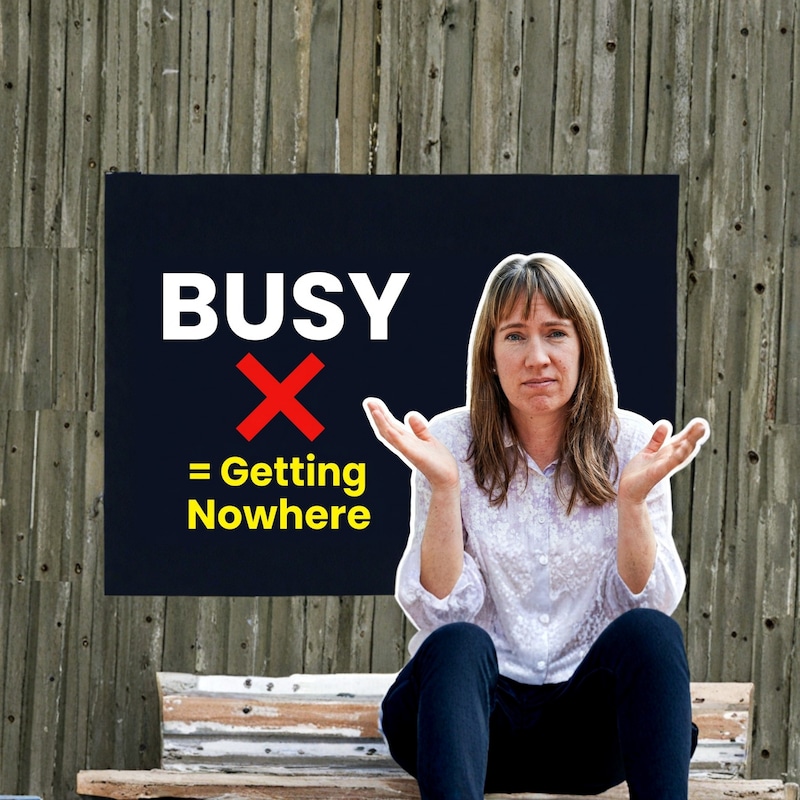
Speaker:Okay, so another one I hear all the time is, I'M JUST BUSY.
Speaker:I'm too busy, I just have too much going on.
Speaker:But busy is not a fact.
Speaker:It's an interpretation.
Speaker:I always tell my students, think about how your level of busyness for
Speaker:someone else might be their easy.
Speaker:That shows you right there that busyness is not a fact.
Speaker:It's just the way we perceive something.
Speaker:So when we start to ask, how am I creating my own busyness, everything can change.
Speaker:Maybe it's saying yes too often to extra work.
Speaker:Maybe it's perfectionism, maybe it's not prioritizing what really matters.
Speaker:I had a participant in my course realized that her busyness was actually
Speaker:coming from her perfectionism, and once she saw that she could change it.
Speaker:Because when you see your role or how you are creating the result, how you're
Speaker:contributing to it, you gain power over it and it may not be comfortable,
Speaker:but eventually if you are able to take control over it and overcome
Speaker:it, it feels amazing at the end.
Speaker:The third one I see commonly where leaders think that it's just the way
Speaker:it is or that they don't have control where they really could is CULTURE.
Speaker:Leaders will say things like, the culture doesn't allow for that, or,
Speaker:my culture doesn't allow me to lead in that way of, of asking others for
Speaker:their solutions because I'm the leader.
Speaker:I'm supposed to have the, the answers.
Speaker:Maybe this sounds familiar to you.
Speaker:And culture is powerful.
Speaker:It's definitely not to be underrated, right?
Speaker:Culture is definitely an influence.
Speaker:It shapes behavior, absolutely.
Speaker:But we can also ask ourselves, how do I want to lead within this culture?
Speaker:Culture is not fixed.
Speaker:It's actually very fluid and there are multiple cultures at play, not just your
Speaker:country culture or the local culture.
Speaker:Also the organizational culture, your team culture.
Speaker:And leadership always starts with you.
Speaker:You can choose to listen more.
Speaker:You can choose to ask better questions.
Speaker:You can choose to empower your team even if those around you aren't doing it.
Speaker:You can shape your team's culture.
Speaker:The more you take responsibility over that, the more influence
Speaker:you'll have in doing so.
Speaker:Even in a system that doesn't fully support it.
Speaker:It may take courage, like we talked about before in previous episodes.
Speaker:It takes courage to do something different from those around you, but no one is
Speaker:forcing you to lead in only one way.
Speaker:So here's the challenge I wanna leave you with today.
Speaker:When or where in your life or your work, are you saying that
Speaker:this is just the way it is?
Speaker:Are you not questioning whether things could be different or that
Speaker:you could get a different result if you took ownership over that result?
Speaker:If you realize, how am I contributing to this and how can I empower myself even if
Speaker:it's uncomfortable, even if it requires courage in order to create what I want?
Speaker:So, not everything is in your control.
Speaker:That is true.
Speaker:But because focusing on what is within your control is where you're going
Speaker:to gain your power, is where you're going to gain your influence, is where
Speaker:you're going to be able to achieve more things than you thought possible.
Speaker:And that is what empowerment really looks like.
Speaker:And if this is something you wanna go deeper on, this is
Speaker:exactly the type of work we do in my course, Becoming the Modern
Speaker:Humanitarian and Development Leader.
Speaker:We take these concepts and we apply them directly to your
Speaker:actual real leadership challenges.
Speaker:And I see within that short six weeks, people go from feeling
Speaker:they don't have control to feeling that they are in control.
Speaker:And that is a powerful shift.
Speaker:The next course is in May 12th, and more information is in the show notes.
Speaker:Alright, until then, keep evolving.
Speaker:Bye for now.