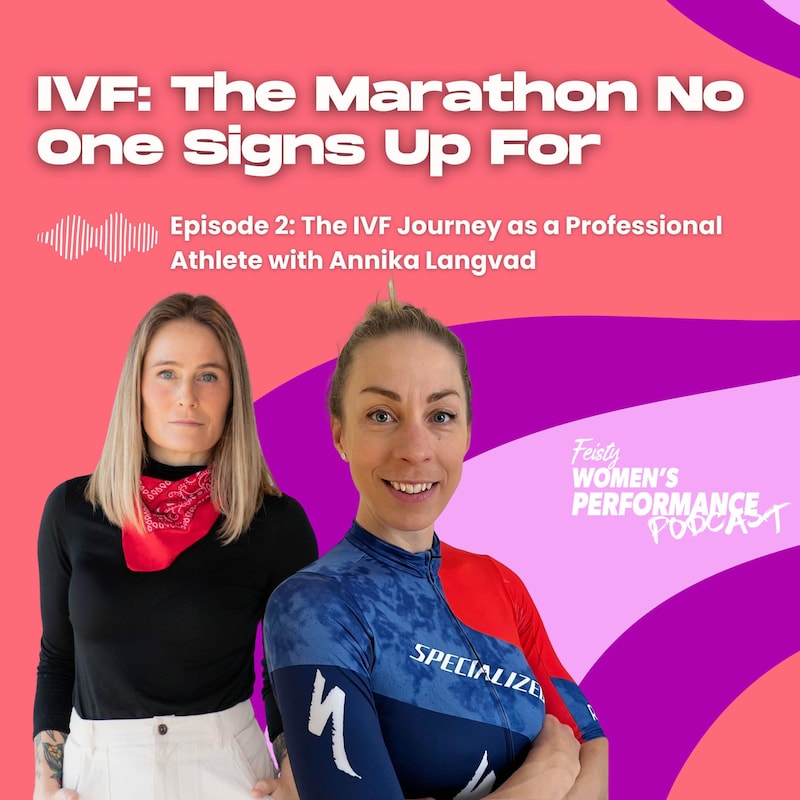
Shownotes
Episode 3: The Fertility Journey as a Professional Athlete
In this final episode of our series on IVF, guest host Jill Van Gyn sits down with six-time world champion mountain biker Annika Langvad to explore the unexpected intersection of pro racing and the IVF process.
Her vulnerability offers insight into the quiet battles many athletes face behind the scenes.
She discusses:
- The unique challenges female athletes face around fertility and family planning
- Societal pressures, career timing, and the stigma surrounding fertility struggles in sport
- Her personal IVF experience—including the "loss of control" in the process
- Learning to separate hope from expectation
- To train or not to train during IVF—and why she ultimately chose to workout for her mental health
- The importance of support, community, and continued education
- Her advice for others seeking IVF
This is an inspiring and eye-opening conversation about navigating ambition and humanity—both on and off the bike.
FeistyFest Info: https://www.wetravel.com/trips/feistyfest-feisty-media-1943243299#about-this-trip
Courses and Coaching: https://feisty.learnworlds.com/
Women's Mechanic Camp in Tucson: https://www.wetravel.com/trips/women-s-bike-mechanic-camp-tucson-az-feisty-media-24985624#about-this-trip
Sign up to Receive The Feisty Women's Performance Newsletter:
https://feisty.co/newsletters/feisty-womens-performance/
Follow us on Instagram:
@feisty_womens_performance
Support our Partners:
Momentous: Head to https://www.livemomentous.com/ and use promo code PERFORMANCE for up to 35% off your first order
Wahoo: Learn more about Wahoo Fitness Products at: https://wahoofitness.pxf.io/0GAByR
Tifosi Optics: Use code FEISTY2026 for 20% off at https://tifosioptics.com/
Hettas: Use code STAYFEISTY for 20% off at https://hettas.com/
Orca: Use the code FEISTY15 for 15% off at https://orca.avln.me/c/HzUkzIfxsmYo
Transcripts
Good morning, good afternoon, good evening all feisties.
Speaker A:We are back for our third and final episode of the IVF series with Jill Van Jean.
Speaker A:Jill, good morning.
Speaker A:How are you?
Speaker B:Good morning.
Speaker B:I'm good, I'm good, yeah.
Speaker A:So I'm excited about this episode in particular.
Speaker A:You know, we looked around for a little while to try to find sort of an elite level athlete who was training at like perhaps a higher level than most of us would think about, who could come in and talk about her story and give her, you know, sort of tell.
Speaker A:Yeah, tell her story.
Speaker A:So tell us a bit about Annika.
Speaker B:Yeah.
Speaker B:So Anika is a six time world champion mountain biker.
Speaker B:She has a fashion fascinating story.
Speaker B:I think her, her coming into sport is not a sort of conventional one and so I found that aspect to be really interesting.
Speaker B:And one of the things that I have been interested in, especially around ivf, is when high level athletes or any type of person that's in athletics, many times we're with career coming in, we want to prior prioritize our careers and put off building a family a bit later than our previous generations might have considered.
Speaker B:So I think it's really interesting now with so many people deciding to wait on family building and then coming into IVF late and then starting to realize that it's just not a straight line.
Speaker B:And especially with pro athletes because their bodies are really the way that they make their career.
Speaker B:You know, going not only falling pregnant and going through the pregnancy process, but also getting into IVF has a huge impact on their physicality.
Speaker B:So in some ways I think a lot of athletes have to be in the mindset to end up having to give up parts of their career in order to have a family because there's, you know, the potential for so many different body changes.
Speaker B:So I find this a really interesting topic.
Speaker B:Anika was candid and really shares her experience.
Speaker B:I think people are just gonna really enjoy hearing not only her personal story of coming into sport, but also of making a decision to pursue family building and IVF and some of the pitfalls and the joys that come along with that.
Speaker A:Oh, fantastic.
Speaker A:That's a great intro.
Speaker A:Well, I think we should leave it there and let folks listen to the interview.
Speaker A:Thank you so much, Jill, for co hosting this with me.
Speaker B:Yeah, it's been a real pleasure.
Speaker B:Thank you.
Speaker B:So I'm joined today by Annika Langvald.
Speaker B:She's a renowned Danish cyclist celebrated for her exceptional achievements in both mountain biking and road racing.
Speaker B:She's a six time world champion in mountain biking, securing five titles in marathon events and one in cross country.
Speaker B:And beyond her athletic pursuits, she's also a licensed dentist.
Speaker B: She completed her studies in: Speaker B:And your career has just been distinguished by your versatility and your resilience and your commitment to excellence across multiple cycling disciplines.
Speaker B:And Anika has also undergone a different type of marathon with in vitro fertilization.
Speaker B:And she's going to join us today to talk us through a little bit about what it's like to be a professional athlete and grapple with fertility issues, the IVF process, and ultimately giving birth.
Speaker B:So welcome.
Speaker B:Thank you so much for being here.
Speaker C:Thank you so much.
Speaker C:It's.
Speaker B:It's nice to be here and just for the audience sake, because I know I mispronounced your last name.
Speaker B:Can you say it for me, please?
Speaker C:Yeah.
Speaker C:It's not easy, so I'm not playing the game one.
Speaker B:Thank you.
Speaker B:Yeah, yeah.
Speaker B:I don't think I have, like, the tongue muscles to do that, so I also have a complicated last name that never gets pronounced correctly, but it is a.
Speaker B:It is a little easier, so.
Speaker B:Gotcha.
Speaker B:Well, let's just jump in here.
Speaker B:I would love for you to tell all of our listeners a little bit about what first drew you to your sport.
Speaker B:What was your professional journey like?
Speaker B:And just sort of take us back to the beginning of how you got into this.
Speaker B:This career.
Speaker C:Yeah.
Speaker C:Where to start.
Speaker C:So I think overall, my journey into a professional sport is it's not like the average one.
Speaker C:I did not grow up in a family, like, who did any sort of sports on this level that I'm doing now.
Speaker C: I moved to Kroenage in: Speaker C:I mean, just to kind of.
Speaker C:I was looking for something to do next to the studies.
Speaker C:And I'm gonna make a very long story very short, but eventually that.
Speaker C:Into mountain biking and.
Speaker C:And, you know, when you have a talent for something, you just.
Speaker C:It goes so, so fast, so quick at the beginning.
Speaker C:So first I just kind of, you know, really had a good time.
Speaker C:I think when I started, there weren't really a lot of female athletes or cyclists at all, like in Denmark or also, like, internationally.
Speaker C:So I was riding with the men.
Speaker C:I just had a good time, you know, being really in a.
Speaker C:In a nice environment that, you know, I really liked.
Speaker C:It was quite a contrast to.
Speaker C:To the studies, which was like, you know, very intense, very Hard.
Speaker C:And I felt like, you know, I had a good time in the spare time and, you know, it was more about using the body than the mind.
Speaker C:And I kind of like that.
Speaker C:Started creating some races first in Denmark, then, you know, in the near international like races.
Speaker C:And, you know, when you have a talent, it just skyrockets.
Speaker C:So within a few years I was on a German team and a few years after that I was writing.
Speaker C:I had a.
Speaker C: career career since retiring: Speaker C:I was really burned off, fed up with the whole thing.
Speaker C:Been working full time as a dentist ever since.
Speaker C: And then this year,: Speaker C:It's not like a traditional comeback because it's a very different discipline that I'm.
Speaker B:Now kind of dabbing my chosen to A different discipline.
Speaker B:And what.
Speaker B:How is it different?
Speaker C:It's a different sport.
Speaker C:So when I was professional Psyches before, I was mainly an athlete within mountain biking.
Speaker C: It's true that one year in: Speaker C: And what I'm doing now: Speaker C:It's a growing discipline within cycling.
Speaker C:Very, very popular.
Speaker C:And actually I just a few days ago, R.A.
Speaker C:returned from one of the biggest American races.
Speaker C:I'm about.
Speaker B:Amazing.
Speaker B:That's amazing.
Speaker B:Okay, well, that's so like, I just love the fact that you came into this in such a natural way, that you hadn't been training as like a.
Speaker B:A child or a young person that you just kind of picked up a sport.
Speaker B:I have.
Speaker B:Do not have those talents.
Speaker B:I constantly pick up new sports and I'm sort of a jack of all trades.
Speaker B:I can kind of do everything a little bit.
Speaker B:Okay.
Speaker B:But what a remarkable journey you've had into such like, a niche sport and a sport that's so underrepresented by women.
Speaker B:So, I mean, it's really amazing that you've been on the vanguard of females in.
Speaker B:In this type of sport.
Speaker B:So congratulations on all of that success.
Speaker B:Really incredible.
Speaker B:So the topic of the day, I suppose, is how you came into professional sports.
Speaker B:And then also, at what point did you start thinking about your life beyond your athletic career, including your own family planning?
Speaker C: Yes, in: Speaker C:And that's when me and my now husband, we started like, thinking about, you know, starting a family.
Speaker C: It so happened that in: Speaker C:And it was a pretty unique thing to do.
Speaker C:And then we were like, okay, actually it's pretty cool because you get to wear, I don't know if you can see the rainbow dresses behind me.
Speaker C:You get to wear race.
Speaker C:And we're like, okay, actually let's do one way year.
Speaker C: nd then the end of that year,: Speaker C:And it so turned out that it was not an easy at all.
Speaker B:Yes.
Speaker C:But you know, at the time we were like, ah, you know, I personally knew nothing about infertility.
Speaker C:I don't even think I knew it was a thing I had.
Speaker C:No, I didn't know anyone.
Speaker C:I didn't hear about.
Speaker C:It was not really something that we spoke about, you know, in my circles.
Speaker C:So both me and my husband were like, oh, well, yeah, it doesn't seem like it's, you know, just happens overnight.
Speaker B:So.
Speaker C:But let's just keep trying and, and yes, probably because you know that I was training as much as I were and you know, traveling and putting my body under a lot of stress.
Speaker C:So we were not too worried about it.
Speaker C:Few years down the line, still nothing happened.
Speaker C: Then after the: Speaker C:That's when I retired from pro cycling mostly because I was just feeling really fed up, burned out.
Speaker C:I was just like over it.
Speaker C:Also because we want to start a family and we didn't really think that it was something that we could combine with raising professionalism, like, okay, let's close this chapter and focus on family.
Speaker C:And only then, you know, we started.
Speaker C:We.
Speaker C:I think we actually approached like a private fertility clinic here in Denmark.
Speaker C:Straight away, in Denmark, we have a good healthcare system.
Speaker C:Way to actually, you know, get these kind of treatments.
Speaker C:But sometimes there's a bit of a waiting list, you know, personally to like investigate.
Speaker C:They need to do, you know, all the tests and stuff.
Speaker C:So sometimes it takes some time and we want to actually, we want to get going now.
Speaker C:So we went to a private clinic and found out what.
Speaker C:Yeah.
Speaker C:What our issues were and what we kind of needed to do.
Speaker C:And it was straight up, okay, we need to do ivf, you know, from the very first day.
Speaker B:Can you.
Speaker B:I've got a couple questions here.
Speaker B:Can you, can you talk a little bit more about like the issues that you face?
Speaker B:Like what was the issues that prevented you from falling pregnant?
Speaker C:Yeah, so like I said, we.
Speaker C:When we had no clue what was going on, we thought you Know, it was me and my body that wasn't working.
Speaker C:But, you know, both Thomas and I, we went through a lot of tests and examinations, and actually my egg result was.
Speaker C:Was quite high, and they couldn't really find any issues on my side.
Speaker C:With Thomas, his sperm cell quality was super low.
Speaker C:Like.
Speaker C:Like, not only low, but, like, crazy low.
Speaker C:That's why they said we need to do ivf.
Speaker C:That's kind of the first thing that we.
Speaker C:That's where we start.
Speaker C:And it's a pretty high.
Speaker C:You know, I don't know if you're going to touch on this, but there's a kind of different.
Speaker C:How you can kind of range the treatment options that you have, like, depending on how severe your issues are.
Speaker C:And since ours were pretty.
Speaker C:Pretty severe, how you would say if was kind of where we entered on this kind of ranked list of treatments of options.
Speaker B:Yeah, it's interesting.
Speaker B:We've covered a lot of the medical side with another guest on some of the treatment options.
Speaker B:But it's interesting because there's so much ground to cover when you're starting to consider what your options are.
Speaker B:And I think, like, you said something earlier, which is one of the main reasons why I wanted to do this podcast, is that I think there's.
Speaker B:There are a lot of people out there that go into trying to conceive thinking that pregnancy is.
Speaker B:Is like.
Speaker B:It's this just a.
Speaker B:Like a very straightforward process, right?
Speaker B:Like, you find somebody, you guys get together, you know, you.
Speaker B:You do the deed, and eventually you'll get pregnant.
Speaker B:And it's.
Speaker B:It's just this sort of expectation that we're really set up for.
Speaker B:And I think that, like, when I found out that we couldn't get pregnant, I was like, well, great.
Speaker B:We go into ivf, and then that solves the problem.
Speaker B:And that often is.
Speaker B:It's not a straight line from, like, A to B.
Speaker B:So I.
Speaker B:I do understand that, like, there's so much to take in, and there's different.
Speaker B:You can start with iui, which is essentially artificial insemination, and then ivf, where the sperm and the egg are put together and they're fertilized.
Speaker B:And this is very.
Speaker B:This is like, in layman's terms.
Speaker B:And then there's icsi, which is where they physically implant the sperm into the egg, I believe.
Speaker B:And then it's almost like a forced fertilization.
Speaker B:So there are different levels of this and different levels of complexity with ivf.
Speaker B:And, you know, sometimes it'll take a few tries to get to a place that you find out what's going to be the appropriate option for you?
Speaker B:And as you said, that time it takes too, can be aggravating.
Speaker C:Yeah.
Speaker C:So we even started off with, yeah, icsi, now that you mentioned all the terms, and I don't know if we should touch on this now, but we then went and went through a few private fertility clinics, and one of the last ones that we used that was Dr.
Speaker C:There was pretty smart, and he was like, you know what, Thomas, we need to have you, like, examinated even further because then really didn't look into why, you know, the.
Speaker C:The quality was low, just like it is low, and, you know, period.
Speaker C:Nothing else.
Speaker C:And then we went to, like, one of the only two hospitals that can make this kind of test in Denmark.
Speaker C:Like, yeah, he got his.
Speaker C:How is it, like, his genetics tested right.
Speaker C:And turned out he had, like, an abnormality that, you know, kind of caused another issue that we need to go into, not only icsi, but when.
Speaker C:If there was something that, you know, some good eggs that came out, the ICSI process, that those eggs had to have a biopsy taken and then, you know, frozen down, analyzed and everything.
Speaker C:So on top of, you know, the whole ICSI thing, we had.
Speaker C:So all in all, it was just like a crazy process.
Speaker B:Yes.
Speaker B:Yeah, we did.
Speaker B:We did genetic testing during our sort of second.
Speaker B:On our process towards our second child.
Speaker B:And we had.
Speaker B:We had a bit of a late loss, and they wanted.
Speaker B:You know, it was so devastating that the remaining embryos, they were like, we should test these for abnormalities.
Speaker B:But it came with this caveat, you know, and it was like, we didn't have that testing in Canada, so they had to be shipped off to the States.
Speaker B:And I think one of the other things that people don't quite understand is that every time there is a new process involved with your embryos or your genetic material, it has the potential to degrade them or lose them.
Speaker B:And.
Speaker B:And so it's quite a harrowing process because you have these in your mind, this.
Speaker B:And this is what it felt like for me was like we were sending all these little babies off to.
Speaker B:And we were like, oh, my gosh, like, we could lose some of these.
Speaker B:And they're.
Speaker B:They're so precious.
Speaker B:And then even in that genetic testing process, they were like, even if we come out with these different grades of, you know, abnormal, or there's a mosaic where it's like, hey, it could be normal, could also not be normal.
Speaker B:And then there's like, you know, these appear to be normal.
Speaker B:They still can't.
Speaker B:They're like, it's just not a guarantee.
Speaker B:Right.
Speaker B:So you can do all of these things.
Speaker B:But what's fascinating to me is that the precision with which people approach these fertility processes is not as precise as people think it is.
Speaker C:Exactly.
Speaker C:It's like, in my mind, I understand totally what you're saying.
Speaker C:It's like, very.
Speaker C:Like, what.
Speaker C:No, it either works.
Speaker C:It doesn't.
Speaker C:You know, it's like, we do this, and then it works.
Speaker C:But it's like, there's so much in crack control, and there's so much like, maybe, maybe not.
Speaker C:It's.
Speaker C:Eventually, it's.
Speaker C:It's your choice.
Speaker C:And you.
Speaker C:You kind of live in that position that you.
Speaker C:You have to decide about yourself based on, like, gut feeling.
Speaker C:You know, for example, now we.
Speaker C:We have some embryos that are frozen down still.
Speaker C:And these tests, you know, the genetic tests kind of came out per, Say, like, inconclusive.
Speaker C:So it's not, like, working.
Speaker C:That working is, like, inconclusive.
Speaker C:And now it's up to us, like, do we want to use these eggs or not?
Speaker C:Which is, like, crazy.
Speaker B:Yeah.
Speaker C:You know, so much and still need so little.
Speaker C:And, you know, at the end, it's up to, you know, us, ourselves.
Speaker B:Yes.
Speaker B:Yeah.
Speaker B:And I think that one of the.
Speaker B:It's so interesting because I.
Speaker B:On my second.
Speaker B:We moved through all of the tested embryos that were supposedly testing well, and we failed on every single one of them.
Speaker B:And we were doing doubles at that point.
Speaker B:We were putting two embryos in, and I was in quite a deep cyc of like, all right, doesn't work, Go again.
Speaker B:Doesn't work, go again.
Speaker B:And eventually we were down to our untested embryos, and voila, we had a beautiful, very wild daughter.
Speaker B:But, yeah, So I like it.
Speaker B:Is it.
Speaker B:Is this.
Speaker B:It's a it.
Speaker B:There was.
Speaker B:When I went into ivf, I felt like there was so much comfort in the fact that we were going into this deeply scientific medical process.
Speaker B:And I think I was quite shocked to find that it's a lot of just vibes and, like, we're gonna see if this works and if this sticks and if this doesn't.
Speaker B:And the.
Speaker B:We spoke on a previous episode of this fact that, like, you can be a little bit pregnant, which was a devastating realization for me because I was like, but I'm pregnant.
Speaker B:And they're like, well, your numbers are funny, and they're not rising in the way, or they're rising too fast.
Speaker B:And maybe it's a chemical pregnancy, but we can't tell until this time.
Speaker B:And I was like, why did nobody ever tell me that being a little bit pregnant was a thing?
Speaker B:And like, IVF is.
Speaker B:It has that very, very similar feeling.
Speaker C:So totally.
Speaker B:It's just.
Speaker C:Yeah, I know.
Speaker C:I can relate to everything that you're saying.
Speaker B:Yeah.
Speaker B:So, yeah, let's.
Speaker B: nd like you mentioned that in: Speaker B:Can you talk a little bit about this tension between your athletic career and needing to move on and then, you know, trying to start a family and how sometimes those things feel a little bit incompatible or they feel complicated and.
Speaker C:Yeah, I'm in here.
Speaker C:So.
Speaker C:Yeah.
Speaker C:Where to start?
Speaker C:Well, I think, you know, when we first time tried to get pregnant, we.
Speaker C:We had no knowledge that we needed to do this crazy IVF thing.
Speaker C:So actually when I stopped my athletic career, I mean, it was.
Speaker C:We would.
Speaker C:We still tried to start a family.
Speaker C:And I think in my mind, I always thought that if I were to get franked, I would, like, you know, end my career, like, not coming back.
Speaker C:It's a good thing now that within cycling at least, I can see that things are really changing and all the, you know, the teams are supporting their female athletes.
Speaker C:It's become much more of a thing that, you know, you need to almost have this thing in your contract that says if you fall for it and then, you know, you still can, you don't lose your contract.
Speaker C:It doesn't end that way.
Speaker C:And in my time before, it was like, pregnancy was not a thing.
Speaker C:I really thought, you know, I was this sure that if I get pregnant, you know, that's where my career stops.
Speaker C:But now l.
Speaker C:Things have already changed and it's so cool.
Speaker C:It's so, so, so cool to see, you know, the.
Speaker C:The teams supporting the female athletes.
Speaker C:It's almost like if it's not in your contract, you know, it makes the team of the company look really, really bad.
Speaker B:Sure.
Speaker C:Yeah.
Speaker C:And it's.
Speaker B:It.
Speaker C:It has flip.
Speaker C:Flipped completely just recently and it's really.
Speaker C:I don't know if I went a little bit off topic now with.
Speaker C:No, that's.
Speaker B:No, that's so interesting.
Speaker B:I have a sister who's a professional athlete in snowboarding and her and her friends have done a lot of advocacy around this because, yes, the p.
Speaker B:Like you're.
Speaker B:You would lose your contract.
Speaker B:And it was always a choice between, you know, pursuing these, like, your athletic career and then having to, like, stop and try to have, you know, a family and then hope that on the other end you can secure another contract.
Speaker B:But then you're out of the sport for so long and you haven't been training and like, or not the level that you are accustomed to and like these are these unique problems that women face in the athletic field is, you know, they, they just perform to a point and then when they are no longer useful to a brand, they, they just sort of get, you know, ushered out the door.
Speaker B:So I think that's so incredible.
Speaker B:Is this something that you're seeing specifically in cycling or is this something that's more unique to Europe maybe?
Speaker C:Good question.
Speaker C:I see it definitely within cycling.
Speaker C:I think the European teams aspires, maybe they have been a little bit ahead on this topic.
Speaker C:I don't know much about other sports.
Speaker C:I don't know how that looks.
Speaker C:But definitely for sure within cycling.
Speaker C:It's, it is, it should be.
Speaker C:And it is very much the case that with your female athletes.
Speaker C:I don't know how it works with the men actually, but there is like some sort of, you know, you know, security and you're not going to get, you know, fired if you get pregnant and you can come back, you know, they allow for some time for you to actually, you know, come back afterwards, which is so cool.
Speaker C:And now that we're speaking about this, because I'm thinking like my situation, spending years and years and years in ivf, I mean, you know, sometimes it's not that straight straightforward to, you know, start a family.
Speaker C:You need to, you know, do a lot of treatments and I cannot see how that could have been combined with training and racing on the highest level.
Speaker C:Like not at all.
Speaker C:Because probably you also on this topic, but when you go through a treatment round, you first of all your body is the best, you know, before, during, after and also you need to go in and out of the hospital all the time.
Speaker C:You cannot combine that with racing and training.
Speaker C:So that could be pretty next.
Speaker C:No, if somehow that was integrated into the contracts as well.
Speaker C:I'm putting it out there, you know, for inspiration.
Speaker C:That's something that should, should be looked upon.
Speaker B:Yeah, that's really incredible.
Speaker B:I think that there is such a need for that type of advocacy for women in female sports.
Speaker B:Because I mean I, not, I, I am not a professional athlete but I, you know, have done athletics my whole life and we did a, what was it, a 24 hour relay race where I ran about 30km over the course of 20 hours with a team and I was having to do injectables throughout it and it was just this like process of like, really being in that.
Speaker B:Those fertility treatments and pushing my body through.
Speaker B:Because also this was like, there was no opportunity to sleep during this either.
Speaker B:So because it was relay and injecting myself in this, like, shitty little van that we were driving and, like, really, like.
Speaker B:And that was such a small version of what I imagine that athletes go through when they're pursuing these options.
Speaker B:And they are also within their athletic career and training that, like, this would be an incredibly hard process.
Speaker B:I mean, athletics is already so hard on your body and then to add in these intensive hormonal changes and.
Speaker B:Yeah, I mean, people don't talk a lot about how many needles that you have to put in your body.
Speaker B:And, like, there's physical pain, bruising, muscle damage, all sorts of stuff that can happen during that time.
Speaker B:So.
Speaker C:Yeah, and also just, you know, the discomfort in your.
Speaker C:Around your, you know, ovaries and stuff.
Speaker C:I mean, how can you even bounce and run with it?
Speaker C:I.
Speaker C:I could not.
Speaker C:But, I mean, you're talking about the physical side, but to be honest, I would say that almost the mental side is.
Speaker C:Is more crazy.
Speaker C:I mean, those hormones make you.
Speaker C:You know, I just, you know, felt like every time I went through a cycle, I just kind of lost myself more and more and more and, you know, having to.
Speaker C:Yeah, the whole.
Speaker C:And your.
Speaker C:Your mind becomes so fragile.
Speaker C:I mean, I.
Speaker C:I could not see how I could combine it with, you know, sports at the high end still, like, doing injections and to the hormones and then have.
Speaker C:Boom.
Speaker C:Yeah, it's a lot.
Speaker B:Did you.
Speaker B:Did you continue doing, like, training on the side, like, after you retired?
Speaker C:Yes.
Speaker B:Yeah.
Speaker C:So, yeah, I.
Speaker C:I did our.
Speaker C:So I rode my bike a lot.
Speaker C:And this is something that I really think we should also talk about in this episode.
Speaker C:I'm sure you have it planned.
Speaker C:The thing is that when you go through these crazy treatments.
Speaker C:Treatments, it's not like you can just, you know, remove it from your life.
Speaker C:You kind of have to deal with it somehow if.
Speaker C:At least if you want to continue doing it.
Speaker C:And for me, you know, staying active was like, a lifesaver because, yeah, you know, I couldn't remove the discomfort in my life, but at least I could try to add something that I loved, you know what I mean?
Speaker C:To kind of balance it out and even it out.
Speaker C:So for me, cycling became, you know, very much somewhere that I could go and just like, switch up my mind and just, like, you know, enjoy it and be someone else than this person who was just in and out of hospital and treatments all the time.
Speaker C:So that was Actually, sports and being active was, yeah, life saving in this throughout all of these years.
Speaker B:Yeah.
Speaker B:And were there any, like, myths around sort of like fitness and athletics and fertility that you had to unlearn during this process, like what you were told versus what you were able to do?
Speaker C:Yeah, it was so funny.
Speaker C:So, like I said, went through, I think, two different private clinics and then we ended up with, you know, in the.
Speaker C:Our main, how to say, like, main hospital in Denmark, one of the, you know, where they can do the.
Speaker C:Those really specialized treatments that we had to do.
Speaker C:And every time I, they asked me, you know, they asked me about, okay, so how much sports do I do per how many hours per week and stuff like that in their whole, like, treatment, sorry, examination around you.
Speaker C:And I was always very open about it.
Speaker C:And some of the first doctors were like, oh, it's too much.
Speaker C:Too much, like completely stop it.
Speaker C:And someone were like, yeah, actually that's.
Speaker C:We haven't really.
Speaker C:We don't have any scientific resolve that says that you cannot do it, but just, you know, do it reasonably.
Speaker C:So bottom line is that some doctors were like, really strict and said, like, really, go home, lie on the couch.
Speaker C:And others were, you know what, there's no, you know, you can do whatever you want.
Speaker C:Just do as you feel.
Speaker C:Just avoid like heart discomfort and you're fine.
Speaker C:And actually some of the first is strict doctors, as I call them, those who talked to do nothing.
Speaker C:I would cry whenever I had a conversation with them.
Speaker C:Afterwards, I would just like, break down a cry and like, okay, so you're taking away from me the only thing in my life that makes me happy.
Speaker C:Oh, it was horrible.
Speaker C:But the good thing is, like, the night stuff is actually we went, we met towards the end of my, you know, our treatments at the hospital, our main hospital, and they were, they were really cool.
Speaker C:Those were the ones that were like, you know what the most important thing is actually to survive this and to be in a mental spot.
Speaker C:So if doing sports make you happy, you should continue doing it.
Speaker C:And I was like, you know, my struggles went from here to like, ah, so good.
Speaker C:And that's also going to be my advice, you know, for anybody out there who goes through it is like, really keep on doing whatever makes you happy.
Speaker C:If it's sports, if it's whatever, something else, keep on doing it because that will help you survive.
Speaker C:Survive it all.
Speaker B:Yeah, it's interesting, like, when we were talking with Carla during our sort of medical episode, she talked a lot about how, you know, stress is the major factor.
Speaker B:Like these Cortisol levels and how stress can really prevent pregnancy or make it more difficult to fall pregnant.
Speaker B:And also the fact that she has written these recommendations around what women are capable of doing in terms of physical activity throughout their fertility process and their pregnancies, in that she's had a very difficult time communicating that and getting that stuff to stick within the medical field.
Speaker B:And, like, I think ultimately, if, like.
Speaker B:And for me, athletics was a.
Speaker B:Is a big part of my stress relief and if it makes you happy and that's the thing that's going to keep you from these high stress, because, like, not being stressed during IVF is not a realistic option.
Speaker B:It is, like, it is the most frustrating thing to hear.
Speaker B:Like, you really need to, like, calm down and not stress about it.
Speaker B:And you're like, great, I'm gonna stress even more about this now because, like, it is such a stressful process.
Speaker B:So I think it's so interesting that, like, these two things combined and like, people throughout history have given birth and conceived under extraordinary circumstances.
Speaker B:And, you know, riding your bike or lifting some weights isn't the thing that's gonna, you know, it's not gonna, like, prevent that from happening, so.
Speaker C:Not at all.
Speaker B:Maybe we could just take some time to.
Speaker B:Could you walk us through, like, the sort of particulars of your fertility journey from when you started and how many rounds you did, if you're comfortable talking about that and sort of what that process was like?
Speaker B:And I, you know, I would love for you to dig a little deeper into, like, how you grappled with this as a couple, as a partnership and, like, emotionally throughout this process.
Speaker C:Yes.
Speaker C:So like I said, we eventually ended up using being.
Speaker C:Yeah.
Speaker C:With three different clinics.
Speaker C:First two private ones, and then our public healthcare system, like our.
Speaker B:Yeah.
Speaker C:Our main hospitality, then mapping.
Speaker C:What is it actually called?
Speaker C:Yeah, I think in total, like I said, I think I lost count towards the end.
Speaker C:It may be something like eight or nine rounds.
Speaker C:You know, I just.
Speaker C:I stopped.
Speaker C:I stopped counting, so.
Speaker C:Yeah.
Speaker C:Yeah.
Speaker C:And every time we did around a thing, embryos that came up that were good for between zero and three and only, you know, I think that we ended up doing three rounds at our public hospital.
Speaker C:That's where they could do the process that we needed to do, like the egg sorting.
Speaker C:Is that what you call it, you know, when you have the biopsy thing?
Speaker C:I think in total, we had, like, three.
Speaker C:Three eggs or embryos that.
Speaker C:Where they couldn't see any defects that were actually, you know, okay to transfer.
Speaker C:And then the third egg was actually.
Speaker C:That's that was Flora.
Speaker C:And before that round.
Speaker C:Well, actually, already when we started at our public healthcare system hospital, the first thing they did was bringing up a donor.
Speaker C:Like donor cells.
Speaker B:Right.
Speaker C:Sperm cells, like as if, you know, this is.
Speaker C:This is where this is going to end.
Speaker C:This is what you should mentally prepare yourself for, but still, you know, continue with our own self.
Speaker C:But just they planted the idea from day one, which was also crazy thing because to kind of, you know, you have these ideas about what a family is, and when all of a sudden, you know, those are just kind of shoved out the window and some Big Mac really different is planted in your minds.
Speaker C:It's.
Speaker C:Yeah, we.
Speaker C:It was a difficult kind of.
Speaker B:Yeah.
Speaker C:Thing to go through and.
Speaker C:But actually, you know, the more routes went through that were unsuccessful, of course, you know, this option, the alternative, you know, became a much more realistic thing because we're like, you know what?
Speaker C:We're.
Speaker C:We cannot do this anymore.
Speaker C:We were like really running on fumes towards the end of all this.
Speaker C:And I think actually already before we got the embryo transfer that turned out to be Flora, we knew that it was going to be our last round and that we're probably going to go towards the direction of donor cells.
Speaker C:So.
Speaker B:Wow.
Speaker C:Yeah.
Speaker C:Mentally we were already like, you know what?
Speaker C:This is going to be the last round.
Speaker C:And actually every time I had an egg transferred, I would.
Speaker C:I tell.
Speaker C:Told you that I stayed active throughout the whole thing, but whenever I had something transferred, you know, just a few days after that, I would like, take it very easy, be very calm, you know, like, you know, just not at least those days.
Speaker B:Don't move.
Speaker C:Yeah.
Speaker C:I wouldn't go crazy those days.
Speaker B:Yeah.
Speaker C:But this time around, I had.
Speaker C:I had to go to Chile for Specialized, the bicycle brand that I'm with.
Speaker C:Launched a new bike that I had to go to a press event in Chile, which is like far away from here, like a long travel.
Speaker C:And we were like, you know what?
Speaker C:We cannot control this.
Speaker C:Anyway, so I think a few days after having that egg transferred, I jump on this plane, you know, run my bike for a week, had a few glasses of wine, end up taking the pregnancy test in Chile.
Speaker C:And then, like, looking at it like, there's something going on here.
Speaker C:There's something.
Speaker B:Wow.
Speaker C:Yeah.
Speaker B:Oh, that's like.
Speaker B:It's so funny.
Speaker B:I had a very similar experience.
Speaker B:We transferred the last egg and I was so done.
Speaker B:I've always described, like the process of infertility.
Speaker B:Like, it's just this.
Speaker B:It's a.
Speaker B:Every time you do it, you dive deeper into Insanity, like, it just, it breaks you further down and further down.
Speaker B:And by the time I was done, I was like, I'd almost leveled out because I was just like a machine going through this.
Speaker B:But I was so tired and I was in the process of like, trying to sell my business and I was just broken and I just like, we had a few more embryos left, but I was like this, like, I can't leave them on the table.
Speaker B:And I just remember thinking like, this is the last.
Speaker B:This is the last one.
Speaker B:I can't go through another loss.
Speaker B:I can't go through more.
Speaker B:Disappointment appointment.
Speaker B:And I was the most stressed I've been like in almost my entire life.
Speaker B:I was so stressed out and I was not eating well.
Speaker B:I wasn't taking care of my body in any way.
Speaker B:I was just in a really bad state and I just didn't care anymore.
Speaker B:I was like, that's it.
Speaker B:I had made my peace with having one child and I was like, this is like, he is enough and our family is enough and we can do this.
Speaker B:And.
Speaker B:And I think I mentioned this on a previous episode, but the day I tested positive for pregnancy was also the day I first tested positive for Covid.
Speaker B:And I was like, well, shit, that's not gonna stick.
Speaker B:And it did.
Speaker B:And it was like a wonderful pregnancy.
Speaker B:You're just like, okay, well, I don't get this anymore because I could like eat exclusively kale and like salmon and still and be like absolutely zen and be perfectly balanced piece wise and then still not get pregnant and then be in an absolute yard sale and get pregnant.
Speaker B:So, yeah, as I said, it's imprecise and what an exciting like to be on that journey and to find that out.
Speaker B:Can you talk a little bit about how your pregnancy was?
Speaker C:I had a fairly easy pregnancy.
Speaker C:Yeah, super easy actually.
Speaker C:Flora was not a big baby, so I never got very, like, big or felt a lot of discomfort, of course, you know, like, towards the end, of course you feel a lot of discomfort, you get more and more tired.
Speaker C:But I think overall it was a fairly okay pregnancy.
Speaker C:That's also why we both, Thomas and I thought, you know, like, giving birth, it's gonna be, you know, no problem at all.
Speaker C:Like with so much else in this, this whole thing.
Speaker C:We didn't like, look a lot into it actually.
Speaker C:So after I, yeah, after I tested positive for pregnancy, I stopped, you know, throughout ivs, ivf, you know, you get more and more desperate and yeah, at least for me, there were times when I would try to get, you know, gain all the knowledge that I could.
Speaker C:To kind of look at some sort of grip or control over this crazy process that you kind of control.
Speaker C:Anyway, so with my pregnancy, I just had to, like, you know, let go.
Speaker C:I had to, like, really let go of all the stress and all the, you know, control.
Speaker C:So I just really didn't look into, you know, a lot of information like pregnancy or giving birth or anything.
Speaker C:So giving birth ended up being, like, super crazy and ended with an emergency C section, but everything went fine.
Speaker C:But it was.
Speaker C:It was quite the contrast to the pregnancy.
Speaker B:Right.
Speaker B:Interesting.
Speaker B:Yeah.
Speaker B:That loss of control is something that we didn't touch a lot on in our previous episodes.
Speaker B:I think somebody, too, as, like, an athlete that is typically super in control of your body.
Speaker B:Can you speak a little bit more on, like, how you grappled with, like, that feeling of loss over.
Speaker B:Over control and then how you really manage that?
Speaker C:You mean, was it in the time of IVF or pregnancy?
Speaker B:Ivf.
Speaker B:Yeah, yeah, yeah.
Speaker C:So like you said before, I also thought, you know, as soon as we started ivf, you know, it'll be like, you know, do one round and it happens because I was like, I have a super body.
Speaker C:Of course, you know, when I do this to my body, yeah, I'll get pregnant, no problem.
Speaker C:So.
Speaker C:So it was very frustrating to have this realization that I could not control anything.
Speaker C:Like, literally, like, nothing, which was.
Speaker C:Yeah, it was some process to kind of learn to accept that, you know, it doesn't really matter.
Speaker C:You that couldn't do anything more or less.
Speaker C:You know, I couldn't control the outcome at all.
Speaker C:Say.
Speaker C:Yeah, so that was.
Speaker C:I don't know how to say.
Speaker C:It was just like.
Speaker C:I didn't.
Speaker C:It was very unfamiliar.
Speaker C:Unfamiliar feeling for me.
Speaker B:Yeah.
Speaker B:I.
Speaker B:I had the same experience.
Speaker B:What's.
Speaker B:It's so interesting to feel because, like, I think that when you move into ivf, the perception is.
Speaker B:Is that you're in such a controlled medical environment and that control will translate to success, or, like, it's okay, like, they.
Speaker B:They know what they're doing.
Speaker B:This is a magical miracle process, but it's backed by science, and it's like.
Speaker B:So you.
Speaker B:You go into it thinking, like, I'm gonna hand over control to the experts.
Speaker B:And then when.
Speaker B:The deeper you get into it, you start to realize that there's just only so many treatments and combinations of treatments that they can offer, and you start to feel like I have no control over any of this.
Speaker B:And I.
Speaker B:At one period during our fertility journey, what I found.
Speaker B:There was one thing that I found Helpful.
Speaker B:And then one thing that I did that probably wasn't helpful, but I still love but was I went into sort of like alternative medicine.
Speaker B:So I did a lot.
Speaker B:I got a really great naturopath and did a lot of like acupuncture cupping and like all sorts of tinctures and just different types of supplements and this rotating of like.
Speaker B:So I kind of felt like outside of the medical process I could like superimpose a little bit of control over my body by, you know, I did like lots of deep meditation and lots of therapy and like, lots of like different, like interesting treatments.
Speaker B:And then the deeper I got into my fertility process, I got a little self destructive.
Speaker B:And it's how I ended up with like so many tattoos on my arm.
Speaker B:Because every time during this period where I had like these six rounds of ivf in my second period of trying to have a child, I would kind of go through this like, interesting process of, you know, these IVF cycles and all these needles and then I would like go in and I would get tattooed and like, it was almost like this process of regaining some control over my body and having these things within my own grasp.
Speaker B:And like, they're wonderful reminders of like that process and like trying to get through it and how we cope.
Speaker B:But yeah, it was that loss of control in hindsight was like a very, very big featured, very large in my infertility process.
Speaker C:Yeah, yeah, yeah, yeah.
Speaker B:It's.
Speaker B:It's so interesting.
Speaker B:It affects people in so many different ways with this.
Speaker B:So are there any supports that you wish you had had throughout your pro, like the IVF process?
Speaker B:Like are there any.
Speaker B:Is there anything that you wish you had known going into it that you might want to tell people to pursue during their own fertility journeys?
Speaker C:First of all, that everything is totally out of your hands.
Speaker C:I mean, there's no direct relationship between doing and result is really.
Speaker C:No.
Speaker C:So it's all about really finding something in life that makes you happy and kind of continue doing that.
Speaker C:That's really the most important thing at all because at least you can put something nice into your life, which is gonna make everything, it's gonna make the whole process a lot easier and maybe you can even endure more just by focusing on the things that makes you happy.
Speaker C:Because it is a fact that really if you just live a recently normal life, there's nothing you can do more.
Speaker C:I mean, to make it happen.
Speaker C:Even though one wishes that if only I could do this, then you know what it'll be, know the us would be better.
Speaker C:But there's really nothing you can do.
Speaker C:That that's, that's kind of, for me, my main advice over anything else.
Speaker B:Yeah, I, I think that's, like, I think that's such great advice.
Speaker B:And I think, like, you know, I, I, I remember, like, I could never drink pomegranate juice again because it was, like, the one thing the fertility clinic would always say.
Speaker B:And you're nodding your head right now because I guess we all have to go onto this regimen of pomegranate juice.
Speaker B:So you're spending all this money on this, like, pomegranate juice, and you're drinking so much of it because apparently it thickens the lining of your uterus.
Speaker B:And then right after an imp, like the, the transfer for the embryos, I would eat, like, the cores of pineapples for the bromine, because apparently it would make your uterus sticky.
Speaker B:So I was in this, like, horrific cycle of fruit and, like, eating pineapples and pomegranates and, like, I can't even look at it anymore.
Speaker B:Like, I still love pineapple, but pomegranate juice, I'm, like, out on it because it was like, this thing where you would have to, like, chug this stuff and then you would.
Speaker C:Oh, my gosh.
Speaker B:Yeah.
Speaker C:I need to be honest with you here.
Speaker C:This is the first time that I hear those tips.
Speaker C:Believe me.
Speaker C:Honestly, I've never heard those tips.
Speaker C:But like I said, I, I made like, a, A housing, like, a Googling band for myself that, you know, I could not Google stuff anymore.
Speaker C:And it just made my life so much easier when I stopped Googling things.
Speaker C:So that's obviously gonna be my advice.
Speaker C:Like, put down your phone.
Speaker B:Yeah.
Speaker B:Stop.
Speaker C:Stop Googling.
Speaker C:Because every.
Speaker C:The most advice you find out there are not true anyway.
Speaker B:It's not helpful.
Speaker B:Yeah.
Speaker B:Yeah.
Speaker B:And it's very individual.
Speaker B:Right?
Speaker B:Like, it's like, if.
Speaker B:If one thing works for one person, that might not be the thing that's going to work for other, but you also will never know if that worked or it didn't.
Speaker B:Right.
Speaker B:So, like, I, with my first, I was eating all this pineapple, so I was like, well, clearly it's the pineapple that got me pregnant.
Speaker B:So then it was just this, like, mind thing that stuck in my head where I was like, well, I got to go eat this, like, an entire core of a pineapple now after I do these transfers.
Speaker B:So it's just like.
Speaker B:Yeah, it is a form of insanity for sure.
Speaker C:Yes.
Speaker C:Well.
Speaker C:But I.
Speaker B:Sorry, you go ahead.
Speaker C:I was finishing up now.
Speaker B:Oh, well, we can.
Speaker B:I Had a few more questions, but I wanted to see if there was anything else that you wanted to say before we started to wrap it up.
Speaker B:Yes.
Speaker C:Yeah.
Speaker C:So you asked me about, like, what advice I would kind of, you know, what was the.
Speaker C:Kind of the.
Speaker C:Yeah, what.
Speaker C:What I would wish, you know, what offers were out there.
Speaker C:Something, but also, you know, like, therapy.
Speaker C:And I wish, you know, that these treatments came, like, with almost like therapy integrated or mandatory.
Speaker B:Yes.
Speaker C:Because like I said, the mental side of this is the worst.
Speaker C:It's not the physical part.
Speaker C:It's the mental side that is the worst.
Speaker C:And having someone, you know, a therapist that you can.
Speaker C:That can kind of, you know, keep you on track is.
Speaker C:It's super important.
Speaker C:So Thomas and I, we actually.
Speaker C:We did do that next to the whole thing, but kind of, you know, our.
Speaker C:On our own initiative.
Speaker B:Yeah.
Speaker C:And not that something that was included, but I wish that it was.
Speaker C:That was kind of included in the whole treatment pack.
Speaker C:How to say?
Speaker C:I mean, we did get the offer that we could, you know, have a conversation with nurses at the hospital, which, I mean, they do a super, super good job, but, you know, they're not like trained psychiatrists or therapists, so.
Speaker C:But just having someone, you know, outside of the whole hospital world, they can kind of, you know, speak with you about, you know, the meaning of things in a bigger scheme.
Speaker C:Of course, there's always, you know, you need someone that actually matches with you, a therapist that matches with you.
Speaker C:But then I wish was a thing, you know, that I was more focused on this.
Speaker C:This side of the.
Speaker B:The treatment.
Speaker B:Yeah, I.
Speaker B:I agree.
Speaker B:I.
Speaker B:I had therapy throughout my fertility process.
Speaker B:It was on my own initiative.
Speaker B:I mean, it was suggested especially after I had so many losses.
Speaker B:And, you know, the.
Speaker B:The grief is very.
Speaker B:It's all consuming.
Speaker B:It's like having a.
Speaker B:A blanket thrown over your.
Speaker B:And it's very hard to navigate the rest of your life, and especially when you're trying to go into these next rounds.
Speaker B:And I also struggled so much with the idea of hope and being optimistic, because I felt like hope and optimism was.
Speaker B:It just created more devastation.
Speaker B:And I found that a difficult thing to do because you need to be optimistic.
Speaker B:You need to be able to envision a future with children.
Speaker C:But something that I learned in this process is there's a difference between hope and expectations.
Speaker C:And I was a lot in, you know, the, you know, expectation.
Speaker C:On the expectation side, you know, I went from.
Speaker C:It was not hope.
Speaker C:It was, you know, I expect this to happen instead of, you know, I hope this to happen.
Speaker C:I was like, I'm expecting this to happen.
Speaker C:And I was always in.
Speaker C:In that kind of mindset, which, of course, breaks you every time.
Speaker C:Every time it doesn't happen.
Speaker B:That's.
Speaker B:That's such a great point.
Speaker B:And I think that splitting yourself off from that is.
Speaker B:Is important, I think.
Speaker B:I mean, being hopeful and optimistic is, like.
Speaker B:Is good in, like, reasonable measure.
Speaker B:And, you know, you do need to have that fortitude going into it, and you do need to have, like, a desire.
Speaker B:Like, a deep desire to continue.
Speaker B:And, you know, I think for.
Speaker B:And I think I want to acknowledge all the people out there, too, that went through this process and then decided to opt out and said, I'm gonna be okay with this.
Speaker B:And, like, in many ways, I've talked to so many different people who have been on so many different journeys and had varying degrees of loss.
Speaker B:It's the people that choose to walk away from this and continue their lives with grace and, you know, and grapple with that idea of, like, I'm gonna move through my life without children.
Speaker B:Those are the people I find the strongest.
Speaker C:That agrees so much with you.
Speaker C:That takes even more springs, you know, to.
Speaker C:To how to say, like, be okay with that.
Speaker C:To say, like, actually, from now on, no kids, and it's all good.
Speaker C:Yeah, that's.
Speaker C:I have a huge respect for that.
Speaker C:I never got to that point.
Speaker C:And that's why I, you know, like you said, became almost like a machine.
Speaker C:Just, you know, continue.
Speaker C:Continue to continue down this, like, hole that just got deeper and deeper.
Speaker B:Yeah.
Speaker B:Yeah, it's.
Speaker B:It's a fascinating process filled with many pitfalls, and, like, you know, some of us are lucky enough to walk out of this with.
Speaker B:With children.
Speaker B:And, like, I am so.
Speaker B:I'm so incredibly grateful, even.
Speaker B:We're going through such a nightmare with my.
Speaker B:My daughter right now.
Speaker B:She's up most of the night, difficult going to bed and, like.
Speaker B:But, you know, I still, like, remain just really like, oh, my gosh, I get to do this.
Speaker B:Like, I get.
Speaker B:I get to be here for these.
Speaker B:For these kids.
Speaker B:So it's great.
Speaker B:Can you.
Speaker B:Can you tell us what's next for your family and for your career?
Speaker B:I think everybody would love to know what's coming up for you.
Speaker C:What's coming up for us.
Speaker B:Yeah.
Speaker C:So let's start with the family thing.
Speaker C:So, of course, you know, if you get one successful kit out of iv.
Speaker C:If it's like, you know, it's such a.
Speaker C:At least that's the vibe that I'm getting.
Speaker C:That is, you know, it's not normal to have only one kid.
Speaker C:It's more normal to have more kids.
Speaker C:So of course it's like we have to decide whether we want to try again to have more kids or if we're going to say, okay with having only one kid.
Speaker C:Yeah, you know.
Speaker B:Yeah.
Speaker C:So that's next for us to kind of make that, make that decision.
Speaker C:And on a more professional side with the cycling.
Speaker C:Yeah, I'm a full time cyclist this year.
Speaker C:This year, of course, it's different with family.
Speaker C:They are very much involved.
Speaker C:We're doing it as a team.
Speaker C:So we have some races coming up.
Speaker C:This year we just went.
Speaker C:Oh, actually, so I just came home from Kansas and my first trip, it was seven or eight days being away from Flora, our doll, who's now 10 years.
Speaker C:Sorry, 10 months old.
Speaker C:So that was a first, you know, to be away from him for that long.
Speaker C:But we all survived.
Speaker C:But from here I think we don't have that many races apart.
Speaker C:We have a few races.
Speaker C:That's a fun way.
Speaker C:So, yeah, everything is, yeah, good here.
Speaker B:So you'll do a little bit more in cycling and then do you anticipate going back into dentistry?
Speaker C:Yeah, definitely.
Speaker C:I see this, this gravel racing thing as a fun little adventure, you know, just trying out something new, something great that I love.
Speaker C:And for sure I will go back and work as dentist at some point.
Speaker B:Well, what an incredible life you are living and what an incredible career you've had and what a wonderful family you've created.
Speaker B:It's just like I, I just have found your journey so fascinating and I just wish you all the best in whatever you choose next for yourself and for your family.
Speaker C:Thank you so much.
Speaker C:It's been a pleasure to be here and I'm sending lots of strength and warm hugs to everybody out there, especially those people going through infertility treatment, because it's not easy.
Speaker B:It isn't easy.
Speaker B:Never is.
Speaker B:Well, thank you so much for taking the time today.
Speaker B:It was wonderful to connect with you.
Speaker C:Sure.
Speaker C:Thank you so much.
Speaker B:Okay.

