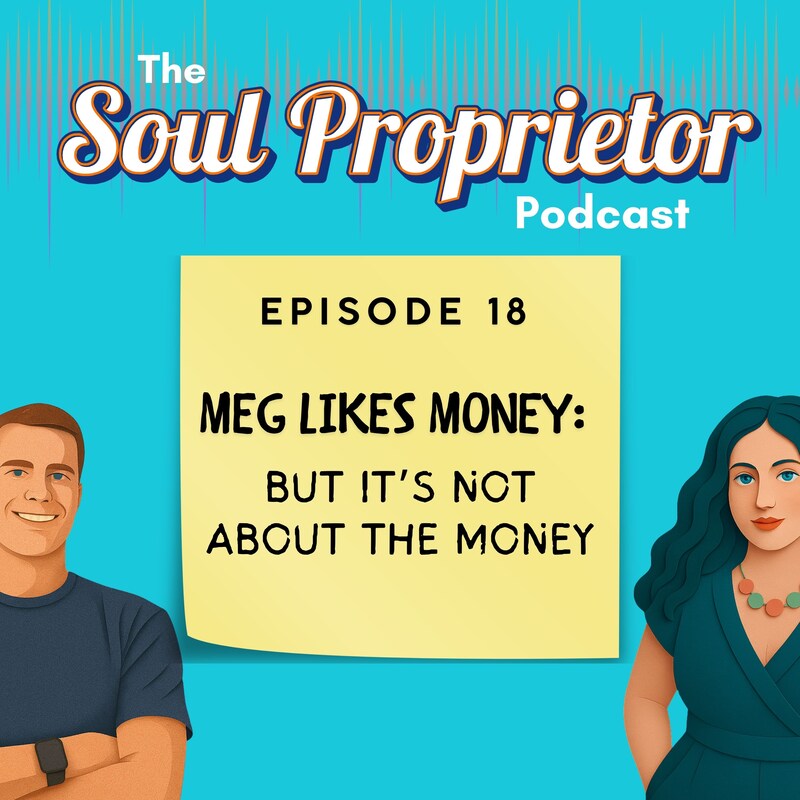
Shownotes
Curt and Melody sit down with their friend Meaghan Likes- entrepreneur, accountant, investor, and the human behind the name Meg Likes Money, for a conversation that goes exactly nowhere they expected.
Curt tries to talk about capitalism.
Meaghan politely shuts that down.
And what unfolds is a surprisingly grounded conversation about money, power, obligation, and what’s really driving entrepreneurs when they say they “want more.”
Meaghan has built and partnered in businesses across accounting, software, home services, and tech. She’s seen the bank accounts, profit margins, and pressure points behind thousands of businesses. She’s sat behind closed doors with very wealthy people. And she’s watched, up close, what money actually does (and doesn’t) fix.
Her Take? It’s almost never about the money.
They talk about
-Why chasing money is usually a cover for something else
-The moral obligation entrepreneurs take on when they choose to build
-Why profit isn’t greedy
-How money reveals people instead of changing them
-Why “passive income” is mostly a myth
-What happens when you stop making money about you
This episode is thoughtful, funny, and occasionally uncomfortable, but it’s the kind of conversation that will stick with you.
If you’ve ever felt conflicted about money…
This one’s for you.
Transcripts
I've never heard a why around money. Even if we go back to the story of William, who was corrupt, it wasn't about the money. It's never about the money. There's something else happening there. There's some sort of entitlement, there's some sort of relationship, there's some sort of need, there's some sort of want, there's some sort of, like, internal dialogue, but it's not about the money. And I think most people who have a shit ton of money know that it doesn't actually fix anything. Like, they're not chasing the money, they're chasing something else, which might be peace, it might be status, it might be assurance, it might be confidence, it might be relationship. There's something else happening there, but it's not the.
Meaghan Likes [:This is not the money's fault.
Curt [:Welcome to the Sole Proprietor Podcast. I'm Curt Kempton.
Melody [:And I'm Melody Edwards.
Curt [:Each week we dive into the ethical questions that keep entrepreneurs awake at night.
Melody [:Whether you're building your own company or exploring life's big questions, you are welcome here.
Curt [:Hey, everybody. Welcome to today's podcast. We're super excited to have one of our very dear friends, Meaghan Likes, on the show today. Meaghan Likes comes from being an entrepreneur probably her whole life, but she ranges in businesses that do accounting and bookkeeping, all the way to software and tech and home service, window washing, gutter cleaning, Christmas lights. She does so much, and she is an absolute guru of knowledge as it relates to money and entrepreneurship. So for today's topic, Melody and I wanted to bring her on so that we can ask her some of our questions that were sort of around that topic.
Melody [:Yeah, I've known Meaghan for quite a long time now as well, and she remains an enigma to me in many respects because she. She is never what I think I'm gonna get. She's so knowledgeable. Her knowledge is vast. She's such a good human. She's put so much good into the world. She really cares deeply about people, and yet she's a money person. Her whole Persona is Meg likes money.
Melody [:So much of this conversation did not go where I thought it was gonna go. Nor I. Yeah, and I also love that you and I get frustrated because we have so much agreement with each other. Like, we are yearning for a, you know, a debate of some sort. Not that we got a debate with Meaghan, but at least she gave us really different points of views on money and a lot to think about.
Curt [:Yeah, I think that there's several topics that we cover around good people. Versus bad people that I think is going to resonate with people. There's some areas that we talk about in terms of how to look at really wealthy people and what she sees behind closed doors, seeing their books and talking to them about that and watching people go from small businesses to much larger businesses. Her insights are absolutely critical, and we think that the audience is going to absolutely love it.
Melody [:Yeah. So I hope that the audience enjoys this episode with our friend Meaghan lan.
Curt [:All right, well, welcome, Meaghan. Thank you for joining the Sole Proprietor podcast. We're so grateful to have you today.
Meaghan Likes [:Hi, friends. I'm so happy to see both of you. I miss you. It's been too long. We have not been in the same place, the three of us, in way too long. I don't even want to think about how long.
Curt [:It kills me because you are so close to me. You're like, miles, just a few miles away from me, but we're still going through zoom.
Meaghan Likes [:I know. It's actually not that few miles. Fun fact about Curt. He says he lives in Phoenix. He does not live in Phoenix. He lives very far from Phoenix, but it is kind of close to Phoenix. And in his defense, just about every time I'm here, he says, do I need to race there to meet you? And he will drive to meet me. Oh, yeah, you're very good.
Meaghan Likes [:There was a time with a minivan and the kids and Rachel and I, it was like a quick, like, drug deal in a parking lot without any drugs. It was like, really?
Curt [:But milkshakes. We did do milkshakes.
Meaghan Likes [:There's usually milkshakes and sometimes Chinese food.
Melody [:We should say, you. You don't live in Arizona. You live in California.
Meaghan Likes [:I do live in California, but Phoenix is close to California, actually.
Curt [:But not Davis, California.
Meaghan Likes [:That's true. It's not Davis, California. Davis, California, is a very small, wonderful place which you both are invited to anytime you want, especially since we got our dream home now, guys. So come on over.
Curt [:Oh, you did?
Melody [:Very exciting.
Curt [:When they have an airport like in Davis, it'll be so much easier, right?
Meaghan Likes [:We do have an airport in Davis, and we just need to race to be the first one to get the private jet.
Curt [:Oh, okay.
Meaghan Likes [:It's just that simple.
Curt [:Yeah, that's true.
Meaghan Likes [:Ryan Lee says he's going to be the first. So we'll let Ryan Lee fly you.
Melody [:All to I'll catch a ride. It's looking pretty good for him. Him.
Curt [:He's kicking butt.
Meaghan Likes [:I'm a fan.
Melody [:We've stayed in the same places before. We were in Masterminds together. Yeah, we've always been in the periphery. I remember specifically it was at responsicon one of the years, early on, probably. I don't even know if you were in the home service world really yet at that point, like, the way that you are, or you have been more visible now. But I remember knowing who Jeff was but not knowing who the lady beside him was. But you looked very professional. I'm like, wow.
Melody [:And you seem to have so much confidence as somebody who always strives to have more confidence. It was like, I want to be a business lady like that someday. And sure enough, I think I went up and I introduced myself, and I think in the beginning, you're harder to like. Meaghan, you're still kind of a mysterious human in many ways to me. Like, you're. You're so many things, you're in so many places all at the same time. But I remember thinking, like, wow, you have a very powerful presence. And I think that was not the time I said, we're gonna be best friends.
Melody [:Definitely not. Then I just remember.
Meaghan Likes [:And then I remember, like, later I was like, I think she's right. Like, we haven't totally made it to the best friends moment, but we definitely made it to the close friends moment.
Melody [:Not yet.
Meaghan Likes [:Said it'll take time, but she, like, called her shot. It was there. Yeah.
Curt [:So, Meaghan, thank you for joining us today, because Melody and I, of course, both being your friends, we've enjoyed having this podcast and discussing certain topics that are really near and dear to our heart. But when we started thinking about capitalism and money, meeting business, meeting large corporations and small businesses and all the different complexities around that, it just made sense to bring in the big guns. Our very dear friend Meaghan likes. So, Meaghan, I just was kind of wanted to get started by asking you a couple quick questions that would at least sort of lay the baseline for where you stand in terms of how capitalism fits into the importance of entrepreneurship. Because entrepreneurship is more than capitalism, but it's an important part of capitalism, entrepreneurship, and sort of maybe where you sort of find your own footing as it relates to feelings towards a capitalistic society and finding your place in it as an entrepreneur.
Meaghan Likes [:Wow, I'm feeling, like, so intimidated and shy. I'm like, what is capitalism? And why did I name myself Meg likes Money? Come on, Meaghan, get it together. What is going on? Melody did name me Meg Likes Money. She is the one that coined that phrase, actually. Fun fact, that Persona, I used to call it an alter ego, and now I'm like, just no, it's a full Persona, and I'm just gonna, like. I'm gonna just get rid of. So if we just say, like, money. Can we say money instead of capitalism?
Melody [:Yes, please. I was gon. Curt, you started with, like, the hardest question ever. We should have been like, Meaghan, what's your favorite flower? Or something?
Curt [:Well, well, the reason I started with the question and the reason that when I think of capitalism, maybe we should just give our own show definition. That's what we always do. We always just define it for our show because it is more than just money. It's sort of. To me, if I'm going to define capitalism, it is the pursuit of money in order to make your business as profitable and healthy as possible in a society that allows for you to do that in any way legally. I guess there are laws that would keep you from taking it too far, but you can still take it too far. I've already buy it. Throwing some bias out there, but the idea of capitalism is seeking to get health of your company at the expense of other people needing to sacrifice for it.
Curt [:Whether it's employees putting in their time and energy, whether it's customers paying for the value you give and potentially enriching yourself off of those dynamics.
Melody [:That's your definition. Let me give mine, and then we'll let Meaghan talk. Okay. That was a really hefty definition. My definition is I just think of power when I think of capitalism. Like, I think of, like, money and power and people who want money and power. So I don't even think of it in terms of the actual definition of capitalism because I think of it as, like, selfishness in a way. I'm just putting it all out there.
Melody [:The words that would come to mind. There are countries where that's not the. You know, they're not capitalist societies. I like the idea of it in theory, but I think once you put humanity into it, it's like we take advantage.
Meaghan Likes [:I honestly don't think I've thought about the word capitalism since college. And what comes to mind for me is if we say capitalism is the pursuit of profitability, which I don't know if that's what we say or not, but let's just pretend that that's what we say. There's all these thoughts about how profit is a dirty word. Profit and money are related. Money and greed are related. Greed and selfishness are related. Then maybe we get. I think Melody maybe used the word.
Curt [:Selfishness, or she used the word power as well. Money and power.
Meaghan Likes [:Okay. And power. Yep. Okay. When I think about all those words together, I go back to a very basic thing that sits on my desk and has sat on my desk since the day I opened like accounting company. And the thing that sits on my desk is the three Ps. And so the Ps are profit, people, planet. And somebody told me very early on in business that I can't change the world until I am profitable.
Meaghan Likes [:And once I'm profitable, then I can actually change lives. Once I've changed lives, then I can change the planet. And I was like, oh yeah, I should do that. Like that's the order of events. And it took me a very long time to figure out the profit part and I'm just now starting to figure out the people part and then I'm going to go fix the planet part, right? But like when I put it in that order of priorities, it's like, oh, so if you guys define capitalism as that, then yeah, I agree. You have an obligation. We have a duty. We're in the minority as a population to be entrepreneurs, to create jobs, to create money, to create market, to like drive economies.
Meaghan Likes [:I happen to live in the fifth largest economy in the world. Like that is our obligation. If we're going to be in business, we should do that with ethics and we should do that like, well, we should do that for us. But like priority number one then if you're going to be business owners, you have to be profitable, otherwise you should be in a non profit. And Curt taught me a lot about that early on. But then priority number two is like people. And then priority number three is planet. And anytime I get out of order, I'm like, no, Meaghan, you're still on the profit part.
Meaghan Likes [:Like go drive profitability and then you can go save people and then you can go fix the planet. Like it's just a really good anchoring.
Curt [:I was just going to point out though, you know, when we sit on the airplane, what do they tell us to do? If you're sitting next to a child, make sure you put on your mask before you put on someone else's. Is it greedy to put your mask on before you put the kids on? When you were talking and you started saying capitalism is associated with money, money is associated with power and greed and profits and all these things that have negative connotations. You said planet. I'm sorry, I'm just putting, piecing together some of the thoughts I had as you were talking. You know, the planet is about planting trees and making sure that there's enough oxygen.
Melody [:Right.
Curt [:But it's also like how livable are you with other people? And how are people in third world countries or not? They're like in the town you're in, the people that live under the bridge, what kinds of things could be helping them on the planet as far as the planet goes? So you could make it a little bigger if you wanted. The point is, is that everything has context and greed can be positioned one way. But if you don't have enough power to put the mask onto the person next to you, you need to first take that power that you need. I did just quickly ask Chat GPT what it says capitalism is because you guys deserve that. And capitalism basically is saying it's private ownership, free markets and competition all coming together to make capitalism. And I think that all of our definitions have been clouded by our own sort of experiences. But at the end of the day, it's our ability as entrepreneurs to make decisions to grow an entity in the private sector. You know, the public sector does it as well.
Curt [:But we, we operate in the private sector and we have to provide value. We have to get the word out about that value and we have to take advantage of extracting as much monetary value in a free market as we can out of the value we put into the world. That can come at a cost. And that's what a lot of our questions are going to be. I think around is that it sounds good, but when there's people who are the kid waiting for someone else to put their mask on, it can feel bad. When you're looking at, they're going, look at you taking your slow sweet time putting your own mask on while I'm over here suffering and need, you know, need air. And most of what we're going to be talking about today is going to be around the empathetic role of this whole free market that doesn't have any feelings at all.
Meaghan Likes [:It's interesting, Meaghan.
Curt [:If I held your head underwater for one or two seconds, you'd be like, don't do that to me. But if I held your head underwater for 10 seconds, it could start to feel like eternity real fast. That's the point. The point is, is that you're doing the best you can and the people around you, it can feel like eternity for them or it can feel like it's not worth the wait or whatever. Or maybe they get the wrong idea that you're the one holding them under, that you're somehow deriving pleasure out of that. So it's the, the view from looking up at the other person with the power versus the heart of the person who is doing what they can, the best they can. And that's where I believe this dichotomy is going to be in this conversation.
Melody [:I'm playing a role in a way, because we all know that I've always. In the past, not anymore, because my new Persona is I love money, just like Meaghan. But, like, I've always struggled with that intersection of wanting to do good and also wanting to make money. It's been a struggle for a decade, well, all my business life to really focus on feeling good about making money and having. Not making money, having profit. I know that so many people that I know, and especially small business owners, really struggle with doing better. Like, we. We hit a cap almost.
Melody [:And I'm sure you've seen that a lot in your world of working with entrepreneurs and just in coaching programs that you've been in or you've. You know, there's a lot of that where we kind of cap ourselves out. So when I'm talking about or when I'm asking some of the questions, I'm kind of representing that side of it. And what I like about you, Meaghan, is you always have really great ways to. And Curt, too. But, like, you have really good ways to talk about money. That makes sense. And it doesn't sound like sales.
Melody [:It sounds like real. It's impactful. So that's why I wanted to talk to you is. I think it. The way you communicate about money is so important for people to hear, because I don't think the billionaires are listening right now to this.
Meaghan Likes [:Well, I hope so. McKenzie. Scott. I mean, she gave away $7 billion last year.
Melody [:I love her. Yes.
Meaghan Likes [:Are you kidding me? Billion with a B7. Not one, not two. Seven. Like, come on. Goals, guys, goals.
Curt [:That is so good.
Meaghan Likes [:Here's the thing. Like, when I'm hearing both of you talk, I'm like, you both have a moral obligation to go make money or you should go get a job. That felt like an attack, but I'm talking to every listener out there. If you would like to have this Persona of being an entrepreneur, then you have this obligation to make money for others.
Curt [:So where do you think that tension comes from? Where do you think the tension between making money and being a good person?
Meaghan Likes [:I think the others part. The others part. So I. In 2019, I started changing my whole, like, rhetoric around making money because one person changed my life. So I'm going to share that sound bite now, if that's fair. But it was my first trip to Kenya. It was a pretty intense, pretty terrible trip, if we're being totally honest. But there was just something very different about that trip for me.
Meaghan Likes [:I don't know if I did any good. Like, I. I don't know how you define good or impact or what, but what I do remember is there was this man named William, and we had raised, like, $250,000 to install a well. And William was in charge of running the. It's called a CBO that was going to organize the community that was going to benefit from the well. And we went through a bunch of red tape to get this well piped to three schools. And we decided the schools would be the stewards because children are the future. And so we go and we turn on the well.
Meaghan Likes [:And this is like, the white privilege part of the trip that I don't know how I feel about. I don't. But in the meantime, we went to 19 schools that we didn't give water to. We saw all this, like, need, and we had. I mean, I've raised hundreds of thousands of dollars just in this teeny, tiny community in Kenya. William, bless his heart, he's corrupt just about every other Kenyan that I have worked with, except for my sister and the do Gooders, but he's a Rotarian. He's the chair, and he asks for a bribe as we're leaving to turn on the well, to bring. It was 11,000 people who were impacting.
Meaghan Likes [:And I am, like, struggling with the greed of, like, he wants personal benefit. Like, how do we. In Rotary, you're not allowed to pay rides. Like, and this is a Rotary fund admission. And now I'm talking about publicly. I've never talked about this publicly. I don't know how I feel about all of that. We did navigate it.
Meaghan Likes [:The water got turned on. Everything was fine. But it was a really intense moment for me. And the way William changed my life was not by asking for the bribe, not by pissing me off, not by. There's a whole bunch of other fun stories about that trip that we could talk about.
Curt [:I'm getting pissed right now.
Meaghan Likes [:When we get loaded up into the van to leave, he puts his hand on my shoulder and he said, Meaghan, go home and make money so that you can come back and help us more. And I, like, looked at him and I was like, you selfish jerk.
Curt [:Yeah. How did you not break your middle finger as it flew up as fast as it possibly could?
Meaghan Likes [:First of all, I'm a woman traveling in a developing country in an area of Kenya that's Polygamous. So, like, we don't even. It's like a whole thing. We're not going to get into any of that. But that comment, which I'm going to repeat because it's worth repeating, is, go home and make money so that you can come back and help us more. Changed everything for me. And I realized when I came home, Jeff wasn't on this trip. So I came home to my darling husband Jeff, who I love, that Melody knew before me.
Meaghan Likes [:That's a very classic thing for me in the window cleaning world. He's the famous one. I go home and I'm telling Jeff, and Jeff goes, well, Meaghan, we stopped making money for ourselves a long time ago. And like, I thought of it, I was like, holy cow. If you think about it, the first time you hire employees probably make less.
Curt [:Yeah, that's true.
Meaghan Likes [:Listening to this. The first time you stopped doing the work and you shift from being the doer to the owner, you stopped making money for you, you started making money for others. And my husband, he's. He's like a simple guy when it comes to the things that I tend to overcomplicate. He's really good for me because he just keeps me anchored and my feet on the ground, and he calls me on my shit.
Melody [:So.
Meaghan Likes [:But I was like, you're right. We probably stopped making money for ourselves back in 2010. 2010. Since 2010, I've been making money for other people.
Melody [:Whoa. That's crazy. I think I had my first employee in 2004 when I bought my window cleaning company, and I definitely did feel the pressure of making money for somebody else. And I've felt the pressure ever since.
Meaghan Likes [:It's a real pressure. It's a real feeling. Like now when I think about the number of families that I feed personally, I think obligation, right. I have a moral obligation to grow or not. Or just go back and Meaghan, stop pretending to be an entrepreneur and just go be an employee. Because I never wanted the window clean business. If you guys remember that story. Like I told my husband, no, I said, no, we're W2 people.
Meaghan Likes [:That's what I said back in 2007 when he wanted to start this. Can you imagine? No, I can't even imagine. He's a W2 person.
Curt [:Do you think that the tension lies in the fact that once we move into that obligation, we start feeling like we can't be a good person and make a ton of money because we're making money for others and that that's the proper role? Where are you pinning that tension, like, there's a fulcrum point, right? Because some people are like, not about you.
Meaghan Likes [:As soon as I make it about me, then I feel selfish. It's not about me.
Melody [:Yeah. Well, I was thinking when you first get employees and you're still maybe working, but you're not making as much because.
Meaghan Likes [:You got this employee, which is true for everybody. For the record, you're listening to this. That is a very normal cycle of entrepreneurship. That first hire, you're going to take a little dip. Personally, I don't think I've ever seen it where that's not the case.
Melody [:Well, what ends up happening, or at least for me, is I felt bad if I was making a lot more than the person I was working alongside of, even though I was providing them with a job. And I've seen that with other people as well. But that was a mindset thing very early on. But it. It stayed a lot longer than I would have liked.
Curt [:Yet you felt probably right at home as you didn't take a paycheck while you made out payroll for all the other people. Because to Meaghan's point, I remember when I had four employees with a window cleaning company and I had to go, like three or four months because of the way that things had. Had panned out with some other stuff going on. I remember had to go three or four months without a paycheck. And yet that doesn't actually get any, like, points in your head. You're just like, yeah, that's just how it worked out. Darn it.
Meaghan Likes [:Fun fact, all three of us have owned window cleaning companies.
Melody [:Weird.
Curt [:That's true.
Meaghan Likes [:Another thing we have in common. And another fun fact, I still have mine. They don't. They've left me here in my window cleaning world, but they are still champions and fans and supporters of window cleaners.
Curt [:Fun fact also is that Meaghan doesn't have any problem chasing multiple rabbits. She can chase as many rabbits and catch them all. And she's like the Pokemon catcher. Let's just tweak this question just a tiny bit then, because where do you draw the line then? Or do you draw a line between healthy ambition and greed?
Meaghan Likes [:We live in a place which I feel so fortunate. First of all, I'm a woman. Second of all, I think it is this thing, capitalism, that I've never given credit to, but I print my own money, guys. Does anybody else feel that way? I literally print my own money. Like, there is no limit to how much I can earn. There's no cap.
Melody [:When did you first realize when did you first feel that thing?
Meaghan Likes [:I do remember the first time I figured that out is when I 2018. I started selling courses. Didn't ever do very well at it. My husband started selling courses, and his first course sold for, like, $500,000. I'm like, are you kidding me? And he calls it mailbox money. Like, Jeff is so smart. It's not fair. I mean, it is fair.
Meaghan Likes [:I'm married to him. I, like, I get.
Curt [:I love that guy.
Meaghan Likes [:But he also is just like, that guy's amazing. But I was selling courses, and I was like. And I had taken a class or something, and it was like, well, you know, you shouldn't. You shouldn't build it till you sell it. And so I was selling nothing. It was literally nothing. It was just an idea, and people were buying it.
Curt [:They're like, okay, I really want this. So, you know, it's worth your time now.
Meaghan Likes [:And then I built it, and then I still sell the same course from 2018. Literally the same one, just slightly updated every year. Once a year, we update it, and I'm like, oh, that's printing money, guys.
Curt [:I think the first time I sent out a marketing email and had my inbox flooded with people who wanted me to go out and do some work or something. I remember the first time I did them, like, so I just hit send, and then I have money.
Meaghan Likes [:I mean, you still have to, like, earn it, right? You still have to, but, like, the definition of earning is different, right? You have this lever that is a send button. I love that visual. You can send it. You can press send, and then money will come. And we live in a place where, like, that's not a bad thing, and that's not illegal, and there's, like, no cap. It's weird.
Melody [:It is weird. Why doesn't everybody just do it, then?
Meaghan Likes [:Because it's hard. It's exhausting. And we have imposter syndrome, and we have a hard time with discipline and focus. Like, I have wanted to burn down that course every year for the past seven years, and it is like a stubbornness factor that I don't. It's boring to me. It is not sexy. Every time I do it, I'm like, yeah, I like this, but I'm like, I don't want to do the same thing again. I want to go build something else.
Meaghan Likes [:I want to go do something else. Curt. He. He's feeling attacked right now.
Melody [:He.
Meaghan Likes [:No, no, he can relate to that.
Curt [:It's like she's talking to me right now.
Melody [:Everybody, I do say that Matt and I have an agreement right now that I'm allowed to have one business for now, since I've always had multiple businesses. And for Matt, one business is a lot, and then putting another business in it. But the way that I did business was probably part of that chaos.
Meaghan Likes [:It is chaotic, and people say I'm addicted to chaos. And I'm like, okay, I'll just embrace that. Of all my vices, I guess that's. I do have to protect. Last night. I had a moment. I had an intense, hard, very long day yesterday. And it was one of those days where we were eating dinner at 10:45pm and I am sitting there just, like, drained.
Meaghan Likes [:And fun fact about me, I am an introvert. People don't know that. They don't believe that. But I. I know. I know.
Melody [:I believe you, listener.
Curt [:I'd like to not to do my disclaimer again. Do not fall into the black hole she is planting in front of you right now.
Meaghan Likes [:Anywho, I am drained. Beyond drained. Rung out. Beyond rung out. And I, like, I'm on my phone. We're having dinner. We haven't talked all day. We haven't, like, seen each other.
Meaghan Likes [:And I, like, put down my phone and I look over and I go, you're a saint. Like, you get the worst version of me. Like, he gets the rung out. Do not want to say words. Do not look at me. Do not talk to me. Do not engage with me. It's like that part of business ship Melody from Matt's perspective.
Meaghan Likes [:Like, our spouses. Oh, Curt's. Rachel. Like, our spouses are saints.
Melody [:They really are.
Curt [:Yeah.
Meaghan Likes [:Level of tolerance they have for our baloney and our crazy ideas and our crazy adventures and our. Honey, I got a great idea. Like, the fact that Jeff still talks to me is shocking. Like, and he's excited to talk to me. He gets to talk to me for, like, three minutes a day without me wanting to kill him and be like, I need space. Let me be quiet, please. Go away. But I love him.
Meaghan Likes [:Like, of course I want to talk to him. I just gave all my energy to the rest of the world, and I'm done.
Melody [:You're speaking the story of my life for sure. Matt and I go to the gym now together at night, which is the worst time for me to go, but I'm doing it. And that is our one moment of connection for the day that I'm like, okay, it's multitasking. I can get on board. And I barely ever do it. I've Gotten five times in the last three weeks, but that's still something.
Curt [:Hey, five times in three weeks.
Meaghan Likes [:Jeff and I take classes together. We love taking classes together. Like, we'll take a class and learn something new together. And we do that regularly. And we have dinner together every night. That's a very important thing. And he's really good about planning dates.
Melody [:Oh, that's a really good skill to have.
Curt [:We'll have family dinner each. Each night. Typically, all the kids are all here, but it's the date night where Rachel's like, okay, you want to catch me up on what happened this week? Like, lady, I'm exhausted. You want me to relive all the reliving?
Melody [:Yeah.
Curt [:Well, here's the thing. You can see in her head, she's, like, getting ready to ask the question. She's like, do I dare? Can I do it? Do I feel like he's got enough gas in the tank? And I'm like, I can see what's happening right now. She's like, so do you want to maybe catch it? Is it cool if we do it tomorrow? Like, can I have, like, a good night's sleep tonight? But anyway, yeah. So you see behind the curtain on so many businesses and over many industries, too, right? I mean, you see a lot. A lot of stuff. Or do you see people change when they start getting more money? They say that money either magnifies or maybe it changes. I'm curious what your experience is just because, you know, Melanie and I have our business acquaintances.
Melody [:Sure.
Curt [:But, like, you have this very specific insight into, like, what's actually happening in the bank accounts and very close relationship with so many people in that way.
Meaghan Likes [:I can also smell bullshit from about 400 miles away. Right. So when you're at a conference and people are talking about revenue and they're talking about how many trucks or, like, what it is that they've decided is, like, I made it number employee. I don't know what it is. Depending on the industry, it's a different thing that's relevant or important. And then when you know, like, that is the worst. And you can't say, and you can't talk. And, like.
Meaghan Likes [:And I've become a bit of a, like, trophy friend in some circles. Like, people like, oh, Meaghan does this for me, or Meaghan works, and I never say who I work with. I try to be incredibly discreet. I try to just, like, keep my relationships all separate, which I think is important. Yes. It's a very slippery slope. So, like, I tend to not even acknowledge who my clients Are. I will.
Meaghan Likes [:But I have a ton of friends. Like, Curt said, I've never met a stranger, like, and I have pretty close relationships with, like, a lot of people.
Curt [:That's why you can't say you're an introvert.
Melody [:No, she can. I'm an introvert, too.
Curt [:She walks around the room with her tail wagon jumping in everybody's lap. The first time I met Meaghan, she's like, you're my new bff. Just so you know. And I'm like, what. What just happened?
Meaghan Likes [:Actually, that is a true story. And it's funny. We might have to tell another time. I actually think I cornered him, and every time I'd walk up to Curt, he would back up. It took years for Curt to not back up when I would approach him. Years. Like, now he. He approaches me with, like, open.
Meaghan Likes [:Like. Like, he's happy to see me. But it took a long time for Curt to not be like, this woman scares me. Like, she's a lot. That is true. I did aggressively charge Curt. He had gotten off the stage. And I like.
Meaghan Likes [:And if you've ever seen me in a. I do. This is, like, a thing I do. But, yeah, and then I'm always right. I feel like I'm never wrong when I say we're going to be friends. Like, we were. That made it into a newspaper article recently. Curt and my friends, my local friends, were absolutely offended what I had done, and they, like.
Meaghan Likes [:They said that this reporter had, like, not shed me in a good light.
Melody [:I thought I saw that article. You put it online.
Meaghan Likes [:Yeah. And there's a mini Curt story in that article.
Curt [:What?
Meaghan Likes [:Yeah, But I came across super aggressive, and, like, now we're saying I. I am aggressive. Like, unapologetically so.
Curt [:Introvertedly aggressive.
Meaghan Likes [:There you go. What was the question? Because I just went down a rabbit hole.
Curt [:Money changing people or magnifying or. Or.
Melody [:Or revealing them.
Meaghan Likes [:Yeah. Yeah. So money's so intimate, right? Like, it's a very personal experience. Our relationship with money, our, like, whole discussion in our head about money, our. Our theories about deserving money and, like, obligation. All of that is so intimate and personal and private. And it has a lot to do with your parents, and it has a lot to do with the family you grew up in. It has a lot to do with your childhood, and it has a lot to do with your relationship with debt.
Meaghan Likes [:And money is tricky. Super, super tricky. It's also incredibly revealing. It's, like, probably the most revealing thing you can spot any person's vice through how they spend their money. Actually. And you can also spot their priorities based on how they spend their money. Like, I paid my way through college as a bookkeeper. It was before I was married to Jeff, but my company was called Meg Likes Balance Books.
Meaghan Likes [:We could actually argue that that might have been probably not my first business. It's probably like my 12th. But Meg likes balance Books and I would do the bookkeeping for doctors. And so I would, like, do all of their personal family funding and accounting, and you would get to know the person. So for me, like, laying that as a foundation, that is very intimate and private the thing. It's also incredibly emotional. There's a lot of feelings around money, like in yourself and in your family and in your business. And so it's amazing how most people, when they go through financial coaching with me, they say it's more like therapy.
Meaghan Likes [:And I'm like, well, I'm not a licensed therapist, but I do have a licensed therapist who analysis psychologists that help keep me in line ethically with this discussion. So I don't cause harm because I think that I take that very seriously. I don't want to cause harm by coaching somebody through doing money or not doing money or however they want to relate to money. But the thing when we transform our relationship with money, the thing that I feel like is true 100% of the time is we become more confident and we become more calm and we take the power back. So I think, like, to me, this healthy relationship money is like when you have power over it versus it having power over you. And so there's this sense of, like, peace that happens. There's this sense of, like, understanding that happens. There's a sense of appreciation that happens.
Meaghan Likes [:It's a really emotional thing, actually. Incredibly emotional.
Melody [:That sounds like best case scenario, because I'm thinking of all of the people I know who have a lot of money and they continue to just chase the money still, though I've actually asked some of them at times because I like to ask questions like, well, when would it be enough? When. When do you have enough money? And. But it's more like a game to them of just collecting and.
Curt [:Melody, can I. Can I add another dimension? Because I think. I think this might be what you're gonna. The game of getting money comes at whatever expense is necessary. Are you alluding to that as well? Yes, because that flies in the face of what Meaghan was just saying. As far as, like, taking the power back. I've seen it myself as well. And obviously, I think with all of our personal lifestyles, we would we're repelled by the whole, like, I want more points on my scoreboard, and if it means me doing unethical things or unkind things or just flat out wrong things, but they're still legal.
Curt [:But my scoreboard got higher. Is that where you're digging right now?
Melody [:Kind of, yeah. Well, I feel like what you said, Meaghan, before, I'm totally on board with that. That confidence you talked about and the peace that comes with it, that probably takes a lot of work for people to get there, I would imagine. But I also see people who don't seem to do that work and they keep chasing. I learned a lot from them, like in the beginning, before I understood, like, as I was entering into these business worlds or going to different places, you know, the people who tend to be looked up to have a lot in those spaces.
Meaghan Likes [:But I don't. I just won't. You guys both know, for me, I have, like, zero tolerance for, like, noise in my head, right? And so for me, they're noisy. Like the noisy person in the bar or the noisy person with the noisy bar or the noisy person with the. Whatever it is. That's just. No, I don't have any space for them.
Melody [:But most people who don't have a lot of money, they. And they're striving to have a lot of money. I'm just thinking of the trades, let's be honest. Home service, the trades. There's a lot of people there who are striving to be billionaires or millionaires, which is not bad. But they're striving. They go after that, like, at all costs, in a way. And they're looking up to this people as examples of it.
Meaghan Likes [:I don't. I just. I'm going to tell listeners to stop. I give a very clear rule for myself when I'm looking for a mentor or when I'm going to listen to somebody or I'm going to take business advice from somebody, I just like to look at their personal lives. Do I like the relationship they're in? Do I like the relationship with. That I see with their children? Do like the relationship I see with their community. I started as a tax accountant. Guys want to talk about, like, money and intimacy with tax counting.
Meaghan Likes [:When you see a rich person's tax return and there's zero charitable giving, I'm not going look up to that person. And when I say I can smell bullshit, like, I like. I'm like, to me, like, is that somebody I respect? No. Is that somebody I want to be? Like, no.
Melody [:Well, you Know too much. You know, everything behind the scenes, Meaghan.
Meaghan Likes [:But you know the same. You just said all the same words. And so I just don't have any space for those people.
Melody [:But listeners don't. They don't know. You know, I didn't know when I first got into those industries or those spaces. Sometimes I would resist my instinct or my intuition about people.
Meaghan Likes [:Let's go there. Because I think as entrepreneurs, all of us have insanely great and undervalued guts. And if your gut says something's not right about this person, something's not right about this guy or this gal or the. Their story or, like, something's just not checking out and just ignore them. Like, I'm so good at ignoring people.
Curt [:There's the internal struggle, though, Meaghan. Like, if I'm feeling myself starting to pivot because money starts to become more beholden, like, I start becoming a little bit more of a slave to money, I. When I have that realization, I need to make that change, there's people who maybe don't recognize it and get a little further down the road than they intended to. That's kind of the thing about capitalism, is that you can tell yourself a story that I'm going down here to provide for my employees. I'm going down here to make this business bigger so I can do something good someday. But in the meantime, my identity has become the scoreboard of my money. And by the way, having money as a scoreboard does take a lot of the passion out of it. It can anyway.
Curt [:And there might be a benefit to it, but I think that people might get something wrong about people who are wealthy or people who are entrepreneurs who are struggling.
Meaghan Likes [:Like, I just haven't seen it. I'm feeling so lost in this conversation because, like, maybe I just have blinders to it, but I'm like, I've literally never seen it. I can't name a single person who is, like, only chasing money for money's sake.
Curt [:You have not.
Meaghan Likes [:No, I can't name one person. Like, there's always a backstory to a backstory to a backstory or a story that they're telling themselves. But, like, I can't think of anybody that is just chasing money for money.
Melody [:You know, so much behind the scenes of people's money. Like, you, because you're an expert at people's books. You've seen a lot of books. You've seen books that aren't doing well. You've seen them when they're doing really well. Lots of money, little money. You have such a Bigger view than the rest of us do. I've seen like, maybe two sets of books before.
Melody [:Besides my own. I have no idea how people are doing. It's just interesting to me that the perception that I have about the business world is not. Is shared by a lot of business owners, I think. I don't look up to people who have money just for the sake of it. But I wanna understand, like, well, what mindset did they have to get there? I don't think about all of the backstories necessarily, although those are the questions I wanna know. I'm like, well, what's the why? Why are you doing it?
Meaghan Likes [:I've never heard a why around money. Even if we go back to the story of William, who was corrupt, it wasn't about the money. It's never about the money. There's something else happening there. There's some sort of entitlement, there's some sort of relationship, there's some sort of need, there's some sort of want, there's some sort of, like, internal dialogue, but it's not about the money. And I think most people who have a shit ton of money know that it doesn't actually fix anything. Like, they're not chasing the money, they're chasing something else, which might be peace, it might be status, it might be assurance, it might be confidence, it might be relationship. There's something else happening there, but it's not the.
Meaghan Likes [:This is not the money's fault.
Melody [:Interesting. What do you think people get wrong about wealthy people or wealthy business owners, like, the average person? Because a lot of people think people with money are bad people who are not business owners, employees.
Meaghan Likes [:I actually don't believe in bad people. I don't believe there's such a thing. I had a person tell me that once. They're like, there's no such thing as a good person or a bad person. Bad people can do good things. Good people can do bad things. There is no bad people, guys.
Curt [:I share that belief with you, Meaghan. But like, to sort of double down on that, the question is, what do you think people get wrong about it? Meaning, like, if you went on to a forum today, you would easily be able to find people who say, Elon Musk is bad because he has a lot of money. And I think a part of it is what you're saying. There's no such thing as a bad person. But what would you say to the people who just automatically assume?
Meaghan Likes [:And I don't know if that's right or not. That's just a personal philosophy. I have no idea. Like, my brother's a police officer, and my mom always talks about all the bad guys he catches. And I'm like, seriously, how old are we? Do we catch bad guys? What? Like, no, that is not a thing. Mother, stop talking. Like, mom, I love you. I know you're gonna listen to this.
Meaghan Likes [:And she doesn't say it anymore. She's gotten really good. I'm like, there's no such thing as bad guys. And we don't catch them. We live in America. Like, come on. And that is not your son's job. And she used to say, he takes bad guys off the street.
Meaghan Likes [:I'm like, are you kidding me? Like, I am a second chance employer. I love people who have done bad things and want to do good things. Like, you're my favorite kind of human.
Curt [:How would you reframe that? Someone who's got a lot of money is obviously an exploiter of their other human beings. How would you reframe that?
Meaghan Likes [:I would just look at all the good. It's how I reframe everything. Like, it's how I live a positive life. I just look like. Think about how many people has Elon Musk fed. Think about how many people have benefited off of his back. Think about, as a global economy, how we've benefited from Elon Musk. Think about California as a California economy, how I've benefited from Elon Musk.
Meaghan Likes [:That guy has giant balls, and he is doing big things, and nobody is perfect. Just, like, nobody's good, nobody's bad. Like, there are. I'm sure there are past employees of mine who would say I exploited them.
Melody [:Yeah. I can think of what people would say about Elon. They would say that, well, if you have all that money, you could, like, change the world with that kind of money.
Meaghan Likes [:He is. He literally is. I'm sorry, but the man is.
Melody [:But in the way. In the way they want to see, like, the basic ways.
Meaghan Likes [:Yes, then go do it. Just go do it, please. By all means, go change the world, right?
Melody [:I think that's what people say. They just simply look at, well, he's worth a trillion dollars now. Should anybody have.
Meaghan Likes [:I don't even care. I have no space to even engage in that conversation. I was like, well, then go do it. Do it better, please. I challenge you. Like, there's also no obligation to keep making money for others. Like, when Jeff said that, it was also permission that we could stop, right? We could stop at any point.
Melody [:So you're choosing it?
Meaghan Likes [:We choose this. Elon Musk chooses This chaos. He chooses this lifestyle. He chooses this, like, way of spending his time.
Curt [:I've also sort of always lived under the presumption that there's no good or bad people. But people who, like, I always tell my employees, everyone's a Pokemon card, right? Like, you have powers up in some areas and you're going to have lessers in others. One of the things that I. I have really also gotten as a piece of advice was that I need to choose my marriage. Like, when I first got married, Rachel and I decided that divorce is not an option. And somebody you know, once told me, like, if you have that mindset, you're wrong. That's a bad way to look at it. Because if there is no option to divorce, you can just live in misery with a roommate and be all proud of what you're doing, but you're not choosing your marriage.
Curt [:You're just choosing to not get a divorce. One of the things that you said that was super cool, where I was already kind of with you on the part of no one's good or bad. And I think I could probably express that to anyone. And I think I could do it well, because it's just. It makes so much sense, and it always has made sense to me.
Meaghan Likes [:And good people do bad things, right? Like, we're not saying there's no bad things. Like, we're not saying that there's not bad.
Curt [:But the moment someone does one thing that identifies their whole entire life, you're taking too simplistic of an approach. And you're not. You're basically belittling that person based off of a single decision they made their whole life.
Meaghan Likes [:Also, you're assuming that you're never going to make a bad decision. And I make a hundred bad decisions a day. Maybe a thousand bad decisions a day.
Curt [:Yeah. So here's where it came together for me. Choosing my marriage is something that I have intentionally done. Choosing entrepreneurship is not something I've always done. And I think that I extrapolate that on people who look at entrepreneurs negatively or positively or whatever based off of either they're a good entrepreneur because they have a lot of money, or they're a bad entrepreneur because they don't have a lot of money, or they're a good entrepreneur because they don't have a lot of money, or they're a bad entre. You know, you can slice this pie however you want. The fact is, is that someone like Elon Musk, if I was talking to somebody who was maybe, you know, fighting against capitalism and trying to prove that all the wealth is finding its way to too few of people. Guess what Elon Musk could do if he wanted right now? He could just cash everything in, go buy an island, have his own laws of his own island, and he could just stop.
Curt [:Yet he doesn't. So either you have to take the approach that he just loves enslaving people for his own things, but he's paying them the whole time, which they're by the way, making the choice to work for him.
Meaghan Likes [:Oh, is that the definition of capitalism? Is the choice? Is that the free market thing that we were missing here?
Curt [:That's what free market is, right? It's the ability for competitors to come in and do it better. Like you were saying, go do it yourself. Or for you to wake up every morning and say, this is a battle I want to fight. And for him, there's battles of innovation that obviously are a big thing, I think is watching that vision come to life. But there's also, I think, the battle of construction. So innovation, I believe, is sort of, you know, if I'm going to define it would be to take an idea that's brand new and make it come to life. The construction is to say, everybody's thought this for a long time, but I'm actually going to make it happen. I'm going to do it.
Curt [:Bringing people together may or may not be an in an act of innovation, but it's a very big battle accumulating people as a skills and getting them to work together in a collaborative way. I mean, this is the part where I, you know, you probably don't even think it's a big deal, but me chasing multiple rabbits, I'm building rockets that go out to the space, I'm building cars, I'm building power grids, I'm building something that can drill underground so we can transport people in tunnels. And by the way, I think he's got a social media platform of some kind or something.
Meaghan Likes [:It's actually quite hard to be wealthy, just like it's hard to be impoverished. It's like there's a choose your hard, right? Like there's a choose your hard here. But like, if you have a lot of money, like, first of all, to spend can be difficult. To spend wisely is incredibly difficult. To give can be difficult. To give wisely can be difficult, like to earn can be difficult. It's not like you just like won the lot. Like, I guess we could use a lottery example or something.
Meaghan Likes [:And you, you stuck it all into like bonds that then helped the government. I mean, it's pretty hard, actually, to be a steward of money. Just, like, it's really hard to not have any money. So choose your hard. And also, if you don't have a trillion dollars, then don't waste any mental capacity wondering what's going on with a trillion dollars. Like, just worry about, like, how much do I want and how much do I need? And I think Melody was kind of hinting at that earlier. Like, most people don't actually know. And so I'm like, go learn that.
Meaghan Likes [:Go learn what enough means to you. Jeff and I, we talk about how much is enough. A lot. Like, a lot. Because, Curt, this language around choice, ugh. I love you more for it. Like, Jeff and I have said that since basically day one. And I got sick less than a year after knowing Jeff, and he chose to stay.
Meaghan Likes [:And then Jeff got sick after We've been together 15 years, and I chose to stay. And it didn't mean that those were easy choices. It didn't mean that it's always been sunshine and rainbows. It didn't mean we didn't like that phase of our life or our marriage or our partnership or whatever. But, like, the choice part was so fundamental to us that we choose each other. And maybe some days we don't. Maybe some days we don't want to choose that other person. But way more days than not, we choose each other, and we choose our marriage, and we choose respecting each other.
Meaghan Likes [:And I love this other idea about entrepreneurship. Like, it is a choice. I stopped, like, I was good a long time ago. And it doesn't mean I don't ever have to make another dollar in my life to be good, but I can absolutely redefine my definition of good. We went to Thailand this year. Jeff and I could absolutely go live in Thailand. We could just pick up all our poker chips and leave. Why not? Like, I love the island philosophy.
Meaghan Likes [:It's a choice. Choose your hard.
Curt [:I actually felt that way about the Philippines.
Melody [:Here's what I wanted to say about what other people think. People struggle with money. A lot of people. We don't teach money in America. We're not taught how to have money. And a lot of us start in poverty or have. Not a lot, but I did. I grew up in a housing complex.
Melody [:Like, I wasn't taught how to have money. A lot of people I know weren't taught. So they don't know how to get money. Even though there's so much on the Internet and everybody says you can make a million dollars when you live in scarcity, which is what a lot of people do, even middle class now. Like, there's a middle class, poor. It's really hard to live the American, quote unquote dream. And so for people like that, I think when they look at somebody who's made more than most people, like, than anybody else in the world, what they're thinking is like, I can barely survive.
Meaghan Likes [:Then they should live in a socialist country.
Melody [:But they can't even people who live in a housing project to leave a housing project. And, you know, it's so hard because it's not just one thing to make money.
Meaghan Likes [:So the freedom of choice is the privilege. That's a good point, Melody. That's a very good point. There's a book that Martha Woodward prescribed to me pretty early on in our friendship, which was Bridges out of Poverty. And I grew up a very middle class, normal vanilla upbringing. Both parents were like, my mom was a schoolteacher. Like, we didn't really have any needs. But Jeff grew up incredibly poor.
Meaghan Likes [:It talked about the difference between generational poverty and situational poverty. And it talked about, like, how do you break cycles of poverty? It didn't really use language around scarcity mindset, but it did talk about opportunity. And I feel like if you are feeling some sense of guilt around money or making money or whatever it is, like, then go educate yourself around poverty and go be a bridge. Like, go be a steward. Go be a. An entrepreneur that creates great jobs with great benefits, right? Like do volunteering. Like, I've had 75 different jobs for a hundred employers. 75 different jobs for a hundred employers.
Meaghan Likes [:So I've worked for a hundred different people for money. And that does not include any client. So I don't consider, even though I probably could add several hundred to that after the clients, because I do tend to work for clients, but different. I mean, as an employee, I worked for a hundred different employers. Jeff and I kind of talk about the selfishness of volunteering because now we have this whole new relationship about, like, the white guilt tours. Like, now we've had to really change our relationship to volunteering because we felt like we were almost like participating in, like a, in an economy of volunteerism that we didn't know how we felt about. Like we were doing good, but only for, like, the benefit of us. Like, I don't know, we've done a bunch of weird things.
Curt [:I know that anyone can turn anything good around. And, you know, a lot of people say, oh, like you're, you're adopting somebody from Cambodia to Look like, you know, you're, you know, so special. Or the whole idea in the Bible is, say, is letting your left hand know what your right hand is doing. So I'm doing something nice, but make sure it gets on Instagram and everybody knows about it. And there's something we said, right, because, like, well, if I do it all in private, I don't inspire anyone else to do it. If I do it at least a little bit in public, people can see that this is something that I could actually dream about, think about, add to my dream board. Do. If Meaghan can do it, you know, why can't I? Anyone can turn a good deed into something that is less savory.
Curt [:And it usually comes from a place of jealousy.
Melody [:Yeah, I'm right there with you on the white privilege, white guilt thing, because I have done a lot of missions trips, too, and when I look back now, I'm like, wait a minute. Even having a company where I'm trying to change the lives or, like, with the work that we're doing here, I'm trying to change the lives of Filipinos through impact with finance. And you know what I'm saying? Like, I still don't know how I feel about that.
Curt [:Let's do a quick lightning round. Meaghan. So I have a question, a few questions for you. I'm going to give you kind of a little bit of a binary. Just in the spirit of getting you to go quick, we're going to let you unpack one of them, but I'm going to put stuff out there. You pick which one you agree with, then when we get to the end, we'll unpack one of them. And we have one final question for you. All right, you ready? Let's do it.
Curt [:Is capitalism a force for good or a corrupted tool?
Meaghan Likes [:Good.
Curt [:Employees should think like owners. Yes or no?
Meaghan Likes [:No.
Curt [:Passive income. Is it real or mostly a myth?
Meaghan Likes [:Mostly a myth.
Curt [:Hustle culture. Is it necessary or is it toxic?
Meaghan Likes [:No, no, pass.
Curt [:That's the one you're gonna unpack. Equality of opportunity. Is that a fact or a fantasy?
Meaghan Likes [:Well, now, Melody, remind me of Bridges out of poverty. So probably fantasy.
Curt [:All right, which one do you wanna unpack for us? You kind of seem to get stuck a little bit on hustle culture being necessary or toxic.
Melody [:Well, I liked the one before that, though.
Curt [:Passive income. Real or mostly myth?
Melody [:Everybody would wanna know the answer to that. Like why you think that's mostly a myth or how you know that.
Meaghan Likes [:Well, probably because of hustle culture. Right. I recently started a partnership, actually, technically, I Started over a year ago, but it really got a lot of money. We're talking about money for good. It started making a bunch of money this summer unexpectedly. And everybody like, that's the best case scenario. Well, it wasn't really, because I never intended it for it to make that much money. It was going to be like a passive venture.
Meaghan Likes [:It was a business in a box that it had sitting on a shelf that somebody needed a job. And so I gave them a bit like it was like a whole thing and then it turned into a whole thing. And money can complicate it. And partnerships are complicated. Fun fact. I've had six failed partnerships. Six, thank God, none of them were my marriage. And I hope that I can keep choosing that and he keeps choosing me.
Meaghan Likes [:And it's not. That is not the partnership that fails, but six, I am not good at everything. There are a lot of failures here. So this partnership we did not do all the soul searching about what does it mean to be a good partner? Or what does it mean to be an equal partner? And we got stuck. Oh, gosh. And I'm in another partnership right now. Partnerships are messy, they're tricky. We got stuck on this idea of what is contribution.
Meaghan Likes [:And it turned out that this partner that we'd started with thought that it was a passive business. And I don't know how to do a passive startup. And we had to talk about what does it mean for contribution in a startup of a business. And we're not talking about like a startup culture of Silicon Valley, we're talking about the startup culture of like bootstrapping, which I think is most of your listeners, right? Like this is on your blood, sweat and tears. Now you add another person in that element. And in my head, partners contribution are defined by time, talent or treasure. So you have to either contribute time or you have to contribute what you're good at, your expertise, or you have to contribute your money. You have to make a capital contribution.
Meaghan Likes [:Now if you are in a situation where the only thing you need is a capital contribution, the person that gives you that capital contribution, if it's written correctly in a certain right, that could be a passive investment opportunity. But I think the majority of your listeners are not in that place where they're able to just have discretionary income or discretionary wealth that they can put into passive opportunities. I think the second part of that is really evaluating what does passive mean. We started a short term rental this year and short term rentals are not passive. I pay 20% of every dollar to a property Manager. I have everything else automated. Like, it is still not passive.
Curt [:I mean, even if you were investing in a business, though, Meaghan, like, if someone came with treasure to put it into a business, we learned that the silicon bubble. But if that's what they're only going to do, we learned with the silicon bubble that when entrepreneurs know that the person giving the money is just going to walk away and there's. There's not going to be any active enforcement or accountability or anything like that, that business will go to zero in no time.
Meaghan Likes [:That is my whole job now, Curt. That is my entire job is I have all of these Wall street guys trying to come onto Main street and I am like, now on this bandwagon of helping Main Streeters understand that if all you want is money, then let me help go get you funding. Do not take their capital investment.
Melody [:Yeah. I've also had a couple failed partnerships, and it's painful every time. For me, it's been very painful. But I've learned a lot. I went to a divorce mediator with my last contract write up because I wanted to know all the things that could go wrong. It was a good investment. I have that for any future partnerships as well to think about.
Meaghan Likes [:There's a really good book called if you're in my office, it's too late, and it's written by a divorce attorney. Curt. I'm also terrified of the D word.
Curt [:Well, honestly, the D word has become a lot less scary to me once I have realized that, like, it is an option. Like, there's a rip cord to pull if my wife started becoming aggressively angry at me all the time and could not be consoled in any way and was sabotaging our marriage. And the same would be said for Rachel, like, if I started treating her like an emotional pinata or, you know, physically, you know.
Melody [:Right.
Curt [:Like, she needs to know that, like, getting away from me is the healthy, right decision for her. The kids for. Well, for her. Like, just she needs to. And divorces that properly used tool for somebody who stops choosing the marriage. And if only one person's choosing, it just doesn't work. I know you're the one unpacking this, Meaghan, but, like, one of the things that is really resonating with me right now is the idea that if someone comes in with time and talent and the other person comes in with treasure and they decide up front that that's a 50, 50 partnership, that means that all the time and talent I apply from this point forward will continue to be asked of me at an Infinite rate. And I've agreed to that.
Curt [:And your finite contribution is going to always be equal to 50% of this business. That can get really tricky because the contract doesn't have emotions. They just sort of live there. These are not things that a lot of people think about at the very beginning of it. And where capitalism might get a little bit of a bad name is that, well, you took advantage of me when I really needed this opportunity and you put in this trite amount of money that was at the time, a lot for me and made it possible to get the dream started. But I am no longer as thankful to you. I'm not 50% thankful to you anymore.
Meaghan Likes [:Because I know more because I'm different. Right? Like, this is what's happening for everybody. Right? And it's a money question. Like, money complicates it. How do we value treasure? How do we value time, but most of the time in partnerships? How do we value talent? How do we articulate value of talent? How do we define value of talent? It's tricky.
Melody [:I want you to come back and talk about just that. Just that. Because that is. No, just like, how do you value in just relationships with other people in business or. I don't know, there's so much there.
Curt [:I just realized that we are getting ready to roll into our last question. That's for Meaghan and our audience, but we gotta ask her about skateboarding.
Melody [:Yes.
Curt [:What if we would have got to the end of this and we didn't ask her about skateboarding?
Melody [:I would have been in big trouble. Matt, my husband. Oh, knows only maybe one, two things about you. One, you like money because it's in the name. And two, he saw you on a skateboard one time and so the question he asked is, can you do a kickflip?
Meaghan Likes [:Absolutely not. I learned how to go downhill recently. That was a big deal. It was a really big deal that my 6 year old nephew taught me. Not my husband, who is the badass skateboarder in our family and can do a kickflip. Absolutely. He can do a kickflip on command. When you shout it from a window driving by him, he will do it.
Meaghan Likes [:Fun fact. So I. So I left the skate park that day because I felt so cool. I'm a skateboard and I went down the hill and I learned the next day how to go up the hill. It was like a whole thing, like, totally changed my life. Like, I can hang out in a skate park now and not embarrass myself. And so I said, okay, honey, how long till I learn a kickflip. And he said, three years.
Meaghan Likes [:I was like, seriously? Yeah. He said, if you do that every day, then you will be able to do a kickflip in three years. I was like, but, like, is there a hack? Is there, like, somebody who could pay? Is there? He's like, nope. You first gotta learn how to do an ollie. And, Meaghan, you've been working on how to do an ollie for three and a half years. So I was like, jeff even bought me the, like, wheel blockers so I could do an ollie. I have successfully done one ollie in my entire adult life.
Curt [:I have still wondered, like, the first guy who did a kick flip. I wonder if he was like, after, like, 10 years of imagining that it's possible. Because I've looked at the physics of it. I watch it in slow motion. I'm sorry, it's just voodoo. It's not real. I've seen Jeff do a kick flip, but I still can't believe it's real. Because you, like, magnetically pull it up and then you kick across the top, and it knows just what to do, and then you land, and it's just not possible.
Curt [:I'm so sorry.
Meaghan Likes [:This is part of the. Meaghan. Traveling with a skateboard is like, I feel like I have an obligation to do a kickflip. If somebody yells out the window, do a kick flip. And that was like, an Andrew Reynolds thing who makes me sound cooler than I am. But, like, I can't do a kick flip. And my husband says, three years.
Melody [:Maybe money is a way for you to get to do it. Like, if you could just get the money to hire Tony Hawk, I'm sure he could compress the amount of time.
Meaghan Likes [:I live with Tony Hawk. I live with a guy better than Tony Hawk.
Curt [:Lives with Tony Hawk, but he's your husband.
Melody [:And so there's a different dynamic than if you just had a person come.
Curt [:In and I'm telling you, Melody, it's one of those things where you can have all the money in the world and you just can't buy everything.
Melody [:You can't buy a kickflip.
Curt [:You can't buy a kickflip.
Meaghan Likes [:He talks about that, actually, about how skateboarding culture is an equalizer. The rich kids aren't better because, like, the equipment is so basic. There's no, like, tricks to it. It's just time.
Curt [:I'm buying a skateboard that can jump itself and do a kick. I just jump up and land on it. No, in all reality. I love that so much. So, Meaghan, now that we know you can't do a kickflip, but luckily you're married to someone who can. On command. Let's land this plane. We've talked about so many things, and there's a lot of emotional charges around it.
Curt [:And I like that you also took a bunch of emotion out of it. That was really helpful for me today. I really like that. I hope our listeners took note of that. Maybe where they land on. On some of that. But the last question that we had for you and for our listeners, I think it's really, really fun to think about. If we took your business away, we took away your title, your revenue, your payroll, your status, the trips that you take that are business related.
Curt [:If we took all that stuff away from you, what part of you remains unchanged?
Meaghan Likes [:I think my passions. So my love of reading. You could lock me on an island with books and I would be fine, right? My love of being outside. I'm doing this podcast. I love to be outside. It's like one of my favorite things. I feel like those are the two basic things. If we could go a little bit further, if I had a little bit of privilege, my love of gardening, which I understand is a totally entitled activity, but I love to garden.
Meaghan Likes [:Like, it is my favorite thing to get my hands in the dirt. And then, like, next level of privilege is like, love of travel. I've loved traveling as a child, and I. I don't think that will ever stop. I don't think that will ever go away. I don't think I'll ever stop wanting to plan the next trip.
Curt [:Do you love gardening so much that if you had nothing and that was all stripped away from you, would you, like, go to the point of, like, knocking on someone's door that's got a yard or something and, like, literally garden in someone else's yard just so you could do it? Is that how much you love it?
Meaghan Likes [:I garden in somebody else's yard. My garden is not at my house, Curt.
Curt [:Well, that answers the question.
Meaghan Likes [:I just bought my dream house, but I also got the bill from the landscape designer to get my dream garden. And my dream house is going to be $250,000. I said that number out loud, but, like, that is a privilege thing. And I realize I just said that on a recorded line, but, like, no, When I'm at a restaurant, I garden. I could be waiting in line and I will garden. I love gardening. It's weird.
Melody [:I don't think it's privileged, by the way. I think it's basic. Like, you can garden no matter who.
Meaghan Likes [:You are, we have to be able to afford land or friendships. You have to be able to afford water, and you have to be able to propagate seeds in some way or be willing to steal things to propagate. So there is a tiny element of privilege.
Curt [:I'm now convinced, based on what you just said, you could find yourself in the middle of Africa, no one knows your name or anything, and you would find a way to do it. So that's pretty cool.
Meaghan Likes [:Oh, I garden in Africa like five times. Their dirt is incredible. It's different.
Melody [:Yeah.
Curt [:Melody, I'm just gonna pose that question to you. I just would love to learn that about you as my co host if we stripped it all away. I know babies. You love babies.
Melody [:One baby. Well, no, I'm sorry. I love all the babies, including my children. Just love one a lot right now.
Meaghan Likes [:Yeah. Currently we're a little obsessed with one.
Melody [:Currently I am obsessed with one baby. Yes, that is true. But I think mostly the thing I think that would still be there is creativity, believe it or not. Music and people, community. And I have been away from business before. Every time I've. And I've had major midlife crises every time I've sold a business but didn't have another business. But I always kind of tended to go towards community and creativity.
Melody [:So you Curt?
Meaghan Likes [:Yeah, we. We gotta know. That was great answers, Melody. I want to like, change my.
Melody [:Oh, thank you.
Curt [:I think I could have actually guessed most of that about Melody. That is so fun.
Melody [:Travel. Oh my gosh, travel.
Curt [:Well, if it all gets stripped away, you gotta do it with a knapsack and a stick.
Melody [:That's how I started, which I've done.
Meaghan Likes [:Yeah, we've all done. If you love travel, you find a way.
Melody [:Yeah.
Curt [:As far as like just like full on getting out. Like, Meaghan talked about being outdoors. Me being on a mountain bike is just where I feel so the most alive. I realized that's privilege. So I'd have to make friends. Someone who had a great bike that was the same size as me, but for really. Oh, I think that hard work. I love digging with a shovel, but not necessarily gardening.
Curt [:And I know it requires like building materials and stuff, but I like sweating. I love getting out on the weekends and any chance I get to dig a hole, make some concrete, make a thing.
Meaghan Likes [:Can I say something there?
Curt [:What?
Meaghan Likes [:You love building.
Curt [:I do. I love building. I like to think that I'm a really hard worker. It feels so good at the end of the day for me to be exhausted in Putting my energy into something that, that's going to last. And that could be children. I know I have talked a lot about physical work, but like, my son and I, we sat down and built a budget out for his new reptile business that he's starting. And we planned which is more profitable species and, you know, helping him think it all through. And, you know, this son, particularly for.
Meaghan Likes [:Those of, you know, I'm assuming it's the one that also had a apiary business at one point.
Curt [:Yeah, yeah, that, that didn't.
Meaghan Likes [:Okay, good. He has had like. And the quail, the quail business. We've gone through a couple of animal.
Curt [:Related businesses this particular kid does not want. He's allergic to spreadsheets. But we got to the end and he, he actually said, wow, that is really cool. Like, look, son, you don't have to guess how many animals you need to sell to make $20 an hour or more. Because look at, look at. If you change this input, if you stopped selling those and you only sold those, guess what? You could put more time and energy into this and you'd make more profit. And you'd only have to sell 200 of these per year in order to make this amount of money. And you'd only have to do three hours a day instead of four hours.
Curt [:So he's like, you just keep messing with the spreadsheet. And he's like, dad, I, I can't believe this is so cool. And so going back to the building thing, just building up something is so fun.
Meaghan Likes [:Yeah. Can we give you a shameless plug real quick? Okay, well, please make friends with Curt, send him a note and find our pricing thing because there is a spreadsheet. And Curt got all of his friends to get together to build a course on how to price things. And the thing that I heard and felt was like, how do we value our time as humans and how do we like, get economic value for our time? And this man practices what he teaches because that applies to any industry, any business, any startup, whether you're selling animals or you're selling dawn dish soap or selling like water heaters. Same math, right? And it comes back to valuing our time. And I love that.
Curt [:That's so cool.
Meaghan Likes [:And Curt has great kids. And Melody, I haven't met your kids, but I know you have great kids.
Melody [:They're adequate.
Curt [:They're great.
Melody [:If they ever listen to this, I can't let them think that they're just that I said they're adequate. They know I like to joke. I'm Massachusetts. You know, every time he talks about Rachel and his family, I'm just like. It's like Anne of Green Gablesy to me. How very quaint and beautiful their relationship and their kids are.
Meaghan Likes [:Anne is real. I've been in that office more than once. Right. I've been in that house more than once.
Melody [:Yeah.
Curt [:Well, it's beautiful. I hope to have you over again soon, Meaghan.
Meaghan Likes [:Yeah. Not today, but next week I get a rain check.
Curt [:Yeah.
Meaghan Likes [:All right. Well, don't be afraid of capitalism. Take back the control of money and stop making about you. Stop making it selfish. Do it for others or don't do it. It's a choice. If you're going to do it, you have a moral obligation to do it well, as long as it fits within your boundaries of what you're willing to sacrifice.
Curt [:I love that. Thank you for joining us today, and it sounds like we're going to be having you back, so don't go too far. Thanks everybody for joining us at the Sole Proprietor Podcast. It has been an absolute pleasure having these discussions with you. If you wouldn't mind taking just a few minutes to rate and review us wherever it is that you listen to podcasts, it would mean so much to us. We really do read each of these reviews and it gives us the opportunity to. To get the word out to more people who could benefit from hearing about topics like this and so many others. If you want to engage with us at our website and maybe share some topics or ideas of other people that you'd like to hear on the podcast, feel free to go to soleproprietorpodcast.com and share with us your thoughts and ideas about what we could do in the future to bring even more light into the world.

