Shownotes
What happens when the skills you spent decades building suddenly feel obsolete?
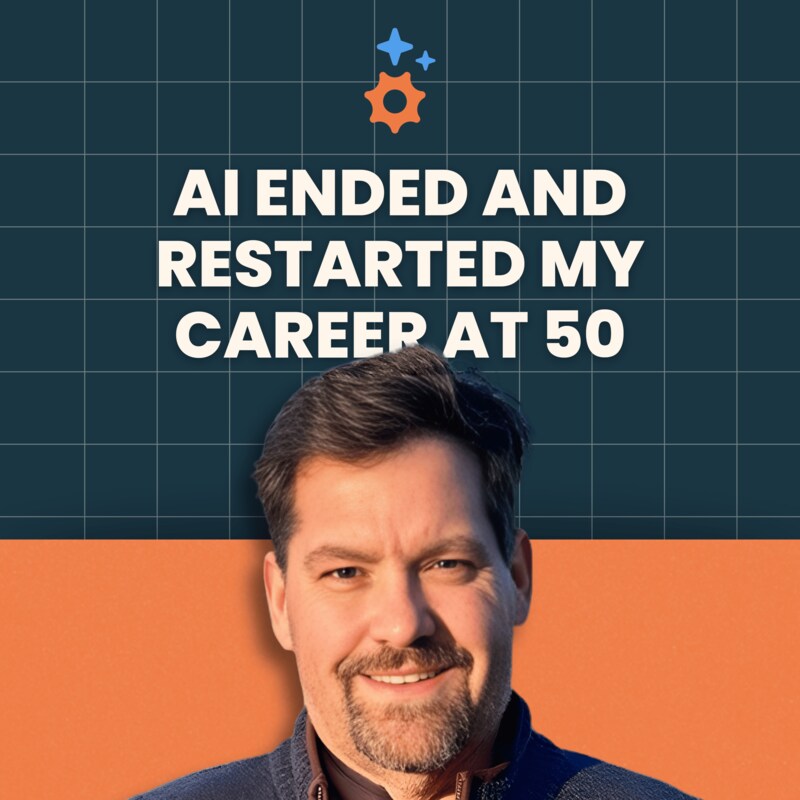
In this episode of Builder Stories, Tom Elliott shares the moment AI forced him to confront a terrifying truth. At 50 years old, after spending over a decade building a successful software consulting business, he watched an AI demo that made him physically ill. The machine could do most of what he had built his career on, faster and better.
What followed was not retreat, but reinvention.
Tom walks through the fear, the identity shock, and the decision to either master AI or walk away from knowledge work entirely. He explains how a single month of intense curiosity and hands-on learning flipped his mindset from panic to possibility, and how he went from marketing leader to building agents, voice AI, and production workflows without a traditional engineering background.
This is not a story about hype or shortcuts. It is a story about relevance, agency, and what it really takes to reinvent yourself in the age of AI.
If you have ever wondered whether you are falling behind, or whether it is too late to adapt, this conversation will feel uncomfortably familiar and deeply hopeful.
Learn more and connect with Tom Elliott:
- Connect with Tom on LinkedIn: https://www.linkedin.com/in/tomelliottnh/
- Learn more about Nutum: https://nutum.ai/
Transcripts
If I have any skills, if people think well of me for anything that I can do, I just watch that machine do it better than me in seconds.
::I am screwed.
::I'm 50 years old.
::I'm A liberal arts guy.
::I can't code.
::I can do a lot of different things pretty well.
::That machine can do everything I can do better.
::Met a guy who had been at McKinsey that had left to go to work for Microsoft to work on AI.
::And I said, look, you know, I'm 50 years old.
::I suspect a lot of the partners at McKinsey that you know are about my age.
::I said, what do they think about this?
::And he said, they're scared to death of them.
::The bad news is I have to reboot here and I got to learn.
::Like I got to go back to school, not literally like in an institution, but I've got to spend some time figuring this stuff out or else I'm going to have to be a locksmith and that might go away too.
::Like this is existential for us as a family.
::I got to spend some time doing it.
::Today's guest, Tom Elliott, is going to walk us through his journey and tell his story about how he went through this.
::Everything from running a successful software company to realizing, oh my gosh, this isn't going to make it.
::We're going to have to shut down shop and I'm going to have to figure out what is next.
::This is a great story.
::It's A vulnerable story that he's sharing.
::And I think something that we're all in some part of this journey going through it.
::And it's something I think everybody can relate to because AI is everywhere.
::People are all talking about it.
::But how do we deal with it?
::And how does this play out?
::And is there a light at the end of the tunnel?
::And 2, if you like this kind of content, if you're getting something from this, do me a favor.
::Give that little subscribe button a tickle.
::Give the thumbs up a little pound.
::And with that, let's get to this episode of Prompted by Agent AI.
::So Tom, you were telling me a story kind of as we were talking about this in prep, about how you had this moment at a conference from, you working at your company, Left Hook, and this realization happened.
::Like, tell us a little bit about that.
::Yeah, so Left Hook is an agency, a software development partner that started in about 10 years ago.
::And my partner and I had big dreams of making it a software company.
::of doing this classic, but also quite challenging arc of selling services, learning, figuring out what to build, and then eventually building it.
::And we were on that path for a long time.
::And in fact, it released our first product and seemed to be on a trajectory towards becoming the valuable software company that I always wanted it to be.
::And then it just went away.
::It just, the bottom fell out.
::And I can't get into details of specific client engagements,
::But there was a moment somewhere in, I'll say the spring or early summer of 2023, when some of our biggest clients effectively said, we don't need you anymore.
::We don't need to buy dev hours from you anymore.
::Thanks, you guys did some good work, but we figured out how to do this internally.
::And the words AI were never uttered, but it started to become clear that Agentic
::the coding tools, the cursors and replicate things, had started to eat away at the special expertise that our team had honed over the years.
::And the advantage that we had being expert in a very niche area, which was API integrations for SaaS products, it stopped being a niche expertise.
::It became something that was in the training data of these large language models.
::And
::None of our major clients said, hey, look, we replaced you with AI.
::It was more couched in, thanks for pioneering how to do that thing for us.
::We got it from here.
::My belief is that the niche expertise that made us worth, you know, $200 an hour as developers, it just stopped being so valuable because something else replaced it.
::And I think we've seen that.
::And Left Hook's still going strong for my partner, but it is no longer a 8, 10-person business.
::It's now a couple of people who are doing great with it, but the business really right-sized to the age of AI.
::Here's the problem for me.
::I wasn't the developer.
::I was the only non-developer in the business.
::I'm A marketer.
::I'm a business strategist.
::I'm A communicator.
::I'm A left-handed history major.
::At that point, I was not doing any development and no one would have trusted any of the code that I would have written.
::That might have changed since.
::But at the time, there wasn't a lot of reason for the business to need me.
::So one of the other things that's clearly happening is that the product that we had built made it easier to develop integrations between SaaS companies, you know, HubSpot to FreshBooks.
::We actually built their app.
::It's in the HubSpot app marketplace.
::And we've rebuilt it in
::worked on it over time.
::But all of the specialized knowledge that comes with spending a decade plus building and learning the SDKs and APIs and the nuances of HubSpot and the nuances of FreshBooks and all that, that's now just a prompt, right?
::And I don't mean to diminish it too much, but it's just far less valuable because this world around us changed.
::So
::In the fall of 23, I'd actually been recovering from a broken leg.
::I broke my leg skiing that spring.
::And, the summer of 2023 was rough as the business started to struggle and we lost some contracts.
::And I was just getting back to hiking after not being able to walk, for much of the spring.
::So I went for a long walk, actually the first hike I'd had after breaking my leg.
::And, you know, I just sat down next to a gorgeous 300-year-old tree and said,
::This is not going to work for me anymore.
::I got to find something else.
::So what was that like?
::Were you upset, anger, fear, and denial that this thing didn't work out?
::Like, talk a little bit about that feeling because a lot of people are feeling what you felt, right?
::So there was a, we'll call it like an eight-week process from August 2023, we had to let go a bunch of our people.
::Not that we were winding the business down, we had to right-size it to the contracts we had.
::And so I had this sort of intense period of doing that.
::Then I had my walk in the woods, sort of an intense self-reflection on this is probably not going to sustain me.
::I hadn't been able to pay myself for many weeks, which as a business owner is just a reality, right?
::My partner and I were putting what little money we had coming in the door to feed the families of the people that were relying on us.
::But you can only do that for so long.
::And so the reflection I had was this business can't afford me anymore.
::I think AI is the cause.
::And I don't know anything about AI, really, or not enough.
::This thing that just drank my milkshake, I wasn't afraid of it, but I was not in any way, you know, it hadn't got my hands in the dirt of it.
::And so I exited the business as a day-to-day operator, mostly so that the, you know, the dollars that were there could go to support my partner and the guys actually writing code.
::And I took some time off and said, I've got to go figure out what's next.
::And I've got a lot of learning to do, which at 50 years old, never been scary for me, but it is a little exhausting, right?
::I got a wife and mortgages and kids to look at your wife and say, like, I think I got to invest after all these years of investing in the business.
::Now I got to invest in sort of rebooting myself and learning what I don't know, which I
::I just didn't have time when I was operating a small business to tinker, to build agents, to really get inside this AI stuff.
::So that fall, I think it was early October, I went to a conference.
::I got invited to go down to a conference in North Carolina with a company called Pendo.
::And I hadn't spent a lot of time understanding what was going to happen there until I got there.
::And I got the nice pretty
::brochure and I opened it up and I was presented with the fact that most of the conference was actually about AI.
::That's all anybody wants to talk about everything right now.
::Yeah.
::I shouldn't have been surprised, but I was.
::And I said, okay, well, here's my opportunity.
::I've been putting it off.
::Enough podcasts listening.
::Let me actually go, you know, listen to some smart people.
::So the first session that I went to was this guy, Ethan Malik, which is, you know, I think a lot of people know about Ethan now, but at the time he was just
::about to release a book about AI, co-intelligence.
::He was becoming a sort of a LinkedIn darling talking about, hey, this stuff is real.
::He's a professor at University of Pennsylvania.
::And so I was in an auditorium with 700 plus people and
::He was talking about AI, which was a lot like listening to podcasts.
::And I'm going, yeah, it's coming.
::That's interesting.
::And then he said, let me demo some things that I've been doing with this that are going to blow your mind.
::And I don't, maybe he has access to earlier models than the general public.
::I'm not sure.
::And he started showing use cases of people, I'll say, solving business problems, thinking through business problems, thinking through how to write a job description, thinking through how to
::build a workflow that gets your ads launched.
::And I'm in this dark auditorium in Raleigh, North Carolina, and it hit me like a punch in the face.
::It was like, this machine that this guy is showing me live on stage can do most of what I have spent my career learning how to do.
::If I have any skills, if people think well of me for anything that I can do,
::I just watched that machine do it better than me in seconds.
::I am screwed.
::I'm 50 years old.
::I'm a liberal arts guy.
::I can't code.
::I can do a lot of different things pretty well.
::That machine can do everything I can do better.
::And I had to leave.
::I got up and left the autorum and I went to this little side hallway and I just started dry heaving.
::I mean, I really thought I was going to throw up or pass out because
::all of the fears of having just kind of lost my place in my business and watching, I suspected AI drink that milkshake, and then to come down to North Carolina and finally have to confront the fact that these machines already were as good or better than I am and we're only going to get better.
::It was just too much.
::I got kids to put through college and it just.
::I got a mortgage.
::I've got a family depending on me and like, oh my gosh, how am I going to keep doing this?
::Because this thing can do 80% or all better and instantaneously.
::It was a really rough moment.
::Now,
::The recovery began almost immediately.
::I actually talked to my wife.
::The other probably just a shocking thing that happened at that conference is I met a guy who had been at McKinsey that had left to go to work for Microsoft to work on AI.
::Young guy, really pretty smart guy.
::He gave a talk.
::And I met him in the hallway and I said, look, you know, I'm 50 years old.
::I suspect a lot of the partners at McKinsey that you know are about my age, kind of similar background, liberal arts guys, pretty good, pretty smart this, you know, good writer, good thinker, blah, blah, blah.
::I said, what do they think about this?
::And he said, they're scared to death of it.
::McKinsey, like the smartest people are.
::Yeah.
::And again, this was over 2 years ago.
::So I'm sure some of them have adapted as well.
::But in the moment, they don't know what to do with their careers either.
::Like you're not alone.
::I said, okay, all right.
::I said, so when this technology gets to where it clearly is headed, what are guys like me or what are McKinsey partners going to do?
::And he kind of took a breath and he looked up in the sky for a minute and he looked at me and said, I don't think AI is ever going to learn how to play golf.
::I'm sitting there thinking, wait a minute, that is, it's not how he thought about me, but it was a reflection of how technologists who understood what was coming with AI were thinking about the role of formerly C-level, formerly, you know, high professional, 30 plus year veterans.
::Well, at least they can still take
::clients out to lunch or to play golf.
::And it really, that was like a one-two punch.
::It was like the Moloch talk was the left hook and the guy with McKinsey was, just knocked me down.
::And just to get to the end of that story, I finished the conference, I got home, I said to my wife, I'm sorry, you've been putting up with a decade plus of me being an entrepreneur and often not being able to pay myself and going through that journey.
::The bad news is I have to reboot here and I got to learn.
::Like I got to go back to school, not literally like in an institution, but I've got to spend some time figuring this stuff out or else I'm going to have to be a locksmith.
::And that might go away too.
::Like this is existential for us as a family.
::I got to spend some time doing it.
::And interestingly, my wife, who's not a technologist, she works for a nonprofit.
::She had been using AI far more than I had
::Through this whole period, she had a Pi account early on and she got co-work or got her job to turn on copilot, in Microsoft land.
::And she actually knew more than I do, which is really funny.
::Here I am running a software company.
::I'm A technologist, but it's just a person trying to do her job in 35 hours a week that she gets paid for.
::She's like, I need to write this thing.
::This thing will help me write it.
::I'm going to go do it.
::So she was actually ahead of me and she kind of nodded and said, yeah, you
::you need to go learn this stuff, which is hilarious, right?
::She couldn't spell API, but she knew that she knew more about how to prompt a bot than I did.
::So anyway, me and my laptop went to Starbucks and I just dove in so intensely for about a month.
::I tried all the different major tools and I had gone from dry heaving in the hallway to, oh my God, this is the most incredible opportunity for me and my skills and my curiosity.
::and my ability to think through problems and ask questions, I couldn't be more excited about my career now.
::And that took about a month of diving in deep.
::That's a big flip right there.
::But I mean, yes, it's a month of uncertainty and confusion and like, oh my gosh, I've got to go back and do this.
::But
::I think for anybody listening to that, like that's not a horrible timeline, right?
::Of like this transition really starting to take place for people.
::It's incredible how fast you can, you know, turn yourself around when it's existential, when it's, you know, pay your mortgage time, when it's like, you've only got, you know, 15, 20 years of working left, you got to make yourself relevant in this economy.
::And I was lucky to have the resources to not have to do much besides sitting at Starbucks
::learning this stuff.
::There are a lot of people who won't have that opportunity, and I very much appreciate.
::I'm glad that I had, but I didn't have six months.
::I needed to figure that out quickly.
::And I was highly motivated in part from fear, right?
::Like I once heard a guy on a podcast say something that stuck with me, which is, you know, you look at all the great leaders and founders of companies, and he said, you know, each one of them,
::They all look like they're running toward something, but they're also all running away from something.
::I just think that's really insightful.
::And in that moment, I was running away from the real, real threat that I was about to become useless in the economy.
::I was running toward, hey, I think if I can just learn how to manipulate and use these things, I probably can create a lot of value because.
::We'll talk about a little bit like that moment, that month time, like
::What surprised you most as you were kind of picking up and learning all this, but also like what misconceptions or what were you completely wrong about as well?
::like pace out a little bit for people because a lot of people are going to go through that and they're like, what to expect and what to like, you're going to be wrong about this.
::When your awareness of LLMs and AI is largely derived from listening to podcasts, and I listen to a lot of different podcasts,
::It bifurcates into two camps, generally.
::One is the maximalists who think this is the greatest thing ever.
::It's going to change the world, who start to sound a little hypey.
::And then there's, of course, there's the countermeasure, the extreme position, which is this is just an autocomplete and it's not really capable of doing real work and it's all overblown.
::And so what surprised me was how quickly I could find a middle ground where, and again, we're talking October, 2023,
::I found a middle ground where I was able to deliver on use cases for myself.
::I wasn't working for any clients or business at this point, where the output was practical and useful in the moment.
::It wasn't science fiction, super hype, but it also wasn't garbage.
::That's what surprised me the most.
::So what took me by surprise was how quickly I could build a process or start doing stuff.
::and trust the output and feel like, what?
::I think that might actually be good work there.
::This isn't just science fiction.
::Yeah.
::Well, okay.
::So go through this month, you go through this period, like, when did you start feeling like, all right, there's something here I can do something with, right?
::I am now back ahead.
::I don't feel behind.
::And there's something I can sell.
::There's something I can provide value.
::You know, the way I think about it personally is like, you're the editor and not the
::the journalist right now, like if you use a newspaper analogy, you're not writing at all, or you're not coding at all, but you're code reviewing it.
::You're testing, you know, you're sitting on top of that as kind of the manager, not the individual contributor.
::Like talk about like that transition and like when you felt like your head like, all right, there's something I could do with this now.
::The first application of AI for a client that made sense to me is I had a friend who was running this community and
::I had stumbled upon a tool that promised to make it easy and no code easy to take a whole bunch of knowledge, reason against it in a chatbot, and let you create a custom GPT.
::I got it to the point where you could chat with this body of knowledge that had been accumulated by humans for 10 years, thousands and thousands of posts, and it was incredibly valuable to
::get to the heart of these, it was actually a community that dealt with human resource issues.
::And, to be able to query the bright minds of your industry and get near instant answers that were really synthesized and well thought through, that was like a, wow, I built that.
::was easy.
::Now, built, I'm going to put that in air quotes, like I uploaded docs that became, you know, that got ragged against them and became, you know, a vector database.
::I wrote a system prompt, which I'd probably laugh at if I saw it now, but I stumbled into some advice somewhere that said, the best way to write a prompt is to ask the LLM how it wants you to prompt it.
::Yeah, I found that super helpful too.
::Obviously, the meta-prompting is, I think Dharmesh coined at Inbound last year.
::He gave a great talk about that.
::So about a year ago is when I figured out this meta-prompting thing.
::And
::Wow, that is such an aha moment when you go to Gemini and you say, hey, Gemini, I need you to do work and I'm going to give you this input and I need you to reason against it and I need you to give me good output.
::How do you want me to ask you to do that work?
::And it's one of those things where like once you learn how to do it, it's so obvious because it's not too different from managing people, right?
::Like how do you want to be, not that every employee gets to tell their boss how they want to be managed, but good bosses do
::have some dialogue to say, look, you've got a job to do and you're going to do it or you're gone.
::But at the very least, let me understand how you want to be prompted.
::And of course, when it comes to the LLM, it's not thinking about its feelings and the fact that it doesn't like to work before 10 A.m.
::and that it needs 2 cups of coffee before it.
::Doesn't need a please or a thank you at all.
::Well, that's interesting too.
::I used to say please and thank you in my prompts.
::And I still do.
::I still do.
::That's A Southerner.
::In the event this does turn out to be a Terminator, I want it to come after me last because at least it remembers I had some sort of manners.
::I'm not afraid to admit that at all.
::That's just not Southern hospitality and charm.
::That's actually a strategy to prevent.
::A little bit of both.
::Yeah, it's a little bit of both.
::Well, as a New Englander, I do have Southern family and some wild Southern roots, but as a New Englander,
::It didn't take me long to be like, I'm just going to tell this thing what I want.
::But asking it what it wants, saying, I'm going to send you repeatedly this work and ask you to do it.
::How do I get the best out of you?
::Such an insight for me.
::And it's probably fairly obvious.
::Here we are in 2026, but a year ago, it was not obvious.
::You didn't see a lot of people talking about it.
::You went through it before I did, because I get it was a conversation I had for this podcast actually with Errol.
::where he was talking about a sales agent he built, he was telling me about that.
::And I'm like, that seems obvious.
::Why didn't I think about doing that?
::So I would take the prompts that I'd pretty really used, like, hey, if I'm trying to one-shot this, what clarification and things do you need to know to make sure that you have all the right answers to give this to me in a clear, concise way?
::And we'd go back and forth a little bit.
::And then it gave me this thing.
::And to your point, it was like, oh, that's an unlock.
::Let me ask you this, though.
::Like,
::One of the biggest fears people have, and I know I have some of the skepticism too, is like, as much as you're communicating and engaging with these things, how do you handle the hallucination of possibility, right?
::Like, all right, you asked who won the World Cup this year.
::How do you trust with 100% certainty that what's giving you back is correct?
::Or do you have some sort of double checks in place?
::Or do you keep your inquiries more of like, well, this is at the end of the world if this isn't right, if it's directionally correct?
::Walk us through that a little bit.
::One way to look at the hallucination problem is to say, these things are directionally correct.
::They're correct 80% of the time, headed to 90, eventually will be 95, probably and never 100.
::And so over the course of a whole day, a whole career of using them, you just bake in the possibility that what you're doing might be wrong, a meaningful but ever diminishing percentage of the time.
::So it's like an error rate, like
::you're going to show up and try to hit the baseball.
::in baseball, if you fail 7 out of 10 times, you're an all-star.
::Flip it around.
::Let's say the LLM gets it right 80% of the time, you're an all-star.
::That's one way to look at it.
::The second sort of solution or way to think about it, at least the way I think about it, is having LLMs check LLMs is really valuable.
::So it's very much a test and iterate.
::I'm going to write this prompt.
::I'm going to see what its response is.
::Then I'm going to go to a different LLM and say, hey, Gemini just told me this.
::What do you think?
::And then start to triangulate.
::Not unlike how we try to teach our kids to navigate the media landscape.
::You know, like you hear this story on Instagram, and then you hear this story on Fox News, and then you hear this story on CNN.
::How do you triangulate that and try to get to some version of the truth that makes sense to you?
::So there's sort of a triangulation effect with playing one LLM against the other.
::And then the third, I think, is I am not afraid to spend the most for the best models, because most of what I do is at fairly low volume.
::So I don't have the problem that somebody running an enterprise agent that's got to run 1000 times an hour has to really think through this, who might choose to use a lower cost.
::I hope to get there in my career and have to make those decisions.
::But at this point, for most of the stuff that I'm doing, I can afford the best models, and they're just wrong less.
::Let's get a little bit deeper there, right?
::Because you started this journey as like, sure, a technologist, but marketer, salesperson.
::And now like, I've heard you mention it, APIs, I heard you mention Python scripts, and you know, now we're talking deep coding.
::Like, I know this from kind of the pre-talk, like you've full gone into vibe coding now over this 18-month, two-year transition.
::Like, did you ever see yourself getting here, you know, especially this quickly?
::Well, I was not, having run a company full of true, committed,
::professional software engineers, I'm not going to give myself that title anytime soon.
::What I'm doing though is trying to understand where the limits are of vibe coding are for actually building useful stuff.
::And you know, you hear lots of conversations about this.
::Jason Lemkin had an incredible experience with Replit that became quite well known where it threw out his whole database and really kind of screwed, but he's back to using it.
::I think what's
::What's very clear is that we're on a trajectory, course and speed, where you can trust LLMs to produce code that will result in production-ready stuff.
::There was a point last summer when I was doing a lot of agent building on agent.ai, where my candid feedback to the team was, this is cool.
::It's a good environment to learn.
::I can't imagine anybody's going to build their business around these.
::Like, there's just too much risk, right?
::Totally different six months later.
::And I'm sure the team there is seeing that.
::The adoption of it as I'm going to embed this into a mission critical workflow that my business depends on.
::It's six months ago.
::That was a risky proposition.
::And I don't think anybody would say that anymore.
::It's happening that fast.
::I think that's definitely been a big switch I've seen in here with a lot of people is 2025 was, and we saw the MIT study, right?
::Like 95% of the tests and trials failed.
::But that was a year of experiment.
::Like learn, failing is okay, and quite honestly, the preferred output, right?
::Like you fail, you learn more when you fail.
::And now we're seeing 2026, and it sounds like you're seeing this too, is like, right now we tried all these things.
::We know what works and what doesn't work.
::We know how these things, what they're good at and what they're not.
::Now we can start like hitting singles, successfully and doing productive stuff and getting out there.
::It sounds like you're feeling a lot of that too.
::Yeah, in the moment, sort of the inflection point moment for me is when I joined my current company, I'm working for a company called Rescue Health, which is a technology-driven entrepreneurial venture in the healthcare space, particularly with the teaching and administration of CPR.
::And so we have a business where we have healthcare professionals
::who interact with no instructor.
::They basically recertify themselves on CPR.
::Some people learn CPR for the first time this way, but mostly it's healthcare professionals recertifying.
::And all of the customer engagement is handled by agents now that have either been built or tweaked by me.
::And so last fall, I decided to dive in and build a voice agent, we call her Molly,
::who handles quite a complex user experience to let people into the building.
::So to achieve their CPR certification, they have to show up at a building, let themselves in.
::Sometimes they have to go to a second door with another code and then get in and start this process.
::But the goal was to have them have that entire user experience happen without any of us having to talk to them by phone, right?
::To scale voice agents in particular
::to handle all that customer service.
::And when I started last August, improving that experience, there was still hallucination, there was still, edge cases where she got confused.
::For example, she was giving out the door codes very prematurely before we even knew if somebody was a customer.
::There wasn't a huge risk to it, but it was inappropriate, right?
::Like, why would you tell somebody who hasn't been a customer yet how to get into the building?
::And so going through that constant iterative system prompting to get down to where every single phone call she gets right now, when it comes to when to send the codes and how to answer their questions, how to pull from a knowledge base.
::We have a very tight, you know, like four-page Google Doc that has the answers to their questions.
::I had enough time to be around so many customer interactions that the limited set, you know, the 80-20 rule, the 80% of the cases,
::that people were calling about, she now answers really well.
::And at this point, really, since I'll say mid-November, she handles several dozen phone calls a day that I don't even bother reading the transcripts anymore.
::I used to obsess over them.
::I used to wait for a call and, oh, oh, she misspoke there, or she didn't do what she was supposed to do there.
::Let me go back and system prompt that.
::And at this point, you know, we have truly automated
::voice customer support.
::And only rarely do I have to read a transcript and go, oh, okay, she's never seen that before.
::I get to teach her that.
::And that was all done without writing any code.
::That was just, you know, prompting.
::What are you most excited about now and into the future?
::You know, like, I love this, like we just talked about, like, you couldn't do that now, you can do this now.
::What's next?
::What do you see kind of coming down next now that you're kind of back on the cutting edge again?
::One thing's very clear to me is that the LLM companies
::have capability on the shelf working inside their labs that they are purposely not releasing yet because it will overwhelm humanity.
::I think Google in particular, but probably all the labs at some level, have the ability to turn on perfect, flawless brilliance via API.
::And they just
::don't think humanity's ready for it.
::So that's one thing that's clear to me.
::Any fear of a Terminator 2 moment with that, like Skynet?
::I'm not terribly worried about the Terminator Skynet scenario.
::I'm a child of the 80s.
::I love that sci-fi.
::I think it's important for somebody to be thinking about it.
::So it's not, and it's not 0 probability, but I think that's actually fairly low.
::What I'm far more worried about and where I really
::want to spend my time, I'm more worried about the humans' reaction to their increasing irrelevance in the economy.
::I think that's a problem for us already.
::Like, I think I see it in my boys' generation in their teens.
::I see it all over the economy.
::There is this impending doom, not unlike what I felt in that conference.
::of what is the point of college?
::What is the point of school?
::What's going to happen here when we all have personal, optimist robots and driverless cars and, there's no more handwork?
::What is our purpose?
::What is our meaning?
::Yeah, I think a lot about this too.
::Where I'm putting a lot of my time and where my ownership and, you know, the team that I work with at Rescue Health,
::is thinking through how we use AI to teach hand skills.
::So if you believe, as I do, that there's some period of time, maybe in the next 15 to 20 years, where having the ability to affect things with your paws while using AI to do it better is going to become valuable and important, then teaching people how to do things with their paws.
::That's a whole other conversation we could definitely get into.
::I'm certain of it.
::I think the application of this tech agentic AI toward hand skills and unlocking that for people is, I would say, it's mission critical.
::And I think it's, I think it's here or going to be here very, very soon to take ordinary people and turn them into extraordinary tradesmen, craftsmen.
::What's the best way, you know, anybody that kind of listens to this conversation and is going through some of this and
::They just want somebody to bout some ideas off or someone who's further along the path.
::What's the best way for them to kind of plug up with you and connect and kind of just have somebody to kind of chat with?
::Yeah, unfortunately, I am super busy selling my time to Rescue Health.
::But I will say the best community that I've found to help me understand this stuff and to give help like this is actually the Agent.AI community.
::So even if you don't think of yourself as a builder,
::Joining the builder community and watching and learning what's going on there, I think is highly valuable.
::I'm happy to chat too.
::I have a website at nudum.ai, which is N-U-T-U-M.
::I'll make sure that is in the show notes.
::Where I was trying to do some one-on-one consulting to teach people these skills.
::I actually built a little chat bot there that you can talk to me and learn about me.
::just a little, vanity project.
::So NUTUM.AI and Tom at Nudum.AI, I'd be happy to talk.
::Just to kind of give you the closing here, you know, anybody out there that's listening to this and, you know, like and subscribe it, leave a comment, leave some thoughts that you've had to kind of go through this journey, let us help you out.
::But in closing, any final thoughts or anything that I haven't asked you that we haven't talked about that you just want to leave everybody with as we just kind of end this one?
::There is no job on earth that cannot be enhanced or given superpowers from these AI tools.
::And so if you're listening to this podcast, you're at least curious about it.
::The best way to learn it is to jump in and do it.
::Go build an agent.
::Go figure out how to prompt an LLM.
::Don't just listen to podcasts.
::Don't do what I did for a couple of years, which is wait to see and let other people speak in my ear and tell me what I need to know.
::No, you got to go do it yourself.
::If you do, and if you're curious and you learn how to ask good questions or you're good at asking the right questions, it will feel like you put a cape on.
::It's unbelievable, the acceleration, the superpowers it gives you.
::And until you have that moment where you just feel some levitation from it, it's scary, but once you do, you won't go back.
::It is a one-way door in the future of our economy.
::your own skills.
::It's a superpower that you need to learn how to use for good.
::That's the lesson, everybody.
::Don't wait, go do it.
::And with that, we'll see you next time and keep learning and keep doing.
