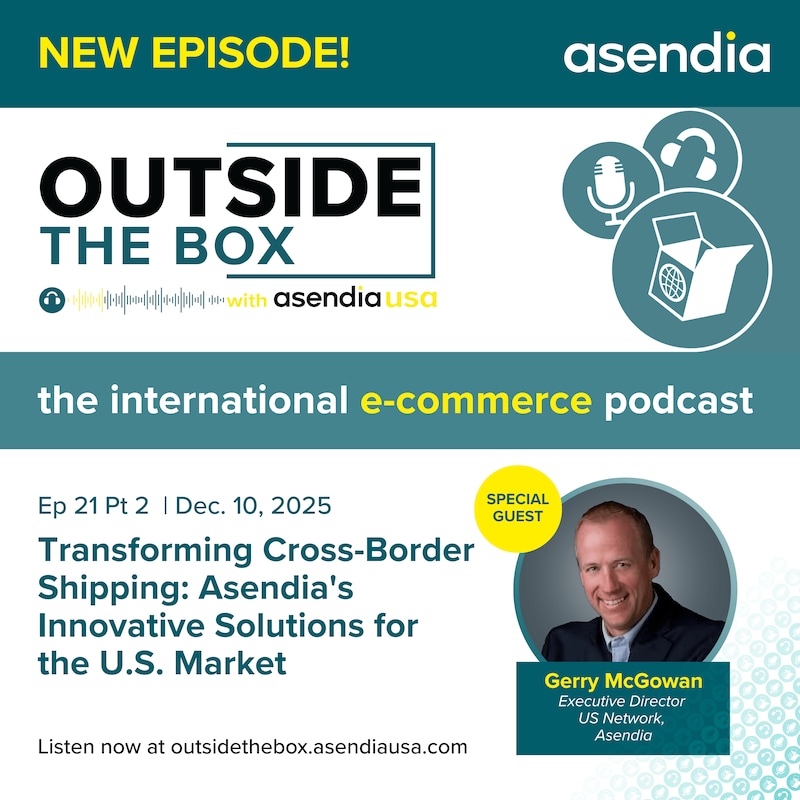
Shownotes
In Part 2 of this 2-part miniseries, our co-hosts, Jason Rowland and Nick Agnetti continued the conversation with Gerry McGowan, Executive Director US Network for Asendia, further diving into Asendia’s new domestic U.S. network, highlighting how it complements their international solutions.
This network supports inbound shipments from Asendia global subs and will soon offer U.S.-based shippers faster, flexible domestic options. Optimized for lightweight DTC parcels, it delivers seamless tracking, avoids postal bottlenecks, and enables creative solutions like zone skipping—all while keeping costs predictable. With ongoing carrier partnerships and expansion plans for 2026, Asendia is building a network that’s fast, flexible, and future-ready.
Learn more about this topic:
Learn more about this topic:
Gerry McGowan | LinkedIn
As an Executive Operations Leader with 20+ years of experience, Gerry has a background spanning supply chain, logistics, and e-commerce. He is well-versed in cost savings strategies, vendor relationship management, and strategic planning. Gerry has leveraged proven success in complex problem-solving and providing strategic solutions to drive operational optimization to global organizations.
Key Takeaways:
- The podcast provides valuable insights on the logistics industry's current dynamics and challenges.
- A critical focus of the discussion is the introduction of a new domestic shipping network.
- Listeners are educated on the significance of volume management and its impact on operations.
- The speakers emphasize the importance of adaptability in the ever-evolving logistics landscape.
- The conversation highlights the necessity of technological integration for seamless logistics operations.
- Future expansion and strategic partnerships are central themes in the logistics conversation.
Transcripts
So I mean I would love to have the problem.
I think we all would of too much volume or you know, when you're in operations you want to be running dirty because if you're not running, if you're not, if you're running clean, you're not, you're not busy, you're not productive. Right.
Voiceover:This is Outside the Box with Asendia USA a podcast educating US based brands, marketplaces and E tailers on international shipping topics and how they can expand their global e-commerce footprint.
Nick Agnetti:Back to another episode of Outside the Box with Asendia USA podcast where we continue the conversation where we left off last week.
Gerry McGowan:But so we have a. That's a huge customer sat pickup right from the beginning, you know.
Nick Agnetti:That's awesome. Okay so. And I think now I'm confident we need to just kind of just talk a little bit to listeners and viewers too.
So we've never talked about domestic on here.
Gerry McGowan:Right.
Nick Agnetti:It's always, it's always, it's always been. I, I don't know what episode this is going to be because we're at the show right now.
But I can tell you that we have never had a domestic convers nation nor a domestic focus very intentionally so because our expertise really you know, lies in the national, the cross border US based shippers Branch 3 pls shipping internationally.
Gerry McGowan:Right. So absolutely.
Nick Agnetti:So this is certainly a unique conversation and product that I think you know and just to you know.
So, so we are launching a new domestic network as we could position it as a, as a value add as well as for those that are located outside the United States shipping inbound into the US to US residents to be able to access that network as well. Very impressive.
So, so you know, do you have goal like this would be a kind of a personal goal that you must have created or potentially have created but in terms of you know, volume numbers for let's say the coming year 2026 because we're, we're, you know, 20Q3 is almost over and then we're going to be in peak before we know it. So it's hard.
Gerry McGowan:I don't, I don't necessarily have personal goals APIs for that because I'm not in the sales side. Right. But you know, without a doubt there's bottom up and top down goals, revenue and all for all the subsidiaries. Sure. World. Right.
Nick Agnetti:Yeah.
Gerry McGowan:Just like the US has their you know, goals for that. So it's really understanding. I just need to like understand because I want to be able to catch whatever's being Pitched right.
So I mean I, I would love to have the problem.
I think we all would of too much volume or, or, or you know, when you're in operations you want to be running dirty because if you're not running, if you're not, if you're running clean, you're not, you're not busy, you're not productive. Right. So obviously the, the benefit of the increased volume also allows us to do maybe more splits.
I can get more creative with maybe doing some direct ship and, and, and zone skipping things. So, so volume is a good problem. I just, I just have, hey, keep selling and I'll make sure we have enough capacity to always catch.
So their forecasts are important to me to make sure because I need to forward those forecasts to the final mile carriers so that they have the capacity to catch what we got coming from the brokers. It's not necessarily my volume projections per se.
Jason Rowland:Are the subsidiaries for Asendia, are they selling this today or is it the start date?
Gerry McGowan:Yes, I'm actually going to Shenzhen in two weeks for the CILF conference which I think is the world's largest logistics conference and they're already lining up customers to talk to, to help assist them and explain some things to customers they'll have at that. So really looking forward to that.
Nick Agnetti:Sounds good. Sounds huge.
Gerry McGowan:What.
Nick Agnetti:So one of the things I was thinking about too is just, you know, you, we didn't really talk about your history and the space and you know, and I know you have a, a long history of working in the logistics space but do you have you run into any challenges? First mile, middle mile? Like what has been some of the more uphill things that you've run into trying to create this network.
Gerry McGowan:I think the biggest challenge is just making sure all the technology flows. You know, I think you know, in the onboarding has been pretty smooth. You know, our team's good.
It's only been taken about two weeks to get a carrier up and going for the most part and but with any integration you have some, they've taken longer and you know, you know, trying to get the technology of tracking to work because there's something there.
But for the most part, you know, in all the years there's so many carriers out there right now and it really is a shipper's market right now for the first time since pre Covid, you know, the capacity's there and people are looking to, you know, fill their networks.
So it also creates, you know, an advantage as a shipper because you know, we can have them do Things that maybe they're willing to do creative and be custom solutions because yeah, we can do that, you know, because they're not as rigid, because they're, you know, there's, there's no capacity constraints right now basically, you know, so it helps that to do that.
Nick Agnetti:I think that's also interesting because I just read about three carriers that just imposed peak and surge pricing for Q4 and peak surcharges. And I mean I'm thinking really, I mean, oh, let me punish you for giving me more volume, you know what I mean? And it's just that it's bizarre to me.
Gerry McGowan:It is. I mean I could go Roy off a soapbox on that, you know, I mean especially when you've had carriers that in the past.
I'll try to keep the names out of it that were larger regionals, right? Not the small but the larger ones who like established. I mean I've been, I've been diversifying since 2008.
I caught the bug to diversify away from UPS and FedEx and I've been doing that ever since. And I've always had eight to 12 carriers I've used at any one time.
Some buildings you can only use one carrier but you know, if there was a startup out of California, I can only use them in Cal so it wouldn't be like 8 to 10 carries out of every building. But it's you know, based off my total network.
But you know what's been disappointing is some of those original regionals I used made sure they differentiated themselves from UPS and FedEx. We are not them. You know, we're going to give you a service better than them. We're going to do this.
We don't have, we have three accessorials, not 337 accessorials or whatever. But now those companies are all like, are walking and talking like UPS and FedEx.
It's disappointing because you lost what you lost, why we gave you Vime and why us as shippers liked it, you know. But now you get the newer ones coming around now they're more the gig companies, the DSP companies.
They're very simplified pricing and getting away from that and we don't have peak surcharges with that.
Nick Agnetti:Love that.
Jason Rowland:Perfect, right. So for this week here at Boston form, obviously you came here to join us today and we're, we're really thankful.
But what else brings you to a forum like this? What are some things from perspective?
Gerry McGowan:It's really making some face to face connections with people I may have just met and I've talked to, you know, so we have meetings set up with those carriers. It's also, even though we got it up and running, I'm still always looking, okay, what am I doing next year? What. How can I improve this?
If we, if we go into other gateways, how can I tap into a carrier from that gateway? I'm not. So I'm trying to make also those connections for future expansion. So it has a lot to do with that.
Jason Rowland:Yeah. Getting better and more efficient.
Gerry McGowan:Absolutely.
Nick Agnetti:Okay. So, Jerry, is there anything that you want to leave with the viewers and listeners before we cap it off?
Gerry McGowan:I, I just. Exciting time, I think, to be in logistics.
I think what's going on, I think even, even regardless of all the de minimis stuff, I mean, we were able to, we were able to handle that with no problem. I mean, so you were T86, now you're T11.
You know, there might be more payments and duties and taxes, whether the shippers, the merchants eating it or passing it on, but it was seamless in that end. I mean, if they're doing postal injection, that's where the bump in the road is right now. But we're not a postal injection.
We're coming into our network which is not postal. So there's no bump in the road coming in with. That's what we'll know if we look at the did.
Nick Agnetti:Okay.
Gerry McGowan:And our broker, who we've, our legacy broker, is also one of seven certified to do the postal injection. So we don't have to run and switch out brokers. We've already got that lined up. We've had our SOP calls, so that's all in the works right now.
So that, that, that'll work so that they can change what they want. It's going to change again, probably, but it really doesn't affect how we'll get the packages to the customer. Love it.
Nick Agnetti:All right, well, everybody, you heard it and you saw it first. Jerry's developing the best domestic network in the United States right now. So, so come 2026, let's get engaged.
We could talk domestic and, and see what we come up with. So thanks so much for joining, Jerry.
Gerry McGowan:Thank you. Thank you.
Voiceover:Share subscribe and download our podcast to learn more about today's topic or for a free consultation, email [email protected]. Come back for more insightful discussions on e-commerce, shipping to Canada, Mexico and worldwide.


