Transcripts
Welcome to Live With The Pricing Lady.
Speaker:I'm Janene, your hostess.
Speaker:This show is all about helping you build a sustainably profitable
Speaker:business while making an unbelievable impact on your world.
Speaker:Learn from my 20 years of experience and from my guests as we discuss their pricing
Speaker:challenges, failures, and successes.
Speaker:Pricing is a way of being or behaving in your business.
Speaker:My mission is to help you confidently charge for the value you deliver.
Speaker:Pricing is either hurting or helping your business.
Speaker:Let's make sure it's helping you reach your dreams.
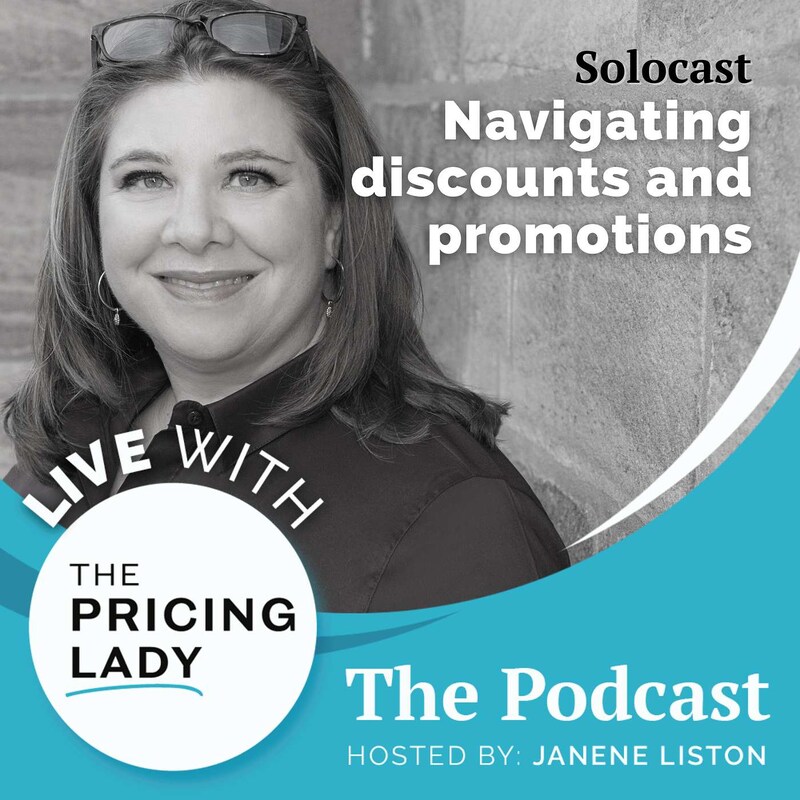
Speaker:In this episode of Live With the Pricing Lady, we're talking about
Speaker:navigating discounts and promotions, how to do it without undermining value.
Speaker:Let me ask you, last time you gave a discount, why did you do it?
Speaker:We're gonna look at that and more in this episode, so sit back, relax, and enjoy.
Speaker:Hello, and welcome to this episode of Live With the Pricing Lady.
Speaker:I am Jenny Liston, your hostess.
Speaker:This show is all about helping you build more confidence when it
Speaker:comes to pricing in your business.
Speaker:We want you to focus on value and be profitable for the long term.
Speaker:Today we're going to be taking a look at navigating discounts and promotions, how
Speaker:to do it without undermining your value.
Speaker:So let me ask you a question.
Speaker:Have you ever offered a discount just to close a deal and then regretted it?
Speaker:Yeah, I have too.
Speaker:Early on in my business, I remember very distinctly one time having a discussion
Speaker:with a client, and as we were talking, she was telling me the story about
Speaker:how her finances were so constrained and all, you know, just a real.
Speaker:Story about what was going on with her and I fell for it, if you
Speaker:will, and I offered her a discount.
Speaker:We closed the sale and then she said, okay, well I can't start for
Speaker:three more weeks because I'm going on holiday to Jamaica for a few weeks.
Speaker:And I felt like the size of an ant At that moment.
Speaker:I thought, okay, actually she probably did have the money, but the priorities were
Speaker:elsewhere and, and I sort of fell for it.
Speaker:Now, that was on me.
Speaker:But most people, at some point in time, if you are a business owner, you've
Speaker:been in this situation where you, for one reason or another, offered a
Speaker:discount and then regretted it later.
Speaker:That's okay.
Speaker:We learned from those mistakes.
Speaker:I know I did, and I'm sure you have.
Speaker:And if you haven't yet, you will soon.
Speaker:So today, why are we talking about navigating discounts and promotions?
Speaker:And I think this is really important because here's the thing.
Speaker:Discounts and promotions can be very effective tools in your business.
Speaker:However, in many small businesses, especially women-led businesses, they
Speaker:are used reactively, not strategically.
Speaker:So we do it as a reaction to some sort of discomfort in the moment.
Speaker:Or as a reaction because we see, you know, everybody else is doing it, so
Speaker:I should do it too, as opposed to it being a real strategic tool or tactic
Speaker:that you're using in your business.
Speaker:The problem with doing that is that discounts are the fastest way to
Speaker:destroy value perception, to erode your profits and to attract the wrong
Speaker:clients when they are not used properly.
Speaker:So I want you to let that sink in for a moment.
Speaker:They can be helpful tactics, but they need to be used strategically, not reactively.
Speaker:Otherwise, it leads to profit erosion, a misconception of value,
Speaker:and building the wrong client base.
Speaker:So in this episode we're gonna take a look at three common challenges.
Speaker:Actually, I think I have four, 'cause I added one at the last minute.
Speaker:So three common challenges and then three tips that will help you
Speaker:rethink your approach at the end.
Speaker:I've got a little piece of homework, if you will, for you in this
Speaker:episode, 'cause I want you to not just listen, but then think about
Speaker:it in the context of your business.
Speaker:So let's get started.
Speaker:So challenge number one is the, so these challenges are basically the challenges
Speaker:that people like you have in your business when it comes to discounting, right?
Speaker:The first one is you're discounting out of discomfort.
Speaker:Now I know a lot of my clients come to me and they are wheeling
Speaker:and dealing with discounts a lot when they feel uncomfortable.
Speaker:In fact, I remember I've had, well, I've had a few clients, but I remember
Speaker:one very in particular who would.
Speaker:Add a discount to the offer before she even had the
Speaker:conversation with the customer.
Speaker:So it was just like, 'cause you're a customer, you get a discount.
Speaker:Not something I would advise, but that was her own discomfort and she was trying
Speaker:to soften the blow for the customer.
Speaker:But that was as a result of her own discomfort around this.
Speaker:For example, if you feel awkward asking for money or you struggle with confidence
Speaker:around what you charge your rates or how much you charge for your product or a
Speaker:software, I. If you feel that awkwardness, that awkwardness can actually lead you
Speaker:to giving out unnecessary discounts, and so you offer discounts to avoid
Speaker:rejection or to even avoid feeling guilty about, you know, maybe what?
Speaker:Charging something that you feel.
Speaker:You might not pay, but maybe you're not actually in your
Speaker:own target customer group.
Speaker:Right?
Speaker:Discounting out of discomfort is definitely one of the big challenges
Speaker:that I see happening out there.
Speaker:So the second challenge I see is using promotions as a crutch to attract clients.
Speaker:Now, you might be sitting here thinking, well, Janine, isn't
Speaker:that what promotions are for Y?
Speaker:We say yin in German.
Speaker:Yes and no.
Speaker:Yin, yin, yin.
Speaker:When you're not confident about your sales and marketing and your ability to attract
Speaker:clients, you may turn to the gimmick.
Speaker:Of promotions to try and get people in.
Speaker:What's the problem with this?
Speaker:So when you're using promotions without a strategic purpose behind them, it leads
Speaker:you to attracting the wrong clients.
Speaker:Clients who are not so loyal, who buy just for the deal, not for the
Speaker:value that is being delivered through that product or service or software.
Speaker:Right.
Speaker:So using promo promotions as a crutch because your sales and marketing isn't
Speaker:effectively, or you don't feel that your sales and marketing effectively create
Speaker:demand can be a real problem because then you're not using strategic promotions.
Speaker:You're using the more out of desperation, let's say challenge number three, not
Speaker:understanding the financial impact.
Speaker:This is a biggie if you follow this podcast you know, this is one of my
Speaker:things that it's really important when you are offering discounts
Speaker:from promotions that you understand the financial impact of that.
Speaker:The challenge here is that you're not actually calculating what
Speaker:you're giving away and understanding how that impacts your business.
Speaker:What a lot of people don't realize is, you know, relatively small discounts can
Speaker:lead to you needing to have a lot more customers or clients in order to get to
Speaker:the same profit level that you were at or to reach that target that you have.
Speaker:For example, a 20% discount in some cases might require 30 to
Speaker:40% more clients just to help you.
Speaker:Just to get you to that same profit point, not even to a place of earning more.
Speaker:Now, it's going to be different in different businesses and different
Speaker:situations, but part of your job is to understand what that number is.
Speaker:So if you offer, if you lower your price by 10%, you should understand
Speaker:what that means in terms of how many more clients you need in order to hit.
Speaker:The same profit or more profit, understanding the financial
Speaker:impact is very important.
Speaker:The fourth one, the one that I snuck in here at the end, is over
Speaker:customizing offers and ad hoc discounts.
Speaker:A lot of times what people will do is they will, offer a discount
Speaker:just to get someone to say yes.
Speaker:So it's a little bit similar to the first one in terms of
Speaker:discounting out of discomfort, but sometimes it's not just discomfort.
Speaker:Sometimes it's, you know, I. Fear of losing that particular client or sale, and
Speaker:there's no strategy again behind it, and there's no consistency behind it as well.
Speaker:This is a big one I often see with service-based businesses is they end up
Speaker:giving, discounts out willy-nilly with no real strategy behind it or consistency,
Speaker:and then they end up having, 20 different clients who have 20 different prices.
Speaker:And then it gets really difficult for you to manage internally in your business.
Speaker:And you also then run the risk if customers or clients talk to each
Speaker:other of them, finding out that they have vastly different prices.
Speaker:And it was just because at that point in time, you granted a
Speaker:discount without really having a strategy or a purpose behind it.
Speaker:I actually had this recently with a client where, you know, the two, this
Speaker:person's clients were actually part of the same larger business, but they
Speaker:worked independently and they had two very different rates from my client.
Speaker:Her client was talking about it amongst themselves and then she had to go
Speaker:and deal with that awkward situation.
Speaker:So again, if you don't have a strategy, then it's hard to be consistent about
Speaker:what you're doing and you can get yourself into some difficult situations.
Speaker:So those are just a few of the challenges.
Speaker:What I'd like to do now is move on to a few tips for you.
Speaker:The first tip is know why before you're making an offer
Speaker:for a discount or promotion.
Speaker:You need to know your why.
Speaker:What is the intention behind this?
Speaker:I remember years ago I had a client who I was working with in
Speaker:one-to-one, and she sent me an email.
Speaker:And in the email was a list of promotions and there were probably,
Speaker:I don't know, maybe eight or 10 promotions listed in there, and
Speaker:I opened it up and looked at it.
Speaker:I was like, what the heck is this?
Speaker:We never talked about it.
Speaker:And she had promotions for all kinds of things.
Speaker:I mean, I, okay, maybe I'll be exaggerating a little bit here,
Speaker:but it was like Valentine's Day promotion, black Friday promotion,
Speaker:and the Easter promotion.
Speaker:It was just like all these different sort of disconnected.
Speaker:Reasons for offering promotions.
Speaker:She was in the health and wellness area, so I couldn't really understand
Speaker:what a Valentine's Day promotion was really going to, how that was
Speaker:going to align with her business.
Speaker:So then we had a conversation, okay, what is the intention?
Speaker:Why are you offering each of these promotions?
Speaker:And she was like, well, that's what I see other people doing.
Speaker:And to me that is not a good reason to be offering a promotion.
Speaker:So ask yourself, is this strategy?
Speaker:Is this promotion or discount?
Speaker:I'm a offering.
Speaker:Is this a strategy or is this a reaction?
Speaker:If it's a reaction, then chances are there may not be a valid
Speaker:reason to be offering that.
Speaker:You have to like think that through and understand it.
Speaker:So discounts of promotion should be used to meet a clear business
Speaker:goal, like a new launch, an early bird testing a new market, but not
Speaker:because you're unsure of the value or because you are afraid of something.
Speaker:Those are not really good reasons to be offering discounts.
Speaker:And of course.
Speaker:You know, it happens from time to time.
Speaker:What I'd like or what I'll challenge you to do is to find ways to put
Speaker:more rigor into it for yourself so that you're doing it more
Speaker:strategically as opposed to reactively.
Speaker:Tip number two, set clear rules for when and how you offer discounts or promotions.
Speaker:So discounts especially.
Speaker:Well, no, both, but I'm gonna focus on discounts for this one.
Speaker:Should be decided in advance.
Speaker:Yeah.
Speaker:So what kind are you gonna offer?
Speaker:Is it a early bird?
Speaker:Is it a loyalty?
Speaker:Is it a bundle?
Speaker:How often will you offer it?
Speaker:And what are the conditions under which you'll offer it, and are there any limits?
Speaker:These are very important things for you to have outlined for your discounts
Speaker:or promotions when there's strategic.
Speaker:I would add one more thing here, that if you're doing a promotion,
Speaker:there's usually a specific goal.
Speaker:You wanna get a certain number of sales.
Speaker:If you're a product-based business, you might wanna get rid of some inventory.
Speaker:If you're a service-based business, maybe you do it at a low time,
Speaker:you know, low a period where.
Speaker:You don't usually have a lot of work, so you're trying to
Speaker:pull work in with a promotion.
Speaker:If it's not helping you achieve that goal within a certain timeframe, then
Speaker:you shouldn't be doing it anymore, right?
Speaker:You should set up a goal around that promotion for yourself and
Speaker:make sure that you achieve that.
Speaker:And if not, then you either need to just.
Speaker:Or do away with it and try something else.
Speaker:Set clear rules for when and how you're going to do discounts and promotions.
Speaker:And I talk about this a lot with my clients as well when it comes
Speaker:to discounting services or if you know you're gonna have a negotiation
Speaker:before you even send the first offer.
Speaker:You can think about, okay, if they come back to me and
Speaker:object, what am I going to do?
Speaker:It's important to consider, not discounting, but adding something of
Speaker:value instead, or having an alternative offer for them that's at a lower price
Speaker:point, because then instead of saying, oh, I feel like I have to this offer a
Speaker:discount, you can say, well, we can take this out Or I have this alternative offer.
Speaker:Would you like me to tell you about it?
Speaker:Because it suits your budget better.
Speaker:By adding value or having offers at different value levels, you
Speaker:can actually navigate those discussions much more easily.
Speaker:Okay, tip number three.
Speaker:Because I already did tip two and tip one almost twice.
Speaker:Tip number three, build pricing confidence, so you feel less
Speaker:likely to need to offer a discount.
Speaker:Yeah.
Speaker:The more confident you feel about the prices that you offer and the better you
Speaker:understand the value of what you offer, the less likely you are going to be
Speaker:inclined to offer a discount unnecessarily or promotion when it's not needed.
Speaker:First of all, what are you gonna do to build confidence?
Speaker:You're going to know why that is the price that you're offering.
Speaker:That's very important.
Speaker:If you can't answer the question, if you meet me and I say, why are you offering
Speaker:this price and not another, and you can't answer that question confidently,
Speaker:then you need to figure out why that's the right price for your business.
Speaker:You need to understand the economic value that you bring.
Speaker:Or that your offer brings, or your product, or your service, your
Speaker:software, you need to be able to communicate that value effectively
Speaker:and practice pricing conversations.
Speaker:Those are ways that you can build your pricing confidence.
Speaker:So how do I wanna wrap this up?
Speaker:First of all, I wanna say discounts and promotions are not bad.
Speaker:However, they need to be part of a well thought out strategy, not
Speaker:just something you do because you feel uncomfortable or fearful.
Speaker:You need to understand and know the impact of that as well.
Speaker:So it needs to be part of a strategy, but you need to have also thought
Speaker:of and, and understood the impact.
Speaker:So I said at the beginning, I'd have a little challenge for you,
Speaker:a little homework for you here.
Speaker:And here's what I suggest you do.
Speaker:I invite you to do.
Speaker:Yeah.
Speaker:And that is to think about the last three discounts that you offered.
Speaker:If you don't do discounts, you do promotions, you can do the same thing.
Speaker:Think about the last three discounts you offered and then do three things.
Speaker:One, ask yourself, why did I do it?
Speaker:So was this strategy or was it reaction?
Speaker:Yeah.
Speaker:So why did you offer it?
Speaker:Was it strategy or reaction?
Speaker:And what could you have done differently that would help you hold the value?
Speaker:Remember that discounts and promotions should be profitable, purposeful, and
Speaker:aligned with the value that you deliver.
Speaker:That's what I wanted to share with you today.
Speaker:I wish you all the best.
Speaker:Please head on over to the pricing lady.com/set my prices because
Speaker:the next cohort of the Fair Price formula is coming up soon.
Speaker:And if you wanna understand how to set prices you can truly believe in, then you
Speaker:are going to join me for that program.
Speaker:All the wish, you all the best.
Speaker:Have a great day and as always, enjoy pricing.
Speaker:Thank you for listening to this episode of Live with The Pricing Lady, the podcast.
Speaker:If you enjoyed the episode, rate, review, and subscribe to it, then share
Speaker:it with your friends and colleagues.
Speaker:I love hearing back from you listeners.
Speaker:If you've got comments, questions, or topic ideas, go on over to thepricinglady.
Speaker:com and contact me there.
Speaker:Not sure where to start when it comes to improving pricing and profits?
Speaker:At ThePricingLady.
Speaker:com you can download a copy of my Self Assessment Pricing Scorecard.
Speaker:Find out where it's going well and where you can begin improving.
Speaker:Or just simply book a discovery call with me.
Speaker:There we can discuss what's up with pricing in your business and
Speaker:how I might be able to help you.
Speaker:Thanks once again for joining.
Speaker:Remember, pricing can hurt or help your business.
Speaker:Let's make sure it's helping you reach your dreams.
Speaker:See you next time and as always, enjoy pricing.