Shownotes
Summary
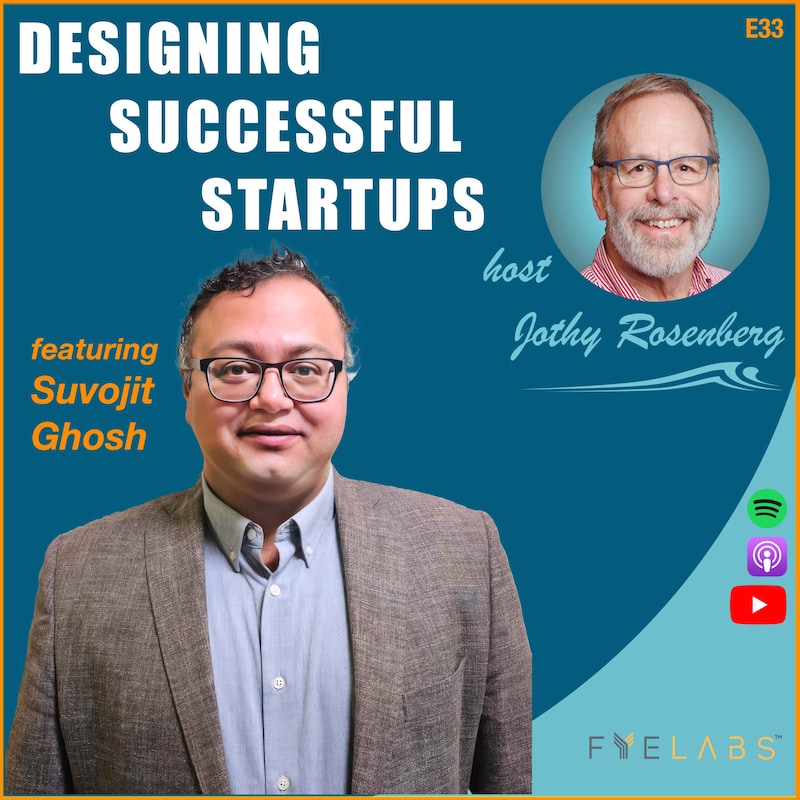
Suvojit Ghosh, founder of FYELABS, discusses his product development shop that is purpose-built for startups. FYELABS offers development services under fixed price and fixed timeline contracts, making the development process more predictable for startups. Ghosh emphasizes the importance of the customer in the startup journey and the need to solve a problem that customers are willing to pay for. He also shares insights on outsourcing product development, the concept of ultra-lean product development, and the importance of passion and grit in entrepreneurship.
Takeaways
- FYELABS is a product development shop that offers development services under fixed price and fixed timeline contracts, making the development process more predictable for startups.
- The customer is the most important element of a startup. Having a paying customer who is willing to pay for the solution to a problem is crucial for success.
- Outsourcing product development can be a cost-effective option for startups, especially for complex products that require diverse skill sets.
- Ultra-lean product development involves building only the bare minimum required to go to market or test the concept, using open source software and knowledge, and minimizing costs.
- Passion and grit are essential qualities for startup founders, as they drive the motivation to overcome challenges and make a positive impact on the world.
Sound Bites
"I wanted to create this service as one that derisks that product development piece for startups that are attempting a complex product."
"If you have a paying customer who's going to pay you to solve a problem that you have identified and you can solve that problem at a price point that they're going to pay you for and you can have a healthy margin, everything else falls into place."
"Ultra-lean is a component of a couple different things. So, number one is what I was just describing to you, is like build only the bare bones of what's required to go to market or test out the concept, nothing more.”
Links
Suvojit Ghosh’s FYELABS: https://fyelabs.com/
Please leave us a review: https://podchaser.com/DesigningSuccessfulStartups
Tech Startup Toolkit: https://www.manning.com/books/tech-startup-toolkit
Jothy’s website: https://jothyrosenberg.com
Who Says I Can’t Foundation: https://whosaysicant.org
Jothy’s TEDx talk: https://www.youtube.com/watch?v=PNtOawXAx5A
Chapters
00:00 Introduction and Weather Talk
02:10 Purpose and Services of Phi Labs
05:06 Derisking Product Development for Startups
07:50 Handling Changes and Delivering Products
09:59 Scaling Production and Manufacturing
15:38 Guiding Startups in Product Development
17:49 Assessing the Innovation and Feasibility of Startups
20:10 Outsourcing vs. In-House Product Development
25:42 Ownership and Patents in Product Development
29:21 The Role of Grit and Passion in Entrepreneurship
34:29 Closing Remarks and Contact Information
Transcripts
And here is
Suvojit Ghosh (:Hello.
Jothy Rosenberg (:Hello, I'm very glad to be talking to you. I hope it's not as hot up there in Canada as it is down here in the East Coast.
Suvojit Ghosh (:We have had a few hot days. Today seems to be overcast and raining a bit, so it's not very hot. It's about, I think, low 20s and Celsius.
Jothy Rosenberg (:Good, good. This is gonna be a really hot one for us. 93 Fahrenheit with a real feel of over 100.
Suvojit Ghosh (:my god, that's the kind of temperatures I don't step outside.
Jothy Rosenberg (:Yeah, yeah, exactly. Well, speaking of stepping outside, I always like to start with where are you originally from and where do you live
Suvojit Ghosh (:So I was born in a city called Calcutta, which is now called Kolkata in India. And that was a long, long time ago, as you can probably tell from my gray hair. And now I live in a town called Hamilton, Ontario. It's right at the western tip of Lake Ontario, about 45 minutes from Toronto.
Jothy Rosenberg (:Okay. Well, where you're originally from, I think is a pretty hot place.
Suvojit Ghosh (:It is a very hot and humid place, but it has gotten a lot hotter since I left from what I see.
Jothy Rosenberg (:how often do you get
Suvojit Ghosh (:Not a lot. I don't really have much family there anymore, I'd say once every five years or so on an average. I wish I could go back more.
Jothy Rosenberg (:Yeah. Yeah, it's heck of a long trip.
Suvojit Ghosh (:Yeah.
Jothy Rosenberg (:All right, so let's talk about the labs that you started called its Phi Labs.
So tell us why you started it and in the process, of course, you'll tell us what it does.
Suvojit Ghosh (:Yep. So I think let me start by what it does because that would set the context. So Firelabs is a product development shop that is purpose -built for startups, early -stage startups and founders. The way we operate is if you're trying to build a product that you can't or don't want to do yourself, as know, founders have a million things to do, we derisk the development process for you, meaning that if you can paint a picture of what you need,
even if it's part of a product, all of a product, making changes to a product, we offer development of that under a fixed price and fixed timeline contract. So it becomes very predictable for our customers to work with us, which was not the norm before we came on the scene. There are a lot of freelancers and quite a few other outsourcing service providers in the world, but they tend to work on either a time and materials like an hourly or weekly
arted a second company around:As the technical founder, always struggled in product development because I couldn't afford a full -fledged team in -house. I had to outsource parts of it because in products like this, need five different people with five different skill sets to collaborate and make a product. And in doing so, when I was outsourcing, I would work with some offshore firms, some local freelancers, and so on and so forth.
The business model was always based on billable hours or billable weeks. And there was not a lot of collaboration happening between people contributing various aspects of technology to the product. Because they're located in different parts of the world, they spoke different languages, came from different cultures, et cetera. So when I exited my last startup, I was trying with the idea of what can I do next? How can I be the most useful to humanity as an individual? And that's
Suvojit Ghosh (:when the idea of Philabs came up, it's more of a, like I know thousands of other founders who are going through the same struggles. And so I wanted to create this service as one that derists that product development piece for startups that are attempting a complex product. That's pretty much how Philabs got started. When I started, it was just,
me and two of my co -founders. didn't realize how popular it would be, but three years down the line we have 45 people on staff. We've shipped, I think, about 225 products to date. So it's been well -liked, and I'm lucky that it has.
Jothy Rosenberg (:So I have a of follow -up questions. First one is, how do you... The next product that comes along, the next startup that comes along is very likely not making something that you've had experience with before. So how do you come up with a firm fixed price and timeline without
either taking a huge amount of risk or having to pad the price and the schedule to make sure you can execute
Suvojit Ghosh (:So any startup that's coming up with a product, yes, there is a chance it has never been done before, but it's almost always built with things, things being broadly pieces of technology that have been used before. So take an example of this phone that I have in my hand right now. This is a Samsung Galaxy something
This was when it was launched, was the first time I'm sure certain technologies were used in a phone. But there are, this essentially uses a printed circuit board with several chips on them. Software in the form of Android operating system, million other apps, enclosure, glass, et cetera. So you can break it down to technologies that are well understood. That's what we do off -front. We take a challenge.
in the form of like an ultimate product, break it down into what needs to go in and how they need to work together to reach that end game. Once we've been able to do that, we have a very diversified team. can figure out how to get each one of those elements to where they need to be. Now, that being said, it's not 100 % accurate. It's not an exact science. It's still a little bit of an art.
and we often take on projects where there is a little bit of a risk but the way we can offer to do that with the fixed prices is because the risk is hedged across about 15 to 20 projects that we do in parallel. So we are more comfortable taking risks than what you would do if you were working on only one project.
Jothy Rosenberg (:And I know how startups work. And there is a really good chance after they've settled everything with you that a month later they think of something they forgot or they're still out talking to customers and they learned about something and they come to you and they say, we've got to add this one feature in.
What do you do then?
Suvojit Ghosh (:Yep, this happens more often than not. But usually we always do, like if it's a sufficiently small enough addition or modification, we just do it by making a small amendment to the contract. If it's large enough, we would do an addendum to the contract to add another additional contract for like a fixed price for that.
Jothy Rosenberg (:And then when you're all ready and then you deliver something to them, you're just delivering quantity one, right? You're just delivering one of
Suvojit Ghosh (:depends on the product. I have a saying that people may may not like sometimes is never make one of anything. I strongly recommend to our customers that make at least three. Three is a good number to have. One you can break, one you can work on, demonstrate and such, and one you have as a backup. For software projects, this doesn't
answer doesn't apply first, because software is deployed on a server somewhere or on a computer and there's copies of it, can redeploy. Hardware projects typically relate to make multiples. We have small, low volume manufacturing in -house where we can make like a hundred units of certain things, but there are certain things that we can only make one of, especially when they're large infrastructure scale projects. So yes, there are limitations there.
Jothy Rosenberg (:And then if they want, if everything has gone well and then they want to make a lot of them, they probably come back to you and have you interface to a higher volume manufacturer. Is that
Suvojit Ghosh (:Yeah, typically on the final stages of every project we would do what's called DFMA or Design for Manufacturing and Assembly. So we would design it in a way where it's easily and cost effectively manufacturable. And in the process also get codes from at least two contract manufacturers that can deliver the finished product. Not always possible to get at least two, but that's always our choice is to have a fully redundant supply chain.
each component used in that product is available from two different manufacturers slash suppliers slash vendors so that something happens to one of them, there's always a little bit of an overlap, like always a backup man. But that is not always possible. That's a preference, obviously, a strong preference. But there are certain things that are very proprietary or very unique that only one manufacturer makes
Jothy Rosenberg (:So you've had experience with your own multiple startups of your own and a lot of startups that you interact with. Based on all of that experience, what do you think is the most foundational, you know, important element of a startup?
Suvojit Ghosh (:is an excellent question because I don't think it's as universally recognized. And the answer changes from who you ask, but for me and for a lot of people I know, it's the customer. If you have a paying customer who's going to pay you to solve a problem that you have identified and you can solve that problem at a price point that they're going to pay you for and you can have a healthy margin, everything else falls into place. If you
then it becomes a problem. And I learned this hard way from my first startup. It was a liquid cooling system for high performance servers and I spent a lot more energy and agony into figuring out who would want our product and into developing the product.
Jothy Rosenberg (:Well, so do you actually ever get into a situation where you're asking the founder that's coming to you and considering having you build a product? This is relative to your comment about customer, which I agree with. But not all customers are the same. do they have a lighthouse customer? Are they working with someone that they know
really wants this and is going to help them turn it into a minimum viable product. Or are they further along and they think they've got product market fit proven. You're going to be dealing with people that are always right in this early stage of, is it a prototype? Do they have
Lighthouse customer, product market fit, you know, all of these are going to be concepts that are swirling around and for you to sort of nudge them in the right direction would be great because you're in a perfect position to do
Suvojit Ghosh (:Yeah, we do that lot. you know, one of the things we always ask our customers when we start a project for them is sufficient detail on who the end user, like who their customers are. Because we're in the business of developing products, not engineering. And there's a subtle difference between the two. Engineering is where you solve a problem that's well specified. Product is a problem that's defined more in real world terms than specifications.
So although our customers communicate to us to a certain extent what the specifications are, we always emphasize on understanding the real world context of the product. Because there's things that our customers often miss that could be a good feature. are often, more often than not, customers trying to build a feature that they don't probably need and is going to be a way overkill.
We know that all of our customers are very cost sensitive because they're in the early days. They may be raised like a few million dollars. Maybe they have a little bit of revenue, but they don't have a 10 -digit bank balance. Let's put it that way. In the course of that, we figure out who the end user is and we make recommendations as to if you're building this and you haven't quite figured out who your customer is,
why don't we instead of fully building it, let's just do a proof of concept that you can now go showcase to a few prospects which would cost you like a tenth of what you were about to spend. Because that way when they do that and they come back to us with the feedback, we can actually build a more robust product for them that would sell which in turn for us is repeat business because then the company succeeds and they keep coming back to us.
Jothy Rosenberg (:You're in a perfect position to give really sage advice to these startup founders. So in the work you do, term ultra -lean product development is used. What does that mean? What do you mean by
Suvojit Ghosh (:So, Ultraline is a component of a couple different things. So, number one is what I was just describing to you, is like build only the bare bones of what's required to go to market or test out the concept, nothing more. Number two is use as much open source software or algorithms or as much off the shelf components as possible. There's no point in reinventing the wheel.
Number three is use as much open source knowledge as possible that's available. Instead of trying to reinvent knowledge, we often look at online forums or dig into experience gained from other projects, which we're in a very good position to do because we do so many other projects. Assimilate all that knowledge into the team that's about to start building a project. So these three together,
kind of make your product development lower cost basically to the extent that it can't be done any lower cost than that because any startup coming to us, they're in a risky situation. They haven't yet proven their market exhaustively because they don't have a product yet. They might have a lot of that evidences that if they launch the product,
it would succeed but they haven't done it yet and unless you actually sell a product and revenue is kind of like the only source of, only way to validate a product if you know what I mean. Anything before that is to a certain extent a hypothesis.
Jothy Rosenberg (:So another thing that you could give good advice on, I think, but I'm asking that this is a question, is if their product is actually as innovative as they think it is. Because you've seen a lot of things and you may say, well, you can't obviously tell them that you've seen something just like this and you built it for somebody.
Suvojit Ghosh (:of
Jothy Rosenberg (:like three months ago, but you know, has that situation occurred where you think, this is kind of a
Suvojit Ghosh (:Typically when our customers come to us, they're a little bit more mature than to come with a copycat idea. And I love that because like the way we engage with customers and the way we procure leads, we kind of identify customers that are a little bit more mature. that doesn't mean that we have never seen this. So it does happen. not more. So there's two categories. One is like not exactly the copycat, but not necessarily as innovative or impactful as the founder might be.
thinking about and so our product managers are like the frontline facing people that train to ask very difficult questions. Knowing full well that like we're not, it might upset the customer but building a product in the startup world you can't afford to just be an yes man, you have to ask the difficult questions because otherwise the company themselves gonna fail, there's not gonna be enough funding for that.
So we do that a fair bit, like ask a difficult question, why are you doing it this way? Why does this feature have to be there? And the second category of customer prospects that we deal with sometimes, very rarely thankfully, they would have ideas that are not feasible within the realm of science and technology available. And so those are the situations where we have
unfortunately tell them the bad news like hey we can't build this this is like if we could we could be making science fiction happen in some
Jothy Rosenberg (:So you're saying that if somebody comes and asks you to build a transporter beam, you're going to say
Suvojit Ghosh (:Yes, there's basically two categories we say no to straight out, is like the equivalent of a transporter beam or a time machine or a perpetual motion machine which we have had three so far, believe it or not. And the other category is when the product is clearly intended to do harm while it
masked as something else, which has happened twice so far in our history.
Jothy Rosenberg (:that's unfortunate. So I can certainly speak from personal experience of all of my startups that there's always been a debate about outsourcing product development, doing it in -house. And one of the reasons that I have always tended to do it in -house
is because I'm trying to build the expertise around this product. And if it's hardware -based, I'm almost for sure interested in making sure it's all patentable. And so you must get in the middle of that. And I wonder what your thoughts about outsourcing to you guys.
and doing it in -house.
Suvojit Ghosh (:Right, so this is an age -old question, right? And actually, I ended up writing an article about this last Christmas while I was vacationing in Mexico, on my way to Mexico with my family, because people have been asking me all about this. And I believe it got published somewhere, too. I think it was at the Startup Boston's blogs that they published it, because I was talking to someone there at the time, and they found this to be useful.
But when you look at, like, as a founder, as you're building out your business, you look at the individual functions that you need and you have to decide what to outsource, what not to outsource. And I think there is like a rule of thumb is if this process needs to be repeated over and over and over over and over and over, I want to do it in -house. If it's something that I need to do only once, I'd rather outsource.
There's a few other nuances to it, like if it's fractional, it's better to outsource, etc. But I think I did a half decent job of formulating a few rules to figure out what to outsource and what not to outsource. Now, let's examine product development in the lens of what I just said. So when you're developing your product, initially there's a lot of heavy lifting to bring an idea into life.
After that, there is a fair amount of involvement required, technical involvement to keep it ongoing operations, ongoing maintenance, etc. Now if your product is of the category where the former far outweighs the latter, it's always better to outsource because otherwise you're going to have a lot of people initially and then they would have nothing to do after like six months or one year once your product hits the market.
when your product is of the category where it's fairly simple to develop but requires more upkeep and ongoing development, which is true for certain types of SaaS solutions, for instance, developer tools, et cetera, it's better to, these are all my opinions, the way, it's better to do it in -house. Now, let's further dissect the former that I said is blankly better to outsource. There again, if you want to build something
Suvojit Ghosh (:that's complex enough, if you want to it in house, yes, you're going to have to do a lot of heavy lifting, means you have to hire multiple people because it requires skill sets for multiple different disciplines. You have to hire them, onboard them, train them and whatnot. They have to form that chemistry, start working together. It costs a lot of money. If you can afford that time and money, nothing better than to do it in house.
Often times for complex products this is not affordable for startups. Plus when you do it in house there is no guarantee spending X amount of money you're going to get Y in return. That is the sole purpose of us doing this business model. If you're trying to attempt a complex product let us de -risk it for you. know the common saying like 99 % of startups are software.
I made up 99, I don't know the actual number, but because software is easy to do. But 99 % of the world's problems are not software solvable.
So my goal in life is to create a service which makes complex products, even certain types of software, but complicated products, a lot more predictable, closer to the not so complicated products.
Jothy Rosenberg (:So do your contracts make it clear that everything that you do for that customer on that contract is completely 100 % their property?
Suvojit Ghosh (:Yep, except for any open source stuff that we're going to use in the process.
Jothy Rosenberg (:Sure. And then if it turns out that in the process you did something very innovative and they, after the fact, decide we're going to file a patent on it, do you have any involvement in that patent or do you just assign the invention over to them? Because you guys might be the inventor.
Suvojit Ghosh (:Yep, so this happens a lot. Like a lot of the products we develop are patentable and are being patented by our customers. So, know, per patent law, the individuals from our team who contributed as inventors, have to be named on the patent, so they're named on the patent. But the patent is assigned to the customer.
Jothy Rosenberg (:Okay. Okay. So you've seen, you see lots of stuff. What kind of products are personally your favorite, most interesting to
Suvojit Ghosh (:That's a loaded question, isn't it? Well, mean, the easy ones for me, the top ones are always the ones that benefit the human condition, whether it be medical devices, health care, or things that we did a product that monitors people who are unfortunately suffering from substance abuse issues and monitors for overdose. You know how you might be walking down the street and
any major North American cities these days and if you see someone on the sidewalk you tend to ignore and walk on assuming they have overdosed or like they're basically they have used something and sleeping it off. But there is a category where it could be an individual who is overdosed and is at risk of passing away. So we designed for one of our customers who identified this as a problem so it's to their credit.
But we designed a system that is a very cost effective wearable smartwatch that has an alarming function to monitor when an individual is at risk of death and it would alert authorities. this was done in a very limited control, like a pilot trial over the last few weeks and we have already saved two lives, which just makes me feel very, you know,
I think I've been able to be actually impactful in this world. This is just one example. There's quite a few others that we have done that are, sorry.
Jothy Rosenberg (:That company is going to get bought by Apple for their Apple Watch.
Suvojit Ghosh (:I don't think so because this is a very low cost alternative. The Apple Watch has enough sensors to do what this one does. But because these watches have to be given out by non -profit groups or municipalities at low cost to individuals, they have to be manufactured at a cost point that's like I can't tell you exactly what dollar amount but like something you wouldn't even think twice about.
Jothy Rosenberg (:I see.
Jothy Rosenberg (:I see, cool. Okay,
Given the work you've done, it would not surprise me if, or I guess I would have to just say, I assume that you, like every other startup founder I've ever talked to, has a lot of grit. And I have no doubt you have a lot of grit. But I would like to...
Suvojit Ghosh (:Thank you. I don't know about that anymore, but thank you.
Jothy Rosenberg (:But I would like, okay, well, let's just say that my assumption is probably correct. And where do you think it comes from for you?
Suvojit Ghosh (:I don't know. And I don't know. Yeah, I can imagine. I don't like, I'm, I had a lot more grit when I was younger, started my first company. And I think it's exponentially fading as I get older. But like, I have no idea where it came from. Like, so you know, the first company I started, it was ridiculous what I did,
Jothy Rosenberg (:I get that answer a lot actually.
Suvojit Ghosh (:I did it anyway. I guess I didn't know any better,
Jothy Rosenberg (:Were you already in, where were you? Were you in Canada or were you at Virginia
Suvojit Ghosh (:I was at Virginia Tech. It all started when me and my grad school roommate at the time, who's still my co -founder for this company, we were talking with the idea and we had a third partner. We were talking with the idea, it was a pitch competition. We just put a pitch deck together. This was like 2011, I believe, a long time ago, when pitch competitions weren't as common. And we ended up winning first prize, which was $100 ,000. I went into grad school thinking I was going to go into academia.
which is what both my parents are, they're both academics. But having won this was an aha moment. like, hey, I came into academia because I wanted to do research and transhuman knowledge, but if I become an entrepreneur, I can actually have way more impact on the world. So let's have a startup. And I also have a couple bucks now that I can use to do this. Did I know what I was doing? No.
Suvojit Ghosh (:I did it anyway.
Jothy Rosenberg (:So the college students or that age up through your 20s, it may not even be grit at that point. It may just be either they're not worried about anything. They're not worried about, they don't have a family in a lot of cases. They don't have a family
And they are fairly immune to risk, I would say, a lot of people, not everybody.
But then once it's not easy, once it starts to be like, you you get this thing going and then, well, you know, actually finding customers and getting the product right and all these things aren't so easy. That's when you start to find out that you've got grit, you know? And I would say that to start Phylabs, that took a lot of grit because
You you're doing you've come up with a model that's different than anyone else is doing. And it is risky to take on these development jobs and make sure you can get them done for the amount you've charged. I'm sure that by now you're very good at making sure you're not sticking your neck out too far.
You know, some people don't know where their grit came from, but they obviously have it and they just, you know, they ultimately decide, well, I was born with it. I mean, I guess that's possible.
Suvojit Ghosh (:Yeah, you know, as you were describing that, think I found my answer. It's more of like, I'm not a generally very proactive person. I'm in general somewhat what people would say a very lazy person. Like I'd rather sit on my couch and watch TV than do anything else. But when I have something that's impactful that I know is going to change a lot of lies,
make a lot of money, et cetera, et cetera. That's when I get excited and that's when I'm kind of unstoppable. And with Phylabs, because every single one of our customers is a founder, every single one of those projects that we do is moving the needle in some way, shape, or form. And that keeps me going.
Jothy Rosenberg (:So it's passion.
Suvojit Ghosh (:Yeah, I guess that's a better name for it.
Jothy Rosenberg (:It's passion, I mean, it ends up getting you into the same place. It's funny to hear after having talked to you a couple of times, you know, video calls, to hear you describe yourself as lazy. Because, I mean, I'm not going to argue with you because I don't know you that well, but that's not a word I would have used to describe you.
Suvojit Ghosh (:Well, ask my wife.
Jothy Rosenberg (:Well, we've covered a lot and I think got to tell you that I think startup founders who discover this episode are going to be very happy. And of course, I'll make sure the link to find you is in the show notes because it's so great
for a founder to have this option. I mean, even if ultimately they decide, well, I've decided I'm going to build it myself. But to know they've got this option is really great. Even if they're going to build most of it and they need help building this other part of it, even that much is a huge relief to know that the kind of capability you're building is there.
I think it's a great thing you're doing. And I love the fact that you're always looking for things that can improve the world.
Suvojit Ghosh (:Thank you. I don't think anybody's said so many nice things about Phylabs and me in the same sentence ever before, but thank you.
Jothy Rosenberg (:Well, I'm happy to do that in such a public way. But thank you for being on this episode. I really appreciate
Suvojit Ghosh (:Thank you for having me. This was a pleasure. For any startup founder that's watching this, you're attempting something impactful and that involves complex technologies and you want just someone to brainstorm with, I love doing that. I volunteer a lot of my time doing that as well as mentors through Techstars, mentors through a local accelerator down in our building here called The Forge.
I invest a little bit here and there, very small, like I'm more of a passionate investor than an actual investor. So give me a shout, I'm always, always eager to talk. So, and I'm fairly reachable, I'm pretty sure if you Google my name and email, my email address and my cell phone numbers out there, because people seem to find it easy
Jothy Rosenberg (:Okay, well, thanks again.

