Shownotes
00:00:22 Hello listeners
00:01:28 We’ll first turn our attention to the much-admired author Viktor Frankl
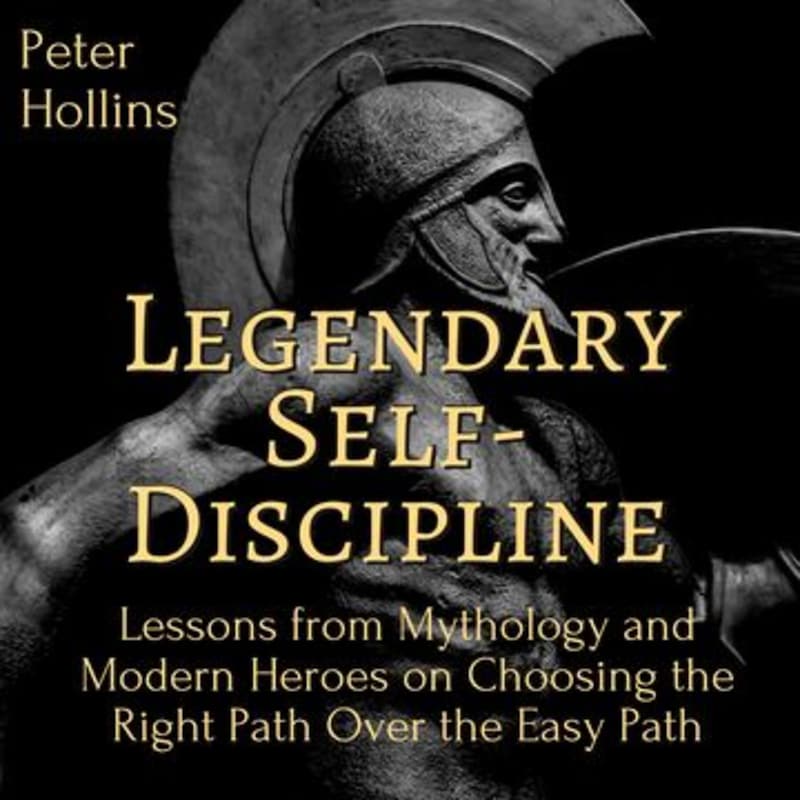
Legendary Self-Discipline: Lessons from Mythology and Modern Heroes on Choosing the Right Path Over the Easy Path By Peter Hollins
Hear it Here - https://bit.ly/legendaryselfdiscipline
https://www.amazon.com/dp/B089G6MNQC
Fight temptation, tame your impulses, and learn to persevere.
We know we should use self-discipline, just like we know we should budget more wisely, or eat more healthy. But just because we know about something doesn’t mean we know how to do it.
See role model; copy role model. It's the quickest path from Point A to Point B.
Legendary Self-Discipline teaches you tough lessons in clear ways. Want to learn to resist distraction, push through your pain, and embrace a life of hardship yet ultimate fulfillment? The ancient Greeks were onto something. Not only that - we’ll dive into a few more modern role models to emulate, and understand how we can cope with the difficulties of life, yet never stop and keep on going.
This book imparts a multitude of lessons in two sections. The first section is on mythology and seeing willpower and great hardship play out - this allows you to understand the best mindset. The second section is on real-life titans of self-discipline and perseverance - this shows you what is truly possible.
How to keep going when the going gets tough.
Peter Hollins has studied psychology and peak human performance for over a dozen years and is a bestselling author. He has worked with a multitude of individuals to unlock their potential and path towards success. His writing draws on his academic, coaching, and research experience.
Learn the willpower lessons that have withstood the test of time.
Pandora’s Box, the 12 labors of Hercules, the story of Arete and Kakia, Icarus and Daedalus, and many more tales to capture your imagination and motivate you to be better. Plus, well-known modern figures such as Victor Frankl, Stephen King, Thomas Edison, and Benjamin Franklin.
Identify the tiny changes you can make for huge results in your life.
Many times, what we want is not complex. You might even call it simple. Yet, it is rarely easy. And that’s because self-discipline holds us back. Our habits, addictions, and limited comfort zone control us. But that’s no way to live. Take inspiration from heroes of old and present-day warriors.
Achieve your long-term goals by clicking the BUY NOW button.
This is the sixth book in the “Live a Disciplined Life” series, as listed below:
1.The Science of Self-Discipline: The Willpower, Mental Toughness, and Self-Control to Resist Temptation and Achieve Your Goals.
2.Finish What You Start: The Art of Following Through, Taking Action, Executing, & Self-Discipline.
3.Neuro-Discipline: Everyday Neuroscience for Self-Discipline, Focus, and Defeating Your Brain’s Impulsive and Distracted Nature.
4.Mind Over Matter: The Self-Discipline to Execute Without Excuses, Control Your Impulses, and Keep Going When You Want to Give Up.
5. Practical Self-Discipline.
6.Legendary Self-Discipline: Lessons from Mythology and Modern Heroes on Choosing the Right Path Over the Easy Path.
Transcripts
Have you ever faced unimaginable hardship and emerged stronger because of it?
Speaker:Victor Frankl's story will inspire you to find meeting even in the darkest moments.
Speaker:Hello listeners, welcome to The Science of Self, where you improve your life from the inside out.
Speaker:Today is the 2nd of April, 2026.
Speaker:Today's featured book from Peter Hollins is legendary self-discipline, lessons from mythology and modern heroes on choosing the right path over the easy path.
Speaker:In previous podcasts we've covered all of the mythology lessons and today we start on modern heroes and the first hero of choice for author Hollins is Victor Frankel.
Speaker:He's most well known for his philosophy of finding meaning in suffering, which he called Logotherapy.
Speaker:So stay tuned and we'll see how consistently looking beyond the everyday can unlock our greatest resource, a profound sense of meaning that empowers us to live with intention and resilience.
Speaker:We’ll first turn our attention to the much-admired author Viktor Frankl, who could be said to have faced off with the god of death himself, only to emerge triumphant with a strengthened spirit and the will to survive and thrive, no matter the adversity.
Speaker:His story is all the more inspiring because of how relatively ordinary it seems.
Speaker:Frankl was surely intelligent and privileged in some ways, but he also suffered immense hardships, the likes of which most people never experience in their lifetimes.
Speaker:In other words, he was human, and in being human he was able to inspire countless people all over the world to expand that definition in the most impressive ways possible.
Speaker:Born in 1905, Frankl showed an interest in psychology from his earliest schooldays, and even maintained a correspondence with Freud for some time.
Speaker:He was curious about the inner drives of human beings—did they do what they did because they were seeking pleasure, or were people primarily motivated by the yearning for power and money?
Speaker:Frankl was interested in this and more, and he studied psychology and philosophy, then medicine at the University of Vienna where he specialized in neurology and psychiatry.
Speaker:Though inspired by both Freud and Alfred Adler at the time, he soon came to challenge Freud’s views that humans were driven by nothing more than primitive unconscious sexual and aggressive desires.
Speaker:He was also expelled from the Adler school for insisting that it was meaning that inspired man to think and behave as he did, rather than a striving for power.
Speaker:Frankl’s take on psychology was distinctly human, compared to what had come before it.
Speaker:He saw the prime motivator in human beings as the search and creation of meaning, blending themes from existentialist philosophy with humanist psychology.
Speaker:Frankl’s vision of humanity was that we are driven on a profound level to live lives that make sense, that mean something, to us and in the grander scheme.
Speaker:It was Frankl’s own experience in the Nazi concentration camps, including Auschwitz, that gave him the opportunity to develop these ideas into what he ultimately christened logotherapy, a “third” Viennese school that challenged the two psychoanalytic conventions of the time.
Speaker:This approach was seemingly a more compassionate one that understood a person’s health and well-being was not exclusively about meeting physical, social or security needs, but ultimately about the ability to create a meaningful life for oneself.
Speaker:Based on his experiences, including those in the concentration camps, Frankl published thirty-nine books, with his Man’s Search for Meaning capturing hearts and minds of readers all over the world to this day.
Speaker:The book has sold well past 10 million copies and has been translated into dozens of languages, proving that it speaks to people of all ages, nationalities and life circumstances.
Speaker:The powerful thing is that Frankl wasn’t merely hypothesizing—he actually lived his philosophy, and like a true hero, went into adversity and emerged stronger.
Speaker:Though his wife and children were killed in the camps, and though he witnessed depravity, despair and pain beyond what most of us can even imagine, he chose to use the experiences to cultivate a life philosophy of dignity, joy, strength and depth.
Speaker:It’s true that most of us will not experience a life as extreme as this, but nevertheless we can learn a lot from a man like Frankl who has been out to experience life’s furthest reaches and come back to teach us how to tackle the more ordinary adversities of life.
Speaker:Let’s take a closer look at what Frankl experienced, what he taught, and how we can use his lessons in our own lives.
Speaker:In the camps, Frankl noticed that no matter how dire the situation was, there were always people who were kind to one another, sharing their last crumb of food with those who needed it more, or comforting and supporting others.
Speaker:This was proof for Frankl that beyond everything there still remained the option available to a person to choose their own attitude, no matter how bad their circumstances.
Speaker:How beautiful it must have seemed to Frankl, to contemplate that even in the face of death and despair, it was in the realm of possibility to decide to act with kindness, to smile, to hold on to what you believed in no matter how seriously it was threatened.
Speaker:Concentration camp victims had everything taken from them—security, dignity, confidence, happiness, family, everything.
Speaker:Their heads were shaved, their families killed and their names forgotten.
Speaker:But what does a human always have, no matter what?
Speaker:No matter what, we always have the freedom to choose our own guiding values, to choose how we will respond to life.
Speaker:This is a powerful message.
Speaker:Large groups underwent the same brutal treatment, and though some of them crumbled and lost hope, others became stronger.
Speaker:This proves to us that it’s not the conditions of life per se that determine our success, but our attitudes toward these conditions—in other words, the meaning we ascribe to our own lives.
Speaker:It was the ability to seize and develop this divine human right to make our own meaning that Frankl came to understand as the key to a rich and fulfilled life.
Speaker:What is different about Frankl’s approach is that he doesn’t deny the existence of suffering, or try to explain it away.
Speaker:He faced one of the most painful experiences a human being can undergo.
Speaker:Rather, his point was that ultimately, we always retain the right to define our experiences according to our own meaning, and we can choose love and compassion even in the face of others turning to death and destruction.
Speaker:We’ll see this very theme repeated in some of the other figures we’ll consider in later chapters.
Speaker:If you’re in the middle of adversity, it’s tempting to rail against it, to get angry, to lose faith, to blame anything and everything, to give up.
Speaker:But Frankl reminds us that in troubles big and small, we always have the choice: how do you want to respond?
Speaker:What are your values, and how you will enact them?
Speaker:You can be faced with a cruel and unfair boss, a sudden accident or death of a loved one, a financial loss, a humiliation, or simply the daily irritations that trouble us all.
Speaker:But all the while, you are able to pause, look inside and choose your response.
Speaker:Always.
Speaker:Nietzsche famously claimed, “Man can endure any how if only he has a why.” Here is an important lesson, as Frankl sees it.
Speaker:Suffering is not a mistake or something to be avoided, but an integral part of human life that adds richness and depth to our time on this earth.
Speaker:After all, would Frankl’s story have been as compelling without having spent those dark days imprisoned in the camps?
Speaker:Suffering, then, is like an invitation to dig deep, to fire ourselves in the great forge of life and come out stronger.
Speaker:By choosing love, service to others, and meaningful work, we live well despite and even because of suffering.
Speaker:To put it simply, we all suffer, but it’s our response to suffering that gives life its real meaning.
Speaker:We can tell ourselves a story about our suffering that inspires despair, hopelessness and blame.
Speaker:Or we can frame our suffering as fuel and use it to be better.
Speaker:There are few successful people in the world who have lived a life free of suffering.
Speaker:The difference between those people and those who give up is that the former have taken charge of how that suffering is defined.
Speaker:Someone could fail in business, get divorced, lose loved ones or any number of setbacks, but emerge stronger, even claiming that the experience was a gift.
Speaker:If you are in the middle of adversity, look it square in the eye and ask it what it can teach you.
Speaker:Of course, nobody is suggesting that it’s a virtue to simply tolerate any maltreatment and never complain.
Speaker:But Frankl observed in the camps that those who survived and even thrived had something the others didn’t—purpose.
Speaker:They had a strong, healthy connection to the world, whether that was someone they loved, a higher calling, unfinished work or a dream in the future they wanted to achieve.
Speaker:This teaches all of us the power of having faith in the universe at large, making plans for the future and trusting always that things can improve.
Speaker:Frankl even noticed that those who had lost hope seemed to literally die sooner than those fiercely holding on.
Speaker:And it isn’t only the values, meaning and purpose we have that matter, but how we manifest these qualities in the world.
Speaker:Frankl showed the strength of his character in real life, out “in the trenches” where his attitude was put to the test.
Speaker:Frankl explains, “We needed to stop asking about the meaning of life and instead think of ourselves as those who were being questioned by life—daily and hourly.
Speaker:Our answer must consist, not in talk and meditation, but in right action and right conduct.
Speaker:Life ultimately means taking the responsibility to find the right answers to its problems and to fulfill the tasks which it constantly sets for each individual.”
Speaker:This is a message that has real power.
Speaker:It’s useless to dwell on abstracts and hypotheticals.
Speaker:We test our true grit in the arena of life itself, in our constant choices, actions, and speech.
Speaker:And those actions are most powerful when we choose kindness.
Speaker:Frankl discovered that there was kindness in some of his captors, and vicious cruelty in some of his fellow prisoners.
Speaker:Beyond the groups and classifications we have for our fellow humans, there is a more fundamental difference: are we going to be people of compassion, gentleness and generosity?
Speaker:Or will we choose a darker path for ourselves?
Speaker:For Frankl, human beings either rise to the challenge to be good or they don’t, but it has nothing to do with their religion, nationality, gender, or age.
Speaker:Frankl’s experience taught him to see the real depth and breadth of the human soul.
Speaker:Far beyond more simplistic conceptions of the human psyche being nothing more than a craving for sex or food or safety or control, Frankl challenged us to think more highly of ourselves, to demand kindness in the face of pain, to adopt a dignity not because it was easy, but precisely because it was difficult.
Speaker:To follow in Frankl’s footsteps, we don’t need to pursue anything other than our heart and soul’s deepest longing—to live a life of meaning and purpose.
Speaker:This is not something that can be done quickly, there are no hacks and tricks, and suffering is inevitably a part of the process.
Speaker:However, remember that others have gone before to light the way and show us another possibility.
Speaker:It can only benefit us to routinely look past the mundanities of life and tap into our deepest resource, our sense of meaning.
Speaker:What is the legacy you wish to leave on this earth and why?
Speaker:What does your suffering mean?
Speaker:And even right now, in the most ordinary of moments, what can you do to truly elevate yourself and your experience?
Speaker:It’s these questions that will lead down a path of the so called “well-lived life.”
Speaker:91 00:13:34,920 --> 00:13:44,400 Victor Frankel's message is a powerful one.
Speaker:Don't get caught up in the pursuit of fleeting pleasures or instant gratification.
Speaker:Instead, dig deep within yourself, listen to your soul's longing, and strive for a life filled with purpose and meaning.




