Shownotes
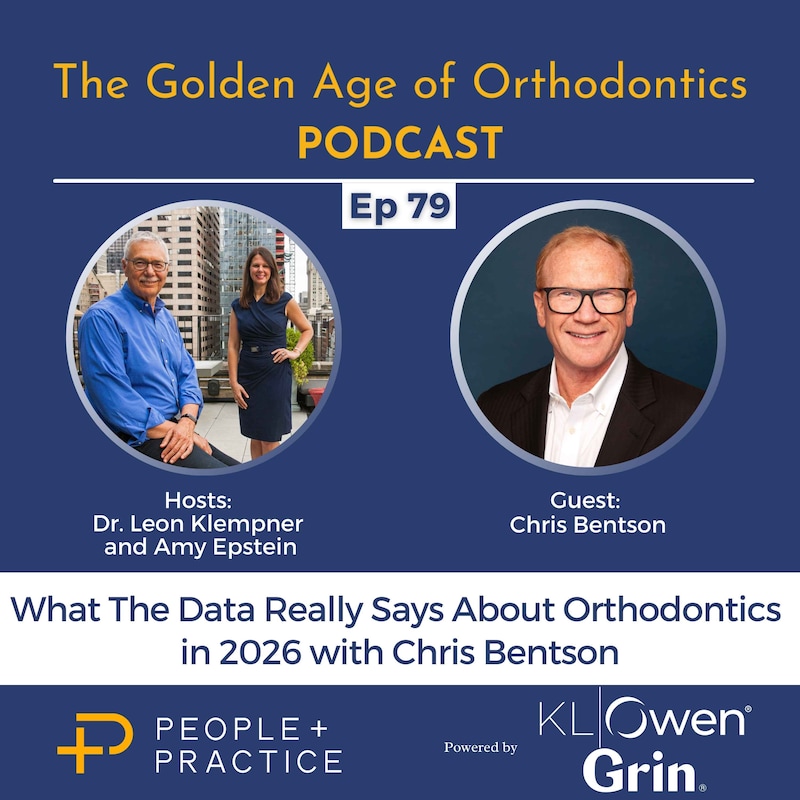
Orthodontic practice management expert Chris Bentson, Founder, Bentson Copple Patterson & Associates, joins hosts Dr. Leon Klempner and Amy Epstein on the Golden Age of Orthodontics podcast to analyze the competitive landscape facing private practice orthodontics in 2026. With nearly four decades of experience in practice valuation and business strategy, Bentson shares critical data showing 3.5% growth in patient starts after three years of decline. The conversation explores how DSO consolidation is reshaping the specialty, why digital orthodontics technology is essential for differentiation, and what data-driven decision-making reveals about successful practices versus struggling ones. Bentson discusses the impact of federal student loan caps on new residents, the lifecycle of consolidation, and why practices that embrace consumer experience innovations, such as remote monitoring, consistently outperform competitors across every operational metric.
What you will Learn in this Episode:
✅ How independent orthodontic practices can compete effectively against corporate consolidation by leveraging digital technology and improving the consumer experience throughout the patient journey
✅ Why practices that engage with consultants and implement data-driven decision making consistently outperform in every operational and financial metric, including practice overhead management
✅ What the latest industry data reveals about practice growth strategies for 2026, including why patient starts are finally showing positive growth after three consecutive years of decline
✅ How new federal student loan caps will impact residents and create opportunities for marketing for orthodontists who want to attract young doctors seeking private practice
Subscribe to the Golden Age of Orthodontics and our sister podcast, Practice Talk, hosted by Lacie Ellis, wherever you listen to stay updated on orthodontic innovation and real-world practice strategies. Visit People in Practice for more insights and to connect with our team for practice growth solutions.
TIMESTAMPS:
00:00 Discussion featuring orthodontic practice management expert Chris Bentson, discussing data-driven decision making that will shape private practice orthodontics in 2026
08:33 The competitive reality for private practice orthodontics, the impact of DSO consolidation and increased overhead pressure
11:36 2025 growth data showing a 3.5% increase in production and 2% growth in patient starts, signaling positive momentum for orthodontic practice management in 2026
19:02 Discussion of why only 20% of orthodontists engage consultants, OSOs and DSOs, and data-driven decision-making and marketing for orthodontists
23:31 Analysis of new federal student loan caps, including how private practice orthodontics owners can attract young doctors and the future of practice valuation
30:31 Digital orthodontics investment strategy for new practice owners, using both custom braces and clear aligner therapy, is necessary
39:26 Discovering the “Why” in becoming an orthodontist
KEY TAKEAWAYS:
💎 The competitive landscape for private practice orthodontics demands that doctors differentiate beyond "we do braces and aligners"—successful practices embrace digital technology, improve consumer experience, and implement data-driven decision making to outperform the industry average growth of 3.5%
💎 DSO consolidation is in its sixth inning, with only two major aggregators completing recapitalization events, while the consolidation rate is slowing and expected to cap around 30% of the specialty, leaving ample opportunity for independent ownership
💎 New orthodontists should invest comprehensively in digital orthodontics with deep penetration in either custom braces or clear aligner therapy to justify technology costs through reduced staffing needs, fewer appointments, and shorter treatment times
ABOUT THE GUEST:
Chris Bentson has been working with orthodontists regarding the business aspects of their practices for over thirty-five years. He is the founder of Bentson Copple Patterson & Associates. He spends much of his time working within the orthodontic industry. He joined the AAOF Board in 2016 and served as AAOF President in 2023-2024. He was awarded the 2022 “Outstanding Contribution to the Specialty Award” by a non-orthodontist from the AAO. Chris is also a guest lecturer in the Wharton Business School’s AAO Partnership course: “Mastering the Business of Orthodontics” covering “Practice Level Financial Management" and "Financial Acumen and Practice Transition Planning". Chris is a frequent presenter at AAO sponsored meetings and is a contributor to national orthodontic periodicals and journals.
Bentson, Copple, Patterson and Associates - Website
RESOURCES MENTIONED:
Dr. Leon Klempner - People + Practice
Golden Age of Orthodontics, Dr. Leon Klempner, Amy Epstein, Chris Bentson, Orthodontics, AAO, Orthodontic Practice Management, Private Practice Orthodontics, Practice Valuation, Patient Starts, DSO Consolidation, Digital Orthodontics, Data-Driven Decision Making, Consumer Experience, Remote Monitoring, Independent Orthodontic Practices, KLOwen, Grin, Marketing
Transcripts
[00:00:25] Kale Owen is revolutionizing orthodontics by turning the chaos of conventional braces into custom control, their custom digital solution. Helps you achieve consistent results while saving on average, over seven appointments per patient. It's custom done right so you can focus on delivering amazing smiles.
[:[00:01:09] Grin provides you with dedicated assistance, enabling you to focus on providing exceptional care, all while saving valuable time for you and your patients. New customers can save up to 35% on their starter package. Transform your practice Better care begins with grin. To find out more about our podcast sponsors.
[:[00:01:37] Narrator: The future of orthodontics is evolving and changing every day, but although the way to achieve practice growth has changed, there's never been a better time to be an orthodontist. Let's get into the minds of industry leaders, forward-thinking, orthodontists and technology insiders to learn how they see the future of the orthodontic specialty.
[:[00:02:17] And now welcome to the Golden Age of Orthodontics with the co-founders of People and practice, Dr. Leon Klempner and Amy Epstein.
[:[00:02:52] I practiced for about 40 years on Long Island before co-founding people in practice with my daughter and my [00:03:00] partner, and my podcast co-host. Welcome, Amy Epstein.
[:[00:03:09] Dr. Leon Klempner: retired. I, I'm doing the things I love to do. That's the difference.
[:[00:03:36] And then I, I sold, uh, shoes across the street. You drove a cab
[:[00:03:41] Dr. Leon Klempner: drove a cab. I sold shoes. Um, I sold handbags. Um, so yeah, that was work. That's, but once I got to be an orthodontist. I mean, no greater profession in the world anyway. Welcome.
[:[00:04:06] And then that's, that may be work. That's real work. That's real work. That's real hard stuff. Uh, I am glad to be here. I have an MBA in marketing, a background in, uh, corporate branding, marketing, public relations, and my dad and I co-founded people in practice in order to bring that. Kind of expertise to the industry of orthodontics?
[:[00:04:51] My favorite quote is, uh, in God we trust all others must bring data. It's, uh, w Edwards Deming. Uh, you [00:05:00] know, we all have instincts and look, I come from public relations and marketing and branding and orthodontics, and you come from an orthodontic background. Everything is measurable. Have you moved to that tooth?
[:[00:05:31] So that's why I like that quote. And I still, it's my favorite.
[:[00:05:59] [00:06:00] So, um, you're preaching to the choir here when you, we talk about data.
[:[00:06:29] So it means collecting data, setting up. Infrastructure to be able to collect data on marketing and then analyzing that data and then processing that data and then revisiting that data to make sure that we're constantly improving. So I think that's one of the things that, aside from the, the merging of ortho and marketing, the, the merging of the data side of things into the marketing, I think we've done a really good job of, if we, if I.
[:[00:07:21] Business strategy overall. He's a founding partner of Benson Koppel Patterson and Associates, and worked with orthodontists across the country to help shape and still does how the specialty thinks about its business fundamentals. He's also held leadership roles within the A a O foundation. Teaches at the Warden a a o partnership program and consulted with many of the major companies that are driving innovation in orthodontics today.
[:[00:07:52] Chris Bentson: Thanks Amy. Thanks Leon. It's always a pleasure to be on this show and, uh, great to see both of you. Likewise.
[:[00:08:08] And it's always like very well received. We always get like, hi. Uh, yeah,
[:[00:08:19] Dr. Leon Klempner: Yeah. Yeah. And I mean, we're, we're painting you as a data guy. I hope that's not. Too limiting or too insulting to you, because I know that insulting. I dunno. Well, I don't know.
[:[00:08:40] Chris Bentson: You know? Absolutely. And we,
[:[00:08:56] We, we don't have a lot of OSO [00:09:00] clients. It's not that we're opposed to it, but, you know, people that gravitate to us typically are in the private practice, uh, arena, and they, and they look to us to help them in terms of their marketing. So for our, and, and there's so many moving parts going on right now in our.
[:[00:09:43] Chris Bentson: Yeah, absolutely.
[:[00:10:03] Um, so I think, uh, what's true is at least. In our careers, Leon, it's, it's harder to make a buck in ortho today than it was 20 years ago, uh, 15 years ago, maybe even 10 years ago. Um, and there's several reasons for that. There's upward pressure on overhead, um, through a lot of technology that we said was gonna replace people, but it really didn't.
[:[00:10:50] And things like that as, as you age in the profession. So, and, and, and it's competitive, I would say everywhere. There's pockets where it's not, but it's, it's pretty competitive [00:11:00] everywhere. Um, and a lot of gps doing a lot more ortho today, so, uh, yeah, it is harder to make a buck the, the, the tough time since, you know, if you look back the last five years we had, we had COVID that upset the Apple Corp.
[:[00:11:36] In OrthoFi particularly, you know, we're up three and a half percent so far, year to date in production. We're up. Uh, similarly in, in collections and up almost 2% in patient starts. We haven't seen that in three years. So, you know, I've been telling people, it's coming, it's coming, you know, we're gonna, it's gonna get better.
[:[00:12:17] Why? Because they're smarter. They look at the numbers better, and they can manage the metrics better. And so orthodontists have to be, have a sharper pencil. You have to be a better businessman or woman than you used to have to be. And if you do those things, um, and you'll be successful. And I think that there's a lot of data that.
[:[00:12:51] Dr. Leon Klempner: Yeah. So, you know, he, here's the, the, um, the trap about the three and a half percent growth Yeah. Is that not [00:13:00] everybody's growing by three point a half percent. And so, so it's like an asymmetric amount of growth and what, what, what we're seeing on the marketing side is that what I would. Consider the plain vanilla orthodontist, the ortho orthodontist that comes to market as we do braces and we do aligners.
[:[00:13:53] Amy Epstein: That's
[:[00:14:12] They want a different cadence of visits. They want digital. They don't want to come in to see you as much. And orthodontists have stiff on that for a long time. Um, you know, your message, your company, your, your podcast speaks to this regularly. But I find when I look around and, and you know, one of the advantages that, that maybe someone like myself gets from the data point is we.
[:[00:14:58] I mean, that stuff [00:15:00] kind of still works, but, but not as much so. I would guess Leon, in, in the middle of the road practice, there's an independent practice owner zone, a, a a 50-year-old, uh, solo practitioner that practices four days a week with a satellite one day a week and doing about 1.6 to 1.7 million at 60% overhead.
[:[00:15:44] 'cause I, I, I know this stuff works, but it has certain advantages and not everybody uses it today. So from a differentiation point of view, I think, uh, those practices are winning more than those that don't engage that way.
[:[00:16:08] 'cause that's the world we live in. Yeah. Before they come into the office, that experience is really important to. Not only, you know, from a marketing standpoint of, of course, build trust and, and educate people about what you do and why you're different and all that, but also when they start reaching out because for whatever reason they saw you, they have reviews.
[:[00:16:47] You have to be able to engage in requesting appointments in different ways, and you need confirmations. Text messaging and all that. So, um, the technology piece extends, I think, to that very specific part of the [00:17:00] consumer experience that has shifted significantly, both from consumer product, good company, ex, you know, uh, experiences and also in other parts of healthcare that are showing examples of how this can be done really well to fit in with your life, remind you about things and follow up with you and, and all of that.
[:[00:17:16] Chris Bentson: yeah, thank God I have kids because they, they really though are the ones in, in later in life that. It taught me what's going on in the world. Um, and I'm, I, I'm coming to New York and, uh, going to see my, my son who lives in Milford, Connecticut. Uh, Connecticut, with his wife and, and you know, they send us something.
[:[00:17:52] And so you've got to listen to, uh, what the consumer wants, how they find out about you. They, you guys know the data I that, that I don't, I mean, they, [00:18:00] they know so much more about you before. There is a conversation, um, largely they've made up their minds based on what, what they found out about you before they talked to you.
[:[00:18:28] So you've got to engage with consultants and groups like yours to learn that. Um, and then. Not just listen to it, but implement what you ask them to do. That's sometimes a jump, right? You hear what Chris
[:[00:18:46] Chris Bentson: Yeah, it works. You know, I, I, I will tell you just overall on consultants and I've, I've been amazed about this and this, this is data that's been true for 30 years. The JCO does a biannual practice. You know, survey that comes out in four parts every two years, and it, it [00:19:00] always asks the question, do you engage with a consultant?
[:[00:19:23] And so I, I asked myself why wouldn't I? Um, and um, there's lots of reasons for it, but one of 'em is because you're so smart, you don't think you need to. And, and so, uh, you know,
[:[00:19:38] So, okay, let, let me go back for a second. Uh, you mentioned just a minute ago, you brought back into the conversation the osos, the DSOs. I wanna talk about that a little bit because consolidation has obviously been one of the most significant forces, um, that's shaping the competitive landscape. Uh, you know, over the last maybe 5, 5, 10 years, it's been [00:20:00] really picking up speed.
[:[00:20:18] Chris Bentson: Yeah. Well, consolidation is a lifecycle, uh, just like a practice lifecycle does. And if you listen to, um, the private equity people, the venture people and the broker people, um.
[:[00:21:00] You get paid these bigger numbers, but then you have to work back. And so you look at the companies. That have aggregated orthodontists, that have done the, the term is recapitalize and that's when your stock becomes liquid and you can take some money off the table. There's only really been two big aggregators in Ortho that have done that Smile.
[:[00:21:38] They have 125 orthodontists, um, in their group and they've recapped three times. They also also have a multi-billion dollar valuation and both those shops have very happy doctors, uh, on balance. Now we all know of six or seven orthodontic centric names, um, that aggregated up, none of which have had a recapitalization event Now.[00:22:00]
[:[00:22:18] Um, you know, there's one out in the market now that is gonna try to turn, that would be good for the others if it did. But to answer your question, it's slowing down. It's not speeding up. Um, and it's going to continue to slow down and the big guys will end up eating the little guys, um, in my opinion, and it'll kind of cap out.
[:[00:22:55] And some of the bigger practices have used them as an exit ramp, uh, because a young [00:23:00] orthodontist couldn't afford to buy them. And so it's, it's served a purpose, but, um. It's not gonna take over the specialty. If your kid wants to be an orthodontist, that's a good idea. Uh, they can be an independent orthodontist forever, as far as I can see, but it's gonna probably cap out at 30%.
[:[00:23:28] The big bad wolf isn't so big and bad anymore.
[:[00:24:01] So, I, I'm curious for your, from your perspective, you know, how do you think. That these changes are going to shape the pipeline for future orthodontics. And specifically, what ripple effects might you see, uh, in private practice owners that they should be thinking about now?
[:[00:24:32] I think go these, go into effect these caps to a mid part of next year. Um, and the way I understand the caps, right now on the federal side, there are 50,000 a year, 200,000 cap. Um, and when you look at the orthodontic resident base, average orthodontic resident debt now is 400 plus or minus. No. Shannon from my team could tell you more.
[:[00:25:10] Because, um, the margins are so good in orthodontics that, um, banks understand that banks who loan money to orthodontists that have a half a million dollars in debt and have never had a W2 before and just got a, a. Partnered up in marriage and maybe have a child on the way will gladly loan that, that person 800 to a million dollars.
[:[00:25:50] The gap will be filled. I think some of the state programs, and we see this in different states already, will offer some loan forgiveness if you go to a less [00:26:00] desired area for a period of time to try to help residents in their state. I think some of these really high tuition programs, we'll have to have it come to make a meeting and decide, you know, can we still.
[:[00:26:31] So, short term, is there gonna be some problems? I think so, probably, but they're gonna figure it out. I think we'll have way more, uh, you know, applications for residents, uh, than we have resident seats, just as we have for the last 40 years of my career. And I don't see that going away.
[:[00:26:55] You need to generate some income and certainly the [00:27:00] DSOs and Osos. If we look at the, at the positive side of it, they've created opportunities for orthodontists to repay some of their debt, to gain some experience to, um, learn a little bit about the business and at people in practice, we, we see a lot of startups now, maybe five or six years outta practice that are a little bit further outta debt.
[:[00:27:51] Chris Bentson: I don't think so because the, the data that we see shows that. I mean, early part of my career, 90% of the, of the residents, and I'll call [00:28:00] this the eighties and nineties, um, got outta their program and went to buy a practice or buy a, uh, or start their own de novo practice. Um, 10% went to work for somebody today that, that's a hundred percent flipped around.
[:[00:28:32] Um, but what happens when you, when you get in, uh. Right outta residency to a program is, um, your hand speed goes, your ability, uh, to, to treat, uh, imp improves and you make a lot more money than you would if, uh, you went to work for another orthodontist. But your money is, is, is capped and there's no real pathway to equity.
[:[00:29:14] Um, and they, they really, uh, I believe did not decide to be an orthodontist, to be an employee doctor. They decided to be an orthodontist, to be a cottage owned, you know, independent owner. They're just doing it lighter. And so those are the people that are coming out and they're coming out. 80% of those are coming out and, and doing something.
[:[00:29:55] Some of this loan forgiveness stuff is actually gonna come to fruition if you, if [00:30:00] you act a certain way. So I think we'll figure out the, the tuition is kind of maxed out and it'll incrementally maybe stay the same or go down. The opportunities with the osos and DSOs is gonna expand a great deal. And so you're gonna go into private practice and what you can do with digital today on.
[:[00:30:31] Dr. Leon Klempner: So let's talk about digital just for a second, since, since you brought it up and, you know, you and I, for, I don't know, as long as I could remember, have been preaching the same message to Orthos for a lot of years, and the message was that.
[:[00:31:25] So this, this, um. Orthodontist asked me, uh, specifically, uh, what part of digital treatment creates the most advantage for patients and parents? He wants to choose. He knows that digital orthodontics is the future, but he wants to make a smart decision as to what to invest in. So how would you, uh, how would you answer somebody like that?
[:[00:32:14] And so I would not suggest to that doctor that they just choose aligners or just choose digital braces or just choose a monitoring company. I would say listen that. The biggest investment orthodontists ever make and, and have for the last 40 years is in people. And the only way that you can justify and affordably, um, have the right number of people, um, if you choose to go digital, is to fully express what digital can do for your practice.
[:[00:33:05] Uh. Braces. And so you can choose whether, whether that's a, an advantage for you or not. We know that you need less people because you're doing less work and seeing people at bigger intervals in, in, in mid treatment, um, with a digital practice. And we know that the consumer would, given the opportunity side by side, do you want this many appointments and this long of treatment versus this many appointments and this long of treatment?
[:[00:33:53] Yet still for all that success, only one in 4K starts are in aligners. All [00:34:00] right, and so now with digital braces and what got me excited about a light force and KLO and and, and dibs and those things is now we can start every patient with a scan and we can have a conversation with the patient that we have custom.
[:[00:34:35] And when I do that, I actually do need less people. So I would tell your. Questioner doctor, I would say, listen, you gotta go digital braces. Choose the one you want. Um, you know, I've chosen KLON and I spent a lot of time with Lifeforce, and I love that technology and those people, but the price points between those two and you can have a full, uh, uh, you know, array of brackets.
[:[00:35:18] You can have fewer people you can keep your overhead at or even below where it's been historically with analog. And this is a huge differentiator for you today, where it won't be tomorrow when. Everybody's digital. So that's what I would tell 'em. Yeah. And I see startups do that and I think Jill Allen and some others, um, would, would probably that work with a lot of startups, would, would concur with that.
[:[00:35:58] Chris Bentson: to change.
[:[00:36:00] Dr. Leon Klempner: yeah. But, you know, but you know, you know, I'd be interested in your perspective on this, but here's my takeaway on that is that. What's misunderstood is that, and I'll use industry speak and say, you know, you do need to go all in. Meaning that you know, you can't. Dip your foot into it and try it and just use it for, you know, let's say remote monitoring, for example.
[:[00:36:45] But a lot of. Practitioners in my experience, they'll start, they'll see the learning curve. They're not seeing the return on investment, and then they opt out. And that, that doesn't, that doesn't work.
[:[00:37:10] Maybe you'll make a little bit less money. It's, you will make less money, um, in the first 18 months. Somewhere in there, depending on what mix of products you have, if you don't grow. Okay? If you're growing at 10%, growth takes care of a lot of sins, right? Um, and, and you can, you can kind of do it, but if you're an established orthodontist and.
[:[00:37:47] Then the whole thing falls. So it takes strong leadership from the orthodontist, uh, to be totally committed to the idea. It takes going in very deep. Um, which. Scary because I still act like an analog practice. I need this many staff people, [00:38:00] I don't get any reduction, um, because I still gotta de bond those cases.
[:[00:38:21] I get six months into it, I've, I've not gone all in, but I've done. Pretty far in, I'm getting all these lab bills all of a sudden and my income's not going up if I'm not growing last three years. And I, I look at myself and my, and I talk to my team and they go, we liked it the other way. Um, and I called my rep up and said, I just can't do this anymore.
[:[00:39:03] It's gonna be okay for 18 months. We're gonna do this and then it'll be great. And that's what happens.
[:[00:39:10] Chris Bentson: Yeah, I think so.
[:[00:39:40] Right? That's making you feel good. Um, about the future. The, you mentioned at the top of the show about, you know, veterinary medicine, accounting law orthodontics is still outperforming those other professional pathways. Why? Why, why is that? [00:40:00]
[:[00:40:04] You know, you're not on call. Um, insurance is largely out of your life. Is is less so than medicine. Um, you know, there's multiple ways to practice now with digital, not digital, you don't have to be digital to degrade orthodontics, but there's just so many options Now. You can be corporate, you can be not corporate.
[:[00:40:44] To have a half a million dollars in debt, not make any money till you're 30, start your family later and then go have to borrow another million bucks or go work for somebody else. Why would you do that? Because it doesn't make sense to a dad, right? Uh, I've got three kids. I'm like, wow, I, [00:41:00] that doesn't make a lot of sense.
[:[00:41:24] And, and, and my orthodontist actually changed my life such that I loved to go to see him. And when I went to undergrad, I said, that's who I wanna be. That's the impact he had. Okay. My life took a, a, a, a little bit different turn, and that's, that's not what I ended up doing. But then I had him again, orthodontic at 60.
[:[00:42:07] Leon, you do it on the, on the in, in the, in other countries, bringing smiles to people. But a smile is a pretty incredible gift, and I think, uh, that's why it will always work.
[:[00:42:27] Chris Bentson: Yeah.
[:[00:42:46] And I, Amy, I, I had Gail as the, uh. Perfect. Yeah, Amy knows Gail. She worked with me for years anyway, so you know, my why turns out to be after all of that. Turns out to be my why is to [00:43:00] help other people so that they can get what they want and that, and that's really that, you know, I don't know how I ended up in this field.
[:[00:43:23] Chris Bentson: and it, it really is cool.
[:[00:43:41] And I am more bullish on the specialty than ever.
[:[00:43:47] Amy Epstein: Chris, thanks so much. Always pleasure talking to you. Appreciate your insights. If we have listeners who may have questions for you, may wanna talk to you about, uh, the types of services that you can recommend, consultants or, [00:44:00] you know, maybe your own insights, how might
[:[00:44:04] I, uh, just look up Benson Coplan Associates. Um, I'm trying to become Leon. I I actually am semi-retired, but I find I'm working harder than I've ever worked, but I, I sold the Romanian interest to Doug and Shannon on my team at the end of last year and working back as an associate for them. Uh, and so that's, that's been a lot of fun.
[:[00:44:36] Amy Epstein: Yep. And, uh, you know, a mention of KLO and they're one of the two sponsors of this podcast that makes it possible for us to bring guests like you onto the show.
[:[00:44:49] Chris Bentson: Yeah.
[:[00:44:55] Chris Bentson: Thanks for all the work you do for the specialty. Uh, great to see you. Thanks, Chris.
[:[00:45:00] Amy Epstein: You can subscribe or download other episodes of the Golden Age of Orthodontics on Apple Podcasts, Spotify, SoundCloud, YouTube, or wherever you get your podcast.
[:[00:45:30] Dr. Leon Klempner: You're getting better with that, Amy.
[:[00:45:36] Dr. Leon Klempner: Thank you for watching and listening. If you wanna contact me directly, my email isLeon@pplpractice.com. As Amy said, we couldn't do this without the support of our sponsors. K Owen, shout out, grin.
[:[00:46:15] Narrator: Thank you for tuning in to the Golden Age of Orthodontics. Subscribe now on Apple Podcasts, Spotify. Or visit our website at the golden age of orthodontics.com for direct links to both the audio and video versions of this episode.


