Shownotes
Episode Summary
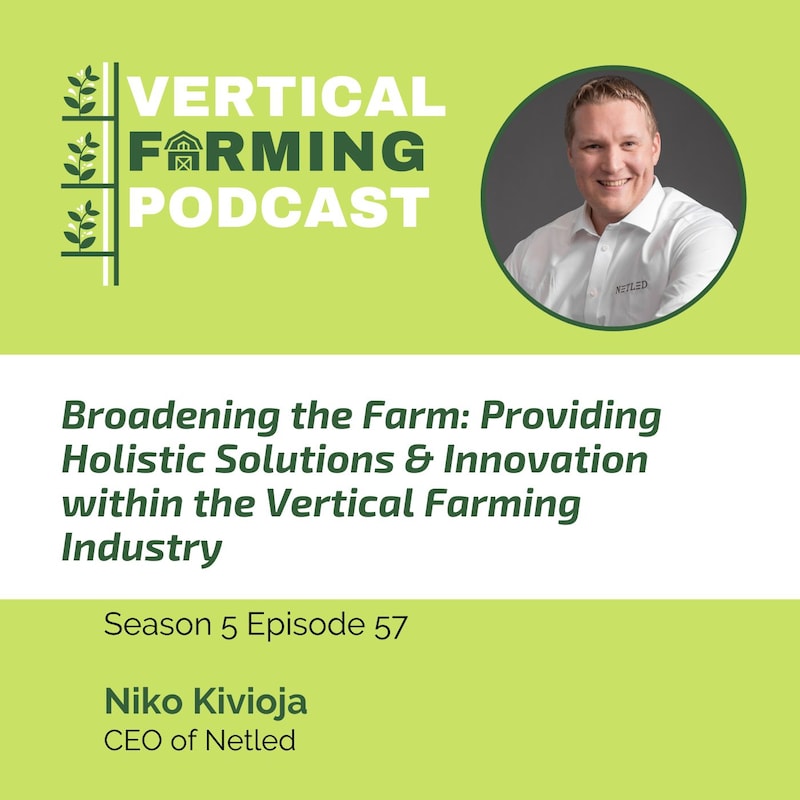
CEO of Netled, Niko Kivioja spent the first part of his career in controlled environment agriculture (CEA) as a grower and has spent the last decade in high-tech closed-environment and vertical farming technology development. Today, Harry and Niko discuss how the vertical farming industry is growing and what opportunities exist for competitors within the industry to share technological advances to benefit all companies. Niko shares some exciting new projects and partnerships, including one with a Calgary-based wholesale supplier to bring Netled’s Vera vertical farming technology to the North American market.
Thanks to Our Sponsors
CEA Summit East - https://indoor.ag/cea-summit-east-2025/
Indoor AgCon - https://indoor.ag/
Key Takeaways
04:27 – Harry welcomes CEO of Netled, Niko Kivioja, to talk about the proprietary Vera vertical farming platform he’s been managing and the research that goes into shifting focus to new produce such as strawberries
14:34 – Providing holistic solutions and building a world-class vertical farming team
18:33 – Advancements and specialization of technology in vertical farming and sharing resources so all companies in the industry benefit
23:01 – Niko talks about the latest initiative between Netled and Calgary-based Rambridge Wholesale Supply to bring Vera vertical farming technology to the North American market
33:15 – What excites Niko most about future innovations in the vertical farming industry
35:54 – Niko shares a major production project he’s currently working on
38:55 – Power consumption at a vertical farm
41:06 – Raising awareness and educating the masses on vertical farming
45:18 – What keeps Niko motivated
48:35 – Harry thanks Niko for joining the show and lets listeners know where they can learn more about Netled
Tweetable Quotes
“I see that, to actually make a difference in this field when there is a lot of new commerce to the business, you have to offer broader offerings than just the farm and just the details of that farm.” (14:19) (Niko)
“That’s the problem for all technology companies. The technology is only as good as the people making it.” (16:45 (Niko)
“It’s always difficult when you risk sharing information with your competitors. Then again, when there is a limited amount of talent, that would benefit the entire industry to actually make a successful method so that all the interests of different companies can be met.” (21:58) (Niko)
“Since the early days of vertical farming, there were challenges of getting financially feasible technology for actual commercial production.” (28:10) (Niko)
“We’re working probably in the most important field right now in solving these food-related issues.” (46:15) (Niko)
Resources Mentioned
Netled Website – https://netled.fi/
Netled LinkedIn – https://www.linkedin.com/company/netled-oy/
Netled YouTube – https://www.youtube.com/channel/UCxWdujAa_kBqCbOAYx7SJKQ
Netled Twitter – https://twitter.com/Netled
Netled Instagram – https://www.instagram.com/netled_/
Netled Facebook – https://www.facebook.com/NetledOy
Niko’s LinkedIn – https://www.linkedin.com/in/niko-matti-kivioja-93333114/?originalSubdomain=fi
Sponsor Info
Cultivatd’s Website – https://cultivatd.com/
Cultivatd’s Instagram – https://www.instagram.com/cultivatdco/
Cultivatd’s Twitter – https://twitter.com/cultivatd
Cultivatd’s Facebook – https://www.facebook.com/cultivatd/
🎙️🎙️🎙️
Podcast Production and Marketing by FullCast
Discover the best podcast services in the world at The Podosphere: https://www.thepodosphere.com/
Mentioned in this episode:
2025 Precision Ag Report by iGrowNews
2025 Precision Ag Report by iGrowNews
Transcripts
$680 million poured into precision ag last year.
Speaker:Autonomous weeding robots dominated, and John Deere made 2 acquisitions in 3
Speaker:months. A food company, not an equipment maker, bought a
Speaker:robotics startup to protect its own supply chain. The deals are
Speaker:accelerating, the money is moving, and the winners are already separating from the
Speaker:pack. If you're investing, building, or buying in this space,
Speaker:you need the full picture before your competitors get it. The 2025
Speaker:Precision Agriculture Intelligence Report From iGrow News is now
Speaker:available. Get your copy today at
Speaker:igrownews.com/precision. If you are starting a vertical
Speaker:farm and don't know where to begin or which technology would suit your needs,
Speaker:then reach out to the experts at Cultivated. As indoor farm brokers, they
Speaker:help connect you to the right technology and ensure your project is successful.
Speaker:Best of all, their service is free because they work on behalf of their
Speaker:partners. Visit cultivated.com to learn more. And
Speaker:that's spelled C-U-L-T-I-V-A-T-D.com,
Speaker:or click the link in the show notes. We just did this questionnaire to
Speaker:consumers of how they feel about vertical farming. 1 of
Speaker:10 knew anything about vertical farming. When we
Speaker:talked a little of what is going on and what is the benefits of vertical
Speaker:farming, what it means, what it really means, so then
Speaker:9 out of 10 people were interested to try out vertical farm
Speaker:produce. That's really promising.
Speaker:Welcome to the Vertical Farming Podcast, weekly conversations with
Speaker:fascinating CEOs, founders, and agtech visionaries.
Speaker:Join us every week as we dive deep into the world of vertical
Speaker:farming with your host, Harry Duran.
Speaker:Vertical Farming Podcast, Season 5. Welcome back. I'm your host, Harry
Speaker:Duran. If this is your first time listening, I am positive
Speaker:you're You're in the right place, you found the right show. It's the one where
Speaker:we interview fascinating CEOs and founders of the leading vertical farming companies from
Speaker:around the world. So pull up a chair. In case you missed
Speaker:last week's episode, we spoke with Viraj Puri,
Speaker:co-founder and CEO of Gotham Greens. Viraj and I connected at
Speaker:Indoor AgCon in Las Vegas, and we had had him
Speaker:scheduled, and so it was nice to get a face-to-face there and have a follow-up
Speaker:conversation or a actual interview on the show.
Speaker:He's on a mission to transform the way we approach our food system by growing
Speaker:greener foods in better ways, and through Gotham Greens, Viraj and his team have
Speaker:helped to build and operate sustainable greenhouses in cities across America. So
Speaker:make sure if you haven't already listened to it, give it a listen.
Speaker:There was an issue with, I think, one of the versions we uploaded, so if
Speaker:you had problems with last week's episode, if you delete it and then you resync,
Speaker:you should be okay. So sometimes that happens on the technical
Speaker:side, so apologies if that resulted in a not
Speaker:perfect experience for you. So that's something we're always looking at to stay on top
Speaker:of and make sure it's, uh, great for you, because I know there's first-time
Speaker:listeners as well, and hopefully that wasn't their first experience with the show.
Speaker:This week we have a return guest. It's Nico Kyriogia. He's the CEO of
Speaker:NetLed, and he spent his first part of his career in CEA
Speaker:as a grower and has spent the last decade in high-tech CEA
Speaker:and vertical farming development. He returns to the show to
Speaker:discuss how the industry is growing and what opportunities exist for
Speaker:competitors, and what possibilities there are for sharing technological
Speaker:advances to benefit everyone. He talks about exciting new partnerships and
Speaker:projects that NetLED is working on, including one with a
Speaker:Calgary-based wholesale supplier to bring NetLED's VERA vertical farming
Speaker:technology to the North American market. I really appreciate the
Speaker:opportunity to connect with Niko and his team at
Speaker:Indoor Icon as well, and got to shake his hand and meet some folks from
Speaker:there. So that's always nice when I can do that, and I'm looking to do
Speaker:that again At the Indoor Ag Conference
Speaker:in New York. Still 50/50 on that, so stay tuned here to see if I
Speaker:can make it. Make sure you tune into Vertical Farming Weekly, our newsletter
Speaker:where we share the latest updates on what's happening in the world of vertical farming.
Speaker:verticalfarmingweekly.com. If you enjoyed this episode or past episodes, I
Speaker:would love it if you leave a rating and review at
Speaker:ratethispodcast.com/vfp. I'd love to read yours out
Speaker:next. Okay. Without further ado, let's jump into this
Speaker:conversation with Niko. Niko Kivijoja,
Speaker:CEO of NetLed, thank you for joining me for round 2 on the Vertical Farming
Speaker:Podcast. Yes, thanks for having me. It's always a pleasure
Speaker:talking with you. So it was nice to meet in person at Indoor
Speaker:AgCon in Las Vegas. That was fun. It was really, really
Speaker:nice event. First time for me in that event. Yeah, I really loved it.
Speaker:Had you been to Vegas before? No, not before. That was an experience as well.
Speaker:What was your thought about what Vegas was like? And then what was it? What
Speaker:was your thought about it once you got to experience it in person? I have
Speaker:to say that I had— my understanding was only
Speaker:from Hollywood movies. So Ocean's Eleven. Yeah,
Speaker:Ocean's Eleven. Yeah. Yeah, it's quite far from that
Speaker:experience. But then again, it's surprisingly clean and everything
Speaker:works well. And so it was really Really nice, nice to
Speaker:see that town with my own eyes. Yeah. Did— do you
Speaker:play poker? Do you do any gambling? Unfortunately, I had really
Speaker:tight schedule when I was there, but I
Speaker:did try those slots a little bit, but I think they are just robbing me.
Speaker:Probably, yeah. I think it was my partner learned Texas Hold'em
Speaker:online during COVID so she was there with me, and then
Speaker:after the conference, she sat down at a actual table with real
Speaker:money for the first time. And like, the heart is like racing.
Speaker:Yeah, really, really excited and really, really nervous. She was surprised at how
Speaker:much adrenaline flows through your system when you're
Speaker:dealing with like— it's not a lot, maybe a couple hundred dollars, but when it's
Speaker:real money and you're trying to bluff and you're trying to have people not read
Speaker:your emotions, it's a really interesting experience. Yeah. Was that
Speaker:the first indoor farming conference you had been to in
Speaker:a while, or had you been to others? We've had our team in
Speaker:the, in the Orlando— was it in Orlando, the
Speaker:previous event? So we had the team there. But back then, the
Speaker:visa arrangements were really difficult with the, with the
Speaker:situations with the pandemic. So, so that then I
Speaker:couldn't attend myself, but we had team there anyways.
Speaker:And what's been your experience and maybe pre-COVID, and
Speaker:maybe adjusted slightly, but do you see the value in
Speaker:these events from an exposure and from an
Speaker:networking perspective? Do you feel like after you've been there and
Speaker:people are getting to learn more about the company that it's a good use of
Speaker:the company's time? I'd say yes. So there is a
Speaker:spectrum of conferences and conference types. Some of
Speaker:those are not so useful than others. But I really like this
Speaker:Akon type, let's say, intimate, small
Speaker:event where there is— it's a big event, a lot of visitors. But then again,
Speaker:the The booths are small. There is only a limited number of
Speaker:exhibitors. Yeah. And this makes the whole event,
Speaker:it's much more focused on certain things than some of the huge events, for
Speaker:example, in Holland, the Green Tech or these, let's say, a lot of different
Speaker:fields touching conferences. So I really like this format a lot.
Speaker:Do you notice a difference between the events in
Speaker:Europe and the events in the States in terms of one of the things you
Speaker:mentioned is the size, but I guess maybe just the maturity of the industry?
Speaker:And Europe is some— it's further along than, than some of the events in the
Speaker:States. And do you notice that when you're here? Well, yeah, the size of the,
Speaker:the conference is one clear thing. So I think it's,
Speaker:of course, this business for those, those arranging parties,
Speaker:and they just wanted to have as big as possible so they can get as
Speaker:much money as possible from, from arranging those things. I, I
Speaker:totally get it. Then again, the challenges are the focus and
Speaker:It's more of a playing with who puts more money on
Speaker:presenting the company with the booth interiors and things like that. I
Speaker:think in Holland they had to limit the
Speaker:amount of layers you can have in your booth because there was
Speaker:like getting out of hand, like hundreds of thousands just to build the booth for
Speaker:there. So it's, it got ridiculous. But, and for this
Speaker:aspect, the indoor RACCON is really good when you have this focused thing,
Speaker:and everybody has the same sized booth, so we can actually focus on
Speaker:the matters at hand, the facts and the actual
Speaker:business, making business. So we've got a new conference coming
Speaker:up in New York City in June, and it sounds like you'll
Speaker:be attending and presenting some new information there as well?
Speaker:Yeah, the Indoor AgTech New York, June
Speaker:23rd to 24th. So that's— we have a team there. I'm not present
Speaker:myself, but we have a team present there and that's relatively
Speaker:new. So it was originally more of
Speaker:broad content of all agricultural
Speaker:aspects, but now they have, I think this is more of a spinoff from that,
Speaker:which is more focused on indoor technologies. And it's
Speaker:also now good with this focus. So we can actually get
Speaker:serious traction, serious discussions. I think this is
Speaker:also getting in a better direction. And are you focused
Speaker:on talking specifically about Greentech Amsterdam, or are there things that you're
Speaker:specifically going to be covering at the conference or exhibiting?
Speaker:Yes. We are not having anything major new releases in that
Speaker:event. We are working with strawberry
Speaker:development right now, still in R&D phase, but we have
Speaker:pretty interesting results in that field. We are
Speaker:going to release technology on that field next winter.
Speaker:So that's something we are a little bit touching on, on green tech as well.
Speaker:But majority, or the focus will
Speaker:mainly be on this industrial-scale mass production
Speaker:facilities of automated potted herbs, potted lettuces,
Speaker:and let's say these core technologies that we are supplying
Speaker:today. And when you think about, you say moving into
Speaker:strawberries, Niko, how much lead time or how much research
Speaker:do you do you put into deciding what
Speaker:direction you want to move into in terms of new produce or new varieties?
Speaker:Well, I think we touched the subject in the last
Speaker:discussion as well, but the main thinking behind this,
Speaker:all of this, is that vertical farming is— I think it's
Speaker:very, or at least getting there with the
Speaker:maturity for, for these leafy greens and
Speaker:herb production. And then again,
Speaker:once that is mature technology and that's mature businesses,
Speaker:then it's getting saturated pretty fast. So
Speaker:when we are in saturated business with those technologies, then we have
Speaker:to have already the next phase of vertical
Speaker:farming. Strawberry is interesting. I think a lot of companies are
Speaker:already looking into strawberry production in vertical farms, even have a
Speaker:lot of companies at least in small quantities, producing
Speaker:strawberries in vertical farming style
Speaker:facilities, at least. But I think there's still a lot of
Speaker:work to do in that field, how to improve the yields per square
Speaker:meter, studying the varieties. There's like
Speaker:tons of varieties that you can grow in
Speaker:strawberries in vertical farms. So there's a lot of work to do in that
Speaker:field. And what is the best combination of genetics
Speaker:Technologies, automation, all of these things.
Speaker:I believe that there's a lot of work for all of the companies to do
Speaker:there. All right, is that something that you're looking— I know that when I—
Speaker:what I've noticed, and it may be different than the last time we spoke from
Speaker:the website, is just this idea of how NetLed is now being
Speaker:the all-in-one place for people who are, you know, all
Speaker:aspects of, you know, not just one aspect of the indoor farming, but
Speaker:it seems like And especially with Vera, because I don't know if we talked a
Speaker:little bit about that last time, but just how like the— can you talk a
Speaker:little bit about what the thinking is in terms of being the
Speaker:one-stop shop so that when people come to you now, it's really they're looking for
Speaker:an all-inclusive solution that can build upon all the, all the,
Speaker:all the research that you're starting to do in-house? Yes, that's a
Speaker:field we are doing a lot of work now. Surprisingly
Speaker:often approaches, or let's say the businesses that
Speaker:wants to buy technology from third-party
Speaker:suppliers, they are bankers
Speaker:mainly, or let's say financial background
Speaker:people. And bankers usually don't have that good touch
Speaker:on growing stuff or green thumb
Speaker:to growing stuff. And usually it
Speaker:comes— the discussions always goes back to the fact that
Speaker:who will arrange these other parts of the businesses?
Speaker:So when you have the vertical farm itself producing the stuff,
Speaker:who will take care of the packaging automation or the
Speaker:planning, the material flows, the workflows, and
Speaker:all these other things that is also required to
Speaker:successful vertical farming? I don't know.
Speaker:Maybe the actual farm is maybe, maybe 40%,
Speaker:30-40% of the overall work that you need to
Speaker:do when you're building a complete greenfield
Speaker:vertical farming business. And since we
Speaker:have built our own farm and operating our own farm
Speaker:all the way from growing to, to the retail
Speaker:stores, which we are not doing on a commercial basis, but more of a
Speaker:proof of concept style. That gives us pretty good understanding
Speaker:of what are all the demands that you have to
Speaker:put on that basil or lettuce to actually make it
Speaker:a product on a shelf of a retail store.
Speaker:I see that when going into this, to actually make a difference
Speaker:in this field, when there is a lot of newcomers to the
Speaker:business, you have to offer broader offering than just
Speaker:the farm and just the details of that farm. And
Speaker:so what were you seeing, or in terms of like changing
Speaker:the approach, was I right in, in seeing that it's really what you're
Speaker:trying to do now is being more inclusive and being a more holistic
Speaker:solution to people who are coming for that? Because obviously, to your point,
Speaker:you know, if the farm is just the 40%, the other 60%
Speaker:is the part that people are not thinking about or not putting enough time into
Speaker:in terms of like figuring out, you know, what the marketing, the packaging, and all
Speaker:this put together. And do you feel like NetLed now is in a better position
Speaker:to paint that holistic picture of the oven-ventilant solution?
Speaker:I think we are getting there, at least. So we have a lot of
Speaker:knowledge of how to build that, let's say, missing pieces of
Speaker:that greenfield business development. And I believe that there's
Speaker:maybe too many failures in vertical farming when, when the
Speaker:focus is too much on the growing itself. So there are 2, let's say,
Speaker:sins of vertical farmers is to focus too much on technology and too much
Speaker:on growing and too little on business itself. And
Speaker:then again, without taking— without going all the way to the
Speaker:business of the pricing and branding and things like that, you
Speaker:still have to figure out all those factory
Speaker:operations and what you need to do inside, like those workflows and
Speaker:things like that, store— storage space and
Speaker:how can you make most efficient operation of all those
Speaker:aspects? And when you have that production
Speaker:planning and that operation planning well done,
Speaker:then it is much easier to build those business,
Speaker:let's say, additions to on top of that, like the
Speaker:marketing, branding, and retail
Speaker:relations and things like that. How do you think about building the
Speaker:team? Because I imagine the team has gotten bigger since the last time we spoke.
Speaker:And You know, when you think about hiring the right skill set and the
Speaker:right combination of people to move you into this new phase,
Speaker:how do you think about, you know, what's the right mix for the
Speaker:skills you're going to need in order to have this succeed?
Speaker:That's a good question, and I think that, well,
Speaker:this is probably the problematics of all technology companies, is
Speaker:the technology is only as good as the people who is
Speaker:making it. And if you cannot get talented people to do
Speaker:the technology and also the other parts of the business, like,
Speaker:like commercializing that technology and doing the
Speaker:financial modeling of the technology and all of these
Speaker:aspects, like when I mentioned that the farms is more than just the
Speaker:farming, but the technology business is also more than just
Speaker:technology. It's like maybe 30% technology
Speaker:and 70% Everything else, like, like business modeling, things like
Speaker:that. So to get all the best people to work in on
Speaker:all of those fields, that's, that's definitely a challenge. I think we've
Speaker:succeeded pretty well. We've increased our team threefold
Speaker:during last year, and that's been a challenge to find good
Speaker:talented people to fill all those slots. But luckily we've
Speaker:succeeded pretty well. That is giving good, good platform to go
Speaker:forward. But then again, When we take a look at
Speaker:the pace, how fast this whole
Speaker:market is developing and how much there are projects starting,
Speaker:it is going to be a bigger and bigger challenge to find the people
Speaker:to fill all the spots required. But that's
Speaker:also a question of how can you integrate
Speaker:partners and other companies, how can you use the
Speaker:outsourced resources efficiently. but still keep all those strings
Speaker:in your own hands. So, that's probably
Speaker:optimizing the outsourced resources, but making sure
Speaker:that your in-house resources have all the skill sets that is
Speaker:needed to control the business. So, I think that's the
Speaker:key to success in technology field. Are you seeing any
Speaker:improvements or developments in the space of either
Speaker:companies share— I mean, I don't know if sharing resources is the right
Speaker:approach, but because obviously there's proprietary information that
Speaker:can't be shared. But I think as an industry, I think there is an awareness
Speaker:that there is a finite source of talent available, and
Speaker:either because they don't have the skill set yet or because it's so new
Speaker:and there's so many people that are needed across all the companies in the
Speaker:space. And so you mentioned that there, you know,
Speaker:it is going to be a challenge to grow that. But is there anything— do
Speaker:you see any initiatives being done in the industry to to bring more awareness
Speaker:to that or to educate in a way that helps everyone, you know,
Speaker:lift up and be prepared for what's coming? Well, of
Speaker:course, the education is also— it's always important to have
Speaker:a right skill set
Speaker:educated to people that is supporting this specific business. And I
Speaker:would say that vertical farming technology business at least is
Speaker:very special from the skill set point of view, because you have pretty much
Speaker:all the areas of physics, involved,
Speaker:maybe except nuclear physics, but pretty much everything else. Not
Speaker:yet. Not yet, yeah. But then again, you
Speaker:have that all the fields of physics, and then you have that biology.
Speaker:Put all those together, you really need to have very diverse
Speaker:know-how in the company, much more diverse than any of these
Speaker:technology gadget businesses where you just need to make
Speaker:that gadget work, and when it works, it works. Once you have
Speaker:succeeded the technology for this very specific breed
Speaker:of plants and genetics, then there can be the
Speaker:deterioration of breeds, and then the same recipes and same
Speaker:work doesn't necessarily work on that specific plant anymore.
Speaker:So there's so much limitless amount of variables that
Speaker:also change over time. And you have to match all of those.
Speaker:So that is definitely a challenge to— of course, you can
Speaker:have different people having different skill sets and combine those to have
Speaker:the overall skill set. But then again, you need to have the
Speaker:general— that the people have general understanding of
Speaker:how to put all of those different know-how
Speaker:together and make that a successful combination.
Speaker:Yeah, so it sounds like it's not a specific challenge with
Speaker:one solution that you can just apply and then you're fine for the next
Speaker:year. Because of all the different moving parts, it seems like it's going to be
Speaker:a very dynamic problem going forward. And obviously
Speaker:there's not one type of person that you need or you need to hire.
Speaker:You're probably seeing gaps and needs at all those different
Speaker:places, all those different touch points, right? Some fields in biology and
Speaker:genetics, electronics, and then on all the physics.
Speaker:And so you're looking for talent in each of those specific places that can be
Speaker:applied to what you're doing at the company. And I'm sure that's— it's not
Speaker:something that's an easy challenge. And I'm sure anyone who's in charge of the
Speaker:hiring has got their hands full when it comes
Speaker:looking, because to look for the right person can't be something
Speaker:that's that easy. And it's got to be a good company and culture fit as
Speaker:well. Headhunters have a headache with the demands we have.
Speaker:But anyways, going back to that sharing skills, that's an
Speaker:interesting thought. And it's always difficult when you are
Speaker:in a risk of sharing information with your competitors and
Speaker:how to actually manage that information. Then again, when there is
Speaker:limited amount of talent, that would benefit the entire business to
Speaker:actually make a successful method or
Speaker:arrangement how that can be made so that all the interests
Speaker:of different companies and competitors even can be met.
Speaker:But I think that we are still very early stage
Speaker:of this vertical farming technology altogether.
Speaker:And going forward, I believe that there will be more and more
Speaker:specialization of technologies and growers. Someone
Speaker:specializes on berries and someone on leafy greens and the third maybe
Speaker:tomatoes, cukes, oil plants, and so on. And when
Speaker:that takes place and the technology is diverse, so different
Speaker:companies can actually focus on different fields, so then they can actually share the
Speaker:information when they don't have overlapping markets that may be a
Speaker:risk to companies. So you've got a new
Speaker:initiative in Canada. Do you want to talk a little bit about what's happening there?
Speaker:Sure. So we have Vera site open in Calgary,
Speaker:and we have our North American team in, in the
Speaker:Rambridge, Calgary, and they are operating the farm there.
Speaker:So it's a small demonstration farm of what Vera technology actually is.
Speaker:It's a 2-layered, 100 square meter unit
Speaker:applying this tech, and it's open for
Speaker:visitors now. So anyone who's interested can
Speaker:book time from our team, and
Speaker:they can get a tour on site and see with their own eyes what is
Speaker:this technology all about. It's
Speaker:very difficult to get the US and Canadian people to
Speaker:go fly over to Finland, so now we have a much
Speaker:easier— approach for them to see what's
Speaker:really going on with our tech. Yeah, and I mentioned Vera
Speaker:earlier. So for the benefit of listener and for anyone who
Speaker:is not familiar with the technology, can you provide just an overview
Speaker:of what Vera is and the thought behind creating it? Sure.
Speaker:So Vera is our brand name for the
Speaker:technology that our company Netleti is developing.
Speaker:And Vera is putting together all the aspects of vertical
Speaker:farming. So it's including the racking
Speaker:system, the plant logistical systems, lighting,
Speaker:irrigation, climate management, but
Speaker:also pre- and post-harvest automation.
Speaker:The philosophy behind this Verra thinking is that how can we
Speaker:integrate all of these pieces of technologies
Speaker:most efficiently into this to
Speaker:serve the need of most cost-efficient production
Speaker:while maintaining high level of quality in the production
Speaker:and so on. So how can we have maximum amount of
Speaker:plants with the resources that we need to produce those and this way
Speaker:optimize the resources used for each plant. But
Speaker:then again, how can we have an elegant design
Speaker:that is integrating also the pre- and post-harvest operations
Speaker:of what needs to be done to the plants. So that's
Speaker:like automated transplanting, automated packing,
Speaker:harvesting, and so on. That's the core of Verra
Speaker:technology. But then again, we do have also these
Speaker:what we call facility services where we are implementing third-party
Speaker:equipment for some additional parts like washing
Speaker:trays and palletizing stuff and
Speaker:labeling, things like that, that doesn't really make sense for us to reinvent
Speaker:into this system. And this is the field
Speaker:what we discussed earlier about this planning the processes all
Speaker:together and how can we best implement
Speaker:the modern technology of packhouses in all of
Speaker:food production. into these vertical farms to
Speaker:support the best and most efficient business model.
Speaker:Have you found that the reason for moving towards this
Speaker:approach was to have better control over all the
Speaker:moving parts? Because in the past, if you would rely
Speaker:on an outsourced or an acquired LED system
Speaker:or an acquired robotic system, there would be— I imagine there would be some
Speaker:challenges in getting those to work within your environment. And
Speaker:because of the need for all the moving parts
Speaker:working in tandem and working
Speaker:smoothly, I think the more that are under your control, I think the better
Speaker:you feel about being confident and being able to produce a product,
Speaker:you know, at the cost you want to, at the quality you want to, with
Speaker:the efficiency you want to. It feels like the more control you have over the
Speaker:moving parts, the better you can tweak it as you see where there's opportunities for
Speaker:improvement. Yeah, I think you are on the right track there. So
Speaker:that's main thinking behind is that, of course, we originally
Speaker:started with the equipment available for greenhouses,
Speaker:that there is a lot of well-established technologies that are used in
Speaker:massive plant production, and, and there's very
Speaker:smart practices even. And we even, uh,
Speaker:take some some influence from greenhouse
Speaker:growing methods and greenhouse technologies of how
Speaker:certain things are done well and done well in 30 years already.
Speaker:So it doesn't really make sense for us to reinvent the wheel on those parts.
Speaker:But then again, the greenhouse technologies, it
Speaker:is developed to suit greenhouses. The
Speaker:environment is very, very different in vertical farms.
Speaker:And from that reason, these technologies at least need some
Speaker:tweaking so that we don't have to compromise
Speaker:anything when we go to vertical farming. And since the vertical
Speaker:farming early days, there were challenges of getting it financially
Speaker:feasible technology for actual
Speaker:commercial production. So, so we didn't
Speaker:have the luxury of looking through our
Speaker:fingers of this list. let's say, faults of greenhouse technology in vertical
Speaker:farming. So we have to optimize all of these parts. And
Speaker:this is the reason why we are
Speaker:taking control of more and more technologies, of how they are
Speaker:implemented in vertical farming. But yeah, the controlling all
Speaker:parts and to have the access to all of the
Speaker:logistics, the PLCs, the computers of different
Speaker:parts of the farm, and to study remote
Speaker:diagnostics, remote engineering. preemptive
Speaker:diagnostics,
Speaker:horticultural
Speaker:consultancy, all of these parts. It's much easier when you have all the
Speaker:information that you can have available from those
Speaker:equipment. So I think this is the bottom line reason why,
Speaker:why we are developing and working with these, these
Speaker:more vertical farm designed
Speaker:parts, mainly with with our own technology. Then
Speaker:again, we are using robotic arms and these certain, let's say,
Speaker:commercially available parts, though, wherever it
Speaker:makes sense. Of course, it doesn't make sense for those to be invented by us,
Speaker:but integrating those as a part of a farm, it's
Speaker:not always so obvious how you can do that. And that's where we are
Speaker:at our best. Do you think there's going to be
Speaker:more either consolidation, acquisitions, because
Speaker:as you see overlapping in some of the companies who are making more
Speaker:investments in the space and growing faster and bigger. Naturally,
Speaker:you know, as they look to bring everything in-house, I would imagine at
Speaker:some point there's going to be opportunities to see maybe smaller companies that are
Speaker:doing something similar that would be in alignment with what you're doing or give you
Speaker:access to a different market. Obviously, if there's nothing that's publicly
Speaker:announced, there's probably nothing you can talk about, but do you think about that
Speaker:as options or opportunities in the future?
Speaker:That's a really good question of how this market
Speaker:should be driven forward, how us, for example, as a
Speaker:company should be growing into this, taking in
Speaker:technologies that are working similarly on the same
Speaker:field. Then again, I think that a lot of the companies are still
Speaker:in their infancy state. A lot of— I believe that
Speaker:companies that are working, and all my respect to those companies, that the
Speaker:companies that are working on some very specific part of
Speaker:technology of vertical farming, they have the
Speaker:difficulty to actually get that technology sold to,
Speaker:let's say, as a commercial product, as a part of vertical farming.
Speaker:Challenge is that, for example, I think good example is our LED
Speaker:design. We couldn't find commercially available LEDs that would fit
Speaker:our understanding of how vertical farms should be built.
Speaker:Difficulty with LEDs is that have certain opening angle and
Speaker:they have certain power per unit. If you don't
Speaker:optimize that for that specific vertical farming
Speaker:design, like layer heights and widths and so on, you're going to be in trouble
Speaker:with the light distribution and the heat distribution and the expense of the LEDs.
Speaker:And when we originally worked with LEDs for vertical farms and
Speaker:pushed those for— to sell commercially just LED systems,
Speaker:we found out that we need to design and engineer maybe
Speaker:10 different LED luminaires just to fit all those
Speaker:racking designs available on the market. And that, that doesn't
Speaker:really make sense. We would never pay back those
Speaker:R&D expenses by doing so many different product lines. So
Speaker:this is the difficulty that I believe that even though in
Speaker:greenhouse field there's LED providers, there is irrigation
Speaker:providers, there's greenhouse providers and so on, but there's so much room to operate
Speaker:in greenhouses. You have 5-meter height ceiling or
Speaker:15 feet high ceiling, it doesn't really matter where you have that luminaire.
Speaker:Meter, but a few feet there on here or there, it doesn't really matter. It
Speaker:works well anyways. But in vertical farm, if you have 1
Speaker:foot aside a LED luminaire, you have dark spot and
Speaker:then you lose crops on that area.
Speaker:And it's like precision engineering, and that's why it's
Speaker:difficult to just get a generally applicable technologies
Speaker:from the market. But having said that, there
Speaker:are some technologies— software
Speaker:harvesting robotics and things like that, pest
Speaker:recognition like picture, automated picture recognition of
Speaker:pests and things like that— that are very interesting and very, very
Speaker:well developing, I would say. I don't think they are really there yet,
Speaker:but They are developing very interestingly. So those are
Speaker:at least the fields that I'm monitoring closely.
Speaker:It feels like you almost need someone in the
Speaker:business just to monitor the new developments and just even
Speaker:some of the things you talked about there because it's so precision and
Speaker:because the technologies and the improvements and
Speaker:the people coming into the space and seeing how they can improve. I mean, even
Speaker:things like pest image recognition.
Speaker:And then when I was at Indoor Ag, they had the pests that eat
Speaker:the other pests and then they die after a certain period of time. It's just
Speaker:like the amount of precision that's happening both from a technology perspective but
Speaker:also from looking at what exists now in nature that can
Speaker:meet some of those challenges is really fascinating. And the development of which is
Speaker:happening seems really, really fast. And it feels like
Speaker:Innovation is happening constantly. So I think it's just a function maybe for
Speaker:you to, you know, as a company, you have to decide which of these are
Speaker:ready and which of these are still too early for you to implement.
Speaker:But, you know, are you seeing anything else that has you excited about
Speaker:what potentially could be something that could enhance what you're
Speaker:currently doing? That is a good
Speaker:question. So I would say that leafy greens and herbs field is
Speaker:The technology is really, really good already. It is very difficult to
Speaker:find these groundbreaking innovations in
Speaker:that field that would hugely improve. Of course, there's
Speaker:always something. I don't say that anything is perfect.
Speaker:There's always room for improvement. But to actually have a
Speaker:5-10% jump in productivity with some certain
Speaker:innovation, that's really hard to see. Yeah. But then again,
Speaker:we are moving towards new crops. There is a lot of work to do, a
Speaker:lot of innovation to do in those crops. So that is
Speaker:definitely something to look into. How, how can we
Speaker:further automate all of those? One good, good
Speaker:thing is, or good example is the pollination of berries,
Speaker:for example. And pollination is tricky thing.
Speaker:You can do it mechanically or you can do it with bees.
Speaker:And both— well, mechanically is easy. You don't have to buy
Speaker:beehives and things like this. But then again, it's not so
Speaker:good. It's not perfect pollination when you do it mechanically.
Speaker:And I know that from by heart because
Speaker:when I was working with my family greenhouse, we had
Speaker:27,000 tomato plants and we had these electric
Speaker:toothbrushes that we used to pollinate those.
Speaker:That, that was like a job, but— Sounds like a lot of work.
Speaker:Yeah, it was. You also have got an initiative
Speaker:you're starting in Sweden, I think not fully developed yet,
Speaker:but is there a little bit you can speak about what's happening there? Yes, we're
Speaker:working on a project there which is, which is, um,
Speaker:big in scale. So, um, we are going to
Speaker:produce About almost 3 million
Speaker:heads annually of herbs in that facility.
Speaker:So that's, that's very sizable production plant, and
Speaker:it's going to be fully automated. So there is no
Speaker:labor involved in any of the plant
Speaker:handling operations. So all the labor will be
Speaker:involved in, in the monitoring and controlling the
Speaker:equipment, but that, that's going to be very advanced
Speaker:vertical farming that, that we are building there, and, and
Speaker:it is almost finished now. So we are
Speaker:on the final steps of commissioning. So it's— there's going to be some news
Speaker:coming up from that field in with more details in, in
Speaker:near future. So, uh, so
Speaker:that is very interesting advancements in
Speaker:in herb production field. It sounds like it's the
Speaker:culmination of everything we've been talking about here. You know, the
Speaker:fact that you've been able to incorporate, um, and this
Speaker:closed-loop production cycle where you can monitor each of the
Speaker:different moving parts. The fact that it's going to be fully automated is, is
Speaker:interesting because I think, you know, there is a portion of the, of the
Speaker:industry that's moving towards that, just as much automation as possible, because,
Speaker:you know, you can To the, as we just talked about, being able to
Speaker:specifically control the variables and tweak the variables is something
Speaker:probably that I would imagine is gonna be a highlight of, of the
Speaker:facility in Sweden because I, I, there's gonna be a lot of monitoring
Speaker:at what, what's working, what's not working, and, and efficiencies.
Speaker:And so it, I imagine that exciting for you because it, it feels like it's
Speaker:where you've been moving and, and where Netlink has been moving in terms of like
Speaker:having a facility that's world, world-class like this. Yeah.
Speaker:Yes, that's true. So there's a lot of— the automation is something that
Speaker:is our core expertise. And automation with plants is
Speaker:always difficult when you don't know exactly what shape and size the
Speaker:plant is going to be. Where can you grab that plant
Speaker:by not breaking it up or ruining the quality? So
Speaker:that is challenging, but when you're doing that, let's say, general
Speaker:enough way, it's doable and it's doable in a reliable way. And that's of
Speaker:course the reliability of of technologies, that is the
Speaker:utmost importance. So it doesn't really help if you save
Speaker:low-cost labor hours on the operation itself,
Speaker:if you then have high-cost maintenance hours running all the time.
Speaker:Yeah, yeah. So the reliability is, of course, a key in these
Speaker:farms, and, and, and that's something I believe that we have mastered that
Speaker:pretty well in this, this farm. Are you
Speaker:tracking any of the enhancements with power consumption?
Speaker:I recently had the, uh, the CEO of VoltServer on, and they were
Speaker:presenting at Indoor Ag as well. Pioneered or patented this
Speaker:idea of digital electricity. And obviously, when it comes time— when it comes to
Speaker:vertical farms and how much energy is consumed, is that something that you're
Speaker:monitoring, a space that you're monitoring closely as well? Sure,
Speaker:yeah, the energy consumption is very important nowadays when
Speaker:we have this ESG popping up everywhere,
Speaker:like the emission rates. So for example,
Speaker:this Swedish site is carbon neutral. So we have to
Speaker:understand what is the energy consumption, where it comes from, and how can
Speaker:we make sure that we are not consuming more than
Speaker:we have in these plants. So the short
Speaker:answer is yes, we know every kilowatt-hour that we are
Speaker:consuming in that farm, and we know where it comes from and where it goes
Speaker:in the farm. So then again,
Speaker:since we are in the phase— since the world is in this
Speaker:stage that we see these climate change effects everywhere,
Speaker:so it means that constantly getting more and more regulations regarding
Speaker:these emission reductions. And I
Speaker:believe that all operations, all food
Speaker:production needs to go to this carbon neutral sooner or
Speaker:later. And there are 2 ways. One
Speaker:is to just cut all the consumption, which is impossible
Speaker:in many cases. But the more reasonable way
Speaker:is to cut down to as minimum as possible the energy consumption and then
Speaker:compensate the rest. And when you do that,
Speaker:that's the most cost-efficient way to do that. But if you have a, let's say
Speaker:you are growing and you're heating up and making electricity with bunker oil or
Speaker:something like that, ridiculous stuff, and you're
Speaker:compensating all that emissions, that will cost you a lot of money.
Speaker:So then it actually drives companies to cut the emissions and
Speaker:compensate as little as possible of those emissions.
Speaker:I'm curious what your experience is, and obviously When you're
Speaker:within the industry and you're seeing the growth and you're seeing the investment come in
Speaker:and you're seeing all the, the companies that are coming out and building and expanding,
Speaker:we all feel like this is an exciting time and, and
Speaker:everyone's excited about vertical farming. But do you see
Speaker:or hear in, in Finland, in countries where you—
Speaker:there's an opportunity to speak to the, you know, consumer or hear what's happening from
Speaker:the consumer, do you feel, you know, that there's more of an awareness
Speaker:about, you know, the potential for vertical farming and
Speaker:how people can begin to incorporate that and see that as a viable option, as
Speaker:opposed to just thinking about produce coming from a
Speaker:typical farm? That's really nice that you brought that up, since we
Speaker:just did a— we just did this questionnaire
Speaker:to consumers of how they feel about vertical farming. Of
Speaker:course, 1 out of 10 people really knew what
Speaker:we're talking about. I don't know what this is about.
Speaker:So 1 out of 10 knew anything about vertical
Speaker:farming. Then again, when, when we talked a little of
Speaker:what is going on and what is the benefits of vertical farming and what it
Speaker:means, what it really means, so then
Speaker:9 out of 10 people were interested to try out vertically farmed
Speaker:produce. That's really promising that,
Speaker:because we were afraid that people will say that, okay, this is some GMO
Speaker:or something horrible. Plants cannot
Speaker:grow if they don't get sunlight. That's
Speaker:the normal reaction. But then again,
Speaker:the consumers are surprisingly aware that there are
Speaker:different ways of doing things, and some ways, and the modern ways can actually be
Speaker:better than the old-school ways. Yeah. So
Speaker:I'm confident that the weirdness of vertical
Speaker:farming is not going to be any issue to consumers
Speaker:anymore, at least. Yeah. And maybe something that the industry can
Speaker:tackle, and maybe at some of the conferences people can have these conversations in the
Speaker:hallways, but I grew up in the '80s and obviously
Speaker:the industries here would spend a lot of money on making people
Speaker:aware of influencing people to drink more milk or just
Speaker:eat more. Everyone remembers the Got Milk?
Speaker:Campaign here in the States. But it was— I don't drink milk, but I
Speaker:remember it was almost like until
Speaker:more education was available, the message was like it
Speaker:strengthens the bones and just very simple marketing, but very
Speaker:effective branding because it became so popular people would just wear
Speaker:t-shirts with that. And even
Speaker:the beef industry, they would have that one commercial that says, beef,
Speaker:it's what's for dinner. And it's big campaign, you're showing the cowboy
Speaker:on the ranch. So I think there's an opportunity
Speaker:maybe within vertical farming, you know, to put our collective heads together and
Speaker:some education to, to show people that the robots
Speaker:and produce can, can play, can play
Speaker:nicely together. And I think there's a little bit misunderstanding,
Speaker:or of course when you think about that ideal old-school way
Speaker:of farming on open field, like the guy with the straw
Speaker:between his teeth and throwing some seeds on the field. Of course, that's an
Speaker:appealing image that, okay, these have been grown with love
Speaker:and so on. But then again, when you
Speaker:put on the table all those challenges of soil-based bacteria and
Speaker:erosion and salination of soil and all those things,
Speaker:consumers really understand that It's not the way how
Speaker:modern world works anymore. It probably never was, but
Speaker:now we understand that. So, so, so I think that
Speaker:that's one of the reasons when we see all these problems with agriculture
Speaker:and also water shortages and things like that, that people really
Speaker:understand we have to do something. To convey that information, that could be
Speaker:some, some vertical farming community
Speaker:work to Yeah. So, Nico, as
Speaker:we wrap up, I'm always curious because the challenges
Speaker:are never-ending in this industry, and especially with someone who's leading a
Speaker:company that's growing as fast as NetLed is. What keeps you
Speaker:motivated to keep going, and what do you see
Speaker:as the hope for the future in this industry? I have to say that now
Speaker:that we are getting these signals from world Food
Speaker:Organization and also the Finnish Agricultural
Speaker:Produce Association chief stated that
Speaker:there are going to be food shortages in Europe by the
Speaker:end of this year, which is like news
Speaker:that comes from movies. Nobody really thought that
Speaker:this will be news in Europe like a year
Speaker:ago. This gives,
Speaker:at least to me, feeling that we are more and more important
Speaker:field. We are working probably in the most important field
Speaker:right now of solving these these food-related issues. Of course,
Speaker:somebody can claim and even myself claim sometimes that lettuces are not
Speaker:going to save the world because there's no calories in it. But then again,
Speaker:if we just grow that lettuce, at least that lettuce, that
Speaker:no-calorie lettuce in vertical farms and leave that. fertile land to
Speaker:grow some proper food like
Speaker:rice or wheat or whatever cereals.
Speaker:So then we can actually do our part of making sure that
Speaker:in future we still have food to eat. Yeah, and I think
Speaker:what— I was listening to a podcast, I think it was the All-In podcast, talking
Speaker:about how China's done a very good job of
Speaker:keeping their supply. I think they said they have 15 months worth of food in
Speaker:storage, but the companies in, you know, some companies in Africa like
Speaker:to your point, in 2 or 3 months, you know, that whatever food they have
Speaker:in storage. And then with what happened in the Ukraine and people not
Speaker:understanding how much of a dependency there was for wheat coming from
Speaker:the Ukraine. And I think just, I think it's
Speaker:a wake-up call, I think, for people to understand, like,
Speaker:you don't— you go to the supermarket and then you just expect that everything is
Speaker:always going to be there in an abundant supply. And then when it's
Speaker:not, and it feels like we're getting to the point where people will be
Speaker:going to a supermarket and not seeing things on the shelves. And I think it's
Speaker:going to be, you know, the alarm bells are already starting to be
Speaker:sounded. And I think educating people about some opportunities that
Speaker:may not provide the immediate solution, but I think could be part of the
Speaker:solution, I think are going to be helpful. Yeah, I definitely agree
Speaker:on that. So it's, uh, I believe that we are working on an important field,
Speaker:the whole vertical farming community, the know-how that
Speaker:is accumulating on these businesses and
Speaker:people working on this field, it's going to be beneficial
Speaker:to solve this, this problem. And of course, the same principles
Speaker:work in open field and greenhouses and vertical farms. So,
Speaker:uh, it is very important we have a lot of enthusiastic, talented people
Speaker:working on this principle know-how of how to
Speaker:produce stuff. And whether the business
Speaker:is in vertical farms or some other, that's They're all part of the solution.
Speaker:Well, I want to thank you for coming back on and then getting us updated
Speaker:on everything that's happening, the exciting things that are happening at NetLed. It feels like
Speaker:it's, you know, we could be having these conversations every 6 months and you would
Speaker:have just these new innovations. Everything is moving so fast. So I'm looking
Speaker:forward. I'm really trying to see if I can make it to New York City.
Speaker:And so I'll definitely connect with the team there. But if people want to learn
Speaker:more, they can just head on over to
Speaker:netled.fi. And we'll make sure to include all those
Speaker:links in the show notes as well. Anything
Speaker:else coming up or anything else you wanted to let people know? And I always
Speaker:say now, you know, because of the audience that we have and how
Speaker:focused it is specifically on this industry, is there a message
Speaker:that you have for listeners and your colleagues that are listening as well?
Speaker:Well, nothing that peculiar, but we—
Speaker:I'm myself visiting the Greentech Amsterdam. So if people
Speaker:wanting to come by and have a chat, so we'll be there. 14th
Speaker:to 16th. So, um, so if there's some topics we missed today,
Speaker:please come, come forward and let's finish that talk there.
Speaker:Thanks again for the opportunity. I really appreciate it, Nico. Sure. Thank you, Harry.
Speaker:Thanks again to Nico for coming on the show and sharing his story. I'm
Speaker:grateful to him and the team for coordinating a second round, and I always
Speaker:appreciate him taking the time to let us know what's happening.
Speaker:As always, a special thanks to our Season 5 title sponsor Cultivated. If you are
Speaker:looking for a vertical farm and don't know where to start or which technology would
Speaker:suit your needs, reach out to them today. Best of all, their service is free
Speaker:because they work on behalf of their partners. Learn more at cultivated.com,
Speaker:and that's spelled C-U-L-T-I-V-A-T-D.com. Just leave out that
Speaker:last E. Podcast production and marketing provided by Fullcast. Learn more at
Speaker:fullcast.co. As a reminder, if you're enjoying this show
Speaker:or this specific episode, leave us a rating and a review at
Speaker:ratethispodcast.com/vfp, and I'll be sure to read those out on
Speaker:future episodes. The great conversations just keep on coming.
Speaker:Next week we'll have another one with Max Lossel. He's the co-founder and CEO of
Speaker:AgRevolution. Until we meet again, here's to your health.
Speaker:Thanks for listening. To read the full show notes for this episode, which
Speaker:includes any links mentioned in the episode as well as a full show
Speaker:transcription, Visit verticalfarmingpodcast.com.
Speaker:There, you can sign up for our email list to be notified when new
Speaker:episodes are published.
Speaker:$680 million poured into precision ag last year.
Speaker:Autonomous weeding robots dominated, and John Deere made 2 acquisitions in 3
Speaker:months. A food company, not an equipment maker, bought a robotics
Speaker:startup to protect its own supply chain. The deals are accelerating,
Speaker:the money is moving, and the winners are already separating from the pack. If
Speaker:you're investing, building, or buying in this space, you need the full
Speaker:picture before your competitors get it. The 2025 Precision
Speaker:Agriculture Intelligence Report from iGrow News is now available.
Speaker:Get your copy today at
Speaker:igrownews.com/precision.




