Shownotes
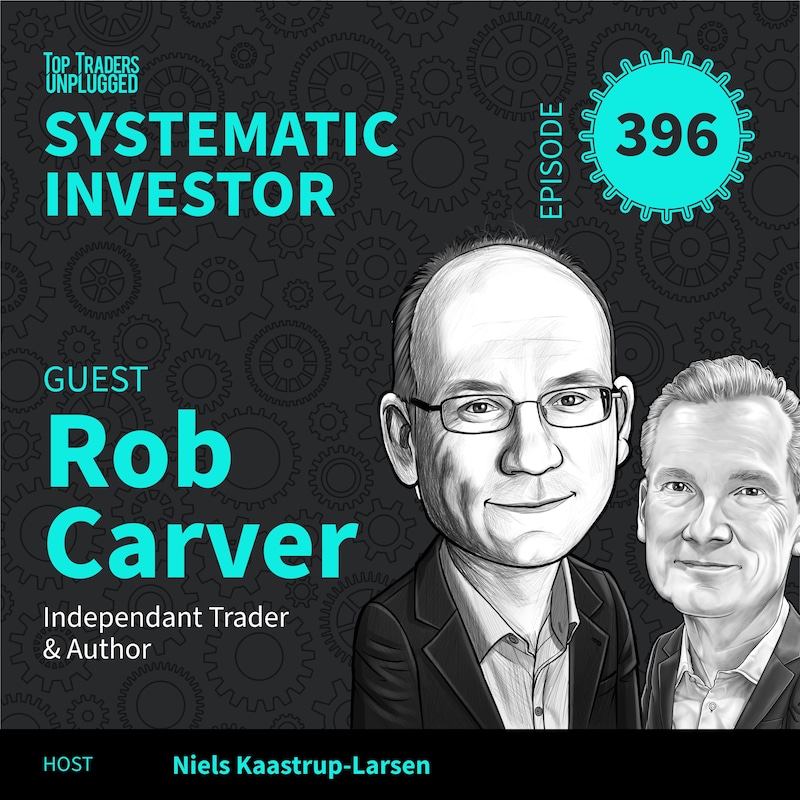
Today, Rob Carver joins us to reflect on a market environment that appears calm on the surface but feels increasingly fragile underneath. From oil market distortions and muted reactions to geopolitical risk to the steady resilience of equities, the conversation questions whether price action is telling the full story. Rob shares insights from his own performance, including why slower trend signals have recently dominated and why he is running lower risk despite positive returns. The discussion moves into portfolio construction, return stacking, and the growing role of ETFs, alongside a candid look at where complexity adds value in systematic investing and where it does not.
-----
50 YEARS OF TREND FOLLOWING BOOK AND BEHIND-THE-SCENES VIDEO FOR ACCREDITED INVESTORS - CLICK HERE
-----
Follow Niels on Twitter, LinkedIn, YouTube or via the TTU website.
IT’s TRUE ? – most CIO’s read 50+ books each year – get your FREE copy of the Ultimate Guide to the Best Investment Books ever written here.
And you can get a free copy of my latest book “Ten Reasons to Add Trend Following to Your Portfolio” here.
Learn more about the Trend Barometer here.
Send your questions to info@toptradersunplugged.com
And please share this episode with a like-minded friend and leave an honest Rating & Review on iTunes or Spotify so more people can discover the podcast.
Follow Rob on Twitter.
Episode TimeStamps:
00:00 - Intro & current market backdrop
04:30 - Oil market dislocations and futures vs physical pricing
10:00 - Equities hitting highs despite geopolitical tension
13:30 - ETFs, fees, and structural shifts in investment vehicles
17:00 - Trend following performance update and April results
20:30 - Rob’s year-to-date and 12-month performance breakdown
25:00 - Why slow trend signals outperformed
27:30 - How to evaluate large CTA managers
31:00 - Where PhDs add value in systematic investing
43:00 - Signal weighting, crisis alpha, and portfolio construction
52:00 - Return stacking and diversifying equities
01:06:30 - Managed futures ETFs vs replication strategies
01:18:00 - Final thoughts and wrap-up
Copyright © 2025 – CMC AG – All Rights Reserved
----
PLUS: Whenever you're ready... here are 3 ways I can help you in your investment Journey:
1. eBooks that cover key topics that you need to know about
In my eBooks, I put together some key discoveries and things I have learnt during the more than 3 decades I have worked in the Trend Following industry, which I hope you will find useful. Click Here
2. Daily Trend Barometer and Market Score
One of the things I’m really proud of, is the fact that I have managed to published the Trend Barometer and Market Score each day for more than a decade...as these tools are really good at describing the environment for trend following managers as well as giving insights into the general positioning of a trend following strategy! Click Here
3. Other Resources that can help you
And if you are hungry for more useful resources from the trend following world...check out some precious resources that I have found over the years to be really valuable. Click Here
Transcripts
Welcome to Top Traders Unplugged. In markets success doesn’t come from predicting what happens next, it comes from being prepared for what you can’t predict.
In each episode we go deep with some of the world’s most thoughtful minds in investing, economics, and beyond to understand how they think, how they prepare, and how they decide, and the experiences that shaped how they see the world. No noise, no short-cuts, just real conversations to help you think better and invest with confidence.
Niels:Welcome and welcome back to this week's edition of the Systematic Investor series with Rob Carver and I, Niels Kaastrup-Larsen where each week we take the pulse of the global market through the lens of a rules-based investor.
Rob, it is great to be back with you today. Hope you're doing well. How are things in the UK? Is it summer yet where you are?
Rob:I mean, summer in the UK is a sort of a moving target. So, we've had like a number of potential summers appear and then disappear. So, last week I think the weather was very good. I was actually in France, but I think the weather was good here as well. So, yeah, it's pretty nice outside at the moment, I have to say.
And I think the last time we chatted was early February, and of course nothing's actually happened in the world since then. It has been pretty boring, to be honest, in markets and with geopolitics. So, yeah, quite chilled out and relaxed to be honest.
Niels:Yes, sounds like it. But let me start on a slightly different note today because I have a bit of a service announcement to all the people listening. And that is because we at Dunn, but also others in our industry, I have noticed, are currently being victimized by scammers; people impersonating, representing CTAs and therefore I just want to make sure and (this can happen, by the way, both electronically on different platforms, on websites, and also we've seen evidence of physical letters being sent out suggesting that they're representing us or some of these other firms that we know well in the industry), just want to let everybody know that they should really be careful at the moment and they should definitely make sure that they contact the companies directly to verify, as we've seen a few people do, and that's how we became aware of it.
My understanding is, right now, that Germany, Austria in particular, are areas where these things are happening. So, just wanted to make sure that everybody is extra careful at the moment if they do intend to make investments in this industry.
Rob:So, anyways, how do people at home know, and, indeed, how do I know that you are Niels and not an AI kind of replication?
Niels:That is true. That is true. Of course, my voice could be an AI. But luckily, I don't think AI is very good with a Danish accent yet, but it might work.
Rob:Thank goodness. It's only a matter of time though, surely.
Niels:Yes, absolutely.
Anyways, by the way, speaking of that, I was listening to, you know, I like Howard Marks memos. I think they're very well written and they turned it into audio format a few years ago. And the last one they published as an audio was actually (and they, of course, made a disclaimer for this) this Make a disclaimer for this was read by an AI. It didn't necessarily sound exactly like Mr. Marks, but it was pretty similar. So, for sure this is changing.
Rob:Well, interestingly, my publisher has asked if they would like me to allow the release of audiobooks of my books, but with an AI voice reading them. Which, I think my books are quite technical, and some might say boring. I'm not sure an AI voice would help. I think you need a more interesting and kind of lively voice to do that. So yeah, we'll see.
Maybe there'll be a big market for my books now in, in terms of helping people sleep at night by listening to the AI audiobook version of them.
Niels:Absolutely, yeah. It's all about helping people, Rob, as you know, in any way we can.
Anyways, before we dive in, we’ve got a lot of topics to talk about today. A lot of questions came in, so that's great, wonderful, thank you so much. But before we do that, I'm always curious what's kind of on your radar at the moment that is not really related necessarily to what we're going to be talking about today. Anything exciting?
Rob:I mean, there is a war happening and it's dominating the headlines. And I guess one thing that's quite interesting about it is the sort of almost muted reaction in the market, particularly in the equity markets. I do feel that, you know, at some point the rubber is going to hit the road because, you know, there is this substantial supply shock happening in oil. The oil price obviously reacted to it to some extent, but even the oil price reaction arguably is muted compared to what's happening.
So, one thing I noticed, that there's quite a good article in the Financial Times on the Alphaville sort of blog of the Financial Times, which actually is free, so, you don't need to be behind the quite expensive FT paywall. And they're talking about the price of physical oil which, it seems, has become quite disconnected from the price of futures that we trade - the sort of two main futures being the WTI and the Brent futures contracts.
So, the sort of futures contracts are hovering around the sort of US$90 to US$100 a barrel level (roughly speaking). Obviously the situation is very volatile and perhaps I should say that we're recording this on Thursday, the 16th of April because things could change quite dramatically.
Niels: At: Rob:Exactly. Even by the end of this podcast things could be quite different. But yeah, so this article was saying that the price of physical oil is quite different and also is very much dependent on location. So, apparently the physical price of oil in Sri Lanka at the moment is (and I feel like a dramatic pause is required here) US$286 a barrel which is, you know, over three times the futures price. So, there does seem to be a bit of a disconnect in the oil market in terms of the futures.
So, futures contracts obviously work with delivery. You know, also all futures contracts are specified for either, as you know and most of the listeners know, for either physical delivery or cash settlement and that physical delivery will be against a particular specification also for a particular location.
So, you know, we've talked on this podcast before about, you know, buying, say, gold. If you buy a gold futures contract then the delivery of that has to be to one of a certain number of warehouses that are nominated by the exchange and sort of specified in the contract.
So, actually where your oil is and where it's being delivered to is extremely important. And you know, it does seem to be that there's a real disconnect between both the futures market but also the spot price in different parts of the world as well. So, as someone who trades oil as futures, you know, we can kind of abstract away from all of this messy black sticky stuff and making sure it's in the right place around the world.
But you know, there are people whose job that is and their job at the moment is very difficult, and it does seem that even US$100 a barrel doesn't really accurately reflect, you know, what the sort of pent up demand and lack of supply for oil is going to be. So yeah, watch this space.
Niels:Yeah, I completely agree. I think there's definitely more to this story than what we see in the markets for sure.
Actually, what's been on my radar, I would say, and what has caught my attention the last day or two, actually the first one was just really this morning and very much in line with what you're saying and that is that the S&P 500 closed at a new all-time high yesterday, like nothing's going on in the world. And this was after, what, a 10% correction or something like that?
Rob:Just buy the dip. Just buy the dip, Niels. Forget all of your systematic models, forget your signals, forget your computers, just buy the dip. That's what works, right?
Niels:Yeah, clearly. The other thing that caught my attention, you know, I think was it last week or the week before, I had Andrew on, we talked about ETFs and of course, you know, the different approaches and how people wrap strategies, either replication of quasi semi true CTA strategies into ETFs. And of course ETFs have been… And I'm no expert, I should highlight here, but ETFs, for a long time, were really known for this flat fee structure rather than what we have in the traditional hedge fund world, which is our CTA world, which is a management fee and a performance fee.
But I just noticed that now there is, I think, in Europe coming out a UCITS ETF that has a performance fee attached. So maybe things are changing, which, from where I sit, is a good thing, that we don't only get paid for raising money but actually get paid for producing real returns for our clients.
Rob:Yeah, I mean performance fees, at least in theory, do provide a better alignment of incentives between investors and managers. Right? So, is this (again, I'm not an expert), is this just the first kind of performance fee in the CTA space or is it the first performance fee in the ETF UCITS space generally?
Niels:Well, I mean, UCITS, ETF is, I think, a very new thing. Right? UCITS have been around for a while. UCITS ETFs, and frankly, again, this is almost like two people not knowing very much about a topic leading each other, which is not a great thing to do…
Rob:Yeah, listen to top traders unplugged for uninformed insight about ETFs…
Niels:Yeah, I think that should be the new tagline. But one of the key differences, in terms of my understanding, is of course that with an ETF you can trade it intraday, while with UCITS you have to trade it at the NAV, and it's only once a day. And in my view, of course it's biased, at least at this stage. As long as we don't have an ETF, I'm very biased towards kind of just UCITS. That is, for my clients, frankly there is no need to have something that can trade intraday where you can end up paying more for just waiting for the NAV. I mean, we're talking about long-term investments, where encouraging people to put this in as a core allocation in their portfolio, why do you need intraday trading? You really don't, in my opinion.
I know there'll be some other reasons, maybe, and it's easier to put in a ticker, of some sort, in a model portfolio.
Rob:Yeah, I'm going to put the other argument across, Niels, for sure, because I agree with you. I think we don't need intraday trading of long-term investments for sure. So, a lot of the investment kind of accounts, like, in the UK for example, you know, if you want to put money in the two main sort of types of account, ISAs and SIPPs, which are, you know, different tax shelter savings accounts, you're really restricted to either buying shares or buying ETFs.
And if you want to get into other things then you can do it but often it's very dependent on the platform you're using. So, you're sort of tied to a specific platform and also, then, you know, that platform will give you a list of investments that they're okay with and that may not be the ones that you want. And also, there's often, then, additional platform fees to pay. So, it's just another layer of fees on top which, you know, if you were in a sort of general account that could only invest in ETFs, that wouldn't be the case.
So yeah, you know, for my own sort of personal investment, I'm on the long only side. You know, I've big allocation to ETFs, and I would be quite tempted, to be honest, because you know, at some point I'm going to probably get too... Well, not old necessarily, but at some point I'm not going to be bothered running a kind of systematic futures trading strategy, you know, like when I'm 98 or something. And it would make more sense, at that point, for me to potentially just buy an ETF instead and have that as my alternative
.
Niels:Or maybe you buy a pure, true offshore, cheap hedge fund, you don't need to worry about.
Rob:Yeah, but as I said, that's not necessarily an option for a lot of people.
Niels:I understand. I'm teasing you.
Anyways, the other thing I noticed, and this was just kind of more... It is obviously political to some extent. It's just that we've seen, now, a long time where the current administration has been really trying to get Jerome Powell out and they've even sued him, and so on, and so forth. And then I noticed a comment by Scott Besant, who was apparently speaking at something called Semaphore World Economic Event in Washington D.C., on Monday, where he basically said, yeah, it seems to make sense for the Federal Reserve, they should wait and see before deciding whether to lower interest rates; admit the Iranian war. So, I'm kind of thinking, you know, it's kind of weird to see…
Rob:Mixed messages though, because Bessant's boss, he who shall not be named, just only yesterday or the day before, attacked Powell again. Which, just frankly, seems bizarre because, I mean, it's only got a few weeks left of his term anyway. So, you know what…?
Niels:Sure.
Rob:Anyway, yeah, I'm going to try not to talk about that, man.
Niels:Yeah, yeah, that's the arrangement we have when you're on. But anyways, let's reverse to something we maybe know a little bit more about, which is trend following.
My own Trend Barometer finished at 55 yesterday, which is pretty strong. Not the strongest we've seen this year, but it's strong. And I think that corresponds pretty well with what's going on so far in April. And of course equity markets, as we noted a few minutes ago, have had a pretty strong recovery. So, no surprise that perhaps managers with longer-term timeframes and who may not have… well, they would have reduced their exposure, I'm sure, in March, but they may not have gotten short equities and they will most likely benefit somewhat, relatively speaking, from holding on to some long exposure.
But also, some of the other things that have moved so far in April are metals. They're back in favor again. And, and some of the currency, some of the, I think, resource country type currencies are doing pretty well. So, let me run through the numbers and then I'm interested to hear what you're seeing on your side, Rob.
As of Tuesday evening, and I think yesterday was a pretty uninteresting day, maybe some managers made a little bit of money, others, you know, would have lost a little bit, but nothing major. But anyways, as of Tuesday, the BTOP 50 was up 51 basis points in April, up 8.03% so far this year. SocGen CTA up 58 basis points, up 8.06% this year. The Trend index - SodGen Trend up 52 basis points, up 7.73% for the year. And the Short Term Traders index of 22 basis points up 4.64%.
However, the big winners are equities this month as mentioned. MSCI World up a whopping 7.82% so far, now back in the black for the year - up 4.07%. And the S&P Total Return index up 7.62% in April so far as of last night, up 2.96% so far this year. And then finally the S&P US Aggregate Bond index also making a little bit of headway this month, up 65 basis points in April, up 69 basis points so far this year. But share some of your experiences so far this year, Rob.
Rob:Well, yeah, actually what I'm going to do, if it's okay with you, Niels, is I'm going to talk briefly about this year and then I'm going to take a sort of a 12 month view because one thing I do every year is do a review of my performance which is aligned with the UK tax year. Which, for reasons far too tedious to go into, runs from 5 April to 5 April in the following year. And I think that'll be interesting for people to give an…
Niels:It’s an interesting time frame.
Rob:Definitely, yeah, yeah around the sort of markets and around the sort of signals that I've seen working and not working in the last 12 months. But yeah, let's do year-to-date so far.
So yeah, I mean I was up, towards the end of March, I was up, in fact, just kind of reached a peak of 9.5% up sort of late February. I gave back a couple of percent of that in March and actually, probably, another percent or so in April. So, I'm actually up about, I don't know, 5.8%, something like that, just looking at it by eye.
Taking quite a lot of risk off the table. I think it's fair to say it's quite a difficult market to trade at the moment and that is reflected in sort of weak signals and forecasts. So, if I look at my current risk level running at about a third of my kind of long-term targets, that's very low. That's kind of something that's analogous to a trend barometer, by the way, Niels, in terms of what it means. And if I look at my exposure by sector, my biggest exposure is actually long equities.
But when I say big, it's not that big because as I said my risk overall is pretty low. I'm also long a little bit of energies and I've got a reasonably sized short position in bonds so it's not really obviously pinned for one thing or another to happen because there's just so much uncertainty about where things are. So, that's kind of the…
Niels:A bit of inflation maybe, is that kind of…?
Rob:Yeah, I mean long equity, short bonds, is kind of inflationary, you know, and a little bit of long energies. So yeah, I don't know, I mean, if this sort of oil shock plays out as I kind of expect it to, then I would probably be flat, to be honest, because I'd imagine the equities position would get hit and that would be balanced out. So, we'll see how that goes.
But let's take a slightly more long-term view then. So, from the time period I said, which is 5th of April to 5th of April, in my futures trading I made (drum roll please) 23.7% and most of that money was basically made in two periods. So, the year started badly, as we know, that was sort of coming out of the tariff tantrum. But from kind of late May to sort of mid-October I made pretty decent money and then that sort of went sideways for a bit.
And then from late December to early January I made a lot of money very quickly and I've kind of gone sideways since then. And that second ramp one, obviously is the now famous kind of metals bubble which we talked about, actually, in the last podcast, I think, in terms of position sizing, and how that affects the position and the way that P&L was taken out of that. So that's quite nice.
Interestingly, so, I do a number of different kind of deep dives analysis on that as well, into a number of different things. So, one thing I do is look at a couple of benchmarks.
I look at the SocGen CTA index, but I look at that just on an outright basis but also on a vol adjusted basis because my vol is quite a lot higher than theirs. And I also look at a fund run by my former employers, AHL, because you know, the obvious people to compare myself against. But also, that fund is denominated in pounds as is my own trading account. So, it's kind of more of a direct comparison, if you like, because it means there's less sort of currency related noise.
And interestingly, so I made … Actually I made about 26% because I'm looking at month end performance rather than April 5th to April 5th. And the relevant figures were, for the AHL fund, 18.1%, for the SocGen CTA funds 15.3%, but that's before the vol adjustment. After the volume adjustment, actually, they're slightly ahead of me, so about 30% each.
So, I'd say ,net/net, slightly behind the benchmarks. And some of them, my theory for that (which I'll talk about in a second when I get onto different signals and forecasts) is because I'm less pure trend following than them, and pure trend following did better than the other signals that I have in my portfolio, which I have a higher weight to.
But last year, which obviously was a terrible year for the industry, it was the other way around. So, my wider variety of signals kind of saved me from and my relative out performance was actually very good compared to those. So, you know, swings and roundabouts.
The other thing I do is look at market by market performance. So, on asset classes, so my best performing asset classes were equities and metals. Metals, perhaps, not a surprise because we've already talked about silver. My worst was actually bonds. So, would imagine it would have been a tough 12 months for anyone running a kind of fixed income focused CTA. And, coincidentally, I'm having coffee with our mutual friend Yoav tomorrow.
Niels:Oh nice.
Rob:So, we'll maybe chat about that.
In terms of individual markets, so, the best market for me was silver. So, not perhaps a surprise there. The second, interestingly, was actually live cattle… sorry, feeder cattle (apologies). And then there's some various equity markets up there.
So, silver we've kind of talked about. Feeder cattle, actually, there was a much nicer kind of market to trade because it had a fairly decent trend upwards for most of the year up to about October, and then it sold off and actually closed my position, and then there was another little run up which I was able to participate in. So, actually, that was quite a nice, smooth journey. Whereas silver, as we talked about last time, was quite a violent move, to say the least. So that's quite interesting.
The other thing I look at is individual trading rule performance. So, I've already given some of the story away. But, generally speaking, to divergent, what you might call divergent trend type signals, did better. And actually, the best of all of those was what I call my core momentum signal which is just literally exponential way to moving average crossovers. And, you know, that did the best of all of those. So that's why I'm sort of thinking, as I said, I underperform the pure CTA industry world wide.
But the other thing that's quite interesting is on almost all of those divergent signals, the best performing out of them was the slowest of those. So, it's really a really, really good year for slow trend following. So, you know, that's true. I'm just looking across… I can't see a single place where even if you ignore costs, where my very fastest signals did better than my much slower ones.
Then on the convergence signals, that's the non-trend following which as I said I've got higher exposure to than most people. So, carry was kind of flat, maybe slightly down, relative carry was up a little bit. And then I have a skew based signal which basically looks for markets where there's been, you know, effectively recent fat negative tails and then buys them. So, it's kind of a bit like a bouncing cap strategy, you might say. That actually did quite well. So, that that sort of helped a little bit.
And then the final thing I look at is my slippage and my costs and they were, you know, the way I like to sort of talk about this is performance is random, costs are not. Costs are very predictable from year to year, and very consistent, and therefore you should kind of give them a bigger weight in considering how to trade than you would performance. And my costs are exactly in line where I'd expect them to be. I think they're about one or two basis points different from last year. So, that's very satisfying to see.
So yeah, an interesting year and, like I said, a good year to be overallocated to slower trend following and, you know, not a sort of interesting mixture of where the money came from a sort of asset class basis. But yeah, always nice to have a 20% plus year, whatever happens.
Niels:There we are. We try to please…
Rob:So, the whole time I was talking, you were just…
Niels:Just waiting for that moment to applaud you. of course.
Rob:Thank you.
Niels:All right, good stuff.
Rob:You're too kind.
Niels:Okay, good stuff.
Okay, let's jump on to some of the great questions we had from our community. The first one that came in is from Mel. He or she… she, I guess asked, how would you differentiate among the large London trend followers? What are their strengths, weaknesses, competitive advantages, and such?
Rob:So, I don't like this question, I'll be honest, but I thought it was only fair that we try and answer questions even if we don't like them.
Niels:Well, you have to be specific in explaining why you don't like them.
Rob:Well, exactly. Well, one reason is that I know people working at all of the large London hedge fund CTAs and I'd hate to kind of pick one out and say that, you know, one is better than another. And then there are reasons why I might not like particular firms, which is more subjective, to be honest. It's not to do with their sort of investment process. And I would be far too polite to pick those out as well. And so, so that, that sort in mind.
But I think we can perhaps talk more generally without being fair or unfair about what we would look for if, let's say, we were allocating to a CTA and we decided that, you know, that was our subset of CTAs that we would want to look at. You know, what would be the, on the sort of list of questions that we'd ask in terms of our due diligence process, and what would we be looking for? That I think is a fair question to answer. Do you want to kick off on that, Niels?
Niels:I mean, again, because I have to kind of be neutral, I think the main thing that I've noticed in terms of, I think the question was focused on London based managers, I actually think that we have to recognize that a lot of the managers, specifically in London, have the same origin, which is AHL. And my impression has always been that, to a large extent, the successful ones, to some degree, actually use more or less the same methodology. Which was a European methodology that got developed, unlike the US methodology which was more kind of breakout style - either vol or price breakout.
I feel, and I could be completely wrong, I feel that it was much more moving average driven and, maybe later, time series momentum driven by the Europeans, even though of course US firms have also adopted certainly times series momentum later on. But I think a lot of it (and obviously I'd love to hear your thoughts on this), it's not necessarily that people use different methodologies, but it's kind of more the details about how we maybe manage the data before it goes into the engines, what criteria we may set for targeted volatility, targeted risk. Of course, a big driver of difference between the firms, I would imagine, are just simply the markets they choose to trade.
And these are not new things. Right? So, it comes down to speed, methodology, markets universe. So, that's how I see it. Because, I think all of our colleagues, established colleagues in Europe, in the US, that are all doing great stuff, and many of the firms have been around for decades, and I think that's a great testament to generally having real sound research teams, business models, of course. So, I don't have anything sort of more specific than that, because I don't want to be… Even if I may have access to information, I don't want to say something that I can't back up.
Rob:I'm in the same situation. Yeah, I mean, the historical thing is quite interesting. I've talked about this before as well. The fact that, you know, the European hedge fund industry has a single parent, if you like. Although it's slightly more nuanced than that, because before Man Group bought AHL, they bought a fund called Mint.
So there's a little bit of the Mint, and Mint was a US fund. So, there's a little bit of this sort of Mint lineage in there. But the fact that the systems were originally designed by three guys who all did physics at Oxford means that the way…
Niels:I don’t think they were all at Oxford. I think they would be offended because I think one of them came from Cambridge, if I'm not mistaken.
Rob:But anyway, they were all physicists, we can say that with certainty. But yeah, I think you're right. I think it was two at Oxford, one at Cambridge. And the joke used to be at AHL that their idea of diversity hiring was hiring a physicist who hadn't been to Oxford or Cambridge.
The point is that those systems were designed sort of from a kind of scientist type, kind of looking at things from a sort of more of a scientific basis. I'm trying not to be rude about the US hedge fund industry here, but a lot of the US CTAs grew out of US floor trading, I think it's fair to say, and grew out of guys who were trading on the floor and had a very particular way of looking at markets. Whereas I think the Europeans came across as more scientific.
I'm not saying that either approach is wrong, or better, or worse. Of course they have the advantages and disadvantages, but that is quite interesting. So, I kind of agree with you about the details.
So, there was a very good British cycling team [formerly called Team Sky], now sponsored by INEOS who did very well in the Tour de France and other competitions. And the coach is a guy called Dave Brailsford, who's also the coach for the British Olympic team. And he had this concept of what he called ‘marginal gains’.
And the idea is that there isn't like one big thing you can do, but you can do lots and lots of small things really well. So, you know, I talked about slippage, for example, you know, so if you can knock 50 basis points off your slippage, you might think that's not very much, but actually that's 50 basis points pretty much guaranteed every year, forever. Whereas if you add 50 basis points onto your top line expected performance, well, some years you might get that, some years you might not because that's randomness.
You know, diversifying through adding lots of markets, for example, making sure you're not trading markets too quickly, making sure you've got accurate estimates of costs, making sure you haven't overfitted. All of these things are quite small, but added up they can make, you know, quite a big difference. And I would say, absolutely, that's what the big firms, or the well established and the good firms, tend to do better.
So, I think that's definitely something I'd be looking for if I was, you know, doing due diligence. I wouldn't probably be asking about the sort of kind of “source of alpha”, because they probably wouldn't tell me that. I'd be asking quite tedious questions about, you know, things like operational processes and cost estimation because I believe that focusing on those details is what tells you whether somebody is likely to be good or not.
Niels:Next question is a long one, or at least it's a long question. I don't know if the question itself is long and we'll spend a little bit of time on it. But obviously there are other things we need to cover today. It is from Matthis.
He writes, my question is about where, in the systematic futures trading process, you think mathematical complexity pays off? Where do all the PhDs in the industry add value? Am I missing something? Of course, I understand that if you're doing exotic derivative pricing or very short-term trading, you can use more math. But even plain CTAs and slow trading firms seem to employ a lot of PhDs. What are these folks doing all day? Nothing against PhDs of course, but I'm just generally curious.
Rob:Yeah. So, I obviously should disclose that I do not have a PhD. And Niels, I don't think you do either. So again, we're talking about things that we're completely unqualified to discuss. Again, this is the theme of this… I think the title of this particular episode could be Two Ignorant People, or something like that… anyways, Two Ignorant Old Men Opining on Things They Know Nothing About.
It is true, for sure, that I'm certainly in favor, and, you know, Mattis gives a number of examples, but I'm in favor of using simpler methods, rather more complex ones. But actually, one interesting thing I've noticed is that people who are very smart tend to have a preference for simpler things, but they have an understanding of when you can use a simpler model and when you can't use a simpler model.
Whereas people who are, I would describe them as a bit clever. So maybe they have got a PhD or they're highly qualified, but perhaps they haven't got much experience, so they've just come out of school quite recently, tend to use more complex methods, almost for the sake of using more complex methods, because they assume that, you know… There are a number of reasons.
One is to sort of justify the fact that they've been hired at this big fancy salary, you know. So, you know, they're probably thinking, well, I wouldn't be expected to use just sort of naive mean variance optimization or, you know, linear regression (these are quite simple techniques, by the way), given the fancy salary I've been paid and all this work I did on my PhD. So, I'm going to use this more complicated method.
Actually, when you've been around the block a few times (and this is true, irrespective of Whether you're a PhD or not), you kind of realize when those methods are unnecessary, and when they actually can make things worse, and when you're better off using simpler methods. So that's one thing I would say is that, actually, not educational qualifications, but certain experience will tell, you give you a better idea of when you need to go simple and when you need to go complex. So that does mean you do need to have the kind of mathematical artillery to go complex.
So, you know, you need to know, for example, that if you do need to use a more mathematically complicated method, well, clearly you need to have the sort of ability to do that. And so that's important. And there's nothing more dangerous than someone using a more complex mathematical method that they don't really understand what it's doing.
And this, I think, is the obligatory point in the episode to, say, AI, LLMs, there's a lot of people using them who have no idea what they're doing and what's going on inside them. In fact, it's almost impossible for a human being to know what's going on inside them. And I'd say that maybe only 0.01% of people using this financial data are actually doing it in a way that's not going to go horribly wrong. So I'd say that for a start.
The more interesting question is, I think I've discussed this before, if what we do is quite simple and also quite, in a way, quite static, so the research cycle is quite long, so you can use the same model for years, potentially decades. And we know we're not in the sort of place where if we were trading much faster, where we'd be seeing very fast alpha decay and where we'd need to have big research teams continuously finding new signals and then incorporating into our models, the cycle is much slower.
And actually, a lot of the things that you can do to improve your performance, as we've discussed, are not necessarily kind of “clever things”. They're tedious things like properly measuring your transaction costs and then diversifying into markets, which is a process that starts with something quite tedious, involving getting data, and making sure it's clean, and things that you don't need to be necessarily kind of super intelligent to do. So, it is a kind of interesting paradox whereby it's felt that to be seen as a good quant hedge fund, you need to hire lots of really smart people.
But actually, in the CTA business, as a general rule, well, what do these people do? Because, you know, it's an interesting one. And some people could be cynical and say, oh, well, it's a marketing thing. You know, funds like to put in their slide deck, oh, we've got 55 PhDs in our research team, therefore we must be good. So, maybe there's an element of that.
Some of it's the fact that, you know, a lot of the bigger CTA businesses have diversified different things like, for example, setting up equity funds, setting up, you know, HFT teams, setting up, you know, I don't know, private credit businesses. For those diversification possibilities, if you like, then yes, you would need smart people.
You potentially need smart people if you're diversifying into other asset classes, like, for example, if you're going to start trading options as well as futures, well, clearly you need people who understand how options are priced and how to build vol services and things like that. So, there is always work for these people to do. But for sure, I do think, if I was to start up a quant hedge fund tomorrow, I think one of the biggest challenges as a manager of quant research is often making sure that they kind of stick to the stuff that may seem a little bit boring, not sexy, and exciting, and interesting, and cool as.
Because I've noticed that very smart people have a tendency to focus on things that they find sort of intellectually interesting and then overlook the sort of boring stuff that as I said, I think genuinely adds to the bottom line of performance.
But yeah, I always use the simplest model I can. But I'd say that it's the best part of two decades of experience that allows me to know when that's the right model and when I need to be more complex.
Niels:Sure, absolutely. I think experience is of course always underrated.
Rob:I've just realized what I just said, Niels. Two decades I've been in the CTA industry now for just short of two decades. That is terrifying and depressing. And I know that you're even…
Niels:I’m Coming up to four decades, so it doesn't feel very long to me, but there we are. Anyways, I just wanted to add, I think you said most of what I wanted to say, but it is true that, certainly in my career, I've often been asked this thing about, you know, how do you compete? you know, with Dunn we've had sort of one, two PhDs at a time, you know, in the research team. But actually, long-term performance has been better than firms with, as you say, 50 PhDs. How does that work? So, I don't think… It's not necessarily the quantity. I think it's definite that you need people on your team that can work with very large sets of data and have that background to do that.
But it always comes down to having people who can think outside the box and, as you say, maybe take certain things that most people might go in one direction and maybe find another direction to go, and whether that's simplification or it's looking at the challenge in a different way. And certainly, it's probably not spending much time on signal generation. It's probably all the other things including risk management, and so on, and so forth. But rest assured, I think most PhDs earn their full wage at these firms. So, it's by no means…
Rob:And if there's a university out there that wants to give the two of us honorary PhDs, I'm sure we would gladly accept.
Niels:Oh yeah… It may be the only way we're going to get one.
Rob:Yeah, for sure.
One really, really quick thing, Niels, is you went sort about thinking outside the box. I think it's really important to have a diversity of thoughts within a research business. And you know, we joked about it, but if you did literally just hire physicists you wouldn't have that. And I think I was the first economist that was hired by AHL, and certainly I'd like to think I brought some diversity of thought against all the mathematicians and physicists that they employed. And I think that's still true.
Niels:Yeah. Okay, cool. We're going all the way to Canada now for a question from Paul that came in. My question to Rob relates to the process of assigning signal, eg. trend, carry, skew, weights, to the instruments and asset classes he trades. My memory is that he advocates at the same weight across all asset classes. I think part of the motivation is to avoid overfitting.
I was curious of his insights on deviating from this approach because of crisis alpha considerations as some rules, for example equity skewness, have large equity crisis exposure.
Rob:Yeah, it's an interesting one. So, actually my sort of big kind of thing I'm doing this year is I'm going to do a big research project on fitting and backtesting and one of the outputs of that will be a book. I don't think I've mentioned it, but I do have a book coming out in December. So it won't be that book, it'll be the one after that. But, but I'm sure there'll be many opportunities to plug the December book coming up, but that's not for today.
So, one of the things I do, at the moment, is actually correct. I do actually, basically, assume that all instruments are the same as far as fitting goes. So, I use the same ignoring costs, I use the same forecast weight. So, I've got the same allocation to carry, to trend, different trend models within that, and so on, and so forth, irrespective of the instrument concerned.
Now, one of the things I'm planning to do in this giant project is to actually have something that tests that assumption statistically. So, the way you might think about how this would work, what essentially you would do is calculate the weights for different asset classes and instruments, like the S&P, the US 10year, gold, silver, feeder cattle, Bitcoin, whatever, and then say are any of these weights sufficiently close to each other that we can treat them the same?
So you might expect, for example, the US five-year and the US ten-year bond would trade similarly enough that you would have the same signal allocation to those two assets. In which case you'd then essentially pull your fitting across those two assets and use the sort of joint information between them, if you like. So that's kind of the idea at the moment. It's just the sort of drawing on the back of a napkin. So, watch this space in terms of whether I get that to work or not.
Because I think one thing that's worth saying actually is, certainly when I was at AHL, the second sort of last few years, the way this process was done was each individual asset class team did their own fitting, and so they may have ended up with different weights. So, the question is (that one question we kept asking ourselves) does that add any value or not? So, this is a sort of rigorous way of exploring that option.
Now, what's interesting about Paul's question is he actually talks specifically about crisis alpha. (And every time I say that I feel I should add in brackets, copyright Kaminski.) And so, this is slightly different because what you're sort of saying is that what we call our objective function when we're fitting, so rather than being, say, maximum Sharpe ratio, the objective function is going to be a little bit more nuanced and subtle than that. And it's actually going to say, well, I don't want to just have maximum Sharpe ratio, I want to have the best performance in crisis situations.
I think last time we were on, we talked about a Man Group paper where they did something like that, right? They said how would your weights be different if you focused on crises rather than just on maximum Sharpe ratio?
So, it's an interesting question as to whether that, separately, is an approach that you would use or not. So, I would say that if all of your money was just in trend following and you had no other investments at all, then you definitely wouldn't do this. You would just focus on maximum Sharpe ratio.
If on the other hand you had a portfolio consisting of some bonds, some equities, and then you added trend following to that, then what you should be doing is optimizing the sort of joint performance of that portfolio. And one way of doing that is to make your CTA portfolio as sort of crisis alpha friendly as possible, if you like. So that that sort of kind of makes sense.
I'm not sure whether I'd necessarily go down that approach myself, I think I'd probably do something that would be a joint optimization of my equities, my bonds, and my CTAs. So, you know, if you do that, it would do things like, for example, reduce your risk weighting in equities and bonds in the CTA sleeve because you already have an exposure in the other parts of your portfolio, and because those assets have gone up over time, you'd have a long bias to those assets.
You kind of already got that exposure elsewhere, so you need less of it in the CTA portfolio and you'd end up allocating more to, you know, things like ags, for example, and you'd probably also speed up your CTA portfolio a bit as well in that process, as well. So, those are the kind of things you'd expect to happen.
And you may also, and I haven't looked at it myself, but you may also end up changing your weighting between divergent and convergent within asset classes as well, potentially, to get that extra crisis alpha. So, you'd want maybe more like trend in equities than carry because you want that sort of responsiveness to sell offs of equity shocks to be very, very sharply defined.
So, it's an interesting idea. I probably wouldn't do it myself, but as I said, I am exploring the idea of, you know, being a little bit less kind of strict with my fitting and going down the route of allowing my weights to be a bit different, but only if there's statistical evidence of that.
Niels:Well, it kind of fits nicely into the next topic we're going to talk about because it is the latest paper from our friends at Quantica, and it's called If You Can't Beat It, Stack It.
But before we dive into the paper, let me just give you a big shoutout to Bruno Gmur, Nicolas Mirjolet, Rob Kende, Arthur Baijot, and the whole team at Quantica, because they very kindly invited me this week to their annual investor lunch in Zurich. And that was a great opportunity, not just to meet the whole team, but actually they did a really good job in terms of presenting some very relevant and interesting topics, including what we're going to be talking about, some of the research. Of course, we owe them a lot because they produce great research that we talk about every time it comes out. So, yeah, just a wonderful opportunity, which I'm grateful for.
So, let's, let's talk a little bit about their latest paper. It's not that we're going to be doing anything that will replace… People should go and read it themselves on the Quantico website, of course.
But we'll talk about some of the observations and maybe some of the different ways they have approached the problem because the problem has always been that it's been, certainly in the last couple of years, decades maybe, it's been very hard to beat equities. And people often compare like a long only equity portfolio to say a trend following strategy. And, to be frank, most of the time in the last 15, 20 years, as I said, it's been very, very hard to, to beat those returns that they've produced.
But maybe, maybe the question is you don't necessarily have to sell your equities in order to benefit from having some trend following exposure. So, so I think that's really what the key takeaway from here.
who launched, I think back in:And so that's why I think it is relevant, even today, because not enough investors look at their equity portfolio in this way and certainly not enough people have made the jump into putting a meaningful allocation into trend following along with their equity exposure. So, can I turn it over to you Rob, and talk a little bit about your kind of observations from this paper and maybe some of the things that Quantica does, maybe perhaps a little bit differently in their approach to this?
Rob:Yeah, so portable alpha, which is the sort of like the old fashioned term, I guess. As you say, it was around in the ‘90s. And the last few years return stacking has become more popular. And the idea, basically, is to sort of get away from this idea that you know, when you're doing a portfolio allocation it's like a piece of pizza, and you have to kind of cut the pizza up into slices. So, would it be 60% in equities, 40% in bonds, and then, you know, you carve out a bit of the pizza for trend following, say.
To get away from that sort of simplistic idea and to say, well, actually, what we're really doing here is we're buying risk, and we're buying risk with cash, and the sort of different levels of efficiency of when you're doing that. So, for example, if you were to buy short duration bonds with cash, unleveraged, that's a really poor thing to do with your cash because you're not buying much risk and you're using a lot of cash to do that because it's an unleveraged position. So, it's 100% funded.
Whereas if you're buying that exposure with, say, a future, then you can… I don't know off the top of my head what the margin is, but it's probably not that different from about say 10%, I think, on a short US bond. So, that's a very highly cash efficient thing to do.
And if you look at a CTA portfolio as a whole; so, I run with a 25 vol risk target, which is a bit higher than most of the industry, but my cash usage typically is about 30% to 35%. So, if you sort of scale those numbers back to sort of industry levels, which are kind of similar to equities overall, so, if you say, well, globally diversified basket of equities probably runs at say about a 15% volume. And if you run a CTA at 15% vol, your average cash usually is probably going to be around the 25% level. So, 25% cash to get 15% vol is an extremely efficient use of cash. And that's not because CTAs or trend following itself is some kind of magic. It's purely because you're doing it using futures. And futures are very, very cash efficient.
So, what that means is you kind of throw away the idea of your fixed slices of pizza and instead you say, well, actually, we can effectively make the pizza bigger because, you know, if we were just buying CTAs, instead of having the sort of small, sort of 8 inch, 12 inch pizza, we'll be able to buy a pizza that was four times bigger than that, which there would be like a 24 inch pizza which would barely fit on the plate. So, that's sort of the kind of, you know, the layman's guide to what they're doing.
The nice thing about this paper is I really like papers that kind of use maths correctly but also in an intuitive way to sort of show an intuitive result. And this paper really does that. I'm a really big fan of papers that have kind of you know, nice graphs that you look at and immediately you don't need to read the rest of the paper. It just makes a lot of sense. And they've done that in some interesting ways.
So what they sort of said, to begin with… As you say, the point of the paper is, well, what's the best way of diversifying equities? They look at a number of different alternative ways of doing that. So, one thing that is interesting about the paper is that I think the kind of span of things they look at is wider than…
So, a lot of the time you read these papers and they're like, well, you want to diversify equities. Well, you can either go into bonds or trend following. Well, you know what guys, the universe is a bit wider than that. There are many other things we could be doing, right? So, they look at a number of different alternatives, so, carry equity, market neutral, gold, treasuries, long vol, short vol, equity long/short. So, fairly standard sort of sources of alternative beta, if you want to use that term. But as I said, it's nice to see a variety of them in a single paper.
And then what they basically do is say, well, these things have got different correlations to equities and intuitively we know… well, we want to have more of the things that are less correlated. But unfortunately, in finance there's no free lunch, as I keep saying to you Niels. You've got to appreciate this. In finance there's no free lunch. And things that are lower correlated tend also have to have lower returns. So, diversification doesn't come for free. And because equities have just been this outstanding asset class, anytime you move away from them and into things that are more diversifying, inevitably there is a cost of lower performance.
But the nice thing about the sort of return stacking or portable alpha approach, because you can use leverage, that means that the improvements in diversification you get, in the form of an improved Sharpe ratio, which would come with lower returns if you had a fixed sort of piece of pizza, you can actually convert those into higher returns by sort of whacking your leverage up again as long as you don't get too crazy. And you're able to do this, obviously more, if you're adding a more cash efficient strategy rather than a less cash efficient strategy.
So, the sort of three things determining what your optimal portfolio is going to be, the correlations we've discussed, the lower the better. What you might call the return track or the diversification drag. So that's the loss of performance as you add things to this, this portfolio. And then thirdly is the cash efficiency as well that also has an impact.
So yeah, they've got this really nice graph, and it basically shows that, you know, essentially there's a sort of maximum amount you can add to an equity strategy depending on these things. And that means, for example, if you add say, I don't know, something like a short vol strategy, which obviously is going to be very correlated with equities because in a crisis short vol is going to get hammered nonlinearly to equities, maybe exponentially worse. Because they're so correlated you want to have quite a small allocation to those as a diversify maybe 10%.
Another extreme, a long vol strategy, unsurprisingly, because its correlation to equities is actually negative you can actually have an allocation that's over 100%... theoretically… And there should be many caveats and warnings. These are all theoretical results and all past performance is no guide to the future, as usual.
But some more reasonable things like, say, trend following, gold, or treasuries, which also kind of sit in the middle, you can kind of stick 50% of your portfolio quite happily into these without any issues. And, you know, 50% is way more. So people might be running 60/40 equities to treasuries portfolios still, but no one's running a 50% trend following portfolio. Well, I am at the moment, but that's another story. I'm a bit crazy. And, you know, only the most obsessed gold bug would necessarily have such a high allocation to gold. So that kind of result I found very interesting. So that's a sort of theoretical result.
And then they talk about and they go into sort of details about, there's another very nice picture which is figure 5, which I can't possibly explain because it has lots of lines on it. But I find it very intuitive in terms of sort of kind of understanding the tradeoff between adding things that are less correlated, more diversifying but then perform worse, and understanding that trade off in a very intuitive way that I'd never seen before.
So yeah, it's a very, very interesting paper. And I think anyone who's thinking about doing any kind of allocation should definitely be reading and understanding it because even if you're not potentially a CTA investor, I think it gives you a really good intuitive understanding of essentially the problem of portfolio optimization when you have different levels of cash efficiency.
Niels:But you're right, I mean, I think there are a couple of things just to kind of (I wouldn't say dumb it down), just kind of the basics. Right? I think a lot of investors, when they think about how to diversify their portfolio, they think about, let me find something different that has a high Sharpe ratio because high sharp is always good. And what they're concluding, and again, as I said, they're not the first ones to conclude this, but it is a very important point. It really isn't about finding something with a higher Sharpe ratio. It's finding something that behaves differently, and is cash efficient, that allows you to have a sizable addition to your portfolio. So, it's this room to scale that is so important.
SocGen trend index in around: ade this, you know, since the:So, this is why, when you look at these studies and analysis, you need to really be careful and consider periods that may not be included in the study itself. And I love the fact that they just make that available for people to do, to do that.
Rob:I mean the other thing you can do is sort of incorporate some notion of forward looking returns which is a bit dodgy and a bit hand wavy, but you know, one of the things I do quite a lot is just assume that all assets have the same Sharpe ratio, for example, forward looking, which doesn't seem to me a unreasonable thing to do compared to, say, assuming that the incredible run in US equities, for example, versus other equities would continue into the future. And the other thing you can do is look at the fundamental returns you'd expect an asset to get.
So, for example, in equities it's not unreasonable to expect that you'd earn price earnings ratio with an inflation component attached to it. And I'd think in gold, to be honest, I think I would… If you ask me what my long term forecast for gold is, I'd say, well, probably just inflation plus zero because it doesn't earn anything. And although speculative runs and temporary demand runs may drive its price temporarily up, eventually there's enough of it left in the ground, I believe. Eventually the people will just mine some more and then that price will come back to a kind of long-term trend. So, I'm pretty confident, if you go back far enough, you'll see that gold, if you kind of plot an inflation line, gold will have just gone around that with big swings, of course, huge swings. But that would be a reasonable…
Niels:You're absolutely right. And I think I've seen that chart going back 50 years or so.
Rob:So, that lines up well, and on that basis, you'd probably say, well, maybe, yeah, you should have a little bit of gold in your portfolio because maybe it is a diversifier. But, given its return, should be systematically lower than, say, equities, bonds, or dare I say it, CTAs. Then that allocation should be relatively low. But you know, I'm not a gold guy. You're not a gold guy. We're talking about things we don't understand.
Niels:Again.
Rob:There should be some bitcoin.
Niels:Then we've done the full thing.
Just round it up, before we move on to another article we wanted to touch on, I mean we did a study on our side at Dunn, six months ago. We've probably updated with some new figures. Just looking at, actually, if you just look at the alternative universe, what are the best strategies to combine with an equity portfolio? Because again, there are certain hedge fund strategies that get all the attention. But actually when you crunch the numbers, there's really only one standing and that is trend following. So, it's not that we are… Well, we are biased, everybody knows that. But we also have the evidence to back us up when we make these claims. And I think that's super important. Even though of course we have no idea what the future will hold.
Anyways, let's turn to an article from another great source, namely Hedge Nordic, wonderful publication that everybody should subscribe to. They had a number of different articles out, some CTA related. And the one that caught my eye, you know, recently I had Andrew Beer on the show and he talked very much about replication from his vantage point. They took a little bit of a different view on kind of the ETF versus CTA style space. And drew, I would say in fairness, some slightly different conclusions in terms of outperformance or lack of outperformance by ETFs. So, what were your thoughts about the way they approached the topic, Rob?
Rob:I'm assuming that these guys, Hedge Nordic, bought you some nice pickled herring or something, did they, in exchange for this?
Niels:No, I'm not sponsored by anyone.
Rob:Okay, so no free lunch in this case.
as actually been around since: Niels:I think you're right.
Rob:Yeah. So, there's 13 of them. And so, there's sort of a reasonably even split now between what they call CTA ETFs, what they call replication ETFs, which of course, Andrew would be the expert on those, and what they call other ETFs.
Now they make some good caveats about the fact that it's not been 10 years is a reasonable length of time, but many funds have been trading for much less time. But even 10 years, actually, you may not want to draw too many conclusions from that in terms of performance, because is it statistically significant? I don't know, I haven't checked. But it's better than nothing, clearly.
So, they've looked at, as one might expect, both performance and correlation, but also, interestingly, what they call crisis alpha. (Again, copyright Kaminski.) And so maybe starting with the sort of, I don't know, with the correlation first.
So, they look at the correlation to the, as mentioned many times already on the podcast, the SocGen CTA index, and they find pretty decent correlations. There's a nice scatter plot in there which is always good to see. There's sort of a kind of hand waving discussion that maybe some kind of ETFs have got a higher correlation to the index than others.
I'm not sure the data is enough to tell you that, but certainly, you'd expect… obviously if you've got a replication ETF that's trying and its benchmark is the SocGen index and, of course, by construction it should have a high correlation that otherwise it's just not doing its job properly. Whereas you know, some arbitrarily chosen managed futures ETF that hasn't got that as a mandate, then you know, clearly won't necessarily be sort of aiming for that.
So, generally speaking they all have a pretty reasonable correlation with the SocGen CTA index. I'd say that the correlations are, you know, if you were to choose 13 random CTAs and actual funds rather than ETFs and look at their correlations, you probably find they were quite similar. So that, to me, that's a sort of test I would apply, and I think they're pretty similar.
So, that's correlations performance, as I said, because 10 years isn't necessarily a lot of time. Is it long enough to judge? I'm not sure.
So, I think, as I discussed right at the beginning, I was talking my own performance, really this is a tradeoff probably between what you might call tracking error or perhaps let's call it a simplification tax. So, if the ETF is is forced or constrained in some way such that it can't do what the sort of pure CTA can do, whether that be a limit on the number of positions, on the types of markets that can be traded, or in the case of a replication ETF, if it's being done in a top-down way that limits the number of contracts you can trade, for reasons which I've discussed before. And there's also a blog article I wrote about it.
That's not a criticism of Andrew or anybody, it's just pure maths, isn't it? And there's sort of no way you can get around it really. So, there the question is, how much that will detract from performance versus potential gains you would get in terms of reduced costs. And again, we've discussed the potential controversy about the exact estimation of costs, and some of the numbers thrown around in terms of cost savings seem a little bit large given that you potentially still have to trade the thing. But that's another story again.
But on that basis, again, obviously there's a differential in performance between the different kinds of ETFs. I'm not sure that the figures are necessarily… that there's enough history here, with some funds only been around for a few years, to actually draw any firm conclusions. But again, I'd say that, roughly speaking, the performance is not massively out of line with the SocGen ETF. In some cases it's a bit better, in some cases about the same, in some cases a bit worse.
So, I'd say, if you're buying the ETF as a sort of (I'm not sure whether this is the right phrase I'd use and Andrew would probably be upset, but I'm going to say it anyway. Apologies in advance, Andrew), if you're buying the ETF as a sort of poor man’s CTA. And as I said, that's not an insult because, as I said earlier, you know, many people only want to (including myself in certain accounts), only want to trade ETFs. But if you're buying it as that then it seems like none of these funds are doing a terrible job. And actually, net/net, it's probably a reasonable thing to do. I don't think there's enough evidence to say one way or another whether one approach is better than another, or whether ETFs are intrinsically worse than “the real thing”. But they seem okay.
You know, I'm not sure I can be more positive or more negative than that, and I'd certainly, happily probably, buy any one of these and maybe even buy a basket as an alternative to my current trend following portfolio should I decide that I can't be faced with the hassle of worrying about the rolling of 250 futures contracts anymore. So that's interesting.
Now, the one part of the article I found a little bit opaque to be honest, in terms I don't really understand how they did the calculations and maybe I need to read more closely or maybe this is something they explain elsewhere, but they do measure crisis alpha but I'm not sure exactly how they calculate it. So, I don't know whether they're doing a sort of episodic thing which is, you know, where you say, well, this was a crisis, this was a crisis, this was a crisis. Or whether they say they're defining a crisis systematically as a movement of more than X downwards in say, you know, S&P or MSCI world. I don't know, they don't actually say. Either way I would say that 10 years isn't probably enough time. I mean the last 10 years has been pretty exciting. And we've had a few crises. You know, principally we've had Covid. We had the tariffs last year. Maybe we're on the brink of another crisis as we discussed right at the top of the podcast. I don't know.
So, I think statistically this is probably the dodgiest part of the paper because regardless of their methodology, there just haven't been enough crises to say, for sure, whether a given type of fund is likely to provide a better or worse crisis alpha than another type of fund. But maybe the lovely people from Hedge Nordic want to send me an explanation of how they calculated this.
Niels:Well, let me just interrupt here…
Rob:Along with my free pickle herring.
Niels:So let me just interrupt here. It's not Hedge Nordic who has written the article. It's Alexander Mende and Per Iverson at RPM in Stockholm who wrote the article.
Rob:Pictures of those gentlemen at the top.
Niels:Exactly.
Rob:So, Alexander and Per, if you want to write to me and explain your methodology, that'd be very interesting. And yeah, any bribes of food would be very welcome.
Niels:So, I don't think, necessarily, as you say, I mean, it's not that because of the limited data, and I think this is the point that I would take away from it, to some extent we've heard one narrative and that is replication. It's more efficient, so it will continue to outperform CTAs, and so on, and so forth.
I think what, what this paper showed me is that actually, when you adjust for volatility, when you adjust for interest income, because the index that is often used to compare to replication CTAs does not include 100% interest income. So, you can't really just, you know, compare it, even though you probably have to.
But once you adjust for these things, and maybe once you use a more appropriate index such as the SocGen Trend index, there has been no outperformance by replication CTAs. I think the main thing that sort of sits with me is that it's not so much, whether managed futures ETFs works or replication works, it's just whether, if you simplify the strategy, you kind of remove the edge that the investor is buying it for, and that is the crisis.
And as you rightly said, with your own performance and your own analysis, for example, the last 12 months, the best thing you could be is very, very slow as a manager. And guess what? That's exactly what some of these replication strategies are, they're incredibly slow.
So, you know, we'll just have to keep plugging along. And as we always say, it's great that people have alternatives, and for some people it's critical that they have access to these type of strategies. But I think they present a slightly different case to what I hear in terms of this, you know, “guaranteed outperformance by replication”. I think they present a different view on that. Of course they have their bias as well. They run fast with real CTAs. So, we understand that and we all have our biases, of course. But it's always good to see things.
Rob:Just a footnote on that. And it sort of ties into the discussion about portable alpha. And my own performance is that if I look at my performance for the last 12 months, then just almost 300 basis points came purely just from interest income on my margin.
Niels:Yeah.
Rob:So that including or not including that can, potentially, make quite a big difference. And yeah, as you say, guaranteed outperformance, well, if anyone says guaranteed anything, I'm immediately suspicious, I have to say.
Niels:Well, that's what the scammers are saying when they try to impersonate the CTAs at the moment.
Rob:I've also been impersonated and it does make me laugh because they always try and sell people, you know, automated AI trading bots trading bitcoin, which is about as far from what I'm likely to ever try and do as it's possible to be. So, I find it slightly amusing, but obviously it's quite terrifying as well.
Niels:Yeah, Rob, we've gone long today, so appreciate people sticking with us. We'll wrap it up now and just say a big thank you to you Rob, for spending some time and preparing for this conversation.
If you want to show Rob some love and some appreciation, go to your favorite podcast platform, whether it's iTunes, Spotify, Amazon, wherever you listen to your podcast, leave a rating and review. It really does help. It also helps to follow the show. Many people actually just listen to the podcast, but they don't press the one called Follow. But you really should because the most popular episodes will show up in your feed, perhaps more promptly. And some of this is pretty time sensitive stuff as well. So do follow the podcast as well.
And of course, if you want even more from us at Top Traders Unplugged, you can subscribe to the weekly emails we send out and that will give you additional information.
next week I'm joined by Cem Kassan, he's back. This will be a timely conversation, I'm sure, but because of everything that's happening and also because a lot of people listening to the show love to hear his thoughts and his ideas about what may happen next.
From Rob and me, thanks ever so much for listening. We look forward to being back with you next week. And in the meantime, take care of yourself, take care of each other, and for sure, stay away from anything that seems to be a scam from a CTA.
Ending:Thanks for listening to Top Traders Unplugged. If you feel you learned something of value from today's episode, the best way to stay updated is to go on over to your favorite podcast platform and follow the show so that you'll be sure to get all the new episodes as they're released. We have some amazing guests lined up for you and to ensure our show continues to grow, please leave us an honest rating and review. It only takes a minute and it's the best way to show us you love the podcast. We'll see you next time on Top Traders Unplugged.
This podcast expresses the views of its hosts and the guests appearing on the podcast as of the date of its recording, and such views are subject to change without notice. Top Traders Unplugged do not have any duty or obligation to update the information contained herein. Furthermore, Top Traders Unplugged make no representation to its accuracy and it shall not be assumed that past investment performance is an indication of future results. Moreover, wherever there is a potential for profit, there is also the possibility of loss.
This content is made available for educational purposes only and should not be used for any other purpose.
The information contained in this podcast does not constitute, and should not be construed as investment advice, or an offer to sell, or a solicitation to buy any securities or related financial instruments in any jurisdiction.
Certain information contained herein concerning economic trends and performance is based on or derived from information provided by independent third-party sources. Top Traders Unplugged may believe that the sources from which such information are obtained are reliable. However, Top Traders Unplugged cannot guarantee the accuracy of such information and has not independently verified the accuracy or completeness of such information or the assumptions on which such information is based.
This podcast, including the information contained herein, may not be reproduced, copied, republished or posted in whole or in part in any form, without the prior written consent of Top Traders Unplugged.




