Shownotes
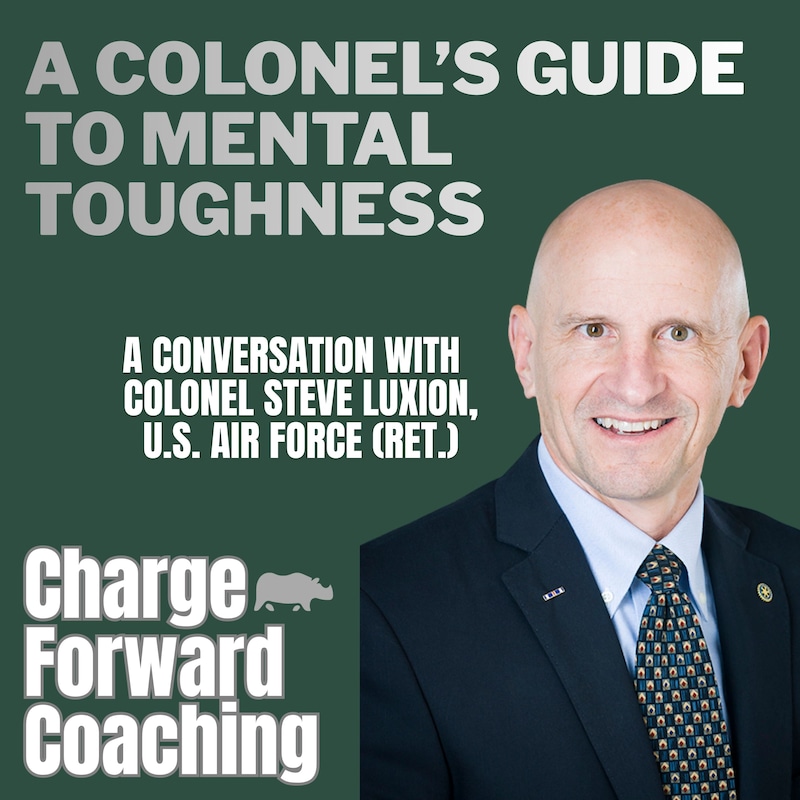
In this episode, I sit down with Colonel Steve Luxion, U.S. Air Force (Ret.), a 34-year veteran with more than 2,500 flight hours, 700 combat hours, and a career that spans the F 111 Aardvark, the Navy’s F 14 Tomcat, the EA 6B Prowler, and the early MQ 1B Predator program. Steve has led at every level — from squadrons to NATO’s first Aerospace Center of Excellence and brings a rare combination of combat experience, strategic leadership, and humility. We talk about what mental toughness really looks like in life-or-death environments, how individuals can better manage fear and focus, and why emotional control is the foundation of great leadership. Steve breaks down the inner arena of decision making under pressure, the habits that keep pilots steady, and the lessons anyone — athletes, leaders, parents, and performers — can use to stay composed when it matters most.
Key Topics:
Military leadership and combat experience
Development of confidence and emotional intelligence
The role of challenge and grit in high-pressure situations
Sound Bites:
"Confidence comes from training and preparation"
"Articulate the mission and its importance"
"Grit and making a difference are key to success"
About the Guest:
Colonel (USAF-Retired) Stephen P. Luxion is the Principal in Luxion Consulting LLC, providing advisory services across a broad span of expertise gained across multiple careers. He serves as an Adjunct Professor at Embry-Riddle Aeronautical University, Senior Advisor to defense and public service industries, and officiates all levels of lacrosse. Lux served as Executive Director of ASSURE (Alliance for System Safety of UAS through Research Excellence) led by Mississippi State University. Steve was responsible for leading the alliance of 35 of the world’s leading research universities and its industry partners. ASSURE is the Federal Aviation Administration’s (FAA) Center of Excellence for Unmanned Aircraft Systems (UAS), providing the FAA a wide-ranging UAS research portfolio and conducts specific research to help inform and address the key challenges to safely and efficiently integrating UAS into the National Airspace System. ASSURE also leverages its expertise, experience, and knowledge to serve others outside the FAA including current research for NASA and the Federal Emergency Management Agency (FEMA) and National Institute of Standards & Technology (NIST).
Lux is a 34-year US Air Force veteran with over 2,500 hours flying time in the F-111 Aardvark, MQ-1B Predator UAV; and the F-14A Tomcat and EA-6B Prowler while on exchange with the US Navy; including 700 hours combat time in operations over Iraq, Bosnia, and Afghanistan. For his combat efforts, Colonel Luxion was awarded the Distinguished Flying Cross for Valor, 4 Air Medals, and 7 Aerial Achievement Medals. Steve received his Bachelor of Science degree in Computer Science and commission from the U.S. Air Force Academy in 1984. He was a four-year letterman in lacrosse and was named as an All-Conference midfielder his senior year. Colonel Luxion commanded at the squadron, group and center levels and helped lead the establishment of NATO’s first Aerospace Center of Excellence.
Colonel Luxion is a distinguished graduate of both the USAF Fighter Weapons School and Air Command and Staff College. He is also a graduate of four Master-Degree programs from Embry-Riddle (MBA-Finance & Master Aeronautical Science), the School of Advanced Airpower Studies (Master of Air & Space Power), and the National War College (Master of Science in National Security Policy).
About the Host:
James Blasco is a CTA Certified Coach, and a Certified Functional Mental Toughness and Resilience coach, and a Certified Neuroscience Coach based in Ormond Beach, Florida, with a rich background in sales, media, and entrepreneurship. Throughout his career, James has excelled in sales and sales coaching for some of the largest media companies, owned three successful businesses, and worked in media relations in the NFL.. James is trained specifically to coach to all aspects of mental toughness and resilience.
Resources:
Website: www.chargeforwardcoaching.com
LinkedIn: https://www.linkedin.com/company/chargeforwardcoaching/
Facebook: https://www.facebook.com/ChargeForwardCoaching/
Instagram: https://www.instagram.com/chargeforwardcoaching
YouTube: https://www.youtube.com/@ChargeForwardCoaching
Spotify: https://open.spotify.com/show/ChargeForwardCoaching
Apple Podcasts: https://podcasts.apple.com/ChargeForwardCoaching
Transcripts
Hello and welcome to another episode of the Charge Forward Coaching Podcast. I'm your host, James Blasco Today we have an incredible show for you. You're not gonna wanna miss it. You're not gonna wanna skip any sections or anything like that. Today we have Steve Luxion Now he's a 34 year veteran of the Air Force. We're gonna talk to somebody who's flown in over 700 combat missions, Bosnia, Iraq, Afghanistan, but that's not all.
I'm gonna look down the list, I don't wanna miss anything. He's also a pioneer in unmanned aircraft, we call those things drone, but this is way back before a lot of us knew what those things were. He's combat tested, he's a NATO strategist, being a part of the first Aerospace Center of Excellence. He's an FAA National Research Leader. He's currently an adjunct professor at Embry-Riddle University here in Daytona Beach, Florida. by the way, he's a lacrosse ref and he played lacrosse.
in college. it's going to be a great show. And I believe I'm going to have to ask him a question. I know he's a mental toughness expert. So Steve, welcome to the program.
Steve "Lux" Luxion (:Thanks very much, James. Yeah, thanks for the nice introduction.
James Blasco (:I would say let's go through your resume, but it would take about five episodes to do that. So what I will ask you is for the last 30, 40 years, what have you been doing?
Steve "Lux" Luxion (:Not a whole lot. I'm trying to improve the golf game, as you're well aware. Now, I ⁓ started out of high school ⁓ slipping into the Air Force Academy. That was part of this whole story, too. ⁓ I got in on La Crosse, but it was a last-minute ad. And when I showed up at the Air Force Academy, they told me, ⁓ the Academy said I wasn't really academically qualified and denied me leaving by the end of the year.
That kind of started my process of learning. You challenge me, I'm not going to let you beat me. Did that when I graduated. I was a computer engineer for a little while before I started flying. I flew the F-111 for 10 years in Desert Seal, Desert Storms at Nuclear Alert. All kinds of different things. Then I went, did an exchange with the Navy, flying F-14s and EA-6Bs was in Bosnia.
Herzegovina with those operations and some of the operations in Iraq. Then back to be trained as a strategist where I did a lot of the war planning for the Middle East on how we deal with all the situations there, some of which is going on today. Then back to flying. was sent to Nellis Air Force Base, Mecca for fighter pilots. When I got there, I was told I'm going to be flying drones.
Thought it was the worst thing in the world that happened to me from flying fighters to flying drones. And I was sent there with a mission to clean up the operations, having no idea how important and what was about to happen. We're going to put weapons on these things and we're going to treat them ⁓ and move them into key combat roles. Right after I did that, 9-11 happened and I was immediately told to finish up, get graduated and get overseas.
with my classmates and start operations ⁓ in Afghanistan, Pakistan, and the border areas around there, doing ⁓ drone or UAS or remotely pilot aircraft type operations. Then I went off to ⁓ do that NATO Center of Excellence after a couple years in the War College. When I got out of that, I was surprised they sent me to strategic command.
with all the big bombers, nuclear alert, all that kind of stuff. But I was sent there to set up cyber operations for the country, how we would manage command, controls, offensive cyber operations for the United States, supporting all government agencies, not just the military. So that was unique. And then I finished up here in Florida, running the ROTC detachment at Embry-Riddle University.
⁓ Before I start my next career running a center of excellence for the FAA on how to get these drones into the national airspace and supporting commercial search and rescue first responders, all that kind of stuff. And just since retired, other than doing a little bit of teaching and primarily trying to keep up with you, James, and my golf score.
James Blasco (:That's so amazing as I was going through and do some research here. always, I scratch my head with individuals like yourself and how much you can accomplish in a lifetime. Obviously you got a long way to go with that, but it's really amazing. And also thank you for your service and all the work and courage that took to do that. Thank you so much. We're going to talk about mental toughness and I always focus on the four C's of mental toughness and that is commitment, control, challenge and confidence. And usually I leave confidence
towards the end of the conversation, but today I'm gonna move it towards the top. And the reason I'm gonna do that is I'm curious within these combat missions that you were on and many of those, if anyone goes out there and looks up the types of missions these were, obviously there's little to no room for error. And so to me, yes, you have to be confident, but there's another layer of confidence to that. Can you bring us into that world?
where you obviously do a ton of training, but you still have to have this extra level of confidence to do what you did.
Steve "Lux" Luxion (:Yeah, the for me, confidence ⁓ comes in, I guess, many forms, but it's really in the training and preparation work, everything you do to know your job better, to understand your competitors or in my case, ⁓ enemies. ⁓ And then practice, practice, practice and build relationships amongst the teams, understanding.
your strengths and weaknesses of your partners and of yourself and ⁓ building that trust and again, lots of practice ⁓ really gives me confidence. And it's not that it's error free, there's tons of errors. There's errors all the time. And I'll hopefully get to talk a little bit more about that later. But errors of commission are your learning opportunities. And if you're well prepared and you have a great team around you that you're working with,
⁓ Everybody understands the mission, what you're trying to accomplish. And I'm always confident when I have that set up upfront and then we get a chance to actually go do whatever the mission or the job or whatever it is we're trying to accomplish.
James Blasco (:And on the confidence side, you just talked a lot about confidence and abilities and the preparation that gets you to that stage. There's also like interpersonal confidence and the ability to communicate effectively, efficiently, and to do so in a constructive way, but also in a assertive way, especially in high pressure situations. Is that something you can ⁓ really train for? Is that a personality trait like?
How does that come to be that you can do that in these situations?
Steve "Lux" Luxion (:Well, you know, some of it's probably obviously personality, you know, that challenge somebody gave me that I can't do something makes me really want to make sure I can do it. But it was ⁓ part way through my career that I finally started developing that inner confidence when I ⁓ had some really good people working with me who worked for me and reminded me of what they needed.
to do their job and this was primarily in the military, extremely talented people in the cyber stuff I did or in the drone stuff that were much smarter than I ever was. And what I developed was what I called the upside down leadership, which is also known and I think it's servant leadership. But ⁓ I had a picture of a pyramid of Giza.
and this little stick man holding that thing up upside down with the pyramid sticking in my head and That that little picture reminded me. It's my job to take all shit rolls downhill falls on me and it's my job just to provide the balance all these other people above me that Usually in a pyramid or below and trying to support the boss My job is to support them and once I figured that out
And that just changed everything. Because I didn't have to know the mission and all the little details that these experts knew. I just needed to provide them the support and give them a little bit of top cover when there were errors of commission, where they're out trying to do something, didn't go exactly what they wanted to happen, and then move on. Once you learn you can work through these little errors and be better for it, confidence just is easy.
You make a decision and it's not exactly working like you want. You just make another decision and keep moving forward. So that's really what gave me a lot of confidence that no decision is final, that I don't have to know everything. I just have to build teams and trust and make sure their expectations, they know what the mission is and what I'm counting on them to do.
James Blasco (:Yeah, I hear that a lot. The more I'm around really good leaders and folks who work with a lot of people and are responsible for a lot of big things, they say the similar things that you got to, you got to, it's all about people and it's all about taking care of the people and the rest will take care of itself. You you mentioned the chip on your shoulder when somebody kind of challenges you or says you can't do something. One of the other C's in the Four C's of Confidence is challenge and
sometimes people wait for it to come to them. It sounds like you go after the challenge and if you fail, you look at it as, I learned something that I move on. Is that an accurate statement?
Steve "Lux" Luxion (:Yeah, when I saw your four C's and I saw challenge, I wrote down attack, know, an explanation point. Challenges are your opportunities. And that is when something's going wrong or, you know, even if you see a positive thing you can go grab right away, that is your opportunity to make a difference, make it better, make the world better.
And that's where my errors of commission and every single officer that worked for me as I became more senior and I had junior officers, I would talk them through this very carefully. There's errors of commission and there's errors of omission. Errors of omission, I will kill you. Those are things like not knowing your job, walking in the room, there's trash laying on the floor, you don't pick it up and throw it into the trash can. It's, you know, being at work on time, it's knowing your job.
Don't do something. ⁓ Errors of commission are those when you're doing something and there's just something doesn't work out exactly right. Those are your learning experience. And a big error of omission that I made very clear to the folks I worked with that worked, that I supported in that upside down pyramid was not going after an opportunity or a challenge in fixing it and making a difference is an error of omission. I expect you to go do it.
And whatever it is, you're the expert. I don't care if you're just one year out of college, you're probably more knowledgeable in that area than I am. So go do. You don't have to ask permission within the resources that you have and we have. Go do it and we'll see what happens. And then if it doesn't work out, the only thing I required from them was to tell me.
what they learned and what they're doing different now. What's the next step? How do you still get to the goal that you were trying to achieve? And do you need anything from me? And again, all that, once that gets playing well, it builds on each other. Your members of your team are holding each other to higher standards. They don't accept laziness or somebody not doing something. They accept things not going right for others and try to all jump in that kind of help out.
It really builds on that and I led a bunch of innovation type units and boy, just, again, I really didn't have to do much except provide that top cover and a little bit of leadership and guidance.
James Blasco (:Now with the challenges that you and others would go through, and not just in the combat situations, but also in the other programs you were working on and you got involved with, you had mentioned when you got involved with drones, it wasn't something you originally wanted to do. There's always emotions that come into play. People have to deal with those emotions. Sometimes people deal really well with them and other times they don't and not, you know, bad things happen.
How do you go about managing your emotions? What are emotions to you, number one? And then how do you go about utilizing them to help you instead of hurt you in any given situation?
Steve "Lux" Luxion (:You hear the statement, don't let them see your sweat, don't let them see the emotions in you. ⁓
I wear my emotions on my sleeve and that's just me and my leadership style. I wouldn't scream or yell. There are certain emotions that are detrimental to the mission, your people, to yourself that you definitely need to control. But ⁓ the emotion and I can feel choking up, sorry, ⁓ that.
was most critical to me is that I cared for the people that were doing these amazing things while I was in the military, while I was doing the research mission and these PhDs and bringing up new PhDs. And they're the only people that have the knowledge to help the FAA make something happen. They needed to know that I thought they were important. And some of the emotion they would see me in times is that importance would show in my face in the senses of urgency. ⁓
but they would know this is who I am. I'm not going after them. I'm not attacking them. I need them to keep me out of trouble and to keep us all going down towards the path that we're going. So a little bit of emotion, especially that caring emotion has served me very well because it is me and it's how I lead and how I care for people. ⁓ And when I care for them, they take care of me and they take care of the job.
And I learned that early on in my life as a teenager with a manager of a pool that hired me as a lifeguard and just the little tiny things that he did for me as a when I was just a lifeguard to give me some grace when something would happen wrong or I just needed a day off or whatever. He told me that and that has stuck with me my whole life. And I have not been afraid to show those kind of emotions when I.
when I go after something or I work with others.
James Blasco (:Well, first, thank you for sharing that. really appreciate that and being so honest and transparent. And I was just reading a book and there was a chapter on leadership. And one of the big parts was exactly what you just said. It's like a lot of people think when they become a leader or try to be a leader, they have to be something they're not or act a certain way or not show their emotions or who they really are. And it's as you just described, the complete opposite. You have to throw yourself into those situations and
Embrace the emotions that you have and use them in a constructive way. You certainly have done that. So hats off to you. But I think emotional control, especially I work with a lot of younger people, younger athletes and so forth. And that's a big deal because they're, they're starting to just now understand what these emotions are and how they, what they represent in different situations. And I think for me, it's one of the biggest things in life you can understand.
is having that emotional intelligence to deal with not just a bad situation, but even a good situation and bring it to other people as well.
Steve "Lux" Luxion (:And just a brief on the lacrosse field when I'm referring and you see this all the time, you know players in the heat of the game, the coach losing his mind over either a perceived miss call or something happening. Talking to them first, having some empathy towards them that you know this is their life, their job, their team, and they're going to of course root for them. But I will also remind him and that emotional control comes in where I attempt.
to work with the coach is, hey, coach, you know, I've got it. I've heard what you have to say. And I got it. We're moving on. ⁓ Don't hurt your team. You know, don't continue down this line because now I'm going to have to throw on sportsman like flag or something. You don't want to hurt your team. So that's when emotions, when they benefit the team, the team knows what they're working with.
one thing, but when your emotions get out of check and it starts harming the performance of the team, then that's too far. That's where you need people on the team to remind you that you're harming not just yourself, but everybody else.
James Blasco (:Yeah, there's definitely a connection about people. I'm glad you brought that up because even in your daily life, you come home from work or you're not in a great mood for some reason and it impacts the people in your home. You know, your spouse or your children or even the cats can, I think, sense when the emotions are a little out of control. The fourth C is commitment and commitment centers around setting goals.
Steve "Lux" Luxion (:Yep, exactly.
James Blasco (:and working towards those goals. And I think a lot of individuals are prepared to set goals, are prepared to have their own mission, if you want to call it that, whether it's professionally or personally, but a lot of people don't have the ability to follow through or stay with it or, you know, go through all those challenges and all those different emotional aspects of it.
and keep moving forward. You were involved with a lot of situations where you had to be 110 % committed and there was no turning back. How do you get into that mindset? What is it about putting yourself in big time challenging situations and saying, I'm committed to this come hell or high water?
Steve "Lux" Luxion (:Yeah, it kind of comes with what we started with. That's that confidence. So preparation meets opportunity is kind of what a NASA astronaut explained to me when they were an alternate on a mission. They had prepared, prepared, prepared, not getting their opportunity. And then an astronaut's sick, but they had done all the work. They've been there along the way and they're prepared. So preparation meets opportunity gives you that chance.
Now, once you get that chance, ⁓ the development of vision required for me, and I would tell it in a lot of different technical fields. And like I said, I got put people around me who are the true experts, but I have to understand enough of the technical and the strategic implications for the United States or for FAA with the national airspace. So lifelong learning, continual learning, taking the time to read things.
read about leadership like what we're doing here ⁓ is critical to ⁓ then developing that vision because firstly, you've to be able to see and develop opportunities out of different areas that have never necessarily been put together or even when it is, you've got to go and move the organization to something new. So then articulate that vision.
Make sure everybody on the team is vested, understands, and willing to participate in that. And then the last part, which again, somebody reminded me many, many years ago, it's not just a leader's not just a visionary. A leader has to have the energy and provide the pathway to getting that vision enacted. And that is usually the hardest part.
You see it, you know where you wanna go. And it's hard sometimes as a leader. You have to repeat yourself hundreds of times over and over again. The people are like sick of it and repeating the same message over and over again to get it to stick. But that's the kind of energy and drive it takes to make it. You can't be embarrassed by that. It's a battleship, it's moving, it's big. Organizations don't change, cultures don't change easily unless you are
James Blasco (:Yeah.
Steve "Lux" Luxion (:driving it hard and constantly repeating the message of where you're going.
James Blasco (:Yeah, I think that the one area you brought up, it's that you need to be able to articulate the mission and why it's important. And I think that's an incredible skill to have because I think that's a big part of that process and getting people to stay with whatever it is you're trying to help them stay with. They have to understand why they're doing it and the importance of it, the purpose behind it and
You're right, some leaders just don't convey that. They're at least conveyed enough, like you said, over and over and over again to where people have bought in, they understand, they know their roles, and they're ready to go. So I agree, I think that's massively important. So I'm throwing a lot of questions at you, but your background's so diverse, so impressive. Why don't you share with me areas of your career, doesn't matter what it is,
that stand out to you as A, I'm really proud of that. B, it took a lot. It really pushed my, not just physical limits, but mental limits. But I'm darn proud of whatever that was that I accomplished.
Steve "Lux" Luxion (:Yeah, I think kind of we're just going through what we just talked about. The first thing we talked about was the Air Force Academy and my experience there and that was life changing. First of all, realizing I can overcome even when everybody says I can't overcome. But what I learned there was they were right. I was probably a poser. I probably shouldn't have been at the Air Force
Academy. I worked hard, I struggled, I had to get a lot of help from instructors, but I did that. I found the path to do it and when I would fail, both laser here, when I would fail, I'd have to let it go. I remember walking down to lacrosse game, I was getting ready to go play and I had just taken, I don't remember, a physics test or something.
And I knew I had just blown it. But now I had to just blank that out, move to the next thing I was working on, play my lacrosse game, get back, do my studying for the night, and then plan on the next day going into my physics instructor and talk to him about this is what I think happened on my test. What do we do to get me back up to speed? So it takes a village.
Number one, to be a good leader. You need people around you to handle and help you around your weak areas and blind spots. ⁓ And that's one thing that I learned early in my career. And I think that lays out all the way through with my confidence that a mistake, a failure is never final. It's just a step in the road that you're gonna kind of take. So that was a big one. Probably my...
One of my biggest humbling experiences is when I was sent from the fighter community to the drone community. And I came home to my wife and I told her, you're not going to believe this. And you know, it's terrible how bad this is. And she said, they must have a reason for this. And I wasn't listening. I was all about Luxion myself and not on the other side, it says US Air Force.
James Blasco (:You
Steve "Lux" Luxion (:I was not thinking about the business, the organization. I was thinking only about me. And I was wrong. ⁓ I was the right guy to go and get that program cleaned up, the bad pilots out, ⁓ let the creative innovators on how we can use drones take charge and provide them top cover. And then we deploy to a crappy location where people are getting sick, we're under threat of, you
terrorists attacking us and everything else. I was the sense of calm. I had already been in combat. So that was necessary then. So, you know, I don't know, you know, everybody is different. But I my higher calling my God put me in the right place at the right time where I could influence just a bunch of people and make a difference in that what became an amazing
Revolution in military affairs on these whole drones. It started in this small group of, I don't know, there was probably 50, 60 of us deployed and we grew the capability out of that. And it was just a little seed that can make a huge, huge difference. So, you know, for me, it's about what has always driven me and I've always wanted positions that if I fail, the mission fails.
But I'm not going to fail because you challenged me I won't fail. And then two is if I'm going to do something, I want it to mean something.
James Blasco (:Yeah, when I was going through and researching some of your history there and that the drone thing jumped out of me, I'm like, wait a minute, this guy was involved at the very beginning of what people see now is, you know, in warfare or different situations as just common day. know, that's so impressive that you were able to be a part of that whole situation. It's amazing. And you're right. You've got put there. And it's funny how we're put in situations sometimes when
Steve "Lux" Luxion (:Yeah.
James Blasco (:We fight it like we don't want to do that, but it is the exact spot to be
Steve "Lux" Luxion (:So one other thing that I think it's important for people to ⁓ leaders in particular to know is ⁓ an event that occurred to me during Desert Storm where it was Article 15 court martial or what ended up being
my distinguished flying cross for valor. You know, at times as a leader, you know what the job is that has to get done and there's no good answer. All solutions are not necessarily the best solution, but you're put in that role to lead. So lead. And fortunately for me,
I was on my way home, but there was plenty of other senior officers and leadership around that saw what I did on this mission. And when everybody else had failed, we had accomplished the mission, but we didn't do it in the way the boss told me to do it, that I was ordered to do it. But I got the mission done because the way we were ordered to do it didn't work. And so when I landed and he saw that and I was, you know,
going against everything he said, he was sending me home and he was going to make an example of me. Well, years later, somebody put me in for that mission. either way, it was what you do every single day. But because of all the challenges associated with that, think somebody felt that this needed to be written up and it was sent in and approved. So my message there is when you're the boss and you're a leader,
you need to lead and sometimes there's no good outcome but that's your role. That's why you're there and if you get replaced, moved on, that's again, that's not the end of the world. You'll go find something else to do. You learn from that and you move on.
James Blasco (:Yeah, now that's a great story and a great lesson that I think a lot of people, especially young people need to hear. Definitely. So lacrosse. It's a great sport. What brought you to play lacrosse and what's your favorite thing about playing lacrosse and even reffing lacrosse?
Steve "Lux" Luxion (:So lacrosse, grew up in Annapolis, Maryland, and if you were ⁓ a young man, a boy at that age, you had to have a lacrosse stick in your hand and be thrown around. ⁓ No girl would ever look at you if you didn't have a lacrosse stick in your hand. So I figured out early on I needed to play lacrosse. I was a wrestler, too. I was probably a better wrestler than I was a lacrosse player. But what drew me to lacrosse more was the team aspect of it. I enjoyed...
not just pushing myself all the time in wrestling, but doing it with my teammates. then, you know, all these things we talked about, strengths, weaknesses, knowing who's good at what and getting the max out of everybody on the field was what I liked about the sport. I liked the aggressiveness. I liked the speed. I liked the opportunity. I was an offensive player to score and make a difference on the tallies on the board. ⁓
It was a great fit for me and then now I'm paying back to the sport that got me into the Air Force Academy, that got me into fighters, that gave me such a great life that when I, before moving to Florida, I was in Mississippi. There would be weekends I'd drive a thousand miles to cover three games just because the sport had earned it. And it's a special, there's.
There's some spiritual sides to it that the Native Americans that I've gotten to referee and work with and play with and ⁓ to understand, know, it's the healing sport, it's the creator's game. And I believe it made a difference in my life.
James Blasco (:Yeah, it sounds like it definitely did. It is a great, great sport. On our way out the door here, if you could just always a tough question. Everybody tells me this is a tough question. If you were talking to young athletes, young people, it could be high school, college age, or just kind of starting their lives and things like that. And it comes to mental toughness, things they need to be well equipped for as they move through life. What would be kind of the one or two things?
that you would say, if nothing else, be good at these one or two things.
Steve "Lux" Luxion (:So your whole premise, the mental toughness, grit, I think is the most important thing that we have. You can be as prepared, everything go your way, and the dice just roll in the wrong direction, but you got to fight through it. Grit, Theodore Roosevelt's quote about the man in the arena. Great, if you haven't ever read that, read that quote to everybody listening.
James Blasco (:It's great.
Steve "Lux" Luxion (:It talks about you're in there, you're fighting the best fight and you dust yourself off even if you lose. You learn, you drive and you keep going. So I would say grit. the last part of that, the second part that I would say with it is be someone that wants to make, we only live this one life and it's pretty short. It's an old guy looking back and thinking where did all the time go?
But make a difference, want to make a difference. Make a difference in your family's life, your community's life, your nation's life, your church, whatever it is, trying to make a difference. Go bigger than yourself and you'll feel such great satisfaction out of your accomplishment. And what was given to me on that, when it was more of a thing about ⁓ being ethical, but it also served in me making a difference.
And that is, what is your epitaph? When you die, what do you want to be in your obituary or your gravestone that people will say and think about you? And if you go and you do things bigger than yourself your whole life, that crowd will be really large and they will have learned a great lesson that you provided and the difference that you made.
James Blasco (:Steve, thank you for leaving that thought with us. That's outstanding. I really enjoyed the times we get to spend together on and off the course. It's probably more fun off the course the way I play, but I definitely enjoy it. Glad that we're getting to be friends and get to know each other. And thank you again for joining us on the podcast.
Steve "Lux" Luxion (:Thank you.
Thanks for the opportunity. I absolutely enjoyed it. Thanks, James.
James Blasco (:And for the rest of you out there, don't forget to like and share and subscribe and all that good stuff. You could always go to chargeforwardcoaching.com. You can learn a little bit more about mental toughness. You can learn a little bit more about me. You could always ask for a free discovery call. I can learn about you, your goals, what you're trying to accomplish, and you can learn a little bit more about my coaching. in the meantime, just keep charging forward.