Shownotes
Hi there and a very warm welcome to Season 6 Episode 42 of People Soup, it's Ross McIntosh here.
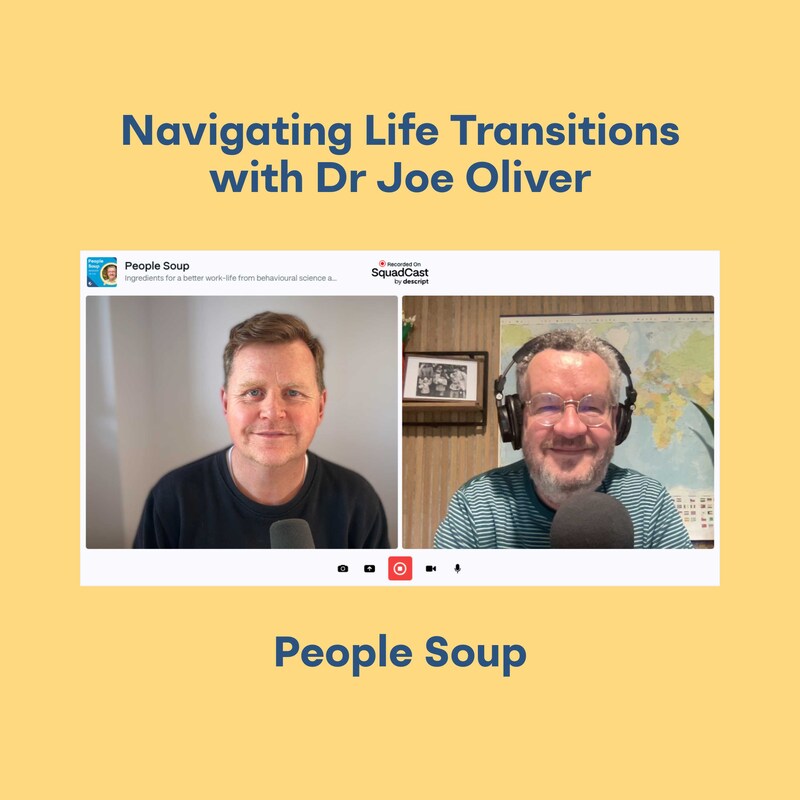
In this episode I welcome back friend of the show - Dr Joe Oliver - and together we discuss how Acceptance and Commitment Therapy can help us navigate life transitions. We draw upon our own experiences of moving to a new country to reflect on the processes at play, exploring what helped us, as well as the surprises.
For those of you who are new to People Soup - welcome - it's great to have you here - I aim to provide you with ingredients for a better work life from behavioural science and beyond. For those of you who are regular P Soupers - thanks for tuning in - we love it that you're part of our community.
- Contextual Consulting - Acceptance & Commitment Therapy Specialists
- Building better teams with Ross McIntosh - Contextual Consulting
- Leading with purpose with Ross McIntosh - Contextual Consulting
There is a transcript for each episode. There is a caveat - this transcript is largely generated by Artificial Intelligence, I have corrected many errors but I won't have captured them all! You can also find the shownotes by clicking on notes then keep scrolling for all the useful links.
Here's the People Soup Website.
And you can subscribe to the People Soup YouTube Channel here.
Visit Ross' Website.
Connect with Ross on LinkedIn
People Soup on Instagram which also features plenty of Ross' photos of the Andalusian life.
Transcripts
Joe: when I think back and when when my wife.
kind of initially suggested it, I mean if I was honest, when she initially suggested I said, hell no, there's no way that sounds way too much work. and I dunno, something kind of, sort of grew in me and I I just kind of resonate as you're talking there about that idea of adventure, and. Adventure for me and, and for our family and for the kids who were six and four, seven and five now.
in this episode, I welcome back friend of the show, Dr. Joe Oliver, And together we discuss how acceptance and commitment therapy can help us navigate life transitions.
us as well as the surprises. [:Our mission is to give you the ingredients for a better work life through insights and stories grounded in behavioral science, especially acceptance and commitment therapy, and other evidence-based approaches. Before we go on, let's take a quick scoot over to the news desk. I am presenting two courses this year in collaboration with Joel Oliver.
The first is called Building Better Teams, where I'll present a practitioner approach to pro-social and act based collaboration in a three hour workshop on the 11th of February.
of ACT Evolutionary science [:I'll introduce you to the approach, my experience of using the approach and the core tools. The second is called Leading with Purpose Act, strategies for Resilient and Authentic Leadership. This one is over three sessions in May, and in it I'll introduce you to fresh and practical approaches to support leaders.
I'll show you how key skills rooted in behavioral science can help them develop and sustain their authentic leadership style. These skills are designed to enhance resilience, focus, And effectiveness whilst supporting leaders to navigate the pressures and complexities of modern workplaces with clarity and purpose.
to my chat with Joe Oliver. [:Ross: Joe Oliver, welcome back to People Soup
Joe: McIntosh, thank you for
having me back.
Ross: Joe, it's great to have you here. I wonder, just in case anyone hasn't come across you, if you wouldn't mind just briefly introducing yourself.
Joe: Absolutely. I'm a clinical
psychologist. Uh, I guess that's my trade and background.
I, work a lot using act, acceptance and commitment therapy, and I'm really
interested in. The
use of act as a way to help people uh, modify, change, shape up their own behavior.
I'm really passionate about that, but also delivering and teaching ideas around it, and just this wide applicability in, in all the areas that we humans do things. I'm a, a parent, uh, a partner, as well. I live in South Spain, near to you, Ross. Not too far. Stone's
throw down the road. yeah, and I, I enjoy Spanish life and, uh, I guess it's been one of the things we'll talk about today, adapting to new life
Changes.
those [:But that's a,
there's a little bit about me in a super short nutshell. I.
Ross: Thank you, Joe. And you're right. The reason me and Joe decided to come together to record this episode is that we both have experience of international relocation. Joe's had some in his past and he's currently going through. Uh, chapter at the moment. So we want to explore how act processes can help us navigate these shifts with openness and vitality.
And this approach can also apply to many, many other life transitions, relationship changes, births, marriages, deaths, promotions, new company, new team, new client holidays even, et cetera.
ct can guide us through that [:Joe: We moved to the south of Spain, uh, just about
one year ago,
and it was a bit of a bit.
I think it'd be fair to say a life adventure. We, that's my wife and our two kids, packed up our house, uh, sold everything.
Ross: everything.
Joe: Anything we couldn't sell, we put into storage and got ourselves a plane ticket and came to Spain and,
uh, we, didn't have our visa booked so
we, we had the,
the joys of wrestling with the Spanish government and Spanish bureaucracy
as we arrived. so we've been here now
one year
in a small. Ish town
outside.
nvolved in moving countries. [:New Zealand originally, as you know. I feel like um, I've done a lot of moving in my time, but I turned 50 last year and I dunno, is there
Something about
kind of being a bit older perhaps and making these
sort of moves.
it was a bit inside of me. I think there was quite, was is really relishing the move, that sort of sense of adventure and some of the things that come along with it. And there's this other part of me that was freaking out, uh, in the other part that is looking for stability and certainty.
Ross: Thank you. And maybe just to set my context alongside that. So we moved, me and my husband moved from Brighton where we lived to, to Spain. And we started off in Malaga, actually. We were renting in Malaga. Then we ended up nine months later in Seville. 'cause we couldn't find anywhere we wanted to buy in in Malaga.
COVID when we were spending [:And whilst it was tragic and awful and very sad. There was also this experience of I was working full time remotely and culture cuisine, people, climate made us think alongside that. Death at a relatively young age made us think like, well, shall we just do it?
Joe: Hmm.
ent the flat out in Brighton [:And the other thing we deliberately chose not to do was map out all the stages that we'd have to do in terms of bureaucracy, in terms of all sorts of things. Like a driving license, registering as a resident, all sorts of bureaucracy, but also other stuff. 'cause I knew. That if we mapped it all out, my mind would get involved.
My minds that I often call a head of drama in enact training, my head of drama would get involved and we wouldn't do it. So I'm now looking at almost, Four years here in Seville and no regrets. Some turbulence along the way, some ups and downs, particularly with bureaucracy.
it was kind of that bli me, [:Apostol and translated and all sorts of stuff that I wasn't expecting and it took about nine months. So that was a bit of a downer to be honest, because it was a bit anxiety provoking. I dunno about you. What did you notice in those early days of the transition or maybe even pre-transition?
Joe: I vividly remember hearing your grappling with bureaucracy. Uh. It kept me up late at night. Uh, having said
that I also remember,
in the process, it'd be fair to say
like a lot of this was driven by my wife
Shalin, and she's [:I don't know, just.
was busy in the work routine and doing things and just living, living. Of course. And just the sort of thought of just, oh, moving was felt huge. and we had made sort of some kind of decision, something like, I think within the next few years we'd go and I remember having a vivid conversation.
The Conversation.
you, I remember vividly, I can't remember when it was, was online.
You were in Spain, I think, and I can't remember exactly your words, but the, the meaning I took from it was something like just, get shit sorted. Joe, that's kind of, I put your exact words, but just, it was like, kind of get on with it. Let's go, you know, if you're gonna do this, do it now. Uh, you won't regret it. And, those kinda words were prophetic. I dunno quite how you knew that. But I, I, I think there's something in that
I'm a really big believer
in, kind of like when it comes to those sort of decisions, if you were to flip a
I think it's always nice to [:being a bit like a sort of,
a blur just in the lead up thinking, gosh, how are we gonna do this? How's this gonna happen? And, and then suddenly, boom, we're there. And I, I just, I remember a few key moments like on the taxi towards towards the airport
where there are like five suitcases and that'd be it. and then on the other
side
like in the taxi late at night, coming towards our,
the first.
of our five Airbnbs, we moved around in like two months and just kind of at night, just kind of coming in and thinking, wow, this is our life now. yeah. And then that sort of
low settling into.
something new and something different.
Uh. And I think
another thing that sort of stood out to me a lot,
was that there's a part of
me was, I think it was it felt quite different. to how I imagined it. I just imagined it to be really big and
grand and it was, and yet something was just kinda like just felt I don't know, normal about it.
Just, okay, this is, this is life now.
And I was Really surprised at how on one level.
nto this new life. There was [:Under deep undercurrent of stuff that I maybe
wasn't always able to put a finger on
that probably bubbled up
in different ways. Just that I don't know, that ongoing
processing and emotional adjustment that was just sort of rear its head in all sorts of different ways. and that perhaps I wasn't able to immediately go,
Oh,
this is because we've moved country, or this is 'cause we're a massive new routine, or this is because I feel like an outsider.
in this different culture. And yet that was still kind of there. Did you get any of that? Did you notice that?
Ross: Yeah. Yeah. It's, it, I found and still southers find it difficult to put my finger on the, the things that are different and, and 'cause I, I was continuing to work and I was continuing to travel quite a lot for work and I traveled before, but it was kind of within the uk but then I was flying so I got more used to.
ting a taste of the, the old [:But in another sense, when I got home, it was like, oh gosh, so this is it now. But I did, when we did get off the plane for that first time in Malaga with, with our extended number of suitcases.
Uh, there's a little part of me that was expecting some sort of brass band there or something to say, to say, bloody hell guys, you've done this. This is enormous shit. Or maybe a red carpet where I'd kiss the ground or something
Joe: That'll be good.
Ross: in a papal like manner. And no, people were just going about their everyday lives.
And I was kind of like, oh yeah, this isn't in the scheme of things, this isn't a big thing.
Joe: Mm.
Ross: But then I remember, I think going to the supermarket on my own and thinking, oh gosh, everything looks different. There's different products, there's different sort of emphasis. And then engaging with the cashier and things like that.
e idiosyncrasies in the sort [:Joe: Yeah. Yeah, absolutely.
Ross: So
how did any act practices? How did you, did you draw on any ACT practices, Joe, to support you in this sort of initial phase?
Joe: So, absolutely.
I wouldn't
say.
As with much of my life, I wouldn't say it was perfect. and of course it's not right and it's not, it's not like just 'cause you'd know a bit about act. You're suddenly this guru who's always at one and mindful and diffused at all moments, at all points of time. there was, uh, it was a couple of things I think stood out to me. One was. This kind of talking a little bit about what, what I was saying before was just this, this reminding myself to connect the dots a little bit. 'cause it is kind of weird. It's sort of like I, I was a bit the same, like I, you know, I work online.
nd it also sort of reminded, [:I felt, I sort of knew that, kind of, sort of in a slightly outta comfort zone the first few weeks or so, and there's a lot of sort of familiarity
and it's like, oh yes, people are speaking a different language.
And, you know, cashiers, it's kind of weird and different. And yet, you know, I, I kind of got there. And, and at that stage there were sort of times I just had that I could Feel my emotions
kind of, sort of fluctuating a lot and sometimes being quite tired or sometimes,
feeling a bit more stressed about things that I probably wouldn't normally or
a bit more irritated. and so for, for me, something really important was that kind of connecting the dots. Which was sort of to say, it was a bit like just reminding myself that this transition sort of amplifies everything. That's just sort of often how it
works for me. And that's sort of normal.
I think an okay. but having
that that reminder to say, well it kind of makes sense you might be just feeling a little bit more stressed than normal
You know, you've gone through a big
major life.
my, my, my accountant in my [:And he was very active in those first six
months,
and again, just remembering, hey, it's, it's okay. It's uh, it's normal. It's understandable. It was a really kind of key part, even though
I wasn't able to sort of like directly feel it, to say, oh this,
anxiety is because we've moved. Just like reminding, like, you know, just go gentle with yourself.
It's okay to be kind of, you know, things not to be perfect at the moment. Take it easy.
Ross: Yeah, I like that. Being gentle with yourself. 'cause I was, like, like you say, it's, it's never sort of perfect and structured. It's a bit haphazard, but I was definitely applying processes of acts to my life before we left. I was thinking what are my values in, in this move? Because I knew it would be helpful to me as an anchor point, when times got turbulent and there were values around.
, really thinking about this [:I felt I was slightly avoiding that and also maintaining network connections with people in the UK and elsewhere. I felt like everything kind of. I took a back seat 'cause I was working, we were moving. I remember one of the first workshops I did was we'd moved into our flat in Malaga and it was the day the removal men arrived with this great big truck of all our stuff.
balanced in a shelf inside a [:Joe: You didn't tell me this Ross.
Ross: Well, I, I like to, I like to maintain this sort of professional ish, facade, Joe,
but that, that felt a bit hairy. But I guess
also before I left, I was preparing myself for the. The thoughts and the emotions that might pop up
because I thought if I do it before then it might help me once I'm there and there were thoughts like, holy shit man, what have you done?
Joe: Yeah.
Ross: Like there's no going back now, Macintosh your fool,
Joe: Well.
Ross: thoughts like that.
But also thoughts like missing people. But the main one was missing my dad and feeling guilt around that. 'cause my dad was on his own in the northeast of England. And I, I'd moved further away, so there was a definite guilt around that, which, which I learned to address. We, we, we spoke every day and that was, that was lovely.
some bit of pre-thinking and [:Joe: I, I wouldn't say I, they were like super structured and organized and we didn't do values court card sorts in anticipation. And, there was this thing that,
Ross: that,
Joe: when I think back and when when my wife.
kind of initially suggested it, I mean if I was honest, when she initially suggested I said, hell no, there's no way that sounds way too much work. and I dunno, something kind of, sort of grew in me and I I just kind of resonate as you're talking there about that idea of adventure, and. Adventure for me and, and for our family and for the kids who were six and four, seven and five now. and that also that thing of for me.
sibilities for the future as [:the things that stood out to.
me and I it's, I think, used as sort of like a. A metaphor there about that stability within a storm. I can't remember exactly what it was. It was a bit like using an anchor or a ballast in a, I, I really like that metaphor. I like that kind of
metaphor.
for me, because I feel values are. Like super powerful in that way. Sometimes it can feel like when people talk about values, oh, it's the thing that motivates me, it's my stick, this thing, I'm gonna go to the future. And maybe there's a bit of that, but there's something that I think super important, like they just sort of
provide that anchor or stabilization for when, lots of
articularly when things are, [:I can let that just slow down.
Just remember, hey, this is, you know, about something that matters. It's in important to me.
Ross: Yeah, I definitely identify with that. The values that I used to return to, and I still do. I think they've shifted over time. How did, how did you find that sense of belonging and connection?
Joe: I got my, my
identify me quite quickly as [:And just sort of, I don't know. there are lots of things that, you know.
Ross: that, you know,
Joe: just, just missing, you know, not, not kind of
knowing how the, sort of the culture, and the language.
and the timetables work. Like, you know, the timetables here in Spain are very strong. and coming from
London, where it's just like you know, whatever you do, whatever you want, when you want.
here, it's just like, like especially in my little. It's, it's regular, right? You know, it's like two o'clock. Everyone's, the streets are dead. and the amount of times we went out looking for lunch at, uh, you know, like a little after like, you know, four o'clock, we'll go out at five o'clock, get something to eat and we're just like, oh my gosh, we forgot again.
know, like it sort of really [:feels like, you know,
I'm, I'm, I'm finally learning it. And then I, you know, I remember this one point, uh, I'd been kind of like meeting my neighbor who's this older lady who lives just across and she's very friendly and, and I met her down by the pool one time and having kind of thought I was getting, getting the hang of it.
And then she just.
Unleashed a kind of torrent of uh, Lucian Spanish on me. And I was like, what are you speaking? What, what language? And I just felt so like, I was so embarrassed. I'm like, what am I doing here? And who am I to be here? All this come my mind sort wearing away. Uh, and you know, those are sort of the points where probably in the normal run of things, an experience like that might not have just kind of hit me, this, in the way it did.
Or, uh, if I wasn't sort of feeling quite so full of stuff. and those were points. I remember kind of feeling like the values piece was important, like, you know, just reminding myself,
e perfect. You're not gonna, [:Ross: I hear you. There's so many things that resonate with me there, Joe, that the timetable one is, is, yeah, going out for an evening meal perhaps, and knowing that restaurants are open till maybe. Earliest might be eight 30 where I am, or nine.
Joe: Yeah.
Ross: And this concept of afternoon, I still struggle with this.
Joe: Yeah.
Ross: 'cause my husband will say to me, oh, I've got a delivery. It's coming tomorrow afternoon. He means from five onwards.
Joe: Right. Yeah. Yeah.
I mean, afternoon, literally:Joe: Exactly until
Five o'clock, probably That's five 30. if you're really pushing it.
Ross: Yeah. And then one thing that really threw me, it's a small thing, but it's so interesting. It's queuing,
Joe: Oh, yeah. Yeah.
about RQs. But I remember, I [:And there were about four people in there already and they were just standing in random places. I was like, what the hell? So I stood in a sort of where I believed maybe the back of the queue was. And I noticed that after each person had been served, everyone knew who was next. There was no doubt about where you were in the queue.
They just didn't feel the need to, to stand in a line and that that pleased me. And also do you find you need to remember these things when you go back to the UK or another country, that these new habits can become a bit embedded and you need to remember not to do them when you are in the uk The, the thing I'm thinking of is being quite direct
Joe: Yes. I was just thinking that absolutely.
do, maybe we could. And he'd [:I go, no.
Joe: Right.
Ross: And you can see he almost thinks, oh, I've he's learned too, too much now. But I need to be careful not to do that. Not to be as direct when I go back to the uk.
Joe: absolutely. Yeah. I, I, I resonates really strongly. It's fascinating, isn't it? I sort of feel like, I feel like there's a big dial in me just sort of having to kind of get used to that. Like that directness and bluntness interacting with our school quite a lot. We had to get trained by, uh, some friends to, to do exactly that.
ake charge then. 'cause they [:when you know the rules. Well, if you don't know the rules, it's terrible, but when you know, it's like, oh, that actually is a quite good idea. And that sort of sense of like, you know, all the kinda normal cues that say, Hey, this, this is who you are, Joe.
This is who you
are. You're about this.
all, you know, this is what you, you are, you, like, you, the things that are good and the things you don't like. You know, those sort of all evaporate and this sort of loosening of identity starts to happen. I guess that's the kind of like the adventure part of it, right?
It's like a new way. A new way to kind of be and be with ourselves. But I don't know, just if I was honest, there's points where I find that slightly disconcerting.
hink, oh, I'm quite shy. And [:And it's probably 'cause I'm. Uh, using extra bandwidth, trying to process conversation and, prepare responses in my head and trying to really integrate. I'm giving more thought to that, which means I may come across as slightly differently and I enjoy that sort of change and thinking there's still me underneath, but it's just a function.
I, I'm really interested in the language and it makes me really appreciate. You know when we go to conferences, Joe, or we have colleagues who are perhaps Spanish and they deliver fluent presentations in English, and we just take that for granted. Well, I don't take that for granted anymore, but I used to, and now I'm like, blame me.
I use some sort of God or goddess. What is happening here?
Joe: Yep.
underestimate that now, and [:What am I doing to help them understand these concepts and these things like metaphors which may not land I've gone off on a complete tangent there, Joe, but, um,
what parallels do you see between this transition we're talking about and other life transitions, like career changes, promotions, returning to the office after remote working even?
Do you think there's lessons to be learned?
we come at it with a, a real [:It's gonna be good for me, or it's gonna be bad for me. and clearly like big life changes, like, uh, a loss of a
job or a loss of a loved one,
or moving countries or getting a new job. I think both of those.
Ross: those
Joe: Those categories or those examples would probably come at those and sort of say good and bad quite quickly. And you know, I guess for obvious sort of reason. But I think one of the things that stood out to me in making this, this move, like, okay, so
coming to Malaga and to the, our little town where we
are, it's like loads of sunshine. The beach is really close. There are
literally palm trees right
outside.
you know, it's sort of paradise. And, you know, this can be easy to kind of get hold, to hold onto an idea. This is, is a good transition. This is good for me. Of course it is. Everyone's really happy here. I think if I hold onto that too
transition, because this is [:when I'm there and thinking, why am I feeling so stressed and anxious and this weird kind of gurgly feeling in my tummy all the time, you know, future me can look back and go, Hey, it's okay. It's just, 'cause this is a big transition. And yet there's a bit of me inside was going, I shouldn't be feeling like this. I should be feeling good or happy, or This is a big deal, and get out there and make the most of this experience. And it kind of sort of collapses things down into like a, this is how it should be.
ed a promotion and they had, [:they're actually quite perturbed by it and they don't know how to handle that. And it's just amplifying the space to, to, to accommodate all of that. And I find that, again, dusting off those values, seeing the values have shifted
Joe: Hmm.
Ross: in relation to how they want to be in that new role. And, and knowing that there'll be times that feel particularly low.
Like when I'm, we we're about 20 minutes on the bus from Seville as you, as you know, and sometimes I'm sitting on the bus and I can hear people speaking and I'm thinking, is that Spanish? Even now? Because sometimes the and Lithian accent is very strong, uh, with lots of, um, vernacular and sometimes particularly younger people, I'm thinking.
you said, just one step at a [:Joe: Hmm.
Ross: I think that can be a real go-to reflection for me when I'm experiencing things like that.
Joe: Mm-hmm.
in a song, life is a roller [:Just got to ride it. And I do think I'm strapped in for the ride and there will be highs and there will be lows, and I'm, I'm here for it all. And that's okay. So on that bombshell.
Joe: It is hard, hard to beat a quote from Mr. Keating. Oh, that's fantastic. Yeah. it's been really nice to talk about this.
I think, uh, I very much like the idea that, We can be daring in our lives. And I, I, at the same time, I like, you know, I know we've been talking about kind of shifting country and moving and, and that, and we're, we're talking about all the kind of transitions.
that exist. and I think it's [:opportunity to be kind and acknowledging to ourselves as we, as we kind of like a little bit brave in doing those moves day by day. I don't have to be big grand moves do they, I think
Ross: I really love that because a transition could be. Going to the supermarket and choosing a different brand of washing powder to your regular powder,
Joe: Yeah.
Ross: that is a entirely valid transition. And if we look at the things that maybe we feel quite stuck in in our lives, transitioning outta those, it it is possible.
And it doesn't have to be, as, as large as moving to a different country. It could just be saying yes to something or perhaps saying no to something.
Joe: Yeah, I agree. I like that.
Ross: Joe, thank you so much for joining me for this chat on Transitions. I will wish you good day. Astella Ogo. Adios. Thank you.
Joe: Thanks, Ross.
It's been really really good to talk to you.
[:Now more than ever, you can help me reach more people with the special people soup ingredients, stuff that could be really useful for them. So please, if you found this episode useful, do share it with people you know, and also if you subscribe and drop us a review, It helps us get recognized in the podcast charts. Thanks to Andy Glenn for his spoon magic and Alex Engelberg for his vocals. But most of all, dear listener, thanks to you. Look after yourselves. Peace supers and buy for now.
Joe: It is hard, hard to beat a quote from Mr. Keating. Oh, that's fantastic. Yeah. it's been really nice to talk about this.
hat, We can be daring in our [:


